
60 times. That's how much more likely a lead is to convert when a company answers within an hour instead of later, according to a 2021 study of online lead generation. The number isn't really about typing speed. It describes what happens to a buyer's attention while an inquiry sits untouched in a shared inbox.
Lead generation in digital marketing gets taught as a capture problem: build the landing page, run the ads, gate the guide, count the submissions. Capture is the easy half. The expensive half is what happens in the five minutes after the form submits, and that half decides whether the click you paid for turns into a conversation or into a row in a spreadsheet nobody calls.
And the industry behaves as if volume were the goal. 91% of B2B marketers named lead generation a top priority in 2025, and organizations reported an average of 1,877 leads per month, per Cirrus Insight's lead generation statistics. Volume isn't the problem. Follow-up is.
Table of Contents
- Lead Generation Channels Compared Side by Side
- The Funnel Stages Every Lead Moves Through
- Why Response Speed Decides Which Leads Convert
- Landing Pages and Forms That Capture Inquiries
- Raising Lead Quality Without Shrinking Volume
- Measure Your Pipeline and Check It This Week
Lead Generation Channels Compared Side by Side
Lead generation is the work of turning strangers who show interest into identifiable prospects, meaning a name, an email address or a phone number that someone can follow up on later. Picture a shop counter where a visitor leaves a business card before anyone has pitched them. The card is not a sale, but it's the difference between a warm conversation tomorrow and a shrug.
Intent differs by channel, and a table keeps those differences visible instead of blending them into one average.
The usage column below comes from SEOProfy's 2025 B2B marketing statistics, where email marketing is used by 66% of B2B marketers, paid social by 58%, paid search by 50% and SEO by 47%.
| Channel | How it captures the lead | Typical intent | B2B usage (2025) |
|---|---|---|---|
| Email marketing | Signup forms, gated content and nurture sequences | Early to mid | 66% |
| Paid social | Lead ads with in-platform forms or landing pages | Early to mid | 58% |
| Paid search | Search ads sending clicks to a landing page or lead form | High | 50% |
| SEO | Ranking pages offering a form, call or chat | Medium to high | 47% |
| Marketplace and review profiles | Inquiries from product or review listings | High | Outside the four channels surveyed |
Usage shows popularity, not performance. Email sits on top because nearly every B2B team already owns a list, not because email closes best. Pick a channel by what the prospect is doing when your offer reaches them. A searcher comparing three providers is high intent and will tolerate a form. Someone reading a newsletter is early and needs an argument before a demo request makes sense.
That's why paid search earns budget so reliably: you buy position in front of a person who already typed their need, and a PPC lead generation program usually converts higher than the same offer placed in a feed.
And a growing share of buyers never shows up in a click column at all. Demandbase's 2025 B2B buyer report puts online search, review sites and AI-powered discovery together at 26% of surveyed buyers as their combined digital discovery method. That narrowing happens before a click, so a click-based table understates how buyers find providers.
Practical rule: if a channel can't tell you what the prospect was doing when they saw your offer, treat its leads as early and staff it accordingly.
The Funnel Stages Every Lead Moves Through
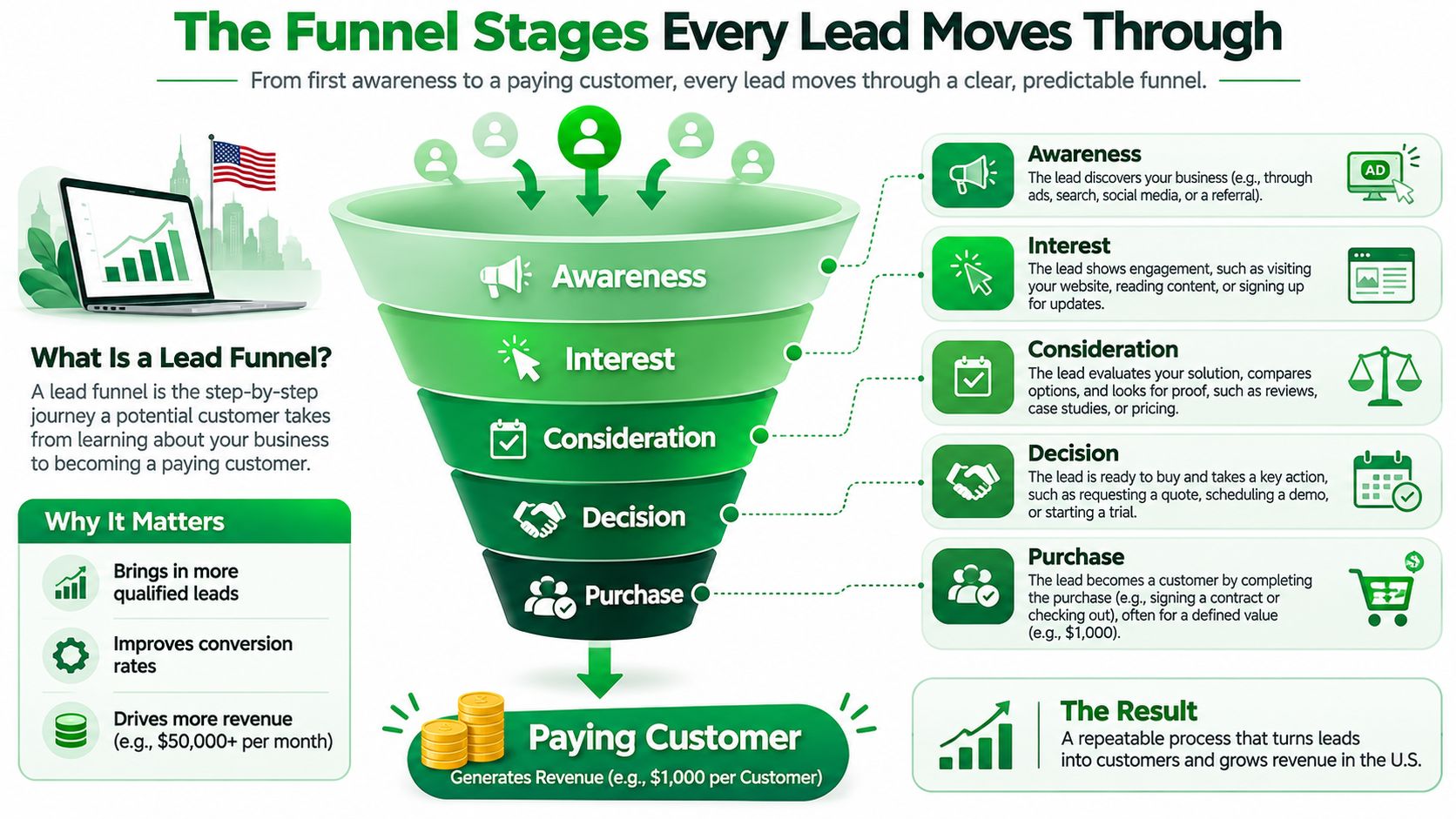
A lead funnel works like a stack of sieves. Each mesh catches fewer contacts than the one above it, and only what falls through the last mesh becomes a customer.
The stages are the same whether you run a dental practice or a B2B pipeline. Only the timing changes.
- Anonymous visitor. Reads a page and leaves no details. You have a session count, not a person.
- Lead. Shares a name, an email or a phone number through a form, a call or a chat window. This is the only stage most dashboards call a conversion, and it is also where your operations begin: consent to contact them, the source they came from, and the time they arrived all need to be recorded here or they never will be.
- Marketing-qualified lead. Shows fit and interest through behavior: a repeat visit, a pricing-page view, attendance at a webinar. Scoring these actions is what separates this stage from a raw lead, and the points you assign decide who gets a call first.
- Sales-qualified lead. A human confirms need, budget and timing.
- Opportunity. A live proposal or deal with a date attached to it.
- Customer. Signed and paid.
A 2024 peer-reviewed study on data-driven sales optimization estimates that only 10% to 15% of leads reach the bottom of the funnel. From 100 digital leads, roughly 10 to 15 progress, subject to industry, offer and follow-up quality. The other 85 to 90 need education, qualification and repeated contact before they're worth a sales call.
That ratio is why a funnel is an operations problem as much as a marketing one. Whether a lead lands in the 15 or the 85 depends less on the form they filled in than on what happens after: how fast the first response goes out, whether the record shows they consented to a text or only an email, and whether scoring routed them to a rep or to a nurture sequence. Two teams can capture identical leads and close very different numbers purely on how they run stages two through four.
Track source, conversion rate, lead quality, sales velocity, opportunity creation and eventual revenue, and you'll see where the sieve is blocking. A stall at stage three means your scoring or nurture is weak. A stall at stage four means leads reach sales before they're ready, or reach them too late.
Quick test for any stage: is the next action a sales conversation, a document, or a nurture email? If nobody on your team can answer that for a stage, that stage is where your leads stall.
Why Response Speed Decides Which Leads Convert
A captured lead is not a won lead. Most guides imply the opposite: form submitted, conversion counted, next topic.
In an audit of 2,241 U.S. companies that received web-generated test leads, only 37% responded within one hour and 23% never responded at all, according to the Harvard Business Review study on the short life of online sales leads. Among the companies that did reply within 30 days, the mean response time was 42 hours.
| Response window | Share of companies | What it means for conversion |
|---|---|---|
| Within one hour | 37% | Best window for qualification and contact |
| One to 24 hours | 16% | Contact still possible, but intent is cooling |
| More than 24 hours | 24% | Most prospects have already spoken to a competitor |
| Never responded | 23% | Lead captured and lost |
| Mean response among companies replying within 30 days | 42 hours | Typical delay in the slow group |
The gap between five minutes and thirty minutes is worse than a gradual decline. The same body of work found that contacting a lead within five minutes produced roughly 100 times higher odds of contact and 21 times higher odds of qualification than waiting 30 minutes.
A prospect's interest behaves like a pan coming off the heat. It doesn't stay warm because you're busy. It cools while they open three competitor tabs and take a phone call from whoever answered first.
So treat follow-up as an event, not a to-do.
- Trigger on every inquiry. A form submission, phone call, chat request or ad-platform lead should create a CRM record, get deduplicated, scored and routed without a human deciding to.
- Set the target at under five minutes for high-intent leads, and write it into a service-level agreement someone owns.
- Route with escalation. Round-robin assignment with a fallback owner, so an unclaimed lead lands on a manager instead of a dead queue.
- Timestamp every stage. Speed to first contact, speed to qualification and speed to revenue are three different numbers. That's the foundation of any marketing automation setup worth running.
Where speed pays most: local services and high-intent PPC. Cutting response delay raises the yield on inquiries you already paid for, which beats raising the ad budget every time.
Pull the last 30 days of leads, list first-contact timestamps beside the target, and count how many beat it. If the median is measured in hours, you have your next project.
Landing Pages and Forms That Capture Inquiries
A dental clinic runs search ads for "emergency tooth pain" and sends every click to its homepage. Visitors land on a slideshow about the practice, hunt for the booking link, and leave. The ad made a promise about pain; the page talked about the team. That mismatch costs the click and the appointment.
A landing page earns the click when it keeps the ad's promise in the first screen.
The build order that works:
- Match the headline to the query. If the ad says "emergency tooth pain," the H1 says the same words, not "Welcome to our practice."
- Put the form above the fold, in the first screen, before the visitor scrolls.
- Ask only what sales needs to make the next move. Name, phone, email and sometimes ZIP code. Every extra field costs completions.
- State what happens next and when. "We'll call within 15 minutes during office hours" removes the anxiety that kills submission.
- Link the privacy policy right beside the form.
- Send visitors to a thank-you page and track that page view as the conversion, not the click.
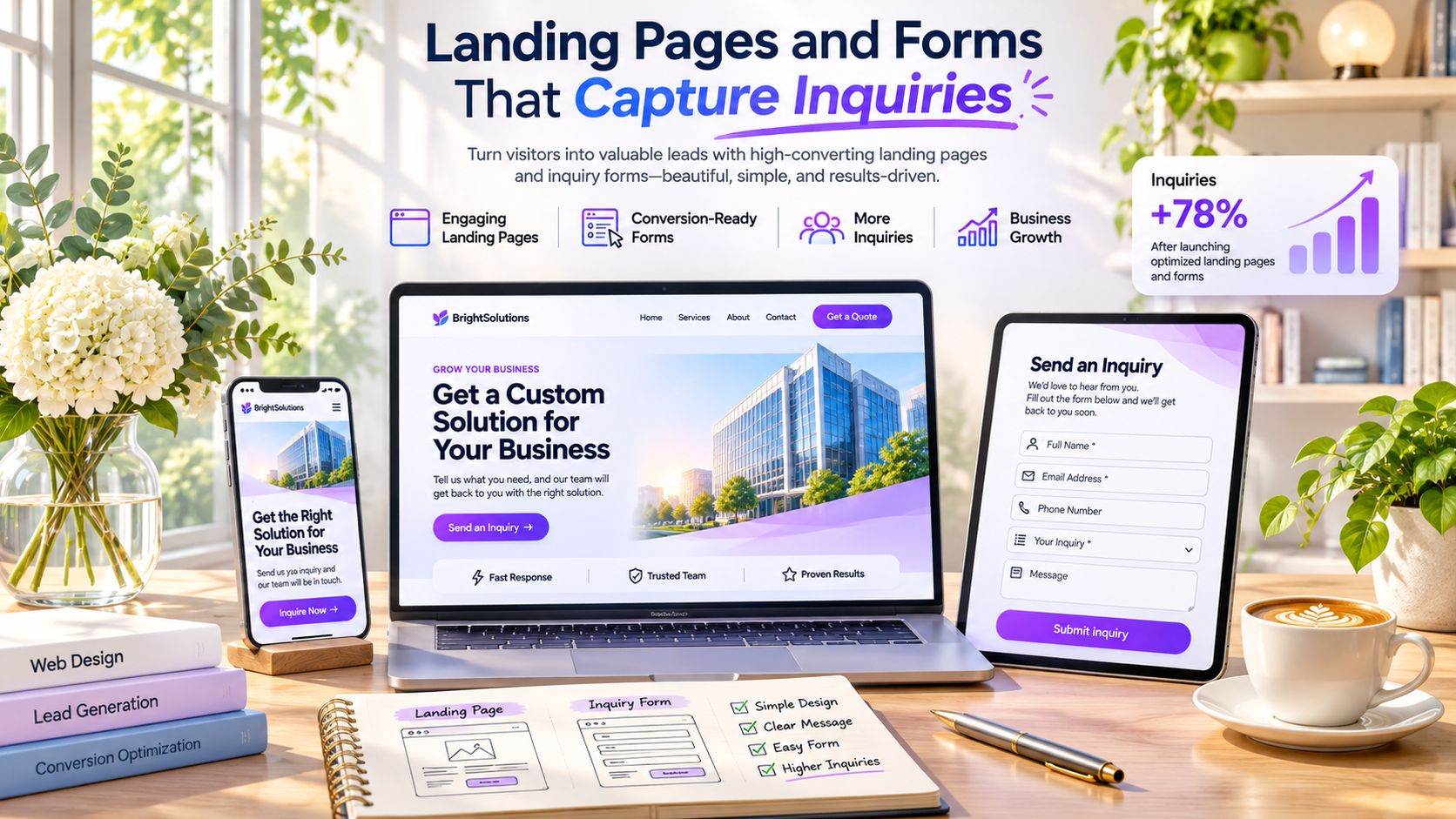
Platform lead forms are the other capture route. Per Google's documentation on lead form assets, forms run with eligible Search and Performance Max campaigns, Search requires responsive search ads, bidding must optimize toward a lead-form conversion goal, and a privacy-policy link sits at the end of the form. Fewer clicks simplify capture, but compliant data collection and conversion tracking still have to exist.
Eligibility tightens that further. Google's lead form policy requires a solid account history, an eligible business vertical and a linked privacy policy, excludes sensitive categories such as sexual content, and for certain reputable advertisers adds verification and spend thresholds of more than $1,000 per account or more than $15,000 across accounts.
| Capture point | What it requires | Main trade-off |
|---|---|---|
| Landing page form | Matching headline, form above the fold, privacy link, thank-you page with tracked event | More clicks, but full control over page and data |
| Google lead form | Eligible Search or Performance Max campaign, responsive search ads, lead-form conversion bidding, privacy link at end of form | Fewer clicks, but eligibility checks and campaign mechanics apply |
Compare a dedicated page against a bare homepage once and the argument tends to end quickly, which is the useful part of this landing page versus homepage breakdown.
My rule is simple: use a landing page when the offer needs explaining, and a platform form when the offer fits inside the ad. Both still need a named owner who calls back.
Raising Lead Quality Without Shrinking Volume
Treating every form fill as buying intent is an expensive habit. NetLine's analysis of 8 million first-party content registrations found the average delay between requesting and opening content grew from 31 hours to 39 hours between 2023 and 2024, a 23% year-over-year increase, per NetLine's 2025 State of B2B Content Report. Leads cool while teams keep describing the original submission as hot, and reps burn hours dialing people who have not even read what they downloaded.
Scoring fixes that. A workable score uses a few honest inputs:
- Recency. A form filled out nine hours ago isn't the same lead as one filled out last month.
- Depth and repetition. Two support-article reads and a pricing visit beat a single newsletter click.
- Channel and geography. Service-area boundaries and campaign intent change what a lead is worth.
- Explicit signals. A proposal request, a callback time or a demo booking outranks everything else.
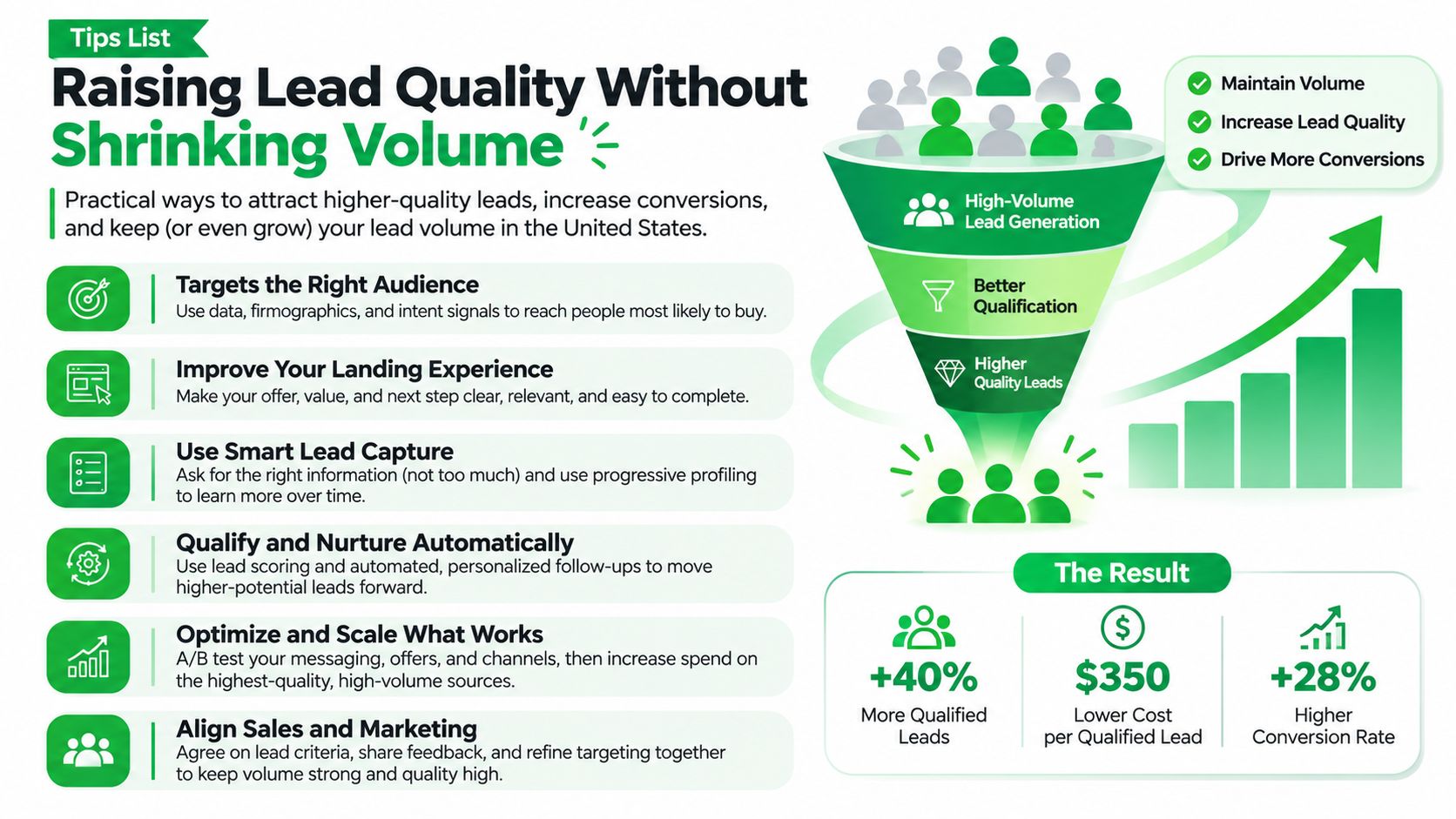
Then attach a response tier to each band. High scorers get a phone call within minutes, mid-band leads get a same-day email plus a call, and low scorers enter a nurture sequence that leaves sales attention free for the leads that need it. Skip the tiers and your fastest response goes to whoever submitted last, not whoever is ready to buy.
Progressive profiling keeps volume intact while scores sharpen. Ask for a name and email on the first visit, then gather company size, budget or timeline on a later one, once the visitor already trusts you. Fewer fields up front means more completions, and the follow-up questions fill in the qualification data the short form skipped. Build these triggers around real buyer behavior, which is the practical side of buyer persona development.
Consent records deserve the same discipline as scoring. Keep the exact wording the prospect agreed to, the timestamp, the page and the entity collecting the data. Written permission belongs to whoever captured it, and buying or sharing a lead list does not transfer that permission to you. If your team cannot produce the record for a given contact, treat that contact as unpermissioned until they opt in again.
The objective worth optimizing: qualified, permissioned pipeline per visitor. A bigger list that nobody calls is a cost, not an asset.
Test it. Run one version of a form with fewer fields and clearer expectations against your current version, and judge the winner on qualified conversations rather than raw submissions. The form that captures slightly fewer leads but feeds reps contacts they can close is the one that earns its keep.
Measure Your Pipeline and Check It This Week
A blended conversion rate can look healthy while hiding three different businesses inside one number: emergency plumbing calls, readers of an informational post and marketplace inquiries. Their intent differs, and so does the acquisition cost you can afford for each.
Ruler Analytics' conversion benchmark report analyzed a global database of more than 100 million data points and reported conversion trends across 14 industries. That scale only helps if you compare like with like.
| Metric | How it is calculated | What it tells you |
|---|---|---|
| Conversion rate | Conversions divided by qualified sessions or ad clicks | Whether the page converts the traffic it receives |
| Cost per lead | Spend divided by leads | Acquisition cost at the form stage |
| Cost per qualified lead | Spend divided by qualified leads | Acquisition cost of leads sales will actually work |
| Lead-to-opportunity rate | Opportunities divided by leads | How well leads match real demand |
| Opportunity-to-close rate | Closed deals divided by opportunities | Sales effectiveness after qualification |
| Revenue per click | Revenue attributed divided by clicks | Overall value of a channel or campaign |
Fix one definition per page first
Decide what a conversion means on each landing page: a completed form, a qualified opportunity, a booked appointment, a phone lead or closed revenue. Then hold one denominator steady, either qualified sessions or ad clicks. When a page is optimized for raw form completions, the cheapest way to improve the number is to weaken the form, which fills the CRM with contacts sales won't call.
Push CRM outcomes back into the ad platforms through offline conversion imports so bidding learns from closed revenue rather than from clicks.
Segment before you compare
Split results by device, geography, campaign intent and service line. Branded searches, local emergency queries, informational SEO traffic and marketplace inquiries carry different intent and different acceptable economics. Blend them and the average hides the fact that one segment is subsidizing another.
Test one mechanism at a time: message match between ad and page, form friction, qualification questions, trust evidence or call-to-action placement. Judge every test on cost per qualified lead, never on raw fills.
One number to steer by: cost per qualified lead. Raw form volume can rise for a year while that number gets worse.
The weekly check
- Confirm every channel's leads land in the CRM with a timestamp attached.
- Measure median first contact against the under-five-minute target for high-intent leads.
- Write down the conversion definition each landing page uses.
- Split branded, local and informational traffic into separate reports.
- Confirm the scoring model routes hot leads to a person before anything automated.
- Check that each consent record holds its wording, source and date.
Reporting should answer those questions rather than restate traffic counts. In our engagements, clients see website traffic, leads generated, conversion rates and revenue measured against KPIs written for their goals, which is the reporting standard this analytics and reporting practice is built around.
Then pick the single fix most likely to lower cost per qualified lead this week. If median first contact sits above an hour, fix routing and alerts before you touch the ad budget. If cost per qualified lead is climbing while cost per lead holds flat, your forms are collecting people sales won't call, and the fix is in qualification questions, not in more spend.
Mr. Green Marketing, LLC builds lead generation programs around the parts most guides skip: landing pages that keep the ad's promise, follow-up that runs on a five-minute clock, and reporting that shows cost per qualified lead instead of raw form fills. The team starts by listening, then writes a strategy and proposal tied to the numbers you want to move, whether you run a local service business or an ecommerce brand. Request a free audit and performance report at Mr. Green Marketing, LLC to see where your inquiries are leaking.
Leave a Comment
sing in to post your comment or sign-up if you dont have any account.