
U.S. internet advertising revenue reached $294.6 billion in 2025, a 13.9% year-over-year increase, according to the Interactive Advertising Bureau's report conducted by PwC. For a small business, that's a reminder of how much competition surrounds every paid message. Spending more isn't a strategy. Knowing which sales your spending causes is.
Advertising and promotion belong in the same budget conversation, even though they do different jobs. The practical question isn't which one is better. It's which combination creates additional customers at a cost your business can afford.
Table of Contents
- Advertising and Promotion Defined Side by Side
- Matching Your Objective to the Right Tactics
- Digital and Offline Channels Mapped Out
- KPIs That Show Whether Your Spend Works
- Building a Strategy and Budget That Scales
- Campaign Templates and Quick Wins for Small Brands and Amazon Sellers
- Short Illustrative Case Studies
- Request a Free Advertising and Promotion Audit
Advertising and Promotion Defined Side by Side
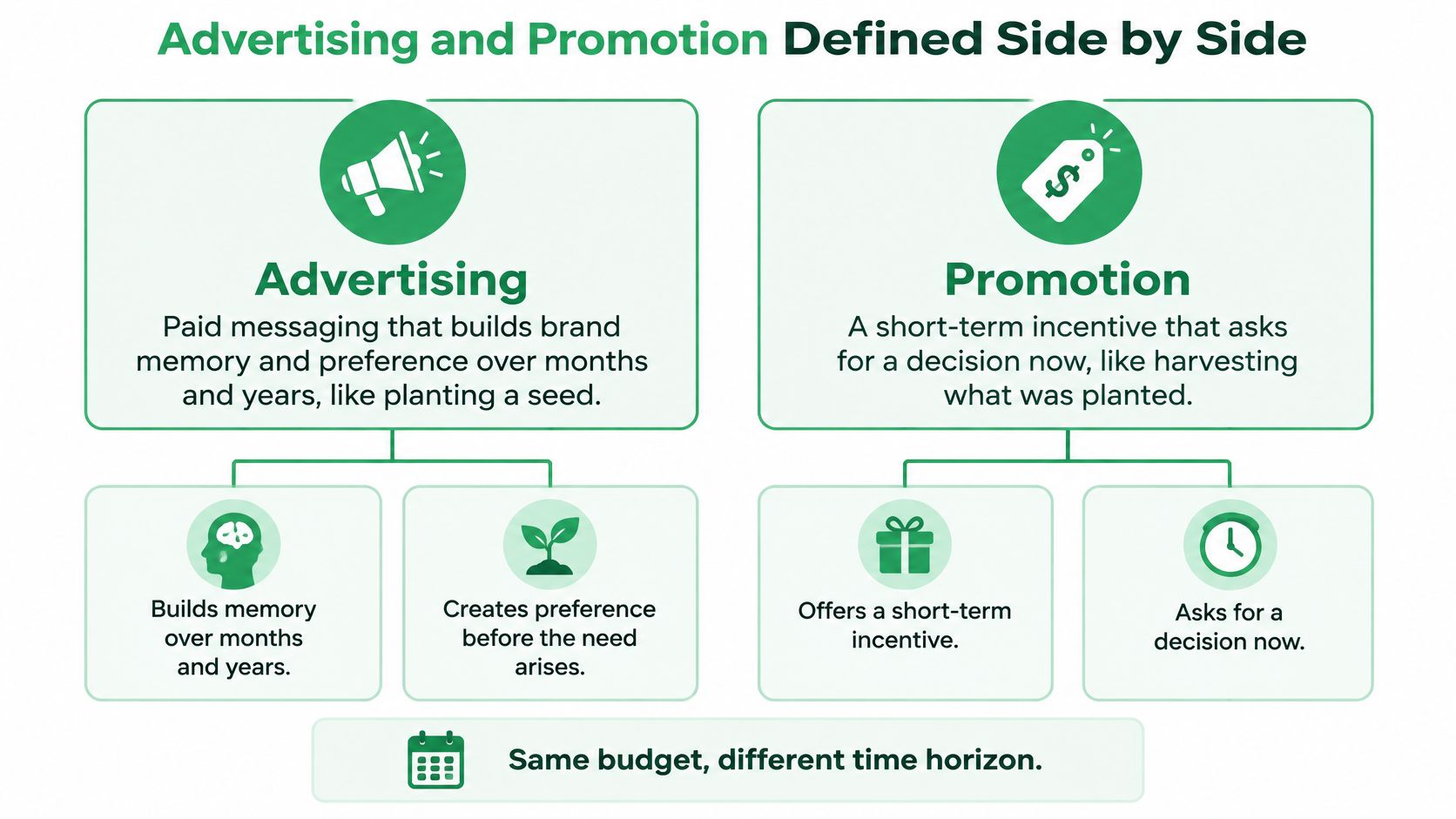
Advertising is paid messaging that builds awareness, brand memory, and preference. Sales promotion is a short-term incentive that encourages action now. Think of advertising as planting a seed and promotion as encouraging the harvest.
Use this quick test when labeling your plan: does the message mainly ask people to remember you, or give them a reason to buy today? A video about a candle maker's craftsmanship leans toward advertising. A limited-time candle bundle leans toward promotion.
There's an important qualification. Promotion can also mean the broader marketing discipline that includes advertising, public relations, and sales incentives. For budget planning here, we're comparing advertising with sales promotion, not pretending they're mutually exclusive channels.
Advertising versus promotion at a glance
| Aspect | Advertising | Promotion |
|---|---|---|
| Main goal | Build awareness and brand preference | Prompt a purchase or action now |
| Time horizon | Months to years | Days to weeks |
| Typical message | Brand story, values and positioning | Offer, discount, deadline or bundle |
| Common formats | TV, video, display and sponsored brand placements | Coupons, sales, samples, giveaways and in-store displays |
| Success signal | Recall, share of voice and consideration | Redemptions, sales lift and conversion rate |
| Measurement difficulty | Hard to isolate; needs lift tests | Easier to track through codes and sales data |
Read the table as a distinction in purpose, not a rigid rule about formats. Advertising can generate an immediate sale, and a well-designed promotion can reinforce a brand. A paid Instagram ad announcing a bundle does both jobs.
Why the distinction matters for your budget
Awareness and preference require different evidence from coupon redemptions. Codes make purchases easier to trace, but tracing a purchase doesn't establish that the incentive caused it. Some customers would have paid full price.
The competitive context is substantial: WARC's forecast, reported by Campaign Asia, put worldwide advertising expenditure at approximately $1.08 trillion in 2024, up 10.7% year over year.
Most businesses need both functions. Advertising makes the business and its offer known; promotion gives an interested buyer a timely reason to order. Label each budget line by its primary job, then evaluate the combined business result.
Matching Your Objective to the Right Tactics
Start with the business goal, not the platform you're most comfortable using. A candle shop introducing itself to new shoppers needs a different campaign from one bringing previous holiday customers back.

Match the message to the buying stage
Awareness means becoming familiar. The candle shop might use spring video placements and podcast sponsorships to introduce its makers, ingredients, and scent collections. Monitor unique reach and on-target rate, then use a recall or brand-lift test where feasible.
Consideration means helping shoppers compare. In autumn, search ads can lead people looking for seasonal candles to useful scent descriptions, ingredient information, and gift guides. Click-through rate and time on site indicate engagement, but check whether visitors also explore products or begin checkout.
Conversion means securing an order. Search, shopping placements, and a clearly presented bundle can help shoppers who are ready to choose. Track cost per acquisition and return on ad spend, while checking contribution margin after discounts, shipping, and fulfillment.
Retention means earning another purchase. An email series can remind last year's customers about returning favorites or suitable refills. Judge it through repeat purchase rate and customer lifetime value, rather than treating every email click as success.
The distinction between consideration and conversion often causes confusion. Someone comparing wax types may need reassurance, not a countdown timer. Someone returning to purchase a favorite scent may need an easy route to checkout.
Our beginner's guide to PPC marketing helps explain how paid placements fit these different intentions.
Practical rule: Choose one primary objective per campaign and write down its KPI before spending.
A discount shown to unfamiliar shoppers can fail because it answers the wrong question. They're asking whether the product is worth trusting, not whether they can save on it. And discounting without resolving that hesitation can sacrifice margin without securing the customer.
Digital and Offline Channels Mapped Out
Digital and offline channels compared
| Channel | Type | Best for | Typical cost model |
|---|---|---|---|
| Google Search Ads | Digital | High-intent local and product searches | Pay per click |
| Meta ads (Facebook and Instagram) | Digital | Visual discovery and audience building | Auction, billed per thousand impressions or per click |
| Amazon Sponsored Products | Marketplace | Sellers whose listings compete for shopper searches | Pay per click |
| Retail media networks | Marketplace | Brands selling through large retailers | Pay per click or per impression |
| Email and SMS | Owned digital | Repeat buyers, loyalty and promo codes | Platform subscription plus content cost |
| Influencer and podcast sponsorships | Digital | Trust-led awareness | Flat fee or revenue share |
| Direct mail | Offline | Local households and seasonal offers | Per piece printed and mailed |
| Radio and local print | Offline | Local awareness and events | Flat rate per spot or insertion |
| Out-of-home billboards | Offline | Neighborhood reach near a location | Monthly flat fee |
| In-store signage and point-of-sale | Offline | Promotion at the moment of purchase | Production cost plus placement |
The cost model tells you what you're buying, not whether it's valuable. A click is a visit, an impression is an opportunity to be seen, and a sponsorship buys access to an audience through a publisher or creator.
Don't compare these purchases solely on their headline prices. A cheap impression outside your service area is still wasted spending.
Qualified reach matters more than cheap delivery
Nielsen's 2023 Digital Ad Measurement Benchmark found an average digital on-target rate of 65% in North America, meaning roughly one-third of impressions missed the defined audience; in its sample, campaigns with at least 85% of content concentrated in other online video reached at most 17% of their intended audience.
That isn't a forecast for your campaign. It's a reason to inspect audience delivery instead of assuming your targeting settings guarantee relevant exposure. Nielsen also found improved reach when advertisers distributed placements across channels.
Diversify deliberately, not everywhere at once. Check unique reach, frequency, location, and conversion quality by placement before adding another publisher.
Apply these channel selection tests
- Existing attention: Where does the buyer already search, browse, listen, or shop? Start with observed customer behavior rather than your own platform preferences.
- Geographic fit: Can the placement reach your actual delivery or service area without buying substantial exposure elsewhere?
- Tolerance for waste: Can you afford the learning period, creative production, and imperfect delivery, or do you need a narrower intent-led campaign first?
For Amazon sellers, Sponsored Products can capture shoppers already searching within the marketplace. Off-Amazon video can introduce the product to unfamiliar shoppers, while email can bring interested subscribers to a relevant listing. Those placements perform different roles, so don't demand identical immediate returns.
A local service business might combine search with direct mail when it can define a tight service area. Out-of-home can also fit when a placement genuinely overlaps that area. A billboard on a busy road isn't automatically useful if most drivers live beyond your operating radius.
Use a media planning and buying process to document the audience, placement, message, cost model, and intended outcome. Finish with a manageable shortlist, not an account on every platform.
KPIs That Show Whether Your Spend Works
Say a home-goods store's platform dashboard credits ads with 40 sales. In this hypothetical example, a randomized holdout indicates only 25 additional sales, leaving 15 purchases that likely would have happened anyway. The dashboard and the test answer different questions: which purchases followed exposure, and which purchases exposure caused?
KPIs and the decisions they support
| KPI | Formula | Use it to decide |
|---|---|---|
| Click-through rate | Clicks divided by impressions | Whether the creative earns attention |
| Cost per acquisition | Spend divided by conversions | Whether a channel is affordable |
| Return on ad spend | Revenue divided by ad spend | Whether revenue covers media cost |
| On-target rate | On-target impressions divided by total impressions | Whether budget reaches the intended audience |
| Incremental lift | Treatment outcome minus control outcome | Whether ads caused sales that would not have happened otherwise |
| Customer lifetime value | Average order value times purchase frequency times retention years | Whether acquisition cost is worth paying |
Keep the units consistent. For the lifetime value formula, purchase frequency should mean purchases per year. It estimates customer revenue, not customer profit, so apply margin and service costs before deciding what acquisition is worth.
Use a holdout to test the whole investment
Randomly assign eligible people or comparable geographic units to a treatment group and a control group. Expose the treatment group to the campaign and withhold the tested activity from the control group. Compare conversion or revenue rates using the same measurement window.
Incremental lift is the treatment outcome minus the control outcome. Compare rates, or normalize totals for group size, before calculating additional sales. Divide incremental revenue by advertising spend to calculate incremental return on ad spend.
For advertising and promotion together, define what you're withholding. Removing the ad but leaving the same discount available tests a different question from withholding both. Include incentive costs when evaluating incremental profit.
Timing deserves attention too: Nielsen's analysis of 863 cross-media campaigns found that advertising on certain higher-performing days generated nearly three times more incremental sales lift than advertising on other days.
Report evidence, not just attributed purchases
Our campaign success measures follow each client's goals and may include website traffic, leads generated, conversion rates, and revenue generated. A practical campaign effectiveness measurement process connects those indicators to a business decision.
Use this reporting checklist:
- Primary outcome: Incremental qualified leads, orders, revenue, or profit.
- Control group: Who was excluded, and from which activity.
- Uncertainty: Confidence interval or statistical significance, plus sample limitations.
- Budget decision: Expand, revise, continue testing, or stop.
Small samples can leave the result inconclusive. Don't turn an uncertain estimate into a confident spending recommendation.
Building a Strategy and Budget That Scales
Build the budget around an affordable customer, not a percentage copied from another company. A plumber paying technicians to travel between jobs faces different constraints from a skincare brand shipping repeat orders.
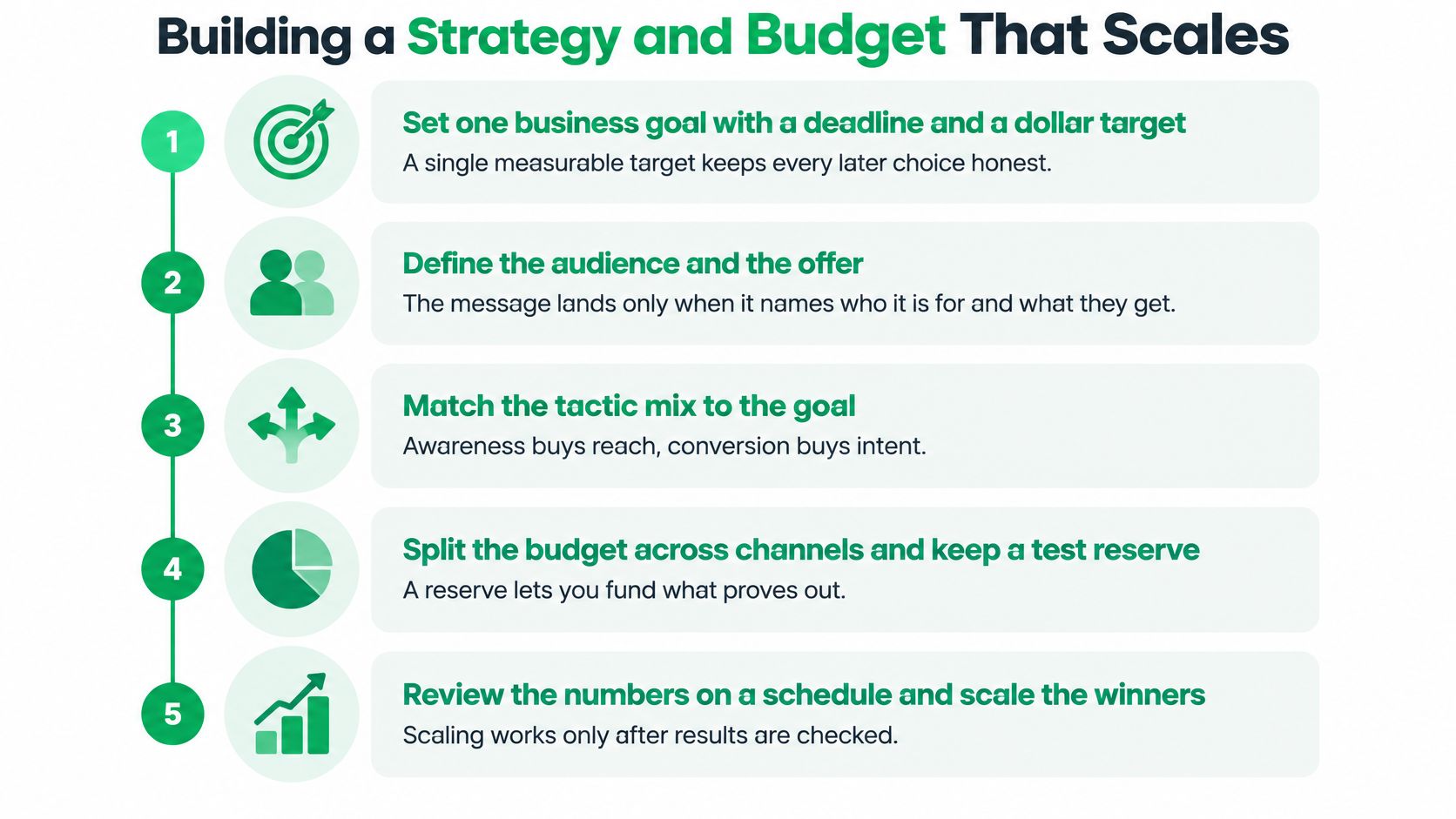
Put the decisions in the right order
Set a business goal with a deadline and dollar target. A defined commercial result lets you work backward to the customers and qualified opportunities you need. Separate the revenue ambition from the amount you can safely invest.
Define the audience and offer. People need to recognize that the message fits their situation before they consider acting. Include a genuine reason to act now, such as seasonal availability or a useful bundle, rather than an invented deadline.
Choose channels that fit the business. We select channels based on each client's goals, target audience, budget, and industry. A plumbing campaign might prioritize urgent local searches, while skincare may need demonstrations and reassurance before purchase.
Set an affordability limit. Calculate what remains after product or service delivery, discounts, payment costs, and required profit. For a hypothetical planning exercise, you could model spending at 5–10% of revenue, but don't treat that range as a benchmark or let it override affordable acquisition costs.
Protect room for experiments. Proven activity and unproven activity shouldn't draw from an undifferentiated pot. A hypothetical starting split is 70% proven channels, 20% tests, and 10% reserve, adjusted to your cash position and the strength of existing evidence.
Keep a human-reviewed control beside automation. Automated bidding needs reliable conversion inputs, so define a minimum conversion count appropriate to the platform, campaign, and reporting delay before handing over bidding decisions. Use the holdout method to judge the business result rather than accepting the automation dashboard's explanation.
Schedule budget decisions. A hypothetical review rhythm is every two to four weeks, provided it accommodates your buying cycle and conversion lag. Move money only when the evidence is mature enough to distinguish a promising result from normal variation.
These are planning examples, not universal spending rules. A new account with no proven channel needs a learning budget, not a forced allocation to supposedly established winners.
Automate execution without outsourcing judgment
The IAB's 2025 State of Data report identifies privacy and compliance, data quality and integration, bias and fairness, and resource requirements as barriers to adopting AI across media campaigns.
Automation can scale a flawed conversion signal as readily as a useful one. Audit location, device, audience delivery, and lead quality; investigate disagreements between platform reports and your order or booking system.
Keep the control campaign running when a platform promises better targeting but gives you less visibility into delivery.
A written marketing budget allocation plan should name who can change spending, what evidence they need, and when they'll review the decision.
Campaign Templates and Quick Wins for Small Brands and Amazon Sellers
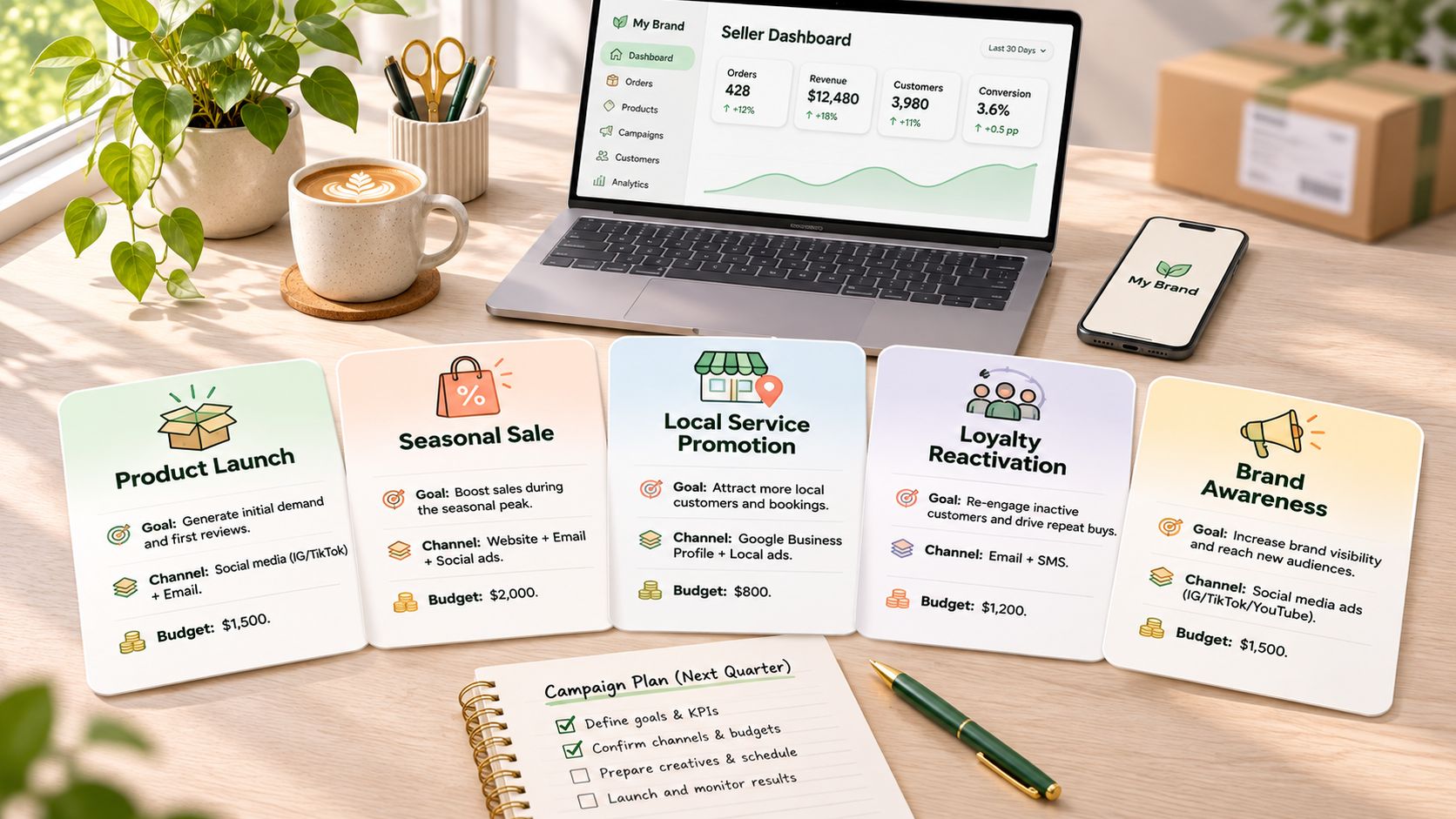
Five campaign templates to adapt
These are suggested planning durations, not performance benchmarks or promises.
| Template | Goal | Channels | Duration | Core KPI |
|---|---|---|---|---|
| Product launch | Awareness and first sales | Meta video, Google Search and email | 6 weeks | Cost per acquisition |
| Seasonal sale | Conversions in a short window | Amazon Sponsored Products, email and Google Shopping | 2 weeks | Return on ad spend |
| Local service promotion | Calls and bookings | Google Search, Google Business Profile posts and direct mail | 4 weeks | Cost per lead |
| Loyalty reactivation | Repeat purchase | Email, SMS and retargeting | 3 weeks | Repeat purchase rate |
| Brand awareness push | Recall in a new market | Video, podcast sponsorship and out-of-home | 3 months | Reach and incremental lift |
Choose a template based on the commercial task, then adapt it to inventory, staffing, and the buying cycle. A local service offer shouldn't generate bookings your team can't fulfill, and a product launch shouldn't accelerate demand for a listing that's about to run out of stock.
Make practical improvements this week
- Remove irrelevant queries: Review search terms weekly and add negative keywords where the query clearly doesn't fit your product or service.
- Match the destination: Align the ad's promise with the listing title, main image, and first bullet without adding unsupported claims.
- Separate redemption tracking: Assign a distinct promo code to each channel.
- Set a stopping rule: Pause ads that exceed a predefined spending and conversion-lag limit without producing a sale.
- Keep offers interpretable: Run a single promotion per listing during the test window.
Channel codes help identify where buyers encountered an offer, but customers can share them. Treat redemption reports as useful operational evidence, not a substitute for causal testing.
For marketplace implementation, an Amazon advertising campaign plan should connect search terms, listing readiness, inventory, and the intended customer action. Don't change the price, imagery, targeting, and offer simultaneously if you need to identify which change helped.
Make paid relationships clear
Under the U.S. Federal Trade Commission's Endorsement Guides, unexpected material relationships, including payment or free products, must be disclosed clearly and conspicuously; disclosures must be difficult to miss and easy for ordinary consumers to understand.
Put the disclosure within the content itself, where people will encounter the endorsement. For visual advertising, include it visually; for spoken advertising, deliver it audibly. A buried profile note isn't a sensible substitute.
And check the testimonial's substance – not just its disclosure. An endorsement must reflect the person's honest experience and can't make a deceptive claim that the advertiser couldn't make directly.
Short Illustrative Case Studies
Hypothetical example of an Amazon kitchen-tool seller
A kitchen-tool seller sees a strong platform-reported return from Sponsored Products targeting its own brand name. It wants to know whether those ads acquire buyers or intercept shoppers already looking for the brand.
In this hypothetical scenario, a two-week holdout suggests most brand-term purchases would have arrived through organic search. The seller reduces brand bids and tests category terms where shoppers are still comparing alternatives. It preserves enough branded coverage to monitor the trade-off rather than assuming all brand advertising is unnecessary.
Hypothetical example of a city plumbing business
A plumber pairs Google Search with direct mail and gives each placement a separate booking code. In this fictional example, the mailer's recorded bookings cluster in two postcodes where the business can serve customers efficiently.
The owner narrows the mailing list and aligns search geography with those neighborhoods. Before expanding the mail budget, the business tests a comparable unmailed area. The codes identified a promising location; the geographic test addresses whether mailing created additional bookings.
Hypothetical example of a skincare launch
A skincare brand launches video ads and podcast sponsorships. Its initial video delivery reaches too many people outside the intended audience, despite an attractive impression cost.
In this scenario, the team excludes irrelevant video environments and adds suitable podcast placements. Audience reporting shows greater unique reach while cost per acquisition stays flat, so the brand retains the revised mix for further testing. That's an operational improvement, not yet proof of incremental profit.
A useful budget move follows the question the test actually answered, not the most flattering metric.
Use the campaign template that resembles your situation, then write down what would make you keep, reduce, or redirect the spending. Decide that before seeing the results.
Request a Free Advertising and Promotion Audit
An advertising and promotion audit should identify where your plan loses relevance, visibility, or measurement accuracy. More clicks won't fix a mismatched landing page, and a bigger discount won't repair unreliable conversion tracking.
Our free audit and performance report help reveal visibility gaps and prioritize quick wins. The review considers:
- Channel mix and reach: Whether placements fit the intended audience and service area.
- Measurement setup: Whether leads and purchases are tracked at their source.
- Landing-page fit: Whether visitors find the product, promise, and next step presented in the ad.
- Budget alignment: Whether spending supports revenue goals and affordable acquisition.
- Marketplace consistency: Whether Amazon listings and ads present the same offer.
Start with the information you already have
- Share your current spending, goals, and active channels.
- Receive a review and recommended plan.
- Choose which quick wins to act on first.
The aim is a short, prioritized action list your team can use, whether or not you hire anyone to implement it. You don't need to arrive with a perfect dashboard; identifying missing information is part of the work.
After the initial consultation, we develop a customized digital marketing strategy and proposal outlining recommended services and approach. Case studies of campaigns we've executed are available on request.
The audit is free. It's a direct way to see where budget may be leaking before committing more money to the same approach.
Mr. Green Marketing, LLC offers strategy-led advertising and promotion support across PPC, Amazon marketing, creative, and conversion-focused websites. Visit Mr. Green Marketing, LLC to request your free audit and performance report, and bring your current channel list, spending, and primary business goal so the review starts with the decisions that matter.
Leave a Comment
sing in to post your comment or sign-up if you dont have any account.