
The most popular advice on logos is still "keep it simple." Simple is easy to print, easy to shrink, and easy to like in a first meeting. And it is also the advice that leaves a small business with one pretty file and no way to use it.
A mark that only works on a white slide does not help on a dark Amazon listing, a tiny browser tab, or a one-colour label. Branding and logo design services that stop at a single artwork hand you a picture. They do not hand you a system. The useful buy is the picture plus the rules that stop every new designer, printer, and freelancer from inventing a new version.
Table of Contents
- What Branding and Logo Design Services Deliver
- Why Logo Design Affects Recognition and Attitudes
- How a Branding Project Runs Step by Step
- How the Brand System Is Handed Off and Checked
- What Branding and Logo Design Services Cost
- How to Vet a Provider and Read Its Results
- Book a Free Brand Audit Before You Commit
What Branding and Logo Design Services Deliver
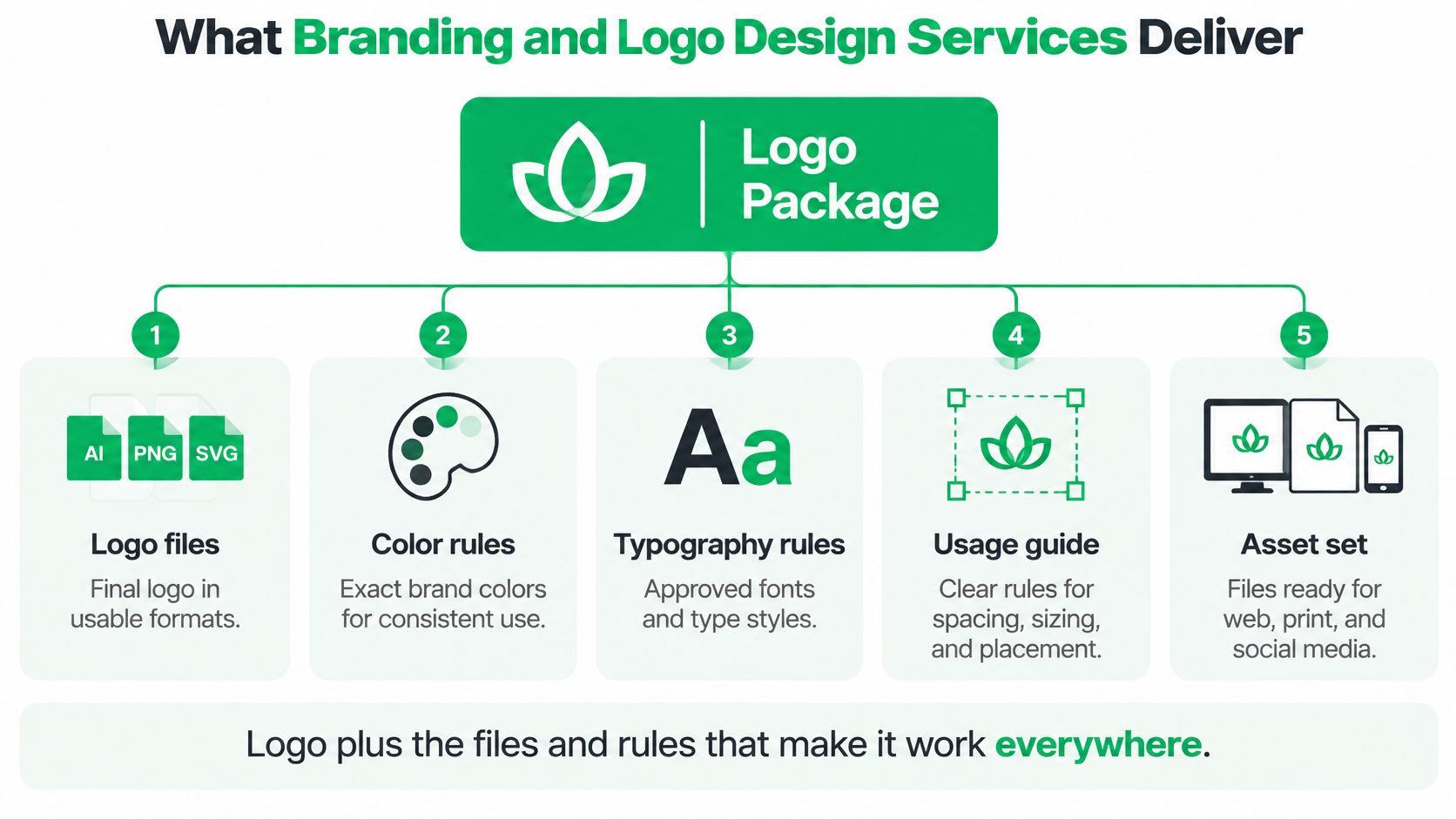
Say a bakery owner asks for "just a logo." What they need is a header on the site, a stamp on the box, a profile picture, and a sales sheet a part-timer can edit. Branding and logo design services cover that whole job: brand design across websites, packaging, social media, and collateral. A project can stay small, a single logo, or grow into a complete rebrand.
The package below is the minimum that keeps the mark consistent. Each row is a file with a job, not a bonus.
| Deliverable | Typical formats | Used for |
|---|---|---|
| Primary logo in full colour | SVG, PNG, PDF | Website header, print and general use |
| Reversed and monochrome versions | SVG, PNG | Dark backgrounds and one-colour print |
| Icon or favicon mark | ICO and PNG at 32 px and 180 px, plus SVG | Browser tabs, app icons and social avatars |
| Colour palette | HEX, RGB, CMYK, Pantone | Matching colour across screens and print |
| Typography rules | Font names with fallbacks | Consistent headings and body text |
| Brand guidelines | Usage rules for staff, designers and vendors | |
| Social and profile assets | PNG, JPG at platform sizes | Profile pictures, banners and post templates |
| Editable templates | Source files and layouts | Ads, email signatures and sales sheets |
The SVG scales on the site. The PDF is what a printer opens. CMYK and Pantone stop a box from printing a different green than the screen. The favicon is the only version many people see in a crowded tab bar. Guidelines are the document you hand a vendor so they stop guessing spacing.
List what you already own. Then list the gaps. A logo without a palette and written rules leaves every new designer guessing, and the next file will not match the last one.
Why Logo Design Affects Recognition and Attitudes
Repeated exposure raises recognition and attitudes, and the lift is stronger for complex logos than for simple ones. A 2016 peer-reviewed study ran two experiments. 68 participants rated six unfamiliar logos. 164 participants rated eight familiar ones. Researchers compared simple and complex designs after one exposure and after four.
Greater exposure increased brand recognition and produced more positive attitudes, particularly for complex logos. A simple mark can communicate on first contact. A more distinctive mark earns value each time someone sees it again.
What that means on a real channel
The mark still has to stay identifiable at small sizes. It also has to repeat, unchanged, on the website, social profiles, ads, packaging, and marketplace listings. Looking through logo design examples is useful only if you judge each mark at thumbnail size, not on a full-screen mockup.
That repetition buys three practical things.
- Faster recognition: shoppers pick the mark out of a crowded feed or search result.
- Fewer words in ads: the picture already carries the name, so the headline can sell the offer.
- One company, not five: packaging, the site, and the profile read as the same business.
Test a shortlist before you lock it. Show each candidate once, then again after several exposures, and score recognition rate, recall, and attitude.
Familiar logos also change how people look. In eye-tracking work, a familiar logo drew higher gaze counts and longer gaze duration, shorter time to first fixation, fewer revisits, and more accurate recognition. Unfamiliar marks produced more random, distraction-prone search. Repeatable visual cues matter on every channel, not just on the brand board.
How a Branding Project Runs Step by Step
A finished project is a signed-off file set and a guideline document you can hand to anyone. Timelines move with scope, revision speed, and how fast you answer. Ask for a dated schedule with milestones in the written proposal. A generic "about six weeks" is not a plan.
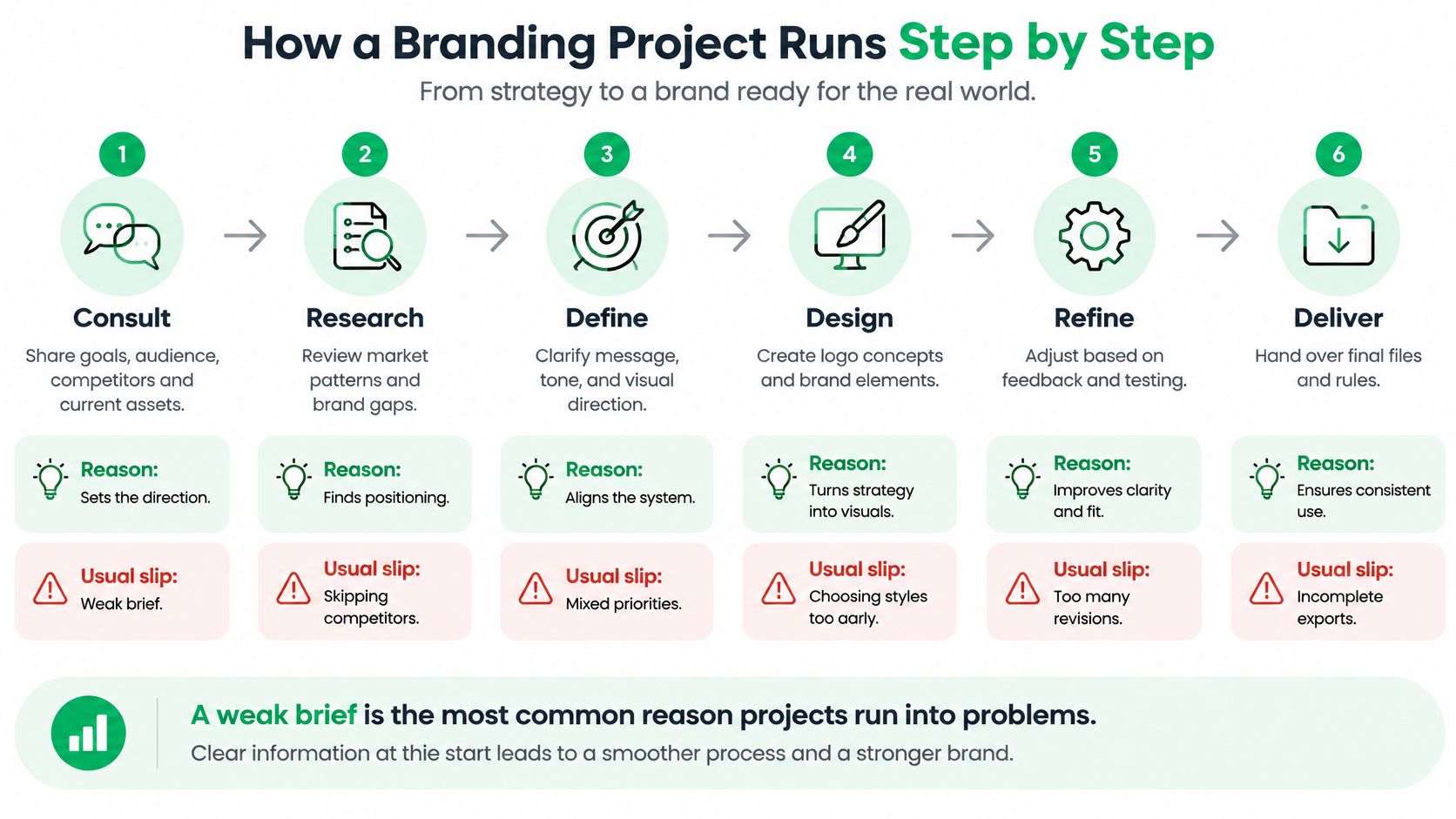
We run this as a project when the scope is a logo or a rebrand, and as ongoing work when you need new assets after launch. The path is the same either way.
- Consult. Share goals, audience, competitors, and the files you already have. A weak brief is the most common reason rounds multiply, because the designer is guessing what "premium" means to you.
- Receive the proposal. After that first conversation we write a customised strategy and proposal that lists the recommended services and the approach. If a quote has no scope, you cannot compare it.
- Define the identity. Work from values and identity to a positioning line and a visual direction. Logo choices then have a reason. Skipping this step is how you end up picking a style because you like the colour.
- Review concepts. Two or three directions, each with the reasoning written down. Dozens of unexplained options waste the round and hide the decision.
- Refine. Pick one direction and put a revision limit in writing. Open-ended "until I love it" is how budgets break.
- Build the system. Final variants, palette, type, and guidelines, checked at small sizes and on dark backgrounds. Our graphic design process covers how those checks happen before files leave the studio.
- Deploy. Apply the system to the website, marketplace listings, social profiles, advertising, and email. A file sitting in a folder is not a launch.
- Launch and report. After onboarding, the work starts and you get regular updates and reporting. Then run a consistency audit. Channels drift in the first month if nobody is assigned to look.
What "done" looks like
You should be able to email the guideline PDF and the source folder to a freelancer you have never met, and the next ad should match the site. If you still have to explain the green, the project is not finished.
How the Brand System Is Handed Off and Checked
Owners often leave with a logo and a few PNGs. Then the mark changes colour on Instagram, shrinks into a blur on a marketplace, and gets redrawn by the next vendor. 53% of small-business owners name standing out from competitors as their biggest marketing hurdle, and research cited by the Clermont County Chamber reports that 33% of businesses associate consistent brand presentation with revenue growth of at least 20%.
A distinctive logo that shows up inconsistently, fails at small sizes, or breaks on a marketplace does not solve visibility. Consistency can earn more than novelty.
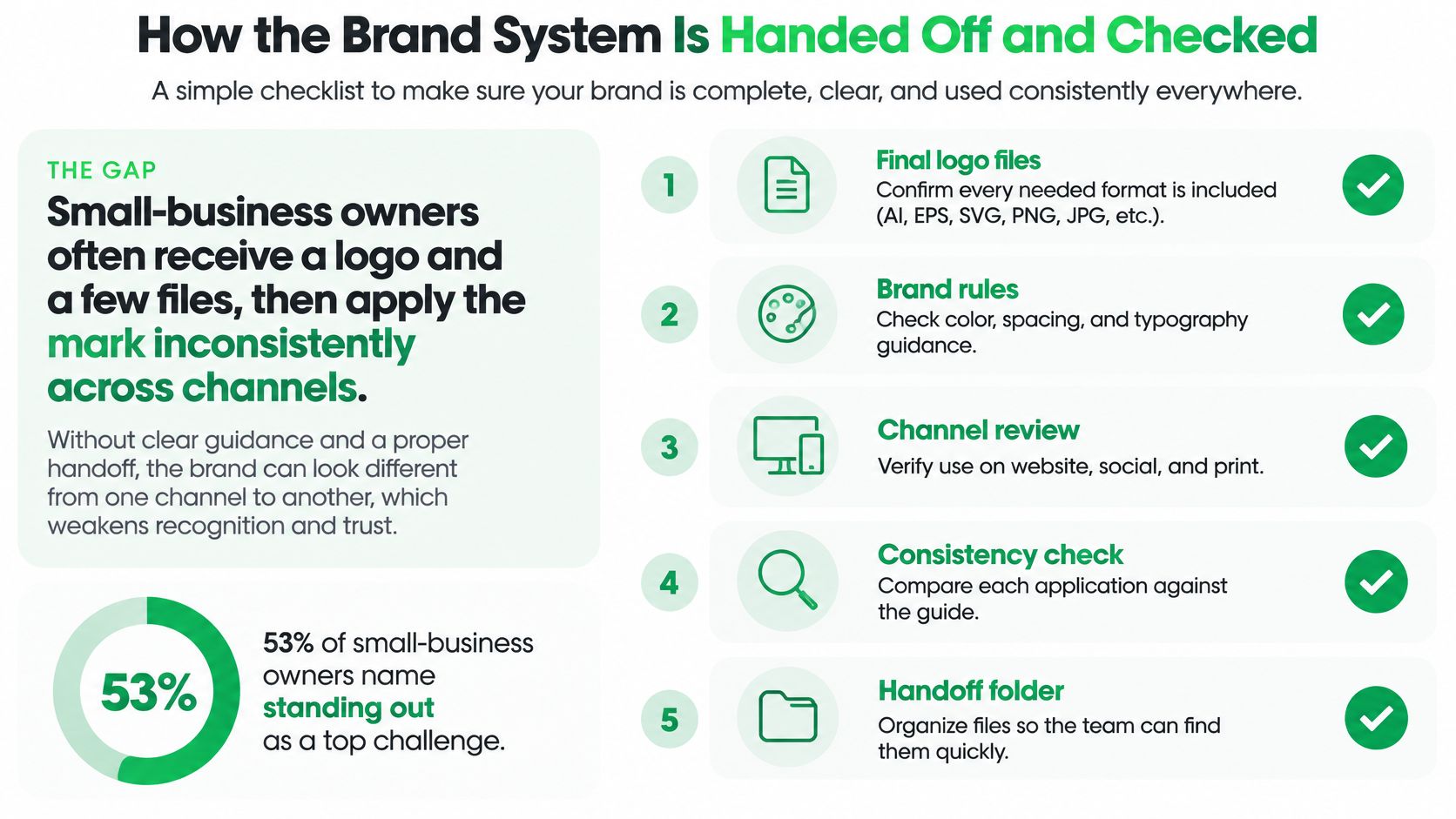
The file list from the package is the raw material. The handoff is who uses it, and how you know they did.
Who applies it, and why the rules exist
The owner, staff, in-house designers, and outside vendors each get the guideline PDF and only the templates they need. Branding work starts with the business's values and identity. We guide clients through a set of logos and branding guidelines, and those guidelines record why each choice was made. A rule without a reason gets ignored the first time someone is in a hurry. If you are writing that document yourself, start with how to create brand guidelines before you brief a designer.
What gets checked, and how you score it
Check the website, marketplace listings, social profiles, paid ads, and email. Measure with a dated audit of each channel against the palette, typography, and mark rules. Repeat it. Track recognition and enquiries alongside the visual check, so you can see whether the look is holding and whether it is doing any commercial work.
Practical rule: name one file owner. If nobody owns the folder, the next campaign will use last year's logo.
That sequence, identity, then deployment, then a post-launch audit, is the brand launch system. Before you accept any provider's handoff, confirm four things: a named file owner, written usage rules, minimum sizes, and a clear process for requesting new assets.
What Branding and Logo Design Services Cost
Compare the model, not the headline number. Pricing comes after a consultation, so two quotes only make sense once both are written line by line. We offer project-based and ongoing services, and the right one depends on whether the work ends at delivery or keeps producing assets. For a wider look at how retainers and projects sit next to other marketing fees, see digital marketing agency pricing packages.
| Pricing model | Best for | What is included | What sets the price |
|---|---|---|---|
| Fixed project fee | One-off logo or rebrand with clear scope | Discovery, concepts, revisions and final files | Scope and number of revision rounds |
| Tiered package | Small businesses wanting predictable scope | Logo only, logo with guidelines, or full identity | Which tier is chosen and what each tier adds |
| Monthly retainer | Ongoing asset updates and campaign templates | Revisions, new assets and brand upkeep each month | Monthly volume of requested work |
| Hourly rate | Small tweaks or advisory work | Billed hours against a defined brief | Hours logged against the brief |
| Trademark filing (separate from design) | Registering the mark with the USPTO | Class-based government fees, plus any legal help | $350 base electronic fee per class, plus $100 or $200 per class in listed cases |
Creative fee and government fee are not the same bill
A fixed fee moves with scope and revision rounds. A retainer moves with how many new assets you request each month. Hourly work should sit against a written brief, or the clock runs on email.
Trademark filing sits outside the design fee. The USPTO fee schedule lists a $350 base electronic application fee per class. Omitting required information from a base application can add $100 per class. A custom description of goods or services can add $200 per class. One application may cover multiple classes, but it still covers only one trademark, and each class carries its own fee. Class choice and the wording of the goods or services change the government cost before examination even starts.
Ask three questions before you sign. Is filing included? Which classes does the quote assume? Who writes the description of goods or services? The same logo can appear on several activities. Protection is not one flat "brand" fee.
How to Vet a Provider and Read Its Results
Pretty portfolio pages are the proof most buyers accept. They are also the proof that hides a missing file list. Vet the shortlist on evidence, process, people, variants, and ownership. Then read any before-and-after as a claim with a date, not as a mood board.
Evidence, process, and who does the work
Ask for case studies with before-and-after files, dates, and metrics. A consultation, a written strategy, and a proposal should land before design starts. We are a boutique agency and the work is hands-on, shaped for each business. The team includes marketers, designers, developers, and project managers, so a logo project is not one freelancer with no backup. Since 2019 that work has included websites, new brands, and new company logos.
Variants and contrast, including the logo exemption
Demand light, dark, monochrome, and small-size versions, with contrast checked on the surrounding page, not only on a standalone file. WCAG 2.2 sets a 4.5:1 minimum contrast ratio for ordinary text and a 7:1 enhanced target, and it excludes text that is part of a logo. The guidance still recommends a higher-contrast logo variant when brand rules allow. The exemption does not make a pale wordmark usable for people with low vision. Treat the wordmark as ordinary interface text when it is a button or navigation. Define minimum sizes in pixels and in print, and keep clear space.
Confirm who holds the source files and that they arrive at handover. You should own them.
A before-and-after with no date and no metric proves that someone changed a picture. It does not prove the change worked.
Red flags are plain. No written scope. No file list. Guaranteed rankings. No revision terms.
Read a case in three beats: what changed in the identity, the metric before and after, and the period. Our published case studies cover digital marketing campaigns and are available on request. Logo and branding case studies are still being built, so ask for the underlying files rather than a finished write-up. Request before and after files, the launch date, the channels where the mark appears, and the metrics tracked, such as recognition, consistency, and enquiries. Stronger brand awareness shows up in those numbers, not in a prettier slide.
Book a Free Brand Audit Before You Commit
Book the free brand audit before you commit budget. It reviews where the mark, and the business, already drop out of view across channels, then ranks the quick fixes. You get a performance report, not a vague "your brand needs work."
Start a branding project by filling in the contact form on the website. A consultation and a custom proposal follow. Bring this so the first meeting is useful.
- Current logo files, in whatever formats you have, plus any brand colours already in use.
- Live URLs for the website, marketplace listings, and social profiles.
- Ad accounts, plus the email signature and sales templates that are in circulation.
- A short note on where the mark already looks wrong or gets ignored.
A brand is ready when every channel shows the same mark, palette, and voice.
Mr. Green Marketing, LLC builds branding and logo design services as a launch system: the mark, the files, the guidelines, and a check after the work is live, alongside websites, SEO, PPC, Amazon, and social. If your current logo cannot survive a tab icon, a dark listing, and a one-colour label, that is the gap to fix first. Visit Mr. Green Marketing, LLC and request the free brand audit before you spend on another standalone logo.
Leave a Comment
sing in to post your comment or sign-up if you dont have any account.