
The most popular advice in HVAC marketing is simple. Get more leads. Get them cheaper. It's also how a busy shop ends up busier and poorer. A lead that doesn't book, books outside your service area, or books a low-ticket job you can't staff isn't a bargain at any price. Judge an HVAC marketing firm on contribution margin by lead source, not on lead volume. Ask for cost per booked job and a 90-day margin report. Those two numbers tell you whether marketing paid for itself after labor, dispatch, financing, and cancellations. Everything else is decoration.
Table of Contents
- Why HVAC Companies Hire a Marketing Firm
- HVAC Marketing Firm Pricing in 2026
- SEO PPC and Local Lead Generation
- Profitable Jobs Instead of Cheap Leads
- How to Vet an HVAC Marketing Partner
- What Strong HVAC Campaigns Look Like
- Request a Profitability Audit First
Why HVAC Companies Hire a Marketing Firm
Say it's the second week of July. The board's packed, two techs are running late, and the owner is still paying for no-cooling leads from towns the trucks don't cover. The calls look cheap in a dashboard. The installs never show up.
That's the gap a good HVAC marketing firm is hired to close. It runs search, paid ads, and local profiles for repair, replacement, and maintenance work, then ties each click and call to a booked estimate. Not brand wallpaper. Not a marketplace listing shared with three competitors.
What the Firm Actually Owns
- Search visibility: Service and city pages that match what homeowners type when a system fails.
- Paid demand: Fenced campaigns for emergency and replacement intent, inside the area you can staff.
- Local proof: Accurate profiles, hours, and reviews that turn a search result into a phone call.
- Attribution: Call tracking and source reporting that follow a lead to a job, a ticket, and margin.
Competition for that work isn't shrinking. The U.S. Bureau of Labor Statistics reported approximately 440,900 jobs for heating, air-conditioning, and refrigeration mechanics and installers in 2025, with employment projected to reach 489,100 jobs by 2035.
Before you sign anything, you need two answers. Which pricing model fits your shop size and capacity. And which profit test you'll use to keep or fire the firm. Start there.
HVAC Marketing Firm Pricing in 2026
| Model | Usual cost | Fits when | Watch-out |
|---|---|---|---|
| Local SEO retainer | $1,500-$4,000 per month | One or a few service areas | First 3-6 months are slow |
| Google Ads management | $1,000-$3,000 per month plus media | Emergency and replacement demand | Media often $3,000-$15,000 extra |
| Percent of ad spend | 10-20% of media | Large seasonal budgets | Low percent can hide a weak close rate |
| Full-funnel retainer | $4,000-$12,000 per month | Multi-location or mixed commercial work | Scope creep without source profit reports |
| Website or landing project | $5,000-$20,000 one time | The quote path is the bottleneck | A build is not ongoing lead gen |
| Reviews and Google Business Profile | $500-$1,500 per month add-on | Trust lags after the click | Incentivized reviews are a liability |
Read the table by bottleneck, not by price. If homeowners can't find you in your own towns, a local SEO retainer does the slow, compounding work, and you shouldn't judge organic demand in month one. If you need booked calls this week for no-cooling and replacement intent, you're buying Google Ads management plus media, which means the management fee is the smaller line item and media discipline matters more.
How the Models Behave Differently
A percent-of-spend deal scales the fee with your budget. That can suit large seasonal pushes, but it also rewards spending, not booking. If nobody reports booked jobs by campaign, a tidy percentage hides a weak close rate for months.
A full-funnel retainer bundles SEO, ads, content, profiles, and reporting under one team. It fits multi-location operators and shops mixing residential with commercial work, where coordination is the main cost. The risk is scope creep. More deliverables, same vague dashboard.
A website or landing project fixes a broken quote path, slow pages, unclear financing, or a phone number buried on mobile. Useful. Sometimes necessary. But a build doesn't generate demand by itself, so don't let a one-time project substitute for ongoing lead generation.
The reviews and Google Business Profile add-on looks small and often carries the click. If your rating, recency, hours, or service-area data lags, paid traffic pays full price to send people to a profile they don't trust.
The Budget Question Behind the Table
A 2025 contractor study reported by EGIA found the average HVAC business spends about 6% of annual revenue on marketing, while companies investing at least 12% saw net profit rise from 5% to 9%.
Doubling spend isn't the lesson. Shops that invest more and track where profit comes from make different decisions than shops that just buy more traffic.
Use that finding as a warning, not a target. If dispatch is full, close rates are soft, or financing isn't offered on replacements, added clicks won't fix the constraint. They'll expose it. Compare your options against the broader digital marketing agency cost picture, then match the row to your capacity.
Ask one question of every row. After labor, dispatch time, financing costs, and cancellations, does this source still pay? If a firm can't answer by source, the price conversation is premature. You're not buying a retainer. You're buying profitable, staffable jobs.
SEO PPC and Local Lead Generation
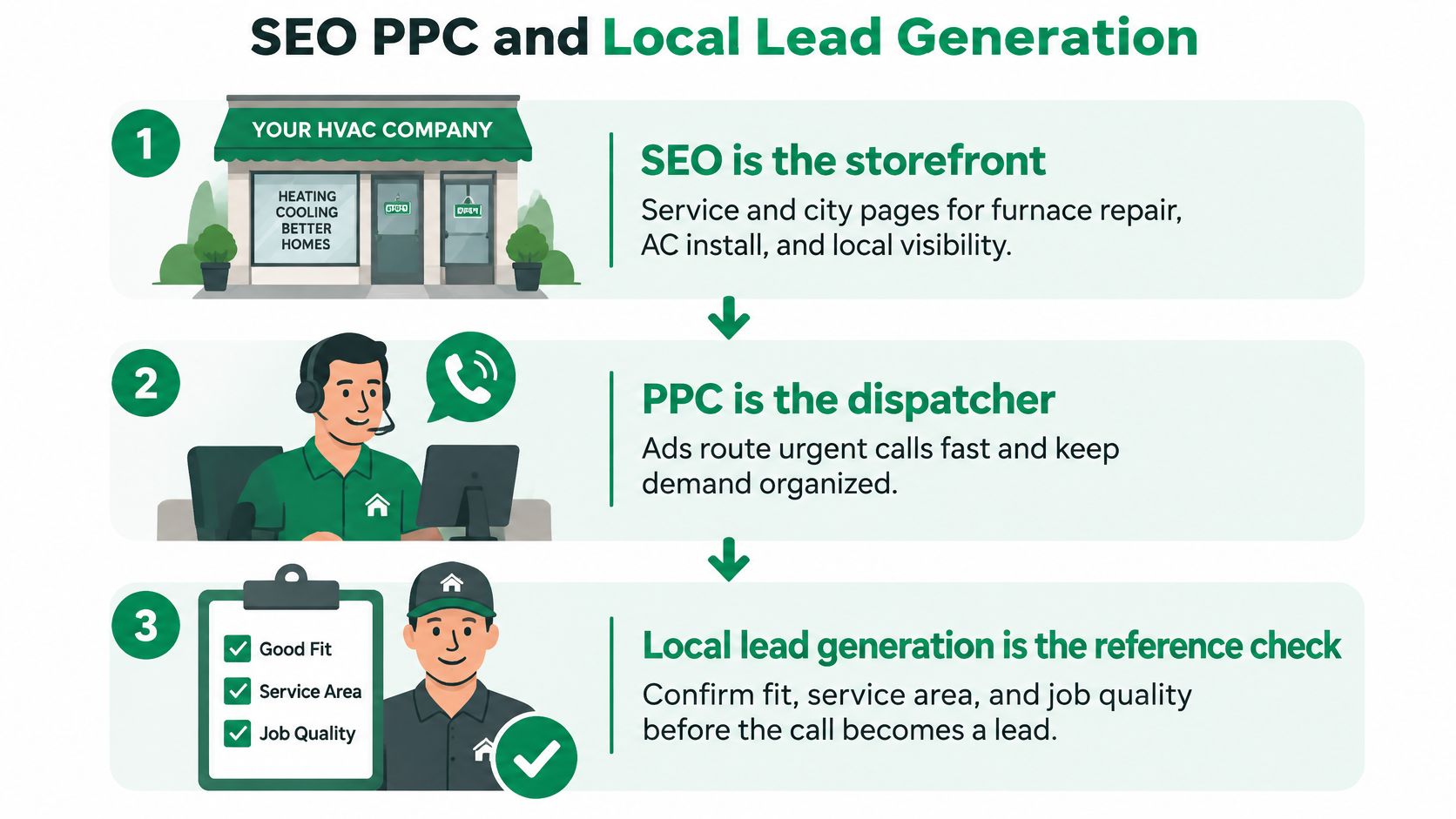
Picture the work in three layers. A storefront. A dispatcher. A reference check. Each layer does a different job, and confusing them is where budgets leak.
SEO Is the Storefront
SEO is where a homeowner decides you do the exact work they need, in the town where they live. That means one clear page per service per area for furnace repair, AC installation, maintenance, and emergency service, written around the symptom typed into search. High bills. Uneven rooms. A system that runs but never cools.
Don't build thin city pages that swap one town name for another. Each page should confirm the service, the area your crew covers, brands serviced, hours, financing, and a direct phone or form path. A homeowner in a heat wave isn't reading your company history.
PPC Is the Dispatcher
PPC routes urgent demand fast, but bidding harder doesn't fix a mismatched page. According to Google's Ad Rank and Quality Score guidance, Ad Rank is recalculated each time an ad is eligible to appear and again when it competes in an auction, the bid can affect Ad Rank but does not determine the ad-quality assessment, and Quality Score is a diagnostic number reported on a 1-10 scale that Google states is not itself an input used at auction time.
That changes the practical task. Don't chase the displayed score. Improve expected click-through rate, ad relevance, and landing-page experience by aligning keyword, ad promise, and destination page.
Say the ad promises same-day boiler repair. The page must confirm boiler service, today's availability, the city served, and a tap-to-call button. If it lands on a generic homepage – and this happens constantly – you pay for the click and lose the job.
Local Proof Is the Reference Check
The third layer runs through your Google Business Profile, website, and reviews. A searcher sees your ad or map result, then checks whether you're real, nearby, open, and trusted. Inconsistent phone numbers, stale hours, or a profile that promises emergency service your site never mentions will cost you after you've already paid for attention.
In practice, hold each layer to a simple build standard:
- One page per service per area: Specific enough that a homeowner knows in seconds they're in the right place.
- One fenced budget per campaign: Emergency, replacement, and maintenance shouldn't share one blended pool you can't read.
- One call-tracking number per major source: So a click can be followed to a booked estimate, not just a form submit.
Treat SEO and PPC services as one system with separate accounting. The storefront earns trust over time, the dispatcher buys speed when demand spikes, and the reference check decides whether either one converts. Measure each layer on booked jobs, and you stop arguing about clicks.
Profitable Jobs Instead of Cheap Leads
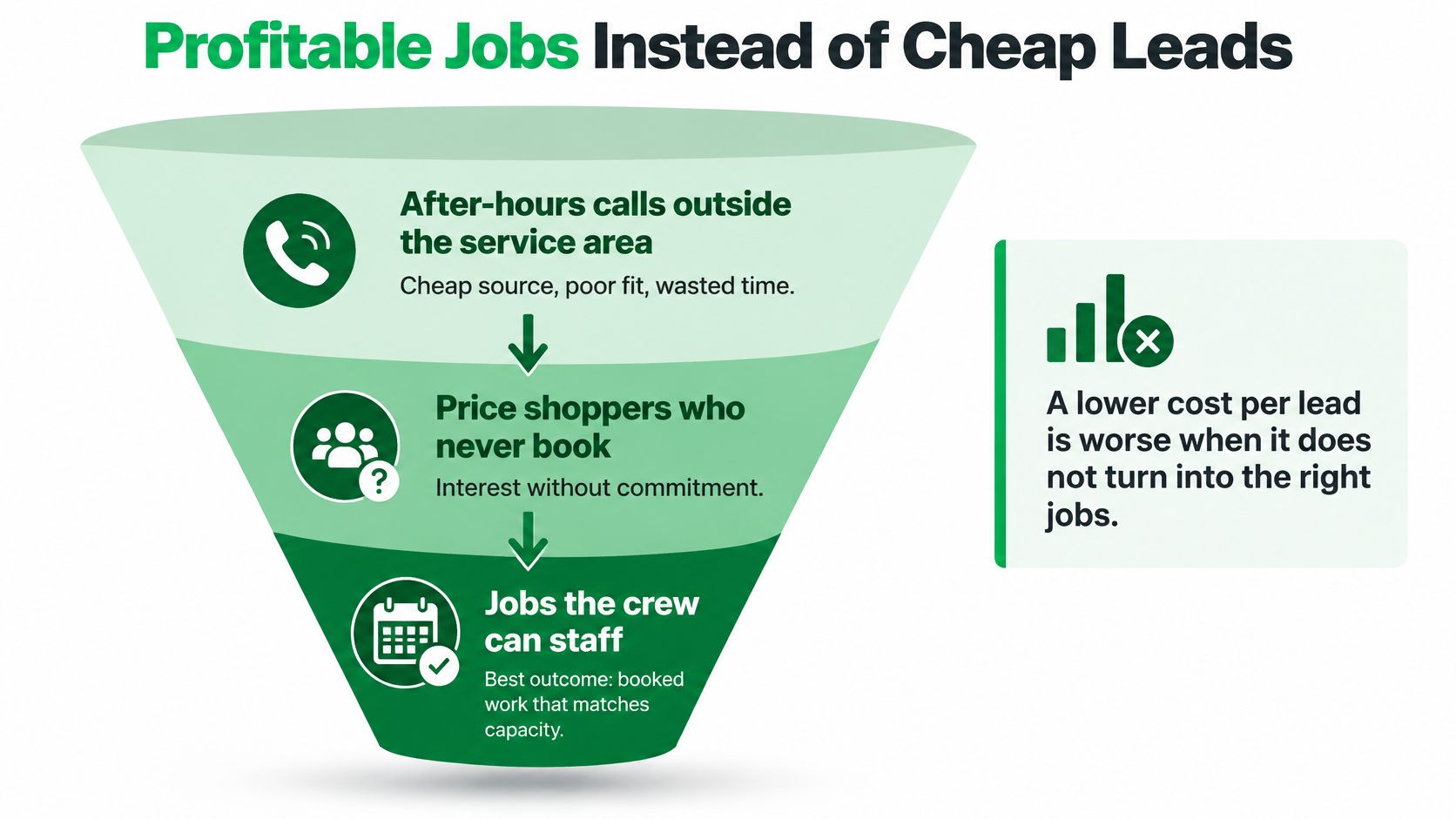
A monthly report that celebrates falling cost per lead should make you suspicious. Cheap leads are easy to buy. Profitable jobs are harder, and they're the only unit that pays techs.
A cheaper source is worse when it sends after-hours calls outside your service area, price shoppers who never book, or work your crew can't staff without overtime and callbacks. Volume goes up. Margin goes down. Fridays get worse.
| Source | Cost per lead | Book rate |
|---|---|---|
| Source A | $40 | 15% |
| Source B | $90 | 35% |
Do the small math firms often skip. Cost per booked job equals lead cost divided by book rate. In this worked example, Source A costs about $267 per booked job on small $180 service calls. Source B costs about $257 per booked job on $8,000 replacements with financing. Similar acquisition cost. Completely different gross margin.
That's why a firm should join the full chain for you. Google Business Profile actions, website sessions, paid-search clicks, and call tracking on one side. Booked-job rate, average ticket, cancellation rate, gross margin, and repeat-service value on the other. Without that join, you're grading marketing on inquiries while operations pays for the outcome.
Decision rule: If a source can't show booked rate and average ticket, you don't have a marketing problem yet. You have a measurement problem.
The numbers force a real choice. Buy more traffic. Fix the sales process. Add financing so replacements close. Or stop advertising services dispatch can't cover. A good firm helps you pick, even when the answer is less ad spend, and that discipline applies just as much to SEO for service-based businesses as it does to paid search.
Creative should follow the same logic. Build around replacement readiness, not slogans. The ENERGY STAR HVAC campaign framework identifies equipment-replacement symptoms, operating-cost savings, comfort, rebates, environmental benefits, purchase guidance, and installation guidance as the core information consumers need before selecting equipment or a contractor.
Use symptom-led pages, a repair-versus-replace guide, and rebate or savings context localized to your market. Keep manufacturer claims separate from verified program rules for rebates, tax credits, and equipment availability. When a page lowers purchase risk, the click arrives closer to a quote request. The firm earns its retainer when it reports contribution margin by source and moves budget toward it.
How to Vet an HVAC Marketing Partner
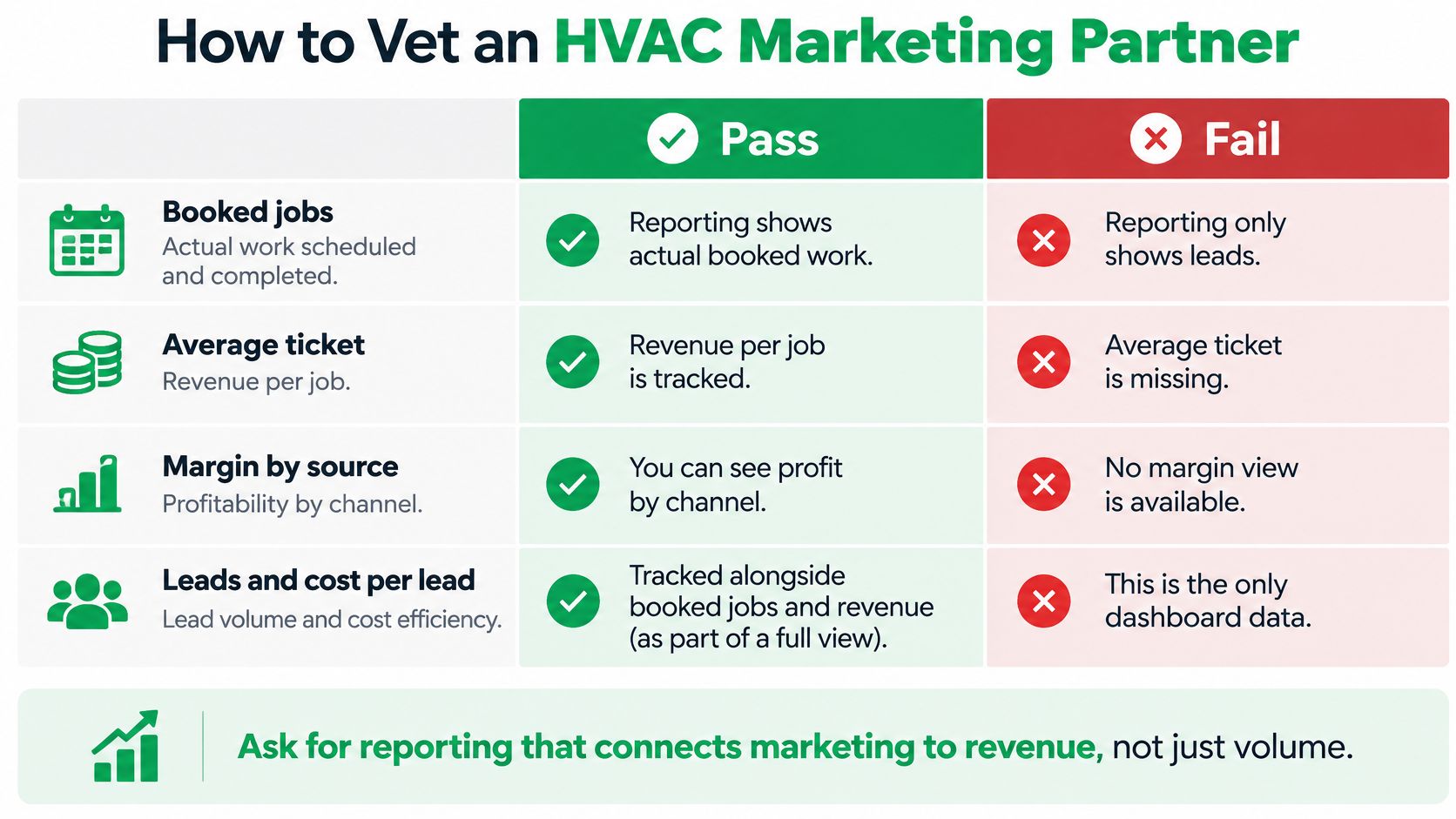
Take this table into the sales call. Each row is a yes-or-no question you can ask before price comes up again.
| Check | Pass | Fail |
|---|---|---|
| Reporting | Booked jobs, ticket, and margin by source | Leads and cost per lead only |
| Local proof | Accurate profile, hours, and job-specific reviews | Incentives or a profile that disagrees with the site |
| Paid search | Matching keyword, ad, and landing page plus a service-area fence | Broad traffic sent to the homepage |
| Account ownership | Ads, analytics, and call tracking in the contractor's name | Rented accounts the firm can lock |
| Scope and people | Written scope, 90-day test, named lead | Long lock-in and a rotating junior |
| Conversion access | Keyboard-usable forms and real image text alternatives | Pretty pages that are hard to finish |
Reporting and Local Proof Come First
A pass on reporting means you can see booked jobs, average ticket, close rate, and margin by source, location by location. A fail is a colorful dashboard of impressions, leads, and cost per lead with no connection to revenue. Ask them to show a sample report with the client name removed. If they can't, they don't have one.
Local proof deserves the same rigor because homeowners validate you in more than one place. A recent HVAC homeowner survey from AdGenius reported that 91% of respondents considered reviews important when selecting a contractor, while 56% checked Google first and 51% reviewed the contractor's website.
So a firm that optimizes only Google or only your site leaves a trust gap. Look for consistent phone, hours, licensing, financing, warranties, and emergency availability across both. Reviews should follow completed jobs, describe what was fixed and how fast, and never use incentives or manipulation. Negative reviews get a prompt, factual reply that moves details offline.
Track it properly. Profile actions, calls, direction requests, landing-page sessions, booked estimates, review volume and recency, response time, and close rate. That's conversion infrastructure. Not branding fluff.
Ads, Access, and the People Doing the Work
On paid search, ask to see one campaign end to end. Keyword, ad, landing page, negatives, service-area fence. If the example is broad traffic dumped on the homepage, the strategy is spend first and sort it out later.
On account ownership, there's no gray area. Ads, analytics, and call-tracking accounts sit in your name, with your login, from day one. Rented accounts turn a breakup into a hostage negotiation.
On fit, require a written scope, a 90-day test, and a named person who owns the account. Long lock-ins plus a rotating junior with no HVAC examples means you're funding their training.
Check the quote path yourself, too. Can you complete the form by keyboard. Do equipment and technician images carry real alternative text. Can you find the phone number without hunting. Forms people can't finish don't count as leads, no matter how good the traffic looks.
Score the firm row by row, using the same discipline you'd apply when learning how to choose a marketing agency for any trade. One fail may be fixable. A pattern of fails is your answer. Walk away before the discount offer arrives.
What Strong HVAC Campaigns Look Like
Rules are easier to trust when you can picture the shop. These are typical scenarios, not trophy case studies, and each one proves a different point about profitable work.

The Two-Truck Shop That Bought Fewer Leads
Say a two-truck residential company buys shared leads because the cost per lead looks low. Evenings disappear into out-of-area no-cooling calls, callbacks to price shoppers, and jobs too far away to run profitably. The owner feels busy. The bank account disagrees.
The useful change isn't more volume. It's a tight service-area fence, a same-day AC page with real hours and financing, and a review request after completed jobs that asks what was fixed. Lead volume falls. Booked estimates rise, because the people who call are inside the fence and ready to book.
The Replacement Shop That Changed the Click
Say a replacement-focused shop runs a generic brand ad to its homepage. Homeowners click, see a slogan, and still don't know whether they need a repair or a new system. The sales team spends every visit starting from zero.
Now give that click a repair-versus-replace page, symptom guidance, and a rebate note localized to the shop's utility. The visitor arrives already sorting an install from a bandage repair. Average ticket moves, not because the ad got louder, but because the page did part of the sales job.
The Three-Location Contractor Hiding a Weak City
Say a contractor runs three locations through one homepage, one phone number, and one blended report. Cost per lead looks acceptable on average. One city, though, burns budget on calls that rarely book, and the other two subsidize it in the totals.
Split the profiles, phone numbers, and service pages by location. Calls and direction requests become traceable, and the weak city stops hiding. Now the owner can fix that market, shrink its budget, or exit it, based on numbers instead of gut feel.
The contrast in all three is the same failed alternative. More leads. Same technicians. Worse Fridays.
Copy the pattern, not the size of the program. Start this month with one city, one painful service, one landing page, and one source report that includes close rate. If that small test shows margin, scale it. If it doesn't, you've learned cheaply, which is the whole point.
Request a Profitability Audit First
Don't start with a 12-month retainer. Start with a short profitability audit and make the firm show its working.
Ask for your current lead sources, booked-job rate, average ticket, and cancellation rate by source. Ask where your site or Google profile loses trust after the click. Wrong hours, thin service pages, no financing, reviews that never get answered. Bring the pricing row that matches your shop and score the firm against the pass-or-fail checks before you discuss discounts.
Define the first engagement as a 90-day test with named sources, a booked-estimate target, and a margin report due at day 30, 60, and 90. Name the person who owns it. Put account ownership in writing. Services described under digital marketing audit services should produce that kind of concrete starting point, not a generic list of website errors.
Set your walk-away conditions now. Rented accounts. No margin by source. No named lead. Any one of those, and you stop.
And if the audit shows capacity is the main constraint, fix dispatch and hiring before buying more clicks. Marketing can't install systems. If it shows a gap between searchers and booked installs, pick the smallest scope that closes it, often the landing page and map profile first, then paid search with a fenced budget.
The right HVAC marketing firm is the one that can show which jobs paid for themselves. In writing. By source. Within 90 days.
If you want that audit before you commit to a retainer, Mr. Green Marketing, LLC offers a free audit and performance report that maps your visibility gaps, lead sources, and conversion bottlenecks so you can see which jobs pay. Visit Mr. Green Marketing, LLC to request yours and bring your current cost per booked job to the conversation.
Leave a Comment
sing in to post your comment or sign-up if you dont have any account.