
The most popular advice on how to build SEO strategy starts with a keyword list and a publishing schedule. That's backwards if your important pages aren't indexed, your forms don't work, or your reporting treats every search as a potential website visit.
Start with what you need to measure, then build the pages and technical systems that support it. A product search, a map search, and a question answered directly in search results don't deserve the same success metric.
Table of Contents
- The Eight Phases of an SEO Strategy at a Glance
- How to Audit Crawling and Fix Technical Gaps
- How to Match Keywords to Search Intent
- How to Plan Content and Optimize Each Page
- Earning Links and Local Signals That Hold Up
- Tracking Results and Testing Each Change
- Confirm Your First 90-Day SEO Plan
The Eight Phases of an SEO Strategy at a Glance
| Phase | Output you should have | Main tools | Typical time |
|---|---|---|---|
| 1. Discovery and audit | Indexable URL inventory and baseline numbers | Search Console, Screaming Frog | 1–2 weeks |
| 2. Keyword and intent research | Intent map with one primary intent per target URL | Search Console queries, keyword research tool | 1–2 weeks |
| 3. Technical fixes | Ranked fix list with owners | Crawler, PageSpeed Insights | 2–4 weeks |
| 4. Content planning | Editorial calendar with page briefs | Spreadsheet, Search Console | 1 week, then monthly |
| 5. On-page optimization | Title, heading and meta rules applied to priority pages | CMS, crawler | 2–4 weeks |
| 6. Link acquisition | Target list and outreach log | Backlink tool, email | Ongoing, reviewed quarterly |
| 7. Local and GEO signals | Business profile and citation audit | Google Business Profile, citation tools | 2–4 weeks |
| 8. Tracking and testing | Dashboard and test log | Search Console, GA4 | Monthly review |
These are typical planning ranges for a small business with a few hundred pages, not promises about ranking speed. A large ecommerce catalog runs longer, especially when developers must change filtering, navigation, or product templates. Some phases overlap; measurement starts immediately.
Build a crawl-to-revenue chain
Inventory indexable URLs and business-critical conversion paths before commissioning articles. Map a primary intent to each target page, consolidate overlapping pages, and make priority pages reachable through crawlable HTML links.
The Google SEO Starter Guide describes URL discovery through links, sitemaps, and redirects, supporting a strategy that connects site structure with content rather than treating them as separate projects. Submit a sitemap containing canonical, indexable URLs, then monitor coverage, queries, clicks, conversions, and revenue.
The common failures are unglamorous: noncanonical URLs in sitemaps, orphan pages, several pages competing for the same intent, and reports showing rankings without leads or sales. More content won't repair those foundations.
Planning rule: Every SEO task needs an affected page, a responsible person, and a measurable reason to do it.
Before phase one, create these working documents:
- Written goals: Define the business outcome, such as qualified quote requests or profitable product orders.
- URL inventory sheet: Record each page's purpose, indexability, template, and conversion destination.
- Metric ownership register: Name the person responsible for collecting, checking, and interpreting each metric.
How to Audit Crawling and Fix Technical Gaps
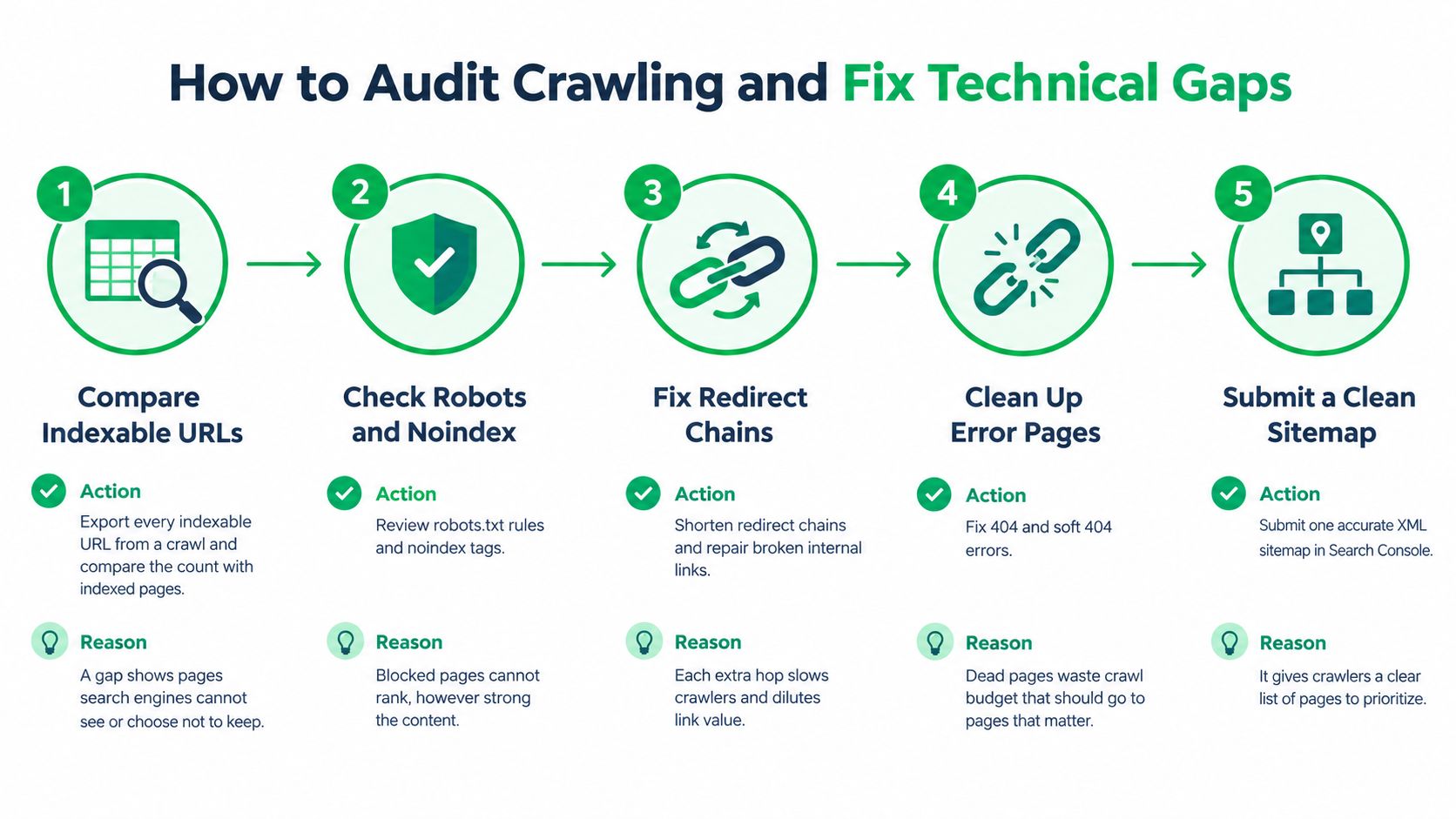
Compare the URL sets. Export indexable URLs from Screaming Frog and compare them with indexed pages in Search Console. Investigate a large gap for blocking, noindex directives, duplicates, or pages Google hasn't selected for indexing. Compare actual URLs, not just totals.
Inspect exclusion patterns. Open the Page indexing report and group examples by template. Look for statuses such as “Crawled – currently not indexed” and “Duplicate without user-selected canonical”; inspect representative URLs before assigning a fix.
Find orphan pages. Compare the crawl against sitemap and analytics exports to identify URLs with no crawlable internal links. Add relevant links from useful parent or related pages, rather than placing every orphan in the footer.
Consolidate duplicates. Start with templates that generate revenue. Use 301 redirects when retiring a duplicate permanently, or canonicals when alternate URLs must remain available; a canonical is a signal, not a guaranteed indexing instruction.
Clean the sitemap. Include only canonical, indexable URLs returning HTTP status 200. Remove redirects, broken pages, and deliberately excluded URLs so the file represents the pages you actually want indexed.
Set performance acceptance criteria
Before checking field performance, establish the pass marks. Google's Core Web Vitals report documentation defines the Good, Needs improvement, and Poor bands shown below.
| Metric | Good | Needs improvement | Poor |
|---|---|---|---|
| Largest Contentful Paint (LCP) | 2.5 seconds or less | Above 2.5 seconds, up to 4 seconds | Above 4 seconds |
| Interaction to Next Paint (INP) | 200 milliseconds or less | Above 200 milliseconds, up to 500 milliseconds | Above 500 milliseconds |
| Cumulative Layout Shift (CLS) | 0.1 or less | Above 0.1, up to 0.25 | Above 0.25 |
Pull real-user performance. Use the Search Console Core Web Vitals report to identify failing URL groups, then diagnose representative pages with PageSpeed Insights. Count a metric as fixed when field measurements reach Good, not merely when a laboratory score improves. Field reporting takes time to reflect deployed changes.
Compare mobile and desktop markup. Check rendered structured data, including properties and embedded URLs. Google's mobile-first indexing guidance calls for equivalent structured data across versions and highlights Product, Breadcrumb, and VideoObject markup; stores should pay particular attention to Product, while editorial teams should check Breadcrumb.
Run a focused remediation sprint
I would start with server response and image delivery before tackling scripts, unless diagnostics identify JavaScript as the dominant problem. Compress oversized images, reserve media dimensions, inspect caching, and remove unnecessary third-party tags.
Retest one or two representative templates before rolling changes across the site. Keep forms, navigation, and checkout in the regression checks: a faster page with a broken purchase button isn't an improvement.
Use a technical SEO implementation checklist to turn findings into assigned tickets with acceptance criteria. Not another unowned audit PDF.
How to Match Keywords to Search Intent
Begin with the queries you already receive. Export Search Console queries sorted by impressions and flag terms with meaningful visibility but weak click-through rates; inspect their results pages before assuming the title is the problem.
Add gaps from your top ten search competitors, including publishers and marketplaces that compete for attention without selling your exact service. Tag each query as informational, commercial, transactional, local, or branded, then assign exactly one primary intent to its target URL.

Let the results page influence the format
Check live results in the market you serve. If prominent results are lists and interactive tools, a plain explanatory guide may miss what searchers want. If an answer box appears, place a concise, self-contained definition near the top, without assuming that placement guarantees inclusion.
| Intent | Typical query pattern | Page to build | Example |
|---|---|---|---|
| Informational | how to, what is, guide | Guide or glossary page | how to build SEO strategy |
| Commercial | best, vs, reviews | Comparison or buyer's guide | SEO agency vs in-house team |
| Transactional | pricing, hire, cost | Service or product page with ranges | SEO agency pricing |
| Local | near me, city plus service | Location page tied to a business profile | SEO consultant Pensacola FL |
| Branded | brand name plus a term | Brand or homepage section | Mr. Green Marketing SEO services |
For example, how to build SEO strategy is informational: the reader needs a usable process. SEO agency pricing calls for a service page with actual prices or ranges, scope, exclusions, and a next step, rather than a long introduction to marketing.
Mixed-intent queries need judgment. When results blend guides and vendor pages, choose the dominant format and note that decision in your content plan. Don't force every commercially relevant phrase onto a sales page.
Map visibility as well as visits
A 2024 analysis by SparkToro and Datos, summarized by Statistics Fundamentals, found that approximately 58.5% of U.S. Google search sessions ended without a click to an external website. For informational queries, appearing in the answer itself can therefore be a useful visibility objective, although inclusion isn't guaranteed.
And low click-through doesn't automatically mean failure. A searcher may get the answer, remember the business, and return through a branded query later.
Record query, intent, page format, destination URL, result features, and intended KPI in a shared sheet. Use semantic keyword grouping to combine closely related queries when they share a search need, rather than creating a separate page for every wording variation.
How to Plan Content and Optimize Each Page
Publish fewer pages until your team can explain why each deserves to exist. Ten pages answering distinct needs are a stronger starting plan than forty near-duplicates built around small keyword or city variations.
Rank the backlog by business value, existing impressions, and effort. Start with the top ten candidates, giving preference to pages that can support a quote, sale, or booking without requiring an expensive rebuild.

Give the writer decisions, not just keywords
Each brief should include:
- Primary intent and query: State what the reader wants to accomplish and which query represents that need.
- Required answers: List the decisions, objections, and practical questions the page must resolve.
- Proof: Specify the source, documented example, product detail, or original finding needed to support the claims.
- Internal links: Identify two or three relevant existing pages that should link to the finished page.
- Business action: Choose the appropriate next step, whether that's comparing products, requesting a quote, or checking availability.
A brief should also identify what the team must obtain from a subject-matter expert. Writers can organize expertise, but they can't invent your installation process, shipping restrictions, or service exclusions.
Apply on-page rules without worshipping scores
Use one clear H1 matching the intent. As editorial targets, keep titles under 60 characters with the main term near the front, and aim for meta descriptions of about 150 to 160 characters; these aren't guaranteed display limits.
Write descriptive image alt text, not a list of keywords. Add FAQ entries only when customers ask those questions, and make sure important answers remain in the main page copy.
A finished page should make the buyer's next decision easier, not merely make an optimization plugin turn green.
The volume trap applies to human and automated production alike. Google's March 2024 spam-policy update defines scaled content abuse around producing pages primarily to manipulate rankings rather than help users, regardless of production method.
Say a planned listicle has fifty entries, but only fifteen offer distinct, useful recommendations. Cut it to fifteen. Likewise, a location template that changes only the town name needs substantive local information – not another synonym pass.
Use a repeatable SEO-friendly blog writing workflow, but require every new page to have a brief, a named intent, and at least one useful fact a competitor page lacks.
Earning Links and Local Signals That Hold Up
A small team needs a reason for someone to link, not a longer outreach list. I would plan one original resource per quarter, such as a customer survey, a clearly scoped pricing benchmark, or a practical reference that industry writers can use.
The trade-off is production effort. An original resource takes more preparation than a generic guest post, but it gives outreach recipients something specific to reference.
Earn links from relevant audiences
- Pitch existing demand: Find local and industry sites that already reference comparable resources. Explain precisely what your resource adds.
- Reclaim brand mentions: Ask publishers to link an existing, accurate mention when the link would help readers find the business.
- Update partner resources: Offer a useful replacement for outdated information on supplier, association, or partner pages.
- Evaluate relevance: Track referring domains, editorial context, and referral quality rather than celebrating raw backlink counts.
Unlinked mentions are often the cheapest starting point because the publisher already knows the business. New resource outreach takes longer and offers less control over publication timing.
Avoid paid link schemes and sites built mainly to sell placements. These link-building strategy considerations can help separate legitimate relationship work from a spreadsheet of purchasable URLs.
Keep local identity accurate
Complete Google Business Profile with the appropriate primary category, service areas, and current photos. Set a review-response schedule and check that the business name, address, and phone number remain consistent across relevant directories.
Multi-location businesses should create separate profiles for eligible locations and useful location pages for each site. Add staff, neighborhood references, completed local jobs, access details, and location-specific services where those details are real.
Don't create profiles for locations that don't meet eligibility requirements. A service-area business also shouldn't expose a private address merely to make directory entries match.
Make claims easy to cite
For GEO, or generative engine optimization, use clear definitions, dated figures with sources, and named authors with relevant credentials. Separate your own findings from outside evidence and explain how original figures were collected.
Citation-friendly writing doesn't guarantee AI inclusion. It does make the information easier for customers, journalists, and automated systems to interpret.
Would a customer find this source useful if no search engine existed?
Use that test before pursuing a link, directory listing, or citation opportunity.
Tracking Results and Testing Each Change
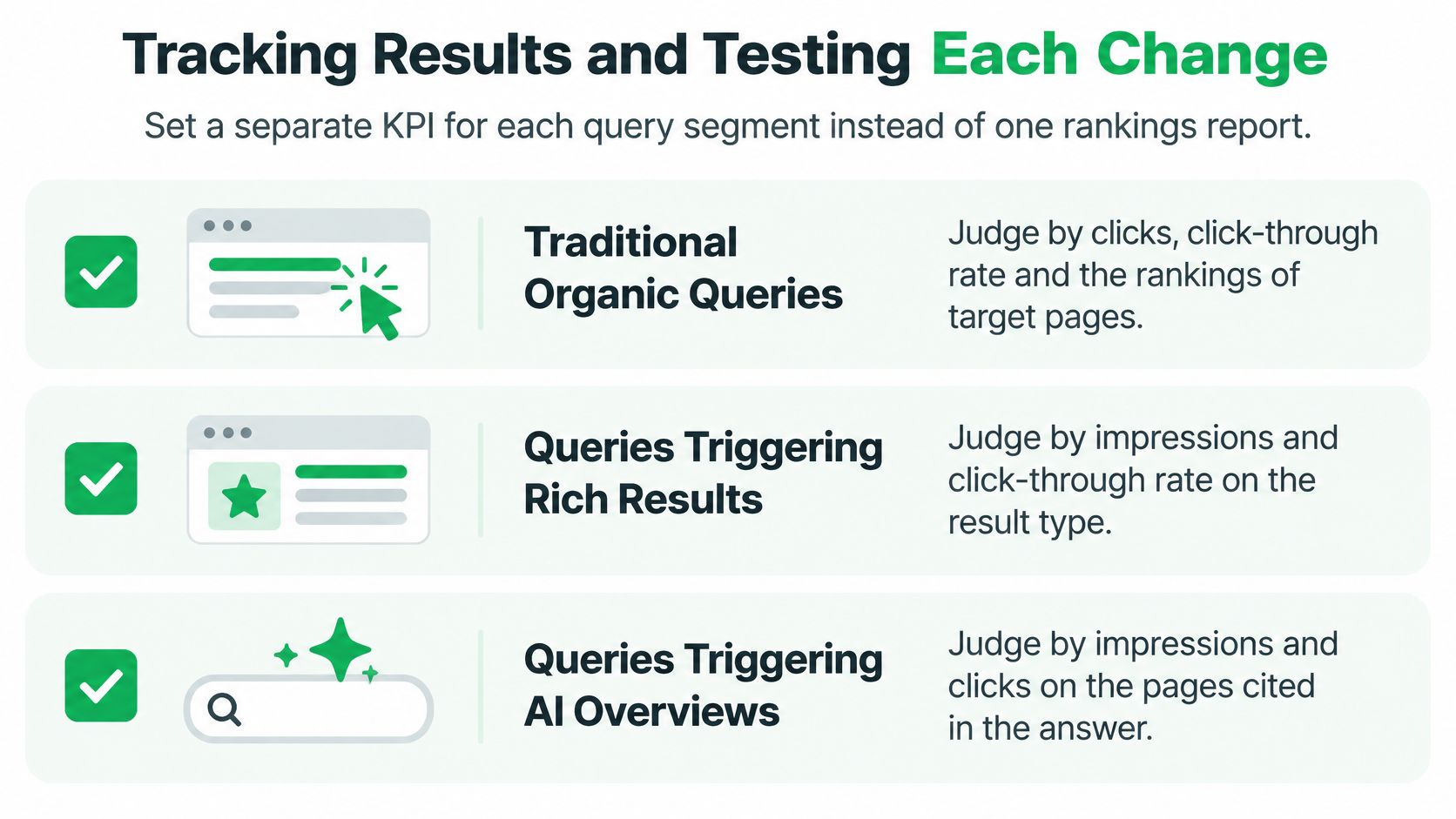
A rankings report can show gains while qualified inquiries fall, or clicks decline as customers encounter the brand in search answers and maps. Rankings help diagnose visibility, but they do not capture every business outcome. Set a separate KPI for each query segment, including searches that may end without a click.
Match the scorecard to the search experience
| Query segment | Primary measures | Business check |
|---|---|---|
| Traditional organic | Clicks, click-through rate, target-page rankings | Qualified leads and sales |
| AI Overview | Observed citations, page impressions, branded search growth | Qualified demand and assisted conversions |
| Local | Profile calls, direction requests, map visibility | Booked work and qualified calls |
| Product and transactional | Revenue per visit, conversion rate | Profitability and order quality |
| Branded | Branded impressions, assisted conversions | Existing versus newly generated demand |
Clicks from AI Overviews to cited sources can be limited. Measure citation visibility separately from referral traffic, and use Google's AI-feature guidance when checking how foundational SEO practices apply to AI features.
Don't report awareness as if it were a complete, directly measurable outcome. Search Console doesn't provide a clean, complete AI Overview citation dashboard, so log observed citations separately and state how you sampled them. Branded search growth can support the picture, but it does not prove that a particular answer caused a sale.
Run tests your team can interpret
Start with a four-week baseline. Then change one element per template, such as the title pattern or internal-link placement. Compare the changed pages with similar pages that stayed the same, and allow four to eight weeks to judge direction. Those are working test windows, not guaranteed response times.
Low-volume pages may need more time to show a clear pattern. Before crediting a change, check for seasonality, promotions, stock availability, and algorithm updates.
Use a test log that captures:
- Hypothesis: What should improve, and why?
- Pages: Which pages changed, and which are the comparison set?
- Start date: Record deployment and later edits.
- Metric: Choose the primary outcome before reviewing results.
- Result: Note the movement and any factors that could have affected it.
- Decision: Keep, revise, reverse, or extend the test.
Attribution should fit the business. A local service company and an Amazon seller have different paths to revenue. Track website-originated demand separately from marketplace sales unless there is a defensible way to connect them.
Build a monthly SEO report around decisions rather than screenshots: what changed, what happened, and what the team should do next.
Confirm Your First 90-Day SEO Plan
Choose the starting point that matches the business constraint. If valuable pages aren't indexed, prioritize the audit and hold content production until the intended indexable set is clean.
If traffic is steady but leads are flat, inspect the intent map and conversion paths on pages that already rank. A single-location service business should finish its Google Business Profile and citation check first; a store with a large catalog should prioritize templates and structured data.
Commit to deliverables the team can inspect
Use a firm publishing gate: don't add new pages until the top ten priority pages pass the audit. That doesn't mean achieving technical perfection; it means resolving material access, intent, usability, and measurement problems.
Over the 90 days, complete:
- The URL inventory: Include page purpose, indexability, priority, and ownership.
- The intent map: Assign the top twenty target queries to appropriate pages and success metrics.
- A repaired template: Keep before-and-after Core Web Vitals field data, deployment notes, and conversion checks.
If nobody owns Search Console yet, assign that responsibility before buying more reporting software. Mr. Green Marketing offers a free audit and performance report as one starting option alongside an internal review or specialist technical assessment.
Make the site crawlable, match each page to one intent, fix speed, then scale content, links, and local signals while measuring every change.
Mr. Green Marketing, LLC offers SEO strategy, technical optimization, content, and GEO services aligned with measurable business goals. Visit Mr. Green Marketing, LLC to request a free audit and performance report and identify which visibility gaps deserve attention first.
Leave a Comment
sing in to post your comment or sign-up if you dont have any account.