
And the phone that used to ring while your crew was out cleaning has gone quiet. You check Google, see bigger competitors on the map, and wonder whether you need more reviews, more pages, or another website rebuild.
SEO for cleaning services works better when you stop treating those as separate projects. Build a consistent picture of who you are, where you work, and what customers can expect, then measure whether the people finding you book suitable jobs. Rankings matter. A schedule filled with the wrong inquiries doesn't.
Table of Contents
- Why Local Search Matters for Cleaning Companies
- Mapping Keywords to Real Service Jobs
- Building Your Google Business Profile the Right Way
- Service Pages and Local Landing Pages That Convert
- Using Reviews as Intelligence, Not Just Star Ratings
- Measuring What Actually Books Jobs
Why Local Search Matters for Cleaning Companies
A cleaning company can't fulfill a job anywhere just because someone finds its website. Travel time, crew availability, service scope, and the customer's location determine whether an inquiry is worth pursuing. That makes local relevance a business constraint, not a keyword modifier.
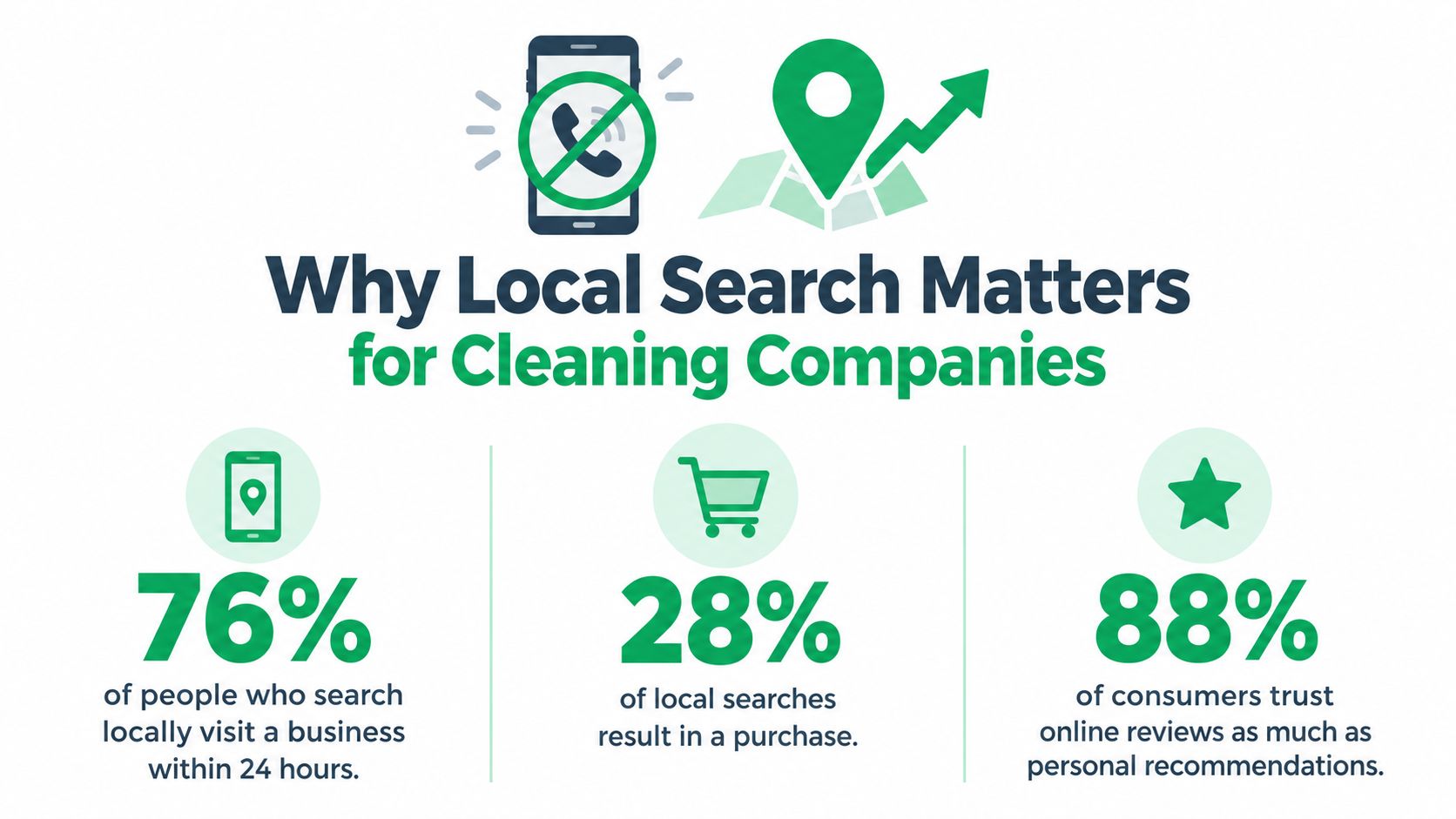
Google has reported that 46% of searches have local intent, and 76% of people who search for something nearby visit a related business within 24 hours, according to this local-search statistics summary. Those figures describe broader local behavior, not cleaning-company booking rates. Still, they support a practical priority: make it easy for nearby customers to discover, evaluate, and contact you without unnecessary steps.
Define the jobs your visibility should produce
Before editing your website, decide what a qualified local inquiry looks like. A homeowner seeking recurring cleaning inside your normal coverage area is different from someone requesting an urgent specialty job your crew doesn't perform.
Use those differences to set priorities:
- Service fit: Identify the cleaning work you want to sell and can deliver reliably.
- Geographic fit: Define coverage around workable routes, not every city you'd like to rank in.
- Operational fit: Match the promise on your pages to actual availability, equipment, and staffing.
- Customer action: Give visitors a clear way to call, request a quote, or book an estimate.
National ecommerce advice often emphasizes reaching a larger audience. For a cleaner, reaching a more appropriate audience can be the better decision. Publishing broad cleaning tips may attract readers who want to do the work themselves, while a specific service page addresses someone considering hiring you.
Practical rule: Judge local visibility by whether it produces work your team can serve profitably, not whether it makes the traffic chart look busier.
Treat discovery and trust as connected
Map visibility can introduce your business, but customers still need to understand what they're buying. Your profile, website, and public customer feedback should describe the same operation.
That's the useful way to think about the benefits of local SEO: better discovery paired with fewer unanswered questions. A visitor shouldn't have to call just to learn whether you clean offices or serve their neighborhood. Save that conversation for the details that require an estimate.
Mapping Keywords to Real Service Jobs
A generic keyword list doesn't know that you're trying to grow recurring residential work rather than accept more last-minute turnover jobs. Your booking records do. Start with the services customers request, the language they use, and the locations your team can support.
Keyword-to-page mapping means assigning a customer need to the page best equipped to answer it. It isn't a mandate to publish a separate page for every wording variation.
Compare intent before creating pages
Use a working map like this, adjusting the examples to your actual offerings:
| Example search | Customer need to investigate | Suitable page |
|---|---|---|
| House cleaning Pensacola | Residential cleaning in a specific market | Residential service page or substantial Pensacola landing page |
| Move-out cleaning near me | A defined turnover job, potentially deadline-sensitive | Move-out cleaning page |
| Eco-friendly office cleaning | Commercial service with product-related requirements | Office cleaning page with substantiated product information |
| Deep cleaning in a served city | Detailed scope beyond routine maintenance | Deep cleaning page with relevant coverage information |
These are illustrative query mappings, not search-volume findings. Validate them against actual inquiries and the searches associated with your existing pages before deciding what deserves more investment.
For one-time or urgent work, emphasize scope, exclusions, preparation, and how availability is confirmed. For recurring contracts, address scheduling, consistency, access arrangements, and the estimate process. Specialty services need their own treatment when equipment, qualifications, or the buying decision genuinely differ.
Keep the architecture useful
A house-cleaning page and a maid-service page may describe the same offer. If the customer need and service details are identical, strengthen the existing page rather than creating a competing near-copy.
Location pages require another decision. Does the city warrant distinct coverage information, genuine local proof, or different scheduling considerations? If not, an accurate service-area section may be more useful than a thin standalone page.
Build the map with a simple list:
- Customer wording: Record phrases from quote requests and sales conversations.
- Relevant destination: Choose the existing page that most directly addresses the request.
- Missing information: Note questions the page doesn't answer.
- Business priority: Flag whether the job supports your preferred service mix.
Use local SEO keyword research to refine that map, not replace your operational judgment. Put the service and location naturally in page titles and headings, then spend the rest of the page explaining the job.
No keyword stuffing. No neighborhood name sprinkled into every paragraph. A prospective customer needs a clear service description, not evidence that someone purchased an SEO tool.
Building Your Google Business Profile the Right Way
A Google Business Profile should represent your real operation. It isn't a collection of geographic placeholders designed to make your company appear closer to customers.
For businesses that travel to customers, Google permits a service-area profile without a customer-facing storefront. Its service-area business guidelines call for one profile for the central office or location, allow up to 20 defined service areas rather than an arbitrary radius, and say the overall boundary should generally stay within about two hours of driving time from the business base.
The eligibility decision comes first. Separate cities served by the same operation don't automatically justify separate profiles.
Work through each legitimate location
Use a location-specific checklist rather than copying settings blindly across the business:
- Claim and verify: Confirm ownership of each eligible profile and resolve duplicate listings.
- Standardize core information: Check the business name, phone, hours, service areas, and website destination against the actual operation.
- Select accurate categories: Choose categories that describe work you perform, not services you hope to add.
- Describe services clearly: Separate relevant offerings and explain their scope without unsupported promises.
- Add firsthand evidence: Use real team and work photos with permission, and maintain a working booking or quote URL.
For a company with distinct locations, assign someone responsibility for each profile. Otherwise, hours, phone details, and booking destinations can drift apart as staff make isolated updates.
Understand what you can influence
Google says local results are primarily determined by relevance, distance, and prominence. Its local-ranking guidance explains that complete information supports relevance, while links, reviews, and overall search visibility contribute to prominence; businesses can't request or pay Google for a better local ranking.
Distance is the awkward part – you can't fix it by adding more city names. Concentrate on accurate information and genuine authority instead of manufacturing proximity with virtual offices or duplicate profiles.
Relevant citations and local links should corroborate the business you operate. A legitimate relationship with a local organization is a sensible place to investigate a listing opportunity; an unrelated directory submission deserves more scrutiny.
A service area is an operational promise, not a wish list.
Keep a shared record of approved business details so profile updates don't contradict the website. The local search optimization process should include checking those details whenever services, coverage, hours, or booking arrangements change.
Service Pages and Local Landing Pages That Convert
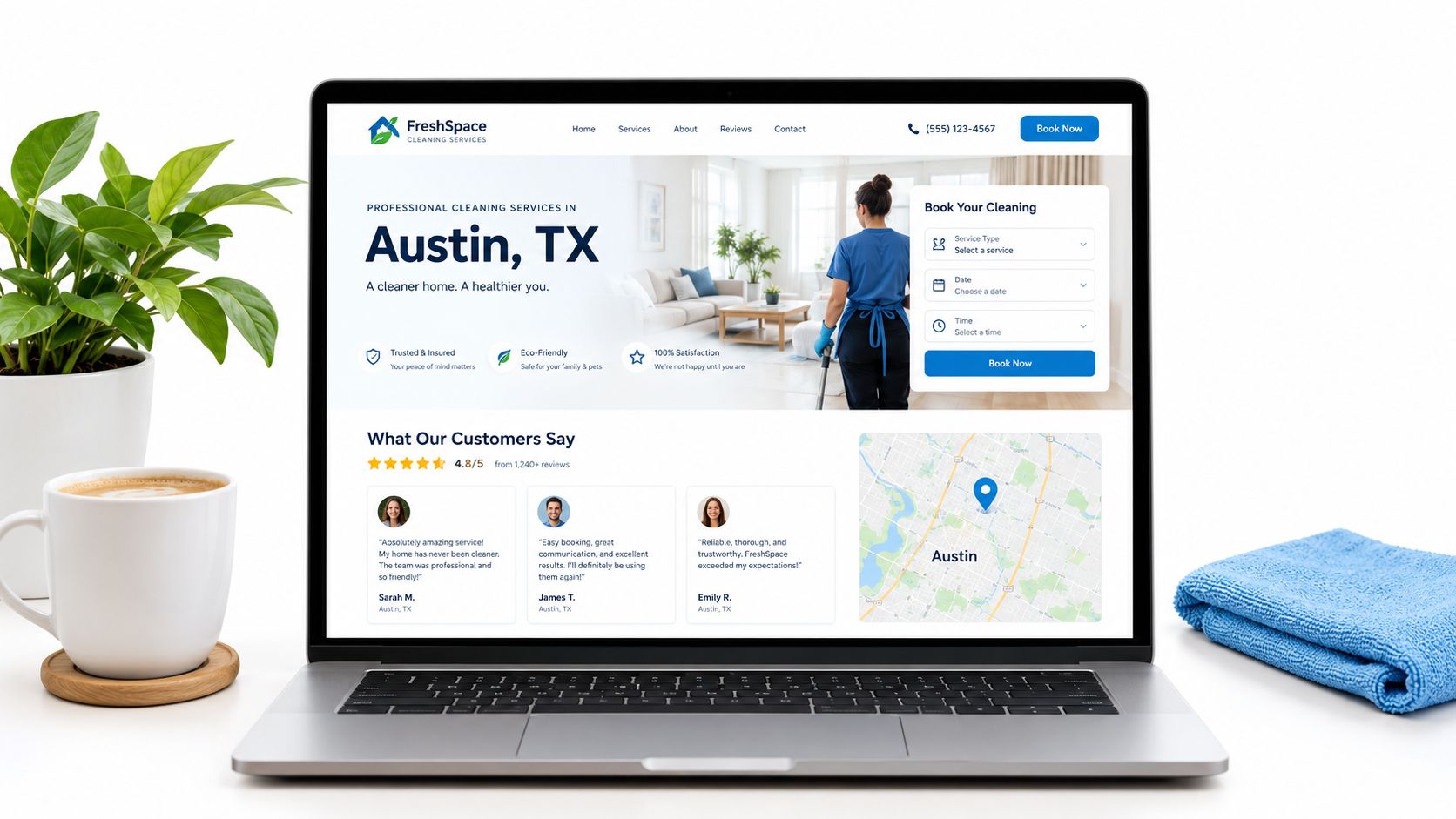
A customer lands on your move-out cleaning page while comparing providers. They need to know whether appliance interiors are included, whether the property must be empty, and how to request an estimate. A large banner promising exceptional cleaning doesn't answer any of that.
Build pages around decision-making information, then make the interface fast and straightforward enough to use on a phone. Content and technical performance belong in the same conversion discussion.
Give the visitor a usable answer
The opening screen should identify the service, coverage, relevant trust evidence, and next action. Include starting-price guidance only when you can explain its conditions clearly; otherwise, describe what affects the estimate.
Develop the rest of the page around practical buying questions:
- Included work: Explain tasks, exclusions, and optional additions using your actual checklist.
- Preparation and access: State what the customer needs to arrange before arrival.
- Proof: Show relevant customer feedback and original photos, plus insurance or other credentials only when verified.
- Availability: Explain how scheduling is confirmed rather than implying every requested appointment is open.
- Conversion path: Use a specific action such as requesting a cleaning quote, with a short form and accessible phone option.
A city page should add genuine local information rather than repeat this material with a swapped place name. Link it to the relevant service details so customers can investigate scope without navigating back through the homepage.
Review high-converting landing-page examples for layout ideas, but retain the information your cleaning customer needs. A visually polished page with vague scope still leaves the buyer guessing.
Remove technical friction from the quote journey
Google's Core Web Vitals reporting evaluates the 75th percentile over the previous 28 days: good results require LCP at or below 2.5 seconds, INP at or below 200 milliseconds, and CLS at or below 0.1, while results are poor when LCP exceeds 4 seconds, INP exceeds 500 milliseconds, or CLS exceeds 0.25.
Apply those checks to service pages and quote forms, not just the homepage. Compress and properly size photos, remove unnecessary third-party scripts, preload only critical assets, and configure caching and a content-delivery network.
Then test on an actual phone. Check whether buttons respond, forms remain stable, and important text is readable. Avoid autoplay video and oversized galleries; retain useful proof rather than stripping the page down solely to chase a performance score.
Using Reviews as Intelligence, Not Just Star Ratings
More reviews can help customers evaluate your business. But asking for another review won't fix a page that leaves your arrival policy unexplained, or an operational problem customers keep mentioning.
BrightLocal's 2025 Local Consumer Review Survey found that 74% of consumers check at least two review sites before choosing a local business, and 89% are more likely to use a business that responds to all reviews. That makes review management broader than maintaining a Google star average.
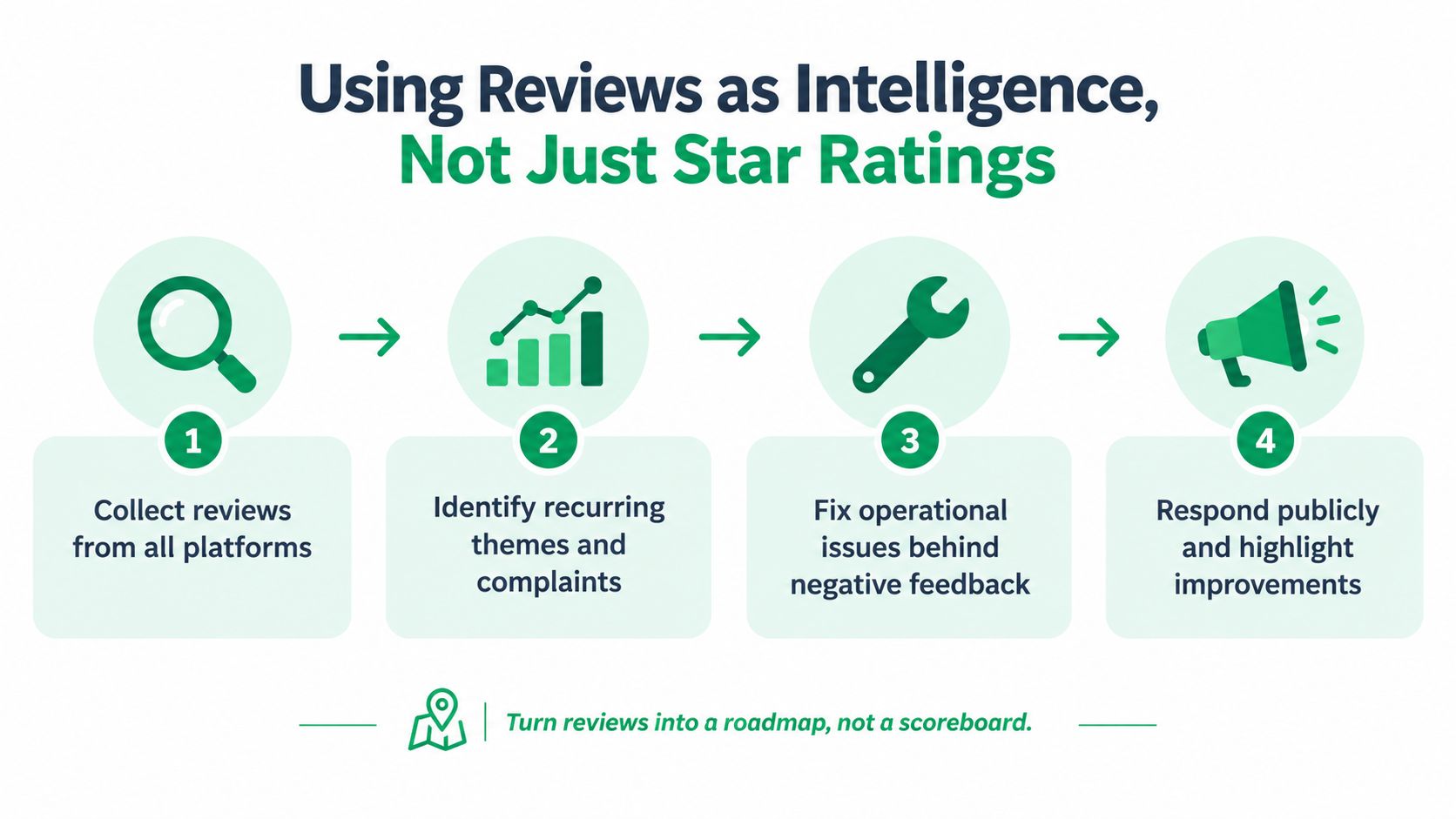
Review intelligence means examining what customers describe, verifying what those experiences reveal, and using the findings to improve both service delivery and public information.
Turn feedback into a working evidence log
Collect feedback from the platforms your customers use, then classify themes such as punctuality, communication, product preferences, checklist accuracy, and damage resolution. Record both praise and complaints. Keep personal customer details out of the working content document.
The next move depends on what you find:
| Review theme | Question to investigate | Appropriate action |
|---|---|---|
| Confusion about arrival | Are customers receiving consistent expectations? | Clarify the arrival-window policy |
| Missed move-out tasks | Was the item included in the agreed scope? | Correct the checklist or explain exclusions |
| Praise for communication | What process produced that experience? | Describe the verified communication process |
| Questions about pet-safe products | Can the product claim be substantiated? | Publish accurate product details and limitations |
Don't turn every compliment into a company-wide promise. A customer praising a particular cleaner's punctuality doesn't establish an unconditional on-time guarantee.
Editorial test: Publish the service promise your operations can support, not the strongest sentence you can extract from a review.
Close the loop publicly and operationally
Assign complaints to someone who can investigate them. Where a service issue is real, fix the process before adding reassuring language to the website.
Respond to positive and negative reviews with useful, specific language while protecting customer privacy. Acknowledge the experience, clarify the relevant policy where appropriate, and offer a private resolution path when personal details are involved.
Make feedback requests easy with a Google review link, but don't script praise or ask customers to insert target keywords. Invite an honest description of the work.
Update FAQs, service descriptions, and profile fields when verified themes expose missing information. Then evaluate whether the changes support better-qualified inquiries and fewer expectation mismatches. Review totals remain useful context, not the entire result.
Measuring What Actually Books Jobs
A report can show rising organic traffic while your dispatcher spends more time declining out-of-area requests. That isn't the result you're paying for.
Use a 90-day baseline, then review non-branded service-and-city queries weekly alongside location-level leads and bookings. Treat the baseline as a measurement design, not a promise about how quickly SEO should produce results.
Separate discovery from completed work
Build a compact dashboard that preserves the stages of the customer journey:
- Visibility: Monitor relevant query rankings, impressions, and clicks by destination page and target location.
- Initial action: Track click-to-call, quote-form starts, and completed submissions separately.
- Qualified inquiry: Record whether the requested service, location, and scheduling needs fit your business.
- Booking outcome: Connect booked estimates and jobs to the originating inquiry where attribution is available.
- Business value: Track recurring versus one-time work and actual revenue without inventing values for unbooked leads.
A click-to-call event isn't proof that someone reached your team. A completed form isn't a booked job. Keep those distinctions visible, and label unattributed bookings clearly rather than forcing every customer into an SEO column.
During a slow week, diagnose the stage that changed. Stable visibility with fewer inquiries suggests a different investigation from falling search exposure. Strong inquiries with fewer bookings should prompt a review of response handling, estimates, and available appointments.
Read performance in context
Google's mobile page-speed research reports that bounce probability rises 123% as load time increases from 1 to 10 seconds, and cites retail findings of up to 20% conversion loss per additional second of delay. These aren't cleaning-specific forecasts, but they justify checking performance when visitors abandon the quote journey.
Discovery also extends beyond a map listing. The local-consumer research summary published by SEOFOMO describes customers researching businesses through video, local news, and multiple review platforms.
For AI and local-search readiness, map important customer questions to accessible, authoritative answers. Keep cancellation rules, product claims, insurance details, and estimate procedures aligned wherever you publish them. This isn't a guaranteed AI placement tactic; it's a defensible way to make your business easier to understand and evaluate.
For help connecting local visibility to qualified cleaning inquiries, Mr. Green Marketing, LLC offers local SEO support, service-page optimization, conversion-focused web design, and measurable reporting. Visit the agency to request a free audit and performance report, and identify gaps in your Google Business Profile, landing pages, and lead-tracking setup.
Leave a Comment
sing in to post your comment or sign-up if you dont have any account.