
You've exported hundreds of keywords for your business. Some mention the same service, others use different wording for the same problem, and a few look related until you check the search results. Now you're stuck with the practical question: how many pages do you need?
Meanwhile, a competitor with fewer pages seems to rank for more relevant searches. The difference often isn't a larger keyword list. It's a clearer system for deciding which terms belong together, which deserve separate pages, and how each page should serve a real searcher.
Semantic keyword grouping gives you that system. It turns an unmanageable spreadsheet into focused content opportunities, then adds the quality check most basic clustering workflows skip: does one page fully satisfy the intent behind the whole group?
This guide covers how grouping works, how to build clusters, how to validate them against search results, when related terms should stay separate, and how AI-generated answers change what success looks like. If you're also turning research into a publishing schedule, a practical content calendar process can help connect your validated clusters to actual production.
Table of Contents
- Why Your Keyword Spreadsheet Is Working Against You
- How Search Engines Stopped Matching Words and Started Understanding Meaning
- What Semantic Keyword Grouping Actually Means
- How to Group Keywords Step by Step
- Validating Your Clusters Against Search Intent
- When to Keep Closely Related Keywords Separate
- Grouping Keywords for AI Answers and Zero-Click Search
- Best Practices for Semantic Keyword Grouping
Why Your Keyword Spreadsheet Is Working Against You
A keyword spreadsheet feels useful at first. You collect phrases from Google Search Console, keyword tools, customer conversations, competitor pages, and local searches. Then the list grows until every row looks like a possible article, landing page, service page, or FAQ.
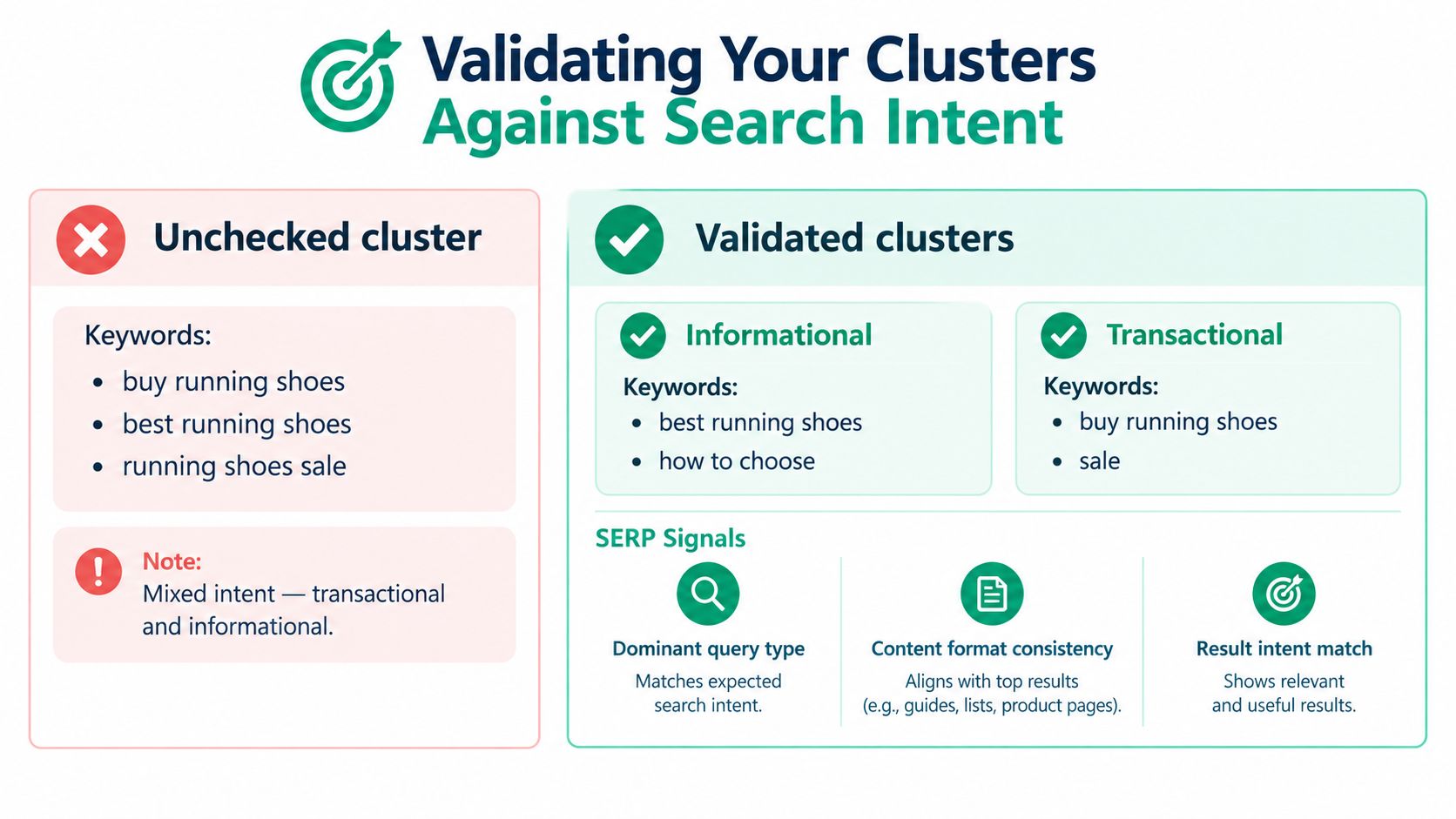
That creates a planning trap. You may target “emergency plumber,” “plumber near me,” and “24-hour plumbing repair” as three separate opportunities because the words differ. Or you may force “buy running shoes,” “best running shoes,” and “running shoes sale” onto one page because they share the same product phrase.
Both choices can be wrong.
The first approach creates unnecessary pages that compete with one another. The second creates a page with too many jobs. It tries to educate, compare, and sell at the same time, leaving visitors unsure what to do next.
Practical rule: A keyword belongs on the same page as another keyword only when the same page can answer both searches naturally and helpfully.
Semantic keyword grouping is the discipline of organizing terms around their meaning, entity, audience, and search intent, not just their spelling. It helps you see that several phrases may describe one topic while still revealing different needs inside that topic.
From rows to page decisions
A useful group should answer a business question:
- What does the searcher want?
- Which page format would satisfy that need?
- Is the person learning, comparing, finding a local provider, or ready to buy?
- Can one URL serve the dominant need without weakening another page?
That last question matters most. Clustering software can suggest relationships, but it can't decide whether a service page should share a URL with a buying guide. You need evidence from the search results and from your customers.
The workflow becomes much clearer once you separate discovery from validation. First, gather related terms. Then test whether they belong to one page. That small distinction prevents a large amount of wasted writing.
How Search Engines Stopped Matching Words and Started Understanding Meaning
For years, SEO planning often revolved around exact phrases. A page targeted one keyword, used that phrase in prominent locations, and tried to repeat it often enough to signal relevance. That model became less useful as search engines improved their ability to interpret natural language.
Google publicly announced the Hummingbird update on September 26, 2013, after it had already been operating for roughly one month. The update emphasized natural-language queries, context, and relationships among words rather than evaluating every term in isolation. Contemporary summaries reported that it affected roughly 90% of Google searches worldwide, a figure presented as an industry report rather than an independently verified measurement. The historical details are summarized in this overview of Google Hummingbird.
The practical change was easy to see. Someone searching “how do I fix a leaking tap” and someone searching “leaky faucet repair” may use different wording while describing a closely related problem. A useful page doesn't need to force both phrases into awkward sentences. It needs to explain the repair clearly, use relevant language naturally, and address the underlying need.
The topic became more important than the string
This shift changed content planning. Exact-match targeting treated each phrase as a separate target. Meaning-based evaluation made it possible for one strong page to appear for variations and longer queries that expressed the same concept.
That doesn't mean every related phrase belongs together. It means the planning unit should begin with the topic and the searcher's problem, then narrow according to intent and page purpose.
For example, an accounting software guide might cover “best accounting software,” “small-business bookkeeping tools,” and “online invoicing software” if research shows that the same audience wants help evaluating tools. A pricing page may still deserve a separate URL if the searcher wants plans, costs, or a purchase path rather than general guidance.
Search engines understand relationships, but your content still needs to make those relationships useful to a person.
Semantic keyword grouping is the planning response to this change. You organize related vocabulary around subjects, entities, needs, and decision stages. The result is a site structure that reflects how people ask questions, not how a keyword export happens to arrange rows.
What Semantic Keyword Grouping Actually Means
Think of a librarian handling a large collection of books. The librarian wouldn't create a new shelf for every different way someone asks about the same subject. Books about emergency plumbing might sit together, while a homeowner's repair manual, a local contractor directory, and a plumbing equipment catalog would still occupy different sections because they serve different purposes.
Semantic keyword grouping works in a similar way. It organizes search terms by shared meaning, entity, and intent rather than by literal word overlap. The terms don't need to contain the same words, but they must describe a sufficiently similar need for one page to serve them well.
One service, several search situations
Consider a local plumbing company:
- “Emergency plumber” suggests urgency and a service need.
- “Plumber near me” suggests local discovery.
- “24-hour plumbing repair” combines availability, urgency, and repair intent.
These phrases can belong to a broader plumbing-service concept. But the differences still matter. A local landing page might need location details, service coverage, phone access, opening information, and a clear booking action. A helpful article about handling a burst pipe may serve someone who needs immediate guidance before choosing a provider.
Grouping identifies the relationship. Validation decides whether the relationship is strong enough for one URL.
People express one need in many ways because they have different vocabulary, levels of knowledge, devices, locations, and urgency. The same phrase can also represent different needs depending on context. “Accounting software” might lead to an educational comparison, a product category, or a branded navigation search.
A study of Web search behavior found that more than 80% of queries were informational, with approximately 10% navigational and 10% transactional. It also reported that roughly 25% of queries were vague or multifaceted, which means a simple one-to-one keyword match often can't capture what the searcher means. The findings are available in research on user intent in Web search.
Meaning can travel across markets
The same principle helps international teams. A service concept can remain stable when wording, spelling, and query length change between languages. You may need separate pages for different countries, currencies, regulations, or local services, but the underlying semantic map can guide your research.
And translation alone isn't enough. A phrase that appears equivalent may carry a different commercial expectation in another market. Check local search results, local terminology, and local customer behavior before merging international terms into one content plan.
How to Group Keywords Step by Step
A practical grouping workflow has two broad stages. First, represent each query by its meaning. Then cluster queries whose representations are sufficiently similar. In plain language, you're trying to compare what searches mean, not just which words they share.
A peer-reviewed search-engine study used word2vec-derived query2vec representations followed by Divide-and-Merge Clustering. This approach captured contextual similarity, avoided requiring a fixed number of groups, and remained computationally lightweight. The technical method is described in the search-engine clustering study.
Start with a clean source list
Export your keywords into a working sheet. Keep the original phrase, source, country, language, landing-page idea, and any available intent notes. Remove obvious duplicates, but don't delete variations too early. Wording differences may reveal useful audience or decision-stage differences.
For a small list, add a manual topic column. For a larger list, use a clustering tool, embedding workflow, or API to create an initial grouping. Automation is helpful for sorting large volumes. It isn't a substitute for editorial judgment.
Let meaning create the first draft
Use a running example:
- “best running shoes”
- “top shoes for jogging”
- “running shoe recommendations”
These phrases may express a comparable information need. A semantic system can place them in one preliminary cluster even though the wording isn't identical.
Next, inspect the surrounding terms. “Running shoes for flat feet” may need a more specific audience and recommendation angle. “Buy running shoes” points toward a transactional page. “Running shoes sale” may require category, inventory, price, and promotional information.
The first grouping pass should be generous enough to reveal patterns. The second pass should be strict enough to protect page purpose.
Build the workflow around a decision column
Add fields that turn clusters into publishing decisions:
- Cluster label: Use a plain description such as “running shoe recommendations.”
- Dominant intent: Mark the group informational, commercial, transactional, or navigational.
- Primary audience: Note who needs the page.
- Suggested format: Choose a guide, comparison, category page, local landing page, or product page.
- Candidate URL: Record an existing page or a new page opportunity.
- Validation status: Mark the group as accepted, split, merged, or requiring review.
For a small list, spreadsheet-based grouping is often enough. Larger sites can use dedicated clustering tools and APIs for the first pass, then have an SEO specialist review the output. A structured SEO content strategy helps turn those decisions into briefs, internal links, and publishing priorities.
Don't assign URLs just because an algorithm produced a neat group. Open the search results for representative terms, compare the page types, and ask whether one page would leave each searcher satisfied. That validation step turns a technically similar set of phrases into a defensible content plan.
Validating Your Clusters Against Search Intent
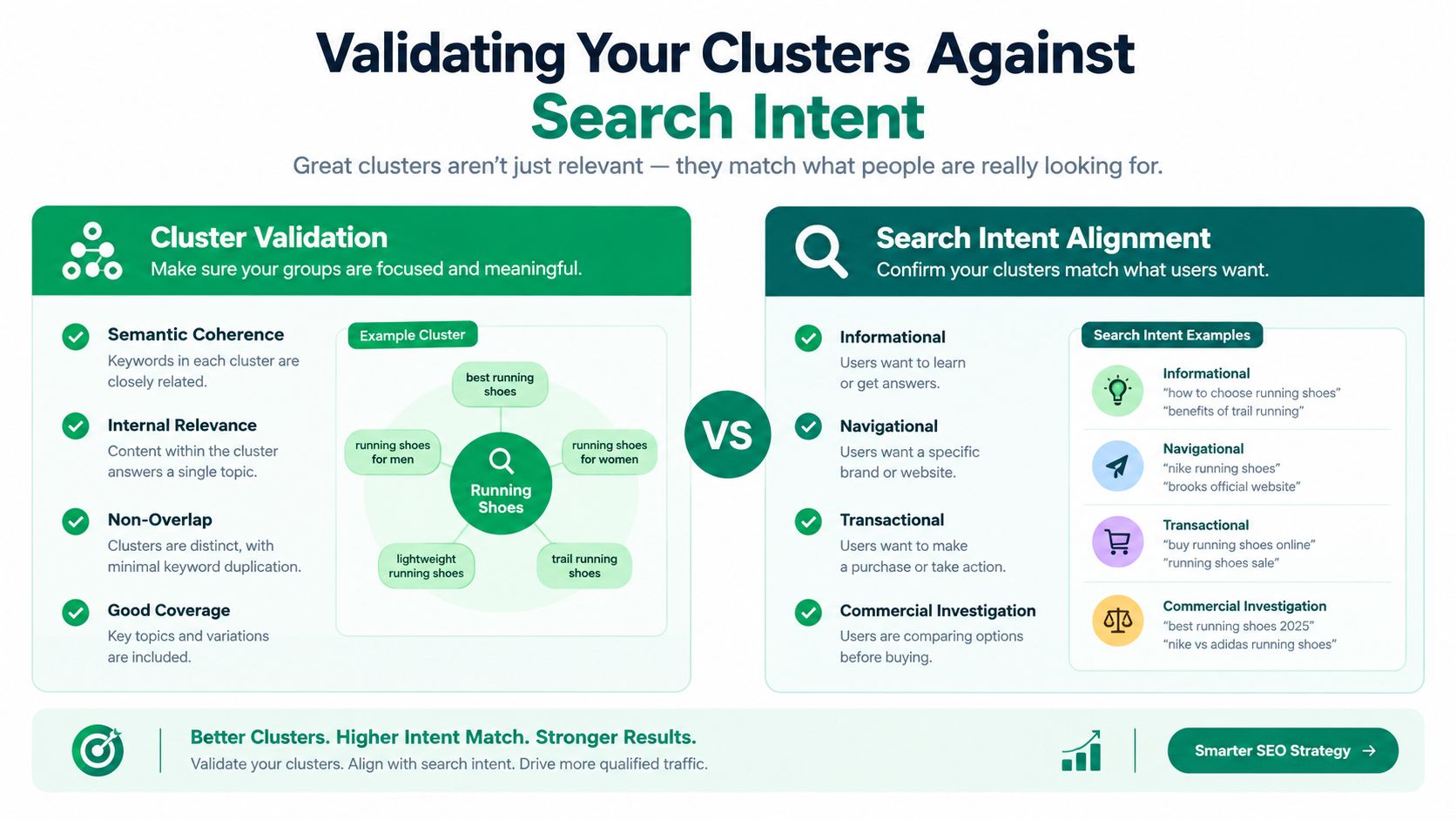
A cluster can be mathematically coherent and still be strategically wrong. “Best running shoes” and “buy running shoes” are closely connected by topic, but one usually calls for evaluation help while the other points toward a shopping action. A single page might mention both, yet it may not serve either need as effectively as a focused guide and a focused category page.
Search-result analysis gives you evidence that word similarity can't provide. Look at the dominant result types, visible SERP features, page formats, and the likely stage of the decision process. If most results are detailed guides, the cluster may be informational. If category pages, product listings, and purchase paths dominate, the cluster may be transactional.
Use a repeatable review sequence
Work through each candidate cluster in the same order:
- Collect SERP evidence: Review representative searches and record the dominant result formats.
- Assign a provisional label: Use informational, commercial, transactional, or navigational.
- Compare audiences: Check whether the searches come from the same kind of person.
- Check the action: Decide whether the page should teach, compare, locate, contact, or sell.
- Review borderline terms manually: Don't let an automated label settle an ambiguous group.
- Map the URL: Choose one page only when it can satisfy the dominant intent without competing with another page.
An SEO-focused query-intent study used features extracted from Google results and K-means clustering. It correctly predicted 94% of informational queries, showing how SERP-derived features can improve intent classification beyond lexical grouping. The methodology is documented in the query-intent classification study.
Similarity starts the conversation
Suppose your cluster contains “best accounting software,” “small-business bookkeeping tools,” and “online invoicing software.” The terms may share a commercial research theme, but you still need to inspect the results. If one term produces software comparisons and another produces invoicing product pages, one article may not be the right answer for both.
Use a split when terms require different formats, different calls to action, or different evidence. Merge only when a single page can cover the shared need without burying the answer for one segment.
The same logic applies to featured results. A page built for a concise definition may not satisfy a comparison query that needs product distinctions, selection criteria, and a next step. Featured snippet optimization can support the format decision, but the cluster still needs an intent review first.
When to Keep Closely Related Keywords Separate
Aggressive consolidation sounds efficient. Fewer URLs can mean less production work, simpler maintenance, and less risk of publishing near-duplicates. But consolidation becomes harmful when it treats semantic closeness as proof that searchers want the same page.
A topic such as “running shoes” can contain educational, comparison, pricing, local-service, and marketplace-buying needs. A guide about choosing shoes shouldn't become a product category page just because both pages mention the same entity. If you combine them, the guide may lack shopping depth while the category page becomes overloaded with educational content.
Test the evidence before merging
Before placing two candidate groups on one URL, compare:
- Dominant result type: Are guides, local pages, category pages, product pages, or reviews appearing?
- Audience: Is the searcher a beginner, professional buyer, local customer, or existing customer?
- Funnel stage: Is the person learning, evaluating, locating, or purchasing?
- Geography: Does the query depend on a city, service area, country, or local availability?
- Product specificity: Does one term refer to a broad category while another names a model, use case, or feature?
- Conversion action: Should the visitor read, compare, call, request a quote, or complete a purchase?
If several answers differ, keep the groups separate until stronger evidence supports a merger.
Search behavior can also change the balance between informational and commercial opportunities. An analysis of more than 10 million keywords reported that AI Overviews shifted from 91.3% informational queries in January 2025 to 57.1% by October, while commercial and transactional queries grew substantially. The analysis is available in Semrush's AI Overviews study.
Avoid turning a cluster into stuffing
Google defines keyword stuffing as filling a page with keywords or numbers to manipulate rankings. Related phrases are not automatically safe to place together, especially when they create awkward repetition or unrelated sections.
Google's guidance does not set a universal keyword-density target. Natural language and contextual fit matter more than repeating every variation. If adding a phrase forces you to create a strange sentence or a disconnected paragraph, the group may be too broad.
The question competitors avoid is simple: what evidence proves one page can satisfy this cluster without sacrificing qualified leads or sales?
Grouping Keywords for AI Answers and Zero-Click Search
Search visibility no longer means only earning a click from a traditional result. AI Overviews and other answer interfaces can summarize information, cite sources, mention brands, and answer part of a question before the searcher visits a website.
Pew Research Center found that 58% of surveyed U.S. adults saw an AI-generated summary in at least one Google search during March 2025. On pages with an AI Overview, users clicked a traditional result 8% of the time, compared with 15% without one, while links inside the summaries were clicked in about 1% of visits. The findings appear in Pew Research Center's analysis of Google users and AI summaries.
That changes the question behind a cluster. You still need to know which page can rank, but you should also ask which concepts require clear evidence, which answer format fits the prompt, and which entities should be associated with your brand.
Add an AI-era measurement layer
A useful cluster record can include:
- Answer format: Definition, steps, comparison, local recommendation, product facts, or troubleshooting.
- Evidence need: First-hand experience, specifications, pricing, policy information, or local details.
- Entity relationship: Your brand, service, product, location, or subject-matter expert.
- Visibility signal: Traditional ranking, brand mention, citation, or inclusion in an answer.
- Business outcome: Assisted conversion, direct visit, phone call, form submission, or marketplace sale.
This approach prevents a narrow click-only judgment. A cluster may produce fewer visits while influencing a decision through a summary, a brand mention, or a later direct visit. That doesn't make every non-click impression valuable, but it gives you a more complete way to investigate what happened.
For a small business, start with a manageable review. Track the pages assigned to high-priority clusters, compare branded search and direct inquiries, and note whether customers mention seeing your business in an answer. Keep the interpretation cautious. Attribution is harder when the searcher doesn't click.
You should also expect volatility. AI features appear differently across queries and can change their coverage over time. Review important clusters periodically instead of treating the original grouping as permanent. AI search optimization guidance can sit alongside traditional SEO, but it shouldn't replace intent validation or business measurement.
Best Practices for Semantic Keyword Grouping
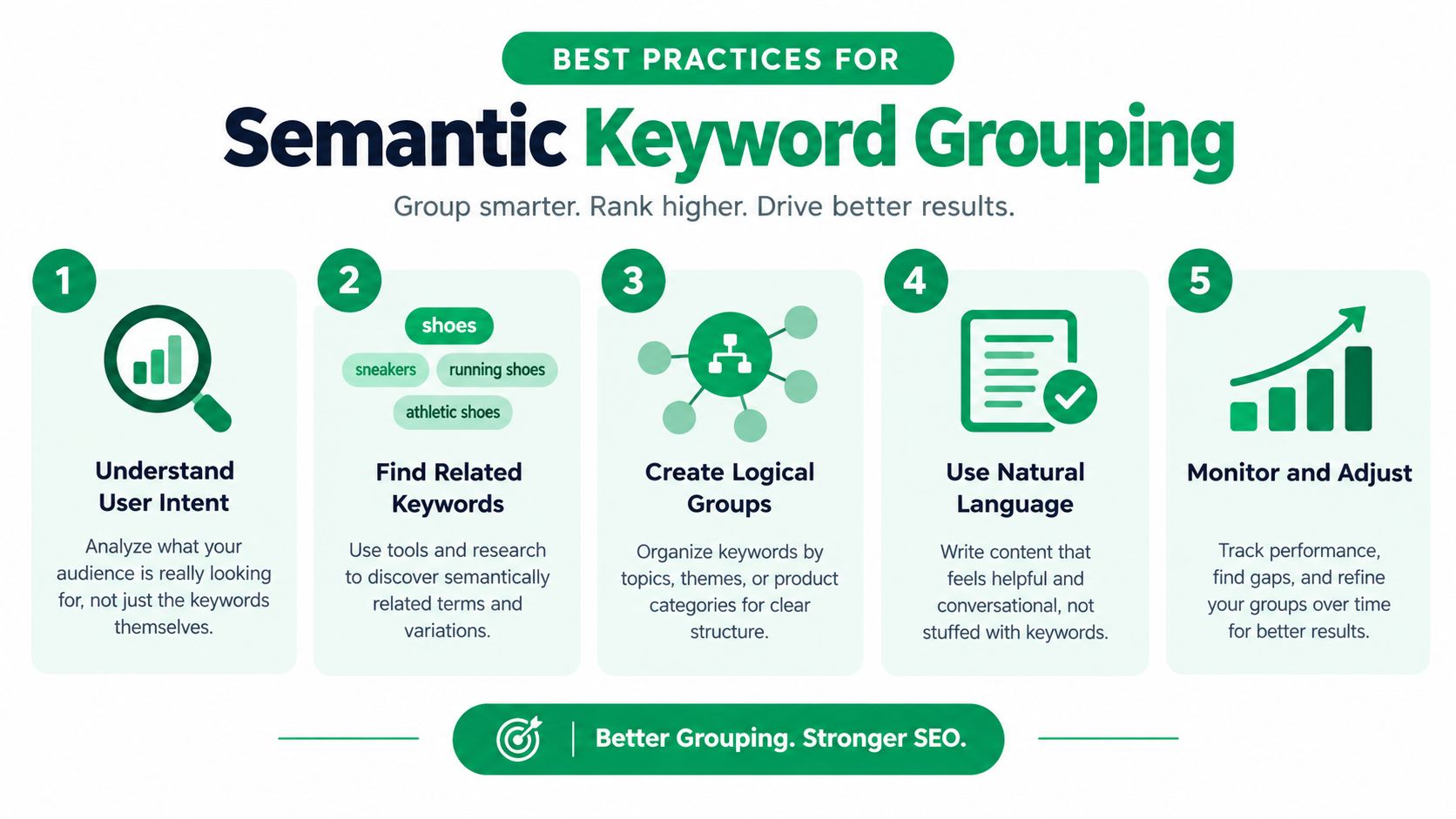
A useful grouping workflow combines automation, SERP evidence, editorial judgment, and business context. Use this checklist to test whether related terms belong on one page or need separate treatment:
-
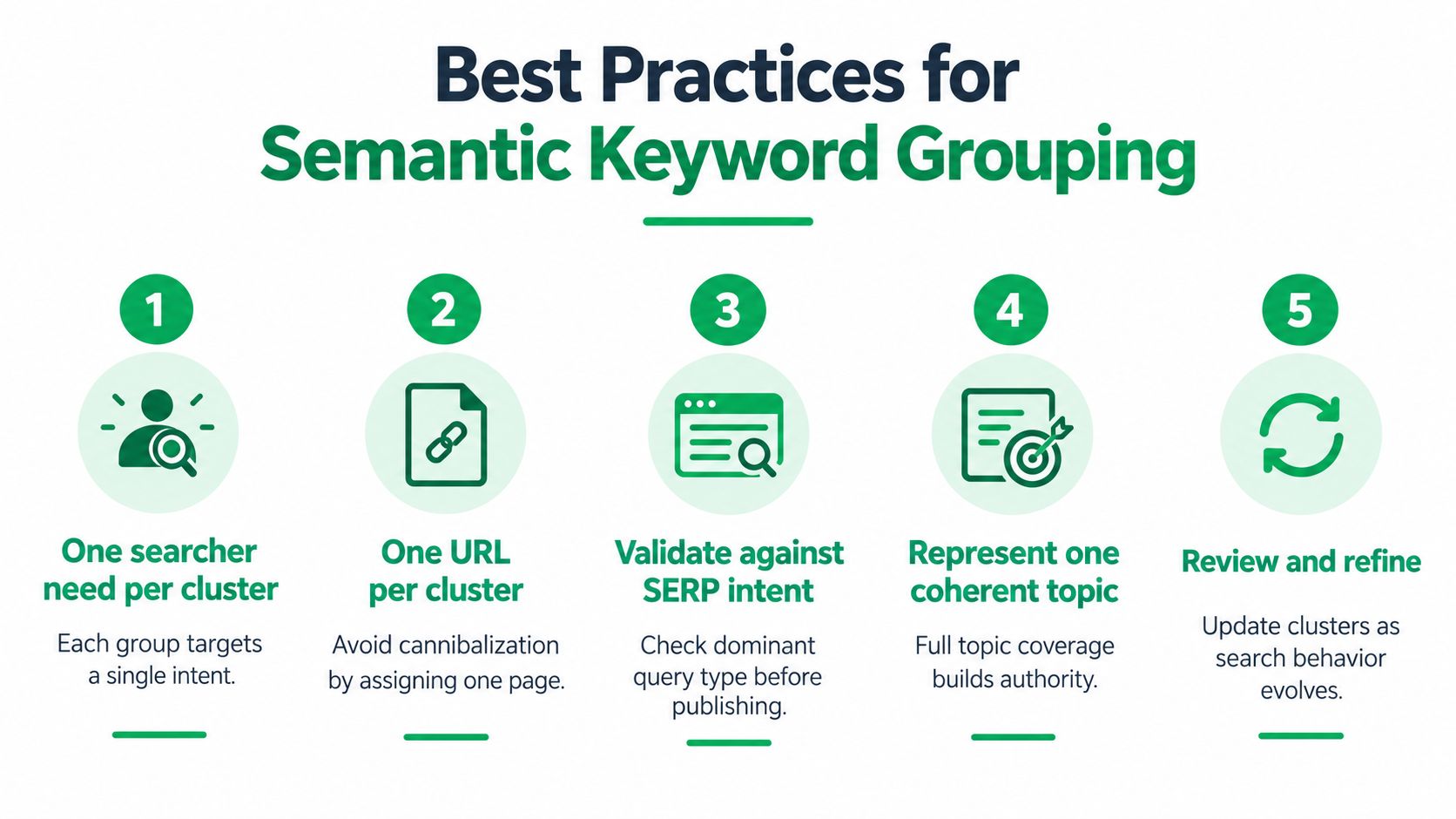
Represent one coherent searcher need per cluster.
A cluster should describe one recognizable problem or decision. “How to choose running shoes” and “buy running shoes” concern the same product, but their page purposes may differ. -
Assign one URL to the dominant intent.
One page can rank for many variations, yet each cluster needs a clear home. This limits competing pages and gives writers a focused brief. -
Validate against the SERP before merging.
Compare result types, features, audiences, geography, and calls to action. Similar wording is only a starting point. If the results serve different needs, split the cluster or mark it for review. -
Use natural language instead of chasing repetition.
Include a term when it helps the reader, not because a spreadsheet demands it. For practical guidance, see how to add keywords to a website naturally. Google's guidance on creating helpful, people-first content focuses on identifiable audiences, first-hand expertise, useful answers, and a clear purpose beyond attracting search traffic. -
Make list content genuinely useful.
A listicle can organize comparisons, steps, or recommendations, but every item should serve a related intent. Google's Article structured-data documentation explains how structured data can help Google understand article content and may support richer appearances. It does not guarantee rankings or justify thin pages assembled from disconnected variants. -
Review clusters as search behavior changes.
New products, services, locations, competitors, and answer formats can alter the evidence. Recheck priority groups when your market or search results change. And measure more than clicks when AI answers or zero-click results affect visibility.
Choose one promising group, inspect its representative SERPs, then assign a URL or commission content. Mr. Green Marketing, LLC applies automated grouping with expert verification and maps validated terms to pages by intent, including services, locations, attributes, and actions.
Mr. Green Marketing, LLC can audit keyword groups, validate SERP intent, and turn the findings into an SEO and AI-search content plan. Request a free audit and performance report from Mr. Green Marketing, LLC to identify visibility gaps and practical next steps.
Leave a Comment
sing in to post your comment or sign-up if you dont have any account.