
Marketplace Growth Strategies: More ad spend is the most popular answer to marketplace growth, and it’s often the wrong first move. Paid traffic can send more shoppers to a weak listing, an overpriced SKU, or a product that will soon go out of stock. Sustainable marketplace growth strategies align product pages, demand generation, pricing, availability, trust, retention, channel expansion, and measurement into one operating system.
The opportunity is large. Global e-commerce reached an estimated USD 33.9 trillion in 2025 and is projected to reach USD 155.98 trillion by 2033, with a projected 21.6% CAGR from 2026 to 2033, according to Grand View Research’s e-commerce market analysis. But scale also raises the standard. The strongest gains usually come from improving conversion and unit economics before increasing traffic.
The strategies below follow that order. Start with the product page, then build trust, pricing discipline, inventory control, profitable advertising, channel diversification, retention, and a repeatable testing loop. Mr. Green Marketing can support that process with a marketplace audit, performance report, or customized growth plan.
Marketplace Growth Strategies: Table of Contents
- 1. Optimize Your Marketplace Listings with Strategic Keywords and Enhanced Content
- 2. Leverage Paid Marketplace Advertising to Accelerate Visibility and Revenue
- 3. Build Social Proof and Leverage Reviews to Drive Buyer Confidence
- 4. Implement Cross-Selling and Upselling Strategies to Increase Average Order Value
- 5. Expand to Multiple Marketplaces to Diversify Sales and Reduce Platform Risk
- 6. Create Branded Content and Storytelling to Build Emotional Connection and Loyalty
- 7. Optimize for Mobile and Marketplace-Specific User Experience
- 8. Master Pricing Strategy with Dynamic Pricing and Competitive Intelligence Tools
- 9. Build Customer Retention Programs and Email Marketing to Maximize Lifetime Value
- 10. Launch Strategic Partnerships and Affiliate Programs to Expand Reach and Sales Channels
- 11. Protect Marketplace Growth with Inventory Planning and Availability
- 12. Measure Marketplace Performance with a Unified Profitability Dashboard
- 12-Point Marketplace Growth Strategy Comparison
- Turn the Ten Strategies into a Repeatable Growth Loop
1. Marketplace Growth Strategies: Optimize Your Marketplace Listings with Strategic Keywords and Enhanced Content
Your listing is the sales page, search result, comparison tool, and first impression rolled into one. On Amazon, Walmart, eBay, Etsy, and other platforms, shoppers often decide whether to investigate further within seconds. Strong marketplace listing optimization starts with the language buyers already use, then turns that language into clear reasons to purchase.
Use marketplace autocomplete, search-result analysis, customer questions, and competitor reviews to build a keyword set. Place the primary phrase naturally in the title, then use long-tail variations in bullets, descriptions, backend fields, and enhanced content. Don’t write for an algorithm at the expense of a buyer. “Stainless steel travel mug” earns attention, but “keeps coffee secure during a daily commute” explains the benefit.
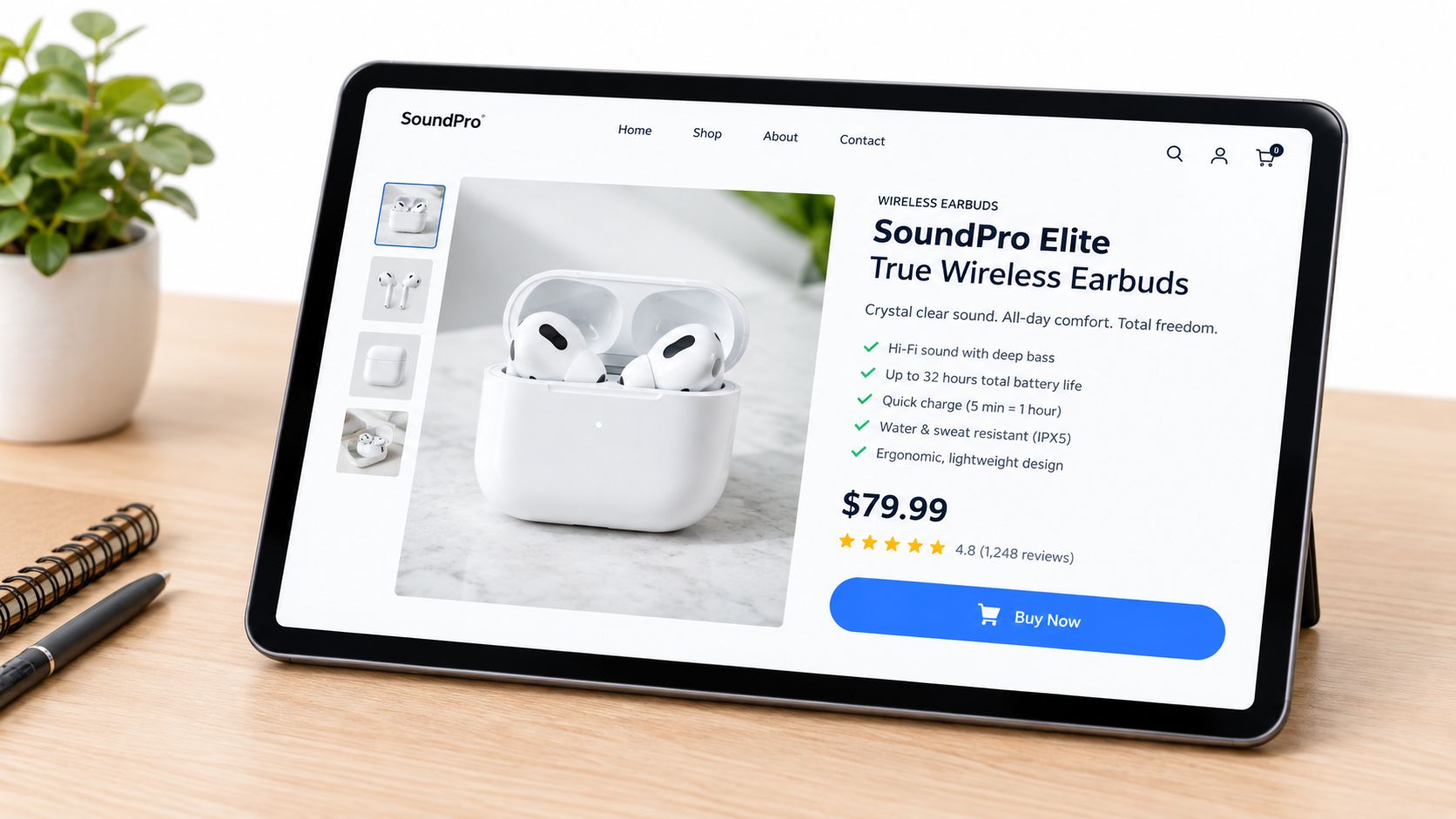
Build a page that answers objections
Use images to show scale, fit, setup, ingredients, compatibility, or what arrives in the box. Enhanced content should clarify the decision, not repeat the title in larger type. Review the top competing listings for missing information, then answer those questions more directly in your own page.
For a deeper process, see this guide to Amazon product listing optimization. Track impressions, clicks, conversion, returns, and customer questions after every meaningful update. A keyword change that raises visibility but lowers conversion isn’t a win.
2. Marketplace Growth Strategies: Leverage Paid Marketplace Advertising to Accelerate Visibility and Revenue
Organic visibility takes time, especially in crowded categories. Sponsored Products, Etsy Ads, eBay Promoted Listings, Walmart Connect, and similar tools can place a product in front of shoppers who are already searching. But advertising should amplify a sound offer, not compensate for poor merchandising.
Start by separating campaigns by SKU, intent, and margin. Automatic campaigns can reveal search terms, while manual campaigns give you control over bids and budgets. Move converting terms into focused campaigns, add irrelevant queries as negatives, and review spend against contribution margin rather than revenue alone.
Practical rule: Never scale a campaign simply because it generates sales. Scale it when the sales remain profitable after product cost, marketplace fees, fulfillment, returns, and advertising.
Amazon sellers also need to account for fee pressure. Amazon said its 2026 U.S. referral and FBA changes would begin on January 15, 2026, with average FBA fees rising by about USD 0.08 per unit, described by Amazon as less than 0.5% of an average item’s selling price, as reported by Searchlab’s marketplace statistics coverage. Those costs belong in campaign decisions.
Use Amazon advertising campaign management to structure testing, but keep the operating principle simple. Ads should create discoverability, improve sales velocity, and eventually support stronger organic placement. They shouldn’t hide a broken unit-economics model.
3. Marketplace Growth Strategies: Build Social Proof and Leverage Reviews to Drive Buyer Confidence
Reviews do more than decorate a product page. They reduce uncertainty about quality, fit, durability, packaging, delivery, and support. A customer comparing two similar products often looks for evidence from people who have already taken the risk.
Ask for feedback through approved marketplace workflows and post-purchase messages. Make the request specific and easy to understand, but never offer compensation for a positive review or attempt to influence the rating. Monitor recurring complaints by SKU. If several buyers mention confusing instructions, a weak image, or a missing accessory, fix the product experience instead of merely answering each complaint.

Turn feedback into operating data
Respond professionally to negative reviews, acknowledge the specific issue, and explain the remedy where appropriate. Positive reviews can inform new bullets, comparison charts, and customer questions. With permission and within platform rules, customer photos can also strengthen branded content outside the marketplace.
Enterprise marketplace sellers show the commercial value of a dependable post-purchase operation. Mirakl’s report recorded 93.2% seller retention and 164% GMV retention year over year, while 47% of sellers were active across multiple marketplaces, according to SaleHoo’s report summary. Reviews are one part of that system, alongside fulfillment and service.
Use this practical resource on getting more reviews on Amazon. The objective isn’t a perfect-looking page. It’s a product experience that earns credible advocacy.
4. Marketplace Growth Strategies: Implement Cross-Selling and Upselling Strategies to Increase Average Order Value
A marketplace buyer may need more than the item they first searched for. A camera buyer may need a memory card. A shoe buyer may need care products. A business purchasing labels may also need compatible rolls. Relevant recommendations make the purchase easier, while random recommendations create friction.
Begin with actual order data. Look for products that appear together, accessories purchased shortly after the main item, and premium versions chosen by customers with particular needs. Present complementary products before checkout when the context is clear. Bundles can also move slower inventory, but the discount must preserve contribution margin.
Match the offer to the buying moment
Use “frequently bought together” placements, marketplace bundles, variation families, and comparison modules where the platform supports them. A premium upsell should explain the additional value, such as higher capacity, stronger materials, longer coverage, or a more complete configuration. Don’t force a larger order when the basic product already solves the customer’s problem.
Test one recommendation at a time and measure attach rate, average order value, margin, returns, and customer satisfaction. A bundle that raises revenue but increases returns may damage the account. The best cross-sell feels like helpful preparation, not a sales ambush.
For a practical scenario, a wireless-earbud seller could pair the core product with a protective case, then compare standard and premium versions by battery needs. That creates a clearer choice without burying the original offer.
5. Marketplace Growth Strategies: Expand to Multiple Marketplaces to Diversify Sales and Reduce Platform Risk
A single marketplace can provide reach, but it also creates dependency. Policy changes, ranking shifts, fee increases, account restrictions, or a sudden category slowdown can affect the entire business when every order comes from one channel.
Marketplaces have become central to online retail discovery. In 2023, they were the main starting point for product searches worldwide, with roughly three in ten online shoppers using them first. In 2024, marketplaces captured 67% of business-to-consumer online retail spending, according to Trade.gov’s e-commerce sales and forecast overview.
That doesn’t mean every seller should open five storefronts next week.
Expand when the operation can support it
Choose the next channel based on product fit, customer behavior, fulfillment requirements, and margin. Amazon may suit standardized, high-demand products. Etsy can suit distinctive handmade or design-led goods. Walmart may offer access to a different shopper base. Shopify can support a direct customer relationship, but it also requires more responsibility for traffic and conversion.
Centralize inventory and order data before expansion. Then localize each listing instead of copying an Amazon page into eBay or Walmart. Each channel has different title conventions, image expectations, search behavior, fees, and promotional mechanics.
A seller with excess inventory might use another marketplace to improve sell-through, but discounting without a channel-level profit view can just move losses around. Diversification works when each channel earns a defined role.

6. Marketplace Growth Strategies: Create Branded Content and Storytelling to Build Emotional Connection and Loyalty
A marketplace listing answers, “What is this product?” Branded content answers, “Why should I choose this business?” That distinction matters when competitors sell similar products at similar prices.
Show the product in use. Explain its origin, design decisions, materials, sourcing, founder perspective, or intended customer. A reusable bottle brand might focus on everyday routines and durability. A specialty food seller could explain ingredients and preparation. A maker can show the process behind the finished item.
Choose one channel and make it useful
You don’t need to publish everywhere. Select Instagram, YouTube, email, a blog, or another channel that matches how customers research the category. Batch related content so the team can maintain a consistent rhythm without turning marketing into daily improvisation.
Customer stories and user-generated content help keep the message grounded. Avoid inflated claims that the product can’t prove. A clear demonstration, comparison, or tutorial usually builds more confidence than a string of vague superlatives.
Branded content also supports marketplace performance indirectly. It can send qualified shoppers to a listing, explain a premium price, reduce repetitive support questions, and create reasons for an existing customer to return. Link to the relevant marketplace page where platform rules permit it, and keep attribution clear.
A strong example is a skincare seller publishing a routine guide that explains product order, use cases, and compatibility. The content can introduce a product family instead of pushing one isolated SKU.
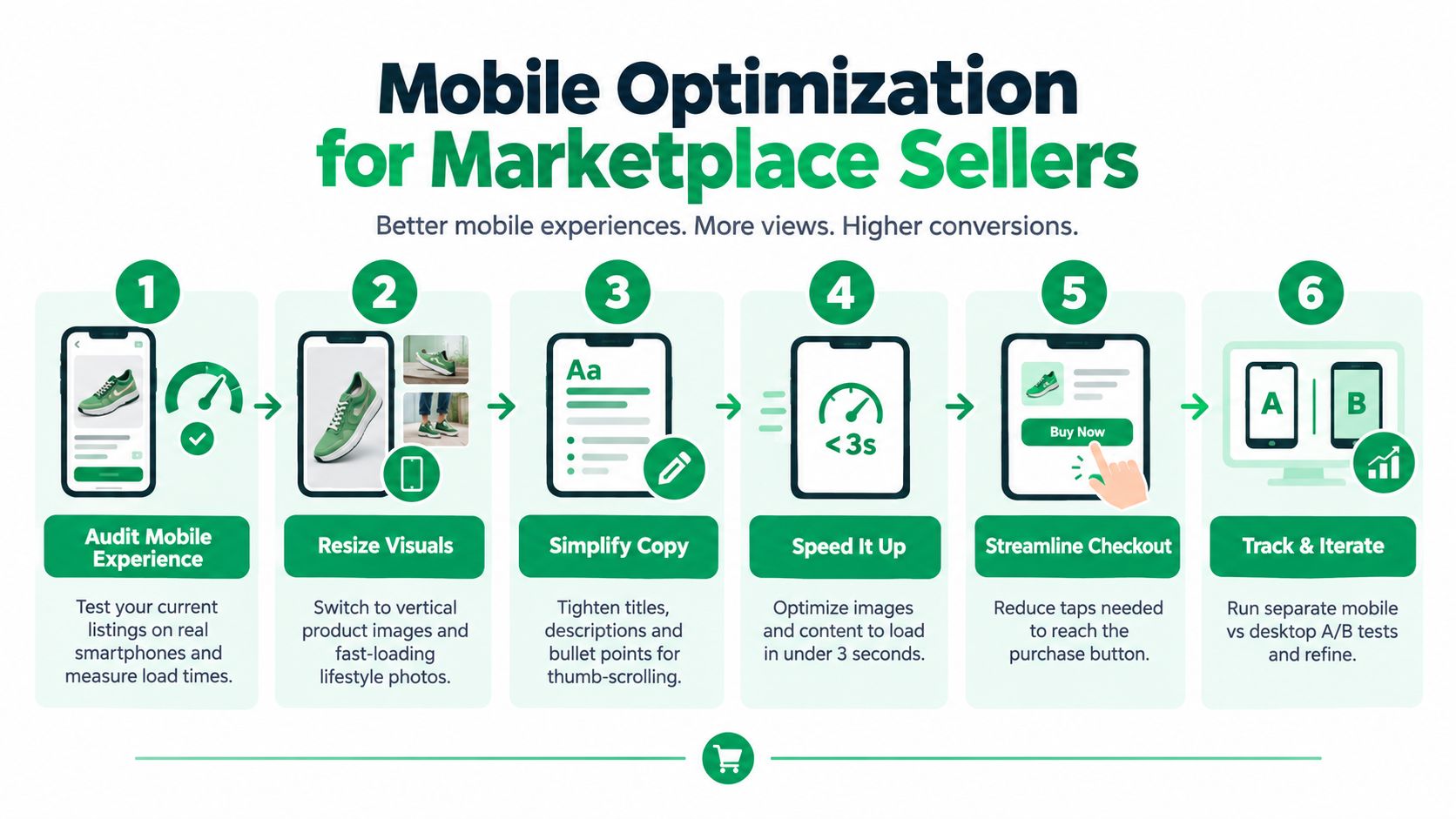
7. Marketplace Growth Strategies: Optimize for Mobile and Marketplace-Specific User Experience
Mobile shoppers read, compare, and buy under tighter constraints. A truncated title, unreadable image, confusing variation, or lengthy checkout can stop a purchase before demand generation has any effect. Treat the product page as the first part of a marketplace operating system, then connect mobile usability with trust, margin, inventory, retention, and measurement across Amazon, Walmart, and other channels.
In 2025, smartphones represented 72.67% of device share in global e-commerce, and Asia-Pacific accounted for 54.46% of global e-commerce revenue, according to Grand View Research. Sellers expanding internationally should account for regional shopping habits and platform preferences when choosing images, copy, delivery information, and testing priorities.
Test the actual buying journey
Open the listing on several physical phones. Check image clarity, title truncation, variation selectors, delivery details, reviews, and checkout steps. Use portrait-friendly compositions when they explain the product better, while keeping the item and its use immediately clear.
The same discipline applies to owned storefronts. Guidance on optimizing a mobile website can help when marketplace traffic later moves to a direct channel.
Change one element at a time, such as the hero image, variation name, or opening bullet. Compare mobile and desktop results separately when the platform provides that data. A page that works with a cursor may still be awkward with one thumb. Record the result, then feed the learning into the next listing, campaign, and inventory test.
8. Marketplace Growth Strategies: Master Pricing Strategy with Dynamic Pricing and Competitive Intelligence Tools
Pricing is the control point between demand and profit. A lower price can lift orders while weakening contribution margin. A higher price can improve unit economics while slowing volume. Set prices with product differentiation, inventory, marketplace fees, advertising, returns, and nearby alternatives in view.
Independent reporting places Amazon referral fees across categories between 6% and 45%, with a median around 15%. Fulfillment, advertising, and returns can bring total cost of sale to 30% to 40% of revenue, according to SupplyKick’s 2026 marketplace trends report. Build those costs into every SKU’s price model before changing the offer.
Reprice within clear boundaries
Competitive intelligence and repricing tools should reveal patterns, not trigger automatic reactions to every competitor move. Set minimum and maximum prices, protect premium SKUs from unnecessary discounting, and create separate rules for launches, replenishable products, and clearance inventory.
Some sellers spend 60% to 70% of revenue on Amazon after referral fees, FBA fulfillment, and advertising, while competitive Sponsored Products categories may show CPCs around USD 1.20 to USD 1.80, as reported by World Metrics. The 30% to 40% figure reflects a typical blended cost of sale. The 60% to 70% figure describes high-fee, high-ad-spend cases. Model each SKU before assuming either applies.
Test price changes on differentiated products first. Track conversion, profit per order, sales velocity, and customer feedback across Amazon, Walmart, and other active channels. Feed the results into the next pricing, advertising, and inventory test. Winning the Buy Box while destroying margin is not growth.
9. Marketplace Growth Strategies: Build Customer Retention Programs and Email Marketing to Maximize Lifetime Value
Marketplace growth becomes more efficient when buyers return. Retention starts with the product experience, then continues through replenishment reminders, education, relevant recommendations, and support. It doesn’t mean collecting customer information in ways that violate marketplace rules.
Use permitted packaging inserts, brand registration tools, follow-up features, and an owned site where appropriate. Make the next purchase useful. A coffee seller can send preparation guidance and replenishment prompts through an approved channel. A software marketplace can help customers understand a new feature before presenting an upgrade.
Segment by behavior, not guesswork
Separate first-time buyers from repeat customers, high-return customers from loyal customers, and accessory buyers from premium-product buyers. Send different messages to each group. Someone who purchased a replacement part needs a different reminder from someone who bought a gift.
Retention programs can include loyalty benefits, subscriptions, educational content, product registration, and service reminders. The right mix depends on purchase frequency and category economics. A durable product may need post-purchase support rather than frequent promotional email.
Measure repeat purchase behavior, time between orders, unsubscribe rates, margin from returning customers, and the effect of each message. Don’t optimize for opens alone. A campaign that generates attention without profitable repeat orders is only a partial result.
10. Marketplace Growth Strategies: Launch Strategic Partnerships and Affiliate Programs to Expand Reach and Sales Channels
Partnerships let a seller borrow relevant distribution without building every audience alone. The strongest partners already serve the same customer with a complementary product, service, publication, community, or creator platform.
A meal-preparation brand could work with kitchen educators. A cycling-accessory seller could partner with local clubs or route-planning publishers. A business software vendor could coordinate with implementation consultants. The partnership should give the audience a reason to act, not merely place another logo on a page.
Manage partners like a performance channel
Give partners approved product information, creative assets, landing-page guidance, and disclosure requirements. Track traffic, conversion, average order value, returns, and contribution margin by partner. Use unique links or codes so the team can distinguish genuine demand from unattributed sales.
Affiliates can produce fast reach, but low-quality placements may bring coupon hunters, duplicate paid traffic, or customers with poor retention. Set clear commission rules and protect brand terms. Pay accurately and on time, because operational reliability affects partner commitment.
Start with a small group of well-matched partners rather than accepting every applicant. Review performance on a fixed cadence, improve the offer where the economics support it, and pause placements that generate activity without profitable customers.
A good partner doesn’t just send clicks. They explain why the product belongs in the buyer’s life.
11. Marketplace Growth Strategies: Protect Marketplace Growth with Inventory Planning and Availability
A product can rank well, attract reviews, and convert efficiently, then lose momentum because it goes out of stock. Inventory planning belongs inside the growth plan, not in a separate operations spreadsheet.
Set reorder points by SKU using sales velocity, supplier lead time, fulfillment capacity, and a safety-stock rule. Connect the forecast to advertising calendars and promotions. If a campaign will exhaust available inventory before replenishment arrives, reduce spend or redirect demand to a suitable alternative.
Give every channel a supply rule
Separate launch inventory from replenishment inventory so early demand doesn’t hide a future shortage. Before adding Walmart, eBay, Etsy, or another channel, synchronize available quantities and reserve inventory where needed. Overselling creates cancellations, late shipments, poor reviews, and avoidable support work.
When supply is constrained, protect high-margin and strategically important products first. Don’t use blanket discounts to clear every SKU if some products are needed for bundles or repeat purchases. Adjust campaign targets and customer expectations alongside stock levels.
Review availability in the same weekly meeting as conversion, advertising efficiency, and margin. A winning product that cannot ship is not currently a growth asset. It’s a forecast problem requiring an operational decision.
12. Marketplace Growth Strategies: Measure Marketplace Performance with a Unified Profitability Dashboard
Revenue is an incomplete measure of marketplace health. A product can grow sales while losing money through advertising, returns, fulfillment, discounts, or platform fees. Build a dashboard that shows what happened and why.
At minimum, track impressions, clicks, conversion rate, organic visibility, ad efficiency, selling price, fees, fulfillment cost, return rate, contribution margin, reviews, and inventory position. Compare these metrics by SKU and channel. Blended totals often conceal a profitable product subsidizing a weak one.
Turn reporting into a testing loop
Every active test needs a baseline, a target, an owner, a review date, and a decision rule. For example, a hero-image test might aim to improve click-through without lowering conversion. A pricing test might seek better contribution margin while preserving acceptable order volume.
Marketplace sellers face substantial execution pressure. Marketplace Pulse’s 2026 Seller Index, which surveyed 181 marketplace businesses representing more than USD 2 billion in annual revenue, classified only 23% as thriving while 38% were distressed, according to Mordor Intelligence’s cited marketplace report. The lesson is direct. Top-line growth alone isn’t enough.
Use analytics and reporting for marketplace performance to create a weekly scorecard and a deeper monthly review. Retire weak tactics, document repeatable wins, and assign the next experiment before the meeting ends.
12-Point Marketplace Growth Strategy Comparison
| Item | Implementation complexity | Resource requirements | Expected outcomes | Ideal use cases | Key advantages |
|---|---|---|---|---|---|
| Optimize Your Marketplace Listings with Strategic Keywords and Enhanced Content | Medium, ongoing testing and updates | Low–Medium (keyword tools, photography, copywriting) | Improved organic visibility and higher conversion rates over time | New or underperforming listings aiming for organic growth | Cost-effective, sustainable conversion gains |
| Leverage Paid Marketplace Advertising to Accelerate Visibility and Revenue | Medium–High, continuous bid and campaign management | Medium–High (ad budget, management tools, analytics) | Immediate visibility and sales; measurable ROI | Product launches, slow-moving inventory, competitive categories | Fast results, highly measurable and scalable |
| Build Social Proof and Leverage Reviews to Drive Buyer Confidence | Low–Medium, process-driven and continuous | Low (email flows, review management tools) | Higher trust and conversion; improved ranking as reviews accumulate | Products needing credibility or social validation | Strong conversion lift and long-term trust |
| Implement Cross-Selling and Upselling Strategies to Increase Average Order Value | Medium, testing recommendation logic and placements | Low–Medium (bundle setup, recommendation tools) | Increased average order value and customer lifetime value | Catalogs with complementary SKUs or tiered products | Boosts revenue without new customer acquisition |
| Expand to Multiple Marketplaces to Diversify Sales and Reduce Platform Risk | High, multi-channel operations and platform differences | High (inventory sync, channel tools, support) | Diversified revenue and reduced platform dependency | Businesses ready to scale and mitigate platform risk | New customer segments and revenue diversification |
| Create Branded Content and Storytelling to Build Emotional Connection and Loyalty | Medium–High, consistent content production | Medium (creative, social channels, time) | Stronger brand loyalty, repeat purchases, premium pricing | DTC brands and premium or mission-driven products | Emotional differentiation and higher lifetime value |
| Optimize for Mobile and Marketplace-Specific User Experience | Medium, mobile-first design and testing | Low–Medium (design resources, device testing) | Higher mobile conversion, lower bounce and cart abandonment | Listings with majority mobile traffic | Significant mobile CVR improvements |
| Master Pricing Strategy with Dynamic Pricing and Competitive Intelligence Tools | High, rules, integrations, monitoring | Medium–High (repricing tools, data feeds) | Improved profit margins and responsive pricing | Competitive categories and inventory-sensitive SKUs | Automated profit optimization and market responsiveness |
| Build Customer Retention Programs and Email Marketing to Maximize Lifetime Value | Medium, segmentation and automated flows | Medium (email platform, content, compliance) | Higher repeat purchase rate and LTV; strong ROI | Products with repeat-purchase potential; DTC sellers | High ROI and owned customer audience |
| Launch Strategic Partnerships and Affiliate Programs to Expand Reach and Sales Channels | Medium, affiliate setup and partner management | Medium (commissions, platform integration, support) | Extended reach and performance-based acquisition | Brands suited to influencer/affiliate audiences | Scalable acquisition with pay-for-performance model |
| Protect Marketplace Growth with Inventory Planning and Availability | Medium–High, forecasting and operational alignment | Medium (forecasting tools, supplier coordination) | Fewer stockouts, protected rankings, reduced wasted ad spend | High-velocity SKUs and multi-channel sellers | Preserves momentum and operational stability |
| Measure Marketplace Performance with a Unified Profitability Dashboard | High, data integration and ongoing maintenance | High (analytics tools, data engineering, governance) | Clear profitability insights and disciplined budget allocation | Multi-SKU, multi-channel businesses seeking margin focus | Visibility into true contribution margin and risks |
Turn the Ten Strategies into a Repeatable Growth Loop
These strategies work best as connected operating disciplines, not as twelve unrelated projects. Start with the customer-facing foundation. Audit the listing, images, enhanced content, mobile experience, variation structure, reviews, and fulfillment promise. If the product page doesn’t convert qualified shoppers, more traffic only makes the weakness more expensive.
Next, establish trust and availability. Fix recurring review complaints, clarify product expectations, set reorder rules, and synchronize inventory across channels. A seller that improves conversion without protecting stock may create a short-lived spike followed by cancellations and lost ranking. A seller that builds reviews without fixing the product experience may accumulate negative feedback faster.
Then validate pricing and profitability. Calculate contribution margin by SKU and channel after marketplace fees, fulfillment, returns, discounts, and advertising. Amazon’s fee environment makes this discipline especially important. Independent reporting says total cost of sale can commonly reach 30% to 40% of revenue when fulfillment, advertising, and returns are included, as noted by SupplyKick. Don’t use a blended account average to make SKU-level decisions.
Marketplace Growth Strategies: Sequence the work deliberately
A practical sequence looks like this:
- Audit first: Review listings, mobile usability, reviews, pricing, fees, inventory, and channel data.
- Fix conversion: Improve the product page, images, trust signals, and customer experience before scaling traffic.
- Protect economics: Set price floors, margin rules, inventory thresholds, and advertising guardrails.
- Scale demand: Increase paid visibility only for products that can convert and remain profitable.
- Expand carefully: Add the next marketplace when inventory, content, fulfillment, and reporting can support it.
- Build retention: Use approved post-purchase touchpoints, useful education, replenishment prompts, and relevant offers.
- Review consistently: Run weekly performance checks and monthly strategic reviews.
Choose two or three priorities, not every initiative at once. Establish a baseline for conversion, contribution margin, availability, review quality, and repeat purchase behavior. Then review results on a fixed cadence, with a clear decision about what to keep, change, or stop.
The operating model matters because marketplace work creates dependencies. Better images can improve clicks, but pricing determines whether those clicks are valuable. More demand can improve ranking, but inventory determines whether the seller can fulfill it. Strong reviews can increase trust, but service and product quality determine whether that trust lasts.
The process should become a loop: diagnose the constraint, change one meaningful variable, measure the effect by SKU and channel, document the result, and reinvest in what repeats. That approach is more durable than chasing every algorithm update or copying the latest advertising tactic.
Sellers can request a free audit and performance report from Mr. Green Marketing to identify visibility gaps, review marketplace economics, and prioritize practical growth opportunities. The agency supports Amazon marketing, product listing optimization, advertising management, inventory strategy, and broader e-commerce growth across channels such as Shopify, Walmart, and TikTok Shop.
Mr. Green Marketing, LLC offers marketplace audits, performance reports, Amazon listing optimization, PPC management, inventory strategy, SEO, and broader digital marketing support for sellers seeking more disciplined growth. Visit Mr. Green Marketing, LLC to request a free audit and identify the next marketplace improvements worth testing.
Leave a Comment
sing in to post your comment or sign-up if you dont have any account.