
What Is Seo Audit: Your traffic looked healthy, then it flattened. Not crashed. Just stalled.
That’s the part that frustrates business owners most. You’re still publishing pages, still posting on social, still paying for ads, and still hearing that SEO “takes time.” Meanwhile, leads don’t move the way they used to. Sales from organic search feel stuck. And your team keeps asking the same question in different ways: what changed?
That’s where an SEO audit comes in. If you’ve been searching for what is SEO audit, the short answer is simple. It’s a structured review of what’s helping your site show up in search, what’s blocking it, and what you should fix first.
A good audit doesn’t stop at rankings. It checks whether search engines can reach your pages, whether those pages deserve visibility, and whether visitors turn into calls, form fills, or sales once they arrive. And today, that also means looking beyond traditional blue links. AI visibility matters too.
What Is Seo Audit: Table of Contents
- Why Your Website Traffic Stalled and What an Audit Reveals
- What an SEO Audit Actually Is
- The Five Core Components Every Audit Covers
- How an SEO Audit Works From Crawl to Fix
- What a Real Audit Deliverable Looks Like
- Turning Audit Findings Into Revenue
- When to Run Your Next Audit and How Often
Why Your Website Traffic Stalled and What an Audit Reveals
A common pattern looks like this. Six months ago, organic traffic was climbing. Then a redesign went live, a few service pages got merged, blog output slowed, and nobody thought much of it. Nothing “broke” in an obvious way, so the team kept moving.
Then the phone got quieter.
What Is Seo Audit: What business owners usually notice first
Most owners don’t spot a canonical issue or a crawl block. They notice symptoms:
- Lead volume feels softer: Form fills dip, calls become less consistent, and sales staff start asking where the good leads went.
- Best pages stop pulling their weight: The pages that used to rank well don’t seem to bring in the same quality traffic.
- Marketing gets blamed broadly: Paid search, social, and SEO all get lumped together when the issue may sit inside the website.
Sometimes the problem is visibility. Sometimes it’s conversion. Sometimes both.
If your business isn’t appearing where it should, this guide on why your business is not showing up in Google search gives a useful starting point.
What an audit is actually trying to answer
A real audit answers three plain-English questions:
- Can search engines access the pages that matter?
- Do those pages send the right quality and relevance signals?
- When people land there, do they convert?
Practical rule: If Google can’t crawl or index a key page, no amount of copy edits or keyword tweaks will rescue it.
That’s why audits matter more now than they used to. A technical SEO audit has shifted from a manual checklist into a data-driven process built around crawlability, indexing, and page-quality signals, with checks around canonical tags, title tags, meta descriptions, headings, structured data, robots directives, mobile and desktop consistency, and performance thresholds such as Largest Contentful Paint at 2.5 seconds or better, First Input Delay at 100 milliseconds or faster, and Cumulative Layout Shift at 0.1 or less according to this overview of how SEO audits evolved.
And that matters because traffic stalls rarely come from one dramatic failure. More often, several smaller issues stack up. A few pages drop out of the index. Internal links weaken. Templates slow down. Conversion paths get clunky. Piece by piece, growth stops.
What an SEO Audit Actually Is
Think of an SEO audit like a medical checkup for your website. Not a vague “you should eat healthier” conversation. A real exam.
You’re checking the site’s vital signs, looking for hidden problems, and deciding what needs attention now versus later. That’s the simplest answer to what is SEO audit.
What it is and what it isn’t
An SEO audit is a structured review of how your website performs in organic search. It looks for the issues that limit visibility, traffic, and conversions.
It is not a random spreadsheet of suggestions. It’s also not a one-time report that gets exported to PDF, glanced at once, and forgotten in a shared drive. That’s busywork.
Modern audit frameworks treat the audit as a continuous diagnostic system, not a one-off checklist. That shift matters because newer guides argue audits now need to monitor crawlability, indexing, Core Web Vitals, internal competition, conversion leakage, and AI visibility across answer engines rather than focusing only on traditional rankings, as described in this 2026 audit framework discussion.
Here’s the mental model.
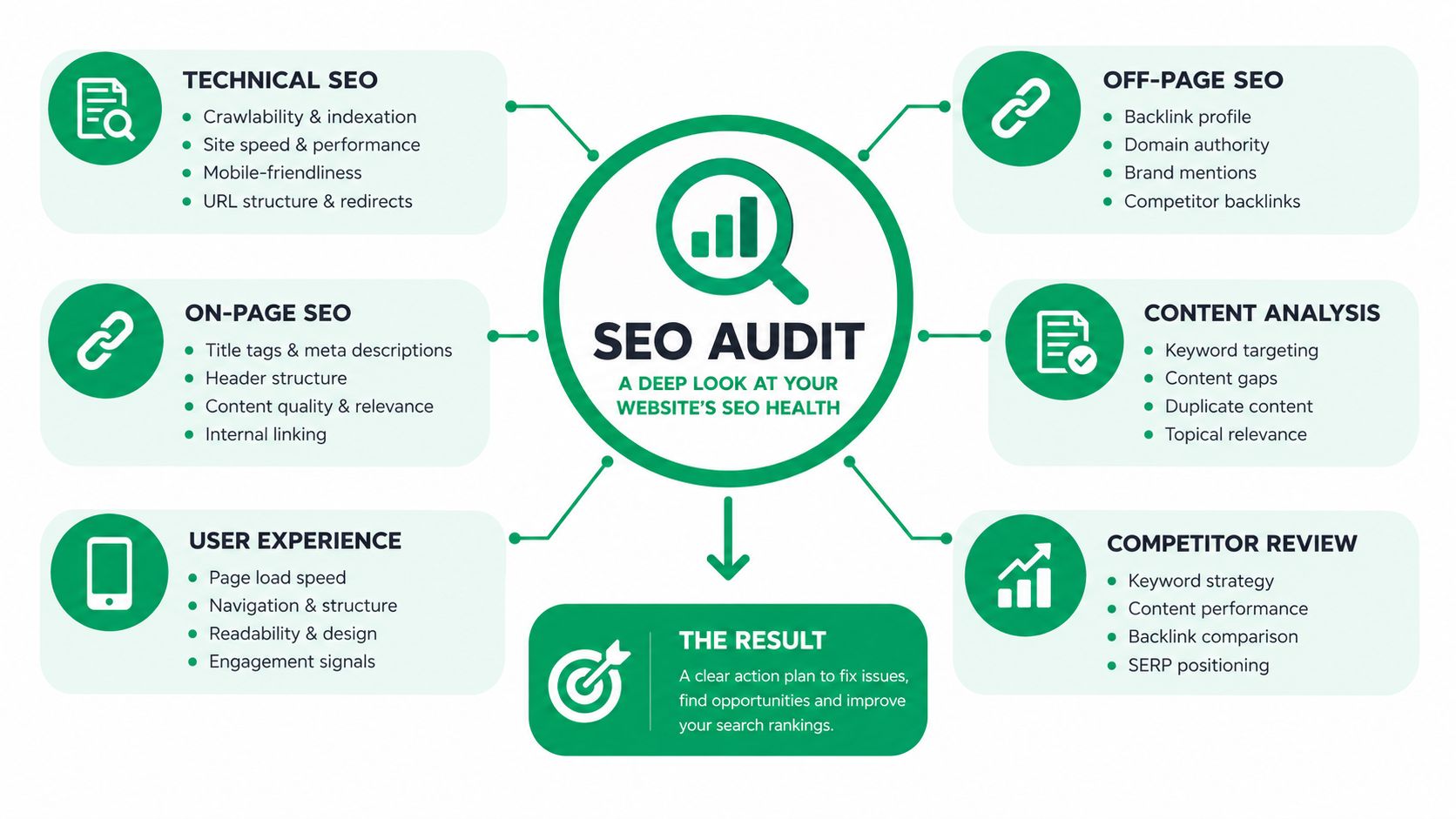
What Is Seo Audit: The five areas a full audit touches
A full audit usually covers these five pillars:
- Technical SEO: Crawlability, indexation, site architecture, structured data, and page performance.
- On-page SEO: Title tags, headings, internal links, metadata, and page-level relevance signals.
- Off-page SEO: Backlinks, brand mentions, and the trust signals coming from outside your site.
- Content quality: Thin pages, overlap between pages, missing topic coverage, and credibility gaps.
- User experience: Mobile usability, page layout, clarity, navigation, and the path to conversion.
And yes, those overlap. That’s normal. If a service page is hard to reach, thin on substance, and loads poorly on mobile, you don’t have three separate problems. You have one business problem showing up in three ways.
If you want the hands-on version after this primer, this walkthrough on how to do an SEO audit is a good companion.
A useful audit doesn’t just tell you what’s wrong. It shows which fixes unlock visibility, leads, and sales first.
That’s the difference between an audit that sounds impressive and one that helps a business grow.
The Five Core Components Every Audit Covers
A real SEO audit works like a diagnostic system for your site, not a one-time checklist you file away. It checks where search visibility breaks down, why the right pages fail to earn attention, and which problems are getting in the way of leads, sales, and AI visibility.
That matters because the same business problem often shows up in more than one place. A service page can be hard for Google to crawl, unclear about its topic, and frustrating on mobile at the same time. If you treat those as separate tasks, teams stay busy without fixing the result the business cares about.
What Is Seo Audit: Five Core Components of an SEO Audit
| Component | What It Measures | Example Finding |
|---|---|---|
| Technical SEO | Crawlability, indexation, redirects, rendering, structured data, performance | Important URLs are blocked, canonical tags conflict, or a large gap exists between crawled URLs and indexed URLs |
| On-page SEO | Title tags, meta descriptions, headings, internal links, schema use | Service pages have weak titles, duplicate headings, or poor internal linking from high-authority pages |
| Off-page SEO | Backlink quality, toxic links, brand mentions | The site has irrelevant links pointing at old URLs or missed opportunities from unlinked brand mentions |
| Content quality | Thin pages, cannibalization, E-E-A-T gaps, intent match | Two pages compete for the same query, or a high-value page lacks depth and trust signals |
| User experience | Mobile usability, navigation, layout stability, conversion flow | Key pages are hard to use on phones, or the path from landing page to inquiry form is too clumsy |
What Is Seo Audit: Technical SEO is the foundation
Technical SEO answers a simple question. Can search engines reach, render, and index the pages that make you money?
That includes crawlability, indexation, site structure, structured data, and performance. It also includes the quiet problems that derail growth fast, such as blocked resources, redirect chains, canonical conflicts, and JavaScript rendering issues. A technical review should examine those together because a strong page cannot drive leads if search engines struggle to process it correctly, as explained in this technical SEO audit guide focused on crawlability and Core Web Vitals.
One useful checkpoint is the gap between what a crawler finds and what Google indexes. One published framework treats a gap greater than 20% as a sign of crawl budget waste, often tied to orphan pages, duplicate URLs, weak internal linking, blocked resources, or parameter-heavy pages, according to this technical audit checklist.
What Is Seo Audit: On-page SEO shapes relevance
On-page SEO is the layer that helps search engines and users understand what each page should rank for. For many SMB sites, good services get hidden behind vague titles, weak headings, and scattered internal links.
A strong audit checks whether each important page has a clear job. Is the title specific? Do the headings match the search intent? Do internal links point authority toward the pages that bring inquiries and revenue? Schema can help too, but it only matters after the basics are doing their job.
What Is Seo Audit: Off-page SEO checks your trust signals
Off-page SEO looks at the reputation your site earns beyond your own domain. That includes backlinks, citations, and brand mentions.
The goal is not to chase the biggest link count. The goal is to see whether the pages that matter for sales are supported by credible signals from relevant sites. If a competitor keeps getting mentioned by industry publications while your brand lives mostly in low-value directories, that trust gap can affect rankings and, over time, visibility in AI-generated answers as well.
What gets missed: Off-page review should connect authority to revenue pages, not just count links across the whole site.
What Is Seo Audit: Content quality reveals overlap and wasted effort
Content quality asks whether your pages deserve attention once they are found. This part of the audit looks for thin pages, overlapping topics, stale information, weak evidence, and poor alignment with what the searcher wants.
Cannibalization is a common example. A company publishes three similar pages about the same service, and Google has no clear signal about which one should rank. The business sees flat traffic, weaker conversions, and a sales team wondering why the site has plenty of content but too few qualified inquiries.
Good content findings are rarely about word count alone. They are about clarity, trust, coverage, and whether one strong page would perform better than several mediocre ones.
What Is Seo Audit: User experience is where traffic turns into revenue
User experience shows whether visibility turns into action. Rankings bring people in. UX determines whether they stay, trust you, and contact you.
That includes mobile usability, page speed, layout stability, navigation, and the path to conversion. If a visitor lands on a promising page but has to pinch and zoom, wait through a slow load, or hunt for the contact form, the problem is no longer just SEO. It is lost revenue.
Google’s “good” Core Web Vitals thresholds are LCP at 2.5 seconds or less, INP at 200 milliseconds or less, and CLS at 0.1 or less, measured at the 75th percentile of real-user page loads, as outlined in this Core Web Vitals guide.
That percentile detail matters. A page does not pass because it looked fast in one test. It needs to perform well for most real visitors.
The best audits do not stop at naming these five areas. They connect them. They show which fixes drive visibility, leads, and sales first.
What Is Seo Audit: How an SEO Audit Works From Crawl to Fix
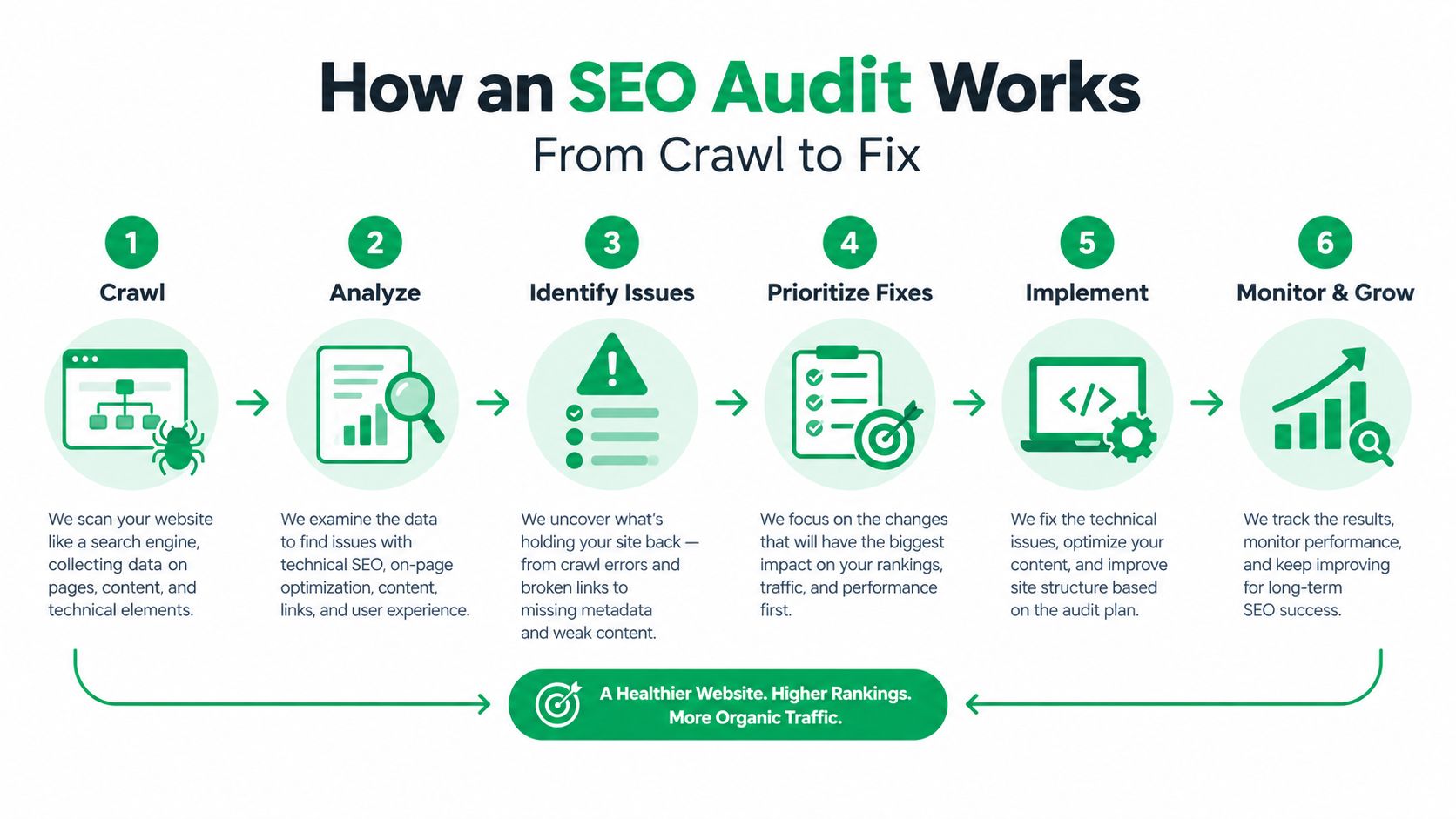
The order matters more than people realize. Many audits go sideways at this point.
Teams jump into rewriting copy on pages Google can’t properly reach, or they debate schema on URLs that shouldn’t be indexed in the first place. That’s backwards.
Start with the crawl
The first pass is a crawl. Tools like Screaming Frog, Sitebulb, and enterprise crawlers map the site’s URLs, status codes, redirects, canonicals, headings, and internal links.
That crawl gives you the raw inventory. Without it, you don’t know what exists, what responds properly, what redirects, and what sits out there as an orphan page.
A proper workflow starts with crawl and indexation checks in sequence. Crawlability issues need to be fixed before indexation analysis, and indexation should be cleaned up before structured data validation makes sense, as explained in this technical SEO audit checklist.
Then reconcile crawl data with index data
Next, compare your crawl against Google Search Console. Ask: of the pages we found, which ones are indexed?
You also compare Search Console’s indexing report to the XML sitemap and a live crawl. That surfaces gaps such as pages that should be indexed but aren’t, and pages that are indexed even though they shouldn’t be. Broken links, redirect chains, excluded URLs, orphan pages, and “crawled, not indexed” pages usually show up here.
If you need help with the sitemap part of that process, this guide on how to validate a sitemap is worth keeping handy.
Then audit the technical layer
Only after crawl and index status are clear should you move into the next technical checks:
- Core Web Vitals: LCP, INP, and CLS
- Robots directives: What’s blocked and what’s allowed
- HTTPS and canonical consistency: Which version is the preferred one
- XML sitemaps: Whether they reflect the indexable pages you want crawled
- Hreflang and rendering checks: Especially for multilingual or JavaScript-heavy sites
Google’s guidance around audits emphasizes using tools and guidelines to identify issues, then tailoring recommendations to the site rather than relying on a generic checklist. That’s one reason a senior auditor won’t skip straight to “optimize content” before fixing access and indexation.
Finish with structured data and dependencies
Structured data validation comes after the core accessibility and index checks. Otherwise you can spend time polishing markup on pages that won’t be surfaced anyway.
This crawl-to-fix approach creates a dependency map. You can see which fixes enable which sections of the site. And that changes prioritization. A single template-level robots mistake may matter more than ten weak meta descriptions.
For businesses that want outside support, one option is a service like the website SEO audit work offered by Mr. Green Marketing, LLC, which centers the review on visibility gaps, technical findings, and a practical action plan rather than a tool export alone.
What Is Seo Audit: What a Real Audit Deliverable Looks Like
A proper audit deliverable should be useful on a Monday morning. That’s the standard.
If the report is so bloated that nobody can tell what to do first, it failed. I don’t care how polished the charts look.
Anatomy of an SEO Audit Deliverable
| Report Section | What It Contains | Why It Matters |
|---|---|---|
| Executive summary | The main findings, major risks, and top opportunities tied to business goals | Owners and stakeholders can see the stakes quickly |
| Prioritized issue list | Severity, effort, affected pages or templates, and recommended action | Teams know what to fix first and what can wait |
| Baseline metrics | Current organic visibility, indexation health, performance status, and conversion benchmarks | You can measure whether the fixes worked |
| Technical findings | Crawl issues, indexing errors, performance problems, structured data gaps | Developers get the detail needed to implement changes |
| Content and authority findings | Thin pages, cannibalization, missing topics, backlink issues | Marketing teams can plan page updates and authority work |
| Roadmap | Sequenced actions across the next quarter with owners and deadlines | The audit turns into execution instead of shelfware |
What the best reports do differently
A good report starts with an executive summary in plain English. Not jargon. Not screenshots with circles around them.
It should tell you what’s wrong, where the risk sits, and what that means for the business. If an issue affects high-intent service pages, say that. If mobile layout problems likely interfere with lead generation, say that too.
Fix lists without business context get ignored. People act when they understand the consequence.
The next piece is a prioritized action list. Every issue should have a severity level, an effort estimate, and the exact URL set or page template affected. That keeps the report from turning into a vague wish list.
Proof, ownership, and the next quarter
Strong deliverables also include the evidence behind the finding. That might be a crawl result, a Search Console screenshot, a Lighthouse result, or a template-level pattern identified across a section of the site.
Then comes the roadmap. Not “improve SEO over time.” A real roadmap.
That roadmap should sequence the work over the next quarter, name who owns each item, and define what success looks like. If you want a sense of how teams structure that kind of reporting, a digital marketing audit template can help you compare what’s useful versus what’s just filler.
And one thing I appreciate when agencies do it right. They pair each technical issue with a plain-language consequence. Example: “These orphan pages are difficult for search engines to discover, so key service content may be refreshed less often and stay weaker than it should.” That’s clear. That gets action.
Turning Audit Findings Into Revenue
An audit by itself doesn’t make you money. Execution does.
Some businesses get disappointed. They paid for insight, got a long report, and expected growth to happen automatically. It won’t.
Translate findings into business levers
Each audit category connects to revenue differently:
- Technical SEO fixes: Recover visibility that already should belong to you by making important pages crawlable and indexable.
- On-page improvements: Help existing pages earn more relevant impressions and cleaner click-through opportunities.
- Content updates and gap pages: Open new search territory and align your site with what prospects ask.
- Off-page cleanup and reclamation: Protect authority and strengthen trust around the pages that matter most.
- UX improvements: Turn more of the visitors you already get into leads or sales.
That last part gets overlooked constantly. Teams fight for more traffic while leaking conversions on-page.
A practical follow-up is to connect audit findings with conversion work. If your landing pages are getting traffic but not enough inquiries, these conversion rate optimization best practices help bridge the gap between SEO visibility and actual business results.
Build a simple 30 60 90 day plan
You don’t need a heroic plan. You need an executable one.
Days 1 to 30
- Fix crawl blockers: Resolve robots issues, broken key pages, bad redirects, and indexing conflicts.
- Clean sitemap and index signals: Make sure the sitemap, canonical setup, and Search Console reality all match.
- Capture baselines: Save current rankings, organic traffic patterns, lead volume, and page-level conversion data before changes ship.
Days 31 to 60
- Ship on-page repairs: Improve titles, headings, internal links, and page structure on priority URLs.
- Update weak content: Consolidate overlap, improve service pages, and strengthen topical depth where intent is mismatched.
- Address visible UX friction: Clean up mobile layout issues, navigation confusion, and thin conversion paths.
Days 61 to 90
- Handle authority work: Reclaim missed mentions, clean up weak legacy links where needed, and support priority pages with better off-site signals.
- Review post-launch data: Watch Search Console, analytics, and rank tracking for movement.
- Re-crawl the site: Confirm that fixes were implemented correctly and didn’t introduce new problems.
Prove the return honestly
Measurement is where newer audit frameworks are getting smarter. Many now emphasize a prioritized action plan, baseline benchmarks, and AI citation or share tracking so businesses can tie audit work to meaningful KPIs rather than stopping at a checklist, as discussed in this guide to audit measurement and prioritization.
That’s the candid version. The audit is a diagnosis, not the treatment.
If nobody owns the fixes, if deadlines stay fuzzy, or if the dev queue swallows the work for three months, revenue won’t move. Good audits create clarity. Good operations turn that clarity into results.
When to Run Your Next Audit and How Often
Once a year isn’t enough for most growing businesses. I know that sounds aggressive. It isn’t.
Search changes faster than annual planning cycles. Sites change faster too. New pages go live, templates get edited, plugins update, products expand, and competitors push into your market. Waiting a full year to look under the hood is how preventable losses turn into “mystery” declines.
Use triggers, not just a calendar
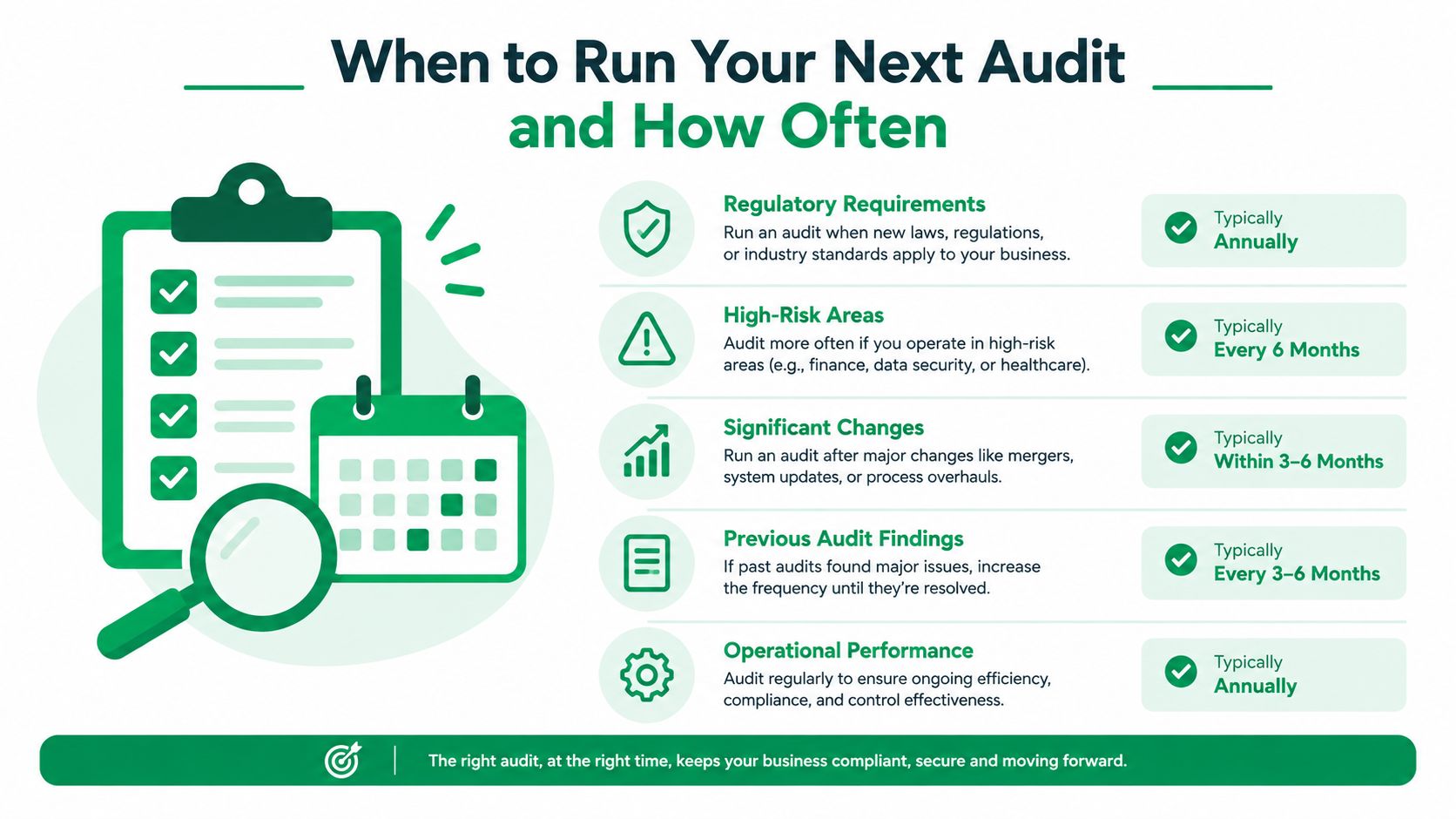
You should run another audit when one of these happens:
- Traffic or rankings drop noticeably: Something changed, and guessing wastes time.
- A redesign or migration goes live: New templates and URL changes can create silent SEO damage.
- A major Google update rolls out: Even solid sites can lose ground if quality signals or page experience lag.
- You expand into new products or markets: New sections often introduce overlap, weak architecture, or thin pages.
- A competitor suddenly gains visibility: Their growth may reveal your gaps.
- A seasonal sales push is approaching: You want the site cleaned up before demand peaks.
- Quarterly health review time arrives: This is the recurring check that catches decay before it grows.
What to review each time
Not every audit has to be a deep, sitewide teardown.
A full audit makes sense after migrations, large traffic losses, or big market expansions. A focused re-crawl may be enough when you’ve only changed one section, deployed a new template, or want to confirm fixes on a set of high-value pages.
Quarterly audits plus event-triggered audits give most SMBs the right balance of discipline and practicality.
That’s the answer to how often. Keep a scheduled rhythm, but don’t wait for the calendar when the site is already sending distress signals.
Mr. Green Marketing, LLC offers SEO audits and performance reviews built to show where your site is losing visibility, leads, and sales, then turn those findings into a practical action plan your team can execute. If you want a clearer picture of what’s blocking growth, visit Mr. Green Marketing, LLC and request a review of your current website performance.
Leave a Comment
sing in to post your comment or sign-up if you dont have any account.