
Podcast Promotion Ideas: Publishing an episode isn’t promotion. It’s production. The growth work starts when you match that episode to the right audience, channel, asset, and measurement method.
That matters because podcast listening has moved well beyond a niche habit. Edison Research’s 2026 Podcast Consumer report estimates that 230 million Americans age 12 and older have ever consumed a podcast, 167 million listen monthly, and 130 million listen weekly. The same report says 58% of Americans age 12 and older consumed a podcast in the last month, an all-time high. For businesses, the opportunity isn’t to publish more. It’s to package useful episodes so people discover them, trust them, and take the next step.
The podcast promotion ideas below move from high-organic channels to paid acquisition. Each one includes practical assets, implementation steps, effort or budget considerations, channel-specific KPIs, and a small example you can adapt. The emphasis is realistic deployment for small and mid-sized businesses with limited staff, time, and budget.
Build the tracking foundation before distributing anything. Use unique landing pages, tagged links, promo codes, platform analytics, and clearly defined conversion goals. Spotify for Creators provides episode-level discovery data, including impressions, sharing analytics, discovery location, average completion rate, and conversion rate through its episode analytics documentation. Apple Podcasts reporting also gives you engagement signals such as average consumption and engaged listeners, defined as people who listened to at least 20 minutes or 40% of an episode, as explained in this podcast analytics guide.
When internal capacity is limited, Mr. Green Marketing, LLC can audit your visibility gaps and build a measurable podcast promotion plan around your existing website, SEO, PPC, social, email, and marketplace activity.
Podcast Promotion Ideas: Table of Contents
- 1. Guest Appearances on Complementary Podcasts
- 2. Cross-Promotion with Partner Brands
- 3. LinkedIn and Professional Network Integration
- 4. YouTube Distribution and Video Repurposing
- 5. Email Marketing and Newsletter Promotion
- 6. SEO Optimization, Transcripts and Directory Submission
- 7. Social Media Clips and Short-Form Content Distribution
- 8. Community Engagement and Listener Interaction Programs
- 9. Sponsorship Deals and Host-Read Advertisements
- 10. Strategic Paid Advertising on Podcast Platforms and Networks
- 10-Point Podcast Promotion Comparison
- Build a Promotion System, Not a One-Off Push
1. Podcast Promotion Ideas: Guest Appearances on Complementary Podcasts
A well-chosen guest appearance can put a founder, consultant, or specialist in front of an audience that already understands the problem you solve. It’s particularly useful for service businesses and e-commerce founders, because expertise travels well in an interview. A strong conversation can create awareness, referral traffic, authority, and reusable content from one recording.
Look beyond direct competitors. An Amazon seller might pitch retail, entrepreneurship, or marketplace operations podcasts. A local service provider could discuss customer education on a community-focused show. A digital marketing agency might offer practical commentary on business growth, PPC, SEO, or scaling.
Research the show’s audience, recent topics, guest quality, and call-to-action habits. Don’t chase download claims without context. A smaller show with a precise audience may be more valuable than a broad show whose listeners have no reason to become customers.
Prepare an appearance package
Create a compact media kit containing:
- Short and long bios: Give hosts versions they can read without rewriting.
- Topic angles: Offer specific discussions, such as “How Amazon sellers waste ad spend” instead of “Amazon marketing.”
- Proof assets: Include relevant articles, speaking examples, or episode links.
- Conversion destination: Send listeners to one focused landing page or lead magnet, not a generic homepage.
Ask the host to include that destination in the show notes. Use a URL unique to the appearance so you can separate listeners from other traffic sources. After publication, request permission to reuse short audio or video excerpts on LinkedIn, TikTok, and Instagram.
Practical rule: Make the host’s job easy. A clear pitch, useful topic, prepared bio, and ready-to-publish links will beat a vague request for exposure.
For a deeper audience-growth framework, see how to grow a podcast audience. A simple pitch template is: “I can explain how [audience] can solve [specific problem], using practical lessons from [relevant experience].”
Effort: Moderate outreach and preparation.
KPIs: Qualified landing-page visits, email signups, consultation requests, and listens attributed to the episode.
2. Podcast Promotion Ideas: Cross-Promotion with Partner Brands
Cross-promotion earns attention when the partner’s offer fits the listener’s existing interests and does not compete for the same purchase. An Amazon seller services podcast might work with a fulfillment provider, while an SEO show could collaborate with a web design or PPC agency. Local service podcasts can also trade exposure with complementary businesses in the same area.
Start with three to five plausible partners. Check their email, social, website, and podcast activity before making contact. An active channel matters because agreement alone does not create distribution.
Build a useful partner campaign
Choose one relevant episode or topic, then agree on the exchange in writing:
- Placement: Newsletter mention, social post, trailer insertion, website feature, or episode recommendation.
- Timing: Set the release date and follow-up window.
- Creative: Prepare co-branded graphics, copy, tracking links, and approved descriptions.
- Exchange: Record what each partner will publish and when.
- Measurement: Create separate referral URLs for every partner and channel.
A co-branded episode or short expert exchange gives the recommendation a clear reason to exist. For example, a web design agency and an SEO agency could each publish an episode about the handoff between site architecture and search visibility, then direct listeners to the other show for the related topic.
Keep the campaign selective. Asking partners to promote every release can fatigue their audience and weaken trust. Reserve shared pushes for episodes with a strong audience fit, guest appearances, product education, or major show milestones.
Use a short briefing to reduce coordination time:
Partner brief: “Promote [episode] to [audience] on [channel] during [window]. Use [tracking URL] and this copy: [approved message].”
Give each partner a ready-to-publish asset, but let them adapt the wording to their own audience. That trade-off preserves consistency without making the placement sound like an advertisement written by someone else.
Effort: Moderate coordination, low direct media cost.
KPIs: Partner referral sessions, attributed listeners, signups, shared engagement, and leads from the partner landing page.
3. Podcast Promotion Ideas: LinkedIn and Professional Network Integration
LinkedIn is a natural home for business podcasts because the platform already supports professional discussion, personal expertise, and buying research. Agencies, consultants, founders, and service providers can use each episode as a thought-leadership anchor rather than treating the podcast link as the entire post.
The strongest post usually leads with a useful idea, tension, mistake, or opinion. The episode becomes the deeper resource. A digital marketing agency might share a clip about PPC trends. An e-commerce consultant could post a lesson from an Amazon seller conversation. A franchise leader might explain a scaling challenge and invite operators to compare experiences.
Use a repeatable mix of content:
- Episode posts: Summarize the problem and link to the full conversation.
- Short clips: Use 60 to 90 second excerpts with captions and clear context.
- Quote graphics: Turn a concise insight into a visual asset.
- Behind-the-scenes posts: Show preparation, recording, or guest research.
- Conversation prompts: Ask a specific question that professionals can answer.
Make the first seconds earn attention
For video, the opening 10 seconds must establish why the viewer should continue. Remove greetings, long introductions, and branding sequences. Start with the sharpest statement, then add the guest name and episode context.
A practical publishing rhythm is three to five posts weekly, mixing full episodes, clips, graphics, and discussion prompts. Create a LinkedIn Newsletter for weekly recaps if your team can maintain it. Tag relevant brands or people only when they appear in the discussion, and pin the strongest podcast post to your profile.
Example caption: “Most local businesses don’t have a traffic problem first. They have a conversion problem. In this episode, we break down the landing-page signals that make paid clicks more valuable.”
Track more than reactions. Record video views, meaningful comments, profile visits, link clicks, newsletter subscriptions, and attributed inquiries. A post that creates fewer likes but more qualified conversations may be doing the better business job.
Effort: Low to moderate once templates exist.
KPIs: Three-second and full-view rates, comments from target buyers, profile visits, link clicks, and assisted conversions.
4. Podcast Promotion Ideas: YouTube Distribution and Video Repurposing
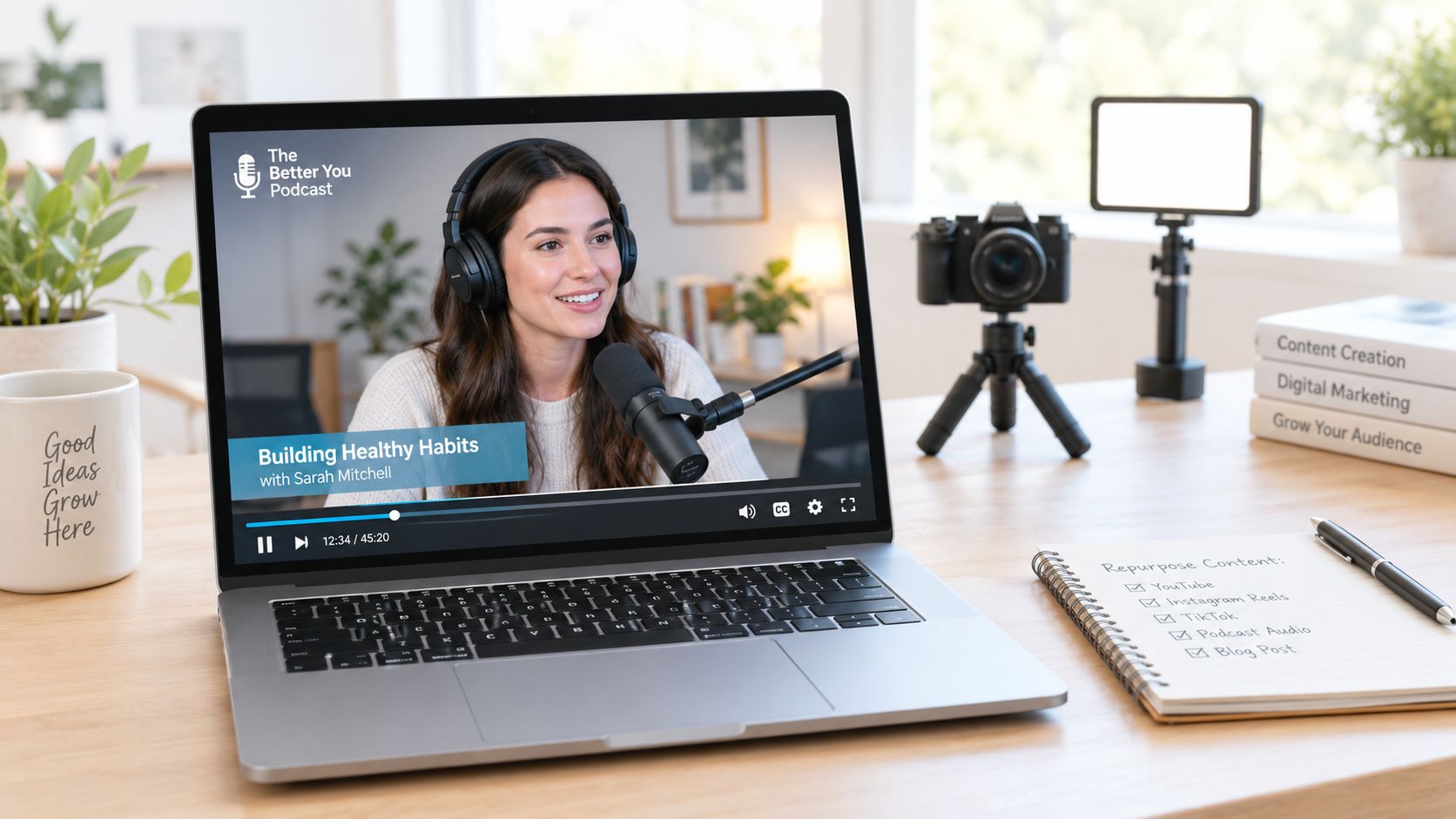
YouTube can turn one podcast episode into a searchable video asset and several shorter entry points. Start with a clean audio upload, guest headshots, readable chapter markers, consistent branding, and a description that answers the viewer’s likely question. An elaborate studio is optional.
Match the visuals to the subject. An Amazon seller podcast can show permitted dashboard recordings or marketplace workflows. An agency founder can pair the audio with slides, graphs, and anonymized examples. Publish the interview as a full episode, then cut its strongest moments into YouTube Shorts that direct viewers to the longer conversation.
Make production repeatable
Create one video template before publishing at scale. It should cover the opening frame, captions, thumbnail treatment, and end screen, limiting production time and protecting the promotion budget. Release videos near the episode launch, then sort them into playlists by topic, guest, or series.
From each full episode, prepare three to five Shorts of 30 to 90 seconds. Select clips that answer a specific question or state a useful opinion, rather than trimming random sections. A strong opening line matters more than a polished intro.
Use this compact publishing check:
- Search-focused title: Name the problem and expected outcome.
- Timestamps: Let viewers reach the relevant segment quickly.
- Detailed description: Add show notes, guest links, resources, and the primary website destination.
- Direct next step: Send viewers to the full episode, email signup, consultation, or relevant product page.
- Topic grouping: Place the upload in a playlist that encourages another related view.
Example title: “Amazon PPC Mistakes That Waste Seller Budget.” Follow it with a description stating who the episode serves and what viewers will learn. For broader planning, review video marketing for small business.
Effort: Moderate at setup, lower with templates.
KPIs: Impressions, click-through rate, average view duration, returning viewers, Shorts-to-full-episode clicks, and website conversions.
5. Podcast Promotion Ideas: Email Marketing and Newsletter Promotion
Email turns an episode release into a repeatable promotion channel. Subscribers can receive each new episode, a useful recap, or an exclusive resource without depending on a social feed. The trade-off is list maintenance: weak targeting and repetitive messages can reduce engagement over time.
Build the email around one action. A weekly digest might feature the latest episode, a brief summary, one standout clip, and a practical takeaway. A business show could give subscribers early access to a bonus segment or extended interview. Segment by listener interest, such as sending a local SEO episode to one group and an e-commerce episode to another.
The School of Podcasting newsletter guidance cites an 8% average conversion rate for email versus 3% for social media, and reports podcast newsletter click-through rates typically ranging from 2.5% to 3.5%. Use these as comparison points, not forecasts. List quality, subject line, offer, and audience fit will shape your results.
Design the release around one decision
Send the announcement on release day. Keep the copy short:
- Benefit-led subject line: Lead with the guest or problem addressed.
- Clear button: Use “Listen Now” and link to the preferred platform or a choice page.
- Brief teaser: Use two or three sentences to create curiosity without retelling the episode.
- Forwarding prompt: Ask readers to share it with one relevant colleague.
- Subscriber reward: Offer bonus material, an extended segment, or early access.
A customer-facing employee can add a specific episode or useful moment to their email signature. Link to the relevant episode rather than the full feed, then track episode-page signups separately. The podcast newsletter conversion formula is newsletter signups ÷ episode page visitors × 100. Page-level tracking keeps unrelated website visits from distorting the result.
Start with one reusable template and two or three audience segments. That keeps production effort low while giving you enough control to compare topics, calls to action, and repeat listening behavior.
Effort: Low after the template and segments are set.
KPIs: Click-through rate, episode-page visits, signups, forwards, attributed leads, and repeat listening behavior.
6. Podcast Promotion Ideas: SEO Optimization, Transcripts and Directory Submission
A searchable episode page can attract listeners after the launch push ends. Give each episode its own URL, then pair the audio player with an edited transcript, useful show notes, descriptive headings, guest details, and internal links. That page serves searchers who prefer reading and gives the episode more context than an embed alone.
Start with the audience problem. For an episode titled “SEO for Local Service Businesses,” explain the search challenge, summarize the practical discussion, and link to relevant service pages or earlier episodes. Write at least 300 words of edited show notes and work in one or two target keywords naturally. Avoid forcing phrases into every heading.
A reliable production order:
- Choose the search intent: Define the question the episode answers and the action you want readers to take.
- Edit the transcript: Correct names, terminology, punctuation, and obvious errors before publication.
- Write descriptive headings: Use headings that reflect topics a reader might search.
- Add internal links: Connect the episode with related articles, services, and previous conversations.
- Add external resources: Cite guest websites, tools, and sources discussed in the recording.
- Implement podcast schema: Add structured data where appropriate, following guidance on schema markup for SEO.
- Submit the show broadly: List it on major platforms and relevant secondary directories, including 20 secondary directories where the audience fits.
Directory coverage helps availability, not weak positioning. Use artwork at 3000 by 3000 pixel and follow platform specifications. Make the show description explain the audience problem and expected transformation, then include three to five primary keywords naturally. Episode titles should distinguish one conversation from another.
Check the page after publishing: confirm indexing, test internal links, and review whether organic visitors reach the player, signup, or inquiry form. Directory submission is a distribution task, while the page itself carries the search and conversion work.
Effort: Moderate upfront, then repeatable for each episode.
KPIs: Organic impressions, search clicks, indexed pages, episode-page engagement, platform discovery, and leads from organic traffic.
7. Podcast Promotion Ideas: Social Media Clips and Short-Form Content Distribution
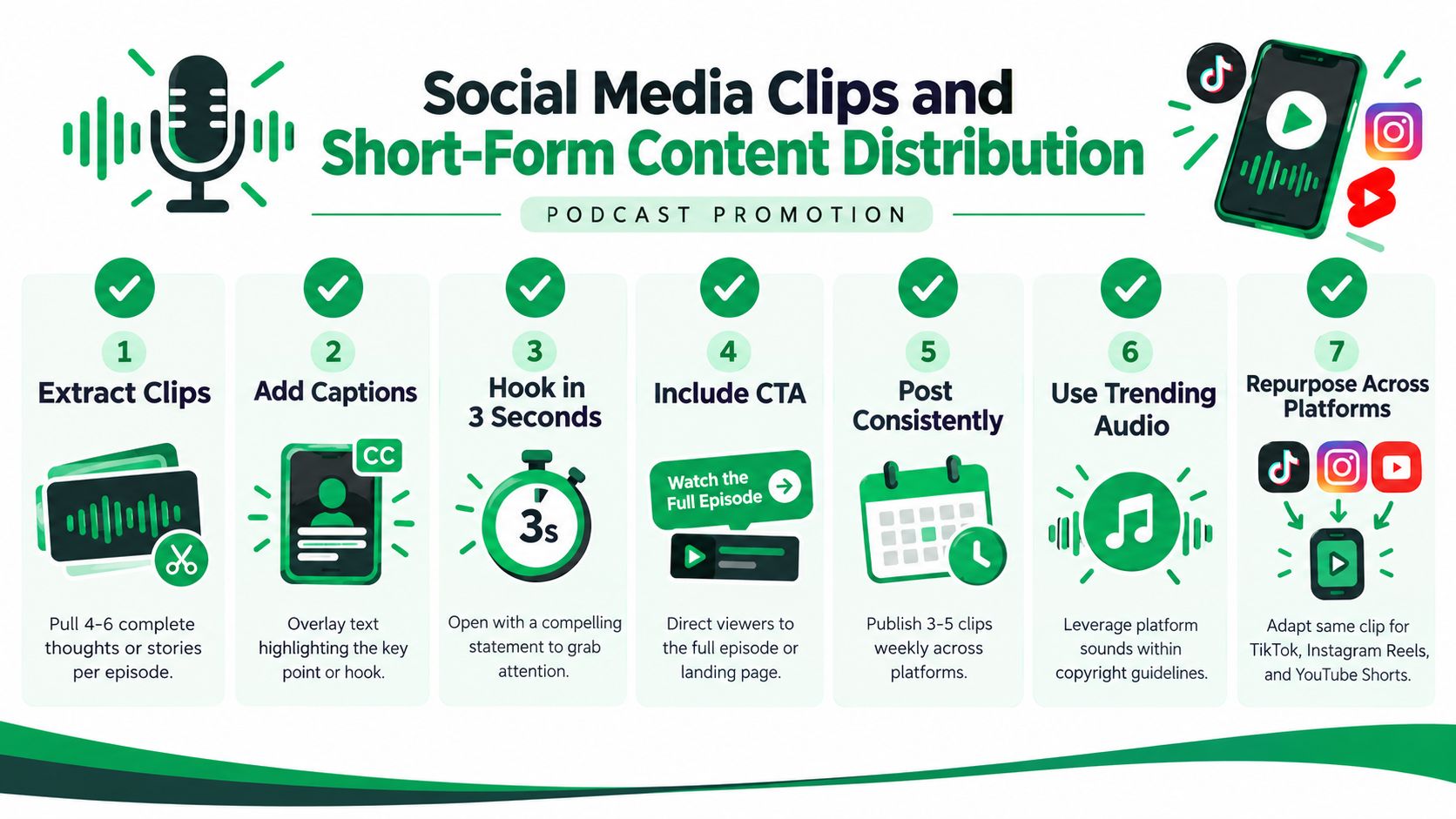
Short-form clips give a long episode multiple entry points. The useful unit isn’t “a clip from the interview.” It’s one complete thought, one story, one mistake, or one practical recommendation that stands on its own.
An Amazon seller episode might produce “Three Keywords You’re Targeting Wrong.” An agency founder could explain why PPC campaigns fail to convert. An e-commerce expert might identify the metric that matters most for a particular decision. A local business episode could show how franchises compete in a specific market.
Edit for the viewer, not the archive
Start with the strongest hook in the first three seconds. Add on-screen text so the point survives muted playback, use captions, and remove pauses that matter in conversation but not in a short feed. End with a clear instruction, such as “Hear the full breakdown on Episode 18” or “Get the worksheet on the episode page.”
The same source clip can work on TikTok, Instagram Reels, and YouTube Shorts, but don’t publish it blindly. Adjust the caption, cover text, hashtags, and destination for each platform. Use trending audio only when it fits the content and remains within copyright guidelines.
A practical weekly workflow is to publish three to five clips across platforms, then review which topics create qualified profile visits and episode clicks. One clip may generate broad reach but no meaningful action. Another may attract fewer viewers who are far more likely to subscribe or inquire.
See types of content for social media for ways to extend the same source material without repeating the identical post.
Start with the sentence people would send to a colleague. That’s usually the clip.
Effort: Moderate editing, low if templates and a clipping workflow are in place.
KPIs: Three-second views, completion rate, shares, saves, profile visits, link clicks, and assisted conversions.
8. Podcast Promotion Ideas: Community Engagement and Listener Interaction Programs
A community earns attention only when participation produces value. Choose the platform your listeners already understand, then match it to the conversation. Facebook Groups suit practical peer discussion. Discord fits technical audiences that need channels for tools, workflows, and live chat. Circle or Mighty Networks can support a branded membership experience.
The platform is a delivery choice. The operating plan determines whether the community lasts.
Before inviting listeners, define what belongs in the space, whether promotion is permitted, how questions are answered, and when the hosts will appear. Use each new episode as a discussion prompt, not a link drop. Ask for one specific reaction, invite members to share how they applied an idea, and feature useful contributions.
A simple recurring format can keep participation focused:
- Episode discussion: Post one question connected to the latest release.
- Member examples: Request a practical result, adjustment, or lesson from applying the episode.
- Live conversation: Hold a recurring Q&A about a business problem listeners already face.
- Exclusive material: Offer early access, bonus content, or extended answers.
- Feedback collection: Survey members about future topics and guest requests.
- Recognition: Highlight thoughtful contributions, regardless of their scale.
Give the community an owner. That person should moderate posts, answer or route questions, maintain the response standard, and schedule live activity. A quiet group can weaken trust if listeners were promised regular interaction, so set a rhythm the team can sustain.
Track active members, discussion participation, event attendance, member referrals, repeat listens, and leads influenced by community activity. Compare those outcomes with the time required to moderate the space. If conversations produce no listening, referrals, or customer discussions, change the prompts or reduce the program before adding another platform.
Effort: High ongoing involvement.
KPIs: Active members, discussion participation, event attendance, member referrals, repeat listens, and leads influenced by community activity.
9. Podcast Promotion Ideas: Sponsorship Deals and Host-Read Advertisements
Sponsoring another podcast can put your business in front of an audience that already trusts the host. The fit must be credible. A SaaS product should appear on shows whose listeners can use it, an e-commerce product belongs near relevant seller or retail conversations, and a local provider should prioritize regional or community-focused programming.
Host-read advertising allows the presenter to explain the offer in a natural voice. That flexibility can help the message sound like a recommendation rather than an interruption, but you still need controls. Give the host concise bullet points, a clear audience benefit, required disclosures, and one trackable action. Don’t force a script that sounds unlike the host.
Buy evidence before reach
Request audience demographics, listener engagement information, episode placement details, and prior campaign reporting before committing. The plan notes for this channel identify shows in the 10,000 to 50,000 listener range as a potential ROI sweet spot, but audience quality and conversion intent still matter more than a large headline number.
Use a unique discount code or landing-page URL. If the show is a strong fit, negotiate a multi-episode arrangement rather than judging the campaign on one placement. Align the timing with a product launch, seasonal offer, or educational resource that gives listeners a reason to act now.
For budgeting and campaign mechanics, review the cost to advertise on a podcast. A local franchise provider, for example, might sponsor a business-growth show with a landing page offering a location expansion guide. The page should ask how the listener heard about the offer and connect the response to the specific show.
Effort: Moderate research and negotiation.
Budget: Paid media investment varies by show, placement, audience, and deal structure.
KPIs: Code redemptions, branded search activity, landing-page conversion, qualified leads, and cost per acquisition.
10. Podcast Promotion Ideas: Strategic Paid Advertising on Podcast Platforms and Networks
Paid podcast promotion can accelerate learning when you already know who you want to reach and what action matters. Options include Spotify Ads, Acast, Megaphone, programmatic buying, and retargeting campaigns connected to your website or email audience.
Targeting might focus on listeners of business and entrepreneurship podcasts, Amazon seller content, a defined interest group, or selected geographic markets. A SaaS company could retarget visitors who reached its podcast landing page without signing up. A franchise network might promote a growth-focused episode to prospects in priority locations.
Start with a controlled test. The implementation plan here uses a $100 to $200 daily budget as a starting range for establishing baseline performance data, not as a universal requirement. A smaller business may need a narrower test, while a mature advertiser may require more spend to produce useful learning.
Build the campaign around distinct variables
Create multiple 30 to 60 second ad variations. Change one meaningful element at a time, such as the opening hook, benefit, proof point, or call-to-action. Use unique landing pages or promo codes for each audience combination. Test interest, listening behavior, and geography together, then separate the results so you know which variable is carrying performance.
Host-read placements may deserve a higher bid than programmatic inventory when trust and context are central to the offer. Retarget website visitors and email subscribers with a different message from the one used for cold listeners. Cold traffic needs a clear reason to care. Warm traffic may respond better to a consultation, trial, bonus resource, or next episode.
Paid reach doesn’t compensate for unclear positioning. If the listener can’t tell who the episode serves within the opening moments, better targeting won’t rescue the campaign.
Effort: Moderate to high, especially for creative testing and attribution.
KPIs: Reach, impressions, completed listens, landing-page sessions, conversion rate, cost per qualified listener, and customer acquisition cost.
10-Point Podcast Promotion Comparison
| Strategy | Implementation Complexity | Resource Requirements | Expected Outcomes | Ideal Use Cases | Key Advantages |
|---|---|---|---|---|---|
| Guest Appearances on Complementary Podcasts | Medium, research, pitching, prep | Low cash; moderate time for outreach and prep | Authority building, lead generation, repurposable content; reach varies | Service businesses, e-commerce founders, B2B experts | Access to engaged audiences, credibility transfer, long-form storytelling |
| Cross-Promotion with Partner Brands | Medium, partner identification and coordination | Low cost; time for agreements and co-branded assets | Expanded reach and mutual audience growth | Agencies, complementary service providers, e-commerce partners | Cost-effective audience borrowing; strengthens partnerships |
| LinkedIn and Professional Network Integration | Medium, consistent posting and repurposing | Moderate time for clip creation and posting cadence | B2B engagement, thought leadership, referral traffic | Consultants, agencies, B2B services targeting decision-makers | Direct access to C-suite, professional credibility, native platform support |
| YouTube Channel Leverage and Video Repurposing | Low–Medium, template setup and editing | Low–moderate (editing tools, thumbnails, occasional video) | Increased discovery via YouTube SEO, longer content lifespan, monetization | Shows with visual examples, tutorials, or broad audience growth goals | Long-term search discoverability, additional revenue streams |
| Email Marketing and Newsletter Promotion | Low, content and send cadence setup | Moderate (email platform, list maintenance, segmentation) | High CTR and direct listener conversion; measurable results | Podcasts with existing subscriber lists and loyal listeners | Owned channel, high ROI, controlled messaging and timing |
| SEO Optimization, Transcripts and Directory Submission | Medium–High, transcripts, schema, submissions | Moderate (transcription services, SEO time) | Long-term organic search traffic and indexed episodes | Content-rich podcasts aiming for discoverability via search | Sustained visibility, multiple indexable assets per episode |
| Social Media Clips and Short-Form Content Distribution | Medium, clip editing and platform tailoring | Low–moderate (editing time, repurposing effort) | Rapid reach amplification, viral potential, referral traffic | Consumer-focused shows, brands targeting younger audiences | High reach growth potential; fast topic testing and engagement |
| Community Engagement and Listener Interaction Programs | High, community building and moderation | High ongoing (moderators, content, events) | Higher retention, advocacy, user-generated content, feedback | Niche shows seeking loyal audiences and repeat engagement | Strong stickiness, direct feedback loop, organic referrals |
| Sponsorship Deals and Host-Read Advertisements | Low–Medium, negotiation and creative alignment | High budget (per-episode sponsorship fees) | Immediate exposure to established audiences; measurable conversions | Brands wanting fast scale and credibility via endorsements | Trusted host endorsement, guaranteed placements, trackable ROI |
| Strategic Paid Advertising on Podcast Platforms and Networks | Medium, campaign setup and optimization | High (ad spend, testing budget, targeting tools) | Accelerated listener acquisition with targeted reach | Brands scaling listeners quickly or targeting competitor audiences | Precise audience targeting, measurable performance, scalable acquisition |
Build a Promotion System, Not a One-Off Push
A podcast grows more reliably when promotion becomes part of production rather than a last-minute task after publishing. The episode should enter a release system with prepared destinations, reusable creative, ownership, tracking, and a defined follow-up schedule.
Start with owned assets. Build an SEO-ready episode page with an edited transcript, useful show notes, guest information, internal links, and a clear conversion path. Prepare the email announcement, a short social caption, a few clips, and a platform description before release. These assets take effort once, then become reusable components of every episode workflow.
Owned channels matter because they compound. Search pages can attract future visitors. Email gives you a direct relationship with subscribers. A website can turn a listener into a lead without depending on a platform’s recommendation system. For newsletters, measure each episode page separately rather than relying only on sitewide totals. That distinction tells you whether the podcast is creating subscribers or merely receiving traffic from unrelated sources.
Podcast Promotion Ideas: Add borrowed distribution next
Once the owned foundation works, add guest appearances and partner promotion. These channels require outreach and coordination, but they can place the show in front of relevant audiences without requiring a large advertising budget. Create a media kit, partner brief, tracking-link template, and follow-up email so every collaboration takes less administrative time.
Discovery behavior makes packaging especially important. Signal Hill’s Canadian research, summarized in 2026 podcast marketing coverage, reports that podcast-to-podcast discovery fell from 22% in 2020 to 13% in 2025. That shift suggests businesses shouldn’t rely only on guest swaps and referrals. Titles, thumbnails, metadata, platform search, home-feed behavior, and episode framing deserve equal attention.
Global listening also supports repeated-touch planning. YouGov’s 2025 podcast listening research reports that across 49 markets, 41% of consumers spend at least one hour per week listening to podcasts, while 9% spend more than 10 hours per week. For campaign planning, that supports a sequence of useful messages rather than a single announcement.
Choose two or three channels first
Don’t attempt all ten at once. Select channels based on your audience, existing assets, internal skills, and commercial goal.
A consultant might begin with SEO episode pages, LinkedIn, and email. An e-commerce brand could add YouTube, short-form clips, and guest appearances on seller-focused shows. A local service business may prioritize partner distribution, community engagement, and targeted sponsorships. A company with strong analytics and creative capacity can test paid platform campaigns after its organic conversion path is reliable.
The concept should lead the plan. Podcast Marketing Academy’s 2025 trends reporting, summarized in podcasting trend coverage, identifies a unique and compelling show concept as the most important growth factor in its report. That aligns with practical experience. Promotion can increase exposure, but it can’t make an unclear show easy to recommend.
Podcast Promotion Ideas: Create a repeatable release workflow
Assign one owner to each stage:
- Pre-release: Confirm topic, audience, title, guest details, landing page, and tracking links.
- Production: Record, edit, transcribe, create show notes, and prepare the full episode asset.
- Launch: Publish the episode page, email, YouTube version, and primary social posts.
- Repurposing: Release clips, quote graphics, short posts, and partner assets.
- Measurement: Review reach, completion, clicks, signups, leads, and qualified listener behavior.
- Iteration: Keep the channels that produce useful outcomes, revise weak creative, and stop activities that consume time without evidence of value.
Record effort and spend alongside performance. A channel that appears free may require hours of founder outreach, editing, approvals, and community management. A paid campaign may be expensive in media terms but efficient if it generates qualified leads. Compare the full operating cost with the result.
Mr. Green Marketing, LLC can provide a free audit and performance report to identify visibility gaps, review your current episode assets, and prioritize podcast promotion opportunities. The agency’s broader work spans SEO, PPC, web design, social media, video production, branding, and podcast promotion, which can help connect your show to the rest of your customer journey.
The practical target isn’t viral reach. It’s a release process your team can repeat, measure, and improve. Publish an episode, distribute it through the channels your audience uses, track the next action, and double down on the sources producing qualified listeners or leads.
Mr. Green Marketing, LLC offers podcast promotion planning, SEO-ready episode assets, video and short-form repurposing, paid campaign support, and performance reporting for businesses that need measurable growth. Visit Mr. Green Marketing, LLC to request a free audit and identify the podcast visibility opportunities your team can act on next.
Leave a Comment
sing in to post your comment or sign-up if you dont have any account.