
SEO for Service Based Businesses: You can have a clean website, solid reviews, and a few pages that technically “rank,” yet the phone still doesn’t ring. That’s the trap a lot of service business owners fall into, especially when they’re staring at impressions, clicks, and vague vanity wins while the calendar stays open. seo for service based businesses only matters when it helps someone nearby find the right service, trust the business fast, and take the next step.
The businesses that win here don’t treat search like a branding exercise. They treat it like a lead engine, because search is where buyers already have intent, and local search is where that intent turns into calls, quotes, and booked work. The question isn’t whether a page gets traffic, it’s whether that traffic becomes jobs.
SEO for Service Based Businesses: Table of Contents
- Why Search Is the Front Door for Service Businesses
- Building the Local SEO Foundation
- Structuring Service Pages and Location Pages That Convert
- Content Strategy That Builds Topical Authority
- Technical SEO Essentials Service Sites Usually Skip
- Citations, Reviews, and Links as One Trust Layer
- Quick Wins and a 90-Day Execution Plan
Why Search Is the Front Door for Service Businesses
A contractor can have a decent-looking homepage, a clinic can have polished branding, and a law firm can spend months tweaking copy, then nothing happens. Meanwhile, another business in the same trade fills its calendar because it shows up at the top of results for urgent, local queries. That is the fundamental split in service SEO: who becomes the obvious answer at the moment of need.
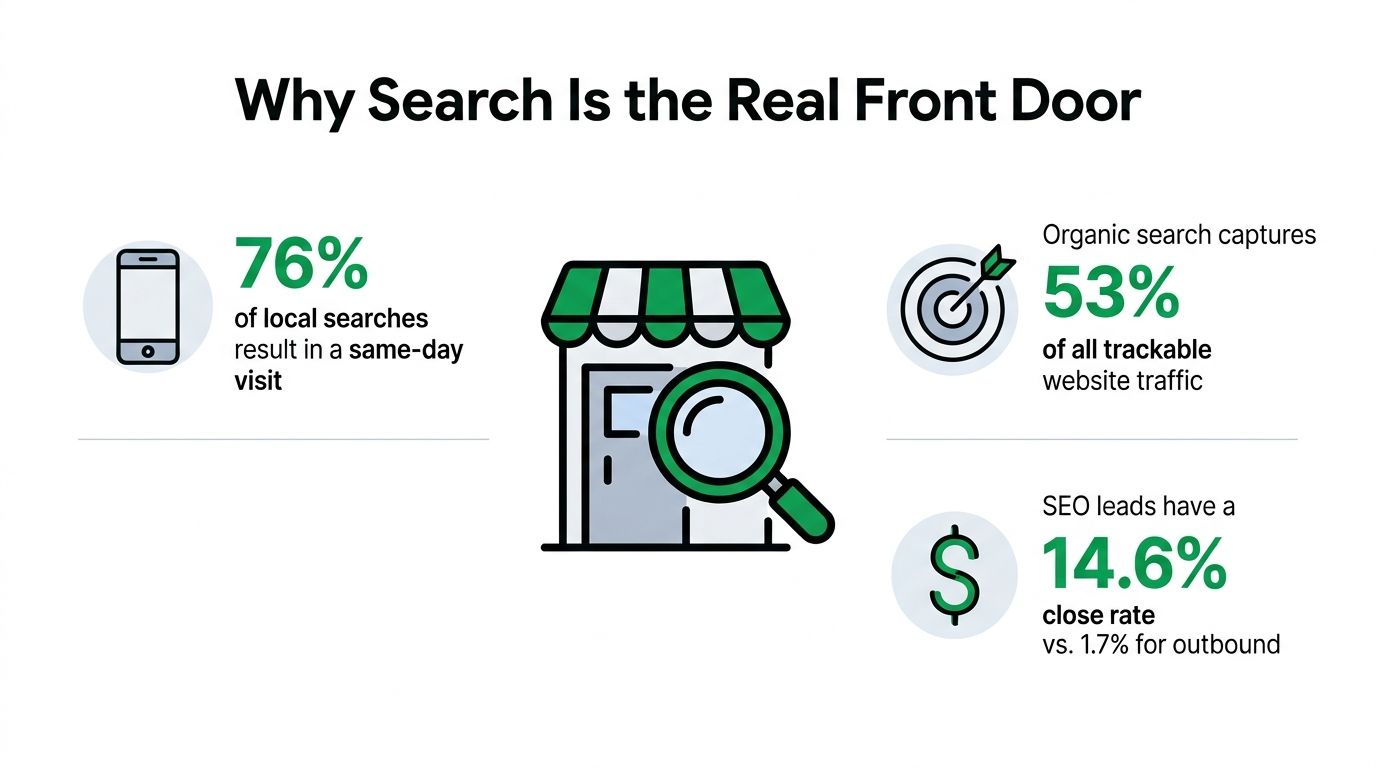
Search is the starting point for local discovery, and local intent drives a large share of that behavior. Multiple 2026 industry sources report that 68% of online experiences begin with a search engine, 46% of Google searches have local intent, and 80% of U.S. consumers search online for local businesses weekly (local search statistics 2026). For service businesses, those numbers point to the same conclusion, search is where buyer attention already lives, and it is where a business has to earn visibility before the phone rings.
SEO for Service Based Businesses: Visibility matters only if it produces action
Organic search also matters because it tends to carry more revenue opportunity than many owners expect. One 2026 source reports 53% of total website traffic comes from organic search, while paid search contributes 27%, and that same dataset reports 2.35% organic conversion rates versus paid search in that dataset (SEO statistics 2026). For a service business, the job of SEO is not to rank for its own sake. It is to capture the right visitor before a competitor or a paid ad pulls them away.
Mobile behavior makes that even more obvious. One cited summary says 88% of searches for local businesses on mobile result in a call or visit within 24 hours (mobile local search behavior). That is why GBP completeness, service pages, and fast contact paths are operational assets, not cosmetic tasks.
Practical rule: if a searcher is close enough to call, book, or visit, the page should make that next step painfully easy.
A lot of owners chase “traffic” because it sounds measurable. Search is really a proximity channel, a timing channel, and a trust channel all at once. Get the right page in front of the right local searcher, and the compounding starts early.
A business that improves online visibility through a clean site structure, accurate service pages, and strong local signals has a better shot at turning search into booked work, not just visits. That is the revenue side of SEO for service businesses, the part that matters when the calendar is the scoreboard.
SEO for Service Based Businesses: Building the Local SEO Foundation
Local SEO for service businesses starts with the boring work that too many teams skip because it doesn’t feel strategic. It is strategic. Google needs clean signals to understand who you are, what you do, and where you serve people. If those signals are fuzzy, everything downstream gets harder.
Get the business profile and directory basics right
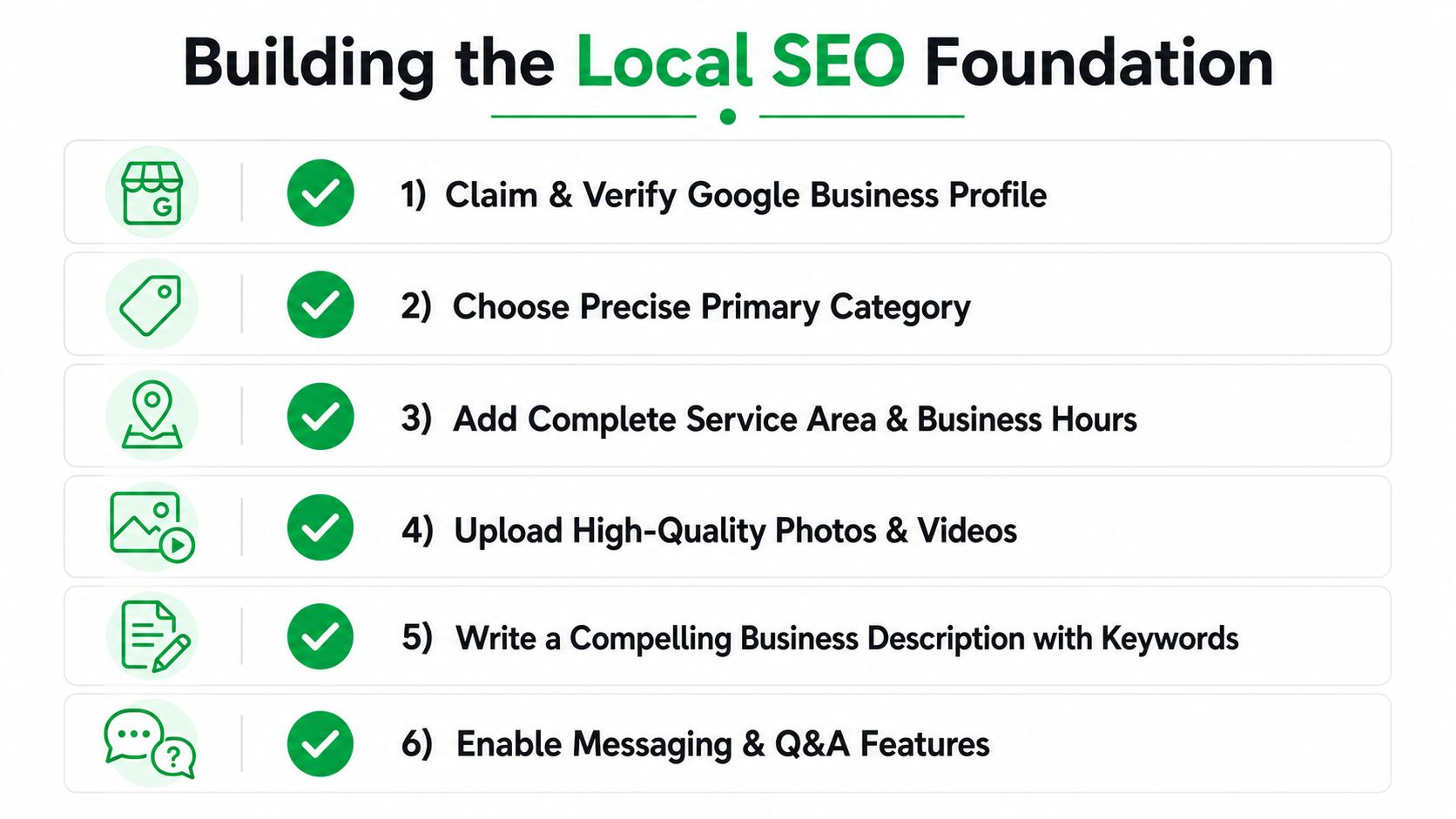
The first move is to claim the Google Business Profile, choose the right primary and secondary categories, and keep the name, address, phone, and hours consistent everywhere. Another guide adds that the profile should send traffic to the best matching landing page, not just the homepage (service business SEO strategy guide). That routing decision matters because the profile is often the first click a prospect makes after search.
The same foundation work applies to citations. Standardize the business name and contact details across directories, then push the most important listings first instead of spraying the same data into low-value sites. For a home-services company with overlapping service areas, that consistency helps Google connect the business to the right place without creating duplicate profiles. For a multi-location dental group, each clinic needs its own clean entity with its own matching page.
Match services to pages, not just to buzzwords
A high-impact workflow for service businesses is to build one page per service-location pair, align each page with the matching Google Business Profile service entry, and then prioritize the top commercial service pages before expanding outward (service-business page workflow). That is more useful than throwing up a pile of generic city pages and hoping one sticks.
The details matter too. Add accurate hours, service entries that mirror the site, and strong photos that show the actual work. A profile with incomplete services and stale images sends a weaker trust signal than one that feels alive and specific.
Keep the profile close to reality. If the team can’t back it up on the phone, in the office, or on site, don’t publish it.
For a quick foundation audit, use the structure in this local SEO audit checklist and fix the profile, directory parity, and page matching before you touch anything fancier.
SEO for Service Based Businesses: Structuring Service Pages and Location Pages That Convert
The site architecture problem is where a lot of service SEO goes sideways. Owners mix services, locations, and blog content into one muddy structure, then wonder why Google struggles to figure out which page deserves to rank. Clean architecture solves that.
Use the right page type for the job
A service page should focus on one offering, like drain cleaning or root canals. A location page should focus on one city or service area. A combined service-location page makes sense when the commercial intent is strong and the business serves that exact pairing. The key is to avoid thin pages that only swap city names and leave everything else identical.
The top of the page needs to do actual selling. A clear H1, proof elements above the fold, an offer block, FAQ schema, and a contact path that matches the phone number in the Google Business Profile all belong there. If the GBP sends a user to a page that feels disconnected from the service they clicked, trust drops immediately.
Prioritize what can book work first
Newer sites usually need the highest commercial service pages first. Established sites can build out city clusters after the core pages are already strong. That order keeps effort pointed at pages most likely to earn leads, not just impressions.
A useful test for any location page is simple. Would a real person in that service area find it helpful before they book? If the answer is no, the page is probably doorway fluff.
| Page type | Best use | Common mistake |
|---|---|---|
| Service page | One service with strong commercial intent | Making it too broad |
| Location page | One city or service area | Repeating the same copy across cities |
| Combined page | Clear service plus clear local demand | Forcing a combo where intent is weak |
A city page should read like local proof, not like a template with a suburb pasted into the title tag.
Use related-service internal links, genuine local references, and unique imagery so each page earns its place. If the page can’t stand on its own, it probably doesn’t deserve to rank.
SEO for Service Based Businesses: Content Strategy That Builds Topical Authority
Most service-business blogs fail because they answer no real buying question. They’re written to publish, not to persuade. The better approach is to map content around the actual path a prospect takes, from problem to service to comparison to cost.
Build around real buyer questions
Start with the problems people feel, then move into the services that solve them. After that, create comparison pages and cost guides that help buyers evaluate options without leaving your site. FAQ blocks help too, especially when they answer the kinds of follow-up questions people ask before they call.
Case studies are the easiest way to turn one job into multiple assets. A completed project can become a case study, a photo-rich location page update, a short video, and a GBP post. That gives one piece of work more shelf life and keeps the content tied to real service delivery instead of generic commentary.
Keep the calendar small enough to execute
A 90-day content calendar for service SEO doesn’t need to be bloated. It needs to be consistent. One practical structure is a handful of service pages, one or two local proof pieces, and a few educational pages that answer pre-sales questions in plain English.
The test for every idea is blunt. Would a real prospect in the service area care about this before they book? If not, skip it. The internet is full of content, but searchers are still trying to solve one specific problem.
Use this content strategy guide as a model for turning service work into assets that attract the right queries without creating thin filler.
SEO for Service Based Businesses: Technical SEO Essentials Service Sites Usually Skip
Technical SEO on service sites doesn’t need to become a permanent audit project. It needs to remove the friction that keeps good pages from reaching the right people. The usual culprits are indexation mistakes, weak internal linking, slow pages, and schema that never got implemented.
Fix the crawl and index path first
Start with the basics. Make sure important service pages are indexable, contact pages aren’t blocked by accident, and navigation helps both users and crawlers move from the homepage to the money pages. If a booking page or contact page is accidentally noindexed, the site can look healthy on the surface while hiding the actual conversion path.
Core Web Vitals and mobile usability matter because service search happens on phones, often in a hurry. A page that ranks but loads slowly can still lose the call. That’s especially painful on high-value jobs, where even small friction feels expensive.
Use schema where it helps, not everywhere by default
LocalBusiness and Service schema are useful when they describe the business accurately and support the page’s purpose. They’re not magic, and they’re not a substitute for content. The goal is clarity, not markup theater.
Be careful with sitemap bloat on multi-location sites. Thin tag combinations and faceted navigation can create lots of low-value URLs that distract crawlers and dilute attention. Internal linking should point toward the pages that matter most, especially the top commercial services and the locations that drive revenue.
Schema markup for SEO is worth implementing when the site structure is already clean. If the structure is messy, schema just labels the mess.
A technical cleanup should make the site easier to understand, not just easier to report on.
Citations, Reviews, and Links as One Trust Layer
Citations, reviews, and links are often treated as three separate tasks. For service businesses, they work better as one trust layer. Each signal supports the others, and each one helps the business look more credible in the exact places buyers check before they call.
Build consistency first, then credibility
Citations make the business easy to verify. Reviews show that real customers had a real experience. Backlinks tell search engines that other sites, local organizations, and partners recognize the business. Put together, those signals support local authority far more than any single tactic can.
That is why NAP consistency still matters. If the business name, address, and phone number drift across directories, the trust layer gets muddy. Clean citations on the right directories beat a pile of random submissions every time.
Reviews need a system, not hope. Ask after the job is done, make the process easy, and respond like a professional who expects future buyers to read every word. The count matters less than a steady flow of reviews and the quality of the response.
Earn links through relationships, not shortcuts
Local service firms usually do better with practical link sources than with generic outreach spam. Chamber memberships, supplier relationships, partner pages, local sponsorships, and community projects can create relevant links that look natural because they are natural. Digital PR around real community work can help too, as long as the story is strong enough to interest a local publication.
A lot of agencies hand over screenshots of rankings and call the job done. That misses the point. The scoreboard is tracked calls from organic traffic, contact form submissions, booked appointments, direction clicks from Google Business Profile, and top landing pages by lead rate (lead-quality playbook). Those signals show whether search visibility turned into actual business.
For teams that want a closer look at authority building, how to improve domain authority is only useful when it supports lead generation, not when it becomes a vanity metric.
Measure the right milestones by phase
The first 30 days should focus on foundation metrics, such as indexed pages, impressions, tracked calls, and tracked form submits, because those show whether search engines can see the site at all. A measurement system only helps if it also separates leads from noise, which is why call tracking, form attribution, and CRM tagging matter from the start. When those pieces are in place, you can tell which pages bring in quotes, not just visits (measurement playbook).
In days 31 to 60, relevance signals like page-level impressions, rankings, and GBP actions become more useful. By days 61 to 90, the picture should start shifting toward lead quality, not just volume.
If the lead can’t be traced, it can’t be improved.
A toolstack can help here, but the process matters more than the logo. Call tracking, form attribution, and CRM tagging turn SEO from a vague channel into something the business can manage. Mr. Green Marketing, LLC is one option for teams that want an agency to handle visibility work alongside tracking, reporting, and local lead generation, but the requirement stays the same, prove the leads become jobs.
Quick Wins and a 90-Day Execution Plan
A service business does not need a year-long SEO roadmap to see whether search can produce real jobs. It needs a clean first pass that separates visible pages, tracked leads, and booked work from everything that only looks busy. The fastest gains usually come from fixing obvious leaks before chasing advanced tactics.
That means claiming and fully completing the Google Business Profile, cleaning up NAP inconsistencies, adding call tracking, tightening the top three service pages, and publishing one useful local case study. Those moves do not feel flashy, but they reduce friction between search and the lead form, call button, or booking path.
What to do first
The first 30 days should be about visibility and measurement. Complete the profile, match service entries to the website, make sure the most important pages are indexable, and set up tracking for calls, forms, and booked appointments. If the site has technical problems, fix those before writing more content, because new pages on a weak site just create more noise.
Days 31 to 60 should focus on relevance. Improve the top service pages, add local proof, build out one or two city or service-area pages where demand justifies it, and publish content tied to real buyer questions. Avoid the shortcut of creating pages only because a keyword exists. If no buyer is likely to search for it in a meaningful way, the page will usually sit there and collect impressions without producing much.
Days 61 to 90 should move toward authority. Continue citations, reviews, and link outreach through real relationships, then review which landing pages produce leads. The goal is not more screenshots. It is clearer attribution and better lead quality. If a page ranks but does not book work, it is a weak asset no matter how clean the report looks.
What to ignore for now
Do not chase backlinks before the foundation is solid. Do not publish thin location pages that nobody would trust. Do not obsess over rankings for pages that do not convert. Do not confuse traffic with revenue.
A simple way to stay honest is to review these three measures together:
- Calls from organic search, because calls often show immediate intent.
- Booked appointments, because booked work is closer to revenue than visits.
- Form-to-job rate, because forms are only valuable if they turn into paying jobs.
For a deeper look at authority building after the basics are live, this domain authority guide helps frame the next layer of work without losing sight of lead quality.
The next move is to audit your current service pages, GBP, and tracking setup with a revenue lens. If you want a second set of eyes on what is blocking calls, form submissions, or booked jobs, visit Mr. Green Marketing, LLC and request a free audit and performance report.
Leave a Comment
sing in to post your comment or sign-up if you dont have any account.