
How to Improve Domain Authority: Most sites don’t stall because they lack content, they stall because their authority signals are weak, noisy, or badly distributed. Domain Authority is a comparative score, not a Google ranking factor, and that distinction matters because Moz says it reflects the quality and quantity of external links pointing at a site, not a single on-page tweak. When teams treat it like a vanity target, they start buying junk links, chasing directory submissions, or ignoring architecture, and none of that builds durable trust.
The better model is slower, but it holds up. Authority grows through compounding signals, and that usually means improving the link profile, tightening technical SEO, and making sure internal equity reaches the pages that need it most. For SMBs, the question isn’t how to spike a score this week. It’s how to build a domain that earns credibility across the next two quarters.
How to Improve Domain Authority: Table of Contents
- What Domain Authority Measures
- Technical SEO Foundations That Directly Compound
- Site Architecture and Internal Linking as a Hidden Lever
- Scalable Backlink Acquisition That Survives Penguin
- Auditing and Cleaning Up Toxic Links
- Measurement, Timelines, and Your 90-Day Reporting Template
- Checklist and Common Questions About Domain Authority
What Domain Authority Measures
Domain Authority is not a Google metric, and it is not something you directly “optimize” with a plugin or a title tag. Moz describes DA as a predictive score built from the quality and quantity of external links pointing to a site, and third-party explainers such as the infographic explaining that Domain Authority is a third-party predictive metric based on website link analysis make the same point in plain language. Scores move slowly. If a site jumps from 10 to 20 in a few weeks, the numbers usually reflect a measurement quirk, not a real shift in authority.
Why the score behaves like a benchmark, not a finish line
The mistake I see most often is comparing a client’s DA to a giant in a different market and treating the gap as a diagnosis. That comparison tells you very little. DA is comparative by design, so the only useful benchmark is your direct competitive set, where the score helps you judge relative trust and link strength in the same market.
A cleaner way to read the number is to pair it with link quality and cleanup work. Moz’s domain authority overview explains that DA is tied to link analysis, while other guidance on authority tracking notes that low-quality backlink patterns can distort the picture. Moz’s domain authority overview gives the core framework here, and the infographic above reinforces why the metric behaves like an estimate of link-based strength rather than a direct site health score.
The practical lesson is simple. Links matter because they signal credibility. Relevant, authoritative references do more for a domain than a long list of weak mentions, and Moz recommends earning high-quality backlinks, removing toxic backlinks, and using internal linking to move equity through the site more effectively. That is why quick fixes so often fail. Low-grade directories, paid placements with no editorial review, and private blog network links may create motion, but they do not build durable trust.
Practical rule: If a tactic does not improve the site’s trust profile over time, it is probably not authority work.
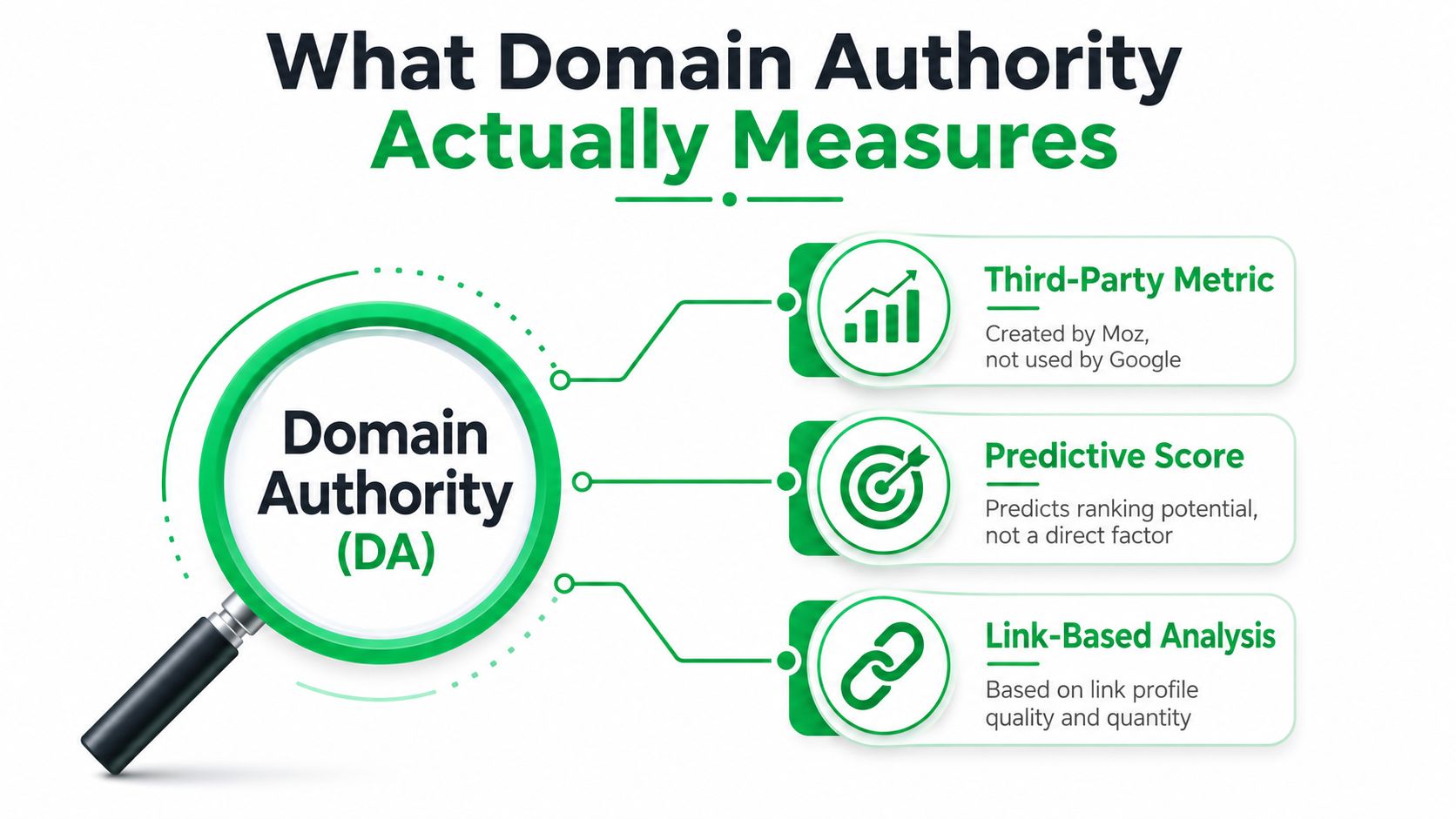
The best reframe is operational, not cosmetic. Do not ask how to force a DA score upward. Ask how to build a domain that earns credible references, cleaner link equity, and stronger topical trust over the next two quarters. That is the work that survives Penguin-era scrutiny and still compounds when your site architecture and internal linking are doing their share of the heavy lifting.
How to Improve Domain Authority: Technical SEO Foundations That Directly Compound
A site can earn solid links and still underperform if the technical base is messy. Start with the crawl path before you start outreach. Check mobile-friendly rendering, HTTPS, an XML sitemap, broken-link cleanup in Google Search Console, faster load times through image compression and caching, and descriptive URLs. Name.com calls out those basics in its domain authority checklist, and they decide whether the authority you earn can be crawled and credited.
A quick mobile pass catches more problems than one might expect. If the layout breaks, navigation shifts, or content disappears on smaller screens, that page loses value before anyone reads it. The same goes for pages that load slowly or hang on heavy scripts, because they waste equity even when the backlink profile is decent.
The technical checks I’d run before any outreach
Start with crawlability. If Google Search Console shows unresolved crawl errors, or if important pages sit behind bad redirects, new links will not help much because the destination is compromised. Then check your sitemap, confirm the site is fully served over HTTPS, and make sure mobile rendering does not break layout, navigation, or content access. If a page is hard to render or slow to load, it leaks value before the visitor even reads it.
Use Google Search Console, PageSpeed Insights, and GTmetrix for different parts of the same diagnosis. Search Console shows what Google is struggling to reach or understand. PageSpeed Insights and GTmetrix show where performance bottlenecks are coming from, especially around images, scripts, and hosting. Descriptive URLs and canonical tags also matter because they reduce ambiguity when similar pages exist.
| Technical Check | Authority Signal Supported | Verification Tool |
|---|---|---|
| HTTPS across the domain | Trust and security | Browser check, Search Console |
| XML sitemap submitted | Crawlability | Google Search Console |
| Mobile-friendly rendering | Usability and indexing consistency | Mobile test, browser review |
| Fast page delivery | Better crawl efficiency and experience | PageSpeed Insights, GTmetrix |
| Broken links and crawl errors fixed | Preserves equity and indexation | Search Console Coverage report |
| Descriptive URLs and canonicals | Cleaner page relationships | Crawl tool, manual review |
If mobile rendering is a weak spot, this mobile optimization guide is worth keeping close while you clean up the rest of the stack.
A site that is hard to crawl or slow to load does not deserve less authority. It just wastes more of the authority it earns.
The point is simple. Fix the plumbing first. Then every link, every mention, and every internal reference has a better chance of compounding instead of disappearing into technical noise.
How to Improve Domain Authority: Site Architecture and Internal Linking as a Hidden Lever
Most guides still over-focus on backlinks and underbuild the site itself. That’s a miss, because current guidance increasingly ties authority to site architecture, internal linking, and pruning weak pages rather than link acquisition alone. Topic clusters, orphan pages, duplicate content, and index bloat all affect how authority flows through a domain, which is why a good structure can outperform a flashy but disorganized backlink sprint. ResultFirst’s authority article gets this part right.
Where internal equity should go first
The pages that deserve the most internal links are usually the ones tied to revenue, service intent, or a cornerstone topic cluster. If your crawl export shows pages with zero internal inbound links, those pages are orphans, and they’re often invisible for practical purposes even if they’re technically live. Connect them only if they deserve to exist. If they don’t, merge or retire them.
A simple rule set keeps this manageable:
- Merge thin overlaps: Combine two pages if they target the same intent and neither has clear link equity of its own.
- Redirect broken URLs: Use a 301 redirect if a previously linked page now returns a 404 but has a logical replacement.
- Leave strong pages alone: If a page already serves a distinct purpose and attracts links or traffic, don’t collapse it into a broader asset without a clear reason.
A clean internal structure is easier to maintain when content planning and architecture are aligned. That’s why the content process in this SEO strategy guide matters here, not just for publishing velocity but for deciding which pages deserve to sit at the center of a topic cluster.
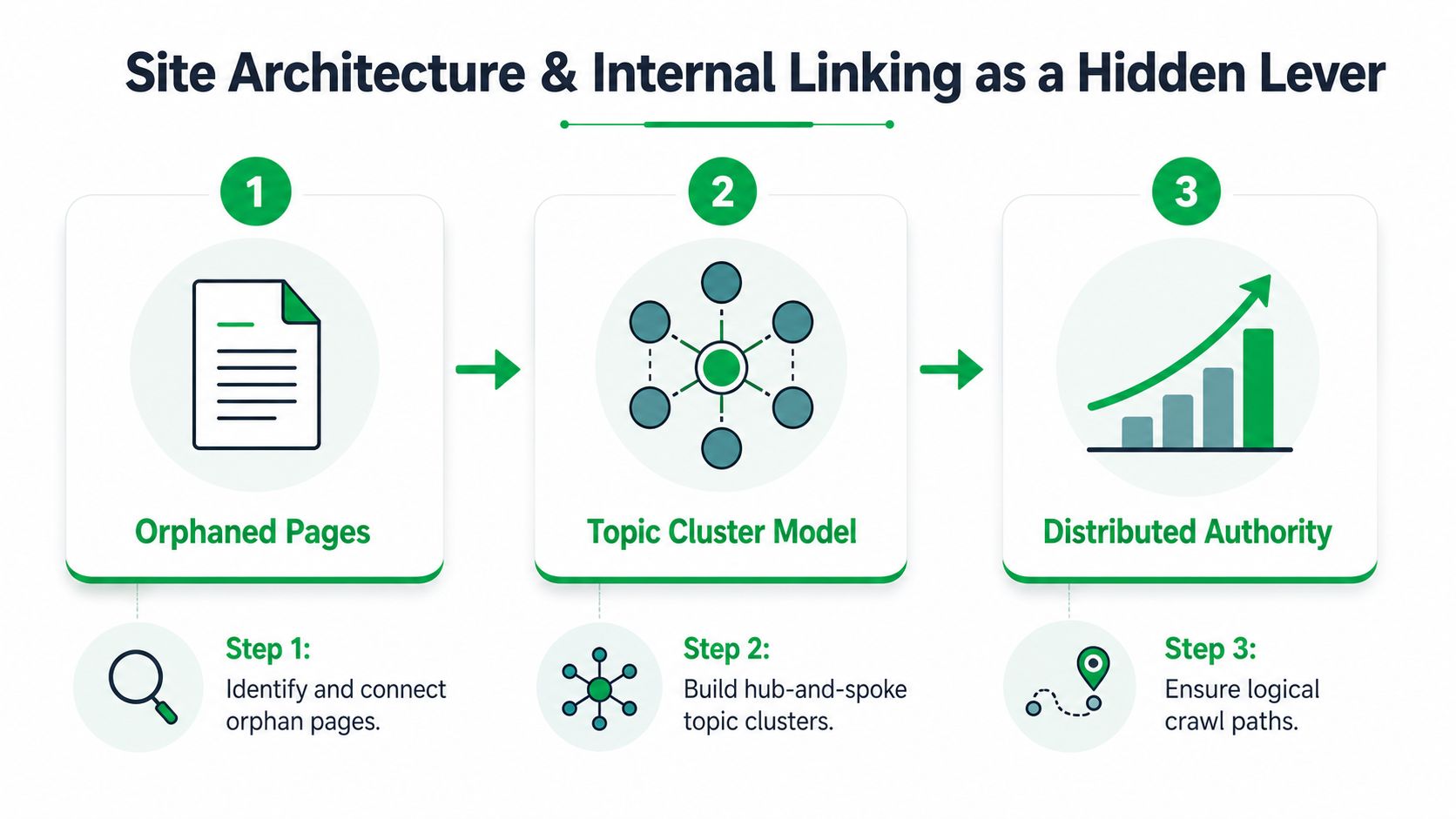
When I audit SMB sites, this is often the fastest structural gain. One good internal link from a strong page can do more than another generic outreach push if the site has been leaking equity through orphaned or competing content. The win isn’t abstract. It’s cleaner crawl paths, better topical grouping, and more authority reaching the pages that matter.
Scalable Backlink Acquisition That Survives Penguin
If the site is technically sound and the structure is clean, backlink acquisition starts to pay off more predictably. Moz’s advice points in the same direction as good practitioners do, build more high-authority links, reduce spammy links, and earn links that can send traffic. That distinction matters because a link that exists only to manipulate metrics fades fast, while a link from a relevant publication can support authority and referral demand at the same time. Moz’s DA improvement guidance separates those levers clearly.
The five tactics worth the time
Original research and analysis work because people cite what they cannot easily copy. Semrush specifically recommends original research, case studies with measurable outcomes, and guides as authority content formats. Those assets earn links over time, especially when they answer a real industry question better than the average blog post. Semrush’s authority guide matches what still works in practice.
Broken-link building is more operational. WordStream lays out the workflow plainly, find broken links with a backlink analyzer, create a replacement resource on your site, then contact the editor and offer the substitute. That gives you a concrete substitution play instead of vague “outreach.” WordStream’s domain authority guide also names directories, guest posting, public relations, and broken-link building as core tactics, though directories only make sense when they are relevant, not when they are sprayed across the web.
For SMBs, I’d prioritize a finite target list. Look for 20 to 40 domains with authority comparable to or higher than yours, then work toward 6 to 12 solid relevant links per quarter and monitor movement every 30 to 60 days. Guest posts are only worth pursuing on stronger, relevant publications, and one practical benchmark often used in authority campaigns is DR/DA 40+ for outreach targets. Keep anchor text varied. Over-optimized anchors are still a Penguin risk, and that kind of shortcut can slow the entire campaign.
The strongest campaigns also connect prospecting to broader outreach process. A clear workflow like the one in this link building strategies for SEO guide helps teams separate research, qualification, and follow-up so the work scales without turning spammy.
Field note: A handful of links from the right places beats a noisy pile from the wrong ones. Search engines are much better at sorting that difference now.
If you need execution support rather than more theory, a boutique provider like Mr. Green Marketing, LLC can handle link acquisition alongside content and technical cleanup as part of a broader SEO program. That only matters if the work is coordinated, because link building by itself will not fix a weak site.
How to Improve Domain Authority: Auditing and Cleaning Up Toxic Links
Old agency work, scraped mentions, spam comments, and low-quality directories tend to collect in the background, and those links can dilute the authority you are trying to build. In practice, cleanup starts with a simple threshold. Moz-style spam scoring below 30% usually looks low risk, while anything above that deserves manual review before you decide whether to keep it, remove it, or disavow it. That makes triage concrete instead of leaving the team to guess. The SEO audit process guide fits directly into that first pass.
A cleanup workflow that doesn’t waste time
Start by exporting referring domains from your backlink tool, then sort them by relevance, language, and quality. If a domain is clearly spammy, foreign-language noise, or part of a hacked network, it does not need a long discussion. It needs a decision. For borderline cases, check whether the link sits on a real site with editorial intent or whether it exists only to pass junk equity.
| Spam Score | Risk Level | Recommended Action |
|---|---|---|
| Below 30% | Low | Keep and monitor |
| Around the middle band | Moderate | Review manually, verify relevance |
| Above 30% | Higher | Attempt removal, then disavow if necessary |
Removal outreach comes first when there is a realistic chance of getting the link taken down. A disavow file is the backstop, not the starting point. Use it for toxic links that will not be removed, especially when you have already documented your cleanup effort. The same audit pass should also catch redirect chains, 404s on previously linked pages, and broken internal links, because all of those waste equity after the fact.
That same review should catch the messy inventory that builds up over time. Redirected agency links, scraped brand mentions, spam comments, and directory listings that never should have existed often sit in the profile for months before anyone notices. If you want the broader cleanup sequence that sits around this work, the audit checklist in the article above gives the right order of operations. The point is simple. New links do not gain much traction until old link debt stops dragging the site down.
How to Improve Domain Authority: Measurement, Timelines, and Your 90-Day Reporting Template
Authority campaigns get messy when nobody knows what progress looks like. Crazy Egg says it’s unrealistic to expect a jump from 10 to 20 in a couple of weeks, and that advice holds up in real client work. Measure monthly or quarterly, not daily, and compare the domain against a small set of direct competitors instead of fixating on the raw number by itself. Crazy Egg’s timing guidance and Moz’s comparative framing both point in the same direction.
A simple cadence that keeps the work honest
The first 30 days are for diagnosis and cleanup. Audit referring domains, anchor text, broken links, redirect chains, crawl errors, and orphan pages. By day 90, the focus shifts to execution, publish link-worthy assets, complete outreach, and secure a small but steady set of relevant links. By day 180, review the trendline and decide whether the site needs more content consolidation, stronger outreach targets, or deeper technical cleanup.
A useful reporting template only needs five KPIs:
- Referring domain count
- Average authority of new links
- Anchor-text distribution
- Organic traffic to cornerstone pages
- DA trendline versus two or three competitors
That keeps the conversation grounded in what’s changing, not what’s wishful. The monthly reporting format in this SEO monthly reporting guide is a good fit if you need to present this to leadership or a client without drowning them in raw exports.
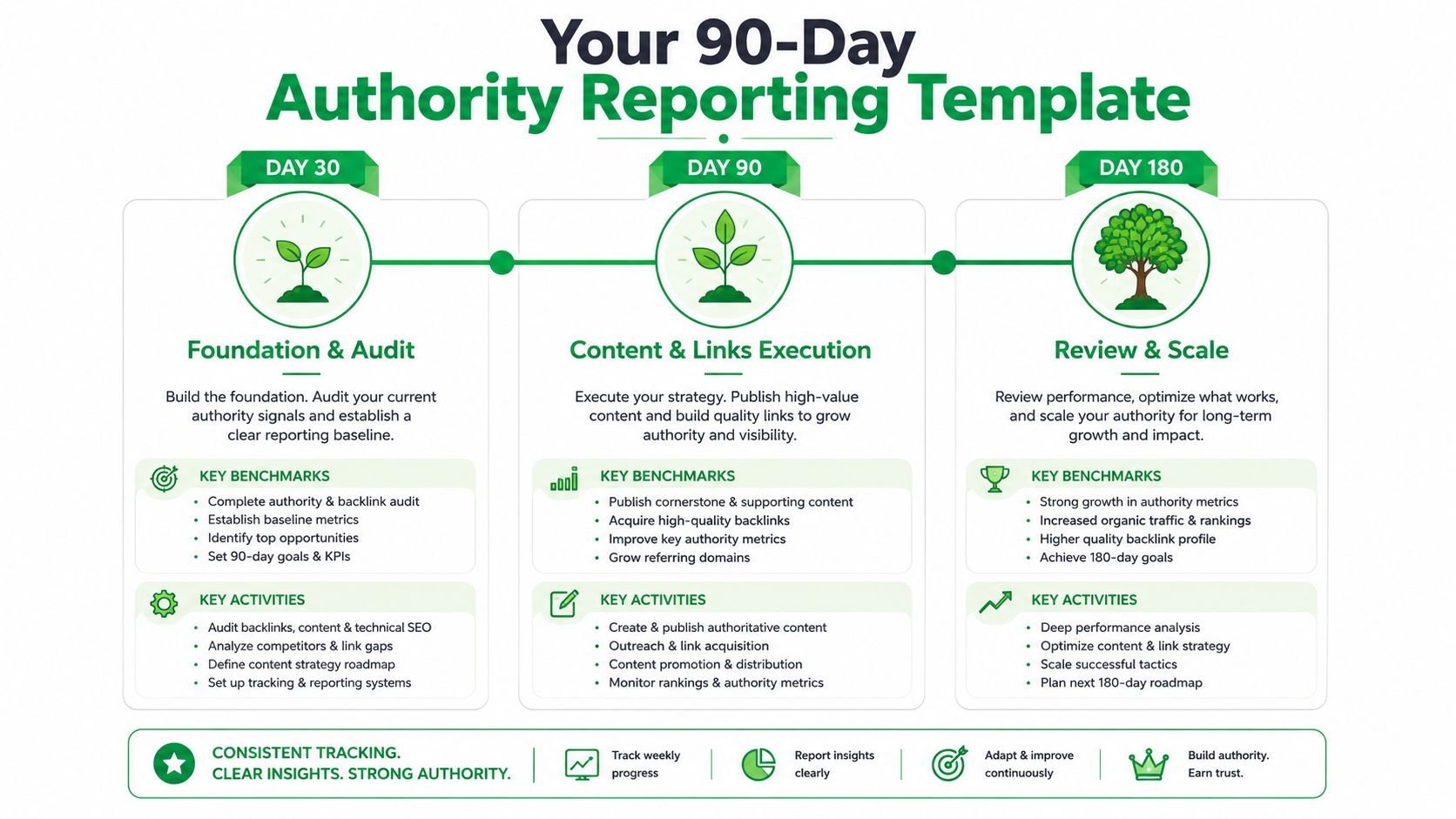
And if a client wants faster movement, say it plainly. Authority is a cumulative metric, so the work compounds after the cleanup and content backlog start aligning. The point of the 90-day cadence is not to promise speed. It’s to make the slow parts visible enough that they can be managed.
Checklist and Common Questions About Domain Authority
Week one, fix the technical basics. Confirm HTTPS, submit the XML sitemap, clear crawl errors, check mobile rendering, and make sure the important pages are accessible and fast enough to load cleanly. Week two through four, map topic clusters, find orphan pages, tighten internal links, and decide which weak pages should be merged, redirected, or removed.
Month two through three, execute outreach against a focused target list, earn relevant links, and clean up any toxic backlink debt that’s still hanging around. Keep the reporting cadence monthly, and compare the domain to direct competitors rather than to a giant in a different niche. If the DA line is flat but referring domains and organic traffic to cornerstone pages are improving, the campaign is usually on track.
Does DA directly affect Google rankings? No. It’s a third-party predictive metric, not a direct Google ranking factor, and that’s why it should be used for benchmarking and trend tracking rather than as the goal itself. How long until results show? Meaningful movement usually takes months, not weeks, and the cleanest way to judge progress is on a quarterly trendline. When is a disavow file necessary? Only after removal outreach fails on links that are toxic.
A lot of SMBs don’t have the time to manage technical cleanup, content production, and link outreach at once. That’s where a coordinated agency process matters more than any single tactic.
If you want this playbook handled end-to-end, Mr. Green Marketing, LLC can run the technical audit, content strategy, and link-building work together so the pieces compound. The team builds SEO programs for SMBs that need cleaner authority signals, better reporting, and outreach that doesn’t waste time on low-value links.
Leave a Comment
sing in to post your comment or sign-up if you dont have any account.