
SEO Services for Startups: And you’re probably in a familiar spot. You raised money, hired fast, shipped the product, and now the board wants traction. Not someday. Now.
But search visibility doesn’t magically appear because the product is good. Plenty of startups are funded, polished, and still invisible. They have a decent site, a few landing pages, some paid spend, and almost no organic pipeline. That gap gets expensive fast.
SEO Services for Startups: The Startup Dilemma Funded But Invisible
You can have funding and still look nonexistent online. That’s the problem.
A founder sees product momentum internally. Investors see a roadmap. Prospects see nothing because your startup doesn’t show up when they search for the problem you solve. Or worse, they find a bloated competitor with weaker software and stronger search presence.
That’s why I push Investor-Grade SEO. Not traditional agency SEO built around vague “authority growth” and pretty ranking reports. I mean SEO tied to traction, lead quality, and revenue validation. If your SEO partner can’t explain how their work supports pipeline, they’re not solving the core startup problem.
The market is big enough that this isn’t optional. The global SEO services market is projected to exceed $83.9 billion in 2026, and organic search drives approximately 53% of all global website traffic according to Yahoo Finance’s SEO market coverage. That same source also notes startups are using AI-driven SEO for GEO, Generative Engine Optimization, to tailor content for AI overviews and chatbots, with claims of 10x faster qualified lead generation than traditional search approaches.
Why traditional startup SEO often misses
Most startup SEO campaigns fail for one simple reason. They act like the company has unlimited runway.
You don’t need a twelve-month content treadmill full of broad topics with weak purchase intent. You need pages that rank for specific problems, answer buyer objections, and help sales conversations move. Fast. That means technical cleanup first, then high-intent content, then authority building around the pages that can generate demand.
Funded startups don’t lose because they ignored marketing. They lose because they funded the wrong kind.
There’s also a second layer here. Investor pressure changes the SEO brief. You’re not trying to “build brand presence” in the abstract. You’re trying to show momentum. Qualified traffic. Demo intent. Sales-assisted content performance. Measurable progress that helps the next fundraising conversation.
SEO Services for Startups: Visibility is part of the fundraising story
Founders usually separate fundraising from SEO. Bad idea.
When investors evaluate your growth engine, they’re asking whether acquisition gets more efficient over time. Search can answer that. If you’re actively raising, a curated resource for early-stage founder funding can help on the capital side, but your marketing side still needs to prove that capital can turn into discoverability and demand. That’s where a focused digital marketing strategy for startups matters.
Investor-Grade SEO does one thing well. It turns “we should rank eventually” into “we’re building a repeatable acquisition channel.”
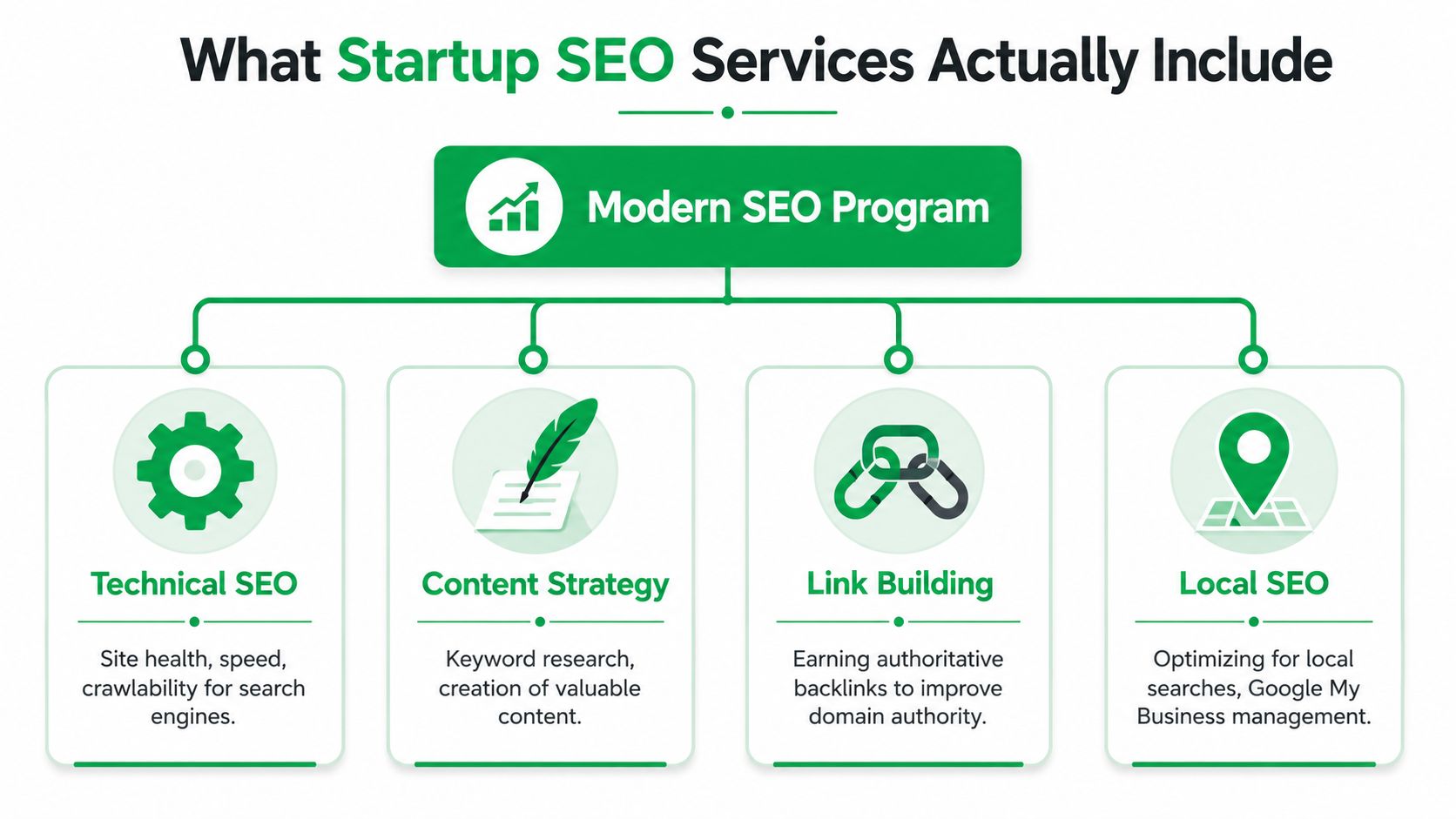
What Startup SEO Services Actually Include
Most founders buy SEO without knowing what they’re buying. That’s how retainers become charity.
A real startup SEO program isn’t a mystery box. It has a few core parts, and each one should have a job. Not busywork. Not reports. A job.
SEO Services for Startups: Technical SEO is the foundation
Technical SEO is your site’s operating system. If it’s messy, everything above it performs worse.
For seed-stage startups, technical SEO should prioritize a mobile load time under 3 seconds and Largest Contentful Paint under 2.5 seconds, based on Averi’s seed-stage SEO benchmarks. That same benchmark guidance also calls for modern image formats like WebP or AVIF, lazy loading for offscreen content, a Cumulative Layout Shift below 0.1, server response times below 600ms, and HTTPS across internal links and canonical tags.
If your developer says this is minor hygiene, push back. It’s not. Search engines need to crawl and understand your site cleanly. Buyers need pages that load without friction. Both matter.
Here’s what technical SEO usually includes:
- Crawl and index checks: Search Console coverage issues, orphan pages, bad canonicals, redirect waste.
- Core Web Vitals work: LCP, CLS, image compression, script cleanup, mobile rendering.
- Site structure fixes: clean internal linking, sensible URL paths, XML sitemap review.
- Schema implementation: organization, product, FAQ, and page-specific markup where it helps.
Content strategy is where startups win early
You are not going to outrank giant competitors for broad vanity terms out of the gate. Stop trying.
Early-stage content should focus on niche queries with a difficulty score under 29% and fewer than 200 monthly searches, again from Averi’s startup benchmark guide. Those are the terms larger companies ignore because the traffic looks small. Founders should love them because the intent is sharper.
A practical content mix looks like this:
| Content type | What it does | Why it matters |
|---|---|---|
| Thought leadership | Builds category perspective | Helps your brand earn attention and links |
| Docs and tutorials | Captures long-tail and developer intent | Pulls in users close to implementation |
| Product pages | Handles comparisons, pricing, security, use cases | Supports conversion and sales conversations |
That architecture lines up with how real buyers move. They learn, evaluate, and then justify.
Practical rule: If a page can’t help a buyer take the next step, it shouldn’t sit at the center of your SEO plan.
SEO Services for Startups: Link building and local visibility still matter
Startups hear “SEO” and think blog posts. That’s incomplete.
You also need external trust signals. That means earning credible backlinks through digital PR, expert commentary, founder stories, partnerships, and useful assets people cite. If you sell locally or regionally, local SEO belongs in the mix too. That includes your Google Business presence, local landing pages, and consistent business information across key platforms.
GEO is now part of modern SEO services for startups
Search isn’t only ten blue links anymore. Buyers ask AI tools questions and expect a direct answer.
That changes content requirements. Pages need clear entity signals, precise structure, concise explanations, and technically sound formatting. Human-written copy still matters most. Tools can assist. They shouldn’t lead.
Good SEO services for startups now blend search optimization with AI answer visibility. That’s not a side tactic anymore. It’s part of the main channel.
SEO Services for Startups: Your First 90-Day SEO Roadmap for Quick Wins
You do not need a year-long grand plan before doing anything useful. You need motion.
The first ninety days should produce signs of life. Better crawl health. Cleaner pages. A handful of tightly targeted assets. Early lead signals. Enough movement that your team can see what’s working and your investors can see that organic acquisition is becoming real.
Start with the roadmap.
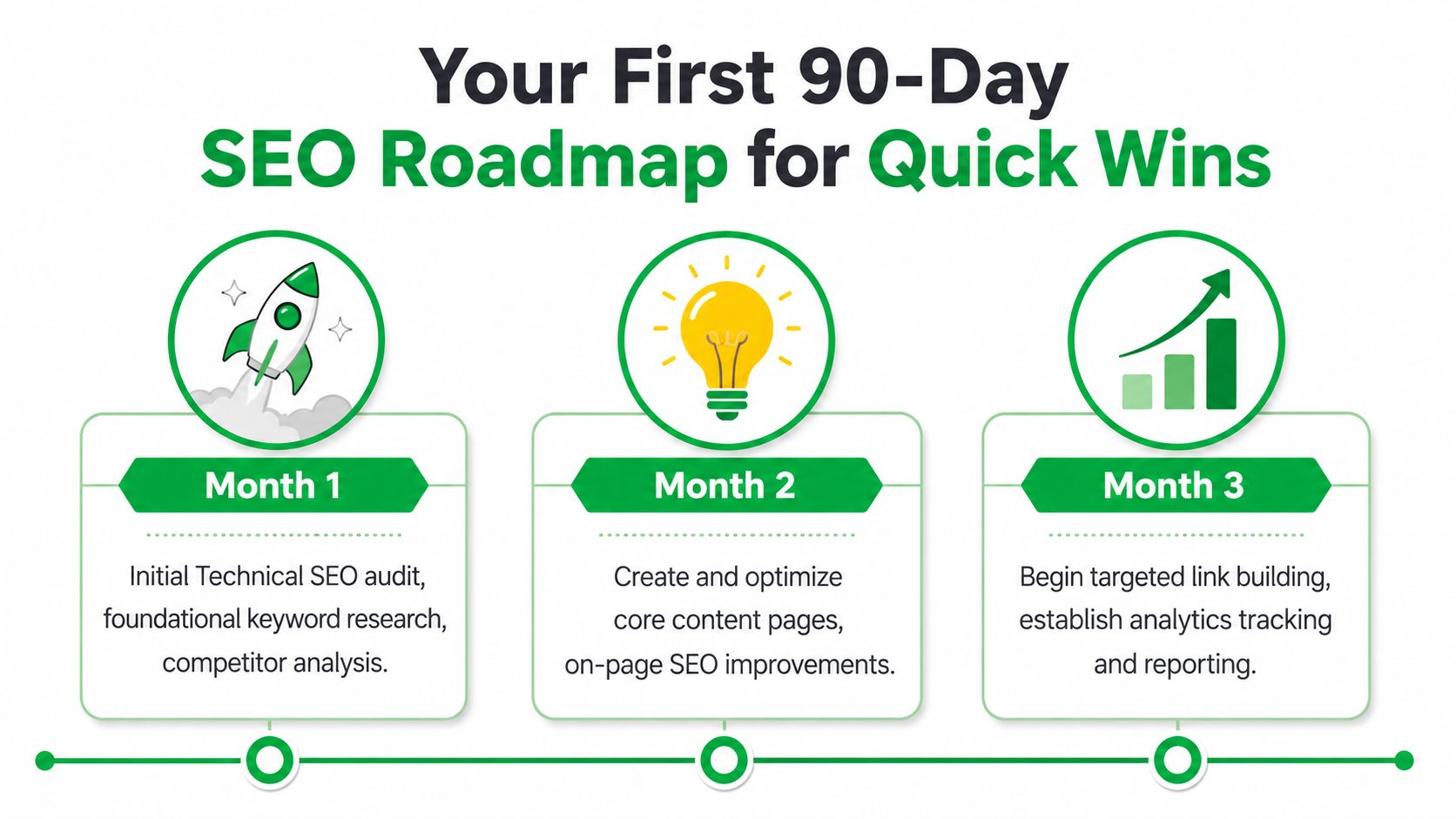
Days 1 through 30 fix what blocks growth
Month one is not about publishing more content. It’s about removing drag.
Run a full baseline audit in GA4 and Google Search Console. Review crawl errors, index coverage, internal link paths, duplicate signals, mobile performance, and page templates. You also need a focused keyword set built around bottom-of-funnel and problem-aware intent, not broad awareness fluff.
If your team needs a practical framework for the site review itself, this set of 10 essential website checks is a useful gut check before you spend money on content.
In this first block, do these in order:
- Repair crawl and index issues: If pages aren’t discoverable or indexable, content work gets delayed.
- Tighten your core pages: Homepage, solution pages, product pages, pricing, comparison pages, and key docs.
- Map intent clusters: Group search terms by use case, pain point, role, and buyer stage.
- Set reporting before scaling: Don’t guess later. Define conversions now.
A short explainer can help align your team on execution priorities.
SEO Services for Startups: Days 31 through 60 publish conversion-focused assets
Many teams tend to overcomplicate things. Don’t.
You need a small number of pages that do specific work. A comparison page that handles competitor searches. A use-case page for a valuable niche. A pricing or security page that answers objections. A tutorial or implementation page that captures practical intent. That’s enough to gain an advantage.
Use this filter before publishing anything:
- High-intent first: Prioritize terms that suggest evaluation, setup, migration, alternatives, pricing, compliance, or specific problem resolution.
- Specificity beats volume: Narrow pages often rank faster and support sales better.
- One page, one job: Don’t cram every audience into one URL.
If your first content sprint creates traffic but no sales conversations, the targeting was wrong.
SEO Services for Startups: Days 61 through 90 build authority around winners
By month three, patterns start to show.
Some pages will get impressions. Some will earn clicks. Some will bring in the right kind of visitor. That’s where outreach and authority building begin. Push backlinks toward pages with commercial value, not random blog posts that look nice in a report.
A simple month-three focus looks like this:
| Priority | Action | Outcome |
|---|---|---|
| Promote strong pages | Outreach, founder commentary, digital PR | Better authority for money pages |
| Refine on-page SEO | Improve titles, internal links, FAQs, examples | Better click and relevance signals |
| Watch lead paths | Track form fills, demo requests, assisted conversions | Clearer investor reporting |
Momentum matters more than volume early. The point of the first ninety days isn’t domination. It’s proof.
SEO Services for Startups: Startup SEO Pricing And How to Budget Without Burning Cash
Most founders ask the pricing question too late. They’ve already burned budget on vague deliverables.
Here’s the clean answer. For startups, the average monthly cost for professional SEO services ranges from $750 to $1,500, according to Reboot Online’s SEO statistics roundup. The same source says leads from organic search have a 14.6% close rate and SEO can deliver an average ROI of 22:1. That’s why I don’t treat SEO as a brand tax. I treat it as a growth investment with a clear efficiency case.

The pricing model that usually fits startups
Retainers work best when you need ongoing execution. That’s most funded startups.
Project pricing can work for a technical cleanup, migration support, or a one-time content architecture reset. Hourly consulting fits founder-led teams that already have an in-house writer or developer and only need strategic direction.
Here’s the blunt version:
- Monthly retainer: best when you need sustained progress and accountability.
- Project work: useful for a narrow problem, risky if nobody owns follow-through.
- Hourly advice: cheap upfront, expensive if your team moves slowly.
SEO Services for Startups: What a lean startup budget should buy
At the lower end of the startup range, I’d expect technical fixes, keyword targeting, on-page optimization, and a focused content plan. Not a sprawling publishing calendar. Not inflated reporting. A concentrated attack on the handful of pages most likely to create revenue opportunities.
At higher spend levels, the service should expand into content production, stronger reporting, and authority building. But more money doesn’t automatically mean better results. A bloated agency package can waste cash just as efficiently as bad paid ads.
A grounded budgeting approach is to start small, tie spend to business outcomes, and raise investment only when the motion is visible. If you want a deeper look at realistic service ranges and tradeoffs, this breakdown of small business SEO cost is worth reviewing.
Spend on pages that can close deals. Not on activity that only fills a dashboard.
That’s the core budgeting rule. It keeps startups from buying prestige SEO when they need traction SEO.
SEO Services for Startups: Measuring What Matters Most Startup SEO KPIs
Traffic is not the goal. Rankings are not the goal. Revenue is the goal.
Too many startup teams stare at total sessions and celebrate movement that has no commercial value. That’s how vanity metrics creep into board decks. A founder ends up saying, “organic traffic is up,” while sales says none of those visitors were worth calling.
The KPI shift founders need to make
Strong startup SEO measurement tracks pipeline metrics, not just visibility. Iceberg’s guidance on SEO services for tech startups makes this point clearly. Performance should be measured against leading indicators, such as organic leads generated from specific content, and lagging indicators, such as closed deals influenced by organic search.
That changes what goes on your dashboard.
Track things like:
- Organic leads by page: Which URLs create form fills, demo requests, or booked calls.
- Conversion rate on key pages: Pricing, comparison, product, and solution pages.
- Sales-qualified progression: Whether organic leads move forward or stall.
- Closed-won influence: Which content appears in journeys that end in revenue.
SEO Services for Startups: Build a dashboard that tells the truth
A good dashboard is boring in the best way. It answers practical questions.
Which pages bring in qualified intent? Which pages assist pipeline? Which topics attract the wrong audience? Which technical fixes improved conversion flow? If a metric can’t shape a decision, it probably doesn’t deserve much attention.
More traffic can mean better SEO. It can also mean you ranked for the wrong things.
That’s why startup teams should review SEO with sales, not just marketing. Sales hears objections, sees lead quality, and knows whether search visitors fit the ICP. When SEO reporting stays isolated, founders get half the story.
If your current agency sends rank reports without pipeline context, that’s not investor-grade reporting. It’s decoration.
SEO Services for Startups: How to Choose the Right SEO Agency or Consultant
Hiring the wrong SEO partner wastes two things startups don’t have enough of. Time and confidence.
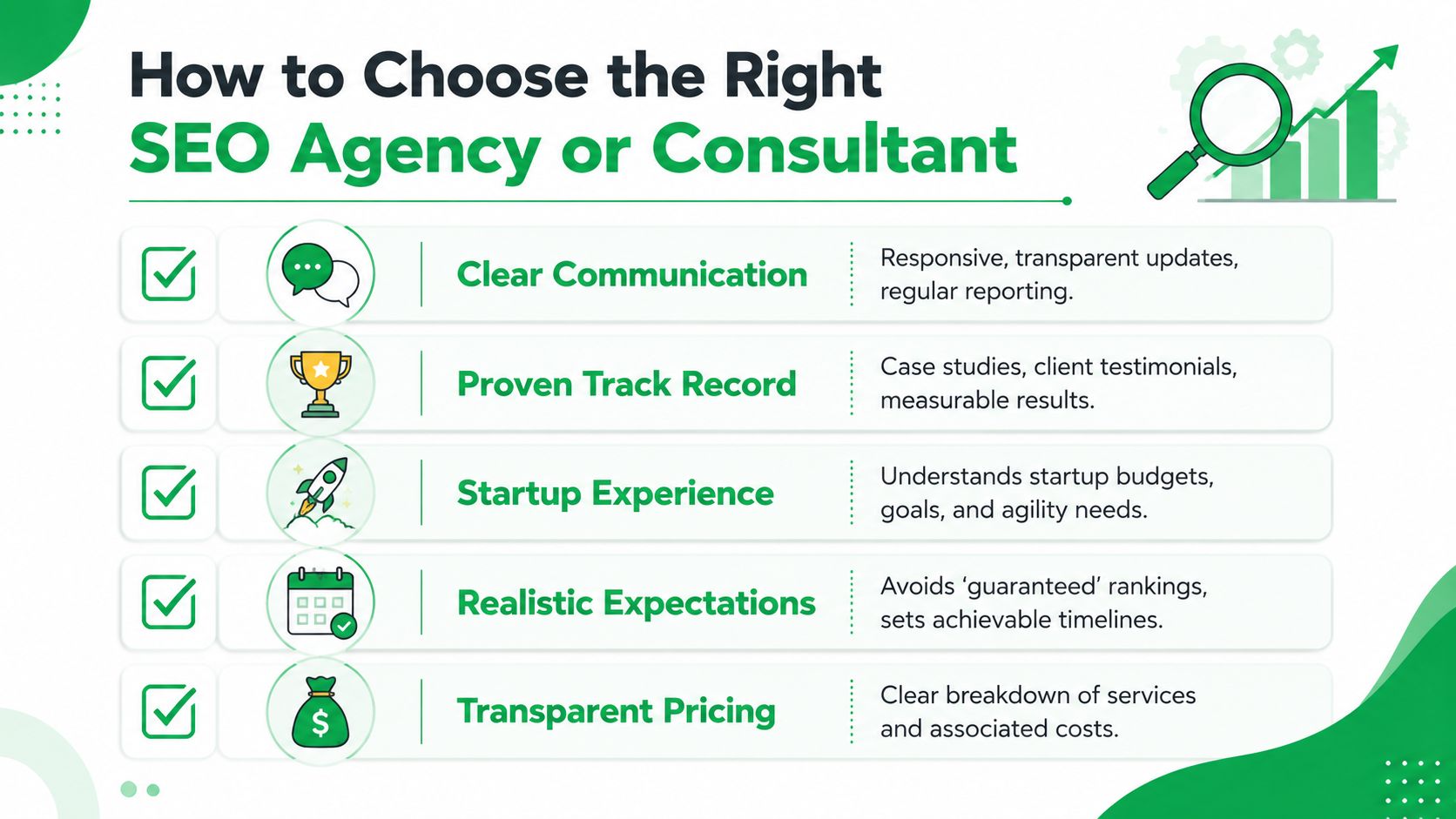
You don’t need an agency that talks well about “topical authority” in a pitch deck. You need one that understands startup pressure, limited runway, and the difference between useful traction and vanity lift.
This checklist helps filter quickly.
Questions that reveal whether they actually get startups
Ask direct questions. If the answers are fuzzy, move on.
- How do you prioritize work in the first quarter? You want a sequence, not a bucket of tactics.
- Which pages would you build first for our business? This exposes whether they understand buyer intent.
- How do you report on lead quality and pipeline contribution? If they only mention traffic and rankings, that’s a problem.
- What do you need from our team? Good agencies know the handoffs required with product, sales, and engineering.
- How do you use AI tools in content and GEO work? They should use tools carefully, not replace strategy with prompts.
If you want another perspective while vetting partners, this guide to startup SEO agencies is a decent companion read.
SEO Services for Startups: The red flags are usually obvious
Founders ignore red flags because they want SEO to feel simpler than it is. Don’t.
Here are the big warnings:
| Red flag | What it usually means |
|---|---|
| Guaranteed rankings | They’re overselling or choosing meaningless targets |
| No access to strategy | They want to hide behind deliverables |
| Generic monthly reports | They don’t know how to connect SEO to business outcomes |
| Huge content promises immediately | They’re using volume to disguise weak prioritization |
| Vague pricing | Scope creep is coming |
Hire for fit, not polish
A glossy proposal means nothing if the team can’t operate inside startup reality.
The right partner should be comfortable with product changes, lean budgets, founder feedback, and fast pivots. They should be able to explain technical issues in plain English. They should push back when your instincts are wrong. And they should know that a startup doesn’t need “all of SEO.” It needs the right slice of SEO at the right time.
For a broader framework on evaluating service partners, this article on how to choose a digital marketing agency is useful.
Hire the team that can tell you what not to do. That’s usually the one protecting your budget.
Conclusion From Invisible to Unstoppable
Startup SEO isn’t a patience game dressed up as strategy. It’s a prioritization game.
The startups that win in search don’t try to do everything. They fix technical friction, publish the pages buyers need, measure pipeline impact, and build authority around the content that moves revenue. That’s what Investor-Grade SEO looks like in practice.
If you’re funded but invisible, don’t respond by demanding more blog posts or broader keyword lists. That usually makes the problem noisier, not better. Start with the gaps that block discovery and conversion. Then build a lean system that proves value early.
That approach does two important things. It gives your team focus, and it gives your investors evidence.
The right SEO services for startups should create momentum you can feel. Better search visibility. Better-fit leads. Better conversations with sales. Not theory. Movement.
Your next step is simple. Audit what exists, cut what doesn’t matter, and put your budget behind pages and fixes that can influence pipeline.
If you want a practical partner to identify visibility gaps, prioritize quick wins, and build a search strategy tied to real business outcomes, Mr. Green Marketing, LLC is a strong place to start. Their team offers free audits and performance reporting, which is exactly what an overwhelmed founder needs before committing more budget.
Leave a Comment
sing in to post your comment or sign-up if you dont have any account.