
3D Cartoon Characters: You’re probably in one of two situations right now. Either your brand already has a visual identity that feels flat, and you need something with more personality, or you keep seeing polished 3D characters in onboarding flows, product videos, and social ads and wondering whether they’re just trendy decoration.
They’re not. Used well, 3D cartoon characters become working brand assets. They explain, guide, reassure, entertain, and give your marketing a consistent face across channels that usually feel disconnected from each other.
The catch is that a character only pays off when it’s built for reuse. Not just for a homepage hero image. For email, paid social, landing pages, short-form video, AR experiments, and whatever your team needs next quarter.
More Than Just a Mascot What Are 3D Cartoon Characters
A lot of businesses still think of 3D cartoon characters as mascots. That’s too narrow.
A 3D cartoon character is a stylized digital character built in three-dimensional space. That means a designer can rotate it, relight it, pose it, animate it, and render it from different camera angles the same way a photographer or filmmaker would work with a physical subject. The “cartoon” part doesn’t mean childish. It means the design uses exaggeration, simplified forms, and controlled visual language to make personality readable fast.
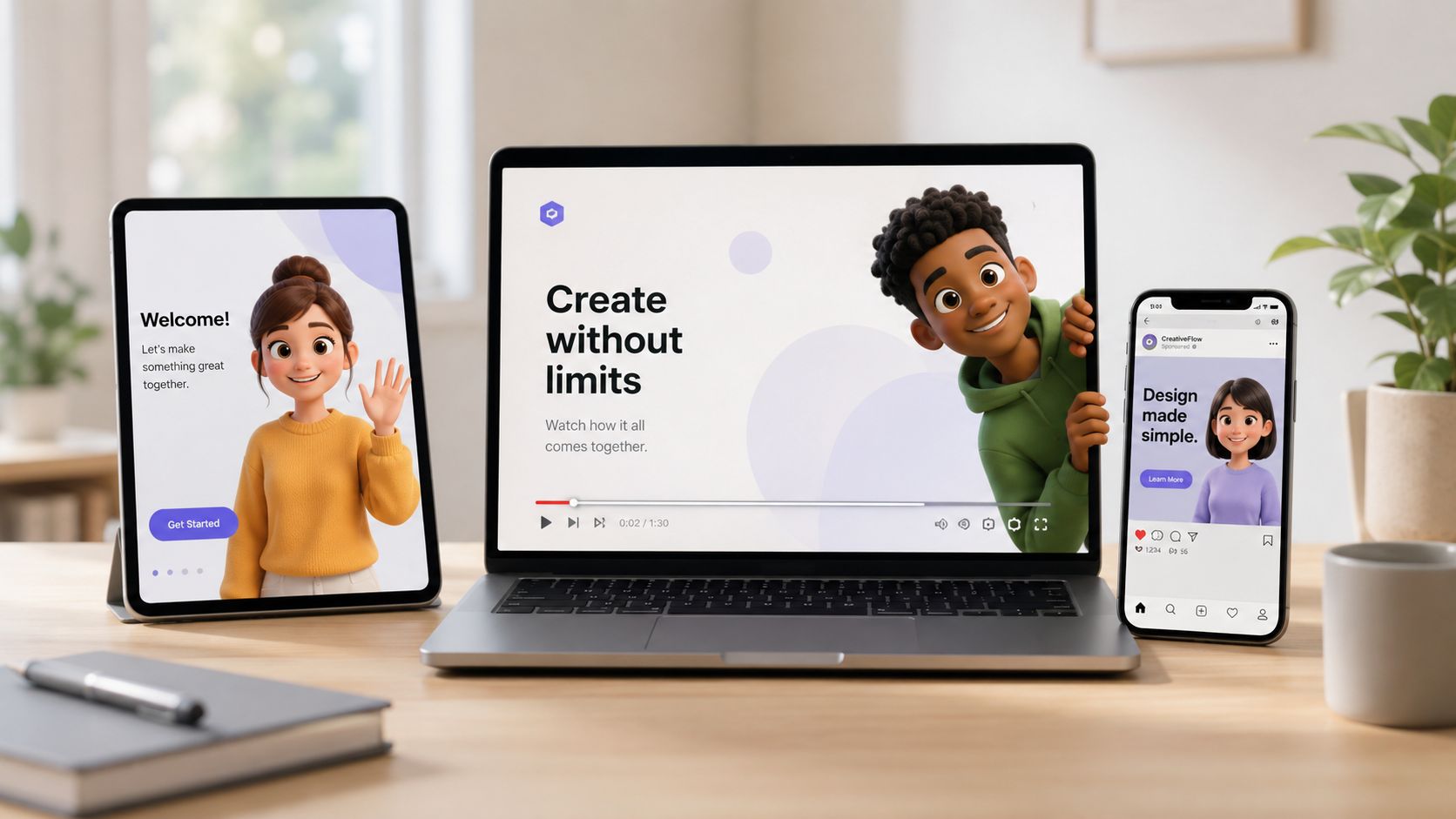
That’s why these characters show up in places where attention is short and clarity matters. App onboarding. Explainer videos. Product walkthroughs. Social clips. Banner creative. A good character gives a brand a repeatable visual shorthand.
Why brands use them instead of generic illustration
Flat illustration can work. Stock photography can work. But neither gives you the same level of ownership and flexibility.
With a strong 3D character, your team can create a library of poses, expressions, scenes, and animations without reinventing the visual system every time. That’s one reason the broader industry matters here. The 3D animation industry was valued at USD 22.67 billion in 2023 and is projected to reach USD 51.03 billion by 2030, with a 12.3% CAGR from 2024 to 2030 according to WOW-HOW’s animation industry overview. That same source notes Toy Story in 1995 as the first feature-length film made entirely with computer-generated 3D animation, while the roots of animated 3D go back to a clip from 1972.
Those milestones matter because they explain why the workflow is mature now. This isn’t experimental anymore. It’s a production discipline with proven pipelines.
Practical rule: If a character can’t carry your brand voice across more than one channel, it isn’t a brand asset yet. It’s just a one-off illustration.
3D Cartoon Characters: What makes them strategically useful
The business value usually comes down to three things:
- Recognition: Stylized characters can become instantly associated with your brand when the shape language is distinctive.
- Clarity: They can demonstrate abstract ideas, software actions, or service benefits without relying on generic screenshots.
- Consistency: One character system can support campaigns, onboarding, product education, and seasonal creative.
If you want a broader primer on how dimensional assets improve flexibility across digital touchpoints, this overview of the benefits of 3D modeling is a useful companion read.
And if your company is still shaping its visual identity, character design only works when it aligns with the bigger brand system. That’s especially true for startups still defining voice, positioning, and visual consistency, which is why this guide to branding a startup company is worth reviewing before you commission anything.
3D Cartoon Characters: The Production Pipeline From Concept to Render
Most clients underestimate 3D character work because they only see the final render. They don’t see the chain of decisions underneath it.
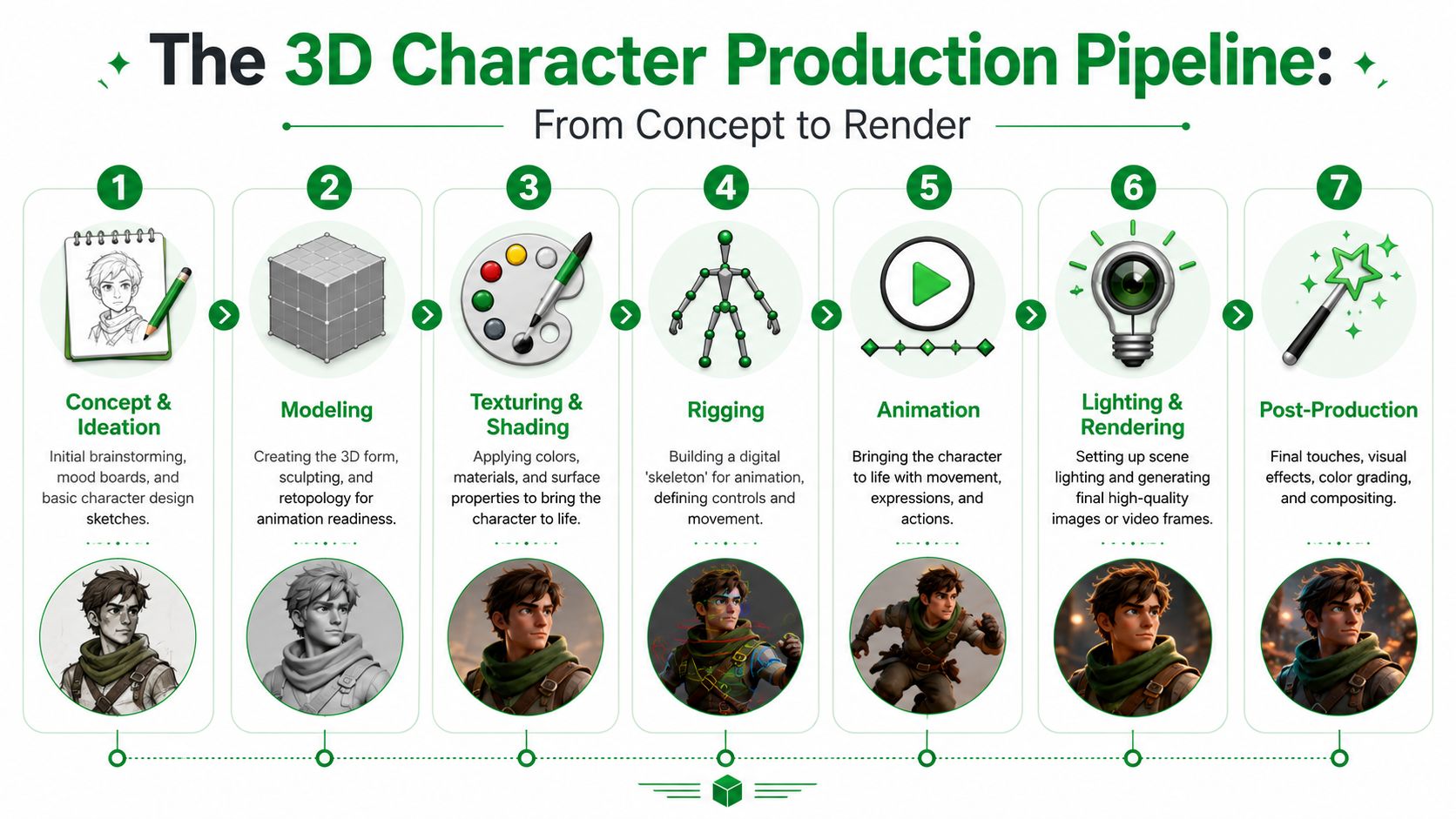
A polished character usually passes through concept design, modeling, texturing, rigging, animation, lighting, rendering, and post-production. If one stage is rushed, later stages get expensive fast. Especially rigging and animation, where weak early design choices start to break.
Where good characters actually start
The process begins on paper or screen with concept work. That includes mood boards, reference gathering, early sketches, personality cues, wardrobe, proportions, and expression studies. Smart teams decide early whether the character needs to feel playful, premium, technical, reassuring, mischievous, or calm.
Then comes one of the most overlooked tests in stylized character design. According to Threedium’s character creation guide, professionals use turntable renders and evaluate the character silhouette from eight directions. Front, back, left, right, plus the four diagonals. If the character isn’t recognizable from those views, the shape language usually needs work.
That single practice filters out a lot of mediocre branding work.
If the outline doesn’t read, the character won’t suddenly become memorable because you added better textures later.
A hairstyle with stronger volume, cleaner limb spacing, or a more exaggerated accessory can solve more brand-recognition problems than surface detail ever will.
3D Cartoon Characters: What happens after concept approval
Once the design holds up, the production stages usually look like this:
- Modeling
Artists sculpt the character in 3D software. In this stage, the form gets built, refined, and cleaned up. - Retopology
The high-detail sculpt is reorganized into animation-friendly geometry. It’s technical work, and it matters. - Texturing and shading
Colors, materials, and surface response are added so the character reacts properly under light. - Rigging
Think of this as a digital skeleton plus control handles. Without it, the model can’t move in a usable way. - Animation
Motion, timing, expression, gesture, and acting all happen here. Personality emerges. - Lighting and rendering
Artists place lights, cameras, and render settings to produce the final images or sequences.
For teams that want a separate lens on how structured creative development works before 3D execution starts, this breakdown of the 6 steps of the design process helps frame the discipline behind good output.
A practical visual walkthrough helps too:
Why the pipeline affects business outcomes
Clients usually care about speed and cost. Fair enough. But the pipeline also affects consistency.
A character designed only for a still image may fail when you try to animate it for Reels or use it in a product demo six months later. That’s why production-readiness should be discussed before modeling starts. Not after the character is approved.
If you want to see how specific concept choices can shape a stylized character system with educational or thematic intent, this piece on designing STEM animal characters is a useful example of how design purpose influences execution.
3D Cartoon Characters: Choosing Your Tools and Tech Stack
Many marketing teams often get blindsided. The character looks great in the artist’s portfolio. Then the file arrives and nobody can use it properly.
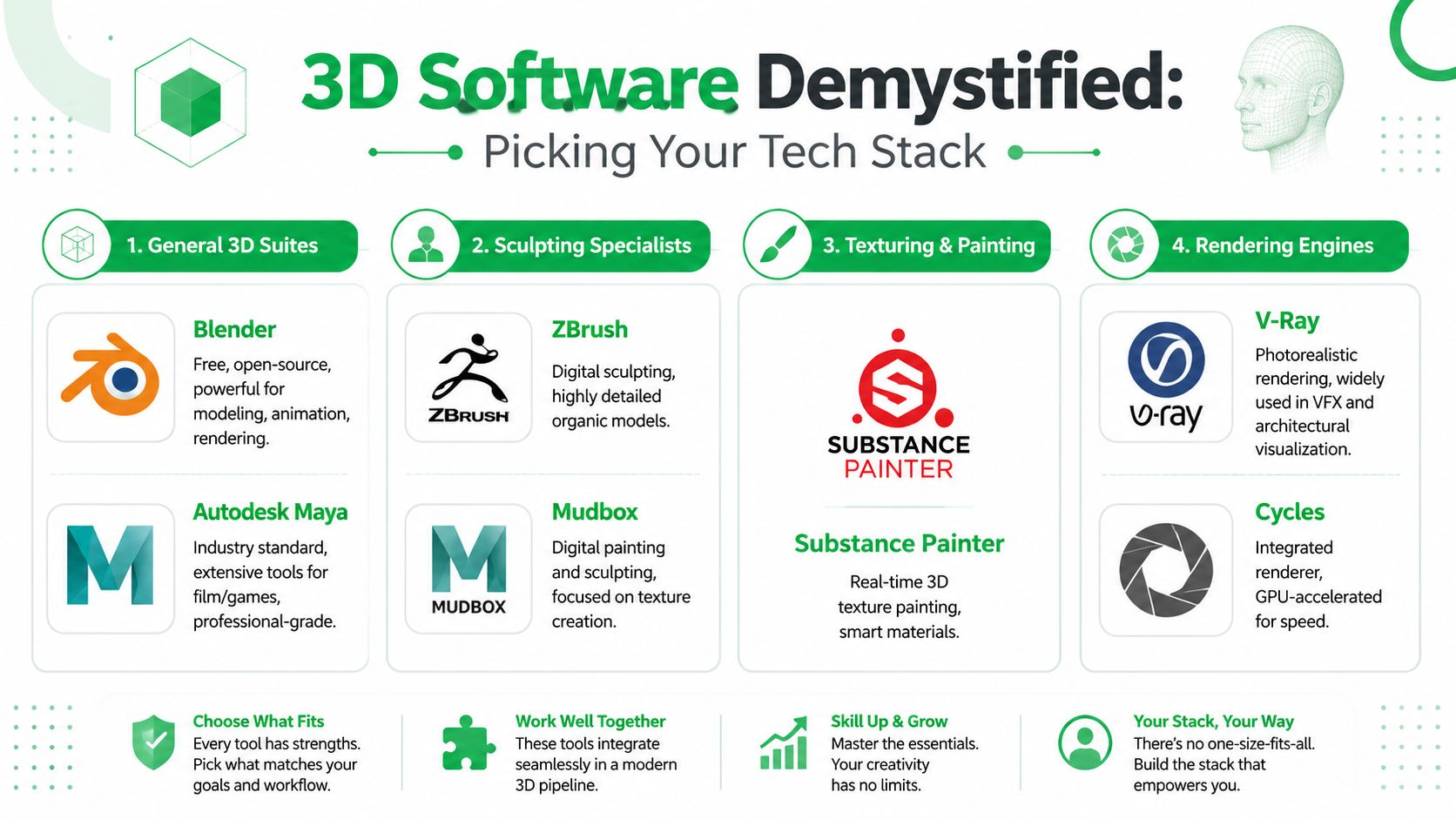
The problem usually isn’t the model itself. It’s the stack. Software choice, export format, rig compatibility, texture packaging, and engine support all determine whether the asset becomes useful or annoying.
Software choices by business need
You don’t need to master the software. You do need to know what your team is buying.
| Tool type | Common tools | Best fit |
|---|---|---|
| General 3D suites | Blender, Autodesk Maya, Cinema 4D | Full character workflows, animation, rendering |
| Sculpting tools | ZBrush, Mudbox | High-detail organic forms and expressive stylization |
| Texturing tools | Substance Painter | Painting surfaces and material behavior |
| Render engines | Cycles, V-Ray | Final image output, look development |
A few practical patterns show up repeatedly:
- Blender is attractive when budget matters and the team wants a flexible all-in-one environment.
- Maya is often chosen when the pipeline leans toward film or game standards and rigging depth matters.
- Cinema 4D tends to fit motion graphics teams already producing branded animation content.
- Substance Painter is often where surface polish gets real.
- ZBrush is hard to ignore when the character style depends on expressive sculpting.
The software itself isn’t the main decision, though. Interoperability is.
3D Cartoon Characters: File formats are not a boring detail
At this stage, projects either stay flexible or become locked to one vendor.
The ecosystem is fragmented, with formats such as MAX, OBJ, FBX, 3DS, and BLEND, which makes cross-platform use a real challenge, as noted in this roundup on 3D cartoon character sources and formats. That same source points to a practical issue many buyers miss: a reusable asset can be highly specific to the software environment it was built for.
Here’s the plain-English version:
- OBJ is commonly useful for static geometry, but it’s limited for animated workflows.
- FBX is often the safer choice when rigs and animation data need to travel between tools.
- BLEND is native to Blender and can be excellent if your production team lives there.
- glTF or GLB can be the better conversation for web and lightweight interactive use, if your vendor supports it.
And then there’s optimization. One commercially available pack ships with 253K triangles across 25 unique characters and is built for Blender 2.91+ with real-world scale, according to the product listing on Superhive Market. That’s a useful reminder that “stylized” doesn’t mean “technically simple.”
Procurement tip: Before approval, ask for the delivery package in writing. Model format, rig format, textures, source files, preview renders, and usage intent. If that list is fuzzy, the handoff will be fuzzy too.
A simple decision screen for marketers
Use this checklist before you buy or commission:
- Need video ads and social clips: Prioritize rig quality and animation-friendly exports.
- Need website or interactive use: Ask early about lightweight delivery formats and performance constraints.
- Need only still renders: A static model may be enough, which can reduce complexity.
- Need cross-channel reuse: Insist on a master asset package, not just final PNGs or MP4s.
That last one matters most. Marketers often approve a character and receive content outputs instead of a usable asset system. Those are not the same thing.
Putting Your 3D Character to Work in Marketing
A character has no marketing value sitting in a folder.
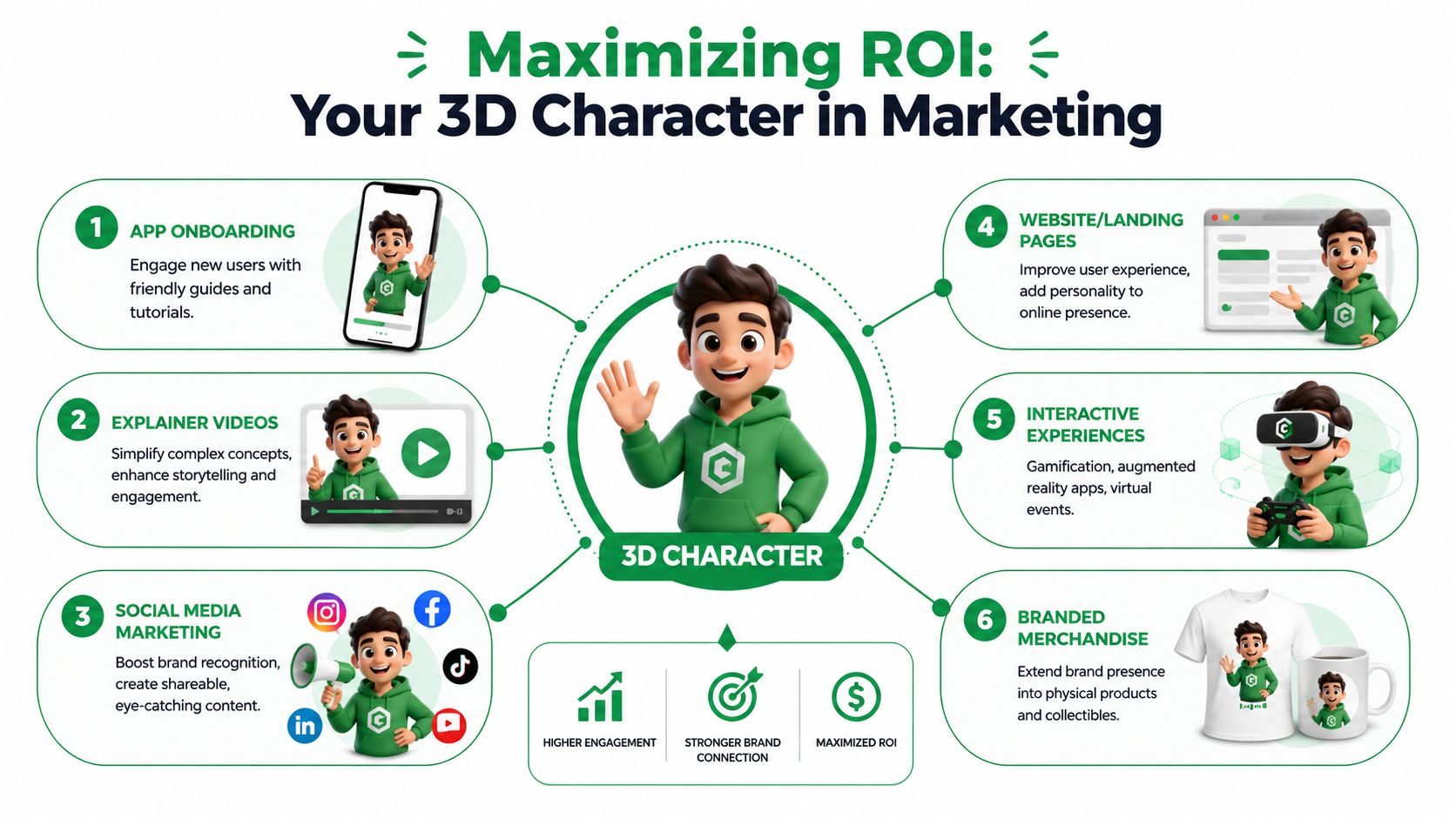
The strongest use case isn’t “we made a mascot.” It’s “we built a branded character system that appears wherever customers need reassurance, explanation, or a cue to act.”
3D Cartoon Characters: Where a single character can earn its keep
Think about a SaaS brand with a complicated setup process. The same character can welcome users in onboarding emails, appear beside setup instructions inside the app, star in a short explainer video, and carry a sequence of paid social creatives that all feel related. Same face. Same shape language. Same tone.
That consistency matters more than realism.
According to Adobe Stock’s marketplace signals around animated 3D characters, stylized 3D cartoon characters can outperform realistic ones in branding when they’re optimized for short-form, multi-channel distribution. Their edge is recognizability and reuse across ads, social posts, and explainer content. That same market demand points to something many teams miss: brands don’t need one beautiful render. They need a repeatable pipeline.
What works across channels and what usually fails
What works:
- Onboarding support with gestures and expressions that make product steps feel less cold
- Explainer videos where the character demonstrates process, consequence, or benefit
- Landing pages where a character anchors the page visually and reinforces messaging hierarchy
- Paid social variations built from the same character rig, pose library, and art direction
- Seasonal campaigns where wardrobe, props, or environments change without changing identity
What usually fails:
- Hyper-detailed realism for brands that need speed and flexibility
- One-off scenes with no reusable source files
- Overcomplicated rigs that the marketing team can’t put back into production
- Channel-blind creative where the same render is awkwardly cropped into every placement
Build the character once. Then build a usage system around it. Poses, expressions, background variants, lighting presets, and export rules.
3D Cartoon Characters: Don’t ignore channel optimization
A character that looks polished in a hero render can look clumsy in a vertical short if the face gets too small, the silhouette collapses, or the textures are too subtle for mobile viewing.
This is also where interactive use gets interesting. If you’re exploring product visualization or branded AR, character assets can become part of commerce experiences rather than just ad creative. For brands evaluating that path, this article on how to improve conversion with AR on Shopify is a practical look at how immersive assets support buyer confidence.
And if video is already a growth channel for your business, the character should fit into that strategy instead of living beside it. This guide to video marketing for small business is useful because it frames content as a repeatable system, which is exactly how a character asset should be managed.
3D Cartoon Characters: Budgeting and Finding the Right Talent
Here’s the honest answer. Custom 3D character work is expensive when it’s done properly because it combines illustration, sculpture, technical production, rigging, motion, and rendering.
That’s not hand-waving. In the U.S., the median annual wage for special effects artists and animators was $99,800 in May 2024, according to the Bureau of Labor Statistics profile for multimedia artists and animators. The same BLS page also notes projected employment growth and ongoing annual openings, which tells you this is a specialized working field, not a hobby market.
What actually drives cost
Price changes based on scope more than almost anything else.
A simple static character for still images is one thing. A fully rigged character with facial controls, multiple outfits, modular props, animation cycles, and cross-platform exports is a different purchase entirely. Add lip sync, secondary motion, or multiple scene renders, and the effort climbs again.
The main cost drivers tend to be:
- Design complexity: Distinct wardrobe, hair, accessories, and stylization all add work
- Rigging depth: A poseable model is cheaper than a performance-ready one
- Output requirements: Stills, short loops, and full narrative sequences are not interchangeable asks
- Revision volume: Endless feedback rounds are where timelines and budgets get bruised
- Asset ownership: If you need source files and broad reuse rights, settle that early
Three ways to get the work done
Most businesses end up choosing between freelancers, agencies, or pre-made assets.
| Option | Best for | Trade-off |
|---|---|---|
| Freelancer | Focused scope, direct collaboration, tighter budgets | More reliance on one person’s pipeline and availability |
| Specialized agency | Larger campaigns, strategy alignment, multi-asset execution | Higher cost, more process |
| Marketplace asset | Fast starts, concept validation, lower-risk experimentation | Limited originality, possible format constraints |
Freelancers can be excellent when you have a clear brief and an internal lead who can manage feedback. Agencies make more sense when the character needs to integrate with broader campaign execution, content production, and brand governance. Marketplace assets are useful for prototypes, internal tests, or situations where speed matters more than exclusivity.
Buy custom when the character is central to your brand. Buy pre-made when you’re testing whether a character belongs in the strategy at all.
How to avoid a bad hire
Ask to see not just pretty renders, but wireframes, turnarounds, rig tests, and examples of the final file handoff. A portfolio full of beauty shots can still hide weak production discipline.
And ask one blunt question: “What will we receive at the end?” If the answer is vague, keep looking.
Answering Your Top 3D Character Questions
A few questions always come up once the project gets real. Here are the ones that matter most.
Is AI useful for 3D character work
Yes, but mostly at the front end and around the edges.
AI can help generate mood boards, early style directions, naming ideas, expression references, and rough concept exploration. It can also speed up some repetitive creative tasks around campaign production. But for brand-safe character systems, teams still need human judgment to decide what should be built, what should be exaggerated, and what will remain usable across formats.
Where AI usually disappoints is consistency. A brand character needs repeatable proportions, controlled expressions, and asset continuity. That still takes a structured pipeline.
How long should a project take
The honest answer is “longer than the first draft of the schedule.”
Timeline depends on the number of approvals, the complexity of the design, whether the character needs rigging and animation, and how organized the brief is before production starts. A still character can move faster than a full system. A reusable marketing character with multiple outputs needs planning room.
The fastest way to slow down a project is to approve concept art before the team agrees on usage requirements. If marketing wants stills, product wants onboarding animation, and sales wants event graphics after the fact, the pipeline gets rebuilt in public.
What should go into the brief
Keep the brief tighter than you think. Vague inspiration boards create vague characters.
A strong brief should include:
- Brand role: Guide, mascot, explainer, educator, seller, or support presence
- Audience fit: Who should connect with the character, and what tone should they feel
- Use cases: Website, ads, social, onboarding, presentations, video, AR, print
- Visual boundaries: Colors, proportions, realism level, forbidden styles, accessibility concerns
- Deliverables: Source files, renders, animations, aspect ratios, transparent outputs, format needs
- Approval process: Who signs off at concept, modeling, and final stages
Should you start custom or use a pre-made asset first
If the character will define the brand, start custom. If you’re still validating the idea, testing with a pre-made asset can be smart.
That approach lets your team learn what it needs. Maybe you thought you needed a fully animated spokesperson, but what really helps is a lightweight character kit for social graphics and onboarding moments. Better to learn that early than after commissioning a heavy custom build.
What’s the biggest mistake brands make
Treating the character like a campaign asset instead of an operating asset.
A campaign asset has one job for one launch. A character system should keep producing value after the launch. That means planning poses, expressions, file formats, motion options, and governance up front. And yes, that extra thinking saves money later.
If your brand needs more than a nice-looking character and you want a system that supports campaigns, content, and conversion paths, Mr. Green Marketing, LLC can help shape the strategy around the asset, not just the visual. That means aligning branding, web, video, SEO, PPC, and creative execution so your 3D character has a job to do and a place to perform.
Leave a Comment
sing in to post your comment or sign-up if you dont have any account.