
Augmented Reality Social Networking: Social media already asks a lot from a small business. You need creative that stops the scroll, offers that convert, and content that doesn’t feel like it came off an assembly line. Then you look at your feed and realize the hard truth. Most posts are still flat.
That’s where augmented reality social networking starts to matter. Not as a gimmick. As a way to move from “look at this product” to “use it right now through your camera.” A customer can try on glasses, preview a sofa in a room, or interact with a branded lens inside an app they already use.
For a founder or marketing manager, the question isn’t whether AR looks cool. The question is whether it improves the metrics you already care about: engagement, product consideration, click-throughs, assisted conversions, and purchase confidence.
Augmented Reality Social Networking: Your Social Media Is About to Get Real
A polished photo can still sell. A short-form video can still perform. But both are passive formats. Your customer watches, maybe taps, maybe saves, then moves on.
Augmented reality social networking changes that dynamic. It turns the camera into an interface. Instead of asking someone to imagine your product in their life, you let them place it, wear it, or interact with it inside the moment. And that shift matters more than most brands realize.
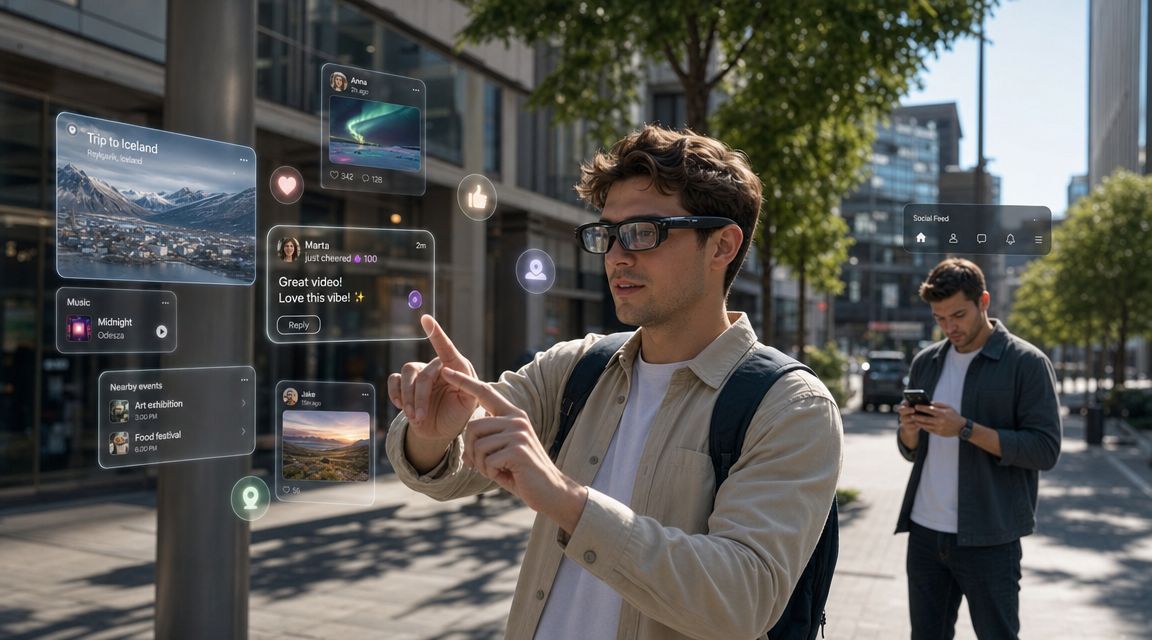
If your current content mix feels crowded and interchangeable, AR offers a different lane. Not for every campaign. Not for every audience. But for brands that sell visual products, location-based experiences, or anything that benefits from “try it before you buy it,” it can become a serious extension of a broader social media marketing strategy for small business.
AR works best when it removes hesitation. If it only adds spectacle, users play once and leave.
Augmented Reality Social Networking: What Augmented Reality Social Networking Actually Is
At its simplest, augmented reality social networking is digital content layered onto the physical world through a phone camera or AR device, then shared or experienced with other people inside a social platform. That could mean a face lens, a 3D product try-on, a location-based effect, or a shared object that multiple users can view in the same space.
It helps to think of it as a digital storefront window that sits on top of everyday life. The physical world stays visible. The digital layer adds interaction, context, and shareability.
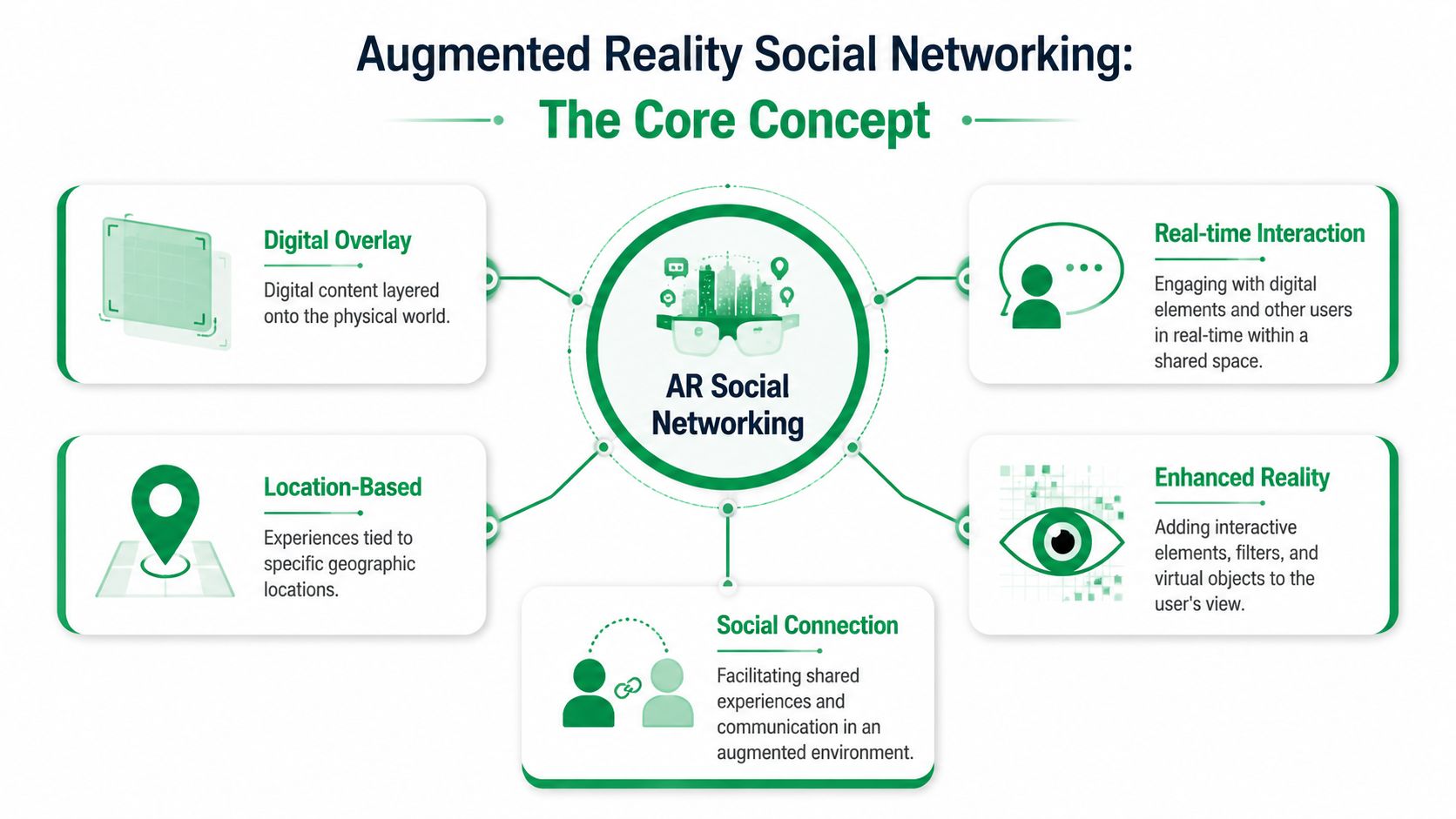
It’s not virtual reality
Virtual reality replaces your surroundings. AR adds to them.
That difference is why AR fits social platforms so well. It doesn’t ask users to buy into a fully separate world. It uses tools they already have, mainly the phone camera, and drops interactive content into environments they know. A lipstick shade appears on your face. A chair appears in your living room. A branded animation appears over a storefront.
For marketers, that lowers friction. Users don’t need to learn a new behavior. They open the camera and start.
Augmented Reality Social Networking: The social part is bigger than filters
A lot of business owners hear “AR” and think face filters. That’s part of it, but it’s not the whole category.
The social layer includes several behaviors:
- Shared creation: People use an effect, remix it, and pass it along in Stories, Reels, Snaps, or short-form videos.
- Co-viewing: Two or more users experience the same digital object or effect in a shared context.
- Location-linked interaction: The effect becomes more meaningful because it appears in a store, at an event, or around a local landmark.
- Commerce assistance: Users test a product visually before clicking through to a purchase page.
A useful historical marker came in 2020, when eMarketer forecast that 43.7 million people in the United States would use social-network AR at least once per month, equal to 20.8% of social network users, with the U.S. total close to 50 million that year and Snapchat expected to lead. That’s the point where social AR stopped looking like a novelty feature and started looking like normal consumer behavior.
What makes it work in practice
The underlying mechanics sound technical, but the business version is straightforward. Good AR social experiences usually rely on a few things:
| Element | What it means for a brand |
|---|---|
| Digital overlay | The product, effect, or animation appears convincingly in the camera view |
| Spatial placement | The object sits where the user expects it to sit, on a face, floor, wall, or table |
| Activation path | The user can launch it easily through an app, link, QR code, or native lens |
| Social sharing | The output is easy to send, post, or reuse inside the platform |
| Clear next step | The experience leads somewhere useful, like a product page, booking flow, or store visit |
And that last point gets missed. A lens without a next action is just digital confetti.
Augmented Reality Social Networking: The Big Players and Standout Examples
The easiest way to understand this space is to look at where people already use it. The major platforms didn’t build AR as a side project. They built it into the camera, the creation flow, and the sharing loop.
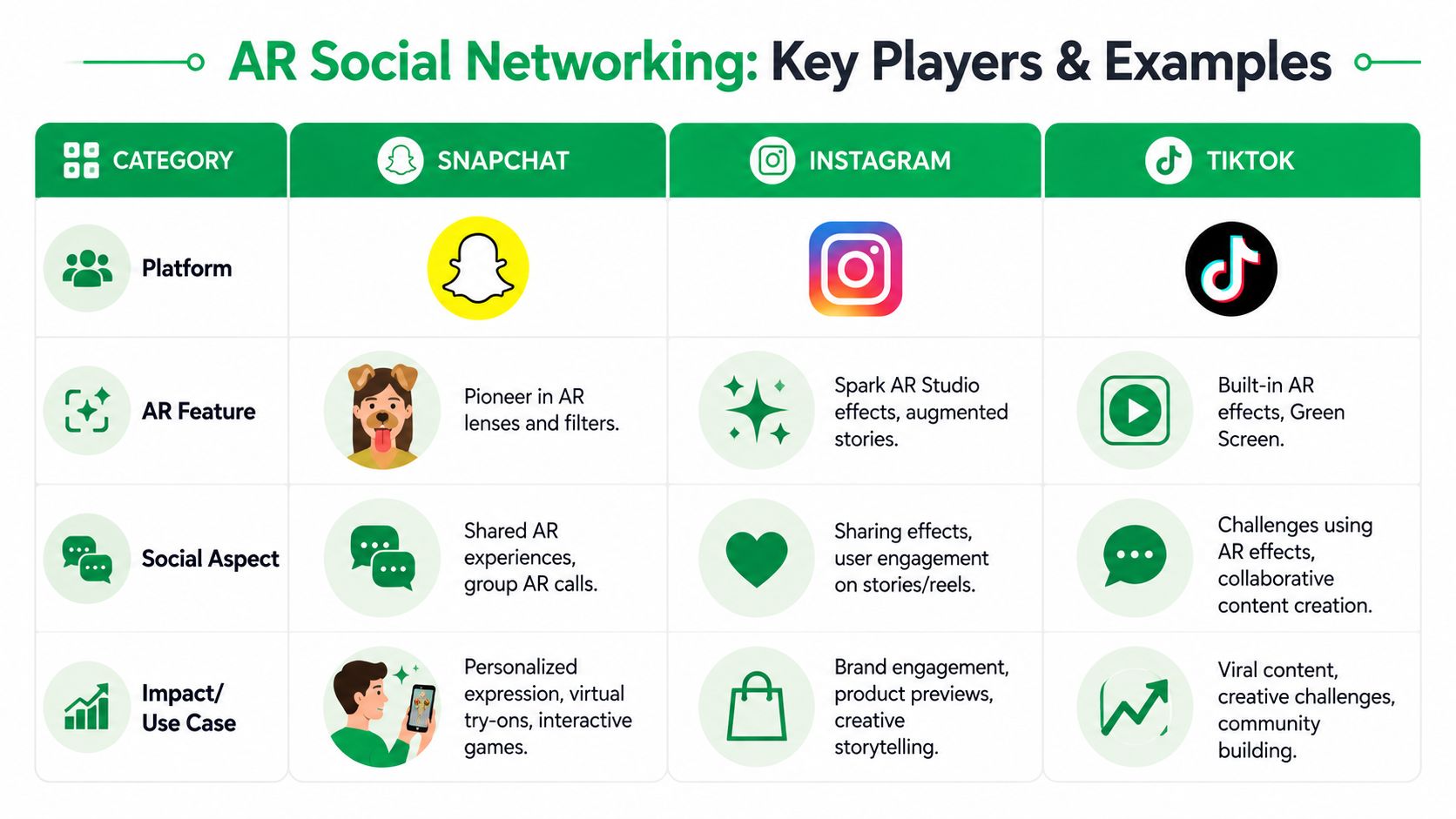
Snapchat still sets the pace
If you want the clearest proof that AR is already normal social behavior, start with Snapchat. According to industry figures cited by Banuba, 200 million users actively engage with augmented reality daily on Snapchat, 9 in 10 medium-sized brands are using AR to power their business, and 88% of mid-sized companies use AR capabilities for product development, training, and marketing.
That tells you two things. First, the audience behavior is already there. Second, brands aren’t treating AR as a one-off stunt anymore.
On Snapchat, the strongest brand uses usually fall into three buckets:
- Virtual try-ons for accessories, cosmetics, and apparel
- Interactive lenses that invite users to play, react, or personalize
- Shareable branded effects built for messaging and fast circulation
Augmented Reality Social Networking: Instagram and TikTok reward different behavior
Instagram tends to work best when AR supports aesthetics, product discovery, and short bursts of branded participation. The effect needs to feel native to Stories or Reels. If it looks like an ad first and a creative tool second, people skip it.
TikTok is different. AR there is less about polish and more about momentum. Effects need to plug into challenges, reactions, trends, or creator-led participation. The best TikTok AR concepts give users a role to play, not just a visual to wear.
Later in the funnel, platform fit matters a lot:
| Platform | Best AR use | Weakest AR use |
|---|---|---|
| Snapchat | Try-ons, playful lenses, direct camera engagement | Overly complex branded storytelling |
| Beauty, style, product previews, creator-friendly effects | Effects with unclear interaction | |
| TikTok | Challenge mechanics, creator prompts, participatory effects | Static branded overlays with no payoff |
Here’s a quick visual example of how the platforms frame the category:
What SMBs should copy
Most small businesses shouldn’t try to mimic a giant brand launch. They should borrow the mechanics.
Field note: The most effective AR campaigns usually do one simple thing very well. They don’t ask the user to learn a mini operating system.
If you run a furniture store, the useful pattern is placement. Let users preview scale and style in a room. If you sell cosmetics, the useful pattern is try-on. If you’re a restaurant, event venue, or local retailer, the useful pattern is location-triggered discovery or shareable in-store experiences.
And yes, smaller brands can compete here. Not by building cinematic AR worlds. By making one practical interaction frictionless.
Augmented Reality Social Networking: Business Uses Beyond Just Fun and Games
The business case for AR gets stronger when you stop evaluating it as “content” and start evaluating it as decision support. Good augmented reality social networking helps a buyer answer a question that static media can’t answer quickly enough.
That question might be: Will this look good on me? Will this fit in my space? Is this worth visiting in person? Can I trust what I’m about to buy?
Product confidence and purchase intent
AR achieves its highest commercial utility in certain applications. VNTANA notes that AR is technically strongest when deployed as interactive 3D try-ons, lenses, filters, and product demos, because these participatory experiences can drive higher conversion than video and increase time on platform.
For a business owner, the practical takeaway is simple. Use AR when visual uncertainty is blocking the sale.
Before AR:
A shopper sees a photo, likes the product, and hesitates.
After AR:
The shopper sees the item on their face, body, or in their home, then clicks through with more confidence.
That use case is strongest for:
- Wearables: Glasses, hats, jewelry, cosmetics
- Home goods: Furniture, decor, lighting
- Packaging-led products: Items where scale or appearance influences trust
- Demonstration products: Anything easier to understand in 3D than in a flat image
Augmented Reality Social Networking: Local discovery that feels useful
A lot of local businesses overlook AR because they assume it belongs to ecommerce. That’s a mistake.
A local campaign can use AR to make a storefront, event, or neighborhood activation more interactive. A mural can trigger branded content. A QR code on a window can launch a lens tied to a promotion. A visitor can access an experience that encourages sharing while also giving them a reason to walk in.
The key is relevance. If the AR layer adds nothing but decoration, it won’t move a real KPI. If it reveals a menu special, a product story, a booking prompt, or a limited-time offer, now it has a job.
Social commerce without the hard sell
The strongest AR social experiences don’t feel like checkout flows with extra steps. They feel like assisted browsing.
That’s why I’d treat AR as a bridge between discovery and conversion, not as a replacement for your product page. It earns attention at the top and middle of the funnel, then hands the user off to a cleaner transaction path.
For teams thinking beyond basic filters, adjacent product categories can also offer smart clues. For example, this guide on how to build a successful AR fitness app is useful because it shows how AR has to support habit formation, usability, and repeat engagement, not just launch-day novelty.
What works and what doesn’t
Here’s the blunt version.
Works well
- Try-before-you-buy interactions that reduce doubt
- Simple branded effects users understand immediately
- In-store or event-based activations tied to a concrete action
- Product demos that answer “how will this look or work?”
Usually falls flat
- AR with no conversion path
- Complicated onboarding
- Effects that are funny once but irrelevant to the brand
- Heavy 3D experiences that load slowly or confuse the user
A good AR experience should behave like a great sales associate. Helpful. Fast. Present when needed, then out of the way.
Augmented Reality Social Networking: Key Technical and User Experience Considerations
Most AR projects fail in boring places. Not in the concept deck. In the load time, the camera permissions prompt, the broken placement, the unsupported device, the awkward first interaction.
That’s why strategy matters before production starts.
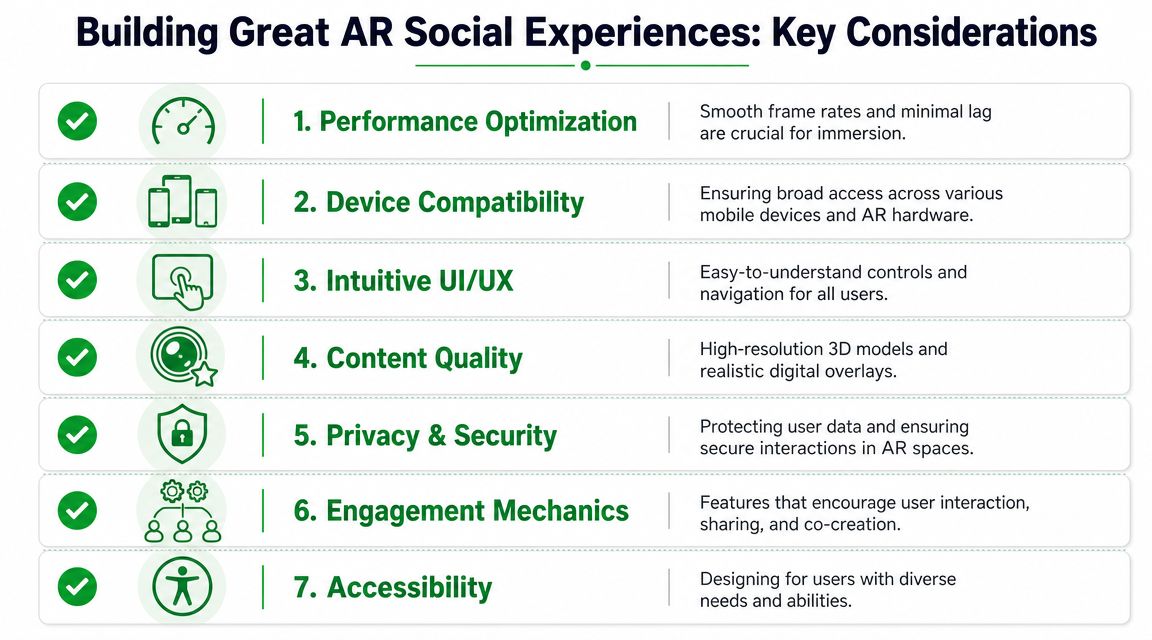
Speed is part of the experience
For shared AR to feel live, the system has to respond almost instantly. The Interaction Design Foundation notes that social AR systems require sub-10 ms interaction latency to preserve liveness, and once latency rises above roughly ten milliseconds, users perceive the experience as less immediate.
That matters even if you’re not building an advanced multiplayer feature. Users don’t separate “creative” from “technical.” If the experience drags, jitters, or lags behind movement, they call it bad and move on.
Augmented Reality Social Networking: Placement and visibility affect social presence
There’s another subtle issue. Better visuals don’t automatically create better connection.
Research summarized in a Frontiers study on social presence in AR shows that when virtual characters appear outside the augmented field of view, users report significantly lower social presence, even if task performance doesn’t change. In practical terms, if your effect sits awkwardly at the edge of the experience, users may understand it but still feel less engaged.
Put the important element where attention already goes. Don’t make users hunt for the point of the interaction.
Questions worth asking before you launch
If you’re hiring an agency, freelancer, or internal team, use questions like these:
- How does the experience start? Through a lens, QR code, product page, ad unit, or in-app camera?
- Which devices are supported? You need a realistic view of where it works well and where it degrades.
- What is the fallback? If AR doesn’t launch, the user still needs a useful next step.
- What is the primary action? Share, save, click, add to cart, book, or visit.
- How will we test usability? AR needs real-world testing, not just desktop approval.
If you need a broader primer on interaction planning, this breakdown of how to design a thriving social networking site is helpful because it focuses on behavior, participation loops, and usability. And for AR-specific validation, structured UX testing services are often underestimated.
Augmented Reality Social Networking: Navigating Privacy Safety and the Rules
AR asks for a level of access that ordinary posts don’t. Camera access. Environmental context. Sometimes face mapping, object recognition, location, or motion data. That changes the trust equation immediately.
A customer may enjoy the effect and still wonder what your app or platform is collecting in the background. Fair question.
Treat consent as part of the product
A neutral industry source notes that AR applications can collect significant personal and environmental data, creating potential surveillance risks, while brands must navigate privacy compliance, user consent, and mobile performance constraints as AR moves toward persistent social experiences. You don’t need to be alarmist to take that seriously.
For a business, the practical standard is straightforward:
- Say what’s being accessed before the user is surprised by it
- Explain why it’s needed in plain language
- Limit collection to what the experience requires
- Avoid vague retention practices that create avoidable distrust
If your AR effect uses camera access only to power a try-on, say that. If location improves the experience, explain the benefit. Users are far more comfortable when the value exchange is obvious.
Safety isn’t just a legal issue
There’s also a brand safety layer. Social AR is interactive, shareable, and often user-generated in effect. That means moderation, context, and misuse matter. A branded effect can be repurposed in ways you didn’t intend. A location-based activation can create behavior you didn’t plan for. And some experiences are inappropriate in certain environments.
That’s why teams building public-facing experiences should study modern trust and safety strategies before launch. Not because AR is uniquely dangerous, but because interactive content scales faster than policy once users get hold of it.
Augmented Reality Social Networking: The reputation angle is real
Privacy mistakes in AR don’t stay technical for long. They turn into screenshots, comments, and public criticism.
That’s where social reputation management becomes part of deployment, not cleanup. If users are confused about permissions, uneasy about data usage, or frustrated by device issues, your team needs messaging ready before the rollout starts.
Practical rule: If your AR experience needs an explanation longer than the user’s attention span, simplify the experience or rethink the ask.
Trust compounds slowly. It disappears fast.
Measuring Success and What Comes Next
AR campaigns get judged too often on applause metrics. People talk about novelty, buzz, and “wow factor.” Those can matter, but they don’t tell you whether the campaign helped the business.
For SMBs, the better approach is to tie the experience to a small set of operational KPIs.
The metrics that actually matter
Track metrics that connect user interaction to business movement:
- Engagement rate inside the experience: Not just impressions, but whether users interact with the AR element
- Time spent in experience: Useful for judging whether the effect held attention long enough to matter
- Share rate or save behavior: A sign the experience had social value beyond the first use
- Click-through to product or booking page: The bridge from interaction to intent
- Conversion actions after exposure: Add-to-cart, lead submission, appointment request, or purchase completion
A founder doesn’t need a huge dashboard. A tight measurement plan is better. If the goal is product consideration, focus on try-on completion and click-through. If the goal is foot traffic, focus on launches tied to local activation and downstream store actions. If the goal is awareness, sharing behavior matters more.
What’s next for augmented reality social networking
The direction is pretty clear. AR is moving away from one-off novelty filters and toward more persistent, utility-driven social experiences. More commerce support. More shared interaction. More pressure on performance, privacy, and platform fit.
And that’s the part smart businesses should pay attention to. The winners won’t necessarily be the brands with the flashiest effect. They’ll be the teams that use AR where it removes friction, supports trust, and fits the rest of the customer journey.
Small businesses can play here. They just need discipline. Start with one use case. Make it easy to launch. Tie it to a real KPI. Then iterate based on what users do, not what the creative team hoped they’d do.
If you’re exploring how AR fits into your broader digital growth plan, Mr. Green Marketing, LLC can help you connect emerging formats to practical outcomes like stronger UX, better conversion paths, and measurable campaign performance.
Leave a Comment
sing in to post your comment or sign-up if you dont have any account.