
Small Business Branding Services: You’ve probably felt this already. The business is real, the work is good, clients are happy, and yet your market presence feels stitched together from five different versions of you.
Your website sounds one way. Your Instagram sounds another. Your proposals look like they came from a different company entirely. Maybe your logo is fine. Maybe your logo is even good. But the business still feels fuzzy when people try to describe it, refer it, or remember it.
That’s usually the point where owners start shopping for branding. And they often ask for the wrong thing first.
They ask for a logo refresh when the actual problem is inconsistency. They ask for colors when the underlying issue is positioning. They ask for a tagline when sales conversations keep drifting because nobody has agreed on what the company should be known for. Small stuff on the surface. Expensive underneath.
If that sounds familiar, spend some time reading the best blogs for small business growth. Not because you need more theory, but because seeing how other operators solve visibility and growth problems can sharpen your own judgment fast.
Branding, done well, is not decoration. It’s an operational system for how your business presents itself, speaks, makes choices, and scales. It gives your team reusable rules instead of one-off guesses. And that changes everything. Marketing gets easier. Sales materials stop drifting. New hires stop inventing their own tone. You stop paying for the same clarity problem over and over.
Small Business Branding Services: Introduction
A lot of small businesses look busy but don’t look coherent.
That sounds harsh. It’s also common.
A contractor might have a strong local reputation, solid reviews, and a website that still reads like a placeholder. A consultant may post useful insights online, then send a proposal deck that feels generic. A product-based business may have good packaging, but no consistent story connecting the website, email flows, and social content. Same owner. Same business. Different signals everywhere.
The invisible drag of inconsistency
Branding, then, earns its keep.
Not because buyers sit around admiring brand systems. They don’t. They notice whether your business feels clear, credible, and easy to trust. They notice whether your message lands the same way on the first touch, the sales call, and the follow-up email.
Branding is what keeps your business from reintroducing itself every time someone meets it.
Without that system, teams improvise. Designers pick whatever looks clean. Salespeople write their own language. Social posts drift toward trends. The website says one thing, while the founder says another. No single choice is catastrophic. Together, they create friction.
Branding as a working system
Good small business branding services fix that at the root. They don’t just hand over a logo file and wish you luck. They define the business clearly enough that future decisions become easier.
If your company were software, branding would be the operating system, not the wallpaper. The visual layer matters, sure, but what matters more is the logic underneath. How the system behaves. How consistently it runs. How easily other tools plug into it.
And once that system exists, your marketing stops starting from zero.
What Are Small Business Branding Services Really
Most owners think branding means logo, colors, fonts, maybe a tagline.
That’s the front door.
The house is everything behind it.

The logo is not the brand
A logo helps people identify you. It does not explain why you matter, who you serve best, how you’re different, or what your business should sound like in a sales email.
That’s why weak branding projects often disappoint. The files arrive. The reveal looks polished. Then nothing really changes operationally. The website still needs rewriting. Sales still tells a different story. Social content still feels improvised.
A high-quality branding service goes wider and deeper. It creates a full identity system that guides both expression and execution.
According to Brandville Group’s breakdown of expert branding services for small businesses, a strong engagement typically includes a positioning statement, audience clarity, brand pillars, a visual identity system, messaging or verbal identity, touchpoint branding, and rollout support.
What you’re actually buying
When you hire for small business branding services, you’re not just buying design. You’re buying decisions made in advance.
That includes things like:
- Positioning clarity so your business isn’t described five different ways
- Audience definition so your copy stops trying to speak to everyone
- Brand pillars that anchor what you stand for and what you don’t
- Visual standards for color, type, layout, and imagery
- Verbal identity so your tone sounds like one company, not a committee
- Touchpoint rules for proposals, presentations, social posts, web pages, packaging, and email
- Rollout guidance so the new brand gets used
Practical rule: If the deliverables only improve how the business looks, but not how the business communicates and decides, the branding work is incomplete.
Small Business Branding Services: Why this matters in day-to-day operations
Owners often underestimate how much waste comes from inconsistency.
Every time someone asks, “Which version of the logo should I use?” or “How should we phrase this?” or “Does this sound like us?” they’re paying a hidden tax. Not always in money that day, but in delay, rework, and diluted trust.
Good branding services reduce that tax. They turn recurring judgment calls into reusable standards.
That’s why the best branding work feels less like a mood board and more like infrastructure.
Small Business Branding Services: The Building Blocks of a Powerful Brand Identity
A strong brand identity has a few core parts. Miss one, and the rest starts pulling too much weight.
Some businesses lean hard on visuals because strategy feels abstract. Others obsess over messaging but never build a usable design system. The result is usually the same. Something feels off.
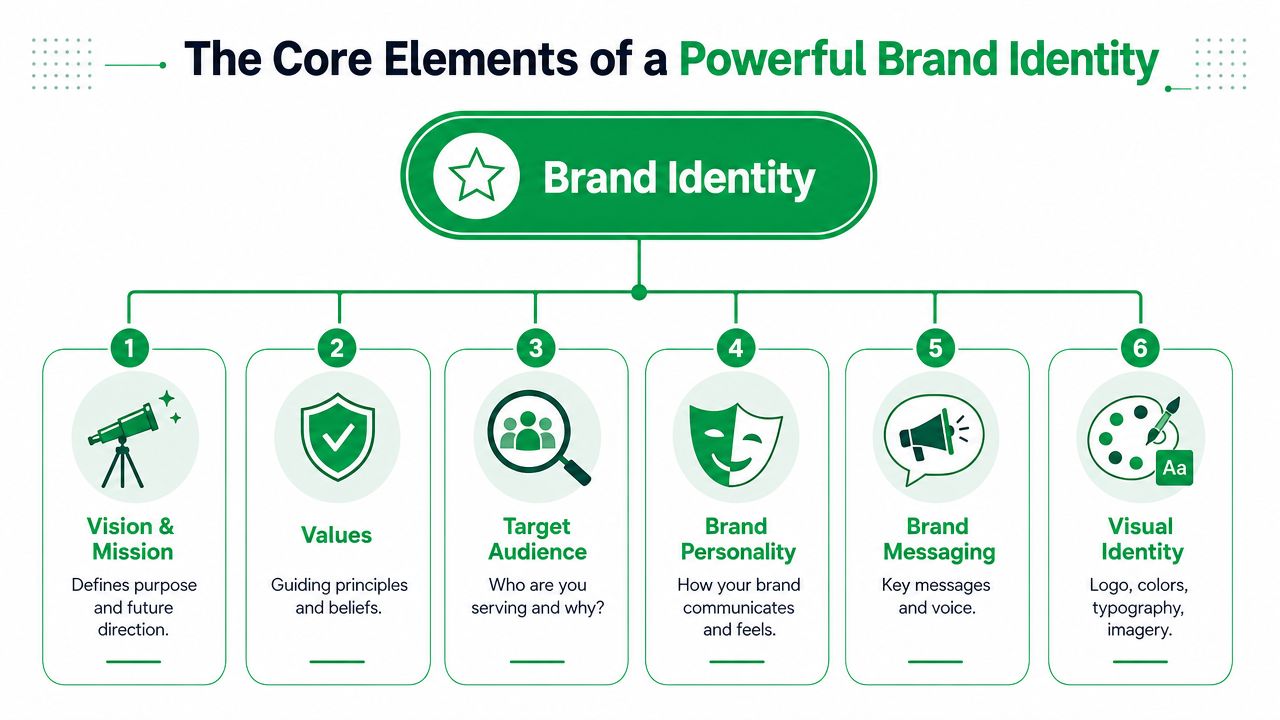
Brand strategy
This is the foundation. It answers the plain questions many companies skip.
Who are you for? What problem do you solve? Why should a buyer choose you instead of a near substitute? What territory do you want to own in the customer’s mind?
If strategy is weak, design has to compensate for confusion it didn’t create.
A useful strategy layer usually includes:
- Audience clarity that goes beyond “small businesses” or “busy professionals”
- Positioning that explains your angle in a competitive market
- Brand pillars that define repeatable themes in your messaging
- Competitive context so you stop sounding interchangeable
For a local accounting firm, strategy might mean deciding whether the brand should emphasize responsiveness, industry specialization, or founder-led guidance. Those aren’t cosmetic choices. They shape every touchpoint after that.
Small Business Branding Services: Verbal identity and messaging
This is your voice in practice. Not just tone, but message discipline.
Verbal identity covers how the business sounds on the homepage, in lead nurture emails, in proposal decks, on service pages, and in sales conversations. It often includes message hierarchy, proof language, vocabulary choices, and a tone-of-voice guide.
One sentence takeaway. If your team can’t explain what you do in the same way, your brand message isn’t finished.
Later, if you’re refining visual presentation too, this piece should connect with practical design decisions such as font personality and readability. A useful related reference is this article on modern fonts for logos, especially if you’re weighing brand feel against legibility and scale.
For businesses that sell merchandise, uniforms, or event gear, verbal identity also needs to translate into physical brand moments. If branded apparel is part of your mix, this guide on blank hats for small businesses is a good example of how material choices affect perceived brand quality in practice.
Here’s a short primer that helps frame the idea visually and strategically:
Visual identity
This is the part people recognize first. It includes logo systems, color palette, typography, imagery style, layout approach, iconography, and design patterns.
Visual identity matters because it compresses meaning. Clean, consistent visuals can make a business feel credible before anyone reads a sentence. Sloppy or generic visuals create doubt, especially in crowded service categories.
But visuals need a job to do.
A logo without a system is like buying a front door before the house plans are finished.
A practical visual identity should work across website headers, social graphics, sales decks, proposal templates, signs, packaging, and internal documents. If it only looks good on a mockup, it isn’t ready for real use.
Small Business Branding Services: Why Smart Businesses Invest in Professional Branding
The easiest mistake is treating branding like a cosmetic upgrade. Something nice to have once the “real” growth work starts.
In practice, branding affects growth work directly.
Multiple branding studies report that consistent presentation across channels can increase revenue by 10% to 20%, while color alone can improve brand recognition by up to 80%, according to this roundup of branding statistics for small business owners. That’s the business case in one line. Consistency changes outcomes.
Trust gets built faster
Small businesses rarely get the luxury of long evaluation cycles. Buyers make quick judgments.
When your website, social presence, proposals, and follow-up emails all feel like they came from the same company, trust builds faster. The reverse is also true. Inconsistent branding creates hesitation, and hesitation slows conversions.
The same source notes that 53% of customers expect small businesses to have a brand purpose and 82% of people are more likely to trust a company whose high-ranking executives actively use social media. For owner-led businesses, that matters. Buyers aren’t only evaluating the logo. They’re evaluating the signals around leadership, clarity, and intent.
Small Business Branding Services: Better branding supports pricing power
Small businesses often underprice because they can’t confidently frame their value.
Branding helps by tightening the story. It gives the business a sharper position, a clearer promise, and more coherent proof. When those pieces line up, price conversations get easier because buyers understand what they’re paying for.
Not magically easier. Just cleaner.
A well-branded business tends to sound more specific, look more stable, and feel less risky. That changes how prospects compare options. And if you’re trying to show up where buyers are already searching, this piece on winning modern search with LLMs is useful because brand visibility now extends beyond classic search listings into AI-generated discovery environments.
Recognition compounds
Brand recall isn’t glamorous, but it matters. Especially when your buyer isn’t ready today.
If the visual cues, tone, and message stay coherent over time, people remember you more easily. They can refer you more accurately. They can spot your content faster. Those are small wins individually. Together, they lower acquisition friction.
A good brand also helps inside the business.
- Sales teams use stronger language because the offer is clearer
- Designers and freelancers move faster because standards already exist
- Founders spend less time rewriting basic company descriptions
- New hires learn the brand faster because the rules are documented
That’s one reason branding should be treated like infrastructure, not a finishing touch.
Small Business Branding Services: A Look Inside Branding Packages and Pricing
A business owner gets three branding quotes and sees a spread from a few thousand dollars to a five-figure project. Same service label. Very different work.
That pricing gap usually comes down to scope. One package covers visual basics. Another gives you the operating rules behind the brand, the messaging to support sales, and the templates your team can reuse without starting from zero every time.
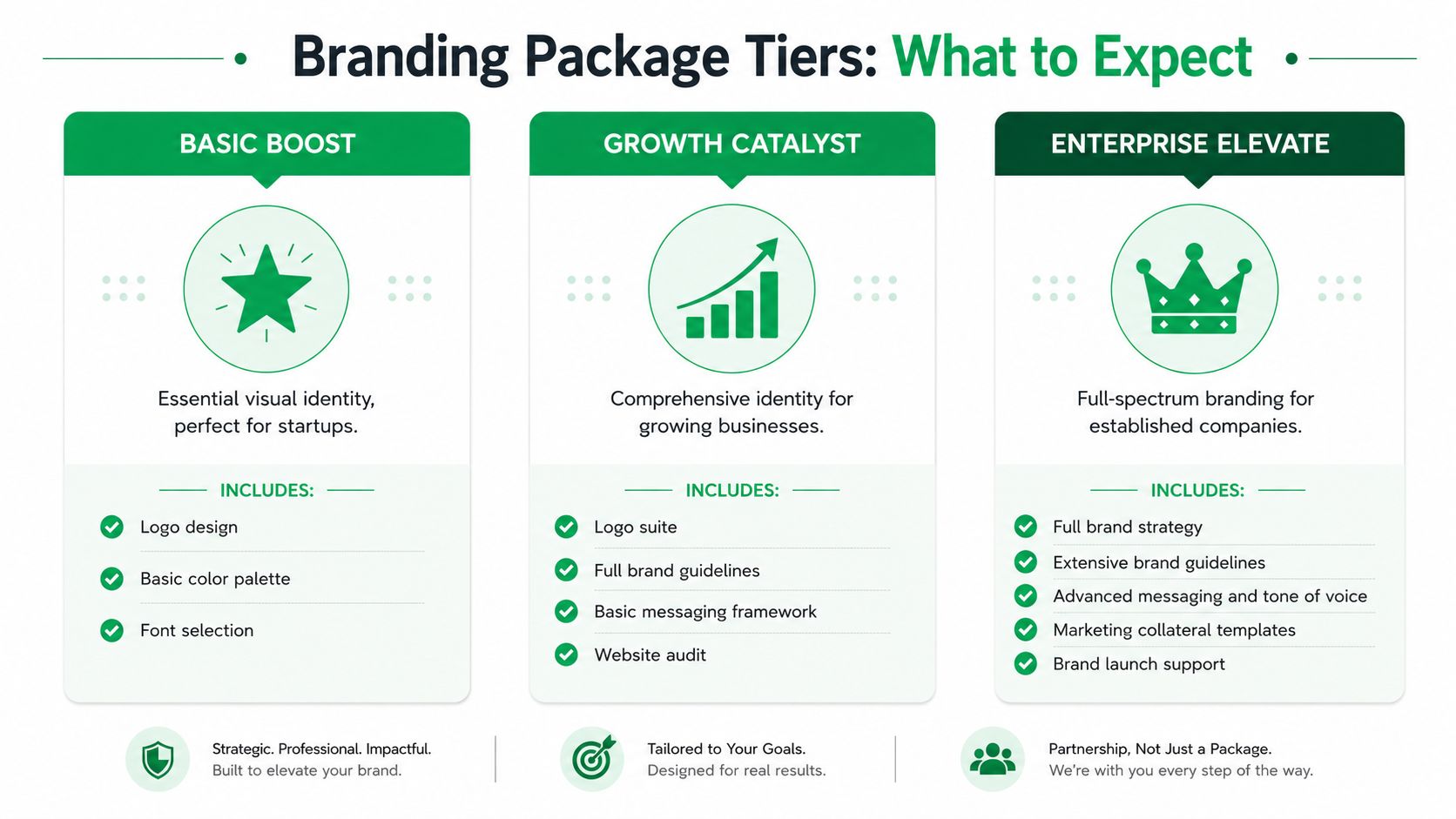
Three common tiers
The better question is not “How much does branding cost?” It’s “What business problem is this package built to solve?”
| Package tier | Best fit | Typical focus |
|---|---|---|
| Starter kit | New businesses that need a credible first identity | Basic visual identity and simple launch assets |
| Complete identity | Growing businesses with traction but inconsistent messaging | Strategy, messaging, and fuller design system |
| Brand system | Companies scaling across channels, teams, or offers | Cross-functional brand rules, templates, and rollout support |
Small Business Branding Services: What each level usually includes
Starter kit
This tier fits early-stage businesses that need to look credible fast without spending on a large strategic engagement. It usually includes a primary logo, a secondary mark, a basic color palette, and font recommendations.
That can be enough for a business still testing demand.
It is rarely enough for a business with message confusion, a crowded offer set, or multiple people creating marketing materials. A starter package gives you parts. It does not always give you a system.
Complete identity
At this stage, branding starts paying off beyond design.
A stronger package often includes positioning work, core messaging, voice guidance, and clearer rules for how the brand shows up across web copy, sales decks, social posts, and email. Consistency is a core value. Your team spends less time debating tone, rewriting introductions, and patching together visuals from old files.
If you’re weighing branding against other growth costs, this guide on how much it costs to advertise helps put that budget decision in context.
Brand system
This tier is built for companies with more moving parts. Multiple offers. Multiple channels. More than one person touching the brand.
According to Parallel’s overview of small business branding services, advanced engagements often include competitive mapping, audience personas, design systems in tools like Figma or Illustrator, customer journey mapping, and a tone-of-voice guide. In practice, that means the brand can be used across the website, sales materials, social content, presentations, packaging, internal docs, and future campaigns without rebuilding the wheel each time.
Cheap branding can lower the upfront bill and raise the cost of rework later.
Small Business Branding Services: Why pricing feels inconsistent
Branding is priced in two very different ways.
Some firms sell it as a design deliverable. Others sell it as business strategy with design output attached. Neither model is wrong, but they solve different problems and produce different kinds of value.
That is why company size is a weak shortcut. A solo consultant selling a high-ticket service may need sharper positioning than a larger local business with a simple offer. A retailer with several product lines may need naming structure and category logic more than a new service business needs visual range.
Good branding packages do more than produce assets. They reduce future decision fatigue. They give your team rules, reusable components, and a clearer standard for what fits the brand and what does not. That is why a higher-priced package can be cheaper over time if it cuts revision cycles, freelancer guesswork, and inconsistent marketing.
Small Business Branding Services: The Branding Process from Kickoff to Launch
A branding project usually starts when the business has hit a wall. Sales materials all look different. The website says one thing, the owner says another, and the team fills in the gaps on the fly. At that point, branding is no longer a design task. It is an operating problem.
A good process fixes that by building a system your business can reuse. The goal is not a pile of files. The goal is a set of decisions, standards, and assets that make marketing faster, sales clearer, and future updates cheaper.
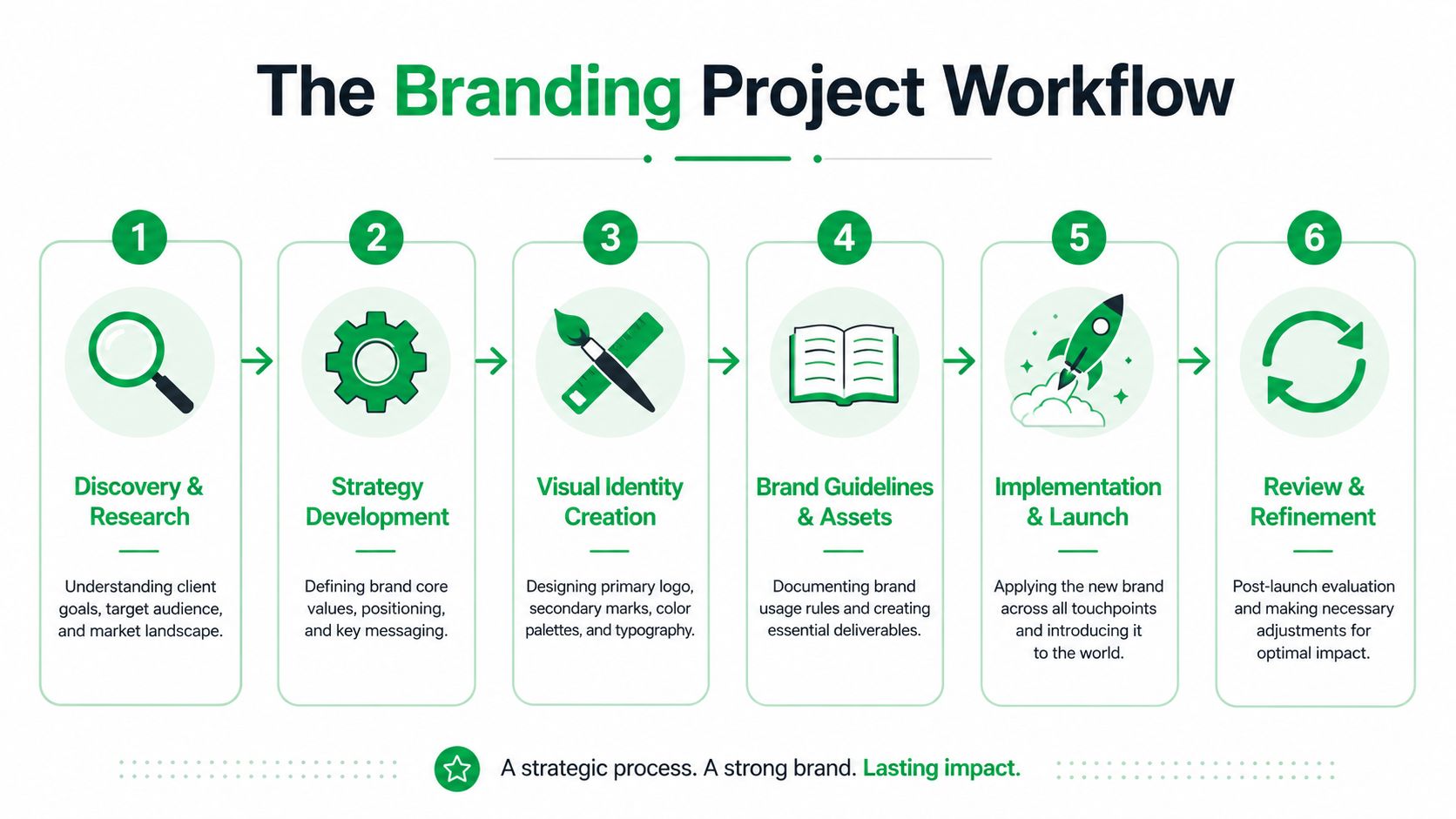
Discovery and audit
This stage is diagnosis.
A serious branding partner reviews what already exists, how customers describe the business, how competitors frame similar offers, and where the current brand breaks down in real use. That includes the website, sales deck, proposals, email follow-up, social presence, signage, packaging, and any internal documents customers see.
The point is to find the friction. Common problems include:
- Message drift across web, sales, and social
- Audience confusion caused by broad or conflicting language
- Design inconsistency across customer touchpoints
- Offer sprawl that makes services or products hard to understand and sell
If this part is skipped, the project can still produce attractive work. It just will not solve much.
Small Business Branding Services: Strategy and concept development
Once the patterns are clear, strategy sets the rules.
Positioning gets sharpened, audience priorities get narrowed, and the brand starts acting like a decision framework instead of a mood board. Good strategy reduces the number of choices your team has to make later. It gives sales a clearer story, gives marketing a tighter brief, and gives designers boundaries that prevent random creative detours.
Strong concepts also create trade-offs. A brand cannot be premium, casual, technical, playful, broad, and hyper-specialized at the same time. Choosing a direction means giving up weaker options so the right ones can repeat across every channel.
Design, feedback, and rollout
After strategy, the identity gets built into working parts. That usually includes logo variations, color rules, typography, layout patterns, messaging examples, templates, and brand guidelines your team can use without calling the agency every week.
Feedback matters here. Vague reactions slow the project down and often push it off course. Useful feedback ties back to the business goal. For example, “this feels too polished for our practical buyer” is far more helpful than “I just don’t like it.”
Final delivery should support launch, not just handoff. Files alone are not enough. The team needs rules for applying the brand to the website, proposals, email signatures, sales materials, social graphics, packaging, and internal templates. That is what turns branding into an operational system instead of a one-time creative exercise.
If you are evaluating agencies before kickoff, this guide on how to choose a marketing agency helps clarify what a sound process should include.
Small Business Branding Services: How to Choose a Partner and Maintain Your Brand
A branding partner should bring clarity, not more fog.
That sounds obvious, but many firms still sell branding as style first and business logic second. That’s risky for a small business because your margin for wasted work is smaller. If the strategy is thin, you’ll feel it later in sales, hiring, web updates, and campaign performance.
Small-business marketing data shows that nearly 49% of owners are unsure whether their marketing is effective, and 14% know it is not, according to Tenet’s branding statistics analysis. That uncertainty is one reason branding services increasingly include audits, positioning reviews, and measurement frameworks. Owners don’t need prettier files. They need clearer signals.
Questions worth asking before you hire
Use these in an intro call. Not all at once, but enough to see how the agency thinks.
- How do you define the problem before designing anything
If they jump straight to visuals, that’s a concern. - What deliverables will help my team use the brand day to day
Look for systems, templates, usage rules, and message guidance. - How do you handle positioning and audience clarity
If the answer is vague, expect generic outcomes. - What happens after final delivery
A good process includes rollout, not just file transfer. - How do you collaborate on feedback
You want a partner who can interpret feedback strategically, not just collect preferences.
If you’re comparing firms more broadly, this guide on how to choose a marketing agency is a useful companion because the evaluation logic overlaps more than most owners think.
Red flags that show up early
Some warning signs are subtle.
A portfolio can look polished while the process behind it is weak. Great mockups don’t guarantee strategic thinking.
Watch for these:
- Tool-led selling where they talk more about Figma, Adobe, or deliverable counts than business goals
- One-size-fits-all packages that ignore your business model and growth stage
- No messaging work even though your sales story is inconsistent
- No rollout thinking which leaves your team to interpret the new brand alone
- No interest in internal use even though brand adoption lives or dies inside the company
A good brand should reduce future decisions, not create more of them.
Small Business Branding Services: Maintenance matters
Branding is not frozen after launch.
Your business changes. Offers expand. Teams grow. New channels appear. The market shifts how it talks about the problem you solve. A healthy brand system can adapt without losing its core shape.
That means reviewing your website copy, sales materials, social templates, founder presence, and customer touchpoints on a regular basis. Not to chase trends. To keep the system usable.
The businesses that get the most from branding are usually the ones that treat it like an asset with upkeep, not a one-time creative event.
If you want to see where your brand is helping and where it’s creating drag, Mr. Green Marketing, LLC offers a free audit and performance report. It’s a practical way to identify visibility gaps, message inconsistency, and quick wins before you commit to a larger branding or marketing project.
Leave a Comment
sing in to post your comment or sign-up if you dont have any account.