
Top UX Companies: Most lists of top ux companies make the same mistake. They rank prestige, not fit. That sounds fine until a startup hires an enterprise consultancy for a focused product problem, or a growing brand picks a beautiful boutique shop when what it really needs is research rigor and internal alignment.
That’s why the better question isn’t “Who’s best?” It’s “Who’s best for the kind of work you need done?” If you’re sorting through options, start by clarifying whether you need strategy, research, implementation, training, or transformation. If you skip that step, you’ll waste time in outreach and sit through calls with firms that were never right for you.
And the stakes are real. Design-centered companies outperformed the S&P 500 by 228% over a decade, according to this UX statistics roundup. Strong UX isn’t a nice extra anymore. It directly affects growth, adoption, and how confidently teams make product decisions. If you also need help selecting the right web design partner, that overlap matters even more.
Below are seven top ux companies, grouped by the kinds of clients and projects they suit best. Some are built for enterprise transformation. Some are better when you need high-craft product work. One stands out when your team needs to get smarter, not just outsource the work.
1. Top UX Companies: Nielsen Norman Group (NN/g)
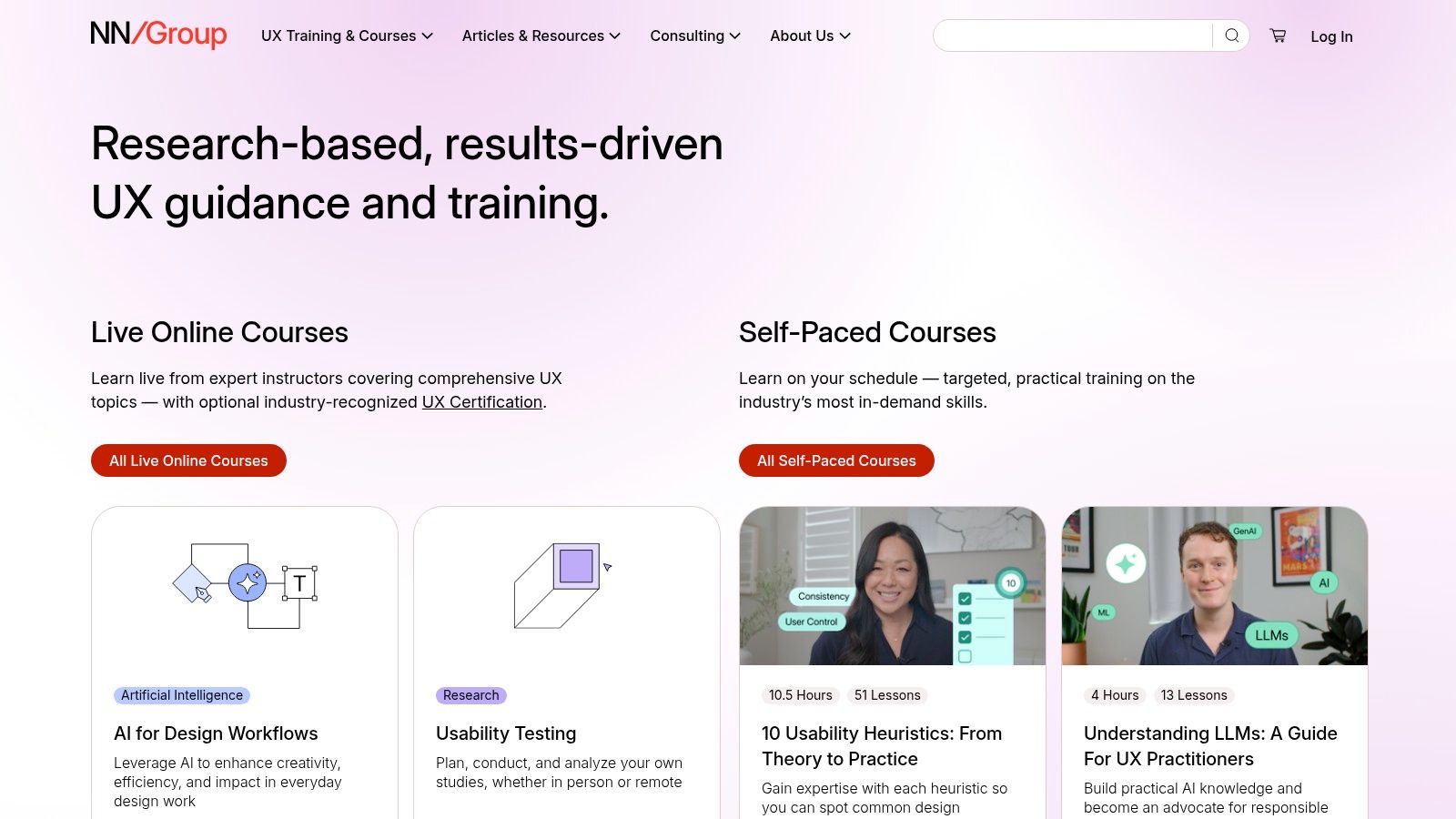
Need a UX partner that can settle internal debates with evidence instead of taste? Start with NN/g.
Nielsen Norman Group fits a specific kind of buyer. Teams that need stronger research discipline, clearer standards, and more confidence in product decisions before they hire for visual polish or full delivery. In a guide like this, that makes them less of a general-purpose agency pick and more of a smart match for companies trying to raise UX maturity from the inside.
Their strength is practical and well-defined. Usability benchmarking, expert reviews, research, consulting, and training. If your company has designers and product managers already in place, but the work feels inconsistent or hard to defend in front of leadership, NN/g often helps create the structure that is missing.
Best fit
NN/g is a strong choice for enterprise product groups, internal design teams, and digital leaders who need better decision quality across multiple products or business units. They are also useful for SMBs doing buyer-side self-assessment. If your real gap is process, research quality, or team capability, you do not need a flashy reinvention first. You need a firmer operating model.
What buyers usually go to them for:
- Research and evaluation: Expert reviews, usability testing, custom research, and UX maturity assessments.
- Training: Live courses, private team sessions, self-paced learning, and certification paths.
- Shared standards: Widely used heuristics and methods that make stakeholder conversations easier.
- Process improvement: Help shaping how teams approach discovery, validation, and iterative design work, which connects well to a broader design process framework for product teams.
Practical rule: Choose NN/g when the goal is to make your team better at UX over time, not just to collect polished screens.
That trade-off matters. NN/g is usually not the right pick if you need a partner to own concept through launch, produce a full interface system, and ship with engineering. Their value is upstream and organizational. They help teams ask better questions, run better studies, and make stronger product calls.
That limitation is also their advantage. Buyers who already have internal execution capacity often get more long-term value from capability building than from outsourcing everything. And if your next step is validating flows and interfaces before redesign work begins, focused UX testing services are often the natural companion to NN/g-style consulting.
Visit Nielsen Norman Group.
2. Top UX Companies: IDEO
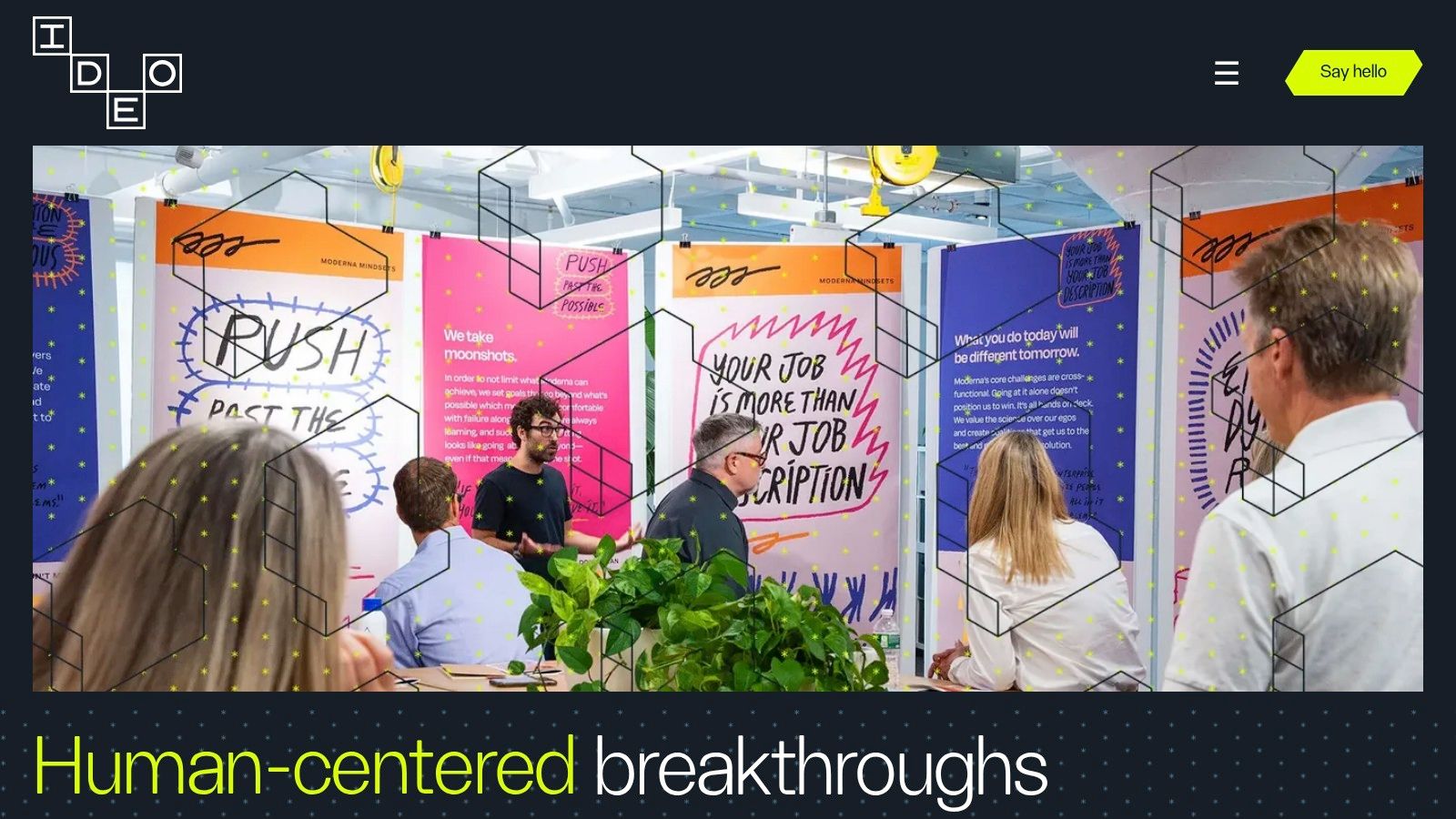
IDEO is what many buyers picture when they think of iconic design consulting. And sometimes that instinct is right. If your challenge is bigger than a product screen, IDEO belongs on the shortlist.
This firm is built for human-centered design, innovation strategy, concept development, and organizational transformation. It’s especially useful when a company needs to shape new offerings, prototype fast, and align leadership around a future-state vision.
Where IDEO shines
IDEO is strongest when the brief is broad and ambiguous. New category exploration. Service innovation. Cross-functional design strategy. Executive teams trying to de-risk a launch before they commit to a full build.
A few reasons buyers still turn to them:
- End-to-end design thinking: They work from strategy and research through prototyping and launch planning.
- Cross-sector breadth: Their portfolio spans digital and physical experience work across multiple industries.
- Leadership-level engagement: They’re built for multi-stakeholder transformation, not just interface cleanup.
The trade-off is execution depth versus conceptual power. IDEO is excellent at framing the right problem and shaping a compelling response. But smaller teams can feel over-served if what they need is a narrower UX sprint, a conversion-focused redesign, or a tactical product team that ships every week.
If you need a new direction, IDEO can be a strong choice. If you already know the direction and need production momentum, look elsewhere first.
That’s not criticism. It’s fit. For companies that need to move from ambiguity into a structured workflow, getting familiar with the 6 steps of the design process helps clarify whether a strategic innovation partner is what the project calls for.
Visit IDEO.
3. Top UX Companies: frog (part of Capgemini Invent)
Need to fix a broken customer experience that runs across channels, teams, and old internal systems? frog deserves a closer look.
frog fits buyers with messy reality. The kind where UX problems are tied to operations, service delivery, data flows, and legacy technology. That makes them a different kind of choice on a list of top ux companies. Less boutique craft shop. More transformation partner for organizations that need the experience and the machine behind it to work together.
Best for service transformation
frog is usually strongest in large programs where the interface is only one part of the problem. A bank redesigning onboarding. A healthcare organization trying to reduce friction across digital and human touchpoints. A global company standardizing journeys across regions without breaking local workflows. In those cases, service design matters as much as screen design.
What buyers tend to get from frog:
- Journey design beyond the UI: They examine how customers move through the full service, including handoffs, policies, and operational gaps.
- Cross-functional working sessions: Useful when product, marketing, operations, and IT all shape the final experience.
- Implementation range: Capgemini Invent gives them more capacity when the work moves from concept into organizational rollout.
There’s a trade-off, and SMB buyers should pay attention to it. frog can be too much firm for too little problem. If you need a site refresh, a cleaner checkout flow, or sharper visual design, the overhead may outweigh the value. Before reaching out, it helps to assess whether the issue is service complexity or execution quality. A quick review of what strong website design actually needs to do can help separate those two.
The practical takeaway is simple. Choose frog when the project touches systems, teams, and service operations. Skip them if the brief is narrow and the main goal is faster production.
Visit frog.
4. Top UX Companies: Work & Co (now part of Accenture Song)
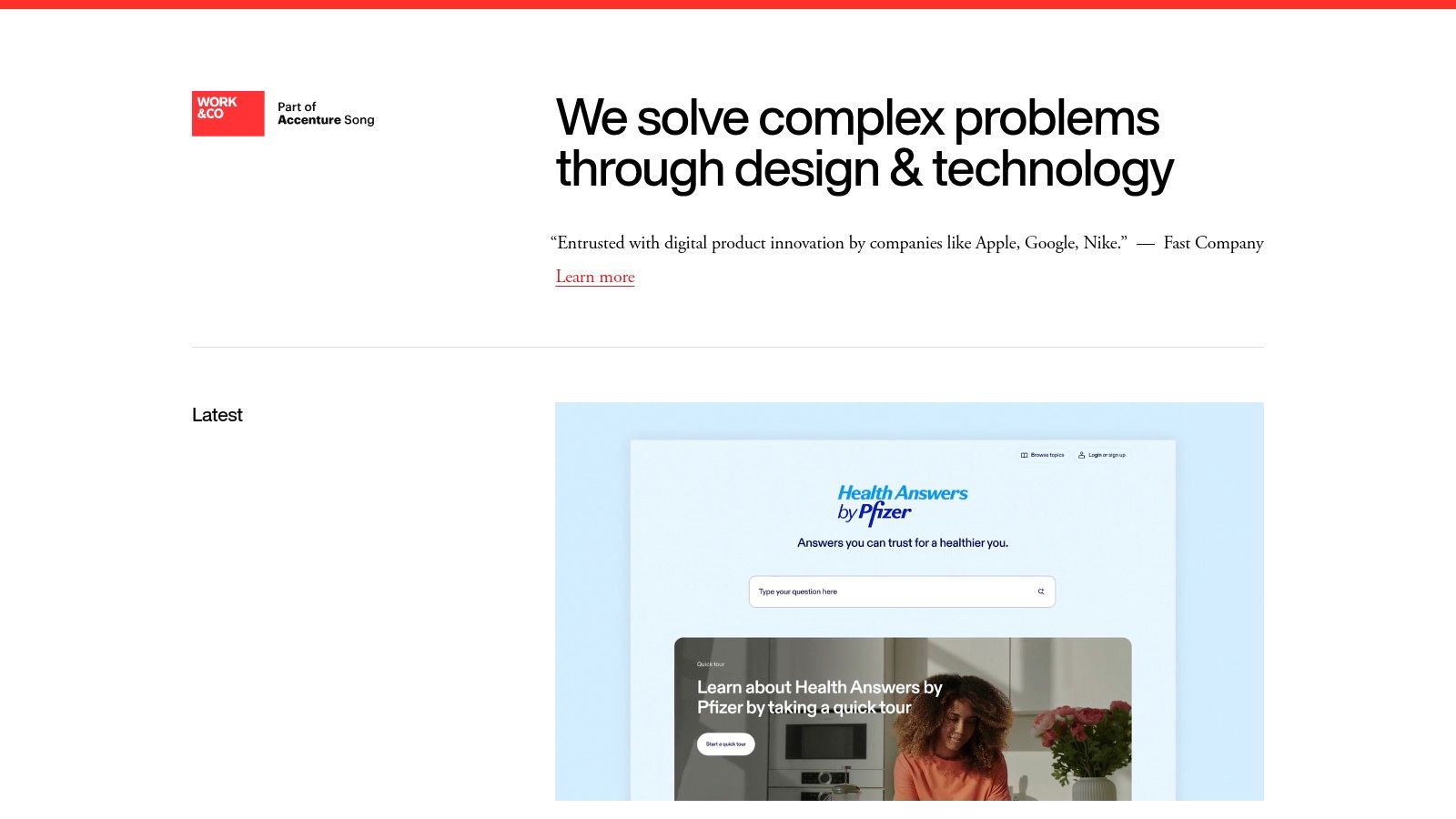
Some firms present strategy beautifully. Work & Co has built its reputation on getting products shipped.
That difference makes them one of the more practical entries on a list of top ux companies. If you want a partner that can handle product strategy, UX, UI, accessibility, and engineering in one motion, Work & Co is worth serious attention.
Why product teams hire them
Work & Co tends to fit organizations that don’t want a long handoff chain between insight, design, and delivery. Their model is built around practitioners who make and ship digital products, not just recommend what should happen next.
That usually shows up in three ways:
- Integrated product execution: Strategy, design systems, front-end work, and broader product capabilities sit close together.
- Shipped-product mindset: They’re known for turning ambiguity into launched experiences.
- Expanded scale: Accenture Song backing gives them more enterprise integration capacity when needed.
The best reason to hire Work & Co is simple. You want fewer gaps between the workshop and the release.
The trade-off is that they’re still a premium option. They’re not the obvious pick for a local business site refresh, a startup with a modest budget, or a team that only needs research and concept validation. They’re better when there’s enough product complexity to justify a heavier-hitting partner.
If your benchmark is digital experience quality and you’re still deciding how much polish versus practicality you need, studying the art of website design and engaging online experiences is a useful reality check before outreach.
Visit Work & Co.
5. Top UX Companies: Huge
Huge sits at the intersection of product, marketing, data, and platform work. That makes it a very specific kind of fit. Not every business needs that mix, but the ones that do usually know it quickly.
If you’re managing a large digital ecosystem with customer experience, brand, commerce, and AI-driven personalization all in play, Huge is more relevant than a pure UX boutique. They operate more like a design-and-technology company than a narrow UX studio.
Best for integrated digital ecosystems
Huge is strongest when the user experience can’t be separated from the broader business engine. Their practices span products and platforms, customer experience, brand strategy and design, plus data and AI.
Here’s the practical upside:
- Connected thinking: Good for companies that need UX and digital marketing logic to work together.
- Platform orientation: Better suited to ongoing ecosystems than one-off deliverables.
- Enterprise readiness: They’re comfortable inside large organizations and complex governance structures.
The downside is the same thing that makes them useful. Their process can feel heavy if you only need a contained product redesign or focused research engagement. Startups and lean teams often need sharper scope and faster movement than a large integrated firm naturally provides.
This is also where buyers should be careful with the word “top.” A top UX company for enterprise platform work can be the wrong choice for a founder-led SaaS product or a regional service business. Same label. Completely different buying decision.
Visit Huge.
6. Top UX Companies: Fantasy
Fantasy is the outlier on this list, in a good way. They’re not trying to be the default answer for every organization. They’re a high-craft boutique with a sharper point of view around intelligent products, advanced interfaces, and AI-led experience design.
Fantasy becomes a compelling choice for those seeking a flagship experience that feels unique.
Where boutique craft wins
Fantasy is well suited to companies launching premium digital products, executive-facing concept work, or AI-powered experiences where the interface itself helps define the brand. Their positioning blends AI strategy, product innovation, identity work, and senior-led execution.
That can be powerful when you need:
- Creative distinction: The team leans into novel UX and high-end product vision.
- Senior-heavy collaboration: Less layer, more direct involvement from experienced practitioners.
- AI and UX together: Useful for teams exploring intelligent interfaces, custom models, and AI-enabled user flows.
A broader trend supports why firms like this matter more now. According to Punchcut’s perspective on leading UI and UX firms, top lists often miss emerging demand around AI-optimized UX and newer multimodal product experiences. That gap is real. Buyers increasingly need partners who can think beyond conventional screen patterns.
Fantasy’s limitation is bandwidth. Boutique shops can do exceptional work, but large enterprise rollouts may require additional engineering or delivery partners. So if the mission is broad transformation across many business units, a bigger firm may be safer.
For a flagship product, though, small can be a feature, not a bug.
Visit Fantasy.
7. Top UX Companies: Blink UX
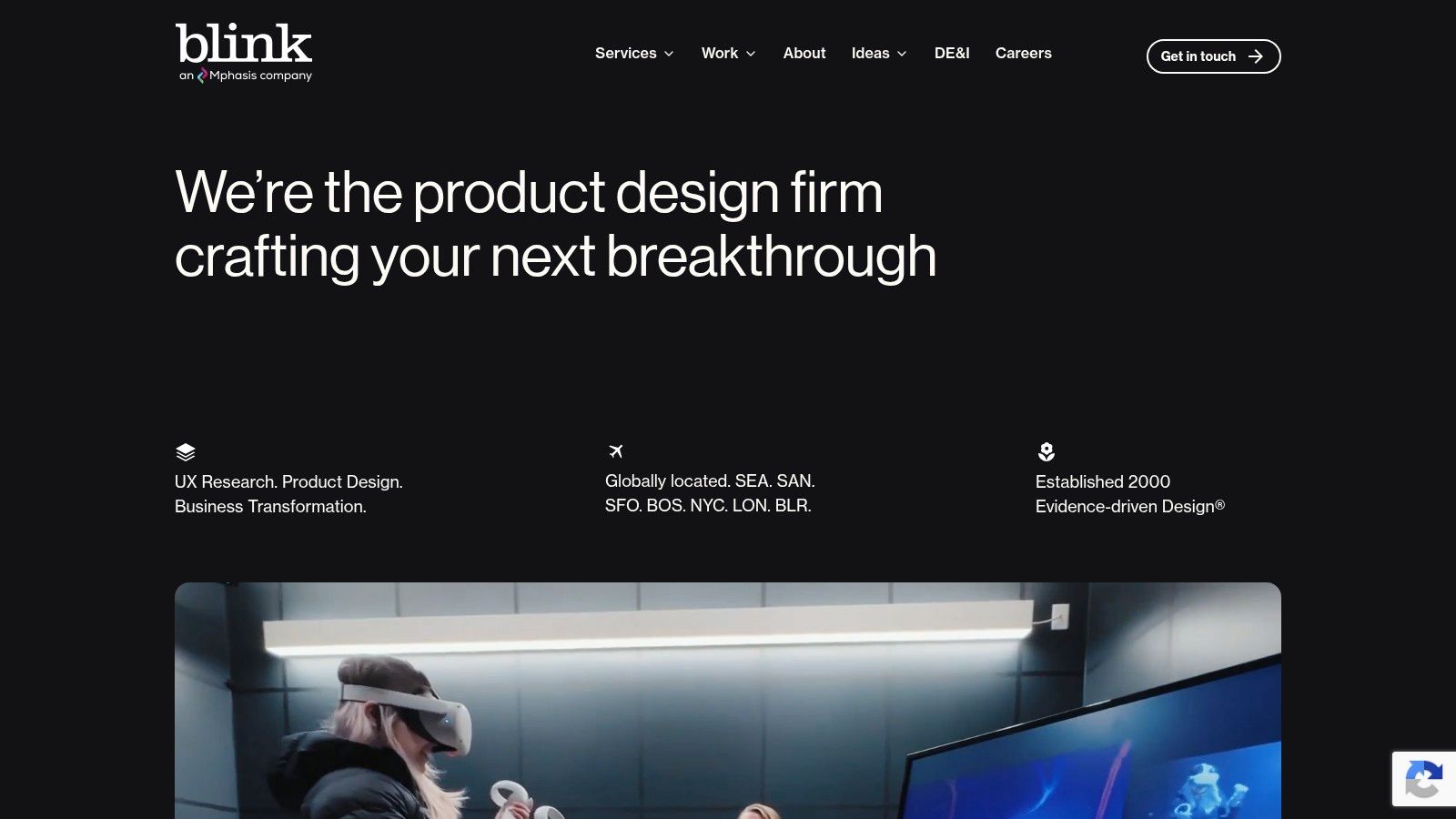
What if the biggest risk in your project is not weak execution, but solving the wrong problem? That is where Blink UX tends to make sense.
Blink is a strong fit for buyers dealing with complex workflows, regulated environments, or internal stakeholder tension. Their value is less about flashy interface work and more about reducing decision risk early, before a team commits budget and political capital to the wrong direction.
Best for evidence-driven product design
For SMBs using this guide to sort firms by project type, Blink belongs in the “research-heavy, clarity-first” category. If your team is still validating users, constraints, or accessibility requirements, this kind of partner can save months of avoidable rework. If your needs are already clear and the priority is shipping at scale, another firm on this list may fit better.
Blink combines UX research, product strategy, design, prototyping, and front-end support. The differentiator is how much weight they put on mixed-method research and inclusive design, especially in domains where mistakes carry real cost.
Why buyers choose them:
- Research depth: Useful for teams that need field research, behavioral insight, and more than a quick round of usability tests.
- High-consequence domain experience: A practical match for healthcare, government, enterprise tools, and other contexts shaped by policy, compliance, or operational complexity.
- Accessibility and AI advisory work: Helpful when teams need to assess how emerging features affect usability, trust, and risk.
I usually frame firms like Blink this way: they can slow the first phase of a project, but they often speed up the full program. Better requirements. Fewer reversals. Less redesign after launch.
The trade-off is delivery scale. Blink is not the obvious choice if you need a massive engineering bench or a single partner to run enterprise-wide transformation across many business units. In those cases, buyers often pair a research-led firm with internal product and engineering teams, or bring in a larger implementation partner.
If your selection criteria start with certainty, alignment, and getting the problem definition right, Blink deserves a serious look. Visit Blink UX.
Top 7 UX Companies: Side-by-Side Comparison
| Firm | Implementation complexity | Resource requirements | Expected outcomes | Ideal use cases | Key advantages |
|---|---|---|---|---|---|
| Nielsen Norman Group (NN/g) | Low–Moderate, research and training; not a build partner | Moderate budget for consulting/courses; internal capacity to implement recommendations | Evidence-based usability improvements; stronger internal UX capability and certification | Upskilling teams, usability research, UX maturity assessments, stakeholder buy‑in | Research-backed methods, scalable training and high credibility |
| IDEO | High, end-to-end design thinking and organizational transformation | High budget, multi‑stakeholder engagement, executive involvement | Strategic vision, validated prototypes, de‑risked product/service launches | Large innovation programs, org transformation, AI strategy and rapid prototyping | Strong prototyping, cross‑sector experience, transformational facilitation |
| frog (Capgemini Invent) | High, holistic service design with tech and data integration | High (enterprise teams + Capgemini delivery for implementation) | Multi‑channel experiences, capability building, cross‑functional alignment | Enterprise service transformation, complex journeys, scaled launches | Full service‑design lifecycle with implementation backing and scale |
| Work & Co (Accenture Song) | Moderate–High, practitioner-led design + build end‑to‑end | High budget, product and engineering collaboration for shipping outcomes | Shipped products, design systems, measurable digital outcomes | Organizations wanting design teams that also build and ship products | Hands‑on practitioners who design and deliver; strong shipping track record |
| Huge | High, integrated product, data, and marketing at scale | High budgets, large roadmaps, cross‑functional resources | Scalable platforms, AI‑driven personalization, integrated brand/commerce | Enterprise platforms, data‑driven CX, global brand/commerce programs | Integrated product + data + marketing capabilities with enterprise credibility |
| Fantasy | Moderate, boutique, high‑craft visionary work; may need partners to scale | Premium fees for senior‑heavy teams; limited bandwidth for large rollouts | Flagship, differentiated AI‑led UX and brand‑defining experiences | Visionary flagship products, novel UX, AI‑forward experiences | High craft, creative differentiation, strong AI×UX expertise |
| Blink UX | Moderate, rigorous research‑driven design; engineering often via partners | Moderate–High (enterprise research projects); emphasis on mixed‑methods research | Inclusive, evidence‑driven designs validated for complex/regulatory domains | Regulated industries, complex software, inclusive design, AI acceleration | Deep UX research practice and practical, research‑led design guidance |
How to Choose A Buyer’s Guide for Your Business
The smartest way to compare top ux companies is to stop comparing companies for a moment and look at your own brief. Most bad agency searches start with a vague goal like “improve the UX.” That’s too broad to produce a good shortlist. You need to know whether you’re buying research, design capacity, product execution, transformation support, or team education.
Start with scope. If you need evidence, validation, and internal capability, NN/g or Blink UX make more sense than a concept-led innovation firm. If you need large-scale service transformation, frog, IDEO, or Huge are more natural fits. If you need a product team that can design and ship, Work & Co moves higher on the list. And if you’re building a distinctive AI-led experience, Fantasy may be the sharper option.
Then look at budget reality. This part gets skipped because buyers don’t like saying the quiet part out loud. But fit depends on financial fit too. For SMBs, that matters even more since they represent 99.9% of U.S. businesses, according to the affordability gap analysis in this review of top UX companies. Many well-known firms are built for enterprise-level engagements, not lean operating environments.
A few questions usually clarify the shortlist fast:
- What outcome matters most: Better conversion, lower friction, new product direction, or internal UX maturity?
- What are you buying: Research, strategy, design, front-end build, or long-term support?
- Who needs to be convinced: Founders, a product lead, a board, or multiple departments?
- How much complexity is real: One flow, one site, one product, or a service ecosystem?
There’s also a broader business case for taking UX seriously. The global UX research software market is estimated at USD 461.02 million in 2026 and projected to reach USD 1,362.68 million by 2035, with a 12.8% CAGR, according to this UX research software market report. Adoption is growing because companies increasingly treat UX infrastructure as core strategy, not optional polish.
For many SMBs, startups, franchises, and growth-stage brands, a boutique partner can be a better operational fit than a globally known consultancy. Mr. Green Marketing, LLC is one example if you need UX-informed web design and digital growth support in the same engagement. And if you’re weighing methods before vendor outreach, it helps to review critical UX design approaches so you can separate must-haves from nice-to-haves.
The right partner listens well, scopes clearly, and matches how your business works. Prestige helps. Fit closes the gap.
If you want a strategy-first partner that connects UX, web design, SEO, PPC, GEO, and conversion-focused growth, talk with Mr. Green Marketing, LLC. The team offers audits and performance reporting to help businesses identify visibility gaps, prioritize UX improvements, and choose the right next move before budget gets wasted.
Leave a Comment
sing in to post your comment or sign-up if you dont have any account.