
How to Start an SEO Company? You’re probably in one of two places right now.
You already do SEO for someone else and you’re tired of building another company’s revenue while your own ideas sit in a notes app. Or you freelance on the side, you’ve proven you can rank pages, fix technical messes, and turn search demand into leads, and you’re wondering whether it’s time to make it official.
That instinct isn’t random. It usually shows up after enough late nights in Ahrefs, Search Console, Screaming Frog, GA4, and client decks to realize the gap in the market isn’t “more SEO agencies.” It’s more competent ones. Agencies that can explain strategy clearly, set expectations transparently, and do the work without hiding behind jargon.
And if you’re trying to figure out how to start an seo company, the answer isn’t “make a logo and post on LinkedIn.” It’s building an operation that can sell, deliver, retain, and adapt. Especially now, when search is shifting under everyone’s feet.
How to Start an SEO Company? So You Want to Start an SEO Agency
And yes, this can become a real business.
The demand is there. The global SEO services market is projected at $83.98 billion in 2026 and expected to reach $148.86 billion by 2030, with a projected 15.4% CAGR. At the same time, 74% of small businesses already invest in SEO, spending an average of $497 monthly, according to AIOSEO’s SEO statistics roundup. That combination matters. The market is large, still growing, and already normalized among smaller businesses.
That doesn’t mean it’s easy. It means the opportunity is real.
Those who should start an agency wait too long because they think the market is “too saturated.” Usually that’s fear talking. Saturated markets still reward operators who can solve a specific problem better than the average provider. Local lead gen for home services. Technical cleanups for multi-location brands. SEO content systems for ecommerce. Amazon-adjacent SEO strategy. Pick your lane.
If you’re still sorting out where SEO fits inside the bigger service environment, this breakdown of what a digital marketing agency does helps frame the role SEO plays alongside web, PPC, creative, and conversion work. And if you’re comparing models, it’s also useful to see how people start a social media marketing agency because the client acquisition mechanics overlap more than most founders expect.
The agencies that last don’t win because they know more buzzwords. They win because they can produce calm, credible answers when a client asks, “What exactly are we doing, and why?”
That’s the part new founders underestimate. Clients rarely buy SEO because they love title tags. They buy clarity, momentum, and the belief that someone competent is finally in charge.
The Unskippable Foundation Business Structure and Niche
The boring stuff is not boring when it saves your business.
Set up the legal and financial basics early. Form your entity, open a separate business bank account, get bookkeeping in place, and decide how you’ll handle taxes before money starts moving around. If you skip this part, you’ll create the kind of mess that turns a decent first year into a paperwork excavation project.

How to Start an SEO Company: Build the company before you market it
A few essential requirements:
- Separate your finances: Use a dedicated bank account and payment processor for the business. Don’t run client retainers through your personal account and pretend you’ll organize it later.
- Write a simple service agreement: Scope, payment terms, revision limits, reporting cadence, and access requirements should all be in writing.
- Decide what you sell: “SEO” is not specific enough. Technical SEO retainers, local SEO campaigns, content-led organic growth, SEO audits, franchise SEO, ecommerce category optimization. Those are offers.
- Create a delivery checklist: Even if it’s ugly and lives in Notion at first, you need a repeatable sequence for onboarding, audits, execution, and reporting.
This isn’t glamorous. It is stabilizing.
Your niche does more work than your homepage copy
Most new founders try to sound flexible. That usually reads as interchangeable.
Specialization is a sales advantage because it reduces buyer uncertainty. If a plumber, med spa, SaaS founder, franchise operator, or Amazon seller lands on your site and immediately sees that you understand their model, sales cycle, and search behavior, the conversation changes. You’re no longer “an SEO person.” You’re a plausible fit.
Hyper-focusing on a niche can boost proposal win rates by as much as 3x, based on analysis of more than 500 agencies cited by Wolters Kluwer’s guide to starting an SEO business. That tracks with what happens in agency sales. Buyers trust specialists faster.
Good niches share three traits
Use this filter before you choose one:
| Niche trait | What it looks like | Why it matters |
|---|---|---|
| Clear pain | Leads are inconsistent, organic visibility is weak, local competition is intense | Pain creates urgency |
| Money in the model | They can afford ongoing services | No margin, no retainer |
| Repeatable problems | Similar site issues, content gaps, and search patterns across clients | Repeatability creates scale |
A weak niche is one where every client needs a totally different process. A strong niche lets you reuse audit templates, SOPs, landing page frameworks, and reporting language without turning your work into cookie-cutter sludge.
Practical rule: If you can’t describe your ideal client in one sentence, your niche is still too wide.
Examples of tighter positioning:
- Local SEO for multi-location dental groups
- Technical SEO for Shopify brands
- Content and on-page SEO for personal injury firms
- SEO for HVAC, plumbing, and electrical contractors
- GEO and content visibility audits for service businesses
What doesn’t work
Three things tend to sink new agencies early:
- Selling everything to everyone
If your menu says SEO, PPC, web design, branding, social, email, Amazon, video, and PR on day one, prospects won’t read that as impressive. They’ll read it as unproven. - Copying another agency’s positioning
You don’t need to be “the growth partner for visionary brands.” You need a plain-English promise tied to a business problem. - Picking a niche you hate
Don’t choose a market just because it’s theoretically profitable if you can’t stand the clients, the pace, or the subject matter.
Niche first. Brand voice later.
How to Start an SEO Company: Packaging and Pricing Your SEO Services for Profit
Pricing breaks a lot of new agency owners because they start with the wrong question.
They ask, “What should I charge?” when they should ask, “What outcome am I responsible for, and how will I package the work so I can deliver it consistently?” Those are not the same question.
The easiest way to underprice yourself is to sell tasks. Ten blog posts. Title tag updates. A backlink sprint. A keyword list. Clients compare tasks like commodities. They compare outcomes very differently.
SEO delivers an average 22:1 return on investment, meaning businesses earn $22 for every $1 spent, according to Reboot Online’s SEO statistics. That doesn’t mean every campaign performs the same way. It does mean you should stop framing your service like it’s a cheap production line item. If the channel can produce that kind of return on average, your pricing discussion should be tied to business value.
How to Start an SEO Company: The three pricing models that actually matter
Some founders overcomplicate this. Don’t.
| Model | Best For | Pros | Cons |
|---|---|---|---|
| Monthly retainer | Ongoing SEO campaigns | Predictable revenue, room for iteration, easier planning | Requires strong expectation setting |
| One-time project | Audits, migrations, technical cleanups | Easier entry point, useful for new clients | Revenue resets when project ends |
| Hybrid model | Audit first, retainer second | Low-friction start and clear path to ongoing work | Can become messy if scope isn’t defined |
Retainers are usually the strongest base
If you want an agency instead of a string of gigs, recurring revenue matters.
Retainers work well because SEO compounds. Technical fixes, internal linking, content improvements, page creation, reporting, and testing rarely produce their full effect in a single month. A retainer lets you sequence the work properly instead of trying to cram everything into a one-off engagement.
A basic retainer structure might include:
- Technical monitoring and issue resolution
- On-page optimization
- Content briefs or content strategy
- Internal link planning
- GBP and local SEO support, if relevant
- Monthly reporting and call cadence
The mistake is promising every discipline inside one retainer at a low fee. That’s how founders end up doing strategist work, analyst work, PM work, QA work, and account management for one modest invoice. Unsurprisingly, they burn out.
Projects are useful when trust is low
A one-time audit, local SEO setup, or technical remediation project can open the door with cautious buyers.
This works best when the project has a sharp boundary. “Thorough SEO audit with prioritized action plan” is clear. “Let’s see what your website needs” is not. Your proposal should define deliverables, timeline, implementation responsibility, and what happens after the project ends.
Done well, a project creates two outcomes. It gets you paid. It also shows the client how you think.
If your project doesn’t naturally lead to the next conversation, you built a deliverable, not a sales process.
How to Start an SEO Company: How to talk about price without sounding slippery
Don’t defend your fee by listing hours. Clients don’t care how long it takes you to do something if you’ve gotten faster through experience. They care whether your work is likely to move a business metric they value.
Use language like:
- This work is designed to improve qualified organic visibility
- We’re prioritizing pages tied to revenue, not just traffic
- The first phase is about removing technical friction and fixing indexation issues
- Reporting will connect activity to leads, inquiries, or sales where possible
That’s a business conversation. “We’ll optimize meta tags and build links” is not.
How to Start an SEO Company: Common pricing mistakes
- Quoting before diagnosis: Don’t price blind. Run an audit first.
- Offering too many packages: Three options is usually enough.
- Charging low to win fast: Cheap clients often demand the most.
- Ignoring implementation load: Strategy is one thing. Doing the work is another.
And one more. Don’t promise rankings. Serious clients are more impressed by disciplined process than fake certainty.
How to Start an SEO Company: The Client Acquisition Engine Getting Your First Five Clients
Your first five clients probably won’t come from a polished funnel. They’ll come from hustle, smart positioning, and doing things that don’t scale.
That’s normal.
A new agency has no reputation momentum yet. No deep bench of testimonials. No giant referral flywheel. So the job is simple at the start. Get in front of the right people, give them a reason to trust you, and make it painfully easy to say yes to a first engagement.

Start with proof, even if the proof is small
You do not need a massive agency portfolio to get started. You do need evidence that you can think clearly and execute.
Offering free or discounted work to a very small number of early clients can help build a portfolio, and that social proof can convert at 40%, according to the earlier-cited Wolters Kluwer guidance. The key is to be selective. Don’t become the free SEO person for everyone you know. Choose businesses where you can produce a clean before-and-after story.
Good early portfolio opportunities usually have one of these traits:
- The site has obvious technical issues
- Local SEO is neglected
- Service pages are thin or poorly targeted
- Internal links are weak
- Search Console data already shows untapped demand
That gives you a path to visible improvements without needing to invent magic.
Your first pipeline should be manual
For traction, direct outreach beats passive waiting.
The same Wolters Kluwer guidance recommends applying to 5 to 10 targeted gigs on Upwork daily, and that’s still useful if you treat it like prospecting, not lottery tickets. Ignore junk listings. Go after buyers who describe a real business problem and need strategic help, not someone shopping for the cheapest “SEO package.”
A practical weekly mix looks like this:
- Upwork applications: Tight, customized, and focused on diagnosis
- LinkedIn outreach: Owners and marketing managers in your niche
- Personal network asks: Past coworkers, designers, developers, paid media freelancers
- Local relationship building: Chambers, business groups, niche meetups, referral partners
If you want more ideas on turning SEO outreach into actual demand, this guide on SEO lead generation is worth reading.
How to Start an SEO Company: The free audit offer works, but only if it’s specific
“Free SEO audit” is overused because most of them are garbage. Auto-generated scores, no context, no prioritization, no business relevance.
A good free audit is short and pointed.
Include things like:
- One indexing or crawl issue
- One title or page targeting issue
- One local SEO gap
- One content opportunity
- One next-step recommendation
That’s enough to prove competence. Don’t give away your entire roadmap. Give them the diagnosis that earns the meeting.
Most founders lose early deals because they overwhelm the prospect. Show you can find the problem. Save the full treatment plan for after the sale.
Here’s a useful training video if you need to sharpen the sales side of this phase:
Your own site should bring in at least some leads
Nothing undermines an SEO agency faster than a website that can’t rank for its own city and service terms.
Optimizing your own site for local intent can capture 20% to 30% more inbound leads, based on the same earlier guidance. That means you should have:
- A clear homepage with your niche and location context
- A service page for your core offer
- A location page if local intent matters
- A Google Business Profile
- Basic internal links and conversion paths
- A contact page that doesn’t make people work to reach you
And yes, you should target terms like “SEO agency in [city]” or a variation that matches how buyers search in your area. You don’t need fifty thin city pages. You need one credible local presence.
What the first five usually look like
They rarely arrive in a neat sequence.
One might come from a former coworker. Another from Upwork. One from a local referral partner. One from someone who saw your teardown post on LinkedIn. One from a business owner who got your audit email and replied three weeks later.
That’s why consistency matters more than elegance in the beginning.
A simple outreach routine works better than a complicated CRM fantasy:
- Build a shortlist of target accounts in your niche.
- Send personalized outreach with one specific observation.
- Follow up without sounding desperate.
- Offer a light audit or consult.
- Convert the best-fit prospects into a starter engagement.
This phase is messy. Good. It’s supposed to be.
How to Start an SEO Company: Building Your Delivery Machine Onboarding Tools and Reporting
Winning a client feels great for about fifteen minutes. Then the practical side emerges. You now need to deliver.
Many new agencies expose their flaws. Sales sounded sharp. The kickoff is chaotic. Access requests are missing. No one defined success. Reporting is an export dump. The client starts wondering whether they hired a strategist or just a talker.
Process fixes that.
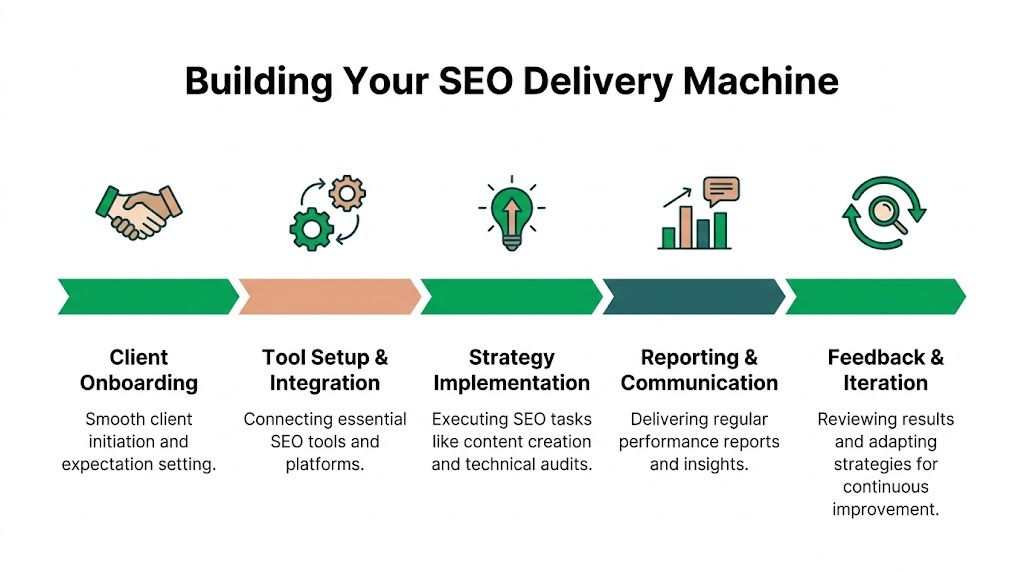
Onboarding should reduce uncertainty fast
Your onboarding system needs to do three things immediately:
- Gather access
- Align goals
- set expectations
That means you need a repeatable checklist. Not a vague welcome email.
A solid onboarding flow includes:
- Business intake form
- Kickoff call
- Access to GA4, Search Console, CMS, GBP, tag manager, and relevant SEO tools
- Baseline snapshot of current performance
- Priority page list
- Competitor list
- Reporting schedule
- Defined communication channel
The best kickoff calls also flush out hidden problems early. Maybe the client has a developer bottleneck. Maybe legal approval slows content. Maybe a franchise model limits page edits. You need to know that before building a plan that dies on contact.
Your tool stack should be lean, not impressive
New founders waste money on software because tools feel like progress.
You don’t need everything. You need enough to research, audit, manage work, and report clearly. A practical stack might include Screaming Frog for crawling, Google Search Console and GA4 for performance analysis, Looker Studio for reporting, Ahrefs or Semrush for research, and Asana, ClickUp, or Notion for project management.
For support work and repeatable admin tasks, many founders also look at operational help before making a full hire. If you need execution support for research, reporting prep, QA, or process admin, this guide on Hire LatAm Virtual Assistants is useful because it helps you think about delegation without overcommitting too early.
How to Start an SEO Company: Create an execution rhythm clients can feel
Clients don’t just judge results. They judge momentum.
If the month feels quiet, they assume little is happening. So your delivery system should make progress visible. A simple operating cadence works well:
| Week | Focus | Client-visible output |
|---|---|---|
| Week 1 | Audit, prioritization, technical checks | Priorities and roadmap |
| Week 2 | On-page and structural work | Updated pages or recommendations |
| Week 3 | Content or local SEO implementation | Briefs, drafts, GBP updates |
| Week 4 | Reporting and review | Performance summary and next actions |
The specifics will vary. The rhythm should not.
Agencies keep clients longer when clients can see what moved, what changed, and what happens next.
Reporting needs interpretation, not spreadsheets
Most SEO reports are unreadable because they confuse data volume with insight.
Clients don’t need a document that proves you can export charts. They need answers to practical questions:
- What changed this month?
- Why did it change?
- What did you do?
- What’s the next priority?
- Is this helping leads, sales, or visibility in the right places?
That’s the difference between reporting and narrating progress. If your report can’t be explained in plain language on a call, rewrite it.
A useful framework:
- Wins: Pages up, issues fixed, new content live, visibility improvements
- Risks: Dev delays, weak conversion paths, tracking issues, content bottlenecks
- Next actions: The handful of priorities that matter next
If you need a cleaner structure, this walkthrough of an SEO monthly reporting format gives a practical model for making reports easier to understand.
How to Start an SEO Company: What breaks delivery most often
Not bad SEO. Sloppy operations.
The common failures are familiar:
- No one requested full access at kickoff
- Scope isn’t documented
- Tasks live in someone’s head
- Reporting is late
- Recommendations aren’t prioritized
- Communication goes silent between meetings
Fix those and you already look more competent than a surprising number of agencies.
How to Start an SEO Company: From Founder to CEO Scaling With People and Technology
At some point, the constraint stops being leads. It becomes you.
You’re selling, auditing, presenting, writing briefs, reviewing deliverables, sending invoices, and answering client messages at odd hours because it feels faster than building a system. For a while, that works. Then it doesn’t.
That’s the moment when a lot of agency owners make the wrong call. They think scaling means “add more clients first.” Usually the better question is whether your current operation can absorb more clients without lowering quality.
Your first hire should remove a bottleneck, not flatter your ego
Don’t hire because you want to feel like a CEO. Hire because a recurring bottleneck is hurting delivery or sales.
That first hire is often one of these:
- A project manager or operations coordinator
- A content editor or content operations specialist
- A technical SEO contractor
- An account support role
- A reliable freelance implementer
Contractors are usually the lower-risk starting point because they give you flexibility. Full-time hires make more sense when workflow is stable, margins are clear, and you know the role will stay full.
A simple decision filter helps:
| Situation | Better fit |
|---|---|
| Workload fluctuates | Contractor |
| Need specialized expertise | Specialist contractor |
| Repetitive weekly workload | Part-time or full-time hire |
| Founder is the PM bottleneck | Operations support |
What you should not do is hire a vague “SEO person” and hope they somehow fix chaos. If your process is unclear, your hire will inherit confusion.

The bigger shift is strategic, not just operational
Most agencies still build their services around traditional blue-link rankings alone. That’s already too narrow.
Google’s AI Overviews are projected to cover over 20% of U.S. searches by Q1 2026, and many guides on starting agencies still ignore what that means for service design, according to The Marketing Agency’s article on starting an SEO agency. That shift matters because clients don’t care whether traffic comes from a classic result, a local pack, or an AI-generated summary. They care whether they stay visible when search behavior changes.
How to Start an SEO Company: GEO should be part of your service design from day one
You do not need to rebrand yourself as an AI wizard. You do need to account for Generative Engine Optimization, or GEO.
In practice, that means services should increasingly include:
- Auditing whether brand and site content appear in AI-generated search experiences
- Structuring content around clear entities, definitions, comparisons, and direct answers
- Improving citation-worthiness with cleaner source material and stronger topical coverage
- Strengthening branded search presence and trust signals
- Aligning SEO, content, and conversion pages so the business still benefits even when clicks shift
Future-proofing starts. Not with panic. With service design.
Old-school SEO agencies sell rank tracking alone. Better agencies sell search visibility wherever buyers now discover answers.
What scaling actually looks like
The founder-to-CEO shift is less glamorous than people imagine.
It looks like documenting your delivery steps. Delegating repeatable work. Saying no to bad-fit clients. Keeping your offer focused. Building a management layer before everything breaks. And making sure your service evolves with search itself, instead of chasing last year’s tactics.
That last part matters more than ever.
If you learn how to start an seo company based only on yesterday’s SERP, you’ll build an agency that feels outdated faster than you think.
How to Start an SEO Company: Your Agency Launch Checklist
If you’ve read this far, don’t reward yourself with more research. Do the work.
Starting an agency usually stalls in one of two ways. People either romanticize it and launch with no systems, or they overthink it and never launch at all. Both are avoidable.
Use this checklist like a start sequence:
- Register the business: Handle the legal setup, banking, bookkeeping, and contracts first.
- Choose a niche: Pick a market or service focus narrow enough that buyers can quickly understand why you fit.
- Define one core offer: Start with a clear retainer, project, or hybrid package. Keep it tight.
- Build a simple website: Homepage, service page, contact page, and proof. That’s enough to begin.
- Create an audit process: Make a repeatable template for diagnosing sites and leading sales conversations.
- Set up your delivery stack: Search Console, GA4, crawling software, project management, reporting.
- Prospect every day: Manual outreach beats waiting for “brand awareness.”
- Get the first proof: Land a few early wins and document them clearly.
- Build reporting early: Clients stay longer when they understand the work.
- Add GEO thinking now: Don’t wait until traditional SEO-only packages feel dated.
Small moves count. A registered business name counts. A niche decision counts. One smart outreach email counts.
Momentum matters more than polish in the early stage. The founders who win aren’t always the most talented. Often they’re just the ones who shipped, learned, tightened the system, and kept going when the work stopped feeling new.
If you want expert help building a search strategy that covers SEO, GEO, web, PPC, and growth planning, Mr. Green Marketing, LLC offers custom digital marketing support, free audits, and performance reporting for businesses ready to grow online.
Leave a Comment
sing in to post your comment or sign-up if you dont have any account.