
SEO lead generation – Let’s be clear: SEO lead generation is all about attracting people who are already looking for you. It’s not about cold calling. Or spammy emails. It’s the art of showing up right when a potential customer types their problem into Google, making the leads you get far more qualified from the get-go.
SEO Lead Generation: Building Your Foundation for SEO Lead Generation
So, you’ve heard SEO is a goldmine for qualified leads, but where do you actually start? Forget chasing algorithms for a moment. The goal here is to build a predictable system that turns searchers into paying customers. And that starts with one crucial step most businesses skip: a deep-dive audit.
Think of it as mapping the territory before you march into battle.
Why an Initial Audit Is Non-Negotiable
A proper audit is your baseline. It’s how you uncover the hidden problems holding your site back, from slow page speeds to broken links that frustrate both users and search engines. More importantly, it’s where you find the low-hanging fruit—the quick wins that can deliver a tangible impact right away.
This process lays out the critical first steps, moving from auditing your own site to analyzing competitors and then building a strategic roadmap.
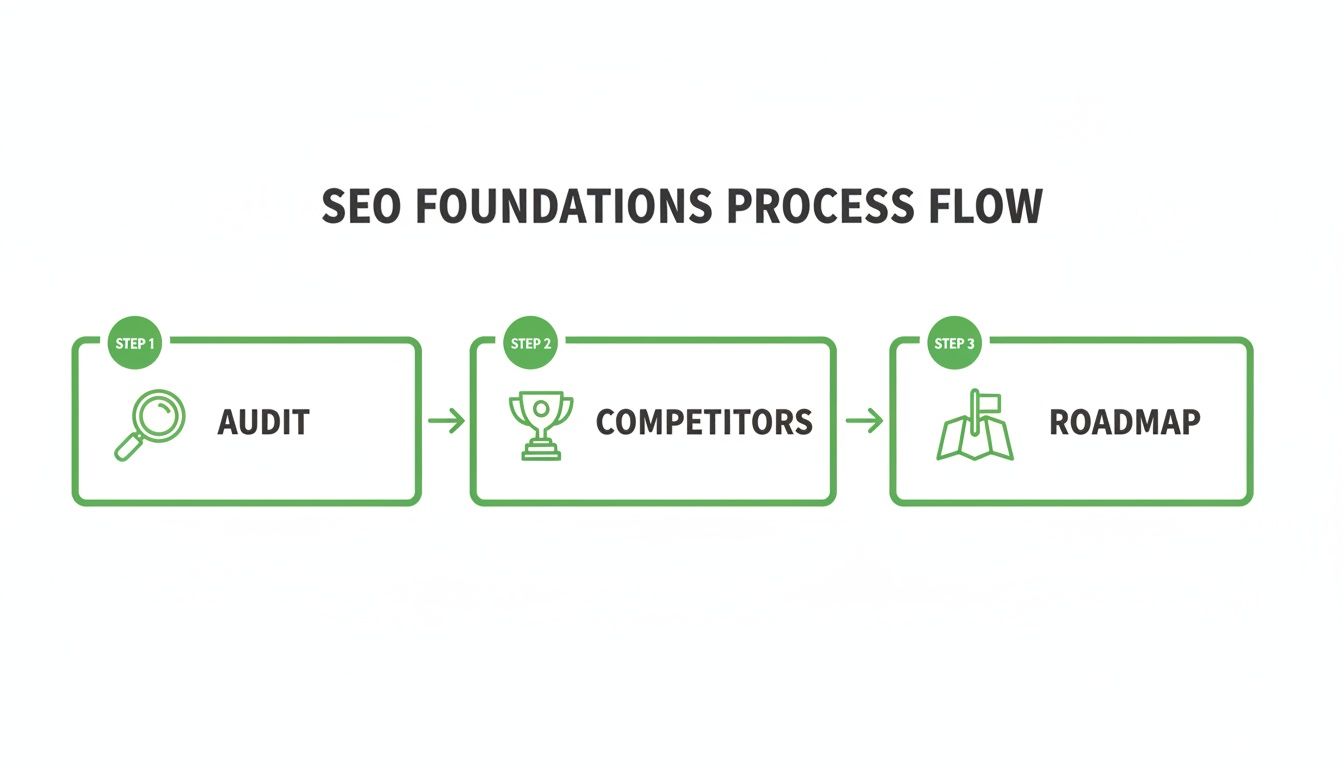
This isn’t complicated, but it is powerful. You have to understand your own site’s health before you can effectively challenge competitors or plan your attack.
Understanding the Competitive Landscape
Once you have your own house in order, it’s time to look at the neighbors. Competitor analysis isn’t about copying what everyone else is doing; it’s about identifying their weaknesses and finding opportunities they’ve missed.
We dig into questions like:
- Who is actually ranking for your money-making keywords?
- What kind of content are they creating to attract customers?
- Where are their most valuable backlinks coming from?
Answering these questions shows you exactly where competitors are eating your lunch—and gives you a playbook for taking it back.
The data overwhelmingly proves why this is the channel to focus on. And the numbers don’t lie.
SEO vs. Outbound Lead Generation Quick Stats
| Metric | SEO Leads | Outbound Leads |
|---|---|---|
| Close Rate | 14.6% | 1.7% |
| B2B Marketer Impact | 59% say it’s #1 | Varies, but much lower |
The numbers don’t lie. Leads that find you are significantly more likely to close. With 59% of B2B marketers confirming SEO has the biggest impact on their lead generation goals, ignoring it is no longer an option.
The goal isn’t just to rank, but to rank for the terms that bring in business. An audit reveals if you’re visible for “plumbing tips” (low intent) versus “emergency plumber near me” (high intent).
This initial groundwork sets the stage for everything that follows. Without a clear starting point from an audit and competitive analysis, you’re just guessing. With it, you have a data-backed roadmap designed for one thing: getting more leads.
To keep the momentum going, check out our guide on other powerful SEO strategies for small businesses.
SEO Lead Generation: Finding Keywords That Drive Sales, Not Just Clicks
Here’s where the real strategy kicks in. Traffic is a nice vanity metric, but qualified leads—the kind that turn into revenue—are what pay the bills. This is all about shifting your focus from chasing high search volumes to targeting commercial intent.
We’re moving beyond keywords that just attract casual browsers and digging into the psychology of a searcher who is ready to buy. Right now.

It’s the difference between someone searching “how to fix a leaky faucet” versus “emergency plumber near me.” One is looking for information; the other is looking for a credit card machine. For your SEO to generate actual leads, you have to attract that second person.
Decoding What Your Customer Really Wants
Search intent is simply the why behind a search. The most critical factor in finding keywords that actually make you money. You could rank #1 for a term with 50,000 monthly searches, but if none of those people are looking to buy, it’s a worthless ranking for lead generation.
We generally see four main types of intent:
- Informational: The user wants to learn something (e.g., “what is the best type of roof shingle”).
- Navigational: The user is trying to find a specific website (e.g., “Mr. Green Marketing login”).
- Commercial: The user is comparing options before a purchase (e.g., “HubSpot vs Salesforce comparison”).
- Transactional: The user is ready to buy or take immediate action (e.g., “hire a local SEO agency”).
While a full-funnel strategy eventually touches on all of these, your lead generation efforts need to be laser-focused on commercial and transactional keywords. These are your money-makers.
The cornerstone of finding keywords that drive sales, not just clicks, is mastering How to Conduct Keyword Research effectively. This foundational skill ensures you’re targeting terms that align directly with business goals, not just traffic metrics.
This isn’t about guesswork; it’s about using data to find winnable opportunities.
How to Find Your High-Intent Keywords
So, where do you find these golden nuggets? It starts with brainstorming but quickly moves into data analysis with tools like Ahrefs or Semrush. The key is to look past just search volume and get a real feel for user intent and keyword difficulty.
Think about the specific language your ideal customer uses when they’re ready to pull the trigger. They often use modifiers that signal urgency and a desire to buy.
Look for modifiers like these:
- For services: “near me,” “for hire,” “services,” “company,” “cost,” “quote,” “emergency.”
- For products: “buy,” “deal,” “discount,” “for sale,” “review,” “comparison.”
- For B2B: “software,” “platform,” “tool,” “vendor,” “agency,” “pricing.”
Let’s say you run a local roofing company. An informational keyword is “how to install shingles.” A transactional, lead-generating keyword is “roof repair estimate pensacola fl.” The difference in intent is massive—and so is the difference in lead quality.
Don’t Sleep on Local Search
For any service-based business, local search is a goldmine. A huge percentage of mobile searches with local intent lead to a store visit or call within 24 hours. These searchers have an immediate need, and if you’re not visible, you’re just handing leads to your competitors.
Here’s how to get started:
- Brainstorm “Service in City” terms: Think “electrician in Chicago,” “plumber in Austin,” or “HVAC repair in Miami.”
- Add neighborhood specifics: Don’t forget hyper-local terms like “landscaper in Lincoln Park.”
- Target “near me” opportunities: While Google handles the location automatically, creating content that speaks directly to your service area strengthens these signals and builds trust.
The final piece of the puzzle is analyzing keyword difficulty. A term like “best CRM software” is incredibly competitive. But something like “CRM for small law firms” might be a winnable keyword that attracts highly qualified leads.
Your goal is to find that sweet spot: high commercial intent combined with a realistic difficulty score. It’s about being smart, not just busy.
SEO Lead Generation: Crafting Content That Converts Visitors Into Leads
So, you’ve done the hard work of targeting the right keywords and pulling qualified traffic to your site. A huge win. But getting people to your website is only half the battle—now you have to convince them to take the next step.
This is where your content strategy and conversion rate optimization (CRO) have to work together perfectly. A great-looking website that doesn’t generate leads is just a digital brochure. Your pages need to be engineered to guide visitors from their first click to becoming a qualified lead.
Turning Service Pages Into Lead-Gen Machines
Think of your service and landing pages as your 24/7 sales team. They need to be persuasive, direct, and completely clear. No place for corporate jargon or vague promises. Every single element—from the headline to the button text—has one job: getting that conversion.
Here are the non-negotiables every high-performing page needs:
- A Headline That Hits Home: It has to instantly answer the visitor’s question: “Am I in the right place?” Speak directly to their pain point and show you have the solution.
- A Clear, Obvious Call-to-Action (CTA): Don’t make people hunt for what to do next. Use strong, action-focused phrases like “Get My Free Quote” or “Schedule My Consultation” on bright, contrasting buttons they can’t miss.
- Powerful Social Proof: People trust other people. Use real testimonials (with names and photos), hard numbers from case studies, or logos of well-known clients to build credibility.
- Visible Trust Signals: Things like security badges, industry awards, or satisfaction guarantees might seem small, but they go a long way in reducing friction and making visitors feel confident.
Following a proven structure like the perfect landing page formula is a great way to make sure all these pieces are in the right place for maximum impact.
This is a great example of a clean, focused design that does exactly what it’s supposed to.

Notice how the page removes all distractions. The value is clear, the form is simple, and the CTA button pops. This page is built for one thing and one thing only: capturing a lead.
SEO Lead Generation: Building a Pipeline with Top-of-Funnel Content
Of course, not every visitor is ready to buy the moment they land on your site. Many are still in the research phase, just trying to understand their problem. This is where your blog becomes a powerful tool for SEO lead generation.
Helpful guides, articles, and resources attract this top-of-funnel traffic by answering their questions before they’re even considering a purchase. You become the trusted expert they turn to for advice.
The data on this is incredibly clear. Businesses that consistently publish 16 to 20 blog posts per month generate over 3 times more leads than those who only post a few times a month. In fact, 74% of companies report that content marketing has significantly increased both the quantity and quality of their leads.
The goal of top-of-funnel content isn’t to make an immediate sale. It’s to earn trust and get an email address in exchange for a valuable resource like a checklist, template, or guide.
Once you have their contact information, you can nurture that lead over time and stay top-of-mind until they’re ready to make a decision.
Monthly Blogging Frequency vs. Lead Generation Impact
The relationship between how often you publish and the leads you generate is direct and powerful. More high-quality content creates more doorways for searchers to find you, establishing your authority and building a steady pipeline of inbound interest over time.
| Posts Per Month | Lead Generation Multiplier | Example Content Type |
|---|---|---|
| 1-4 | 1x (Baseline) | Company news, basic service explanations |
| 5-10 | 1.5x | How-to guides, industry trend analysis |
| 11-15 | 2x | In-depth tutorials, expert interviews |
| 16-20+ | 3x+ | Comprehensive pillar pages, original research, tools |
As the table shows, there’s a tipping point where your content engine really starts to accelerate lead flow. Committing to a consistent, high-frequency publishing schedule is one of the most reliable ways to grow your lead volume.
By creating a mix of conversion-focused service pages and educational top-of-funnel content, you build a complete system. You’ll be ready to capture leads who are ready to buy today while simultaneously building a relationship with the customers of tomorrow. To learn more about building this out, check out our guide on content marketing best practices.
SEO Lead Generation: Essential Technical SEO Fixes That Boost Rankings
This is where we get under the hood. All the amazing, conversion-focused content in the world won’t generate a single lead if search engines can’t find, crawl, and understand it. That’s the technical side of SEO—and for a small business, nailing a few key fixes can make a massive difference.
Think of these as the foundation of your house. Ignoring them is like building on sand; you might look good for a little while, but eventually, everything will crumble.
It All Starts With Site Speed
Let’s be direct: a slow website is a lead killer. We live in a world of instant gratification, and if your page takes more than a few seconds to load, your potential customers are gone. They just hit the back button and click on your competitor’s listing instead.
Google knows this, which is why site speed is a direct ranking factor. A speedy site doesn’t just help you rank; it creates a far better user experience, which is crucial for convincing someone to actually fill out your contact form.
Here are the usual suspects we find that slow sites down:
- Bloated, uncompressed images: This is the #1 offender. A massive, high-resolution photo straight from your camera has no business being on your website without being properly sized and compressed first.
- Too many plugins or scripts: Every extra plugin adds code that has to load, slowing things down. Be ruthless about deactivating and deleting anything you don’t absolutely need.
- Poor quality web hosting: That cheap, shared hosting plan can be a major bottleneck. As you grow, investing in better hosting is one of the quickest ways to see a serious speed boost.
You can use Google’s free PageSpeed Insights tool to get a report card on your site’s performance. It will show you exactly what’s holding you back and give you actionable recommendations to fix it.
Mobile-Friendliness Is Non-Negotiable
This one is simple. The majority of web traffic now comes from mobile devices. If your website looks broken, is hard to navigate, or requires users to pinch-and-zoom to read your content on a phone, you’re toast.
Google switched to mobile-first indexing years ago. This means it predominantly uses the mobile version of your site for indexing and ranking. A poor mobile experience isn’t just a user problem—it’s a massive SEO problem.
Your website must be responsive, meaning it automatically adjusts to fit any screen size, from a huge desktop monitor to the smallest smartphone. This is no longer a “nice-to-have”; it’s a fundamental requirement for generating leads with SEO.
Using Schema Markup To Speak Google’s Language
So, what is Schema? Think of it as a special vocabulary of code you add to your website to help search engines understand your content on a deeper level. It’s like giving Google a cheat sheet for your business.
For a local business, this is a goldmine. You can use schema to explicitly tell Google:
- You are a local business
- What services you offer
- Where you’re located
- Your hours of operation
- Even your customer reviews
Implementing schema correctly can earn you “rich snippets” in the search results—those little extras like star ratings, review counts, and event details that make your listing jump off the page. A listing with five glowing stars is far more likely to get the click and, ultimately, the lead.
SEO Lead Generation: On-Page Basics That Still Move the Needle
Finally, let’s cover the on-page fundamentals. Some of the oldest tricks in the SEO playbook. And they still work because they’re tied directly to clarity and user experience.
- Write Compelling Title Tags: Your title tag is the blue, clickable headline in the search results. It’s your first and only chance to earn that click. It absolutely must include your target keyword and be compelling enough to make someone want to see more.
- Use Header Tags Correctly: Every page needs one—and only one—H1 tag for its main title. From there, use H2s and H3s to break up your content into logical, scannable sections (just like I’m doing in this guide). This helps both users and search engines understand the structure of your information.
- Optimize Your Images: Besides compressing them for speed, use descriptive file names (e.g.,
local-roof-repair-service.jpginstead ofIMG_1234.jpg). More importantly, always add descriptive alt text. Alt text helps visually impaired users and gives search engines another powerful clue about what your page is about.
Getting these technical and on-page fixes in order creates a solid foundation. It ensures all your hard work on content has the best possible chance to rank, get seen, and attract high-quality leads.
SEO Lead Generation: Building Authority With Links and Local Citations
In SEO, authority is the coin of the realm. It’s how Google decides whether you’re a credible, trustworthy source of information, and its number one yardstick for measuring this is backlinks.
We’re not talking about buying a thousand spammy links from some sketchy website directory. We’re focused on earning high-quality, relevant links that signal your expertise. Think of each quality backlink as a vote of confidence from another trusted site in your industry.
The more of these votes you get from reputable sources, the more Google trusts you, and the higher you’ll rank. This is an absolutely core part of any SEO lead generation playbook because authority is what gets you seen.
Earning Links The Right Way
For most small businesses, massive, high-cost link-building campaigns are a non-starter. The good news is you don’t need one. There are plenty of practical, white-hat tactics that work exceptionally well when you focus on being a resource, not just a service provider.
The goal is to earn links because your content, expertise, or business is simply that good.
Here are a few proven methods we use all the time:
- Guest Posting on Industry Blogs: Find non-competing blogs in your niche and offer to write a genuinely helpful article for their audience. You’ll get a valuable link back to your site, usually in your author bio. A classic win-win.
- Getting Featured in Local News: Local journalists are always on the hunt for a good story. Did your business win an award, sponsor a community event, or launch something unique? A simple press release or a direct email can land you powerful local links.
- Creating “Linkable Assets”: This is all about making content so useful that other sites want to reference it. Think about creating original research, a comprehensive guide to a local attraction, or a free tool that solves a common problem for your customers.
A single backlink from a highly respected, industry-specific website is worth more than hundreds of low-quality links from irrelevant directories. Always focus on quality over quantity.
This is how you build real, sustainable authority that search engines are designed to reward.
Why Local Citations Are Non-Negotiable
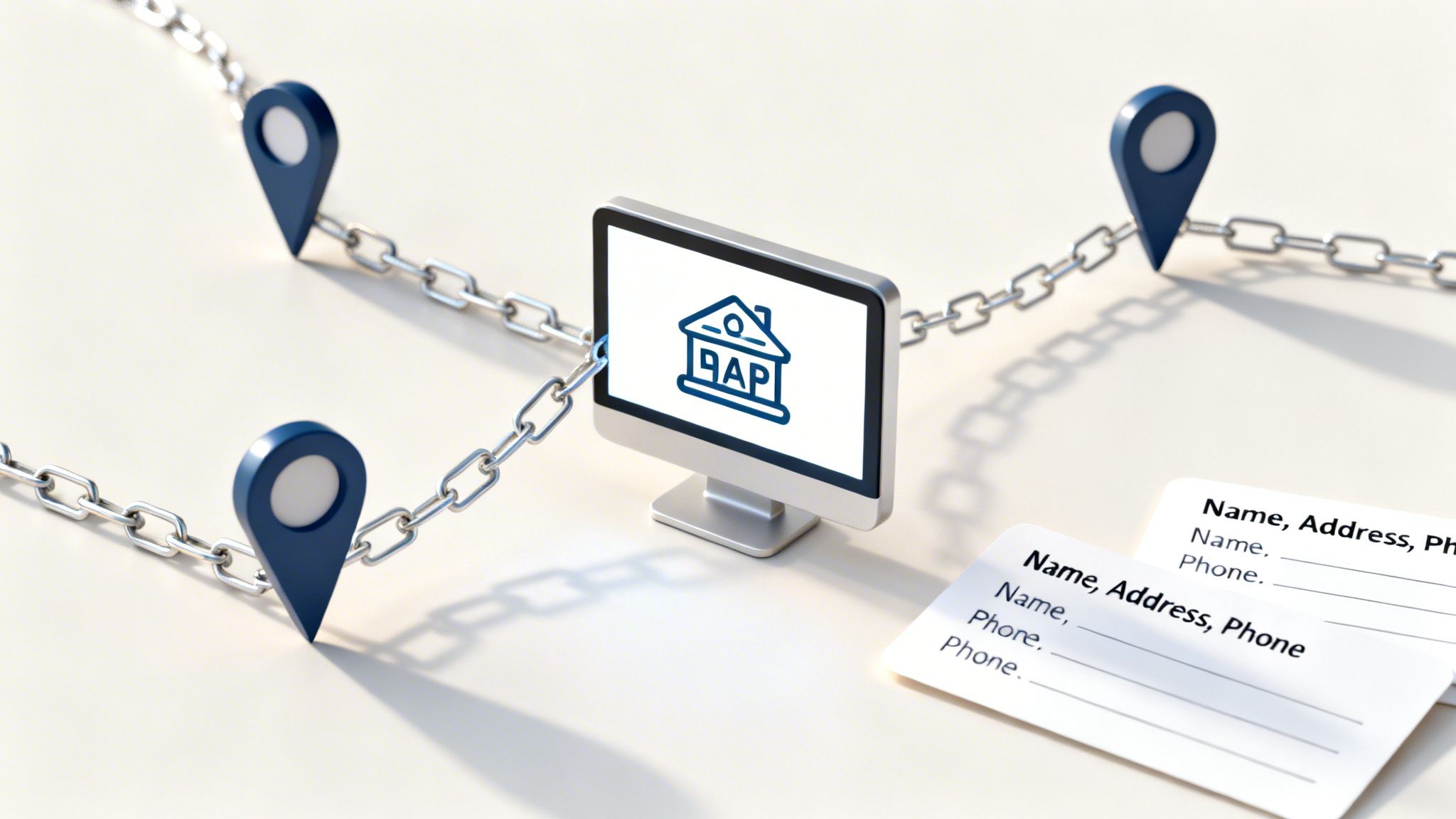
If your business targets local customers, citations are just as critical as backlinks. A citation is any online mention of your business’s Name, Address, and Phone number (NAP). These mentions are crucial for helping Google verify that your business is legitimate and physically located where you claim.
Consistency here is everything. Your NAP information must be 100% identical across every single platform—from your Google Business Profile to Yelp, Apple Maps, and niche industry directories. A tiny difference, like using “St.” on one site and “Street” on another, can create confusion for search engines and hurt your local rankings.
Tools like Whitespark’s Local Citation Finder are invaluable for this. They let you spy on your competitors to see where they’re listed and uncover new citation opportunities you might have missed, so you can prioritize your efforts for the biggest impact.
A strong, consistent citation profile is a massive ranking signal for the local map pack—that high-value block of listings at the top of local search results. For any local business, showing up there is a direct pipeline to new leads. To really dig into this, check out our complete guide to local SEO lead generation.
Ultimately, building a strong backlink profile and a clean set of local citations sends powerful trust signals to Google. It proves you’re an established, authoritative business worth showing to its users—which is the entire point of using SEO to generate leads.
SEO Lead Generation: Measuring Your SEO Lead Generation Success
Here’s where we separate the pros from the amateurs. All the keyword research, content creation, and link building in the world mean nothing if you can’t prove it’s making you money.
It’s time to move past vanity metrics. Traffic is nice, but it doesn’t pay the bills—qualified leads do. Your mission is to draw a straight line from your SEO activities to actual business results.
SEO Lead Generation: Setting Up Your Tracking Foundation
To get this right, you need two essential, free tools: Google Analytics 4 (GA4) and Google Search Console. Think of it this way: Search Console tells you which keywords bring people to your site, and GA4 shows you what those people do once they get there.
The magic happens when you set up conversion goals. A conversion is any meaningful action you want a visitor to take.
For most service-based businesses, the most important conversions to track are:
- Form Submissions: Anyone filling out your “Request a Quote” or “Contact Us” form.
- Phone Calls: Using simple call-tracking software to see which calls originate from organic search.
- Email Clicks: Tracking when a user clicks a
mailto:link to send you a direct message.
Once these goals are configured, you can finally answer the million-dollar question: which pages and keywords are actually generating leads, not just clicks?
SEO isn’t a “set-it-and-forget-it” channel. It requires constant experimentation and a commitment to data. The goal is to create a feedback loop where you test, measure, and refine your approach based on what the numbers tell you.
SEO Lead Generation: Implement a Simple Testing Cadence
Continuous improvement is the name of the game in SEO. You should always be testing something—a new headline, a different call-to-action, or a tweaked page layout.
You don’t need a complicated system. Start with a simple hypothesis. For example: “I believe changing the CTA from ‘Learn More’ to ‘Get My Free Quote’ will increase form submissions by 10%.”
Run the test for a few weeks, measure the conversion rate in GA4, and see if you were right. This data-driven mindset is what turns SEO from an expense into a powerful, revenue-generating investment.
This constant push for improvement is happening everywhere. AI-powered tools and chatbots, for instance, are changing how businesses capture and qualify leads. Businesses that use AI for lead generation report a 50% increase in sales-ready leads and can see up to 60% lower customer acquisition costs. Some B2B companies have even seen conversion rates jump by up to 20%. You can dig into more of these powerful AI lead generation statistics on martal.ca.
This commitment to tracking, testing, and adapting is what will ensure your SEO efforts deliver compounding returns for years to come.
Ready to turn your website into a lead generation machine? At Mr. Green Marketing, LLC, we combine data-driven SEO with strategy-led execution to deliver real results. Request your free audit and performance report today to see how we can accelerate your growth. Find out more at Mr.Green Marketing, LLC.
Leave a Comment
sing in to post your comment or sign-up if you dont have any account.