
Customer Journey Mapping: And the orders are coming in, but you still can’t explain where customers hesitate.
A local service company may see plenty of calls yet lose prospects between a search result and a booked appointment. An Amazon seller may get product-page traffic, strong reviews, and advertising clicks, then watch shoppers disappear at the comparison or checkout stage. The reports show isolated events. They don’t show the experience connecting them.
That’s where customer journey mapping earns its place. It turns scattered interactions into a practical view of what customers do, think, feel, and need from the first problem they recognize through purchase, support, repeat business, and advocacy. The value isn’t a colorful workshop board. The value is knowing which handoff needs attention, who owns it, and which metric will tell you whether the change worked.
Customer Journey Mapping: Table of Contents
- Introduction Why Your Business Needs a Map
- What Customer Journey Mapping Actually Is
- The Step-by-Step Framework for Your First Map
- Real-World Journey Mapping Examples
- From Map to Action Turning Insights Into Growth
- Common Pitfalls and How to Avoid Them
- FAQ Your Journey Mapping Questions Answered
Introduction Why Your Business Needs a Map
A business owner often experiences the company in a neat sequence. Marketing creates awareness, the website explains the offer, sales answers questions, operations delivers the product, and support handles anything afterward. Customers don’t experience those departments separately. They experience a chain of moments, often across search, social media, email, a product page, a phone call, a payment screen, and a follow-up message.
That difference creates expensive blind spots. A marketing manager may celebrate a campaign that produces visits, while customers are confused by the landing page. A sales representative may believe the booking process is simple, while prospects wait for a response. An Amazon seller may improve images but overlook unclear variation details, shipping expectations, or unanswered questions in the listing.
A journey map makes those gaps visible. It places the customer’s actions alongside touchpoints, emotions, pain points, internal owners, and business evidence. Instead of asking, “Why aren’t people converting?” you can ask a more useful question: “At which moment does confidence fall, and what happens immediately before and after it?”
Practical rule: Map the experience customers actually have, not the process your team intended to create.
Start with a focused audience and a specific business problem. A map for first-time buyers choosing a premium product will look different from a map for returning customers seeking support. Your buyer persona development work can provide a starting point, but customer evidence must refine it.
The rest of the process is straightforward. Gather real signals, reconstruct the journey, attach metrics, assign ownership, and create a review rhythm. The result should help someone decide what to change on a normal working day.
What Customer Journey Mapping Actually Is
A customer journey map is a visual representation of how a defined customer segment experiences a company across a series of interactions. It can cover a single task, such as booking an appointment or completing an Amazon purchase, or the broader relationship from discovery through retention and advocacy.
Think of it as a road-trip itinerary written from the passenger’s seat. The map records the route, stops, delays, confusing signs, moments of relief, and reasons the traveler might turn around. Your internal process chart, by contrast, shows which department controls each road.
That distinction matters. A sales funnel describes the business’s progression from awareness to conversion. A journey map describes the customer’s experience, including actions your funnel may ignore:
- Stages: What the customer is trying to accomplish, such as recognizing a need, comparing options, buying, getting help, or deciding whether to return.
- Touchpoints: Every meaningful interaction, including search results, product pages, reviews, forms, calls, emails, delivery updates, and service conversations.
- Customer actions: What the person does at each stage, rather than what your team hopes they’ll do.
- Thoughts and emotions: Confidence, urgency, uncertainty, frustration, relief, or enthusiasm.
- Pain points: Friction that slows progress, creates doubt, increases effort, or sends the customer elsewhere.
- Opportunities and ownership: The change to test, the team responsible, and the evidence used to judge it.
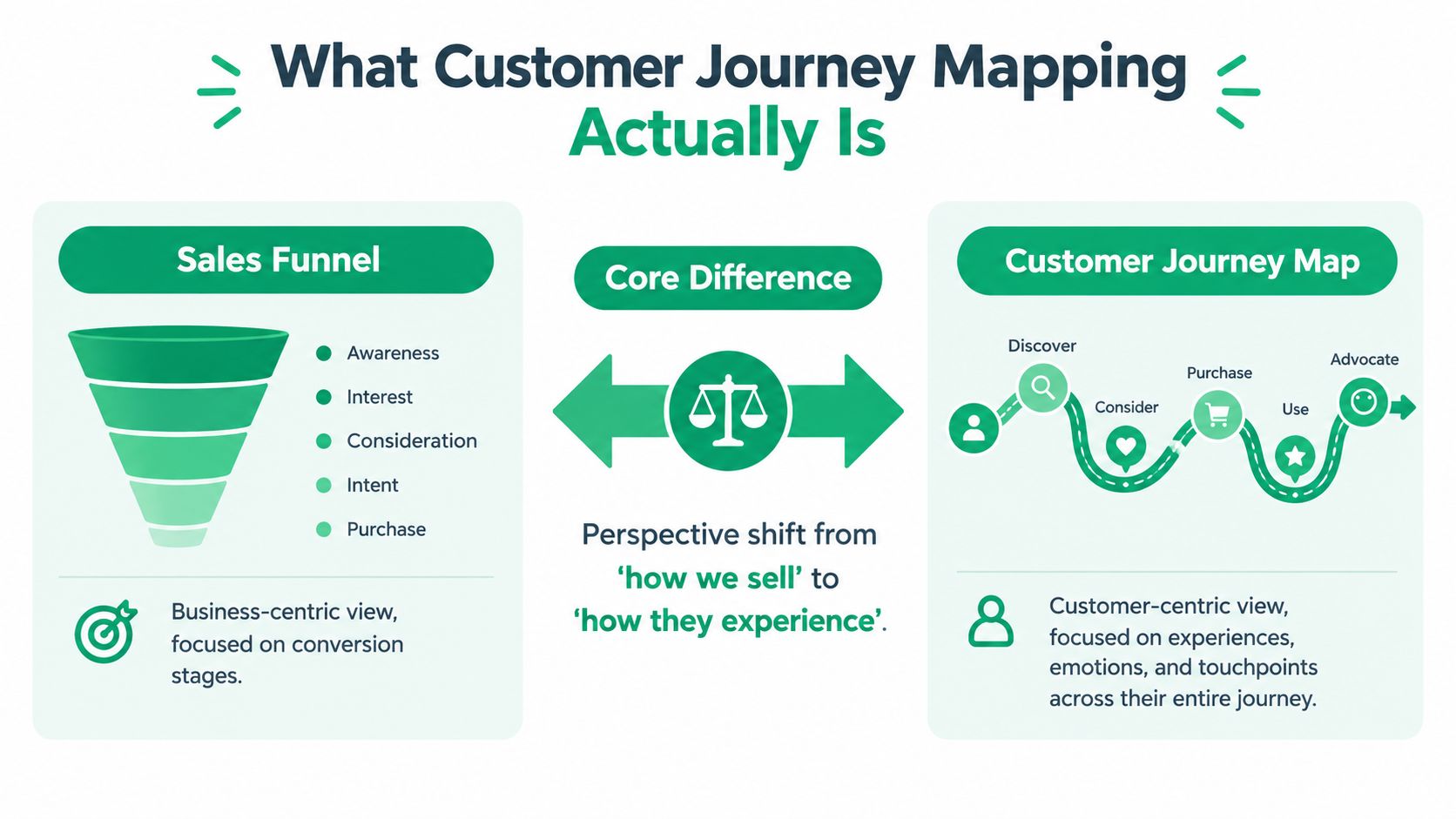
A funnel can tell you that shoppers reached a product page and didn’t purchase. A map helps investigate what happened there. Did the listing answer the customer’s question? Did the price feel justified beside competing products? Did the shopper find the right size, bundle, or delivery information? Did a support handoff preserve context?
This outside-in perspective has become a serious business practice. A prior survey reported that 42% of organizations already had a journey map, while two in five of the remaining organizations planned to create one. Among organizations with a map, 57% used an external market research vendor, and average development spending was $260,000. The source is the customer journey mapping research report. A later report found that the number of companies with maps was 12% higher in 2022 than in 2019, showing continued adoption.
For an SMB, that doesn’t mean copying enterprise spending or building a giant enterprise system. It means treating the map as a decision tool that connects your omnichannel marketing strategy to the lived experience customers encounter.
Customer Journey Mapping: The Step-by-Step Framework for Your First Map
A first map should answer a business question, not document every interaction a customer could have. Start with one high-value journey, such as new-lead booking, a first purchase, post-purchase support, or repeat ordering. Keep the scope narrow enough to manage, while including the handoffs that affect conversion, delivery, retention, or support cost.
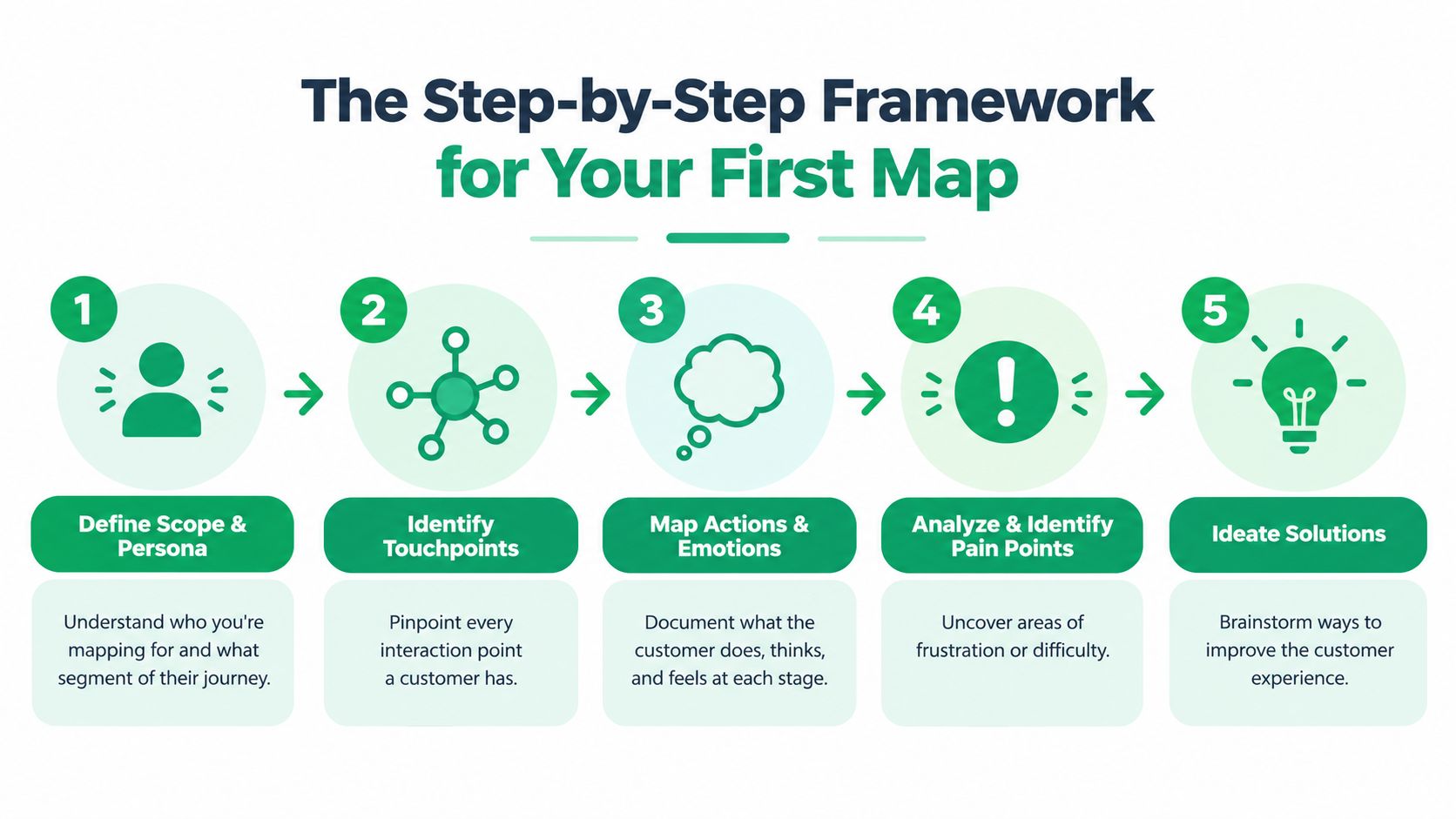
1. Start with real customer data
Collect evidence already available in the business. Review website analytics, search queries, abandoned forms, customer service conversations, sales notes, product reviews, return reasons, email replies, and delivery questions. Speak with customers when the records show what happened but not why.
The 10-step customer journey map framework from MeasuringU starts with data, then moves through persona selection, stages, steps, touchpoints, customer goals, pain points, metrics, and map creation. That sequence keeps the team from drawing an internal process and calling it customer-centric. It also fits the logic of a structured design process for customer-focused work, where evidence guides the next decision.
2. Choose one persona and one goal
Choose a persona that represents a meaningful customer group, rather than trying to include every buyer. An Amazon seller might map a first-time shopper comparing several alternatives. An HVAC company might focus on a homeowner with an urgent repair problem. Record what the person wants, what creates urgency, what they already know, and what could make them hesitate.
Write the business question in one sentence. “Where do first-time shoppers lose confidence before purchase?” gives the team a clear research target. “Improve the customer experience” is too broad to guide investigation, ownership, or prioritization.
3. Define stages from the customer’s perspective
Use stages that show customer progress, not departmental ownership. A practical sequence can include awareness, consideration, decision, purchase, onboarding or delivery, support, retention, and advocacy. Select only the stages relevant to the journey under review.
For a local service, the sequence may run from a symptom or urgent problem through search, provider comparison, contact, scheduling, service delivery, payment, and review. An ecommerce journey may begin with a need, then cover discovery, comparison, product evaluation, purchase, delivery, use, support, and reorder.
4. List touchpoints and customer actions
Record every interaction at each stage. Include visible touchpoints such as ads, landing pages, product listings, checkout, calls, and emails. Include customer effort that companies often overlook, such as waiting for a reply, checking a competitor, asking a friend, reading negative reviews, or interpreting a return policy.
Separate what customers do from what your business does. “Customer calls to confirm availability” describes an action. “Sales team answers the phone” describes an internal response. Keeping both entries separate reveals unnecessary effort, unclear ownership, and handoffs that may lose context.
5. Add thoughts, emotions, and pain points
At each touchpoint, record the customer’s likely question and emotional state. Mark assumptions until evidence confirms them. A shopper may question whether a product is durable. A homeowner may worry that the technician will arrive too late. A new customer may feel uncertain because the next step is unclear.
Make pain points specific enough to investigate. “The website is confusing” does not identify a fix. “The customer cannot tell whether the quoted price includes the required service” gives the team a concrete question for content, sales, or pricing review.
6. Add metrics before you decorate the map
Assign evidence to every major stage. A marketing stage may use qualified inquiries or landing-page engagement. A service stage may require response time, completion rate, repeat contact, or sentiment. A product journey may use listing engagement, conversion behavior, returns, review themes, and support contacts.
Do not force one metric across the entire journey. Match each measure to the customer’s task and the business outcome. Then convert the map into an operating list with prioritized problems, owners, tests, and review dates. The visual explains the journey. The operating list keeps it active in weekly decisions and connects improvements to revenue and customer effort.
Customer Journey Mapping: Real-World Journey Mapping Examples
A map becomes easier to build when you follow one customer through a real situation. These examples are illustrative operating models, not claims about the performance of a specific company.

Local service example
A homeowner notices that the air conditioner isn’t cooling properly. The journey starts before the company receives a lead.
| Stage | Customer experience | Touchpoints | Operational question |
|---|---|---|---|
| Problem recognition | Urgent, uncertain, looking for a trustworthy answer | Search engine, reviews, local listing | Does the message address the immediate problem? |
| Provider comparison | Comparing availability, service area, reputation, and price expectations | Website, phone, form, review profile | Can the customer quickly verify fit? |
| Contact and booking | Wants reassurance and a clear appointment | Call, voicemail, booking form, confirmation | How much effort is required to schedule? |
| Service delivery | Expects competence, punctuality, and explanation | Technician visit, estimate, payment | Does the handoff preserve customer context? |
| Follow-up | Decides whether to recommend or return | Receipt, follow-up message, review request | What creates confidence after the visit? |
The opportunity might not be another advertisement. It could be a clearer service-area statement, a reliable booking confirmation, or a technician handoff that includes the original complaint. For a service-heavy journey, include operational measures such as average speed to answer, abandon rates, transfer rates, first contact resolution rates, top contact drivers, self-service success rates, and customer sentiment scores, as outlined in the customer journey mapping template.
Customer Journey Mapping: Amazon seller example
A shopper searches for a solution and discovers a product through Amazon search or an external ad. The product title earns attention, but the shopper still needs proof that the item fits the intended use.
They inspect images, bullet points, A+ Content, specifications, variations, delivery information, and reviews. A negative review may raise a question that the listing never answers. The shopper compares alternatives, checks the total value, and either buys, saves the item, or leaves.
After purchase, the journey continues through confirmation, delivery, unboxing, setup, usage, questions, returns, and possible repeat purchase. The map should connect each moment to an owner. Listing content belongs to the marketplace team, inventory and delivery concerns involve operations, and recurring product questions may belong to customer support or content.
A useful opportunity list might include clarifying compatibility, reorganizing comparison information, improving setup guidance, and routing recurring questions into listing content. A case study marketing approach can help organize customer evidence into a story, but the map must still preserve the customer’s actual sequence and uncertainty.
Customer Journey Mapping: From Map to Action Turning Insights Into Growth
A wall-sized map can impress a meeting and change nothing. Operationalization begins when each important insight becomes a decision with an owner, a measure, and a next review.
Start by identifying the moments where the customer’s confidence changes. These may be the first response to a lead, the product comparison screen, the payment step, the delivery update, or the first support interaction. Rank moments by customer impact, business relevance, evidence strength, and effort to improve. Don’t let the loudest opinion win by default.
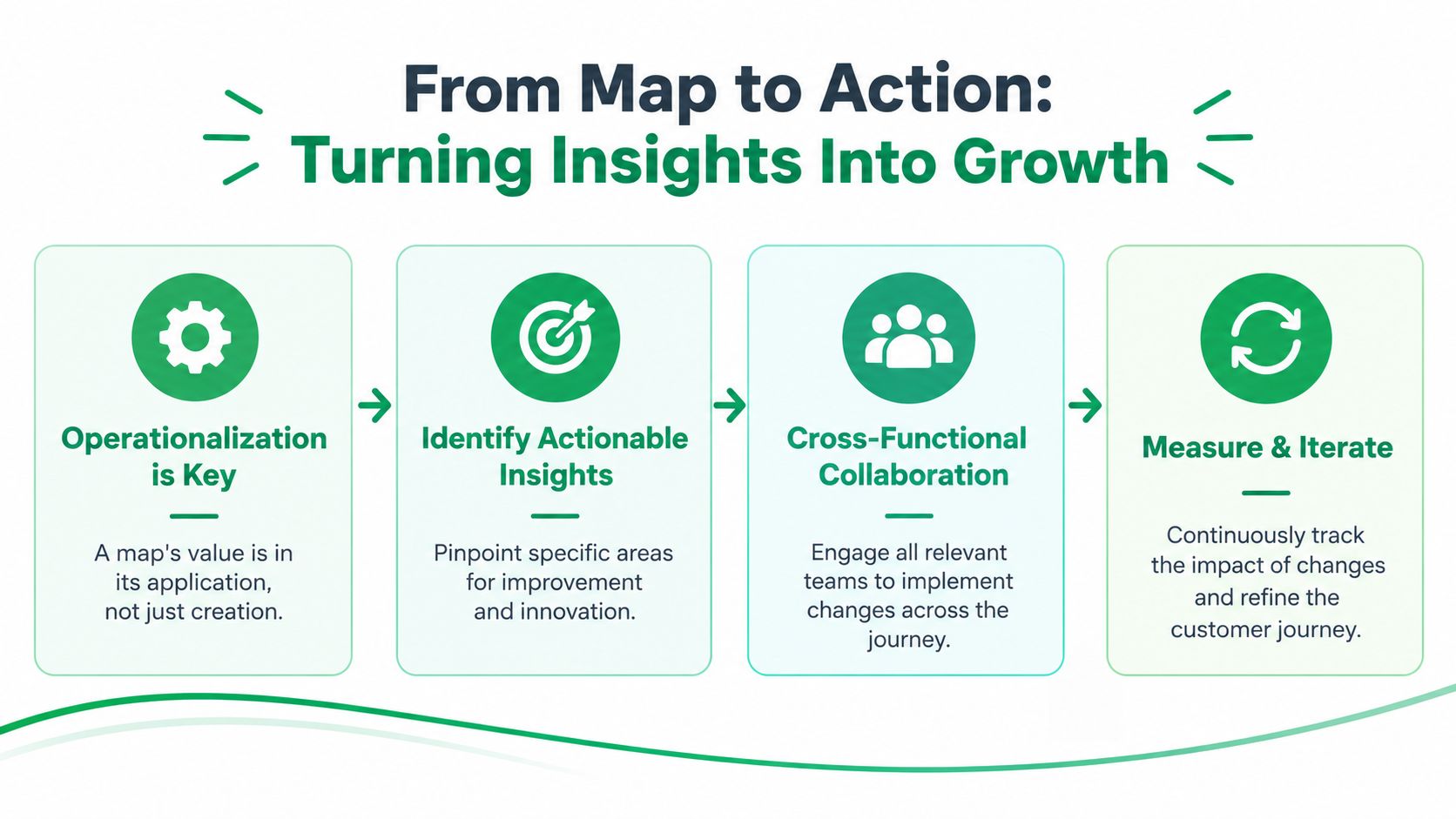
Convert friction into an operating brief
For every priority, write a compact action brief:
- Observed problem: State what customers do and where progress slows.
- Evidence: Attach the relevant conversation theme, analytics signal, review pattern, or direct observation.
- Owner: Name one accountable person or team, not a department with no decision maker.
- Change to test: Specify the page, message, handoff, policy, workflow, or training adjustment.
- Metric: Choose the measure that reflects the stage and intended outcome.
- Review point: Decide when the team will inspect the evidence and choose the next action.
This structure keeps a map from becoming a collection of interesting observations. It also lets a small business make progress without waiting for a large transformation project.
Forrester recommends selecting and mapping the journey with metrics in mind, assessing the health of existing CX metrics, using the map to design future-state metrics, and then using the map to share those metrics more effectively. That sequence is explained in Forrester’s guidance on making journey maps useful for CX measurement.
Build a living review rhythm
Keep the current-state map accessible to marketing, sales, operations, fulfillment, and support. A weekly team review may focus on open actions and fresh customer signals. A broader review can examine whether the journey, ownership, or measurement has changed after a product update, new campaign, channel shift, or recurring service issue.
The map should also have a future-state layer. It describes the experience you want customers to have, then links that vision to the operational changes required to produce it. For an SMB, this might mean replacing manual follow-up with a reliable sequence. For an Amazon seller, it might mean connecting listing questions, inventory decisions, support content, and post-purchase feedback.
Operating principle: A journey map creates revenue value only when it changes a decision, a handoff, or a customer-facing interaction.
Website work should follow the same logic. A website conversion rate optimization program can use journey evidence to prioritize pages and forms instead of testing elements in isolation. The map tells you why a customer hesitates. The test tells you whether the proposed remedy helps.
Common Pitfalls and How to Avoid Them
The most common failure is building the map from the inside out. Teams list campaigns, departments, and internal milestones, then assume the customer experiences those steps in the same order. Correct this by starting with customer evidence and writing actions in the customer’s voice.
Another problem is trying to map every persona and channel at once. The result becomes unreadable, and no one knows which issue deserves attention. Begin with one audience, one journey, and one business question. Expand only after the first map produces useful decisions.
Cross-functional exclusion creates a different kind of distortion. Marketing sees acquisition, operations sees delivery, and support sees complaints, but nobody sees the complete handoff. Invite representatives from the teams that influence the chosen journey, then give each owner a clear responsibility after the workshop.
A static map also fails quickly. Customer behavior changes, products change, staffing changes, and channels change. Assign a map owner, record the evidence behind each assumption, and create a simple update trigger when a major process or offer changes.
Finally, don’t confuse visual polish with accuracy. Sticky notes, spreadsheets, Miro, Lucidchart, or another shared workspace can all work. The tool matters less than whether the map reflects real behavior, exposes internal friction, and guides measurable action.
FAQ Your Journey Mapping Questions Answered
How do we keep a journey map current?
Treat it like an operating document, not an annual presentation. Store the current map where the teams who use it can find it, attach evidence to important claims, and review open actions on a recurring cadence. Update it when customers reveal a new pattern, the business changes a major workflow, or a new channel alters the experience.
The need is practical. CX Network’s research identified data silos at 76%, poor cross-functional communication at 73%, and difficulty understanding actual customer behavior at 46% as major barriers to journey management success, according to its state of customer journey success research. A living map creates shared visibility, but only if teams use the same evidence and act on it.
How much data do we need to begin?
You don’t need a perfect research library. Start with the signals closest to the chosen journey, then mark what is observed, what customers reported, and what the team assumes. Review a focused set of support conversations, analytics paths, reviews, sales notes, or interviews. The purpose is to find recurring friction worth investigating, not to claim that every customer behaves identically.
For an SMB, a small, well-scoped map is more useful than a massive generic model. Expand the research when the map reveals an important question that the current evidence can’t answer.
How do we connect customer steps to employee processes?
Add a service-blueprint layer beneath the customer journey. For every customer-facing step, document the employee action, system used, decision right, dependency, and handoff. Then ask what the employee needs to deliver the intended experience.
Many businesses discover that the visible customer problem begins internally. A delayed reply may reflect unclear ownership. A repeated support question may reflect missing product information. A failed delivery update may reflect disconnected systems rather than poor customer intent.
Give internal friction the same discipline as customer friction. Assign an owner, define the operational change, and connect it to the customer metric that should move. That turns empathy into accountability and keeps customer journey mapping tied to execution, not just discussion.
Mr. Green Marketing, LLC helps businesses turn customer evidence into practical digital growth through SEO, PPC, conversion-focused websites, Amazon marketing, branding, and related services. Visit Mr. Green Marketing, LLC to request a free audit and performance report, then use the findings to prioritize the journey gaps most likely to affect visibility, conversion, and revenue.
Leave a Comment
sing in to post your comment or sign-up if you dont have any account.