
Executive coaching has become a substantial business investment, not a perk reserved for a handful of senior leaders. The International Coaching Federation’s 2025 study materials estimate worldwide coaching revenue at about $5.34 billion annually, with nearly 123,000 coach practitioners, representing roughly 13% to 15% growth since 2023. A separate market projection places the broader executive coaching and leadership development market at $103.56 billion in 2025, rising to $112.98 billion in 2026 and $174.53 billion by 2031, implying a 9.11% CAGR from 2026 to 2031 according to Mordor Intelligence’s market report.
That scale creates an uncomfortable question for small and medium-sized businesses. If coaching is a serious professional-services category, why do so many buyers still struggle to explain what they’re paying for, which outcomes matter, and how they’ll know the engagement worked?
The answer usually isn’t a lack of leadership ambition. It’s weak measurement and fuzzy boundaries. Effective executive coaching changes observable behavior, decision quality, communication patterns, and execution. Poorly designed coaching becomes an expensive conversation series with no defined finish line.
Executive Coaching: Table of Contents
- What Executive Coaching Actually Is
- The Business Case and Measurable Outcomes
- How a Typical Coaching Engagement Works
- Who Should Get Coaching and When
- How to Evaluate and Hire the Right Coach
- Pricing Models and Budget Planning for SMBs
- Real-World Coaching Scenarios and Results
What Executive Coaching Actually Is
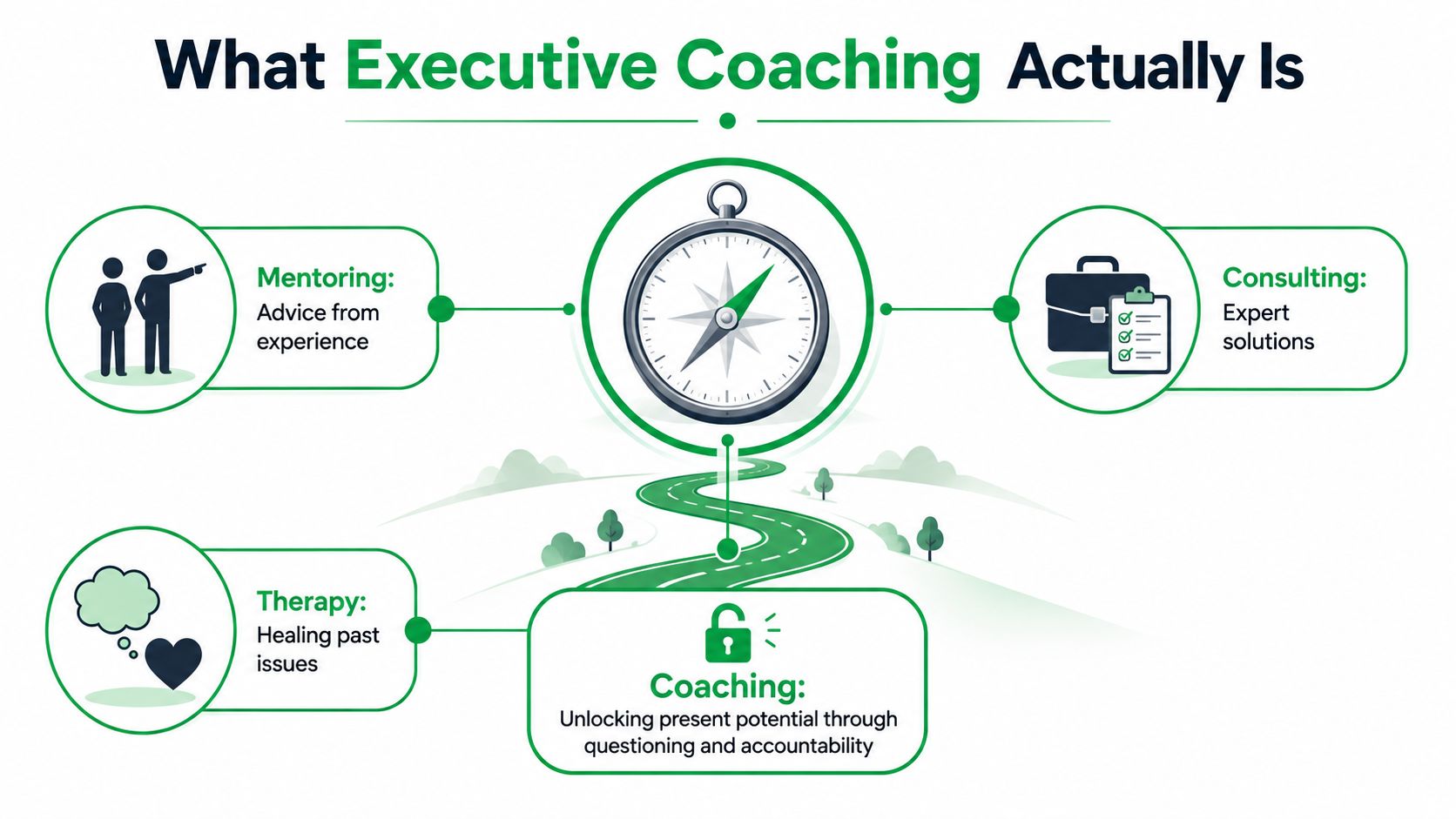
Executive coaching is a structured professional relationship that helps a leader improve how they think, decide, communicate, and act in a business context. The International Coaching Federation definition of professional coaching describes it as a partnership using a thought-provoking and creative process to help clients maximize personal and professional potential.
That definition matters because coaching is not advice delivered by an impressive person. The coach helps the client examine assumptions, identify options, test commitments, and build accountability. The client remains responsible for the decisions. A coach may bring relevant business experience, but the engagement shouldn’t turn into consulting unless both parties explicitly agree to that change.
The boundaries buyers need to understand
Mentoring generally involves guidance based on the mentor’s experience. A former chief executive might explain how they handled a board conflict or entered a new market. That can be useful, particularly when the client needs context or pattern recognition.
Consulting focuses on expert diagnosis and solutions. A consultant may assess an operating model, recommend a restructuring approach, or design a sales process. The buyer is paying for specialized answers and implementation support.
Therapy addresses psychological health, distress, trauma, and healing. Executive coaches can encounter personal material, but responsible coaches know when an issue requires a licensed mental-health professional. Coaching shouldn’t be used as a substitute for clinical care.
The distinction protects the budget. If the business needs a go-to-market plan, hire a consultant. If a newly promoted leader needs industry perspective, consider a mentor. If someone is experiencing serious psychological distress, seek therapy. If the leader understands the problem but repeatedly fails to convert insight into action, coaching may be the right tool.
Leadership language can obscure these differences. Even a simple resource on the acronym for leader can become more useful when the organization replaces labels with clearly defined responsibilities, behaviors, and outcomes.
Executive Coaching: Why the market’s scale matters
The market data signals a shift in buyer expectations. Organizations increasingly purchase coaching as part of leadership development, performance improvement, succession planning, and transition support. That doesn’t mean every coaching provider delivers equal value. It means buyers should evaluate coaching with the same discipline they apply to other professional services.
The practical test is straightforward. Can the coach define the behavior being changed, explain how progress will be observed, and protect confidentiality while giving the sponsor enough information to judge business impact? If not, the engagement is probably underspecified.
Executive Coaching: The Business Case and Measurable Outcomes
A defensible business case for executive coaching starts with specific behavioral changes and business-relevant indicators, rather than confidence alone. Confidence may support performance, but it is difficult to defend as a standalone investment outcome. A coach helps the client examine assumptions, identify options, test commitments, and build accountability. The client remains responsible for decisions.
A meta-analysis of 39 coaching randomized controlled trial samples involving 2,528 participants estimated an overall effect size of g = 0.59 across leadership and personal outcomes. Another meta-analysis found an overall weighted effect of g = 0.43 across behaviors, attitudes, and personal characteristics. These findings are summarized in the peer-reviewed meta-analysis available through PubMed Central. The strongest gains were behavioral, especially in planning, strategy formation, and adopting new behaviors.
That evidence points to the practical test: reflection must lead to repeated implementation. A leader who identifies a delegation problem but leaves meeting ownership, decision rights, and follow-up habits unchanged has produced little business value.
What the ROI evidence can and cannot prove
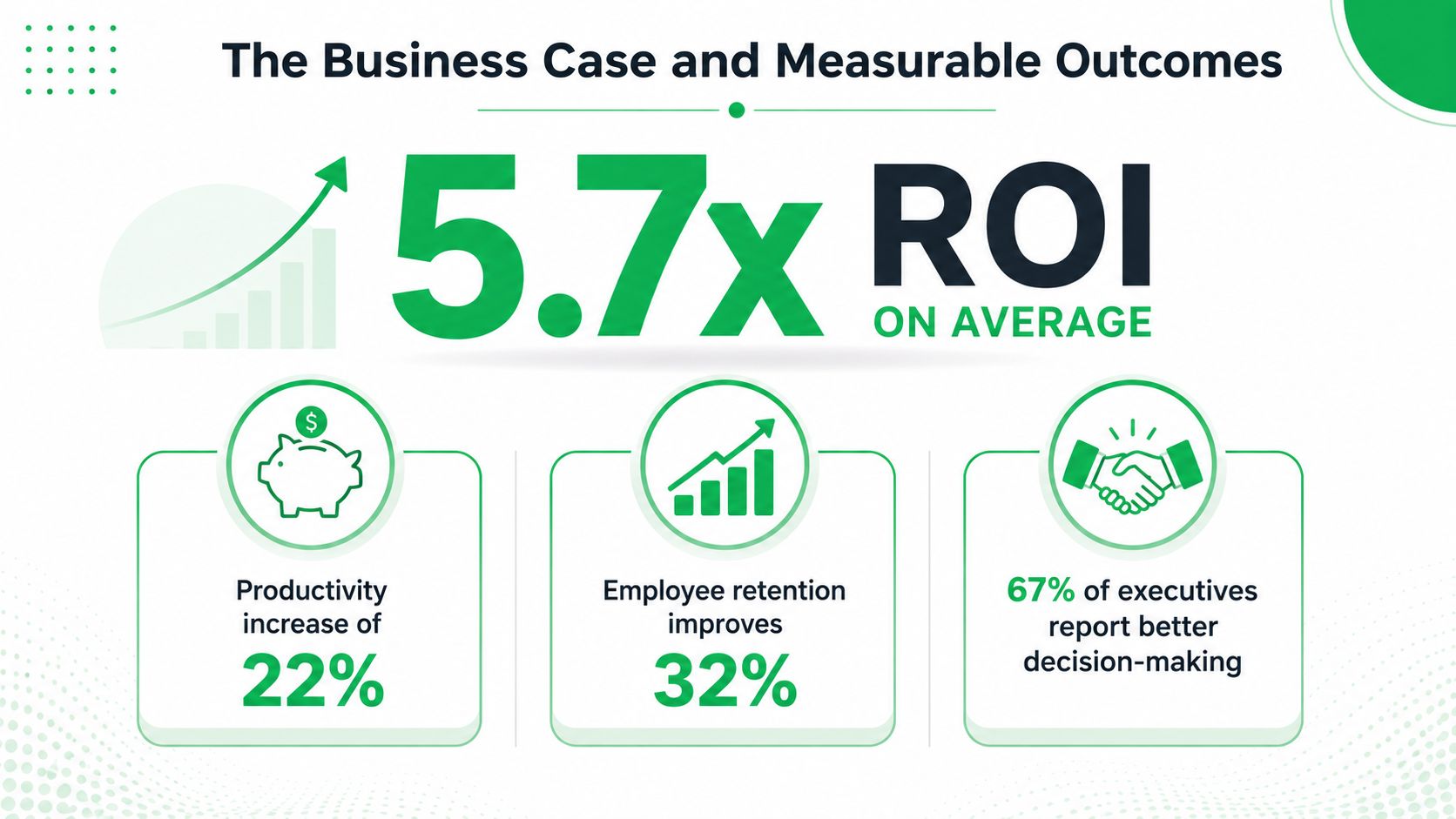
Major coaching studies have reported returns of about 5.7 times the initial investment in a typical assignment, with one executive-coaching study reporting more than $100,000 in average value created. An ICF-linked briefing also reported a 529% return on investment, excluding employee-retention benefits, as documented in this coaching ROI briefing.
A global ICF and PwC coaching study reported that 86% of companies measuring coaching ROI recouped at least their investment, while the headline median return was around 7 times the cost, according to this executive coaching ROI analysis.
These figures are benchmarks, not guarantees. They come from measured assignments and should not appear in an SMB proposal as promised results. Attribution is also difficult. Better performance may reflect coaching, a new manager, a market change, or several interventions at once.
SMBs can use a practical measurement plan:
- Define the baseline: Record the current behavior or business condition before coaching begins.
- Choose observable indicators: Track decision cycle time, missed commitments, delegation quality, stakeholder feedback, or progress against strategic priorities.
- Use multiple perspectives: Combine the client’s reflection with sponsor feedback, direct reports, peers, and operating data.
- Review at agreed points: Discuss progress during formal reviews instead of waiting until the engagement ends.
- Separate evidence from interpretation: Record what changed, what probably contributed, and what remains uncertain.
Use the same discipline applied to calculating marketing ROI. A useful coaching measurement plan fits on one page. If explaining it requires a data science team, it is probably disconnected from the leader’s actual work.
Executive Coaching: How a Typical Coaching Engagement Works
A credible engagement has a beginning, a working phase, and a deliberate close. The conversation may feel flexible, but the commercial relationship shouldn’t be vague.
Start with context and a contract
The coach first learns about the leader’s role, business environment, stakeholders, strengths, and current friction. The sponsor, usually the owner, chief executive, HR leader, or board representative, should explain why coaching is being funded and what business outcomes matter.
The parties then establish a coaching agreement covering confidentiality, roles, communication with the sponsor, session logistics, cancellation terms, and escalation boundaries. This step prevents a common failure: the executive believes the coach works exclusively for them, while the sponsor expects a detailed report on every conversation.
Turn ambition into objectives
Broad goals such as “be a better leader” won’t guide useful work. Strong objectives describe behavior and context. For example, a leader might aim to delegate recurring operational decisions, run more effective conflict conversations, create clearer strategic priorities, or improve the quality of executive-team commitments.
The GROW model, which moves through goals, reality, options, and will, can provide a simple structure. Cognitive-behavioral approaches can help clients identify thought patterns that trigger avoidance, defensiveness, or overcontrol, then test alternative responses in real situations.
A practical engagement often includes:
- Initial assessment: Gather context and identify strengths, gaps, and stakeholder expectations.
- Goal-setting: Define a small set of measurable objectives rather than a long personal-development wish list.
- Regular sessions: Use consistent meetings for reflection, decision preparation, and accountability.
- Between-session practice: Apply one behavior in the workplace, observe the result, and bring the evidence back.
- Formal reviews: Compare progress with the baseline and adjust the work when the business context changes.
The process resembles a disciplined six-step design process, not because leadership is a design project, but because progress improves when people define the problem, test an intervention, and review what happened.
Executive Coaching: Expect an awkward middle
Early sessions can feel productive because the client is naming issues that have been avoided. The middle phase is less comfortable. The leader must change habits under pressure, and colleagues may respond in ways that reveal how entrenched the old pattern was.
A successful conclusion doesn’t mean the leader has become flawless. It means the client can recognize the trigger, choose a different response, measure the effect, and continue practicing without permanent dependence on the coach.
Who Should Get Coaching and When
Coaching produces the most value when a capable leader faces a meaningful challenge that requires changed behavior, not merely more information. The leader must also have enough authority to act on the work. Coaching someone who can’t influence the relevant decisions often creates frustration rather than progress.
Strong-fit situations
Executive transitions are a natural fit. A new chief executive, vice president, or functional head must interpret unfamiliar expectations, build trust, establish decision rhythms, and avoid importing habits that worked in a previous role but fail in the new environment.
Performance plateaus also deserve attention. A leader may be technically strong yet struggle with delegation, prioritization, conflict, or communication at greater scale. Coaching can help expose the gap between intention and the experience other people have of that leader.
High-potential development works when the business can offer stretch responsibilities and real feedback. Coaching shouldn’t be used to polish a favorite employee while ignoring the systems and managers around them.
Organizational change creates another useful opening. During a restructure, acquisition, strategic pivot, or technology shift, leaders need a confidential place to examine competing priorities and translate uncertainty into decisions.
The manager-capability question is particularly important for SMBs. Gallup-linked findings cited in 2026 report that managers account for 70% of the variance in team engagement, while only 27% of managers are effective coaches and 31% of frontline leaders want more coaching from their own managers, according to the executive coaching market analysis from Hallett Leadership. That suggests coaching shouldn’t automatically stop at the C-suite. A carefully designed manager capability system may reach more employees than an isolated premium engagement.
Poor-fit situations
Coaching is the wrong first response when a leader lacks a basic skill that training can teach, when a performance problem requires direct managerial action, or when the individual needs therapeutic support. It also fails when the sponsor wants the coach to pressure an unwilling participant into compliance.
Use this decision test:
- Is the issue primarily knowledge? Start with training or mentoring.
- Is the issue primarily execution or accountability? The manager must manage it directly.
- Is the issue primarily clinical or psychological distress? Refer to an appropriately qualified professional.
- Is the leader willing and able to experiment? If not, coaching will have limited impact.
- Can the business observe meaningful change? If not, define better indicators before spending the budget.
Executive Coaching: How to Evaluate and Hire the Right Coach
The buyer carries much of the risk because coaching quality varies widely. Credentials don’t guarantee a good match, but they provide useful evidence of training, ethical expectations, and professional discipline. Look for relevant affiliations such as the International Coaching Federation, EMCC, or APECS, then examine the coach’s actual approach and business experience.
Ask candidates questions that force specificity:
- What kinds of leadership situations do you handle best?
- How do you distinguish coaching from consulting, mentoring, and therapy?
- What will the sponsor receive, and what will remain confidential?
- How do you define progress at the start of an engagement?
- What happens when the client doesn’t complete agreed actions?
- Can you describe a time when you referred someone to another professional?
- How do you adapt your approach to an owner-led SMB, a functional executive, or a leadership team?
A chemistry session should feel like a working conversation, not a motivational performance. Notice whether the coach listens closely, asks precise questions, challenges assumptions respectfully, and explains the limits of their role. A coach who promises a guaranteed transformation is selling certainty that no responsible practitioner can provide.
Ethics deserve direct scrutiny. The APECS Code of Ethics and Conduct identifies autonomy, fidelity, beneficence, non-maleficence, justice, and caring for self as foundation principles. It also requires respect for individuals and organizations, fairness, sensitivity to difference, and healthy professional relationships.
Coach Evaluation Checklist
| Evaluation Area | What to Look For | Red Flags |
|---|---|---|
| Credentials | Recognized training, ethical code, ongoing professional development | Vague claims about certification |
| Business relevance | Familiarity with executive decisions, teams, and organizational pressure | Generic motivational language |
| Methodology | A clear explanation of how sessions connect to goals and action | A branded method the coach can’t explain |
| Measurement | Baselines, stakeholder input, behavior indicators, and review points | “You’ll know it worked” with no evidence |
| Confidentiality | Written boundaries between client, sponsor, and coach | Promises to share private session details |
| Chemistry | Curiosity, candor, listening, and respectful challenge | Dominating the conversation or forcing a sale |
| Proposal | Scope, cadence, fees, responsibilities, and termination terms | Open-ended commitment with no review |
The same discipline applies when evaluating any strategic provider. A structured guide on how to choose a digital marketing agency is useful for the same reason: buyers should compare evidence, process, fit, and accountability rather than selecting the most polished pitch.
Executive Coaching: Pricing Models and Budget Planning for SMBs
Executive coaching pricing varies by coach, specialization, geography, client seniority, delivery format, and sponsor expectations. The market doesn’t offer a universal rate card, so an SMB should resist both extremes: choosing the cheapest option without checking quality, or assuming a high fee automatically signals competence.
Match the model to the problem
Hourly coaching suits a narrowly defined need, such as preparing for a difficult board conversation or making a transition plan. It gives the buyer flexibility, but it can encourage reactive use without enough continuity to change habits.
A retainer package provides recurring access over an agreed period. This works when the leader needs regular accountability and the coach will support ongoing decisions. The contract should specify availability, response expectations, session frequency, and review points.
An engagement-based fee is better for a defined outcome, such as onboarding a new executive, improving delegation, or supporting a strategic transition. The fee isn’t a promise that the outcome will occur. It pays for a structured process with agreed responsibilities and evidence of progress.
Group coaching stretches the budget further and can create shared language among managers. It sacrifices some privacy and individual depth, so it isn’t ideal for sensitive performance issues or highly personal leadership challenges.
Budget rule: Buy enough continuity to practice new behavior, but don’t purchase an indefinite relationship before the first review proves the fit.
SMBs can reduce risk without treating quality as optional. Start with a defined pilot, combine individual coaching for the most senior leader with group work for managers, and set a decision point before extending the engagement. Ask for a transparent proposal rather than negotiating only on the headline fee.
Outcome-linked structures require care. A coach can influence reflection, preparation, and accountability, but they don’t control market conditions, team decisions, or the client’s willingness to act. If variable compensation is used, link it to process milestones and agreed evidence rather than promising a specific revenue result.
A sound budget includes the leader’s time, stakeholder interviews, assessment work, and review meetings, not just the coach’s invoice. The cheapest engagement can become the most expensive if nobody defines success.
Real-World Coaching Scenarios and Results
The following vignettes are practical composites, not attributed case studies. They illustrate the mechanics that matter more than polished transformation stories.
A founder has built a growing company by making every important decision personally. The approach worked when the team was small, but now department heads wait for approval, routine issues reach the founder, and strategic work gets postponed. Coaching doesn’t begin with “delegate more.” It maps the decisions the founder is holding, identifies the fear behind each one, assigns ownership to specific leaders, and creates a review rhythm that doesn’t pull every decision back upward.
The first attempts are uneven. A department head makes a poor call, and the founder nearly reclaims the work. The coaching focuses on separating a bad outcome from a bad delegation system, then improving decision boundaries. The tangible result is not that the founder stops caring. It’s that the company gains clearer ownership and the founder spends more time on decisions only they can make.

A newly promoted vice president is excellent in their former functional role but struggles in executive meetings. They provide too much detail, avoid disagreement until after the meeting, and leave colleagues unclear about their recommendation. Coaching uses meeting preparation, concise decision statements, stakeholder mapping, and post-meeting review. The leader practices saying what they recommend, why it matters, and what decision is needed.
Progress doesn’t arrive as a personality change. It appears as clearer communication, earlier disagreement, and fewer follow-up conversations required to discover the leader’s actual position.
A leadership team facing a strategic pivot has a different problem. The members understand the market pressure, but each function protects its own priorities. Coaching the team involves clarifying the decision criteria, surfacing trade-offs, and creating commitments that can be reviewed. Individual sessions may address defensiveness or political behavior that participants won’t raise in the group.
The outcome is a more honest operating conversation, not perfect agreement. Some priorities are dropped, ownership becomes visible, and disagreements move into the meeting rather than leaking into private resistance. That kind of narrative can resemble a marketing case study, but the measurement discipline remains the same: define the starting problem, record the behavior that changed, and distinguish coaching’s contribution from everything else happening in the business.
Coaching doesn’t remove the hard part of leadership. It makes the hard part visible enough to practice.
Mr. Green Marketing, LLC helps businesses connect strategy-led digital marketing with measurable growth through SEO, PPC, web design, branding, Amazon marketing, and GEO optimization. Visit Mr. Green Marketing, LLC to request a free audit and performance report, identify visibility gaps, and prioritize practical next steps with a team that values transparent reporting.
Leave a Comment
sing in to post your comment or sign-up if you dont have any account.