
Omnichannel Marketing Strategy: Your customer finds your product on Instagram during lunch. They tap through to your Shopify store, browse two collections, add something to cart, then leave because a meeting starts. That night, you send a generic newsletter featuring products they already ignored. The next morning, they see a retargeting ad with a different offer than the one on your site. If they also sell on Amazon, they may check your listing there and find another price entirely.
That isn’t a traffic problem. It’s a coordination problem.
A lot of SMBs think they need more channels when what they really need is a system that connects the channels they already have. Website, email, paid social, Amazon, SMS, customer service, even in-person conversations if you have a store or showroom. When those touchpoints don’t talk to each other, customers feel the friction immediately. They may not describe it as “fragmented journey architecture.” They just hesitate, bounce, or buy from someone else.
And that’s why single-channel thinking doesn’t hold up anymore. Customers don’t move in straight lines. They jump from social to site to inbox to marketplace to search and back again. If your marketing resets the conversation every time they switch channels, you’re asking them to do the work your systems should be doing.
Omnichannel Marketing Strategy: Your Customers Are Everywhere So Why Is Your Marketing Not
A familiar scenario. A shopper clicks a Facebook or Instagram ad, lands on your site, reads reviews, leaves, then gets an email blast the next day with a message that has nothing to do with what they viewed. Two days later, your Google Ads campaign pushes them back to the homepage instead of the product they already considered. If you’re also selling on Amazon, they may see your Sponsored Display ad, click to your listing, and get a totally different brand experience again.
That disconnect costs sales because it creates doubt.
Customers don’t think in channels. They think in tasks. Can I trust this brand? Is this the same product I saw earlier? Why am I getting this message now? If the answers aren’t obvious, the purchase gets delayed. Sometimes lost for good.
What the customer actually experiences
Multichannel businesses often look busy from the outside. They’re posting on social, sending email, running ads, and maybe listing products on Amazon or Walmart Marketplace. But busy isn’t the same as aligned.
What the customer feels is this:
- Mixed signals: One offer in email, another on the site, and something else in ads
- Lost context: They already viewed a product, but your next message treats them like a stranger
- Repeated friction: They have to restart the buying process every time they switch channels
- Weak trust: Inconsistent pricing, inconsistent creative, inconsistent follow-up
Customers rarely complain that your channels aren’t integrated. They just stop moving forward.
A real omnichannel marketing strategy fixes that by making the journey feel continuous. The ad matches the landing page. The email reflects the product browsed. The support team can see prior purchases. The marketplace experience doesn’t conflict with your direct site. Small things, yes. But small things stacked together become conversion rate, repeat purchase rate, and margin.
For SMBs, this matters even more because every wasted click hurts. You don’t have room to pay for traffic twice because your systems dropped the handoff the first time.
Omnichannel Marketing Strategy: Understanding Omnichannel Versus Multichannel
Being on several platforms doesn’t make a business omnichannel. It just means you’re present in more places.
Multichannel is when your channels operate side by side. Omnichannel is when they operate together.
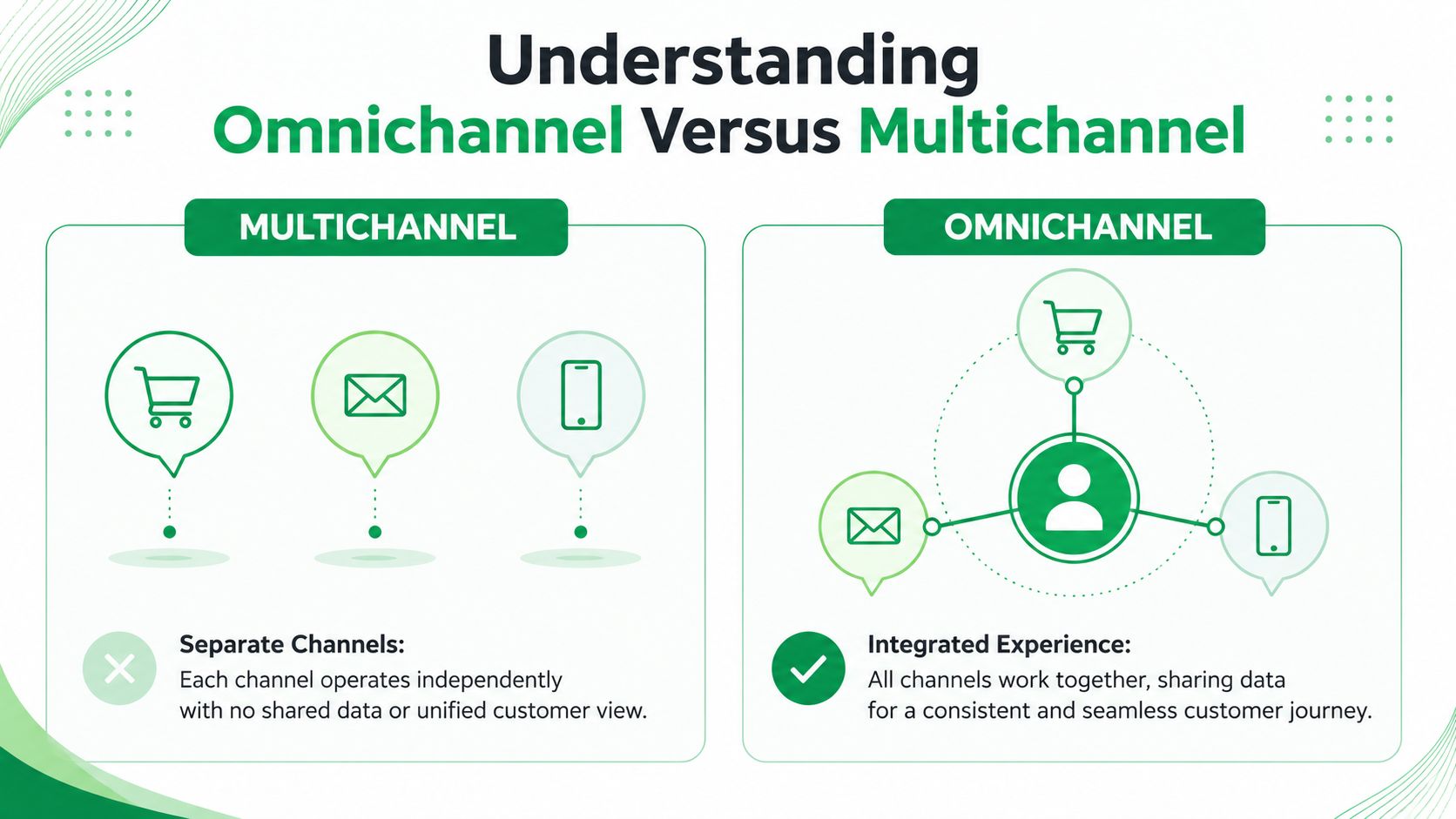
One conversation versus separate conversations
The simplest way to explain it is this. Multichannel feels like having separate conversations in different rooms with people who never compare notes. Omnichannel feels like one conversation that picks up where it left off.
A customer clicks an ad, visits your site, signs up for email, asks a question through chat, and later buys in-store or on Amazon. In a multichannel setup, each platform stores a fragment and acts independently. In an omnichannel setup, each interaction informs the next one.
That distinction matters because personalization only works when context carries forward.
Omnichannel Marketing Strategy: The three requirements that separate real omnichannel from wishful thinking
A lot of brands call themselves omnichannel when they’re really just running multiple isolated campaigns. A true setup has a technical baseline. According to Digital Applied’s definition of omnichannel infrastructure, a true omnichannel strategy is technically defined by three minimum infrastructure requirements: (1) a single inventory pool visible across all channels in real time, (2) a unified customer identifier that links online and offline activity, and (3) consistent pricing and promotions regardless of the channel used.
If one of those is missing, the cracks show fast.
| Setup area | Multichannel reality | Omnichannel reality |
|---|---|---|
| Customer data | Split across tools | Connected under one profile |
| Inventory | Channel-specific visibility | Shared view across channels |
| Promotions | Different depending on platform | Consistent wherever the customer buys |
| Messaging | Repetitive and disconnected | Sequential and context-aware |
Where SMBs usually get stuck
Not because they don’t understand the goal. Because most advice assumes enterprise systems and enterprise budgets.
An SMB might have Shopify, Mailchimp, Meta Ads Manager, Klaviyo or another email tool, plus Amazon Seller Central. None of that is a problem by itself. The problem starts when those tools aren’t stitched together in a practical way. Then email doesn’t know what paid social did. Ads don’t know what customer support handled. Amazon activity sits in its own silo.
Practical rule: If a customer changes channels and your brand loses the thread, you’re not running omnichannel yet.
That’s the shift. Stop thinking “Which channel should we add next?” Start asking “How do we make the next interaction smarter than the last one?”
Omnichannel Marketing Strategy: The Undeniable Business Case for Omnichannel
A customer clicks your Instagram ad on Tuesday, browses your Shopify store on lunch break, reads your email that night, then buys on Amazon two days later. If those touchpoints are disconnected, you pay for the same conversion multiple times and still lose visibility into what worked.
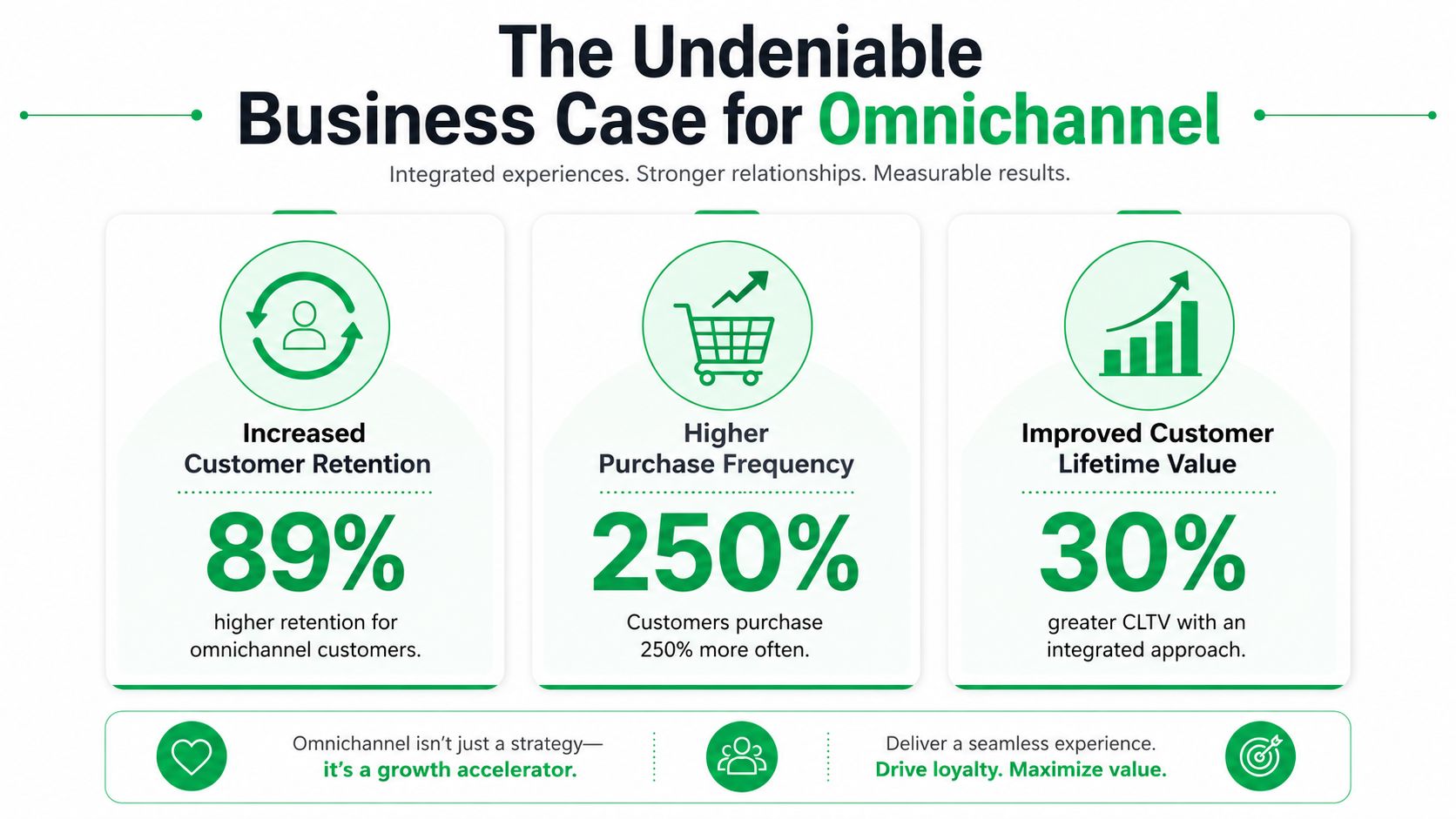
Retention is where the payoff starts
For most SMBs, the biggest financial win is not flashy acquisition. It is getting more value from buyers you already earned.
According to this roundup of omnichannel performance data, companies with strong omnichannel customer engagement retain 89% of their customers, compared to 33% for companies with weak omnichannel engagement. The same source reports that 86% of consumers expect consistent, personalized experiences.
That lines up with what happens in the field. When email reflects what a customer viewed, support can see recent orders, and paid ads stop pushing products someone already bought, the experience feels organized. Organized brands get more second purchases.
This matters even more if your sales cycle has comparison shopping baked into it. Harvard Business Review reported that in a study of 46,000 shoppers, 73% used multiple channels during their shopping journey. The study also found that customers who used more than one channel spent more and shopped more often than single-channel customers.
For an SMB owner, that is the key consideration. Buyers already move across channels. Omnichannel enables your business to keep pace.
A clearer understanding of your audience helps here too. If you have not mapped channel behavior by segment, this guide to buyer persona development for growing brands will help you decide where coordinated messaging matters.
Conversion and order behavior improve too
Retention usually gets the strategic conversation started, but conversion economics are what make omnichannel easier to justify on a budget.
According to this collection of omnichannel ecommerce benchmarks, omnichannel marketing campaigns generate a 494% higher order rate compared to single-channel campaigns, with 0.83% order rate versus 0.14%. The same source says marketers using three or more coordinated channels see a 287% higher purchase rate, and campaigns using five or more synchronized channels reach a 347% higher purchase rate.
Those gains change the math. If coordinated channels raise conversion rate and repeat purchase behavior, you can afford higher acquisition costs without crushing margin. That is a big deal for brands selling on thin margins, especially Amazon sellers who already deal with fees, rising CPCs, and limited customer data.
There is a trade-off, though. More channels do not automatically produce better results. More channels with poor coordination create waste faster. An SMB with Shopify, Mailchimp, and Amazon can still outperform a bigger brand if those tools are connected well and the messaging follows the customer instead of resetting every time.
Better coordination usually beats more volume. A connected system turns existing traffic into more revenue before you spend more on acquisition.
Omnichannel Marketing Strategy: Revenue growth follows execution
Revenue improves because the entire system gets more efficient. Fewer abandoned journeys. Better repeat purchase rates. Higher customer value over time.
Forrester found that companies with strong omnichannel strategies achieved a 9.5% year-over-year increase in annual revenue, compared with 3.4% for weak omnichannel companies. That gap is large enough to matter even if you are not operating at enterprise scale.
That is why the business case is straightforward for smaller brands. Omnichannel is not a software vanity project. It is a practical way to get more return from traffic, customers, and channels you already paid for.
If you want another practical perspective, this guide to omnichannel strategies for DTC brands keeps the focus where it should be: execution, not theory.
A Practical Framework for Your Omnichannel Strategy
The good news is you don’t need a huge CDP project to start. You need a workable structure, clean priorities, and a stack that can share enough data to act intelligently.
Start with the visual below. It captures the rhythm of a solid rollout.
Omnichannel Marketing Strategy: Stage one, audit what already exists
Don’t start by shopping for software. Start by documenting reality.
List every place a customer can interact with you: website, email, SMS, Meta ads, Google Ads, Amazon listing, Brand Store, chat, phone, retail location, packaging insert, support inbox. Then mark what data each channel collects, where that data lives, and whether another tool can use it.
A short audit should answer four questions:
- Where do customers first discover you
- Where do they compare options
- Where do they buy
- Where does the journey break
This is also where persona work becomes practical. If you haven’t tightened that up, a structured process for buyer persona development helps because channel orchestration only works when you know who you’re guiding and what objections show up at each step.
Omnichannel Marketing Strategy: Stage two, map the real journey, not the ideal one
Mapping the journey teams want customers to take is a mistake.
Map the messy version. The shopper who clicks an ad, reads reviews, checks Amazon, abandons cart, opens an email on mobile, then buys on desktop two days later. Or the customer who discovers your product on Amazon first, follows your brand on social, then later purchases bundles on your Shopify store.
That journey map should include three channel categories, not just digital ones. According to Medallia’s omnichannel strategy guide, omnichannel integration must cover digital channels, non-digital channels, and hybrid channels. If you ignore phone calls, in-person interactions, or hybrid experiences like buy online pickup in store, you’ll miss where consistency breaks.
Omnichannel Marketing Strategy: Stage three, orchestrate the next best touchpoint
Once you know the path, decide what should happen next when a customer takes a specific action.
A good SMB setup often looks like this:
- Viewed product but didn’t add to cart: Retarget with product-specific creative and suppress broad prospecting messages.
- Added to cart but didn’t purchase: Trigger an email reminder with the exact item. If SMS is part of your program, follow with a short reminder later.
- Purchased once: Move the customer out of acquisition messaging and into onboarding, support, or replenishment.
- Opened support ticket: Pause sales-heavy promotions until the issue is resolved.
Teams usually overcomplicate things. You don’t need fifty branches. You need a few high-intent sequences that don’t contradict one another.
A quick walkthrough helps:
Omnichannel Marketing Strategy: Stage four, align creative, offer, and timing
Omnichannel falls apart when each channel speaks a different language.
Your paid social ad shouldn’t promote one benefit while the landing page emphasizes another. Your Amazon product detail page shouldn’t feel like it belongs to a different company than your website. Your welcome email shouldn’t ignore the source that brought the customer in.
Use a simple campaign sheet with these fields:
| Element | What to define |
|---|---|
| Primary offer | What the customer sees everywhere |
| Entry channel | Where the journey starts |
| Follow-up logic | What happens after click, browse, cart, or purchase |
| Suppression rules | Which messages stop after another event occurs |
| Creative anchor | The headline, image style, and promise that stay consistent |
Omnichannel Marketing Strategy: Stage five, build the good-enough stack
This is the part enterprise content gets wrong for SMBs. It assumes you need a major data platform before you can behave like an omnichannel brand.
You don’t.
According to MoEngage’s discussion of omnichannel challenges, SMBs should use “unified CRM + lightweight API stitching” such as connecting Shopify, Mailchimp, and Google Ads via Zapier or custom scripts to create pseudo-unified profiles. The same source says 42% of SMBs using this tool-bridge approach achieved 23% higher cross-channel conversion rates compared to those waiting for CDP implementation.
That approach is usually enough to get moving:
- Commerce hub: Shopify
- Email and automation: Mailchimp, Klaviyo, or similar
- Ad platforms: Meta and Google
- Marketplace channel: Amazon Seller Central
- Connector layer: Zapier or custom lightweight scripts
- CRM source of truth: One place where customer status is updated consistently
Use the stack you can maintain. A smaller connected system beats a larger broken one.
Omnichannel Tactics for SMBs and Amazon Sellers
Theory is useful. Tactics pay the bills.

For SMB ecommerce brands
A solid SMB omnichannel marketing strategy usually starts with one high-friction journey. Cart abandonment is the obvious candidate because the intent is already there.
Here’s a practical sequence:
- Site behavior triggers email: Customer adds a product to cart on Shopify and leaves. Your email platform sends a reminder featuring that exact item.
- Paid social mirrors the same product: Meta retargeting uses matching creative and doesn’t swap to a completely different collection.
- On-site return experience stays consistent: When the customer clicks back, they land on the cart or product page, not the homepage.
- Post-purchase suppression kicks in: Once they buy, acquisition ads stop and onboarding begins.
Another reliable play is category-intent sequencing. If someone browses your protein powder collection three times but doesn’t buy, stop sending broad newsletters. Send one focused email about that category, show matching ad creative, and feature that collection prominently on the site when they return.
Short version. Relevance beats volume.
Omnichannel Marketing Strategy: For Amazon sellers
Amazon complicates omnichannel because you don’t own the customer relationship the same way you do on Shopify. But you still have room to coordinate.
Sponsored Display can help keep your product visible off-Amazon after shoppers show interest. Amazon Posts can reinforce brand familiarity and move traffic inside your Amazon ecosystem. Your Brand Store can act like a cleaner continuation of the product discovery process instead of forcing shoppers to bounce between unrelated listings.
If you’re selling both on Amazon and direct, your branding needs to travel. Product naming, imagery style, core value proposition, and bundle logic should feel connected. Not identical in every detail, but clearly from the same brand.
For a deeper playbook on that side of the business, this guide to Amazon marketing strategy is worth reading because marketplace growth usually stalls when sellers treat Amazon as separate from the rest of their customer acquisition system.
Omnichannel Marketing Strategy: Where direct-to-consumer and Amazon should connect
Often, a lot of sellers leave money on the table.
Your direct site can do jobs Amazon can’t do as well, like richer email capture, stronger post-purchase education, bundles, subscriptions, and customer segmentation. Amazon can do jobs your site may struggle with, like high-intent marketplace discovery and trust transfer for shoppers who prefer to buy there.
Use each channel for its strengths:
| Channel | Best use |
|---|---|
| Shopify site | Brand storytelling, bundles, retention flows, email capture |
| Amazon listing | Intent-heavy discovery, conversion on marketplace terms |
| Product education, replenishment, post-purchase follow-up | |
| Meta ads | Retargeting and category reinforcement |
| Support inbox | Objection handling and retention rescue |
The goal isn’t to force every customer into one channel. It’s to make each channel support the others.
And one more thing. Don’t chase omnichannel complexity before you can execute one or two journeys well. A clean cart-recovery flow and a strong post-purchase sequence will beat a sprawling setup nobody on your team can maintain.
Omnichannel Marketing Strategy: How to Measure Your Omnichannel Success
Most reporting breaks because teams measure channels instead of customers.
Email reports live in one dashboard. Paid social lives in another. Amazon data sits elsewhere. Then somebody tries to judge performance by open rates, click-through rates, and platform-specific ROAS in isolation. Useful for tactical tuning, yes. Not enough for evaluating an omnichannel marketing strategy.
Focus on five to seven metrics only
According to Insider’s guidance on omnichannel metrics, an effective omnichannel strategy must prioritize exactly five to seven primary metrics to avoid overload. The same source identifies the top five as Customer Lifetime Value by channel mix, cross-channel conversion rate, repeat purchase rate, time-to-purchase by segment, and revenue per unified customer profile.
That’s the right lens because it ties performance to business outcomes, not channel vanity.
A useful companion for setting up a practical scorecard is this guide on how to measure marketing campaign effectiveness. It helps keep the conversation tied to action rather than dashboard sprawl.
What each metric tells you
- CLV by channel mix: Which combinations create the most valuable customers over time
- Cross-channel conversion rate: Whether customers who touch multiple channels convert better in your business
- Repeat purchase rate: Whether your experience encourages a second and third order
- Time-to-purchase by segment: Where delays happen for different buyer types
- Revenue per unified customer profile: Whether your connected experience increases value at the customer level
If you want a cleaner way to think about CLV, Lexer explains a cohort-based approach to Customer Lifetime Value, including tracking cohorts over 12, 24, and 36 months and using historical LTV as total orders minus total refunds while predicted LTV is average annual spend multiplied by average customer lifespan.
What not to overvalue
Don’t let channel metrics run the meeting.
A high email open rate doesn’t mean your journey is healthy. A strong click-through rate in Meta doesn’t prove your handoff to the site worked. And Amazon unit movement alone won’t tell you whether those buyers become long-term customers elsewhere in your ecosystem.
Measure the journey your customer took, not just the last platform that got credit.
Good omnichannel reporting should answer simple questions. Which journeys convert. Which customers come back. Which channel combinations create stronger lifetime value. If your dashboard can’t answer those, it’s too fragmented.
Start Building a Unified Customer Experience Today
A customer clicks your Instagram ad, checks reviews on Amazon, visits your Shopify store, joins your email list, and then gets a promotion that ignores everything they just did. That gap is where sales stall.
Omnichannel work fixes that gap. For SMBs and Amazon sellers, the good news is you do not need a heavy enterprise stack or a costly CDP to start. Shopify, Mailchimp, Amazon data, your ad platform, and a clear journey map are often enough to clean up the handoffs that cost you revenue.
Start small and stay specific. Pick one customer path that already matters to cash flow. Cart recovery is a good start. Post-purchase follow-up is another. If you sell on Amazon and DTC, tighten the message, offer, and creative between those channels so buyers get a consistent experience instead of feeling like they are dealing with two different brands.
Content also carries more weight than many owners expect. If you want your ads, product pages, emails, and social proof to feel connected, study the formats buyers already trust. What is UGC marketing is a useful place to start because user-generated content often helps tie acquisition to conversion and retention without adding much production cost.
The teams that make progress are rarely the ones waiting for perfect attribution, perfect data hygiene, or perfect org structure. They fix the obvious friction first and build from there.
If customers are already feeling those disconnects, start there. If you want a clear read on where your journey is breaking, Mr. Green Marketing, LLC offers a free audit and performance report that identifies channel gaps, highlights practical quick wins, and shows what to fix first without overcomplicating your operation.
Leave a Comment
sing in to post your comment or sign-up if you dont have any account.