
B2B Branding Agency: Your sales team says prospects “don’t get it” until the third call. Marketing keeps rewriting the homepage. Leadership wants better leads, shorter cycles, and more credibility in the market, but the brand still lives in disconnected decks, old pitch slides, and a logo file someone emailed around two years ago.
That’s a common place to be in B2B. Especially when the product is complex, the buying group is large, and every deal carries some real risk for the buyer. And now there’s another layer. Buyers aren’t only evaluating your company through your website, sales reps, and content. They’re also discovering and filtering vendors through AI-assisted research and AI-discovered search, which pushes branding far beyond a one-time identity project. Recent agency guidance frames brand as an ongoing system that keeps messaging and experience consistent across web, content, and sales enablement so it can influence later-stage purchase decisions through the full buying journey, including AI-assisted ones (DesignRush on B2B branding).
That shift matters.
A real B2B branding agency doesn’t just make things look sharper. It builds the strategy, language, proof, and operating rules that help buyers understand why you’re credible, relevant, and worth shortlisting. Done well, brand work supports pipeline. It gives sales clearer stories to tell, gives marketing a stronger foundation for campaigns, and gives leadership a market position that people can repeat without distortion.
If you’re evaluating whether to hire a B2B branding agency, the useful question isn’t “Can they design a great logo?” It’s “Can they make our company easier to trust, easier to understand, and easier to choose?”
Introduction
Most B2B companies don’t have a visibility problem first. They have a clarity problem.
The company knows its product. The product team knows the roadmap. Sales knows the objections. But the market sees scattered signals. One page says you’re premium. Another sounds like a low-cost vendor. The deck talks about innovation. The proposal talks about implementation speed. LinkedIn sounds smart. The website sounds generic.
That inconsistency hurts more in B2B than most leaders realize. Buyers take time. They compare. They revisit. They involve finance, operations, technical stakeholders, and someone senior who wants the “safe” choice. Brand is what holds those touchpoints together so the company sounds like one company.
And that’s before AI enters the picture.
When buyers use AI tools to research vendors, summarize categories, or compare alternatives, weak messaging gets flattened fast. If your positioning is vague, if your proof is thin, if your language changes from one asset to the next, you’re harder to surface and harder to trust. Brand now has to work for human readers and machine-mediated discovery. Small difference on paper. Big difference in practice.
Your brand isn’t your visual layer. It’s the system that keeps your company legible across every buying touchpoint.
That’s why old-school branding advice falls short. A new logo can help. Better design can help. But if the core story is still muddy, prettier assets just spread confusion faster.
A capable B2B branding agency brings discipline to that problem. It helps you define who you’re for, what category you want to own, what business problem you solve, how to talk about it, and how that message shows up consistently across the website, content, decks, proposals, and sales conversations.
The payoff isn’t abstract. The work should make pipeline conversations easier, qualification cleaner, and market perception stronger.
B2B Branding Agency: What Is a B2B Branding Agency Anyway
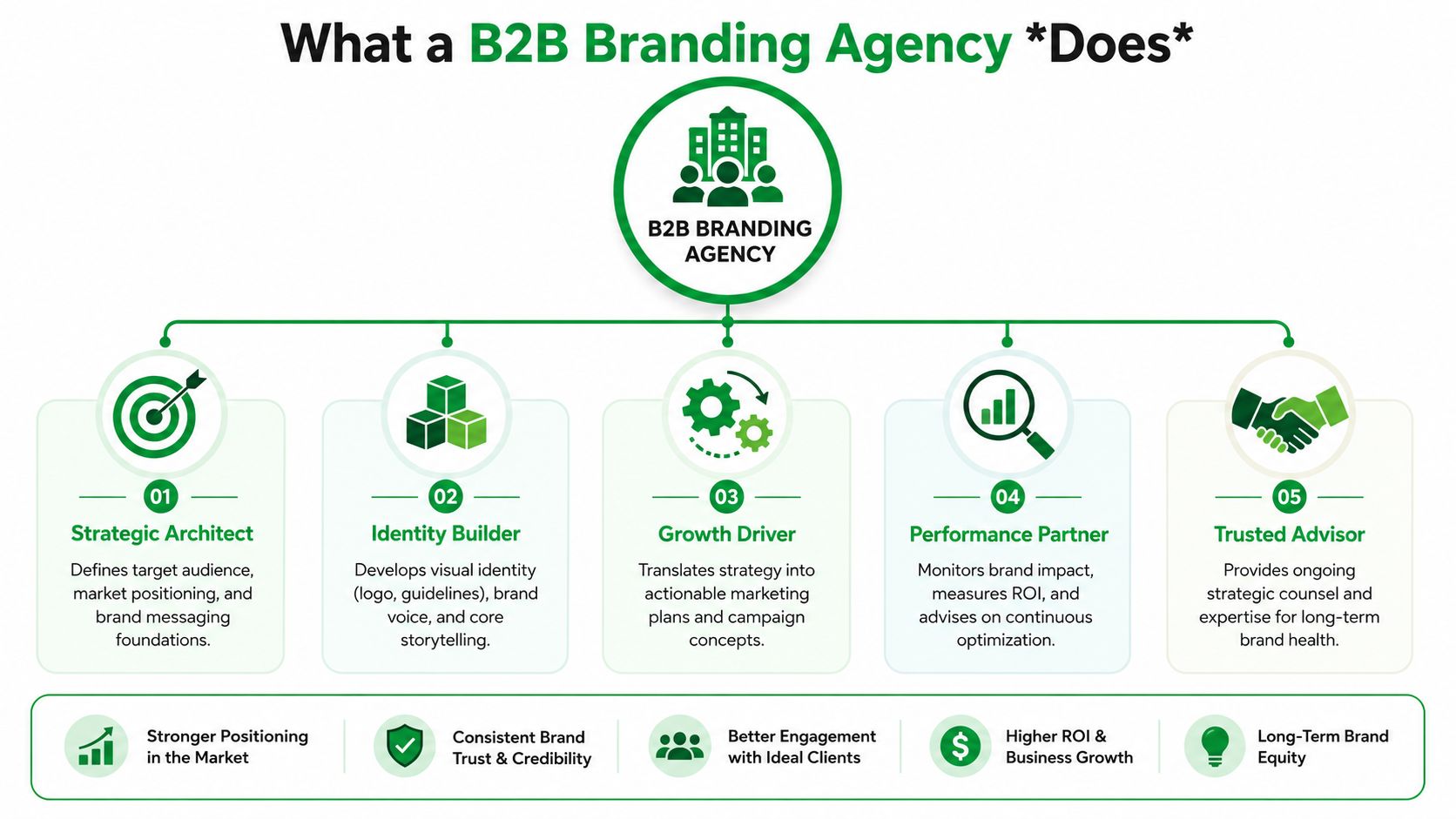
A B2B branding agency is less like a design vendor and more like a strategic architect.
Architects don’t start by choosing paint. They start by understanding the site, the use case, the constraints, and what the building has to do. A branding agency should work the same way. It defines the structure before it styles the surface.
It aligns market reality with business goals
B2B branding happens in a large and growing environment. U.S. B2B marketing spend reached about $107 billion in 2024 and is projected to rise to $144 billion by 2030, while the average B2B buyer completes 12 online searches and consumes 13 pieces of content before engaging with a vendor’s website, according to Statista’s B2B marketing overview. That’s not a quick-hit decision path. It’s a repeated evaluation process.
In that environment, branding has a practical job. It must help the market understand your relevance across multiple interactions, not just make a strong first impression.
It gives your company one usable story
Inside many B2B firms, every department explains the company differently.
Sales talks in objection-handling language. Product talks in features. Founders talk in vision. Customer success talks in outcomes. None of those are wrong, but if they’re not organized into one narrative, the buyer does the translation work. That’s a problem because busy buyers usually don’t.
A good agency creates the shared framework that keeps those teams aligned. Usually that includes:
- Positioning: What market you serve, who you serve, and why you’re different
- Messaging architecture: The main story, supporting proof points, and audience-specific variations
- Brand voice: How the company should sound in web copy, thought leadership, outreach, and sales materials
- Identity system: The visual assets and usage rules that make the brand recognizable
B2B Branding Agency: It makes brand useful, not decorative
Plenty of agencies produce polished work that doesn’t change how the business operates. That’s not enough.
A real B2B branding agency should leave you with assets your team can use. Website copy that sales agrees with. Deck language that product doesn’t reject. Messaging that works on LinkedIn, in nurture content, and inside proposals. Guidelines that reduce improvisation instead of creating a PDF no one opens.
Practical rule: If the agency can’t explain how brand decisions support pipeline, they’re probably selling identity work, not strategic brand work.
B2B Branding Agency: Core Services and Real-World Outcomes
Most CEOs don’t care about deliverables in the abstract. Fair enough. They want to know what they’re paying for and what changes after the work is done.
Brand strategy and positioning
This is the foundation. The agency identifies your ideal audience, market context, category pressure, competitive alternatives, and the role you want to occupy in the buyer’s mind.
The outcome isn’t “better words.” It’s sharper qualification. When positioning is clear, the right prospects recognize themselves faster and the wrong prospects opt out earlier. That saves sales time and improves conversation quality.
For companies that need adjacent support, some firms combine brand work with web and growth execution. One example is small business branding services, where positioning work connects directly to website and campaign execution rather than staying in a strategy deck.
B2B Branding Agency: Messaging frameworks and brand voice
Agencies often earn their keep in this area. Strong messaging frameworks translate business complexity into language buyers can process quickly.
That usually means creating:
- Core narrative: The short version of what you do and why it matters
- Audience layers: Variations for technical buyers, commercial buyers, and executive stakeholders
- Proof language: Claims paired with evidence, not adjectives
- Voice rules: Clear guidance on tone, jargon, specificity, and structure
When this part is done right, sales and marketing stop sounding like separate companies.
Content strategy and thought leadership
Digital channels carry a lot of the brand load in B2B. According to SearchLab’s B2B marketing statistics, 96% of B2B content marketers use LinkedIn, 91% of B2B marketers use content marketing, and 2,000+ word blog posts generate 3x more traffic, 4x more shares, and 3.5x more backlinks than shorter posts. That reinforces a hard truth. In B2B, brand is often experienced through expertise before it’s experienced through design.
So content strategy isn’t a side service. It’s part of brand expression.
That includes:
- Editorial themes tied to buyer pain points
- LinkedIn content systems for company and leadership visibility
- Case study structure that supports trust and late-stage evaluation
- SEO-informed topic selection so authority compounds over time
Teams that want to turn marketing data into revenue usually discover the same thing. Brand content performs best when it’s tied to buying questions, channel behavior, and actual sales conversations, not generic “awareness.”
B2B Branding Agency: Visual identity systems
Yes, visual identity matters. But in B2B, it matters because it supports recognition and coherence across touchpoints, not because it wins applause in a creative review.
Good identity work gives you:
- A professional signal that matches the value and complexity of the offer
- Consistency across site, slides, docs, paid creative, and social assets
- Decision rules so internal teams stop improvising logos, colors, and layouts
The outcome is speed and trust. Buyers don’t consciously score every visual detail, but they do notice when a brand feels fragmented.
B2B vs B2C Branding Why It’s a Different Game
A lot of bad B2B branding starts with the wrong reference point.
Leaders look at consumer brands, see bold campaigns and memorable slogans, and assume branding works the same way in every market. It doesn’t. B2B buyers don’t buy like consumers, and they shouldn’t be marketed to as if they do.
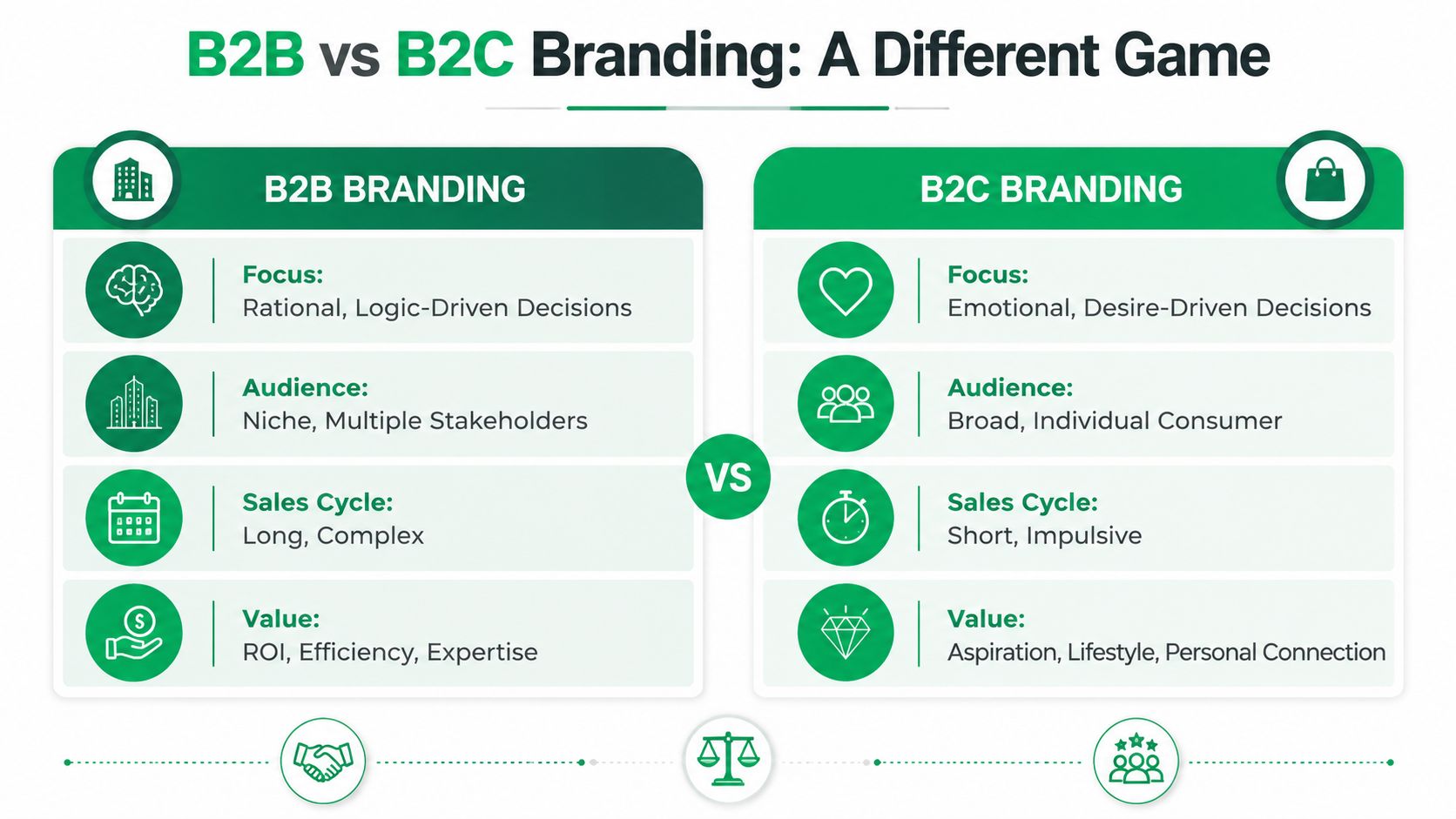
The decision structure is different
In B2C, one person can see an offer, like it, and buy it minutes later.
In B2B, a purchase often moves through multiple people with different concerns. One person wants integration confidence. Another wants financial justification. Another wants operational simplicity. Another wants to avoid making a bad decision in public. Brand has to reduce risk for all of them.
Here’s the short version:
| Dimension | B2B branding | B2C branding |
|---|---|---|
| Buyer | Multiple stakeholders | Individual consumer |
| Decision style | Rational, risk-aware, consensus-driven | Emotional, preference-driven, often fast |
| Sales cycle | Long and layered | Short and often direct |
| Proof needed | Expertise, fit, credibility, business value | Desire, identity, convenience, lifestyle fit |
B2B Branding Agency: The message has to carry more weight
B2C can win with speed, distinctiveness, and emotional pull. B2B needs those too, but it also needs explanation. Not endless explanation. Clear explanation.
That changes the creative brief.
A B2B branding agency has to ask questions like:
- What business problem does this offer solve?
- What proof lowers perceived risk?
- What language helps the buyer justify the purchase internally?
- What should a technical evaluator see versus a CFO?
Those questions shape a very different output than a consumer-facing campaign would.
A B2B brand doesn’t just need attention. It needs defensible credibility.
The relationship is longer after the sale
In many B2C categories, the transaction is the goal.
In B2B, the relationship usually outlasts the sale by a long margin. Implementation, onboarding, renewals, expansion, stakeholder turnover, procurement reviews. Your brand has to survive all of that. It needs enough clarity and consistency to support not just acquisition, but retention and expansion too.
That’s why specialist B2B branding matters. Not because B2B is “boring,” but because the buying environment is more complex and the consequences of confusion are higher.
B2B Branding Agency: The Typical Agency Process From Kickoff to Launch
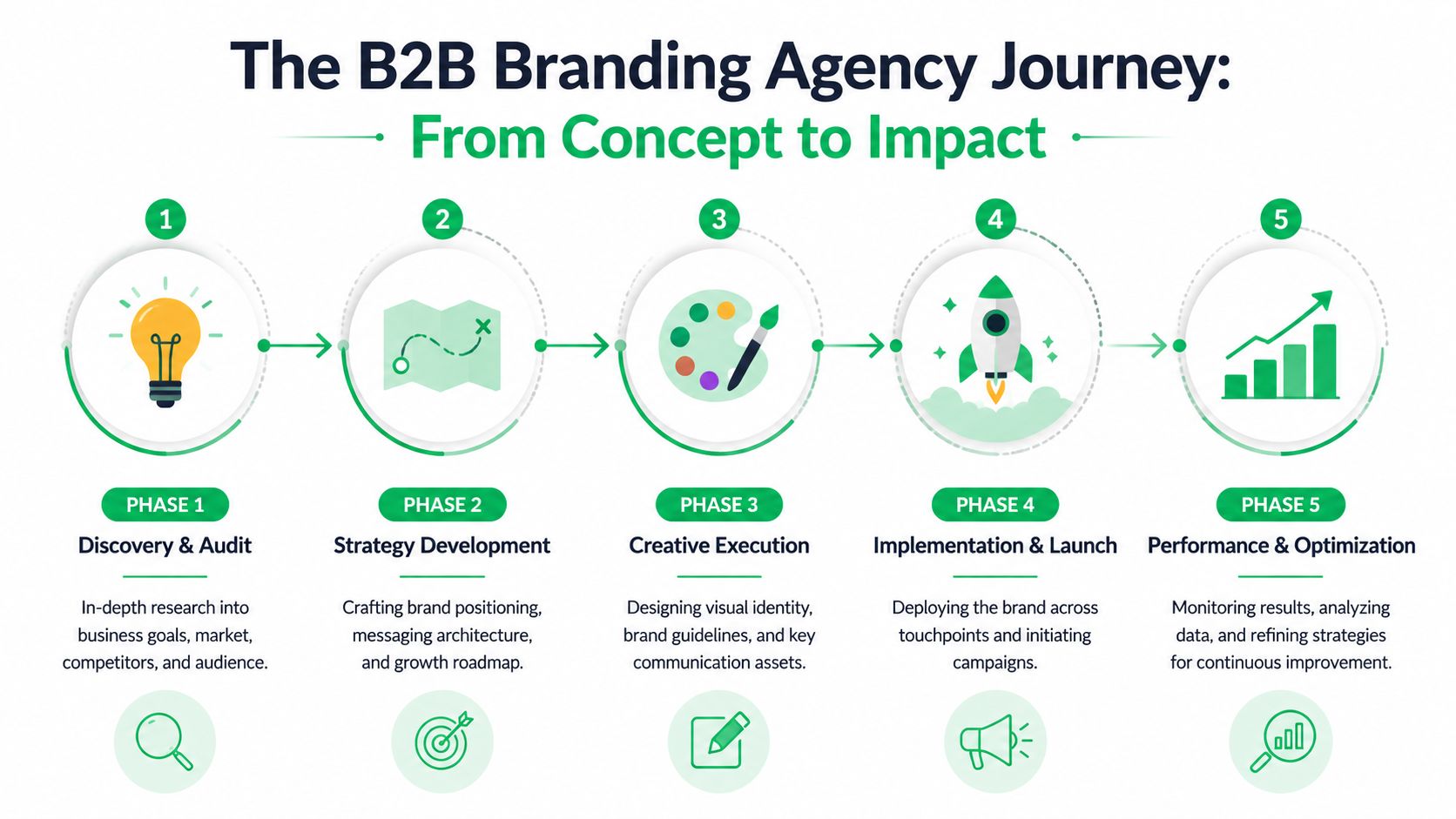
If an agency can’t explain its process in plain English, be careful. You’re not hiring mystery. You’re hiring structured judgment.
Discovery and audit
The serious work begins. Not with mood boards.
A rigorous B2B branding process begins with discovery work such as stakeholder interviews, competitor analysis, and customer feedback to build a brand platform that acts as a single source of truth for positioning and messaging, according to Hatfield Creative’s guide to technical B2B branding. This step aligns sales, marketing, and leadership and reduces message drift over time.
In practical terms, the agency should study:
- Internal perspective: Leadership goals, sales friction, product strengths, expansion plans
- Customer perspective: Why buyers choose, hesitate, or leave
- Market perspective: Competitor claims, category sameness, whitespace
- Asset reality: Website, decks, proposals, paid creative, sales materials, and onboarding assets
If you want a broader look at how structured creative projects move from problem definition to execution, this overview of the 6 steps of the design process is a useful companion.
Strategy development
Once the research is in, the agency should turn it into decisions.
Not observations. Decisions.
That normally includes positioning, messaging pillars, value propositions, audience-specific language, and a summary of what the brand should mean in the market. The strongest teams document this tightly, often in a concise strategy summary leadership can approve before creative starts.
If leadership, sales, and marketing can’t agree on the positioning before design begins, the project will get expensive fast.
A quick visual overview helps here before the next phase:
Creative execution and rollout
Only now should design move into full gear.
That can include identity refinement, homepage messaging, visual systems, deck templates, campaign concepts, sales collateral, and brand guidelines. The important part is that creative choices trace back to strategic choices. Every headline, layout, and proof point should support the positioning.
Then comes rollout, a phase where many projects wobble.
A proper launch usually needs:
- Internal enablement: Sales, marketing, and leadership get trained on the new message
- External deployment: Website, LinkedIn, decks, proposals, and key assets update in sequence
- Governance: Teams get usage rules so consistency doesn’t degrade in a month
Without that final discipline, even strong brand work gets diluted by daily operations.
B2B Branding Agency: How to Choose the Right B2B Branding Agency
The portfolio review is where most buying processes go off course.
A polished site and good-looking logos can tell you an agency has taste. They do not tell you whether the agency can improve positioning, sharpen demand quality, or help sales close better-fit opportunities. Those are different capabilities.
Start with pipeline, not aesthetics
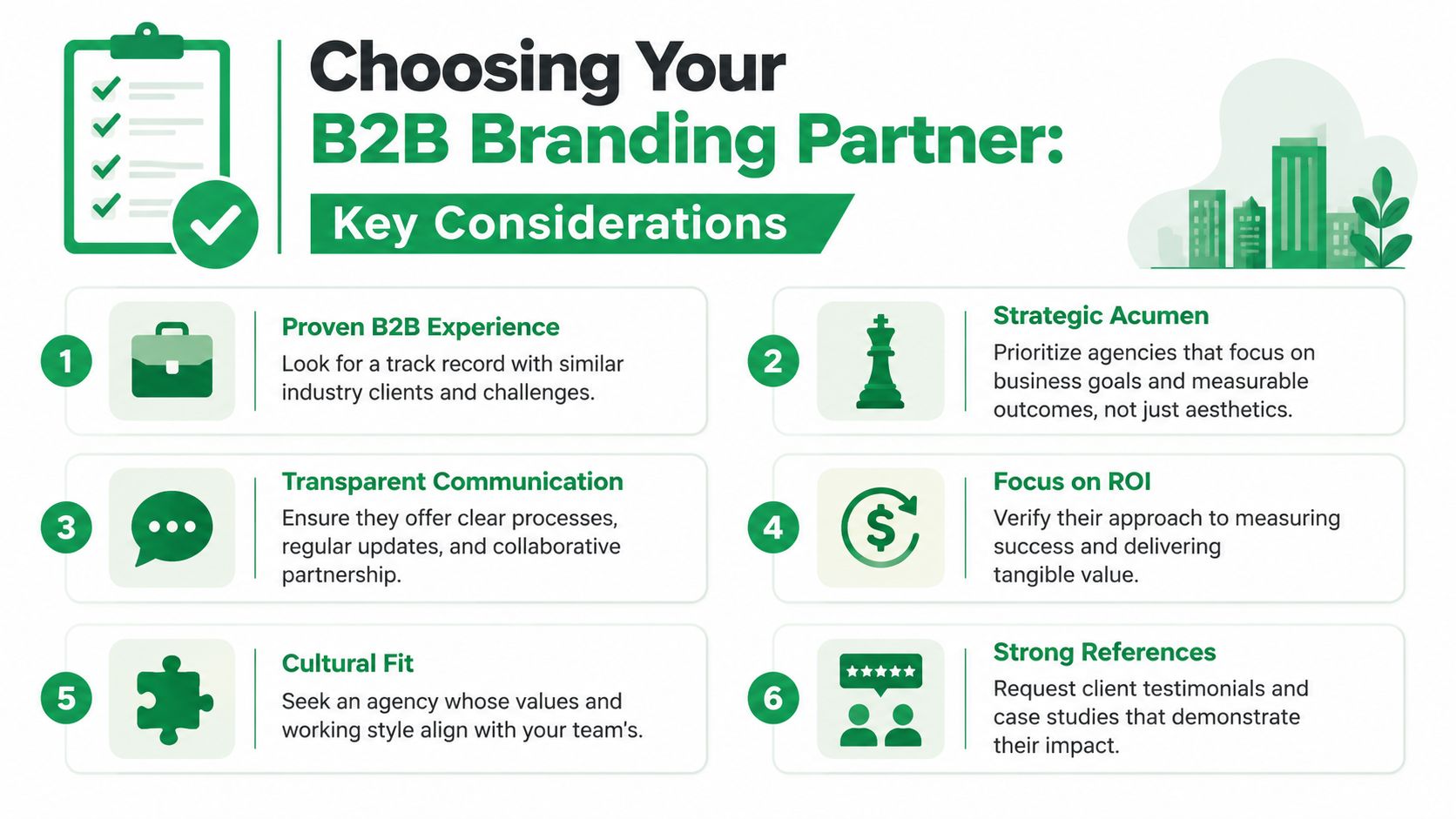
A useful evaluation framework asks one hard question first. Can this agency connect branding decisions to commercial outcomes?
That standard matters because many agency roundups still overemphasize creative presentation and generic strategy language. More rigorous B2B evaluation now prioritizes an agency’s ability to tie work to pipeline impact, customer acquisition cost, and attribution rather than stopping at portfolio polish, as noted by Directive’s view on choosing B2B agencies for pipeline growth.
That doesn’t mean every agency must promise exact revenue outcomes. They shouldn’t. It does mean they should be able to explain the path from brand clarity to stronger commercial performance.
What to look for in the room
The best agencies usually behave differently in early conversations.
They ask inconvenient questions. They challenge fuzzy goals. They push for evidence. They want to know where deals stall, how the category sounds, what the sales team hears, and what the market currently misunderstands.
A weak agency often jumps too quickly to visual inspiration. A strong one spends more time diagnosing.
Use this checklist:
- Ask how they handle discovery: Do they interview leadership, sales, customers, and subject matter experts, or do they rely mostly on a kickoff questionnaire?
- Ask how they define positioning: Can they explain category choice, audience fit, and differentiation in business terms?
- Ask how they test messaging: Do they validate language with internal teams or customers before rollout?
- Ask how they support adoption: Will they help sales, marketing, and leadership use the brand consistently?
- Ask what success looks like: Can they talk intelligently about awareness, consideration, sales enablement, pipeline quality, or attribution without getting vague?
- Ask what happens after launch: Do they offer governance, optimization, or performance reviews?
For a broader agency vetting lens, this guide on how to choose a digital marketing agency is worth reviewing alongside your shortlist.
Red flags that matter more than style
Some warning signs are easy to miss because they’re packaged nicely.
| Red flag | What it usually means |
|---|---|
| They can’t explain the process clearly | They rely on improvisation |
| They show only visuals, not business context | They may not think beyond creative output |
| They avoid talking about sales alignment | They treat brand as a marketing-only exercise |
| They promise easy transformation | They may not understand internal adoption friction |
| They use generic category language | They may produce sameness, not position |
Choose the agency that helps your company say one sharp thing consistently, not the agency that presents the prettiest mood board.
One practical hiring standard
If you remember one thing, use this.
The right B2B branding agency should make your business easier to buy from. Easier to understand, easier to trust, easier to compare favorably, and easier for your own team to explain. If an agency can’t show how its work contributes to that outcome, keep looking.
B2B Branding Agency: Your Brand Is Your Most Powerful Growth Engine
A CEO approves more budget for paid search, hires another rep, and asks marketing for more leads. Pipeline still stalls. The problem often is not volume. Buyers do not quickly understand why the company matters, why it is credible, or why it is a safer choice than the alternatives.
That is a brand problem with revenue consequences.
In B2B, brand shapes how efficiently demand turns into pipeline. It affects click-through rates, conversion rates, sales conversations, proposal win rates, and expansion after the first deal. When positioning is clear and believable, the market does more of the sorting for you. Better-fit buyers raise their hands. Sales cycles get less painful. Teams stop rewriting the story in every channel.
A good B2B branding agency helps build that commercial system. The work should produce sharper positioning, stronger proof, tighter messaging, and a website experience that supports trust instead of creating doubt. Design matters, but the business result matters more. Can buyers understand the value fast? Can sales use the message without translating it? Can leadership connect the investment to pipeline quality and revenue?
That last question gets missed too often.
For SaaS and service businesses, brand strength also shows up after the deal closes. Delivery experience, adoption, and customer advocacy shape how the market talks about you when your team is not in the room. This article on strategies for customer advocacy in SaaS is useful because it ties retention and word of mouth back to brand in a practical way.
Mr. Green Marketing, LLC is one example of a firm that pairs brand work with website execution, SEO, paid media, and AI search visibility. That model can make sense when a company needs strategy and execution connected, not split across disconnected vendors.
Brand will not rescue a weak offer or create demand that is not there. It will not fix poor sales management.
But with a solid offer and real market demand, brand becomes a growth multiplier. It lowers friction across the buyer journey, improves how every channel performs, and gives the business a clearer path from attention to revenue.
Leave a Comment
sing in to post your comment or sign-up if you dont have any account.