
Search Engine Optimization Edmonton: You might be there right now. You know your business does good work. Customers who find you tend to buy, call back, and refer people. But when someone in Edmonton searches for the service you sell, your competitors show up first. They get the map visibility, the clicks, and a lot of the easy leads.
That gap feels personal because it hits revenue fast. And it creates a weird kind of doubt. Is your business less established than theirs? Is your site broken? Is Google ignoring you?
Usually, it isn’t one dramatic problem. It’s a stack of smaller issues. Weak local signals. Thin service pages. A neglected Google Business Profile. No clear structure for search engines. No system for measuring what turns visibility into booked work. That’s where search engine optimization in Edmonton stops being a buzzword and starts becoming a practical growth channel.
Search Engine Optimization Edmonton: Struggling to Get Found in Edmonton? You’re Not Alone
A lot of Edmonton business owners assume they have a visibility problem because they aren’t spending enough on ads. Sometimes that’s true. More often, they have a discoverability problem. Different issue.
If your site isn’t appearing for your services, you’re missing buyers at the exact moment they need help. And search still matters at the top of the funnel. Around 93% of internet users begin by searching with a search engine, according to OuterBox’s SEO statistics roundup. In a city as competitive and spread out as Edmonton, that’s not a side channel. It’s where people start looking.
What makes this frustrating is that competitors can look bigger than they are because they’ve done the basics better. Their Google Business Profile is complete. Their service pages mention real local intent. Their reviews are recent. Their site loads properly on mobile. Nothing magical. Just consistent execution.
Practical rule: If people can’t find your business when they’re ready to compare options, your quality doesn’t get a vote.
If you’ve been wondering why your company seems invisible in search, it’s worth reviewing Circle Monkeys’ advice on Google visibility. It lines up with what we see in local campaigns all the time. Missing listings, poor relevance signals, weak page targeting, or basic setup problems can bury an otherwise solid business.
And if that question has been nagging at you for a while, this related breakdown on why a business may not show up in Google search gives a useful diagnostic starting point.
What this usually looks like in the real world
- You rank for your name, not your services
That means existing customers can find you, but new buyers can’t. - Your map listing appears inconsistently
Some people see it. Others don’t. That usually points to weak local trust signals or profile issues. - Your website gets traffic but not leads
Then the problem may be page intent, offer clarity, mobile usability, or local relevance.
Edmonton SEO works when it fixes the main bottleneck, not when it chases vanity rankings.
Search Engine Optimization Edmonton: What Exactly Is Local SEO for an Edmonton Business
Local SEO is simpler than most agencies make it sound. You’re not trying to become famous everywhere. You’re trying to become the most credible answer for a nearby search.
For an Edmonton company, that usually means showing up in three places that matter. The map results, the standard organic results, and your own website experience once someone lands there. If one of those breaks, the whole system gets weaker.
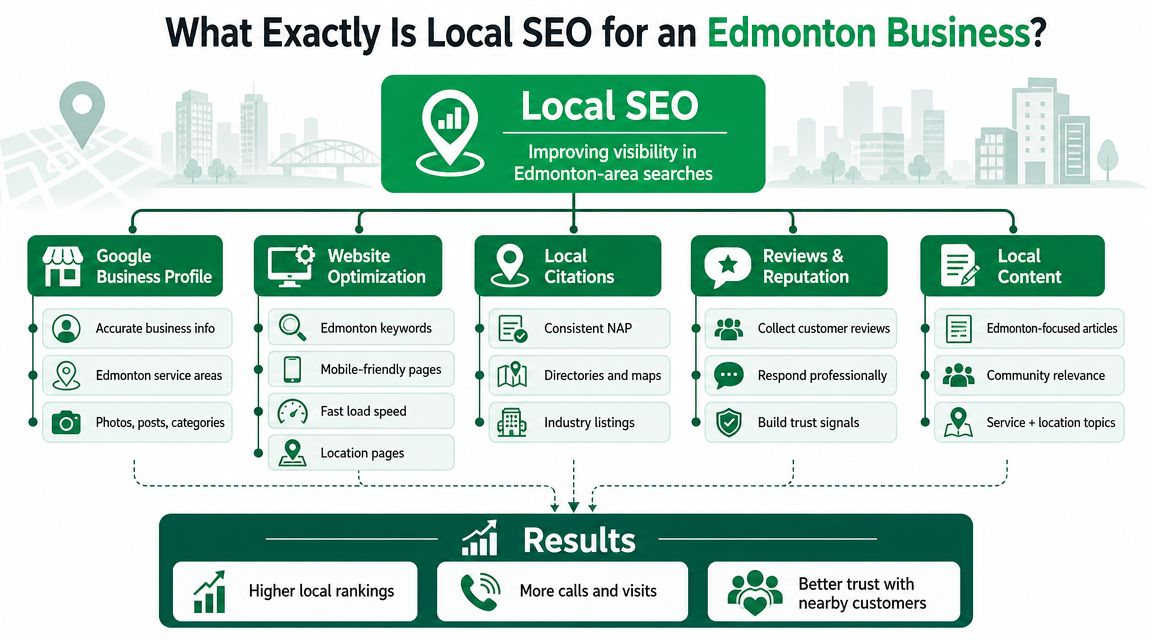
Search Engine Optimization Edmonton: The three areas that drive local visibility
Google Business Profile often decides whether you show in map-heavy local searches. Categories, services, hours, reviews, and location consistency carry a lot of weight for this purpose.
Organic service pages do the heavy lifting when someone wants more detail. They compare providers, read about services, and look for signs that you serve their area.
Supporting local signals help confirm you’re a real Edmonton business with local relevance. That includes local links, citations, location references, and consistent business information.
Google’s local systems look at relevance, distance, and prominence, and businesses reinforce those signals by aligning their Google Business Profile, website pages, and local links around Edmonton intent, as explained by ProStar SEO’s Edmonton local search overview.
What “relevance” actually means
A lot of business owners think adding “Edmonton” to the homepage is enough. It isn’t.
If you offer several services, each meaningful service usually needs its own page with clear local intent. Not a paragraph buried on one generic page. A dedicated page. Something that says what you do, who it’s for, and where you do it. That’s how search engines connect a query to a page that deserves to rank.
A good companion read here is this guide to local business visibility from Growth 4 Trades. It does a nice job of grounding local SEO in real buyer behavior instead of abstract jargon.
What local SEO is not
It isn’t stuffing neighborhood names into every paragraph. It isn’t buying random backlinks. And it isn’t publishing ten blog posts no one in Edmonton was ever going to search for.
Local SEO works best when your profile, your pages, and your reputation all tell the same story.
That’s the part many businesses skip. They build a website for people, a Google profile for Google, and citations for directories. Those pieces drift apart. Rankings drift with them.
Search Engine Optimization Edmonton: Hyper-Local Factors That Win in the YEG Market
National SEO advice gets recycled a lot. The problem is Edmonton buyers don’t search like abstractions. They search like people who know the city, drive across it, and often want someone nearby or someone familiar with their part of town.
That changes how local content should be built.
Be specific about place, not just city
A homepage that says “serving Edmonton” is fine. It’s not persuasive on its own. Search engines and customers both respond better when your site reflects real service geography.
That can mean mentioning neighborhoods, nearby landmarks, service areas, or the kinds of jobs you do in specific parts of the city. If you’re a contractor, your ideal page isn’t “Contractor Edmonton.” It’s a page that speaks to the actual service, the local context, and the intent behind the search.
For example:
- Service-area pages for places you serve, written with unique details and not cloned text
- Location references that sound natural, such as common routes, districts, or recognizable local landmarks
- FAQ content that addresses local buying questions, timelines, or service differences by area
The goal isn’t to sound clever. It’s to sound grounded.
Reviews need local texture
Generic five-star praise helps less than business owners hope. Reviews that mention the service, the area, and the experience tend to do more for both trust and local relevance.
Ask for reviews after a clear success point. Not too early. Not with a canned script that sounds robotic. A simple request works better when it nudges the customer to mention what was done and where.
A better ask sounds like this in practice: if you’re willing, mention the service we provided and your area of Edmonton so other customers know whether we’re a fit.
That kind of detail helps future buyers too. They aren’t just checking your rating. They’re scanning for evidence that you’ve solved their problem before.
Field note: In dense local markets, broad authority can lose to a business with sharper location intent and clearer service relevance.
Local trust isn’t built only on your website
You also need off-site proof. Local directories, chamber listings, relevant community references, sponsorship mentions, and other legitimate local citations all reinforce that your business belongs in the Edmonton market.
The following tends to work better than generic outreach:
| Approach | What tends to happen |
|---|---|
| Random directory submissions | Low trust, little strategic value |
| Relevant local citations | Better consistency and stronger local validation |
| Generic guest posting | Often disconnected from local buyer intent |
| Community-based mentions | More useful for trust and geographic relevance |
And one more thing. Edmonton content should reflect Edmonton life. Weather impacts, seasonal timing, event-driven demand, neighborhood differences, and service logistics all create opportunities for content that feels native to the market. That’s what separates “we operate here” from “we understand this market.”
Search Engine Optimization Edmonton: Your Quick-Start Local SEO Audit Checklist
Most businesses don’t need a full technical teardown to spot obvious local SEO problems. They need a fast gut check. Open your site, open your Google Business Profile, and answer a handful of yes-or-no questions.
If too many answers are no, that’s your starting point.
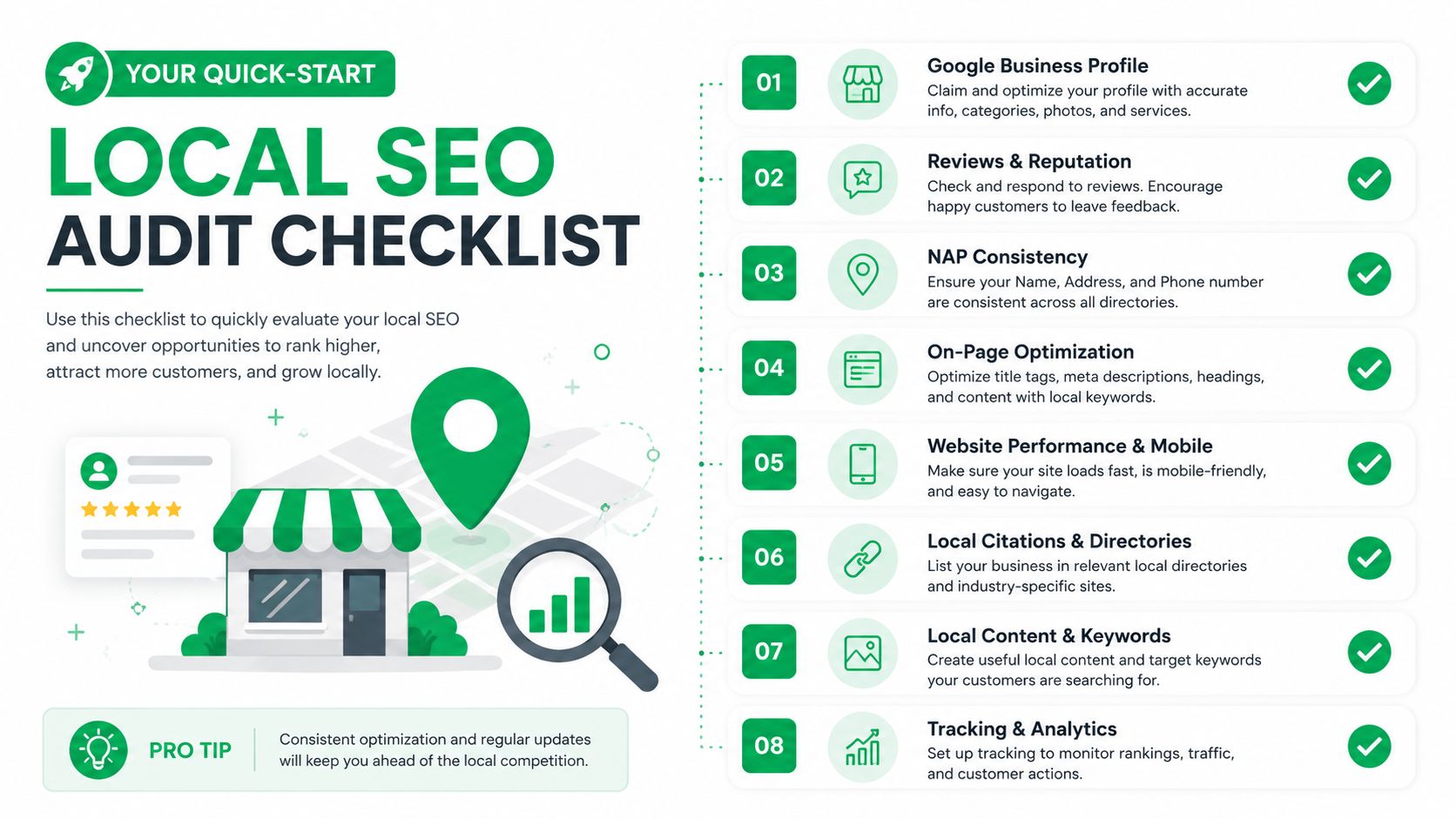
The fast audit
- Google Business Profile claimed
If you don’t control it, fix that first. - Primary category aligned to the core service
Close enough isn’t good enough. Pick the category that most directly matches what you want to rank for. - Business name, address, and phone consistent
Check your website, listings, and profile. Small mismatches create unnecessary trust issues. - Homepage clearly states service plus Edmonton relevance
A visitor should know what you do and where you do it within seconds. - Each main service has its own page
If every service is crammed into one page, search engines have less clarity. - Site works cleanly on mobile
Menus, tap targets, forms, and phone links all need to be easy to use. - Contact options are obvious
Calls, forms, directions, and hours shouldn’t be buried. - Recent reviews and accurate hours visible
Stale profiles and outdated info cost trust fast.
Search Engine Optimization Edmonton: The technical foundation most businesses skip
A proper technical audit should prioritize crawlability, page speed, mobile usability, and structured data, because those elements affect whether Google can discover, understand, and trust local service pages, as outlined by Seologist’s technical SEO guidance.
That matters more than people think. If your key pages are slow, confusing on mobile, or difficult for search engines to interpret, better content alone won’t save you.
A few practical checks:
- Crawlability means important pages can be found and indexed
- Page speed affects how quickly users can act once they land
- Mobile usability determines whether the visit turns into a call or a bounce
- Structured data helps search engines understand what the page is about
If you want a more detailed benchmark beyond this quick pass, a page like this one on website SEO audit services shows the kinds of issues a deeper review typically investigates.
What deserves attention first
Don’t start with blog topics. Start with the pages that should produce leads.
- Fix the profile if your local listing is incomplete or inconsistent.
- Fix the money pages if your main services don’t have strong Edmonton relevance.
- Fix the mobile experience if the site makes calling or booking harder than it should be.
That’s how quick wins usually happen. Not from tricks. From removing friction.
Search Engine Optimization Edmonton: The Future of Edmonton Search AI and Real ROI
A lot of businesses still judge SEO by one question. Where do we rank?
Fair question. Incomplete one.

Google’s search experience has changed. With AI Overviews, the more useful question is whether your content is structured in a way that can be pulled into answers, summaries, and citation-style results. That shifts the work. Optimizing for AI answers means structuring content for retrieval, creating clear entity signals, and building pages that are citation-worthy in AI-generated summaries, as discussed in this AI Overviews video reference.
What AI-friendly local content looks like
It usually has a few traits in common:
- Clear factual organization
Services, areas served, contact details, and business specifics are easy to parse. - Strong page intent
Each page answers a focused question instead of trying to rank for everything. - Entity clarity
Your business name, location, services, and topical authority line up across the site. - Useful supporting content
FAQs, service explanations, and comparison content help reinforce what your business does.
This doesn’t replace classic SEO. It tightens it.
If a page is vague, bloated, or written mostly for search engines, it’s less useful for people and less useful for AI systems trying to summarize trustworthy information.
Rankings matter less than outcomes
For local businesses, real ROI usually shows up in a short list of actions:
| Signal | Why it matters |
|---|---|
| Phone calls | High-intent leads often call before they fill out anything |
| Form submissions | Useful for tracking service demand by page |
| Direction requests | Strong indicator for local intent and in-person interest |
| Qualified conversations | Better than raw traffic because they connect to revenue |
Campaigns often go sideways. The business gets obsessed with rank tracking while ignoring whether the traffic is producing actual customers.
If you’re reworking content for this new search environment, a practical reference is this guide on how to optimize for AI search. The key shift is simple. Build pages that answer real questions clearly enough that both humans and machines can trust them.
Search Engine Optimization Edmonton: Hiring an Agency Pricing and Promises in Edmonton
Sooner or later, many business owners hit the same wall. They know SEO matters, but they don’t have time to run technical audits, rewrite service pages, manage local listings, build content, and monitor results consistently.
That’s when hiring help starts to make sense. The problem is the market is crowded with vague promises.
What SEO usually costs in Edmonton
There is a real range here. SEO services in Edmonton commonly cost between $1,500 and $5,000+ per month, and results often take 6 to 12 months, based on Adster’s Edmonton SEO pricing guide. The same source frames SEO as an ongoing investment tied to recurring work such as on-page optimization, content development, authority-building, and account management.
It also breaks out common work components like on-page optimization at $300 to $1,000, off-page optimization at $300 to $1,200, and account management and reporting at $100 to $500, which is useful because it shows what the monthly retainer is paying for in many cases. For smaller local businesses in low-competition settings, that source notes $1,000 to $1,500 per month may be enough, while single-location service or retail businesses may need $1,500 to $3,500, and multi-location or regional businesses may require $3,500 to $6,000+.
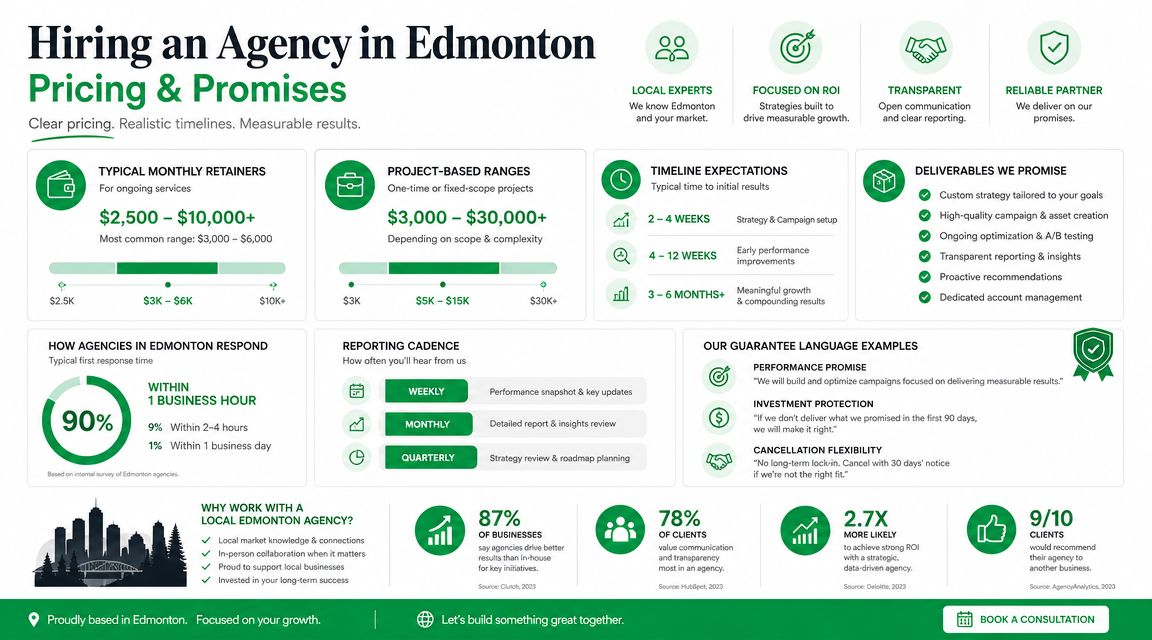
What a serious agency should talk about
Not guarantees. Process.
A credible agency should be able to explain:
- How they prioritize work based on your site, your service mix, and your market
- What gets done monthly on-page, technical, content, and authority-related
- How they report progress beyond screenshots of ranking tools
- How local SEO ties to leads rather than just impressions
And they should be comfortable talking about trade-offs. Sometimes the right move is fixing weak service pages before publishing more content. Sometimes it’s cleaning up location signals before chasing backlinks. Sometimes paid search fills the gap while SEO matures.
Red flags that deserve an immediate no
“Guaranteed rankings” is usually a sign that the conversation is headed in the wrong direction.
Watch for these:
- Cheap flat-fee promises that sound too small for sustained work
- No clear deliverables beyond vague monthly “optimization”
- No questions about your business model or service geography
- Heavy focus on vanity metrics with no lead tracking plan
- Opaque link building that they can’t explain clearly
Mr. Green Marketing, LLC is one option in this category. It offers strategy-led SEO support as part of a broader digital marketing stack, including audits, content planning, and GEO-style optimization for AI search. That’s useful if you want one team to connect local SEO with website performance and lead generation, not just rankings in isolation.
The right agency relationship should feel like operational support, not mystery theater.
Your Next Step to Winning Local Search
Search engine optimization in Edmonton gets easier once you stop treating it like a black box. The businesses that win locally usually aren’t using secret tactics. They’re more consistent with the basics, sharper with local intent, and more disciplined about measuring what turns into revenue.
Start where the advantage is.
Tighten your Google Business Profile. Make sure each core service has a page that deserves to rank in Edmonton. Clean up your mobile experience. Ask for better reviews. Build pages that answer real questions clearly enough to help both search engines and AI systems understand what you do.
And keep your eye on business outcomes. Not just whether you moved up for a phrase one morning.
If you’re doing this in-house, use the quick audit as a filter. Find the obvious gaps first. Those often tell you whether the problem is relevance, trust, technical quality, or conversion friction. Once that becomes clear, your next move gets a lot simpler.
If you’re too busy to sort through all of that, that’s normal. Most owners should be spending their time running the business, not decoding crawlability issues or rewriting location pages on weekends.
A useful next step is getting an outside view of where your visibility is leaking and which fixes are most likely to improve lead flow first. Good local SEO work isn’t about doing everything. It’s about doing the right things in the right order, then tracking whether they produce calls, forms, and booked work.
If you want a practical second opinion, Mr. Green Marketing, LLC offers a free audit and performance report that identifies visibility gaps, quick wins, and a realistic roadmap for improving local search performance in Edmonton.
Leave a Comment
sing in to post your comment or sign-up if you dont have any account.