
SEO Sri Lanka: Most advice on SEO Sri Lanka is stuck in an older playbook. Claim your Google Business Profile, add a few local keywords, publish a service page, wait. That used to be enough for weak competition.
It isn’t now.
Sri Lanka is a tougher SEO market than many guides admit. A Sri Lanka-focused industry analysis notes that around 65% of medium to large enterprises have already implemented basic SEO practices, which means basic optimization is no longer a differentiator. The same analysis points to three market realities that matter more: Sinhala and Tamil language optimization, mobile-first experiences, and location-based optimization across regions and cities (Sri Lanka SEO market analysis).
And that’s the part most businesses miss. The critical work isn’t adding more keywords. It’s building the right structure for how Sri Lankans search, on mobile, across languages, with local intent.
SEO Sri Lanka: Dominate Rankings & Traffic – Why Most SEO Sri Lanka Advice Is Incomplete
Most local guides still push the same checklist. Set up listings. Add district names. Ask for reviews. Those are table stakes.
The gap is bigger than tactics. It’s strategy.
Ranking alone isn’t the real goal anymore
Traditional advice treats SEO like a race for blue links. But search behavior has shifted. Existing Sri Lanka SEO content still focuses heavily on classic ranking factors and doesn’t meaningfully address what happens when AI Overviews synthesize answers directly in search results, creating a visibility problem even for pages that rank well. The better question now is not just how to rank, but how to get cited and chosen by AI (analysis of Sri Lanka SEO gaps in AI search).
That changes how you write, structure, and prove content quality.
If your service page says the same thing as ten competitors, AI systems have no reason to surface you. If your page includes clear service detail, location signals, trust elements, original proof, and concise answers to commercial questions, you have a better shot at staying visible even when the click never comes directly to your site.
Practical rule: Build pages so they can rank, earn clicks, and stand on their own as answer sources.
Sri Lanka is multilingual, not just local
A second problem is even more basic. Many businesses treat Sri Lankan SEO as if it’s only English SEO with a Colombo modifier.
It isn’t.
Search intent can diverge sharply between English, Sinhala, and Tamil. Query phrasing changes. Word order changes. Transliteration changes. Sometimes the searcher wants a formal service page. Sometimes they want a fast answer in the language they think in. Those are not the same thing.
Incomplete advice usually gets wrong:
- It treats translation as SEO. A translated page is not automatically a search-targeted page.
- It ignores architecture. Without clear language targeting, businesses create cannibalization between similar pages.
- It overlooks local nuance. Colombo, Kandy, Galle, Jaffna, and regional searches often deserve different landing page logic.
- It assumes a click is guaranteed. In AI-driven results, visibility can happen without a visit, which means authority signals matter more.
What actually wins now
The businesses making progress in Sri Lanka usually do three things well:
| Weak approach | Strong approach |
|---|---|
| One English site with a few translated paragraphs | Separate language intent mapped across English, Sinhala, and Tamil |
| Generic “best service in Sri Lanka” terms | Local, intent-rich queries tied to district, city, or service area |
| Blog output with no structure | Technical hygiene, multilingual architecture, and conversion-focused pages |
That mix matters because global SEO behavior is unforgiving. If a site isn’t on page one of Google, it has less than a 1% chance of receiving an organic click, while the top 3 organic results account for more than 60% of total clicks (Safari Digital SEO statistics). In Sri Lanka, where businesses often compete within tight local categories, sloppy strategy gets buried fast.
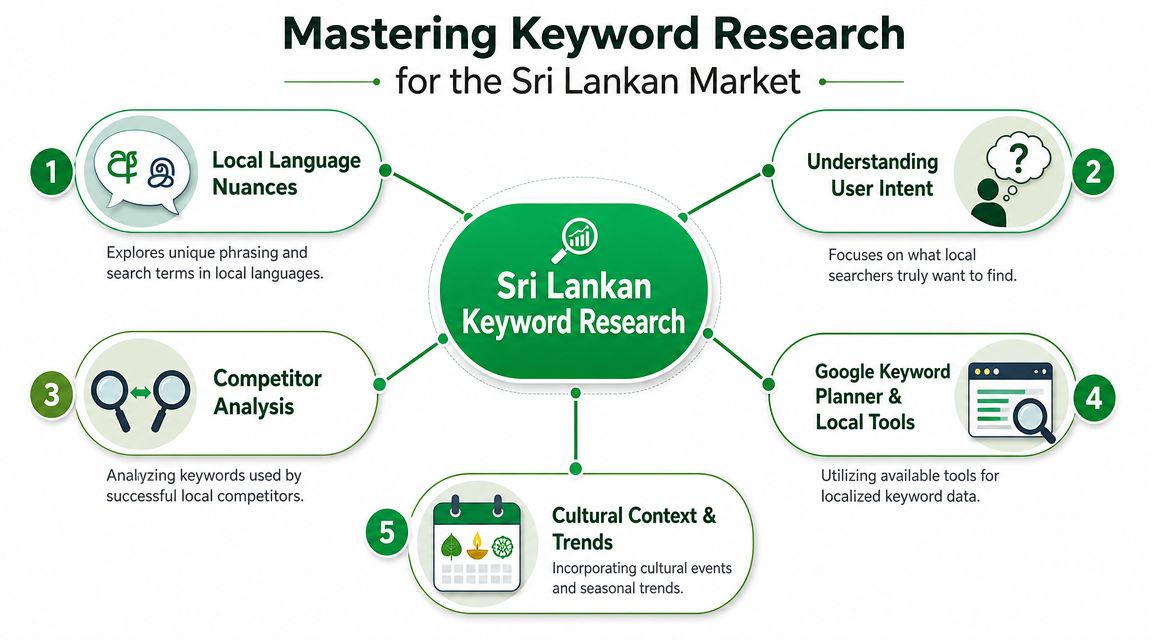
SEO Sri Lanka: Mastering Keyword Research for the Sri Lankan Market
Keyword research in Sri Lanka fails long before content is written. The failure usually starts in the spreadsheet, where teams copy English keywords from a tool, translate them line by line, and assume demand exists in Sinhala and Tamil in the same form.
Search behavior does not work that neatly.
The work starts with intent, then language, then location. In that order. If the query has buying intent but the wording changes by city or script, the keyword list has to reflect that. If it does not, pages rank for the wrong terms, attract the wrong traffic, or miss the search entirely.
Start with revenue intent
High-volume keywords look good in a report. They often perform poorly for actual leads.
For Sri Lankan businesses, better opportunities usually sit in phrases that combine service, problem, and place. A user searching for a broad head term is still exploring. A user searching for a service plus Colombo, Kandy, Jaffna, price, repair, appointment, or supplier is closer to action. Local SEO guidance from localized keyword research is useful here because it focuses on query context, local phrasing, and entity signals instead of raw export lists.
Start the keyword set in four layers:
- Core service terms
The primary commercial phrases for each service line. - Buying modifiers
Price, cost, near me, urgent, same day, booking, repair, consultant, clinic, delivery, supplier. - Location modifiers
City, district, and service-area combinations that match how the business operates. - Language variants
English, Sinhala, Tamil, plus transliterated forms typed in Latin characters.
At this stage, a lot of Sri Lankan campaigns lose ground. They collect the first three layers, then ignore the fourth. On mobile, plenty of users switch between scripts, mix English service terms with Sinhala or Tamil intent words, or type local pronunciation in Latin letters. If keyword research does not capture that behavior, the site will look complete on paper and still miss demand in search.
Build a trilingual keyword map, not a single master list
A usable keyword map needs more than term and volume. Add columns for intent, language, location, SERP type, and target page.
That structure forces better decisions. It shows whether one page can serve multiple variants or whether separate pages are needed. It also exposes cannibalization early. If an English Colombo service page, a Sinhala version, and a broad national page are all targeting overlapping commercial queries, rankings will usually stay unstable.
A practical map looks like this:
| Query type | What to capture | Best page format |
|---|---|---|
| English commercial | Standard service demand and comparison intent | Core service pages and city pages |
| Sinhala native-script | High local relevance and mobile-heavy searches | Local landing pages, FAQs, service sections |
| Tamil native-script | Regional demand and community-specific phrasing | Service pages with tailored headings and FAQs |
| Transliteration | Mixed-language and phonetic search behavior | Supporting copy, subheadings, FAQ entries |
Transliteration deserves special attention in Sri Lanka. It rarely justifies a full standalone page by itself, but it often belongs in headings, FAQs, image alt text, and body copy where it supports the main term naturally.
SEO Sri Lanka: Validate keywords in live SERPs
Keyword tools are useful for expansion. They are weak at nuance.
Manual SERP checks show what the tools miss. Search the term on mobile. Check autocomplete, People Also Ask, local pack behavior, title tags, and whether Google shifts the results into a different language or intent class. That last point matters more now because AI-driven search features often group entities, locations, and services in ways that flatten weak keyword targeting. If Google cannot tell which page on your site best answers a location-and-language-specific query, visibility drops before the click ever happens.
Use that review to make page-level decisions:
- One page if the intent is the same and language variants can be handled cleanly
- Separate pages if the query changes by city, service variation, or commercial intent
- FAQ support if the term appears as a modifier or transliterated variant rather than a primary target
After that, move the keywords into execution. A guide on how to add keywords to website pages is useful at that stage because the value of research only appears once terms are mapped into titles, headings, internal links, service copy, and FAQ blocks.
Narrow keyword sets usually outperform impressive ones. That is especially true in Sri Lanka, where multilingual intent, local modifiers, and mobile search habits create smaller but far more profitable pockets of demand.
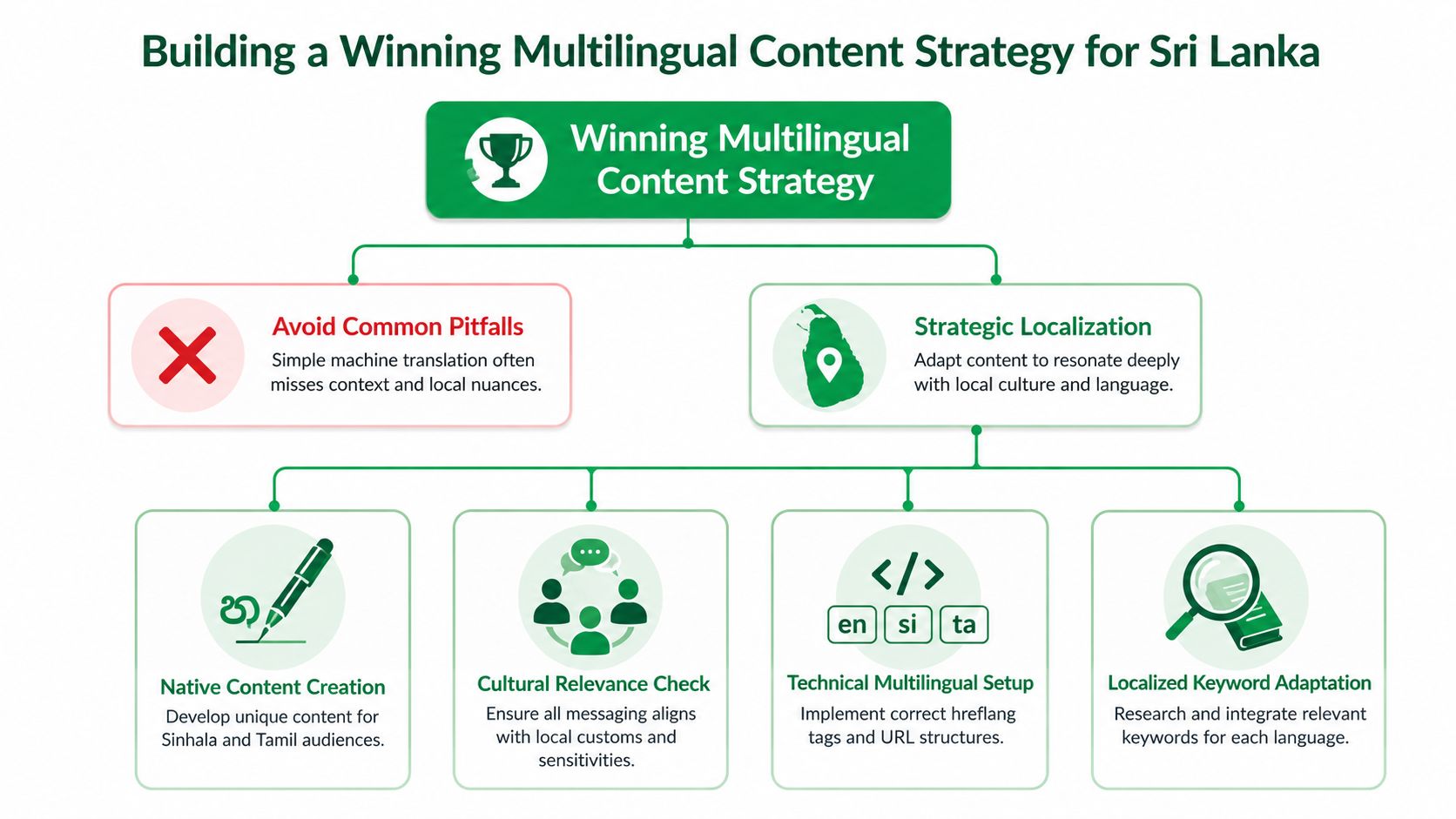
SEO Sri Lanka: Building a Winning Multilingual Content Strategy
Simple translation is where many Sri Lankan SEO campaigns fail unnoticed.
A page can be accurate and still weak. It can be grammatically correct and still miss search intent. And it can be indexed in multiple languages while competing against itself.
SEO Sri Lanka: Translation isn’t enough
Current guidance around SEO Sri Lanka has a major hole. It rarely provides a real framework for multilingual architecture, even though businesses need to structure sites for English, Sinhala, and Tamil in ways that avoid cannibalization and target language-specific intent properly (multilingual architecture gap in Sri Lanka SEO guidance).
That gap matters because each language version may need different wording, examples, FAQs, and calls to action.
Use this rule set:
- Translate when the audience and intent are effectively the same.
- Localize when examples, terminology, or expectations shift by region or language.
- Transcreate when persuasion matters and the message must feel native, not converted.
Service pages often need transcreation, not translation. Legal, healthcare, education, home services, finance, and B2B pages are common examples. People make trust decisions differently by language context.
Choose a structure before you publish
A messy multilingual setup creates indexing problems fast. Pick a system and keep it consistent.
| Option | Best fit | Caution |
|---|---|---|
| Subfolders | Most SMEs and growing brands | Requires disciplined internal linking |
| Subdomains | Larger teams with separate workflows | Can fragment authority if handled poorly |
| Separate domains | Rare cases with distinct brands | Highest maintenance burden |
For most Sri Lankan businesses, subfolders are the cleanest option. They centralize authority and make governance easier. That usually means an English version, a Sinhala version, and a Tamil version under one root domain.
Then handle the technical layer properly:
- Use hreflang for each language version
- Keep page purpose aligned across versions
- Avoid publishing three pages with identical English-derived metadata
- Link between equivalent language pages clearly
- Write unique titles and descriptions for each language version
A content calendar also gets harder in a multilingual environment unless you define ownership early. This resource on how to create a content calendar is useful for assigning language-specific topics, update cycles, and publication workflows before content debt piles up.
Here’s a useful walkthrough before implementation:
What content should differ by language
Not every page needs full variation. Some do.
Pages that often deserve localized rewriting:
- Homepages, because positioning language changes
- Service pages, because trust and objections differ
- FAQs, because query wording differs sharply
- Location pages, because local references carry more weight
- Review and proof sections, because language matching boosts confidence
If two language pages target different user expectations, write them as different assets. Don’t force symmetry for the sake of convenience.
SEO Sri Lanka: Dominating Local Search with Listings and Citations
Local SEO still matters in Sri Lanka. A lot. But most businesses treat listings as a setup task instead of an operating system.
That costs visibility.
SEO Sri Lanka: Optimize the profile like a landing page
Your Google Business Profile has to do more than confirm you exist. It has to explain where you serve, what you do, and why the searcher should trust you.
Work through the profile field by field:
- Primary category first
Pick the closest match to the core revenue service, not the broadest description. - Service areas with intent
Use actual districts, cities, and service coverage zones. Don’t stuff every place name you can think of. - Business description
Write for the user, not just the algorithm. Mention core services, language support, and local coverage naturally. - Photos and updates
Add current images tied to the business. Team, storefront, work examples, products, facility, before-and-after where appropriate. - Language matching in reviews
If a customer writes in Sinhala or Tamil, respond in that language if you can do it accurately.
A profile audit is worth doing before you push citations. Bare Digital has a useful tool to analyze your local business profile, especially if your listing has grown messy over time.
SEO Sri Lanka: Citations should reinforce, not confuse
The point of citations is consistency. If your name, address, phone, category, or URL varies across directories, you dilute trust signals.
Prioritize:
- Sri Lanka-relevant directories
- Industry-specific listings
- Social profiles that rank
- Marketplace or association profiles if they apply to your sector
Keep the same canonical business details everywhere. Fragments matter here. Suite names. Abbreviations. Phone formatting. All of it.
A structured local SEO audit checklist helps catch the common issues, especially duplicate listings, weak categories, missing review responses, and mismatched NAP details.
Reviews are a ranking signal and a conversion asset
Reviews don’t just influence local pack visibility. They also help a hesitant user choose.
What works:
- Ask after the service moment, not weeks later
- Guide customers to mention the service and location naturally
- Reply with specifics instead of copy-paste thanks
- Address criticism directly and calmly
What doesn’t:
- Bulk review requests to cold contacts
- Incentivized review language
- Generic replies on every review
- Ignoring multilingual comments because the team doesn’t have a process
A fully completed profile with weak review handling still underperforms. Local search is operational, not static.
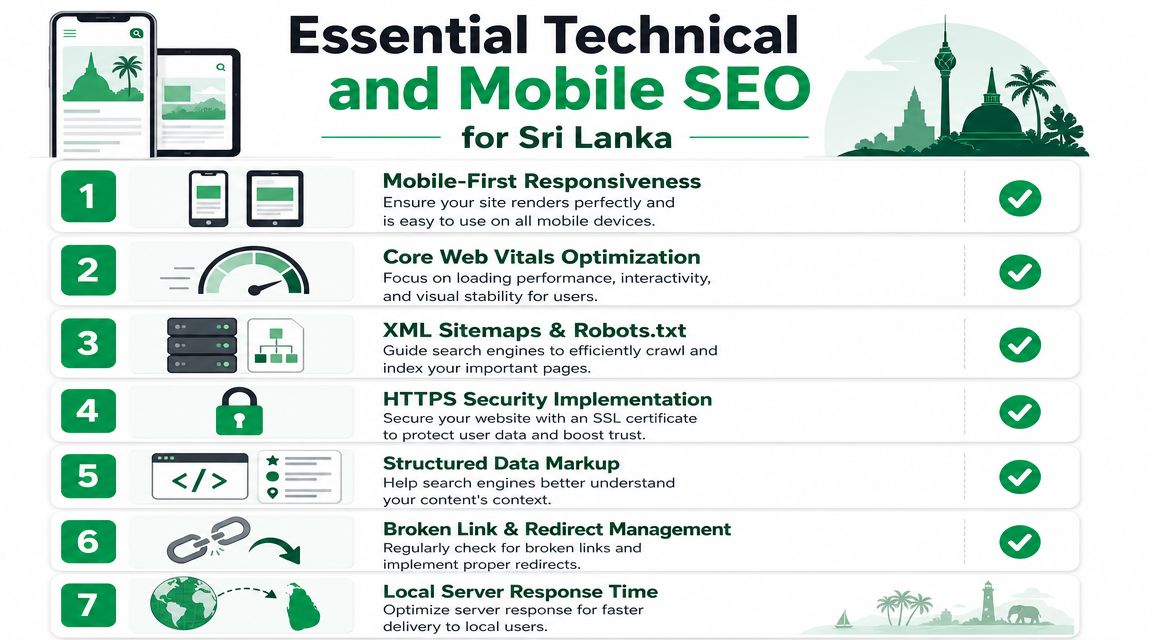
SEO Sri Lanka: Essential Technical and Mobile SEO for Sri Lanka
Technical SEO isn’t glamorous, but it decides whether your content even gets a fair shot.
In Sri Lanka, the technical baseline is even more important because the market is strongly mobile-first and many businesses still carry old site issues: bloated themes, duplicated service pages, weak internal linking, and slow templates.
Follow the crawl, index, rank sequence
The technical workflow is simple in theory. Google has to crawl, then index, then rank your pages. Industry guidance also keeps pointing back to the same practical issues: fix crawl blockers, support indexing with clean structure, improve mobile performance, strengthen internal links, and reduce duplication. A common target is getting pages to load in under 3 seconds for better engagement and crawl efficiency (technical SEO workflow and mobile performance guidance).
That means your audit should move in order:
- Can Google reach the important pages?
Check crawl blockers, robots instructions, broken internal paths, and sitemap coverage. - Are the right pages indexed?
Make sure your key service, category, and location pages are indexable while thin or duplicate versions are handled properly. - Do indexed pages deserve to rank?
Improve intent match, internal links, metadata, and content structure.
Skipping straight to content production is usually a waste if the site has technical drag.
SEO Sri Lanka: Mobile performance comes first
On many Sri Lankan sites, the mobile version is still an afterthought. That doesn’t hold up.
Prioritize these fixes:
- Compress large images
- Reduce heavy scripts and plugin bloat
- Use responsive templates that don’t break forms
- Keep buttons, menus, and calls to action easy to use on small screens
- Test key pages on actual mobile devices
A page that looks fine in a desktop builder can still be painful on a mid-range phone over a weaker connection. And yes, users leave. Fast.
Technical items that move the needle
A short checklist beats a massive audit document nobody implements:
| Priority | What to check | Why it matters |
|---|---|---|
| High | XML sitemap and indexability | Helps search engines find the right pages |
| High | Internal linking | Distributes authority and clarifies page hierarchy |
| High | Duplicate or thin pages | Prevents cannibalization and wasted crawl budget |
| Medium | Structured data | Improves entity understanding and search presentation |
| Medium | Redirect cleanup | Preserves value and avoids dead-end paths |
Structured data is especially useful for local entities. Add the business details that matter, then keep them aligned with your listings and site footer.
And if you need outside execution support, agencies such as Mr. Green Marketing, LLC handle SEO among broader digital services, including technical cleanup and visibility strategy. That’s useful when an in-house team can write content but can’t untangle indexing, mobile, and architecture issues efficiently.
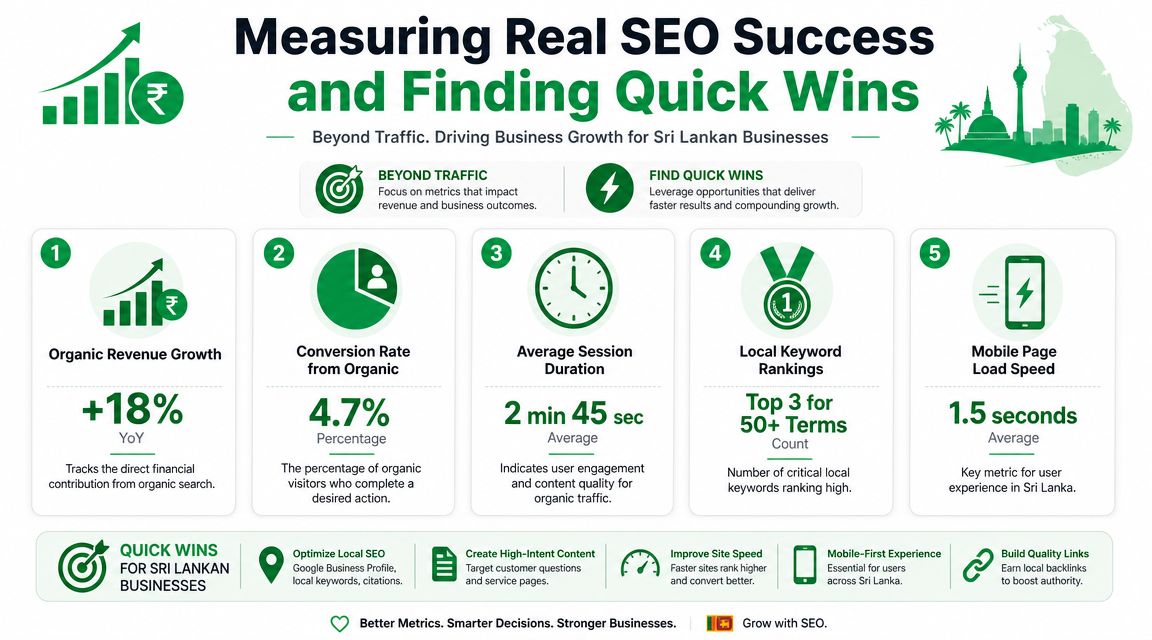
SEO Sri Lanka: Measuring Real SEO Success and Finding Quick Wins
A lot of SEO reporting in Sri Lanka still rewards the wrong things. Rank screenshots, traffic spikes, and long task lists look impressive in a monthly report, but they do not tell a business owner whether SEO is producing qualified inquiries, booked calls, showroom visits, or sales.
What matters is business movement from organic search. That includes leads from English pages, conversions from Sinhala or Tamil pages, branded search growth after local visibility improves, and assisted conversions where search starts the journey but does not close it on the first visit.
Track the KPIs that connect to business value
Useful SEO measurement starts with four questions.
Are the right pages getting impressions? Are those pages attracting visits from the right locations and languages? Are those visits turning into leads or revenue? Are AI search summaries and search features reducing clicks while still increasing brand visibility and assisted demand?
That changes what goes into the report. Organic sessions and rankings still matter, but they sit underneath harder metrics such as qualified form submissions, call clicks, WhatsApp starts, direction requests, ecommerce revenue, and lead quality by landing page.
Digitas notes that SEO gains usually take time and often need several months of sustained work, not one round of fixes (SEO KPIs and realistic timelines). In practice, that means judging early progress by leading indicators first, then by conversion performance once the right pages have enough visibility.
For Sri Lankan businesses, this reporting rhythm works well:
- Weekly
Check commercial and local-intent rankings, review leads from priority pages, and look for sudden drops by device, city, or language version. - Monthly
Review index coverage, top landing pages, conversion paths, branded versus non-branded traffic, and whether Sinhala or Tamil pages are being discovered and used as intended. - Quarterly
Refresh pages that have impressions but weak click-through rate, merge overlapping content, and rework pages where traffic is growing but conversion rate stays poor.
One warning matters here. A page can rank, get clicks, and still underperform because the offer is weak, the proof is thin, the form is broken on mobile, or the language does not match user intent.
Quick wins that usually matter first
The fastest gains usually come from pages already sitting near page one, service pages with impressions but weak clicks, and local landing pages that get traffic without converting.
I usually start with five checks.
- Rewrite title tags on revenue pages
Use the service, location, and intent clearly. For Sri Lanka, that often means separating broad national terms from city-specific searches instead of trying to force one page to do both. - Improve pages with a language mismatch
If users search in Sinhala or Tamil and land on an English-first page, engagement drops fast. Build or revise the right version, and make sure the page title, headings, FAQs, and calls to action match the language of the search. - Strengthen internal links into money pages
Blog posts, FAQs, and support pages should push authority and context into the pages that convert. - Fix weak local pages
Add proof, service detail, delivery areas, trust signals, and answers to practical questions. Generic city pages rarely hold rankings for long. - Audit analytics before making decisions
Bad event tracking leads to bad SEO decisions. If you run Shopify, wRanks’ Shopify GA4 setup advice is a useful reference for cleaner ecommerce measurement.
AI-driven search adds another layer. Some pages will lose clicks even as visibility improves because users get part of the answer inside search results. That does not make the page a failure. It means the page should target queries where brand recall, trust, and follow-up action still matter, especially high-intent service searches and comparison terms.
A simple decision filter
Use a strict filter when choosing next month’s SEO work.
| Ask this question | If yes | If no |
|---|---|---|
| Does this page target buying or inquiry intent? | Prioritize it | Leave it behind lower-value content |
| Is the page indexed and eligible to rank? | Improve relevance and conversion | Fix access, canonicals, or indexation first |
| Is it getting impressions already? | Improve title, intro copy, and CTA | Recheck keyword targeting and search intent |
| Does the page match the user’s language and location? | Strengthen that version | Split, rewrite, or rebuild the page |
| Can the page still win clicks in AI-influenced results? | Add clear expertise, proof, and concise answers | Target a narrower or more commercial query set |
Many campaigns frequently misstep. Teams publish more pages instead of improving the pages already closest to revenue.
SEO in Sri Lanka works better when measurement reflects how people search and convert. That means tracking by language, by location, by device, and by intent. It also means accepting that AI search visibility and classic click-based SEO now overlap, especially for informational queries.
If your business needs a clearer plan for SEO in Sri Lanka, Mr. Green Marketing, LLC can help assess where visibility is leaking, from multilingual page structure to local search gaps and technical issues. A focused audit is usually the fastest way to find the pages, fixes, and quick wins that can move performance without wasting months on generic SEO work.
Leave a Comment
sing in to post your comment or sign-up if you dont have any account.