
Cost of Advertising on the Radio: A typical 30-second radio ad can cost anywhere from $200 in a small market to over $5,000 in a major city. In prime time, the national average for a 30-second spot ranges from $200 to $5,000, and in places like New York City, that number can reach $3,000 to $8,000.
And that’s usually the moment business owners start asking the right questions. Not just “can I afford radio?” but “what am I really buying?” and “how would I know if it worked?”
That skepticism is healthy. Radio still feels opaque to a lot of SMB owners because the price isn’t fixed, the jargon gets thick fast, and most station pitches lean hard on audience size while saying very little about attribution. For a local service business, an e-commerce brand, or a multi-location company, that’s the primary issue. Airtime is only half the decision. The other half is whether you can connect spend to leads, traffic, and revenue.
Cost of Advertising on the Radio: So You Want to Advertise on the Radio
You hear your competitor on the morning drive again. Same station, same offer, same voice. After the third or fourth time, the question stops being theoretical.
How much are they paying for that?
Most owners assume radio is reserved for regional chains, car dealers, and brands with deep pockets. Sometimes that’s true. Sometimes it isn’t. A lot depends on where you’re buying, when your ad runs, how often it runs, and whether you’re paying for a polished creative production or keeping it simple.
Cost of Advertising on the Radio: Why radio feels more expensive than it is
Radio has a reputation problem. It sounds like old-school media, so people assume it works like a black box. You write a check, your ad goes live, and then you just hope the phone rings.
That’s not a great way to buy anything.
The smarter way to look at the cost of advertising on the radio is as a media buy with several moving parts, much like TV, paid search, or streaming audio. The station inventory has value. Your message has to fit the audience. And your campaign has to be measured in a way that makes sense for your business model.
Radio stops feeling mysterious once you separate airtime cost from business outcome. Those are related, but they are not the same thing.
There’s also a practical comparison worth making. If you’ve already looked into how much it costs to advertise across channels, radio sits in an interesting middle ground. It’s usually more structured than social, less visually demanding than TV, and still strong for local reach, commuter attention, and repeated exposure.
What smart buyers want to know first
Before you ever ask a station rep for a proposal, get clear on these:
- Your goal: Are you trying to drive calls, website visits, coupon use, branded search, or general local awareness?
- Your market: A secondary city and a major metro are completely different pricing environments.
- Your offer: Radio works better when the listener has one action to take, not five.
- Your tracking setup: If you can’t track a response path, the campaign will feel vague even if it helps.
That’s where most bad radio buys go wrong. Not at the rate card. At the planning stage.
Cost of Advertising on the Radio: How Radio Ad Pricing Actually Works
A station quote usually looks simple until you ask what you’re buying. One 30-second spot might be cheap on paper and still be overpriced if it runs at a weak hour, on a poor format fit, or without enough repetition to make anyone remember it.

Radio pricing comes down to four variables. Market, daypart, spot length, and frequency. If you’ve bought TV advertising across different markets and time slots, the logic is familiar. Better inventory costs more because more advertisers want the same audience at the same time.
The four inputs that shape the rate
Market size sets the baseline. A station in a major metro can charge more because it reaches more people and competes for more local ad dollars.
Daypart changes the value of that audience. Morning and afternoon drive usually cost more than middays, overnights, and weekends because listening levels and advertiser demand are stronger.
Ad length affects both price and creative performance. A 15-second spot costs less than a 30, but it leaves less room for an offer, proof, and a call to action. A 60-second spot gives you room to explain, but you pay for it and you risk losing attention if the script drags.
Frequency is the piece many first-time buyers underestimate. One or two placements rarely do much. Radio works through repetition. You are buying memory as much as reach.
The simplest comparison is retail rent. The city, the street, the size of the unit, and how often shoppers pass by all affect what that space is worth.
CPP and GRPs without the media-buyer jargon
Stations and agencies often price plans with CPP and GRPs. Those terms sound more technical than they are.
The University of Texas guide to radio advertising metrics explains CPP, or Cost Per Rating Point, as the cost to buy one rating point of audience in a market. In practice, CPP helps compare one station or daypart against another on audience efficiency, not just sticker price.
That distinction matters. A spot with a higher unit rate can still be the better buy if it delivers audience at a lower CPP.
GRPs, or Gross Rating Points, measure the total audience weight of a schedule. The easiest way to explain it to an SMB owner is this: CPP is what you pay for a unit of audience, and GRPs are how much audience pressure your campaign puts into the market over time. If your goal is lift in branded search, direct traffic, or store visits, GRPs help explain whether the schedule had enough weight to create that lift.
This is also where radio and digital often miss each other. Radio sellers talk in ratings. Business owners care about revenue, leads, and attributed conversions. Both views matter. A schedule can be efficient on CPP and still underperform if the offer is weak, the landing page is poor, or nobody can track response.
If you’re used to paid search, this is conceptually similar to calculating Google Ads auction costs. Different buying mechanics, same discipline. You still have to judge whether the price matches the likely business outcome.
What makes a quote rise fast
High radio quotes usually trace back to a few predictable choices:
- Premium drive-time inventory
- A larger, more competitive market
- Longer spot lengths
- Enough weekly frequency to create recall
- Format alignment with a desirable audience
Format matters more than many station reps admit. A cheaper station with the wrong audience is expensive inventory. A higher-rate station with strong audience fit can produce better downstream results, especially if you track branded search lift, direct traffic spikes, unique promo codes, or dedicated landing page visits during the flight.
That last part is the bridge between old-school airtime buying and modern measurement. Airtime has a market price. ROI has to be built after the buy, with call tracking, vanity URLs, offer codes, post-purchase surveys, and clean campaign timing. Without that setup, radio can still work, but proving it becomes much harder.
Cost of Advertising on the Radio: Radio Advertising Cost Ranges and Examples
A station rep quotes $350 per spot and the number sounds manageable. Then you realize that amount buys one airing, not enough repetition to make anyone remember your brand, search for you later, or use your promo code. Radio cost only makes sense in the context of a full schedule and a measurement plan.
The range is wide. In small and mid-size markets, a 30-second spot can be relatively affordable. In major metros, the same unit can cost several times more, especially in high-demand dayparts. As noted earlier, market size changes the math fast.
A quick market comparison
| Market Type | What pricing usually looks like |
|---|---|
| Major metropolitan market | High enough that a short test can burn through budget quickly |
| Mid-size market | More room to build weekly frequency without paying top-tier metro rates |
| Smaller market | Often the most practical place for a first radio test |
That spread is why two businesses can both say they “tried radio” and have completely different experiences. One bought enough weight to be heard. The other bought a handful of scattered spots and learned very little.
Ad length changes the budget, but it also changes what kind of campaign you can run.
A 15-second spot is usually best for reinforcement. It can keep your name in rotation, support a sale, or back up another channel. A 30-second spot is the standard starting point because it gives enough room to name the problem, make the offer, and give one clear call to action. A 60-second spot can work for host-read style messages, more emotional storytelling, or offers that need setup, but the extra time only pays off if the script earns it.
If the message is hard to explain in 30 seconds, fix the message before buying longer inventory.
Here’s the practical trade-off. A shorter spot may let you buy more frequency. A longer spot may explain the offer better but reduce how often people hear it. For many SMBs, especially service businesses and local retailers, more weekly repetition with a clean 30-second ad beats a few expensive 60s.
Cost examples are only half the job. The other half is connecting airtime cost to business response. If two schedules cost the same, the better buy is usually the one that gives you cleaner attribution. That might mean using a dedicated landing page, a vanity URL, a tracked phone number, or a radio-only offer code. Without that setup, the cheaper schedule can look better on paper and still be harder to judge after the campaign ends.
Radio also needs to be priced against alternatives that compete for the same budget. If you’re weighing broadcast options, this breakdown of TV advertising costs by market and format is a useful comparison. TV often asks for more production work and visual creative. Radio usually gets on air faster, but it still needs enough frequency and a trackable response path to justify the spend.
A good benchmark is simple. Don’t ask only, “What does one spot cost?” Ask, “What will it cost to run often enough that I can measure lift in calls, traffic, branded search, or sales?” That question gets much closer to the actual price of radio.
Cost of Advertising on the Radio: Building Your First Radio Ad Budget
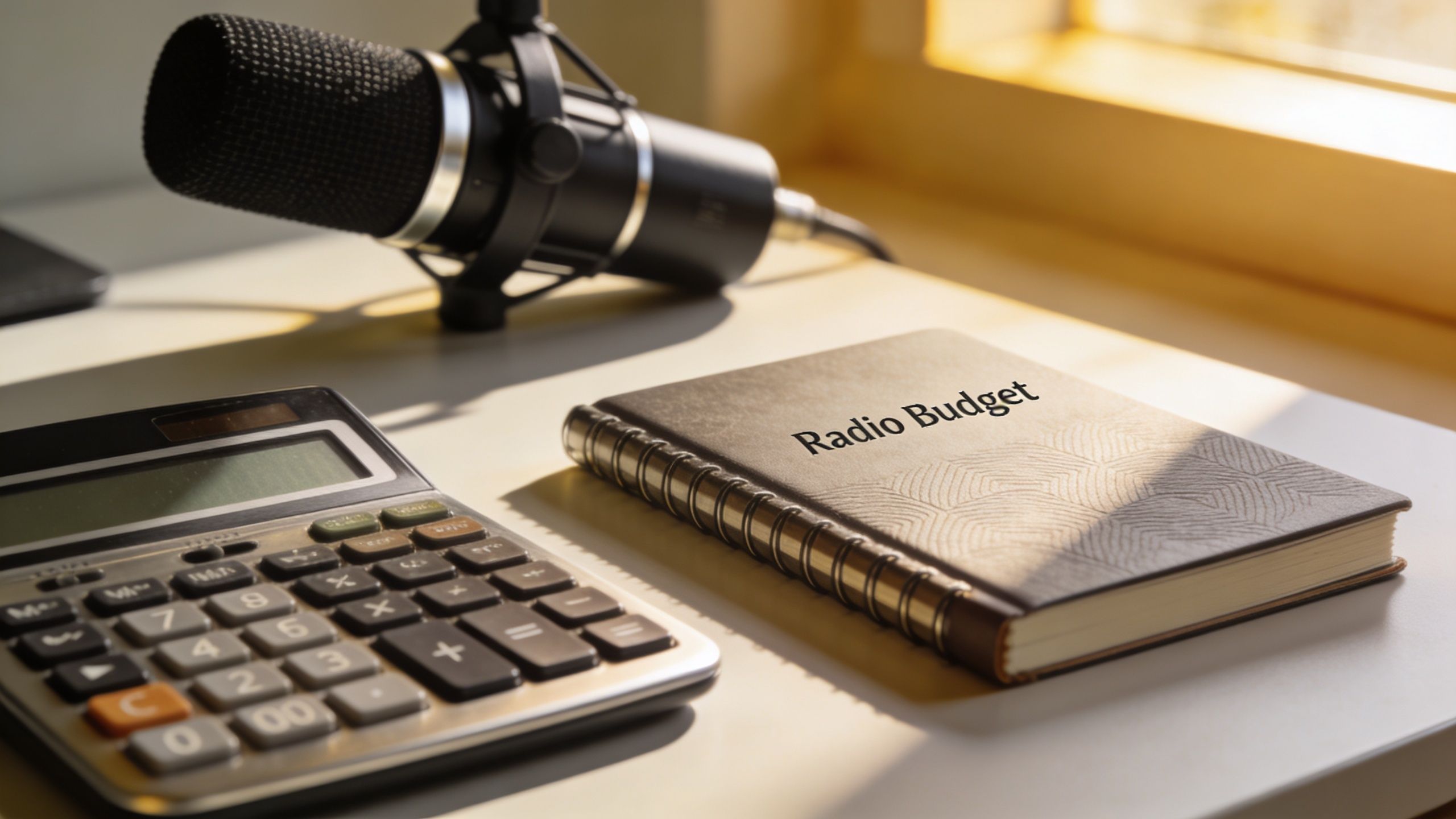
A first radio budget usually breaks down in a predictable place. The station quote looks affordable. Then real-world execution shows up: production, enough weekly frequency to matter, and some way to tell whether the campaign drove calls, visits, or sales.
Start with two buckets
Keep the budget simple at first. There are only two main buckets:
- Production cost: Script, voice talent, studio time, editing, and revisions
- Airtime cost: The schedule itself
That split matters because SMB owners often focus on the media line and forget that creative still has to be made. A polished spot can help, but radio is not a channel where expensive production automatically fixes a weak offer. For many local advertisers, a straightforward ad with a clear promise and one call to action beats a clever script with extra sound design.
A practical first budget usually puts most of the money into airtime, not production. Earlier cost examples in this article show why. Radio only starts to work when enough people hear the message often enough to remember it.
Build the budget around response, not just reach
The old-school way to budget radio is to ask how many spots the station can fit into a given dollar amount. That is incomplete.
A better question is: how much can you spend while still giving yourself a fair shot at measuring response?
For a local service business, that usually means budgeting for:
- A simple ad that can be produced quickly
- A schedule with repeated weekly exposure
- One trackable action, such as a dedicated phone number, landing page, or offer code
- A test window long enough to judge results, not just one week of scattered spots
That last point gets missed all the time. Radio often behaves more like planting than flipping a switch. People hear the ad, do nothing, then need a plumber, roofer, dentist, or attorney two weeks later and search the name they remember. If there is no tracking setup, that delayed response gets credited to direct traffic, branded search, or “word of mouth” instead of radio.
Budget example for a local service business
A good starter budget for a plumber, HVAC company, med spa, or family law firm is usually plain by design.
Use one offer. Use one voice. Run in lower-cost dayparts if needed. Save money for repetition.
That approach works because local radio often wins on memory, not on one perfect listen. If the ad says who you help, what problem you solve, and what to do next, the schedule has a chance to produce calls later, even if the listener does not act on the spot.
The trade-off is straightforward. Premium inventory can sound attractive, but a thinner schedule often leaves you with too little frequency to judge performance. I would rather see a smaller advertiser buy a schedule they can sustain and track than buy a prestige slot they cannot repeat.
Cost of Advertising on the Radio: Budget example for an e-commerce or DTC brand
E-commerce brands need a stricter budgeting lens. Airtime cost is only part of the decision. Attribution setup matters just as much.
A workable radio budget for DTC usually includes:
- A short offer people can remember once
- A landing page or vanity URL built only for radio
- A promo code or post-purchase survey field
- A market selection strategy tied to shipping economics and audience fit
Radio can still help an online brand, but only if the path from hearing to buying is easy. If the product name is hard to spell, the URL is forgettable, or the offer needs too much explanation, the budget will get wasted fast. In those cases, the problem is not airtime cost alone. It is the gap between a traditional channel and a digital checkout process that was never set up to capture radio influence.
Where first budgets go wrong
The weak first budgets usually fail for one of three reasons:
- Too much money goes into production. Nice audio is helpful. It does not create demand by itself.
- Too little goes into frequency. A handful of scattered spots rarely gives you a clean read on performance.
- No attribution method is built in. Then every result turns into an argument about what radio “probably” did.
CPP and GRPs matter when buying, but budget planning should still feel concrete. GRPs are a pressure gauge. They tell you how much weight your schedule puts into a market. Your budget decides whether that pressure is enough to move anything, and your tracking setup decides whether you can prove it.
Keep the first budget disciplined. Fund the ad, fund enough airtime to test it properly, and fund the measurement setup that tells you whether radio is assisting search, calls, store visits, or online orders. That is how a radio budget stops being a line item and starts acting like a channel you can manage.
Cost of Advertising on the Radio: Smart Buying and Negotiation Strategies
A station sends over a proposal with a morning-drive package, a neat rate card, and a deadline. Many SMB owners treat that first version like a final price. It is not. It is an opening offer built around the inventory the station wants to move and the story the rep wants to tell.

The better approach is to buy radio the way you would buy paid search traffic or Meta inventory. Start with the outcome you need, then shape the buy around it. If you need calls, site visits, or redemptions you can track, the cheapest-looking package is often the wrong package. The right package gives your message enough repetition, puts it in the right dayparts, and leaves room for attribution.
Buy schedules, not isolated spots
One-off spots are usually a weak negotiation position and a weak test design. Stations price them that way for a reason. A single spot gives you little bargaining power and almost no useful read on response.
A schedule gives you options.
Ask what pricing changes if you commit to a fixed number of weeks, a set weekly spend, or a guaranteed spot count. In many cases, the effective rate improves when the station can count on continuity. That matters more than chasing a headline discount on one premium placement.
I usually look at radio the same way I look at reach and frequency in digital video. One impression rarely changes behavior. Repetition does.
Negotiate the structure first
Price matters. Structure matters more.
A smart negotiation usually covers:
- Daypart mix: Blend some higher-demand inventory with lower-cost hours instead of forcing the whole budget into one expensive window.
- Weekly consistency: Keep spots running on a stable cadence so the campaign has a fair chance to produce lift.
- Added value: Ask for bonus spots, live reads, website mentions, podcast inventory, or social posts if the station group offers them.
- Separation and rotation: Make sure your spots are not bunched too tightly, and rotate at least two versions if the offer can support it.
- Cancellation and makegood terms: Know what happens if a spot does not run as ordered or if results are weak after the initial test period.
That last point gets overlooked. Makegoods have value only if the replacement inventory is useful.
Morning drive is not always the best buy
Morning drive gets attention because it has attention. It also gets crowded and expensive.
For many local businesses, midday or afternoon can produce a better test because the budget buys more repetitions. For e-commerce brands and lead-gen offers, that can be the difference between a campaign that creates a visible bump in branded search and direct traffic, and one that disappears into the noise. Prestige does not help if the schedule is too thin to measure.
CPP works like a price tag on audience delivery. GRPs work like the total weight of your schedule in the market. If your budget only buys a little weight in premium hours, you may end up with an impressive-looking plan that cannot generate a clear response signal.
Here’s a useful explainer on the business side of media placement and timing:
Ask questions that connect cost to measurement
This is the gap that trips up a lot of first-time buyers. The station is selling airtime. You are trying to buy outcomes.
So ask direct questions:
- What days and hours will these spots run?
- How much of the package is fixed versus preemptible?
- What proof of performance do you provide after airing?
- Can the schedule support a dedicated URL, promo code, or call tracking number without changing copy every day?
- If performance is weak after two or three weeks, what can be reworked without starting over?
Those answers tell you whether the seller understands modern accountability or is just filling inventory. If you need a framework for evaluating channel performance, this guide on how to measure marketing campaign effectiveness is a useful companion to the buy itself.
Direct station buy or outside buyer
For one market, buying direct can work well. It is faster, simpler, and often good enough for an initial test.
For multi-market campaigns, radio gets messy fast. Rates vary, avails change, copy instructions multiply, and post-log reconciliation becomes real work. An outside buyer or agency can help if they are disciplined about the math and honest about trade-offs. Ask them how they calculate blended cost, how they compare stations, and how they tie the buy back to results using a clear marketing return on investment formula.
Good negotiation in radio is not about squeezing every last dollar out of a station rep. It is about building a schedule you can afford, track, and judge accurately. That is what turns radio from a hopeful spend into a testable media channel.
Cost of Advertising on the Radio: Measuring Radio Ad ROI in 2026
Radio campaigns either become a disciplined channel or a fuzzy branding exercise.
The attribution gap is real. A station can tell you what ran and roughly who might have heard it. That’s useful. It is not enough for most SMBs.

Trackable calls to action fix the biggest problem
The strongest practical guidance here comes from SparkPod’s breakdown of radio advertising costs and attribution. It notes that while radio CPMs might be $10 to $25, businesses close the measurement gap by using unique URLs, specific promo codes, and dedicated phone numbers to connect radio exposure to traffic, leads, and sales.
That’s the bridge between old media and modern accountability.
What to use in a real campaign
For a local service business, use:
- A dedicated call tracking number: Keep it exclusive to the radio campaign.
- A landing page built for radio traffic: Short URL, simple headline, one action.
- Intake tagging in your CRM: Mark the lead source when the call or form arrives.
For e-commerce, use a slightly different setup:
- Vanity URL that’s easy to hear once and remember
- Radio-only promo code
- Campaign-specific landing page
- Branded search monitoring after launch, if your team tracks channel interaction
A listener rarely responds like a paid search user. They may hear the ad, remember the brand, then visit later from direct traffic or search. That means radio ROI usually needs a wider lens than pure last-click reporting.
What not to rely on
The weakest measurement method is asking every customer, “How did you hear about us?” It can help, but memory is messy and attribution gets muddy fast.
Better options combine direct and indirect signals:
- Direct response data: calls, coupon use, promo codes, form fills
- Website behavior: traffic to the vanity page
- Sales correlation: whether campaign windows line up with response changes
- CRM follow-through: which leads turned into revenue
If you need a clean framework for the math, this guide to the marketing return on investment formula is useful because it keeps the calculation grounded in spend and return, not vanity metrics.
Radio reporting gets stronger when you judge it like a blended channel. Direct responses matter. So does downstream lift.
The standard I’d use before renewing
Before extending a radio buy, I’d want clear answers to four questions:
| Question | Why it matters |
|---|---|
| Did people respond to the CTA? | Tells you whether the message landed |
| Did tracked calls, visits, or code use justify the spend? | Tests direct payoff |
| Did the campaign support branded demand or lead volume? | Captures indirect effect |
| Was the station and time mix worth repeating? | Improves the next buy |
If your team already reviews campaign performance across channels, this guide on how to measure marketing campaign effectiveness gives a useful way to think about radio as part of a broader reporting system instead of a standalone mystery.
Radio can work. But only if you buy it with the same discipline you’d use in search, social, or email. That means cost control, frequency planning, and tracking that survives contact with the actual world.
If you want help planning a radio campaign that’s measurable, Mr. Green Marketing, LLC can help you connect traditional media with digital tracking, landing pages, CRM attribution, and broader campaign strategy so the spend is easier to judge and easier to improve.
Leave a Comment
sing in to post your comment or sign-up if you dont have any account.