
South Carolina SEO: You’re probably in one of these situations right now. Your business is solid, customers like you, referrals happen, and your team delivers. But when someone in Charleston, Columbia, Greenville, or Spartanburg searches for the service you sell, your site barely shows up. Or worse, a bigger brand with a weaker local presence keeps taking the clicks.
That gap usually isn’t because your business is worse. It’s because your strategy is too broad, too generic, or too disconnected from how people in South Carolina search. And that matters more than most owners realize.
South carolina seo works best when it’s built around place, intent, and proof. Not just keywords. Not just blogs. Not just a prettier homepage. The businesses that win here tend to make Google’s job easy. They show where they operate, what they do, why they’re trusted locally, and how searchers can take action fast.
South Carolina SEO: Why South Carolina SEO Is Its Own Beast
South Carolina isn’t one market. It’s a patchwork of very different search environments.
Charleston behaves differently than Greenville. Myrtle Beach has tourism pressure that changes query patterns. Columbia has a mix of local service demand, university-adjacent search behavior, and regional competition. Spartanburg and Rock Hill often reward businesses that look more embedded in the community, even when larger competitors have stronger overall websites.
That’s why generic national advice falls apart here. A template that says “create some city pages and build backlinks” doesn’t tell you how to outrank a franchise in Mount Pleasant, a long-established local company in Greenville, or a service business that dominates map results in North Charleston because they’ve done a better job with reviews, categories, and citations.
South Carolina is also crowded from the agency side. Clutch listed 245 SEO companies serving the state as of April 2026, including 15 industry leaders and 15 strong contenders, which tells you two things at once: competition is real, and bad advice is easy to buy (Clutch South Carolina SEO firms).
Local context beats broad SEO theory
A statewide strategy usually underperforms because search intent gets narrow fast. Someone typing “personal injury lawyer Charleston,” “HVAC repair West Ashley,” or “boat detailing Hilton Head” isn’t looking for a brand with broad awareness. They’re looking for the most relevant local answer.
That’s where local positioning becomes an advantage, not a limitation.
Practical rule: If your SEO plan would look almost the same in South Carolina, Ohio, and Arizona, it’s probably too generic to win locally.
A lot of business owners read broad guides on title tags, content hubs, and backlinks, and those ideas aren’t wrong. They’re just incomplete. If you want useful outside reading, these search engine optimization tactics are worth reviewing through a local lens, especially if you’re trying to connect general best practices to Myrtle Beach or other coastal markets.
What usually fails here
Three patterns show up over and over:
- City stuffing: Pages that repeat “Charleston SC” or “Greenville South Carolina” without adding anything useful.
- Thin service pages: One page trying to rank for every service, every city, and every audience.
- National-style content calendars: Lots of blog posts, very little local relevance.
And then there’s the quiet problem. Businesses often assume their website is the main battleground. Sometimes it is. But in South Carolina local search, your visibility often starts somewhere else entirely.
South Carolina SEO: The Foundation Mastering Your Google Business Profile
If you only fix one thing first, fix your Google Business Profile.
For many local businesses in South Carolina, it’s the strongest visibility asset they own. A well-maintained profile can reach top local map pack positions through prominence signals like 200+ reviews and consistent citations, even without enterprise-level domain authority (modern local SEO in South Carolina).
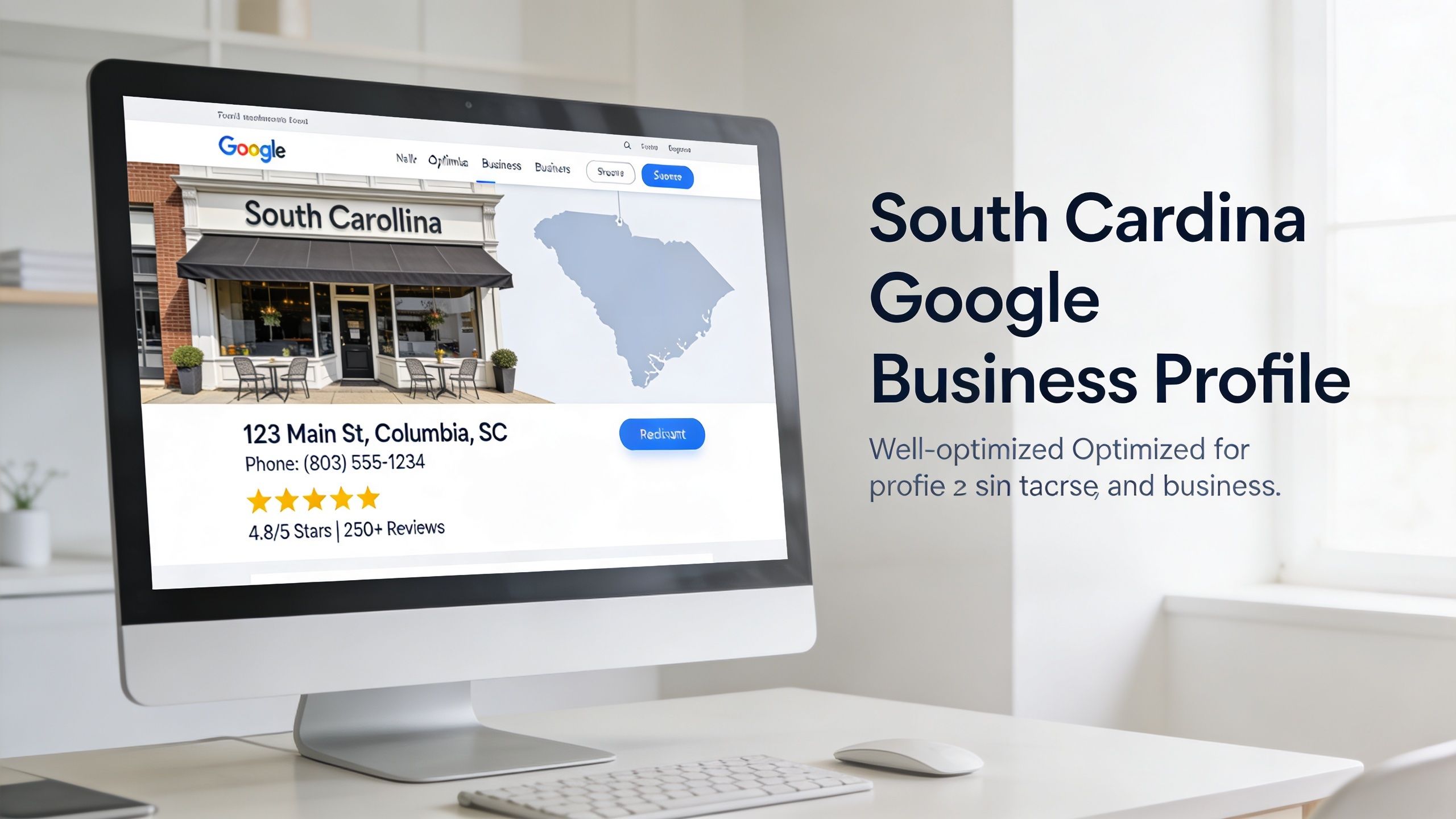
That’s why we treat GBP like a revenue channel, not a listing to “set and forget.” If you’re a roofer in Summerville, a dentist in Greenville, or a med spa in Columbia, this profile often shapes first impressions before anyone clicks through to your site.
Get the core fields exactly right
Google gives you room to be vague. Don’t take it.
Your primary category should match your main money-making service as closely as possible. Secondary categories should support adjacent services, not pad relevance with loosely related terms. If you’re a family law attorney in Charleston, pick the category that best matches that business, then support it with secondary categories only where they’re accurate.
The same rule applies to:
- Services: Add specific offerings people search for, not just umbrella terms.
- Products: Use them if they fit your business model, especially in retail, wellness, and specialty services.
- Business description: Write for clarity first. Mention real locations served, real services, and what distinguishes your business locally.
- Attributes: Fill out every relevant one. These can help both click-through and qualification.
A half-complete profile sends mixed signals. So does inconsistency between your GBP, website, and citation listings.
The details most businesses skip
This is usually where local rankings separate.
Seed your Q&A section with common buyer questions and answer them clearly. Add photos that reflect the actual experience a customer will have. Keep business hours updated during holidays, event weekends, or seasonal changes. In tourist-heavy markets like Myrtle Beach or Hilton Head, stale hours create avoidable frustration and wasted leads.
Use Google Posts to show the profile is active. They don’t replace a content strategy, but they help reinforce recency and operational legitimacy. A law firm in Columbia can post about consultation topics. A home service company in Greenville can highlight seasonal service reminders. A restaurant in Charleston can spotlight events, specials, or neighborhood-specific appeal.
Your GBP should answer three questions fast: What do you do, where do you do it, and why should someone trust you today?
Here’s a simple operating rhythm that works:
- Weekly check: hours, messages, reviews, and suggested edits.
- Photo refresh: new team, work, location, and product imagery.
- Post cadence: short updates tied to real services or offers.
- Q&A maintenance: add or refine answers based on sales calls.
- Review response workflow: respond to positive and negative reviews with calm, specific language.
A quick visual walkthrough helps if you want to see the profile elements in motion:
Reviews are not a side task
A lot of owners ask for reviews only when they remember. That’s too random.
You need a repeatable ask tied to the moment of highest customer satisfaction. For a contractor, that might be right after project completion. For a chiropractor, after a successful visit sequence. For a CPA, after a clean filing or tax resolution. The key is consistency, timing, and making the ask simple.
What works:
- Train the front line: staff should know when and how to ask
- Use direct review links: remove friction
- Respond to every review: yes, the difficult ones too
- Reference real service details: generic responses look automated
What doesn’t:
- Buying reviews
- Batching requests once every few months
- Ignoring negative feedback
- Using the same canned response every time
Negative reviews don’t automatically hurt you. Sloppy responses do. A measured reply shows future customers that your business is present, accountable, and professional.
South Carolina SEO: Finding Your Customers Through Hyperlocal Keyword Research
Most businesses start keyword research too high up the ladder.
They go after terms like “plumber South Carolina” or “marketing agency South Carolina,” then wonder why nothing converts. Those keywords are broad, uneven in intent, and often disconnected from how real buyers search when they need help now.
The better approach is to build outward from service + place + situation.
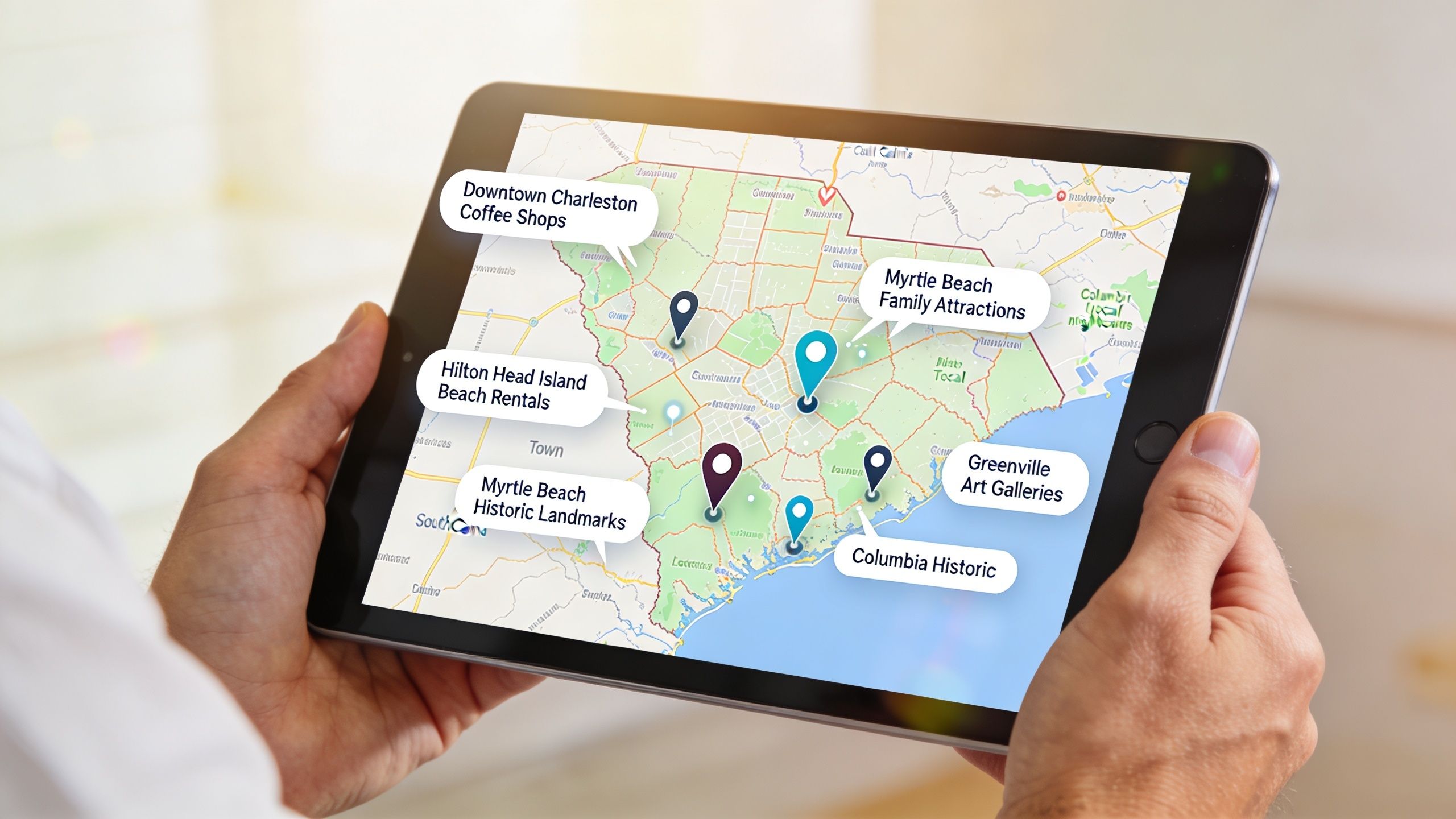
South Carolina SEO: Start with the map your customer has in their head
People don’t always search by city. They search by neighborhood, corridor, suburb, landmark, or service area language that locals use.
A Charleston-area business might need pages or content shaped around West Ashley, James Island, Mount Pleasant, North Charleston, or Daniel Island. In Columbia, Five Points, Forest Acres, and Lexington can matter. In Greenville, people may search by downtown, Travelers Rest, Greer, or Simpsonville depending on the service.
That means your keyword list should include several layers:
- City-level terms: broad local intent
- Neighborhood modifiers: tighter and often more actionable
- Service-specific variants: the exact thing the customer wants
- Urgency phrases: “same day,” “emergency,” “near me,” “open now”
- Problem-based searches: the issue behind the service request
A family dentist shouldn’t stop at “dentist Charleston.” They should map terms around emergency visits, pediatric care, cosmetic concerns, insurance questions, and neighborhood-specific demand.
Build pages for intent, not for volume
At this stage, many local sites get messy.
They create a single “areas we serve” page and expect it to rank across the state. It usually won’t. Google wants alignment between the query and the page. If someone searches for a service in Spartanburg, the page that ranks best is usually the one clearly built around that service in Spartanburg.
That doesn’t mean creating dozens of duplicate city pages with swapped place names. It means building location pages with substance:
- What you offer in that city
- How the service works there
- What common local issues come up
- Proof tied to that market
- Clear calls to action
If every city page says the same thing except the town name, Google can tell. So can customers.
South Carolina SEO: Put keywords where they actually help
Once you’ve got the right terms, placement matters.
Use your main keyword in the title tag, H1, opening paragraph, and naturally throughout supporting copy. Add geo-modifiers in subheads where they make sense. Use internal links from related pages. Make sure the business name, address, and phone details stay consistent where appropriate.
Schema matters too, especially for local context. We typically use JSON-LD to reinforce business details, service relationships, and local relevance. It doesn’t replace good content. It supports it.
A practical page structure often looks like this:
| Page element | What to include |
|---|---|
| Title tag | Primary service plus city or area |
| H1 | Clear service phrase written for humans |
| Intro copy | Local relevance and core value |
| Subheads | Specific service scenarios, neighborhoods, FAQs |
| Internal links | Related services and nearby locations |
| Schema | Local business and service context |
Keyword tools help, but they’re only part of the process. Search Console, live SERPs, autocomplete, “People also ask,” customer call transcripts, and sales team notes usually reveal better intent than a spreadsheet alone. And yes, sometimes the best phrase is the one that looks too specific to matter. Those searches often carry the strongest commercial intent.
South Carolina SEO: Building Local Authority with Content and Links That Matter
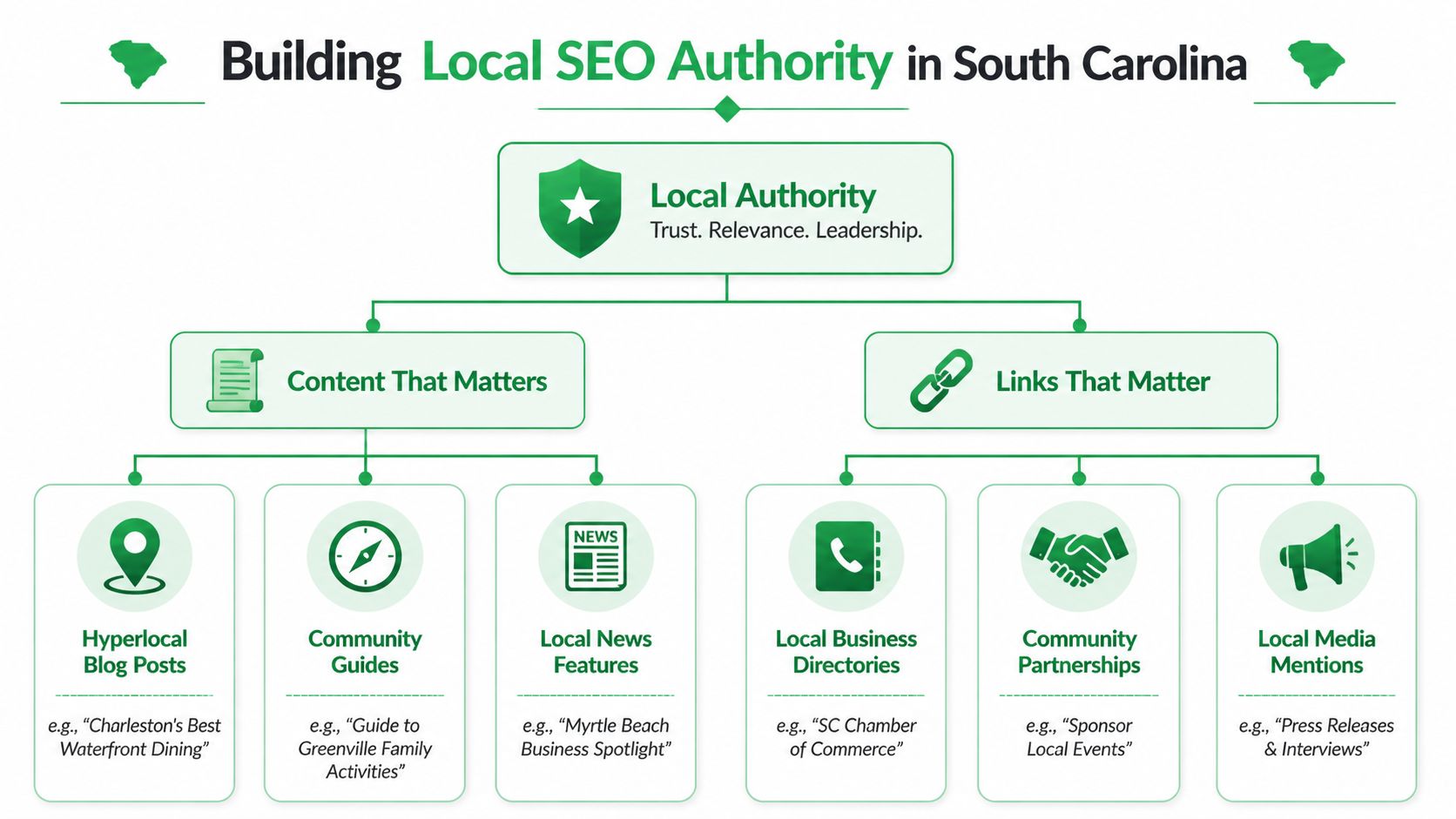
Local authority in South Carolina doesn’t come from publishing generic blogs every Tuesday. It comes from proving that your business belongs in the market you want to rank in.
National brands often have stronger domains. That’s true. But they also tend to publish broad content for broad audiences. Local companies can beat them by being more specific, more useful, and more obviously connected to the places and industries they serve.
Content should sound like it could only come from here
The best local content isn’t just “best tips” content with a city name added at the end. It’s rooted in local problems, local buying patterns, and local context.
A property management company in Charleston can publish content around flood-prone maintenance issues, seasonal leasing concerns, and neighborhood-specific renter expectations. A med clinic in Greenville can create content tied to local demand cycles and treatment questions they hear every week. A restaurant group in Myrtle Beach can publish event-driven pages and highly specific local guides.
That’s the baseline. But the bigger opening in South Carolina sits in sectors most agencies barely touch.
South Carolina has documented critical teacher shortages across 31 subject areas including Computer Science and Special Education, yet there’s minimal SEO content focused on how edtech companies, tutoring services, or related education providers can capture this demand (South Carolina critical need areas).
The overlooked verticals are where smart SEO gets interesting
This is the opportunity most competitors miss.
If you’re an edtech company, tutoring provider, curriculum platform, staffing firm, or training business, you do not need to fight only on crowded generic terms. You can build content around South Carolina’s actual demand gaps. Think practical searches around special education support, computer science tutoring, district-facing solutions, teacher support resources, and workforce development.
The same pattern shows up in B2B technology and innovation-focused businesses. South Carolina has active technology and innovation hubs, but most local SEO content still acts like every business is a dentist, roofer, or restaurant. That leaves room for cleantech firms, advanced energy companies, research-adjacent service providers, and B2B software businesses to own a category before competitors wake up.
A few examples of content angles that tend to work better than generic blog filler:
- Problem-specific local pages: content built around an actual need in Charleston, Columbia, or Greenville
- Industry explainers: pages that translate complex services into buyer language
- Partnership content: co-created pages or features with local organizations
- Community relevance assets: guides, interviews, event tie-ins, or resource hubs tied to local demand
When lead generation is the goal, a stronger local SEO lead generation strategy begins to separate itself from “publish more blogs” advice.
Broad local terms are crowded. Niche local terms with real buyer intent are where smaller brands often gain ground faster.
South Carolina SEO: Links still matter, but the right ones matter more
Most bad link building leaves obvious fingerprints. Mass outreach, irrelevant placements, junk directories, and paid placements on random blogs don’t build local trust.
The links that tend to move the needle in South Carolina are more grounded:
- Chamber and association listings: strong for legitimacy and local relevance
- Community sponsorships: charity runs, school events, business mixers, local nonprofits
- Local media mentions: interviews, features, and quoted commentary
- Partner links: suppliers, vendors, complementary businesses, and referral partners
- High-quality niche directories: only where buyers or industry peers specifically look
A Spartanburg business sponsoring a local event can earn a better signal than a pile of irrelevant national directory links. A Greenville law firm featured in a local publication can gain more trust than a generic guest post on a weak site. Local links work best when there’s a real relationship behind them.
And yes, this takes effort. Good local authority is slower to build than buying fifty junk links. But it’s also far less fragile.
South Carolina SEO: The Technical Edge Audits AI Search and Reporting
A Charleston software firm can publish strong service pages, target the right searches, and still underperform because the site loads poorly on mobile, key pages sit too deep in the architecture, and forms break on iPhones. We see the same pattern with Greenville manufacturers and Columbia law firms. Rankings stall because the site itself keeps getting in the way.
That is why technical SEO sits so close to revenue in our process at Mr. Green Marketing. It affects crawling, indexing, usability, and conversion at the same time. South Carolina businesses in higher-value verticals like EdTech, SaaS, healthcare, and B2B technology feel this faster than average because buyers compare more vendors, visit more pages, and expect a cleaner experience before they contact sales.

What a real audit should look for
A real audit checks whether search engines can reach the right pages, whether users can complete the next step, and whether the site structure supports the way people buy.
For local South Carolina companies, we audit five areas first:
- Performance: large images, script bloat, poor caching, layout shift, and slow mobile rendering
- Indexation and crawl control: pages blocked by robots rules, weak canonicals, orphan pages, redirect chains, and duplicate URLs
- Site structure: shallow paths to money pages, clear relationships between service pages and city pages, and internal links that help priority pages gain authority
- Structured data: valid schema for organization, local business, services, FAQs, and reviews where appropriate
- Conversion paths: click-to-call visibility, short forms, working CTAs, and mobile layouts that do not bury contact actions
We also look at what competitors in places like Myrtle Beach, Rock Hill, and Spartanburg are missing. In South Carolina, that often creates the edge. A B2B tech company may need clean schema and content relationships that help AI systems understand product categories. An EdTech firm based near Charleston may need stronger internal linking between platform pages, use-case pages, and industry pages so search engines can map expertise by audience, not just by feature.
AI search changes presentation, not standards
AI search still depends on pages that are easy to parse, specific in their claims, and supported by clear site structure. If your service page hides the answer, mixes three audiences together, or buries proof under vague copy, AI search engines have less to work with.
We build for both traditional results and AI-driven discovery. That means direct headings, concise answers, well-labeled sections, FAQ blocks where they help, and schema that supports entity clarity. For the full process, read our guide on how to optimize for AI search.
The same principle shows up outside this market. This article on a Nassau County web designer for business growth gets one thing right. Design, site performance, and SEO work best as one system.
A technical audit should explain why a page is underperforming, what to fix first, and how that fix connects to leads or sales.
Report the metrics that touch revenue
A padded SEO report wastes time. Business owners in Lexington, Mount Pleasant, and Greenville need a short read on what changed, why it changed, and whether qualified leads improved.
The metrics we care about depend on the business model, but the reporting should stay tied to outcomes:
| KPI | Why it matters |
|---|---|
| Local map pack visibility | Shows whether the business appears where high-intent local clicks happen |
| Google Business Profile calls | Tracks direct action from local searchers |
| Direction requests and website clicks | Helps measure local intent and in-person demand |
| Leads from service and location pages | Connects landing page visibility to pipeline impact |
| Form completion rate and call tracking | Shows whether traffic quality and page usability are improving |
| Indexed page health | Confirms important pages are eligible to rank |
For South Carolina B2B companies, we usually add another layer. We break reporting out by service line, city, and funnel stage. That matters for a Greenville cybersecurity provider, a Charleston EdTech company, or a Columbia SaaS firm because branded traffic can hide weak non-branded performance. If the report cannot show which pages attract new buyers versus existing brand searches, it is too shallow to guide strategy.
Traffic can go up while leads stay flat. Rankings can improve while the wrong pages get visibility. Good reporting makes those trade-offs obvious fast.
South Carolina SEO: Your Quick-Win Audit and SC SEO Checklist
If your site feels messy and your local visibility is inconsistent, don’t start with a total rebuild. Start with a short audit. You can do this in one sitting and spot the gaps that matter most.
A “no” answer doesn’t mean your business is failing. It means you’ve found the next fix.
15-Minute South Carolina SEO Self-Audit
| Audit Point | Yes/No | Action if ‘No’ |
|---|---|---|
| Is your Google Business Profile fully filled out with accurate services, hours, categories, and photos? | Complete every relevant field and align it with your website | |
| Do your primary service pages target one clear service and one clear local audience? | Split broad pages into focused service or location pages | |
| Does each key page have a unique title tag and H1? | Rewrite duplicates so each page has a distinct search target | |
| Are your city or location pages actually different from one another? | Add local specifics, proof, FAQs, and service detail | |
| Can a customer reach your contact form or phone number quickly on mobile? | Simplify layout and make calls to action obvious | |
| Are you earning reviews consistently instead of occasionally? | Create a repeatable review request workflow | |
| Do you publish content tied to local demand, not just generic topics? | Build a short calendar around actual customer questions in SC markets | |
| Do local organizations, directories, or partners link back to your site? | Start with chambers, associations, and real business relationships | |
| Is your site fast and easy to use on a phone? | Run a technical review and fix the biggest friction points first | |
| Do you track calls, form submissions, and local landing page performance? | Set up reporting around lead actions, not just rankings |
The fastest way to use this list
Don’t try to repair everything at once. Pick the three weakest points and handle them in this order:
- Visibility asset first: GBP and review flow
- Conversion path second: mobile contact experience and key service pages
- Authority third: local content and links
That order prevents a common mistake. Businesses often spend time publishing new content before their profile, service pages, and conversion paths are ready to turn visibility into leads.
For a broader worksheet, this local SEO audit checklist is a useful companion if you want to go line by line.
Small fixes compound. A corrected category, a stronger location page, and a faster mobile experience can change lead flow more than another month of guessing.
South Carolina SEO Frequently Asked Questions
How much should a business budget for south carolina seo?
Budget follows scope, competition, and how many markets you need to cover.
A home services company focused on one metro, like Lexington or Mount Pleasant, usually needs a different plan than a firm trying to rank across Charleston, Columbia, Greenville, and Spartanburg at the same time. The same goes for South Carolina companies in overlooked verticals. An EdTech provider in Charleston or a B2B software company selling from Greenville often needs stronger service pages, industry content, and sales-focused reporting than a local plumber or med spa.
The better question is this. What work has to get done each month to produce leads, and who is responsible for it? If the answer includes technical fixes, location pages, content production, link outreach, review generation, and conversion tracking, the budget needs to match that workload.
How long does it take to see results?
It depends on the starting point.
If a business has weak location pages, inconsistent local signals, and thin content, we usually look for early traction from foundational fixes first. If the site already has strong pages and a clean profile, results often come from better keyword targeting and authority building. In South Carolina, that timeline also shifts by city and category. Ranking a pressure washing company in Columbia is a different fight than building search visibility for a manufacturing software firm in Greenville.
SEO works best for companies that can stay consistent long enough to let improvements stack. Paid search can turn leads on faster. SEO usually lowers acquisition costs over time and builds a stronger long-term channel.
Can I do this myself?
Yes, up to a point.
A business owner can improve titles, publish better FAQs, request reviews, and tighten up core service pages without hiring an agency. That work matters. I recommend it for smaller teams in places like Rock Hill or Summerville that need momentum before they need a full program.
The ceiling shows up fast for multi-location brands, technical sites, and companies selling complex services. That is especially true for South Carolina B2B and niche verticals. If you need schema, reporting tied to pipeline, content mapped to buyer stages, and pages built for multiple cities without creating duplicate content, the work gets more specialized.
What matters more, website SEO or Google Business Profile?
For local lead generation, Google Business Profile often drives the first wave of visibility. The website closes the gap between a search impression and a real lead.
A strong profile can get calls from branded and map-based searches. Your site still has to rank for service intent, answer objections, and convert visitors who want more detail before they contact you. For firms in higher-consideration categories, especially legal, healthcare, B2B technology, and education, the website usually carries more of the sales burden because the buyer needs proof, clarity, and trust signals before taking action.
What’s the biggest mistake South Carolina businesses make?
They build for broad visibility instead of local demand and buyer intent.
I see this all the time. A company in Greenville writes generic blog posts that could belong to any business in any state, while a competitor publishes pages tied to actual searches in Greenville, Anderson, and Spartanburg. Or a Charleston software company targets national vanity terms and ignores the easier wins around industry-specific use cases, regional partnerships, and South Carolina business clusters.
That miss is even bigger in sectors many agencies overlook. South Carolina has real opportunity in EdTech, advanced manufacturing, logistics, healthcare, and B2B technology. Companies in those spaces can win by creating content around local hiring trends, compliance questions, regional events, procurement cycles, and use cases tied to employers and institutions across the state.
If your visibility in Charleston, Greenville, Columbia, Spartanburg, or anywhere else in the state feels stuck, Mr. Green Marketing, LLC can help you figure out why. Request a free audit and performance report to see where your local SEO is leaking leads, which quick wins matter first, and how to build a strategy that fits your market.
Leave a Comment
sing in to post your comment or sign-up if you dont have any account.