
Lead Generation Marketing Services: Some months your sales team can’t keep up. Forms come in, phones ring, demos pile up, and everyone feels busy in the good way. Then the next month hits and it’s quiet enough to hear the panic.
That feast or famine cycle wrecks planning. You hesitate on hiring, second-guess ad budgets, and start treating every lead like an emergency. I’ve seen this pattern in local service businesses, B2B firms, e-commerce brands, and franchises. Different industries, same pain. Revenue gets stuck because marketing is operating like a series of disconnected campaigns instead of a system.
Lead generation marketing services are supposed to fix that. Sometimes they do. Sometimes they just add more dashboards, more jargon, and more low-intent names in your CRM.
The difference comes down to whether the service is built around business outcomes or around channel activity. SEO by itself isn’t the answer. Paid ads by themselves aren’t the answer. Posting on social media because “you need to stay active” definitely isn’t the answer. What works is a coordinated engine that attracts the right people, moves them toward action, and hands sales something usable.
Lead Generation Marketing Services: Introduction The Feast or Famine Sales Cycle
A business owner calls after a strong quarter and says leads have dried up. Not disappeared completely. Just slowed enough that every missed call suddenly feels expensive. They already tried boosting posts, running a few Google Ads, and asking for more referrals. Some of it worked for a minute. None of it was stable.
That’s the trap. Most companies don’t actually have a lead generation system. They have a collection of tactics, a few landing pages, maybe a CRM nobody fully trusts, and a sales team filling the gaps with hustle.
That setup creates volatility because each part is working on its own timeline. Ads can turn on quickly, but stop the spend and the flow drops. SEO compounds, but it needs structure and patience. Email can revive dormant opportunities, but only if somebody built the nurture path in the first place. And if your intake process is weak, even good leads leak out.
You don’t solve inconsistent revenue by chasing one more tactic. You solve it by tightening the entire path from first click to sales conversation.
A real lead generation program brings discipline to that path. It defines who you’re trying to reach, where to find them, what message earns attention, how to capture intent, how to qualify it, and how quickly the lead moves to the right person. That sounds less glamorous than “growth hack.” It works better.
What Are Lead Generation Marketing Services Really
The term “lead generation marketing services” often brings to mind appointment setting, form fills, or running ads. That’s too narrow.
The better way to think about it is an assembly line. Anonymous visitors, searchers, scrollers, and marketplace shoppers enter at one end. A sales-ready opportunity comes out the other side. Between those points, a lot has to happen correctly.
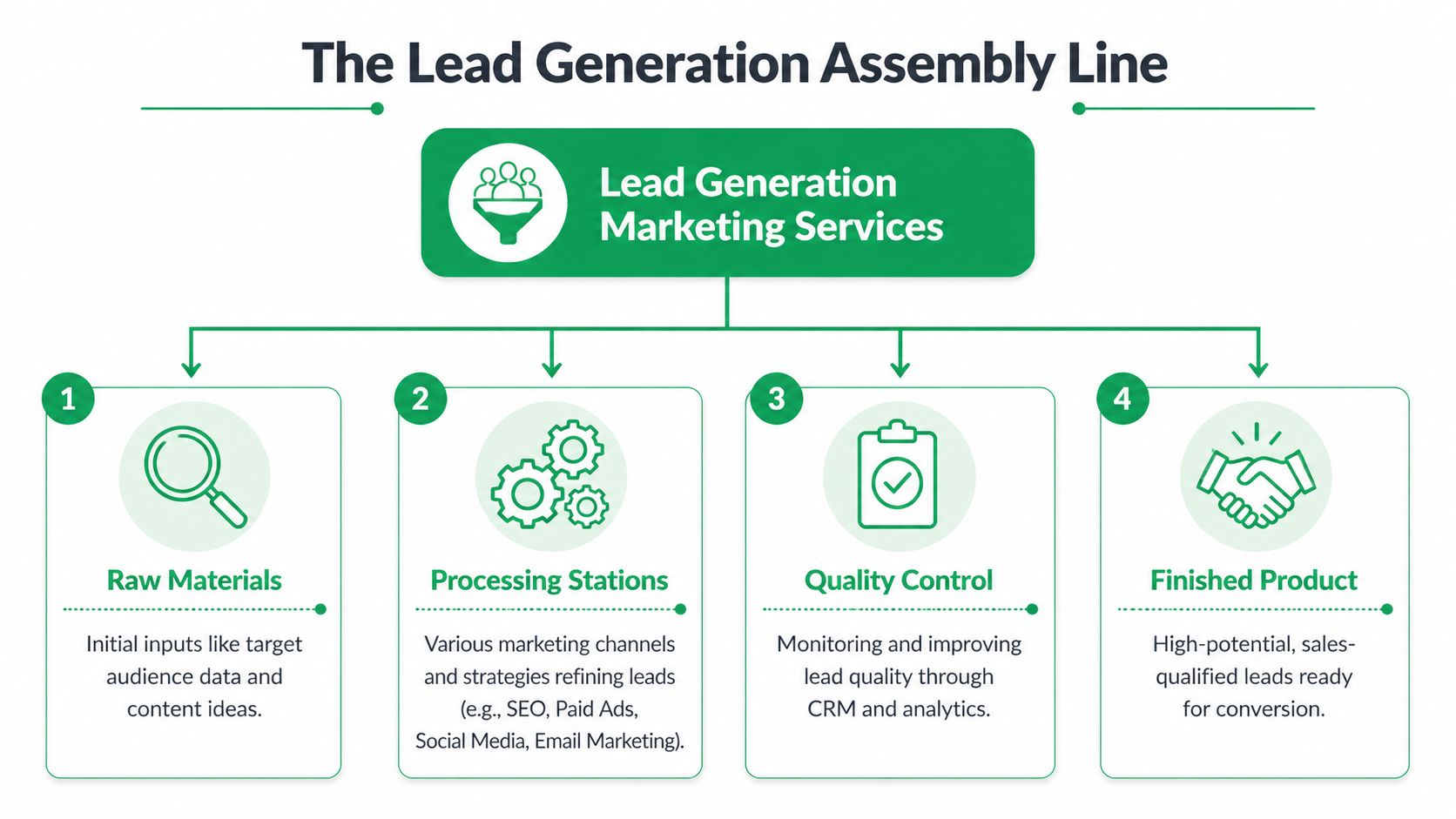
The raw materials are attention and intent
Every lead gen system starts with inputs. Audience research. Offer positioning. Search demand. Content topics. Creative angles. First-party data from your CRM. If those inputs are weak, the rest of the system doesn’t get better downstream.
Marketers aren’t short on lead volume. Lead generation is a top priority for marketers, with 50% identifying it as an essential part of their strategy. Businesses generate an average of 1,877 leads per month, yet 80% of new leads never convert into sales, which is why lead quality and nurturing matter so much according to Exploding Topics lead generation statistics.
Plenty of companies can buy traffic. Fewer can turn that traffic into qualified demand.
Lead Generation Marketing Services: The processing stations do the heavy lifting
The initial focus for agencies and in-house teams often includes these areas. SEO, PPC, landing pages, email, retargeting, social campaigns, lead magnets, CRM workflows. Useful tools, all of them. But tools are not strategy.
A lead generation service worth paying for connects these moving parts so they support each other:
- SEO captures existing demand. Someone is already looking for the solution.
- Paid media creates controlled reach. You can test offers, audiences, and messaging faster.
- Content educates and filters. It attracts interest while discouraging poor-fit prospects.
- Email nurtures lagging intent. Initial engagement often does not result in immediate conversion.
- CRM automation keeps handoffs clean. No spreadsheet gymnastics. No orphaned leads.
And yes, fragments matter. A thank-you page matters. Form length matters. Call routing matters. The confirmation email matters. If any of those break, the line slows down.
Quality control is where mediocre agencies get exposed
Lots of providers can generate names. Fewer can show whether those names belong to buyers.
Here’s the blunt version. A lead is not valuable because it exists in HubSpot, Salesforce, Zoho, or Pipedrive. It’s valuable if sales accepts it, works it, and has a fair chance of closing it.
That means quality control has to be built into the service:
| Stage | What to check | What goes wrong when ignored |
|---|---|---|
| Capture | Form quality, phone tracking, source tagging | You don’t know where leads came from |
| Qualification | Fit, urgency, service need, budget cues | Sales chases bad leads |
| Routing | Speed, ownership, notification rules | Good leads sit untouched |
| Feedback loop | Sales disposition, close reasons, lost reasons | Marketing keeps optimizing for the wrong thing |
Practical rule: If an agency reports lead totals every month but can’t explain lead acceptance, handoff quality, or sales feedback, they’re measuring activity, not outcomes.
Lead Generation Marketing Services: The finished product is not traffic
The finished product is a prospect who matches your target profile, understands your offer, and is ready for the next conversation.
That distinction sounds obvious, but it’s where a lot of engagements go sideways. A freelancer can run ads. A content writer can publish blogs. A designer can make a nice landing page. A true lead generation service designs and operates the full system so growth becomes more predictable.
And that’s what businesses are buying. Not tasks. Not random deliverables. A working pipeline.
Lead Generation Marketing Services: The Engine Room Channels That Drive Leads
Every lead gen channel has a job. Problems start when a business expects one channel to do all the jobs at once.
SEO isn’t built for instant demand capture at launch speed. Paid search isn’t usually the cheapest way to educate a cold market. Social media can build trust, but trust without a conversion path becomes background noise. Good lead generation marketing services assign each channel a role and then force them to work together.

SEO brings in high-intent demand
SEO does its best work when buyers already know the problem and start searching for solutions. Service pages, location pages, comparison content, FAQ content, and case-study style pages all help turn search demand into inquiries.
And the lead quality can be strong. Content marketing accounts for over 51.5% of all lead acquisition methods, and SEO stands out as the top source of high-quality leads with a 14.6% close rate, according to Databox lead generation statistics.
That doesn’t mean every SEO program works. Some fail because they chase broad vanity keywords. Others publish generic blog posts with no conversion path. The right SEO setup is tighter than that:
- Commercial pages first. Service, solution, and location intent pages usually carry more revenue value than random top-funnel traffic.
- Internal linking with purpose. Blog content should push users toward service pages, forms, calls, and demos.
- Local proof. Reviews, certifications, service areas, and trust elements matter, especially for local providers.
- Conversion tracking. Calls, forms, chats, and booked appointments need attribution.
If you want a deeper breakdown of how search turns into pipeline, this guide on SEO lead generation is useful because it frames SEO around inquiry quality instead of rankings alone.
Lead Generation Marketing Services: PPC is the express lane
Paid search and paid social can create demand quickly. That’s the upside. You can launch a campaign, test messaging, validate offers, and get traffic fast.
The downside is just as real. PPC magnifies weak positioning. If your landing page is vague, your form asks for too much, or your offer isn’t differentiated, you pay to learn that lesson in public.
A few common trade-offs:
| Channel | Best use | Watch out for |
|---|---|---|
| Google Ads | High-intent search capture | Expensive clicks on broad terms |
| Meta Ads | Offer-led campaigns and retargeting | Low intent if creative is too general |
| LinkedIn Ads | B2B targeting by role or company profile | Higher costs and slower conversion |
| Retargeting | Bringing back interested visitors | Weak if traffic quality is poor upfront |
PPC works best when it sits on top of a clean offer. Free estimate, audit, consultation, sample, buying guide, category page, marketplace promo. Something concrete.
Content marketing holds the system together
Many businesses frequently underinvest, then wonder why paid performance feels brittle.
Content does more than attract traffic. It pre-qualifies. It answers objections. It gives sales something useful to send after the first conversation. It supports search visibility, email nurturing, and remarketing audiences all at once.
For B2B, service businesses, and franchise brands, that often means a mix of practical formats:
- Problem-solution articles that answer what buyers ask before they talk to sales
- Comparison pages for branded and non-branded alternatives
- Location or vertical pages designed for specific audiences
- Lead magnets like checklists, calculators, assessments, or buying guides
- Email follow-up assets that keep the conversation moving
Franchise operators, in particular, need content that works at both the brand and local market level. If that’s your world, these strategies to grow your franchise network are worth reading because franchise lead flow breaks when national messaging and local execution drift apart.
Good content doesn’t just “build awareness.” It shortens the explanation sales has to give later.
Lead Generation Marketing Services: Social media builds familiarity, not magic
Organic social rarely saves a broken pipeline on its own. That’s not a knock on social. It’s just a role question.
Social can reinforce credibility, distribute content, show proof, keep your brand visible, and give prospects another place to evaluate you. It can also support retargeting and audience building. But if the website is weak or the offer is unclear, social will mostly create polite engagement and not much pipeline.
For local businesses and service brands, social tends to work better when tied to visible proof:
- project photos
- before-and-after examples
- short educational videos
- team introductions
- customer questions answered plainly
- community involvement
This is especially true when trust is local and buyers want to verify you before they call.
Email is where patience pays off
A lot of leads aren’t ready now. That doesn’t make them bad. It means timing and education still matter.
Email keeps warm leads from going cold. Simple nurture sequences, estimate follow-up, abandoned inquiry reminders, reactivation campaigns, and segmented newsletters can move stalled prospects back into conversation. This channel gets undervalued because it doesn’t always look flashy in reporting. Still, it often does the hard middle-funnel work others can’t.
And if your team responds with one generic autoresponder and then silence, you’re leaving money on the table.
Lead Generation Marketing Services: CRO fixes the hidden leaks
Conversion rate optimization is the least glamorous part of lead generation and one of the most profitable. If traffic is already arriving, CRO improves what happens next.
Sometimes the fix is small. A shorter form. Better trust signals. A clearer CTA. Better page speed. Click-to-call buttons on mobile. A page headline that matches the ad or keyword. Not exciting. Very effective.
For e-commerce and Amazon sellers, the same logic applies on category pages, product detail pages, storefront content, and post-click flows. You’re not just trying to “get traffic.” You’re trying to reduce friction where buying intent shows up.
Lead Generation Marketing Services: Beyond Channels The Anatomy of a Great Partnership
You can usually tell within the first month whether a lead gen relationship is built to last. Not from the first report. From the questions asked during onboarding.
Weak partners ask what budget you want to spend. Strong partners ask how revenue is made, what a qualified lead looks like, how quickly sales follows up, what happens after form submission, and where deals stall.
KPI alignment starts with sales reality
Most bad reporting begins with a bad definition of success. If the only KPI is lead volume, the agency has every incentive to maximize cheap conversions, even when sales hates them.
The better model ties marketing performance to sales usefulness. The most important checkpoint in many organizations is the handoff between MQLs and SQLs. When that handoff breaks, the issue is usually qualification criteria, routing, or speed to follow-up.
A critical bottleneck in lead generation is the MQL-to-SQL conversion rate. When this conversion is low, it usually signals misalignment between marketing and sales. Agencies improve this with unified lead scoring and immediate follow-up, which can reduce false positives by 30-40%, based on Lead Forensics research on lead generation metrics.
That has practical implications fast.
- Marketing needs clear qualification logic. Job role, company type, service area, urgency, product fit, behavior signals.
- Sales needs a response standard. If high-intent leads wait too long, quality degrades before anyone speaks with them.
- Both teams need shared definitions. Otherwise one side says “great lead” and the other says “junk.”
If sales keeps rejecting leads, don’t ask for more top-of-funnel spend first. Fix the definition of a good lead.
Lead Generation Marketing Services: Pricing models reveal how the agency thinks
Pricing doesn’t just affect your budget. It shapes behavior.
A flat retainer usually works when the scope includes strategy, content, technical work, reporting, and cross-channel execution. A percentage-of-ad-spend model can make sense in media-heavy engagements, but it can also encourage budget expansion before the fundamentals are fixed. Performance-based deals sound attractive, yet they often hide fights over lead definitions, attribution, and quality standards.
Here’s the practical lens:
| Pricing model | Works well when | Risk to watch |
|---|---|---|
| Flat retainer | You need strategy plus execution across several areas | Scope gets fuzzy if deliverables aren’t defined |
| Percent of ad spend | Paid media is the main engine | Incentive may lean toward spend, not efficiency |
| Performance-based | Lead definitions are crystal clear | Disputes over quality and attribution |
| Hybrid | You need baseline service plus campaign flexibility | Can become complicated without clean reporting |
No model is automatically wrong. The wrong one is the one that rewards the wrong behavior.
Good onboarding is operational, not ceremonial
A lot of agencies treat onboarding like paperwork. Logo files, access requests, kickoff call, done. That isn’t onboarding. That’s admin.
Real onboarding builds the operating system. In the first stretch of an engagement, a strong partner should work through things like:
- Offer and audience fit
What exactly are you selling, to whom, in which geography or market segment, and why would they choose you? - Tracking and attribution
Are forms, calls, chats, booked meetings, and CRM stages tracked cleanly enough to make decisions? - Lead routing and response process
Who gets notified, how fast do they respond, and what happens after a missed call or incomplete form? - Sales feedback loop
How will rejected leads be labeled? What reasons are captured? Who reviews them? - Content and creative inventory
What assets already exist that can support landing pages, ads, nurture emails, and sales conversations?
And one provider can differ meaningfully from another. For example, Mr. Green Marketing, LLC offers strategy-led execution across SEO, PPC, web design, Amazon marketing, and related digital channels, which is useful when a business needs lead generation tied to both visibility and conversion operations rather than a single isolated service.
That kind of integration matters because lead generation rarely fails in only one place. It usually fails in the handoff between places.
Lead Generation Marketing Services: How to Choose the Right Lead Generation Agency
Most agency pitches sound the same after a while. More leads. Better leads. Proven process. Transparent reporting. Dedicated support. Fine. None of that tells you how they think.
The right choice usually isn’t the cheapest proposal or the flashiest deck. It’s the partner that can explain, in plain language, how they’ll turn your market, your offer, and your sales process into a working acquisition system.

Start with the hard questions
A good agency won’t dodge specifics. Ask questions that force them out of pitch mode.
- Channel strategy
How will you decide which channels fit our business, and which channels would you avoid at the start? - Lead qualification
How do you define a qualified lead for a company like ours, and how will that definition be validated with sales? - Reporting
What do your monthly reports include beyond traffic and form fills? - Ownership
Who handles strategy, who handles execution, and who will be in the weekly conversations? - Testing process
What do you change first if lead volume is fine but close rates are weak?
Those questions reveal whether they understand systems or just deliverables.
Lead Generation Marketing Services: Watch for the quantity trap
Many buyers encounter significant issues. Agencies promise volume because volume is easy to sell. But bad leads cost money twice. First in acquisition spend, then again in sales time.
That problem is bigger than most proposals admit. A major gap in lead generation is the focus on quantity over quality. Low-quality leads waste sales time and damage ROI, while outsourced experts often produce 43% better outcomes because they bring stronger qualification expertise, according to NobelBiz on the hidden cost of low-quality leads.
That means you should press for specifics:
- Ask how they score leads. If they don’t have a real answer, that’s a warning sign.
- Ask how sales feedback gets used. A monthly report without closed-loop feedback is incomplete.
- Ask what happens to weak-fit inquiries. Nurture path? Disqualification? Referral? Nothing?
- Ask which metric they use when CPL looks good but revenue doesn’t. This separates operators from presenters.
Buyer check: If an agency celebrates cheap leads before it understands your close process, slow the conversation down.
A broader market scan can help with shortlisting too. If you’re comparing firms across regions, lists of top UK marketing agencies can be useful for initial research, but the shortlist still needs deeper vetting around lead quality, process, and fit.
Industry context matters more than generic talent
A skilled team can learn a market. That’s true. But some lead gen environments have quirks that punish generic playbooks.
A local roofer doesn’t need the same funnel as a B2B software company. A multi-location franchise has brand consistency issues a single-location business doesn’t. A regulated service category has messaging constraints that a DTC product brand doesn’t.
So ask this directly: what has the agency learned from businesses with similar buying cycles, similar lead handling realities, and similar trust requirements?
If you want another framework for evaluating fit, this guide on how to choose a digital marketing agency is a practical companion because it pushes past surface-level portfolio review.
A quick reality check helps here too.
What a useful case study actually looks like
Most case studies are dressed-up before-and-after snapshots. They show impressions, clicks, traffic, maybe cost per lead. Helpful, but incomplete.
A meaningful case study explains:
| What to look for | Why it matters |
|---|---|
| Initial problem | Shows whether the agency can diagnose, not just execute |
| Channel mix used | Reveals strategic choices instead of generic service bundling |
| Lead qualification method | Shows they care about sales value |
| Operational fixes | Proves they worked on routing, pages, tracking, or nurture |
| Business outcome | Ties marketing work to actual revenue motion |
And yes, some fragments count more than glossy slides. The best agencies can tell you what didn’t work, what they changed, and why.
Lead Generation Marketing Services: Your Quick Win Audit Find Low Hanging Fruit Today
If your pipeline feels shaky, don’t wait for a full rebrand, a giant media budget, or some massive martech overhaul. Start with the pieces already sitting in front of you.
This audit is meant to find obvious friction. Not every issue will be glamorous. Some will be almost boring. That’s fine. Boring fixes often create the fastest lift in lead quality and conversion flow.

Check your service pages like a buyer would
Open your core service pages on desktop and mobile. Don’t review them like the owner or the marketer. Review them like someone who found you five minutes ago.
Ask:
- Is the headline specific? It should say what you do and who it’s for.
- Is there a visible CTA without scrolling? Call, book, quote request, consultation, audit, something clear.
- Does the page build trust fast? Reviews, credentials, locations, process, proof.
- Is the phone number tappable on mobile? This gets missed constantly.
- Does each page match a real search intent? Generic “solutions” copy usually underperforms.
If the page feels vague, visitors feel it too.
Run a simple technical and local visibility pass
This part matters even more for service-area businesses, healthcare-adjacent categories, local franchises, and trust-heavy verticals. Generic advice often breaks here. Lead generation tactics that work for SaaS don’t automatically work for local categories like home services or senior care, because those sectors have different customer behavior, budgets, and messaging needs, as discussed in Targetron’s analysis of overlooked B2B sectors.
That means your audit should include local and vertical basics:
- Title tags and metadata
Make sure key pages reflect the service and geography you want to rank for. - Google Business Profile
Fill it out completely, update photos, review categories, and make sure the contact details match your site. - Location signals
Service areas, city pages, maps, team references, and customer proof help buyers confirm relevance. - Review presence
Don’t obsess over perfection. Focus on recency, authenticity, and whether reviews mention the service you want more of.
The local lead gen game is often won by the business that is easiest to verify, not the one with the cleverest slogan.
Lead Generation Marketing Services: Fix one conversion path this month
Don’t try to optimize the entire site in a weekend. Pick one path and clean it up thoroughly.
A good candidate is your highest-intent page. Maybe it’s a primary service page, a franchise inquiry page, or a product category page that gets steady traffic. Review the complete path from click to contact:
| Audit point | What to look for |
|---|---|
| CTA clarity | One primary action, not five competing ones |
| Form friction | Remove fields you don’t need at first contact |
| Response expectation | Tell people what happens next and how soon |
| Thank-you flow | Add next steps instead of a dead-end confirmation |
| Follow-up | Make sure submissions trigger a real response process |
And if you publish content already, look at the article that attracts the most relevant traffic. Add a practical next step to it. A downloadable checklist. A short assessment. A request form. A contextual call booking prompt. Something tied to the topic.
Give yourself a 30-day scorecard
Keep this simple. You are not building an enterprise measurement model in one afternoon.
Track whether these questions move from “no” to “yes”:
- Can we identify our highest-intent pages?
- Does every core page have a clear CTA?
- Do mobile visitors have an easy call path?
- Are local trust signals visible?
- Do leads get a timely, consistent response?
- Can sales tell us which inquiries are poor fit and why?
If you want a more structured version of that process, a focused review using digital marketing audit services can help organize what to fix first across SEO, paid campaigns, pages, and tracking.
The point isn’t to make everything perfect. It’s to remove the obvious drag that’s already suppressing results.
If your business is stuck in the feast or famine cycle, Mr. Green Marketing, LLC can help you turn scattered tactics into a lead generation system with clearer tracking, stronger conversion paths, and channel execution tied to measurable business goals.
Leave a Comment
sing in to post your comment or sign-up if you dont have any account.