
Alright, let’s get into the nitty-gritty of how local customers actually find businesses like yours. And it’s no longer about just having a website or being online, it is Lead generation for local businesses. It’s about showing up at the exact moment a pipe bursts, someone gets a flat tire, or a craving for the best local pizza hits.
These are the high-intent moments where local lead generation really happens.
Lead generation for local businesses: Understanding How Local Customers Find You Today
The game has completely changed. Forget the Yellow Pages. Today, the customer journey almost always starts on a smartphone.
Think about it from their perspective. A clogged drain isn’t a “let’s browse for a week” kind of problem. It’s an “I need a plumber near me right now” emergency. That sense of urgency is what makes local search so incredibly powerful. Your job is to be the solution they find in seconds.
This is what that modern journey looks like—from a problem cropping up to a customer walking through your door (or you walking through theirs).
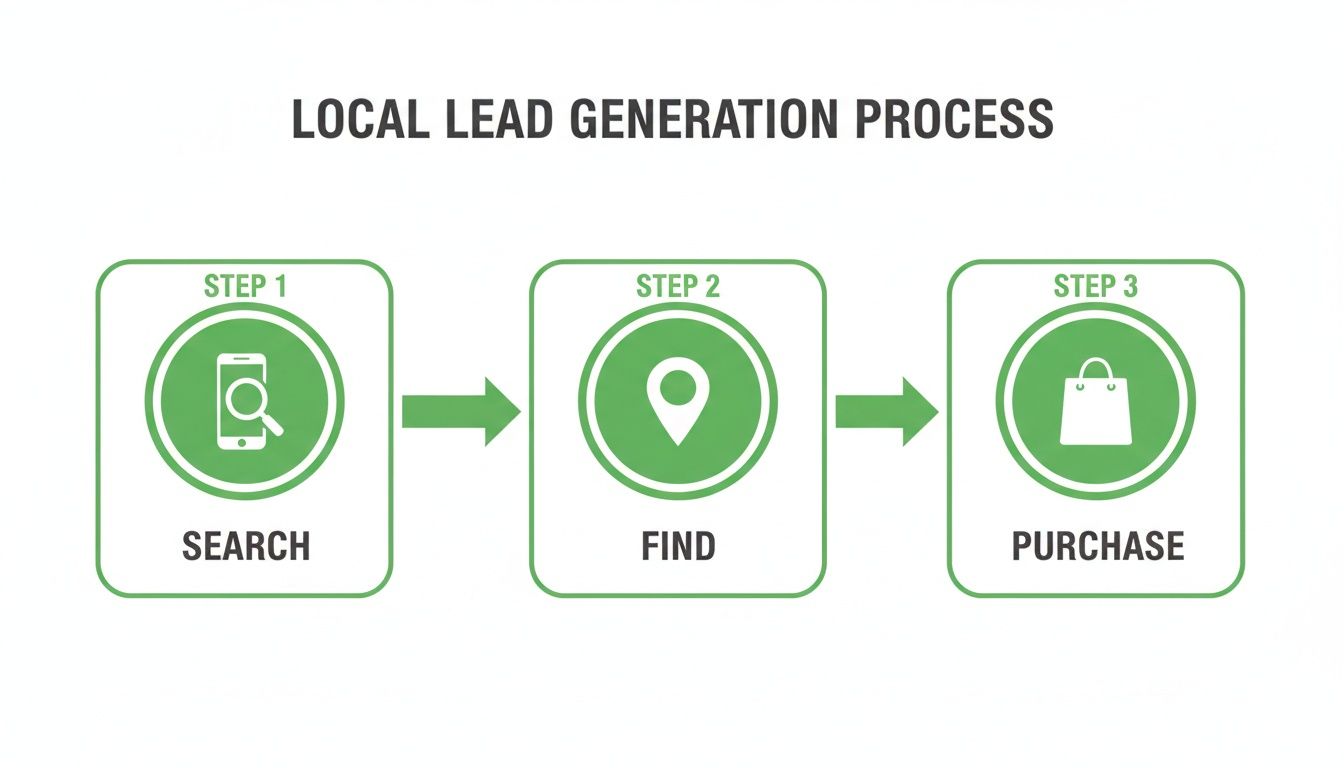
The takeaway here? It’s all about speed and convenience. Customers go from searching for a fix to finding a local pro and making a decision in minutes, not days.
The Power of “Near Me” Searches
The phrase “near me” has absolutely exploded in search engines. A direct signal of immediate intent.
When a potential customer types “best coffee near me” or “emergency roof repair in [Your Town],” they aren’t just window shopping. They have a problem. And they’re ready to pay someone to solve it.
This isn’t just theory; it’s the entire playbook for how modern local businesses win. An eye-popping 78% of local mobile searches result in an offline purchase. If you’re not visible when they’re searching, you’re missing out on real, paying customers. It’s that simple.
Lead generation for local businesses: Building a System That Works for You
Look, you’re busy running your business. You don’t have time to become a full-time digital marketing guru. The goal here is to build a simple, effective lead generation system that works for you—one that brings in a steady stream of qualified local leads while you focus on what you do best.
This means zeroing in on a handful of high-impact channels where your customers are already looking for you. You don’t need to be everywhere. You just need to be in the right places. For some ideas on where that might be, check out these 7 powerful lead generation sites for Kiwi businesses.
So, what does this system actually look like? It’s built on a few core fundamentals:
- A perfectly optimized Google Business Profile that acts as your digital storefront.
- A simple, mobile-friendly website that makes it dead easy for customers to contact you.
- A solid strategy for collecting positive reviews that builds trust before they even call.
Getting these basics right is the foundation for everything else. It ensures that the next time a pipe bursts or someone needs a haircut, your business is the first and best option they find.
Local Lead Generation Prioritization Checklist
Feeling overwhelmed? Don’t be. Not all marketing activities are created equal. Use this checklist to focus on the quick wins that will deliver the biggest bang for your buck right away. These are the foundational steps that get the lead generation engine started.
| Priority Level | Activity | Why It Matters | Quick Win Action |
|---|---|---|---|
| High | Optimize Google Business Profile | This is your digital front door. It’s often the first interaction a local customer has with your business. | Fill out every single section. Add 10+ photos of your work, team, and location this week. |
| High | Get More Online Reviews | Social proof is everything. 88% of consumers trust online reviews as much as personal recommendations. | Set up a simple system to text or email every happy customer a link to leave a review. |
| Medium | Create Local Landing Pages | If you serve multiple towns, dedicated pages show up better in search for “service in [Town Name]”. | Build one new landing page for your highest-value service in your most important neighboring town. |
| Medium | Run a Hyper-Targeted “Near Me” Ad | Paid ads on Google or Facebook can put you at the top instantly for high-intent searches. | Launch a Google Ad targeting just one service within a 5-mile radius of your business. |
| Low | Post on Local Facebook Groups | It’s a free way to get in front of your community, build brand recognition, and share special offers. | Find 3 active local community groups. Post a helpful tip (not a sales pitch) related to your industry. |
Once you’ve nailed these priorities, you’ll have a solid foundation to build on. The key is to start with what moves the needle most, then expand from there.
Mastering Your Digital Storefront with Google Business Profile using Lead generation for local businesses
Your Google Business Profile isn’t just another online listing. Let’s be clear: it’s not a set-it-and-forget-it task, either. Think of it as your digital storefront, your billboard, and your welcome mat all rolled into one. And it’s completely free.
For any local business, this is hands-down the most powerful tool you have for generating leads. When someone in your town searches for “plumber near me,” what do they see first? Not a website. They see the Google Map Pack, which is powered entirely by these profiles.
This is where the battle for local customers is won or lost. A half-empty profile just isn’t going to cut it. To dominate your local market, you need to treat your GBP with the same care and attention you give your physical shop.
Fully Optimize Every Single Section with Lead generation for local businesses
Google rewards completeness. An abandoned profile is a red flag, but a rich, detailed one tells Google you’re an active, legitimate business worth showing to its users.
So, let’s get tactical. Here’s a quick-hit list of what you should fill out right now:
- Services & Products: Don’t just put “Landscaping.” Get specific. Add “Lawn Mowing,” “Tree Trimming,” “Garden Bed Installation,” and “Spring Cleanup.” If you can, add prices—transparency builds trust instantly.
- Business Description: Tell your story. Why did you start this business? What makes you different from the other guys down the street? Weave in keywords naturally, like “family-owned bakery in [Your Town].”
- Photos & Videos: This is huge. Aim for at least 10-15 high-quality photos. Show your team, your work van, before-and-after shots of your projects, and your physical location. A 30-second video tour is even better.
- NAP Consistency: This is non-negotiable. Your Name, Address, and Phone number must be exactly the same here as it is on your website and every other directory. No “St.” in one place and “Street” in another.
The Power of Social Proof: Reviews
Reviews are the lifeblood of your GBP. In fact, they’re one of the most important ranking factors after your profile is fully optimized. A study from BrightLocal found that 88% of consumers trust online reviews as much as a personal recommendation.
But asking for them can feel awkward. Here’s how to do it without being pushy:
- Time it Right: Ask for a review right after you’ve finished a great job, when the customer is happiest with your work.
- Make it Easy: Don’t just say, “Leave us a review.” Send them a direct link to your GBP review page via text or email. Remove every bit of friction you can.
- Respond to Every Review: Thank customers for positive reviews. For negative ones, respond professionally and offer to take the conversation offline to fix the problem. This shows potential customers that you actually care.
A simple “Thank you for your business!” or “We appreciate you taking the time to share your experience” goes a long way. Responding to reviews signals to both the customer and Google’s algorithm that you’re an engaged, customer-focused business.
Connecting GBP to Your Broader Local SEO
Your Google Business Profile doesn’t exist in a vacuum—it’s the star player on your local SEO team. The information on your profile needs to be backed up by what’s on your website.
This is where location-specific landing pages come into play. If you’re a roofer based in one town but serve three surrounding towns, you need a dedicated page on your website for each of those service areas.
Each page should talk specifically about your work in that town, maybe mention local landmarks, and use keywords like “roof repair in [Town Name].” This tells Google you’re a true local expert. If you’re looking for a deeper dive, our guide on creating high-converting local SEO landing pages is a great place to start.
By making sure your GBP and website are perfectly aligned, you send powerful signals to Google that you are the most relevant choice for local customers. This coordination is what transforms a simple listing into a consistent lead generation machine.
Lead generation for local businesses: Building Authority with Hyper-Local Content
Let’s be honest: content marketing can feel like a game for huge, faceless national brands. But for local businesses? A secret weapon. Most of your competitors are completely ignoring it.
I’m not talking about generic blog posts about your industry. We’re going to create simple, effective content that speaks directly to your community and answers the specific, hyper-local questions your customers are asking Google every single day.
The goal here isn’t just to be another option on a list. It’s to become the go-to authority in your town.
Go Beyond Generic Blog Posts
The real key to making local content work is relevance. If you’re a plumber in Phoenix, a blog post about “preventing frozen pipes” is a total waste of time. But an article on “common plumbing issues caused by Phoenix’s hard water”? Pure gold.
This is exactly how you stop competing on price and start winning on expertise. You need to create content that answers the questions your customers have, sometimes before they even know to ask them.
Here are a few hyper-local content ideas that kill it for almost any service business:
- Neighborhood-Specific Case Studies: Don’t just write a generic “Kitchen Remodel” post. Instead, title it “A Modern Kitchen Remodel in the North Hill Neighborhood.” Pack it with pictures, talk about the specific challenges of homes in that area, and let your local knowledge shine.
- Guides to Local Regulations: Are there quirky permits or zoning laws that affect your work in your specific city? Write a simple guide explaining them. You’ll become an invaluable resource for both homeowners and even other contractors.
- “Best Of” Lists (with a twist): A landscaper could skip the generic “Best Patios” list and instead write, “5 Low-Maintenance Plants That Thrive in [Your Town]’s Climate.” It’s genuinely helpful, hyper-relevant, and positions you as the expert.
Answering Questions Your Customers Are Actually Asking about Lead generation for local businesses
Think about the phone calls you get every single day. What are the top 3-5 questions every new customer asks? Boom. Each one of those is a perfect topic for a short, helpful article.
This isn’t just a hunch; the data backs it up completely. Content marketing is the single most dominant channel for lead generation, responsible for over 51.5% of all lead acquisition. In fact, businesses that consistently publish content generate 67% more leads than those that don’t.
And here’s the kicker: long-tail keywords—those super-specific, local search queries—convert a staggering 2.5x better than broad, generic ones. When you answer a precise local question, you attract a customer who is much further along in their buying journey. You can dig into more stats on the power of content for lead generation from Kyleads.com.
The goal isn’t to rank for “plumber.” The goal is to be the only result when someone searches for “cost to replace a water heater in a 1950s ranch home in Springfield.” That’s a customer who’s ready to buy.
Lead generation for local businesses: Simple Formats That Build Trust
You don’t need to be a professional writer to pull this off. Your authenticity and deep knowledge of your trade are what matter most. Just focus on simple formats that are easy for you to create and even easier for potential customers to read.
Project Spotlights
This is your bread and butter. After finishing a job you’re proud of, just snap some good photos (your phone is fine!) and write a few short paragraphs following this simple structure:
- The Problem: “The homeowner in the Eastside neighborhood called us because their old wooden deck was unsafe…”
- Our Solution: “We designed and built a new composite deck using Trex materials, perfect for our climate…”
- The Result: “Now the family has a beautiful, safe outdoor space to enjoy for years to come. Here are the before-and-after photos…”
This format is incredibly powerful. It provides social proof and showcases your work in a real-world, local context that people can relate to. For more ideas on structuring these posts, check out our guide covering content marketing best practices.
By consistently sharing this type of hyper-local content, you’re not just selling a service; you’re building a portfolio of trust right in your own community.
Lead generation for local businesses: Driving Immediate Leads with Local Paid Ads
Sometimes, you just need the phone to ring. Right now.
While SEO and content are fantastic long-term plays, they don’t solve an immediate need for new jobs this week. That’s where paid advertising comes roaring in.
But here’s the thing—for local businesses, running paid ads is like using a scalpel, not a sledgehammer. Go too broad, and you’ll vaporize your budget showing ads to people hundreds of miles away. It has to be smart, targeted, and completely locked in on your service area.
Laser-Targeting with Google Ads and Geo-Fencing
When it comes to high-intent local leads, Google Ads is the undisputed king. Think about it: when someone’s basement is flooding, they’re not scrolling social media. They’re frantically searching “emergency plumber near me.” Being at the very top of that search result is priceless.
The secret sauce is geo-targeting. You can literally draw a circle on a map around your business and tell Google, “Only show my ads to people inside this circle.” You can set it as a 5, 10, or 20-mile radius, or even target specific postcodes known for having your ideal customers. It’s an incredibly powerful way to ensure not a single penny is wasted on clicks from outside your service area.
A perfect starting point for any local business is a “near me” campaign. This is where you bid specifically on keywords dripping with local intent.
Here’s a simple way to structure it:
- Keyword Example: “roof repair in [Your Town]” or “best HVAC company near me.”
- Ad Copy: Make your location painfully obvious. “Serving the [Your Town] Area for 20+ Years.”
- Landing Page: The ad must click through to a page on your site that’s all about that specific service in that location.
This alignment—from the search, to the ad, to the landing page—is critical. It tells the user (and Google) that you are the most relevant solution for their immediate, local need.
Tapping into Local Interests with Social Media Ads
While Google Ads captures active demand, platforms like Facebook and Instagram let you generate it. People might not be actively looking for a landscaper, but seeing a slick ad for a beautiful patio design might just plant the seed. A different angle on lead generation, but just as powerful.
The targeting options are—frankly—amazing.
The real power isn’t just targeting by location. It’s layering location with behaviors and interests. You can target new homeowners in your city who have also shown an interest in home improvement shows. That’s a highly qualified potential lead.
Let’s say you own a local gym. Instead of just blasting an ad to everyone within 10 miles, you could run a Facebook ad campaign targeting:
- Location: People living within a 5-mile radius of your gym.
- Demographics: Ages 25-45.
- Interests: People who have liked pages related to “marathon running,” “healthy eating,” or even competing gyms.
This level of detail ensures your message about a “New Year’s Fitness Challenge” gets in front of the exact people most likely to sign up. If you’re new to the world of paid advertising and want a clearer picture of the fundamentals, this beginner’s guide to PPC marketing breaks it all down.
Crafting Offers That Turn Clicks into Customers
Getting the click is only half the battle. Your ad needs a compelling offer that pushes someone to take the next step. Generic messages like “Call Us Today” rarely cut it. You have to give them a real reason to act now.
A strong local offer is specific, time-sensitive, and valuable. It creates urgency and lowers the barrier for a potential customer to reach out.
Examples of High-Converting Local Ad Offers
| Business Type | Weak Offer | Strong Offer |
|---|---|---|
| HVAC Company | “Quality HVAC Service” | “Free A/C Tune-Up with Any Repair This Month Only” |
| Dental Clinic | “Schedule an Appointment” | “$99 New Patient Special: Includes X-Rays, Cleaning & Exam” |
| Landscaper | “We Do Yard Cleanups” | “Book Your Spring Cleanup By April 1st & Get 15% Off“ |
| Pizzeria | “Best Pizza in Town” | “Two Large Pizzas & Garlic Knots for $29.99 (Online Only)” |
See the difference? The strong offers are specific, provide clear value, and often have a deadline. This is what turns a casual browser into an immediate, paying customer.
Tapping into Offline and Community Marketing
While digital ads and SEO are fantastic for reach, some of the strongest connections are still made face-to-face, right in your own backyard. It sounds old-school, I know. But tapping into your local community is a massive opportunity that many of your competitors completely overlook.
This is how you build a business with deep roots and a reputation that digital-only brands simply can’t touch. Digital is great for casting a wide net, but offline marketing is king for building genuine trust and relationships. It’s about being a visible, active member of the community you serve. And a handful of well-chosen offline efforts can generate leads with a much higher closing rate than cold digital traffic.
The goal here isn’t just passive brand awareness—it’s active community engagement.
Get Face-to-Face with Local Events
Local events have made a huge comeback as a serious channel for generating leads. Why? Because they allow for direct, personal interaction that cuts through all the digital noise. You get to shake hands, answer questions on the spot, and showcase your expertise in real-time.
There’s a reason 73% of companies now use events to generate leads. In fact, for local businesses, it’s a top source of new customers for 61% of them. Think of a real estate firm that hosted a webinar on local zoning laws; they mixed educational value with smart digital tools and walked away with 150 qualified leads.
Here are a few ideas to get you started:
- Host a Small Workshop: A local financial advisor could host a free “Retirement Planning 101” seminar at the community library. Simple, valuable, and positions them as an expert.
- Sponsor a Local Team: Putting your name on the back of a youth sports team’s jerseys gets you in front of dozens of local families every single weekend.
- Set Up at a Farmer’s Market: If you’re a local baker or landscaper, offer samples or free mini-consultations. It’s a low-pressure way to capture emails and phone numbers for follow-up.
Forge Strategic Local Partnerships
Ask yourself this: who else serves your ideal customer but doesn’t directly compete with you? These are your perfect partnership candidates. By partnering with a complementary business, you get to tap into their existing customer base—a warm audience that already has a degree of trust built-in.
A high-end interior designer partnering with a real estate agent who specializes in luxury homes is a classic example. A natural fit.
Pro Tip: The best partnerships are built on mutual benefit. Don’t just show up asking for referrals; figure out how you can provide real value to your partner’s customers. This turns a simple business relationship into a powerful, lead-generating ecosystem.
Choosing the right channels can feel overwhelming. Here’s a quick breakdown to help you decide where to focus your energy and budget first.
Local Marketing Channel Comparison
| Channel | Typical Cost | Speed to Results | Best For |
|---|---|---|---|
| Community Events | Low to Medium | Medium | Building brand trust and capturing high-intent leads in person. |
| Local SEO | Medium | Slow but steady | Long-term, sustainable lead flow from high-intent searches. |
| Strategic Partnerships | Low (often free) | Medium to Fast | Tapping into an existing, trusted customer base. |
| Local PPC Ads | High | Immediate | Generating immediate calls and form fills for specific services. |
This table isn’t about picking one winner; it’s about finding the right mix for your business goals and budget. A smart strategy often combines a fast-acting channel like PPC with a long-term play like Local SEO, all while building trust through events and partnerships.
Build a Referral Program That Actually Works
Word-of-mouth is powerful, but it’s often a happy accident. A structured referral program turns that accident into a predictable, repeatable lead generation machine. You’re not just hoping customers will talk about you; you’re actively encouraging and rewarding them for it.
The secret to a great referral program is making it dead simple and valuable for everyone involved.
- Define the Reward: What’s in it for them? A discount on future services, a cash bonus, or a gift card to another local business are all fantastic options.
- Make it Effortless: Give your customers a unique link or simple referral cards they can easily share. Don’t make them jump through hoops.
- Promote It: Mention your referral program in your email signature, on invoices, and especially after a job well done when the customer is happiest.
And remember, many of these new leads will be picking up the phone to call you. For local businesses that rely on phone inquiries, finding the best answering service for small business is crucial. It ensures every referral you earn actually gets a chance to become a customer instead of hitting your voicemail.
Got Questions About Local Lead generation for local businesses? We’ve Got Answers.
You’ve seen the playbook, you get the tactics—but there are always those nagging questions. That’s a good thing. It means you’re thinking like a business owner, figuring out what will actually work for your company in your specific town.
Let’s tackle some of the most common—and toughest—questions that pop up. No fluff, just straight, practical answers to get you moving.
How Much Should a Local Business Really Budget for Leads?
There’s no magic number here, but a solid starting point is 5-10% of your total revenue. If you’re a brand-new business or trying to grow aggressively, you might need to push that a bit higher. It all comes down to your goals.
The most important thing? Start with a budget you’re genuinely comfortable with. Don’t stretch yourself thin trying to be everywhere at once.
Instead, focus that initial budget on just one or two channels and get good at them first. A killer starting combo is:
- Google Business Profile: This is your highest-impact, zero-cost first move. Optimizing it completely costs you time, not money.
- A Small, Hyper-Targeted Ad Campaign: Try a small-scale Google Ads campaign focused on one high-value service within a tight geographic radius.
Once you see a return, reinvest those profits back into your marketing. And for goodness’ sake—track everything. Knowing your Cost Per Lead (CPL) for each channel is the only way to stop guessing and start making smart decisions about where to put your money.
What’s the Absolute Fastest Way to Get Local Leads?
If you need the phone to ring now, paid advertising is your best friend. Specifically, Local Services Ads (LSAs) and well-targeted Google Ads are the quickest ways to get in front of people who need you today.
For eligible businesses—think plumbers, electricians, locksmiths—LSAs are a total game-changer. They put you at the very top of Google with a “Google Guaranteed” badge, which is a massive trust signal. The best part? You only pay per legitimate lead, not just for a click.
A properly structured local Google Ads campaign can start generating calls and form fills within a day or two of going live. It’s direct, it’s fast, and it hits customers right when they have an urgent need.
But here’s the catch—paid ads are like a faucet. The leads flow when you’re paying, but they stop the second you turn the money off. For sustainable, long-term growth, you need to run these fast-acting campaigns in parallel with foundational strategies like Local SEO. That’s what builds momentum and authority over time.
How Do I Know Which Marketing Efforts Are Actually Working?
If you’re not tracking, you’re just guessing. Throwing money at marketing without tracking is like driving blindfolded—you might be moving, but you have no clue if you’re headed for a ditch.
Getting this right doesn’t have to be some overly technical nightmare.
Just start with these three core tracking methods:
- Google Analytics 4: This is your website’s command center. Set it up to see where your traffic comes from and which pages are actually leading to conversions (like a contact form submission).
- UTM Parameters: This sounds geeky, but it’s simple. A UTM is a small bit of code you add to a link’s URL that tells Google Analytics exactly where the click came from. Use them on links in your emails, social media posts, and ads to see which campaigns are driving real traffic.
- Call Tracking Software: This is non-negotiable for any business where phone calls are a key source of leads. A service like CallRail gives you unique phone numbers for each marketing channel (your website, your Google Ad, your Facebook page). That way, you know precisely which effort made the phone ring.
And don’t forget the simplest tool of all: your own voice. Just add one simple question to your intake process for every new customer: “How did you hear about us?” The answers might surprise you.
Do I Really Need a Blog for My Local Business?
Yes—but probably not the kind of blog you’re picturing. Forget writing generic articles about your industry. Nobody is reading “5 Tips for a Healthy Lawn” from their local landscaper.
Instead, think of your blog as a “Resource Hub” or a “Project Showcase.” Its job is to answer the top questions your customers are already asking you every single day.
Use it to create detailed case studies with photos from jobs you’ve completed in the specific neighborhoods you serve. Write short, helpful articles that answer hyper-local questions. For example, a roofer in Charleston could write a post titled, “Choosing the Right Shingles for Historic Downtown Homes.”
This type of content does two incredibly powerful things:
- It captures search traffic from people asking very specific, high-intent questions.
- It positions you as the undisputed local authority, building immense trust before they even pick up the phone.
It’s one of the most effective ways to stand out from competitors who are all saying the same generic stuff. You’re not just another contractor; you’re the local expert.
Ready to stop guessing and start growing with a clear, data-driven strategy? Mr. Green Marketing, LLC specializes in building custom lead generation systems for local businesses. We can help you identify the biggest opportunities in your market and execute a plan that delivers real, measurable results.
Request your free performance audit today to see exactly where you can get more local leads.
Leave a Comment
sing in to post your comment or sign-up if you dont have any account.