
Let’s be honest—your website design and digital marketing aren’t two separate things. They’re completely codependent.
A beautiful website that no one can find is a failure. And a top-ranking site that frustrates every visitor is just an expensive digital paperweight.
Your Website Is Your Digital Marketing Engine
Think of your website as the central hub for every single marketing move you make. All those PPC ads, social media campaigns, and email newsletters? They all point back here. This relationship is non-negotiable for anyone serious about growth, whether you’re a local service business or a national e-commerce store.
And this isn’t just about looking professional. Strategic design directly fuels your marketing efforts by shaping brand perception, building immediate trust, and guiding visitors toward becoming actual customers. The engine that powers the whole machine.
1. The Foundation of Trust and Conversion – Website Design And Digital Marketing
First impressions happen fast—we’re talking milliseconds. A clean, modern design communicates that you’re a legitimate, trustworthy business. A confusing or dated one does the exact opposite, and a staggering 94% of users admit to mistrusting a site based on its design alone.
Your website is often the very first interaction a potential customer has with your brand. Every design choice—from the font to the page speed—either builds trust or erodes it. There is no middle ground.
This initial trust is the entire game. Without it, no amount of clever marketing copy or persuasive calls-to-action will convince someone to hand over their contact info or credit card details.
2. A Skyrocketing Industry for a Reason – Website Design And Digital Marketing
The intense focus on professional web design has fueled explosive growth in the market. And for good reason. Businesses are finally waking up to its importance. The global web design market hit an estimated USD 56.03 billion in 2024 and is projected to reach USD 61.23 billion in 2025.
This surge reflects a massive digital shift, especially among small and medium-sized businesses desperate for a real online footprint. With over 252,000 new websites launching daily, just having a site isn’t enough. You have to create an experience that stands out. You can read more about the web design market surge on mordorintelligence.com.
This growth highlights a simple truth: A strong digital presence starts with a thoughtfully designed website that supports key business goals.
- Lead Generation: Intuitive forms and clear calls-to-action make it easy for interested visitors to raise their hands.
- E-commerce Sales: A seamless checkout process, high-quality product images, and easy navigation directly increase sales.
- Brand Authority: High-quality content presented in an accessible, professional format establishes you as an expert in your field.
The table below breaks down exactly how specific design elements directly power your marketing channels.
Website Design And Digital Marketing – How Website Design Fuels Digital Marketing Channels
This table shows the direct impact of specific website design choices on the performance of key digital marketing activities, illustrating their powerful synergy.
| Website Design Element | Impact on Digital Marketing Channel | Business Goal Supported |
|---|---|---|
| Mobile-First Responsive Design | Improves SEO rankings (Google’s mobile-first indexing) and Paid Media performance (better mobile ad Quality Scores). | Increase Organic & Paid Traffic |
| Fast Page Load Speed | Reduces bounce rates for all traffic, lowers PPC costs, and is a critical SEO ranking factor. | Improve User Retention, Lower Ad Spend |
| Clear Calls-to-Action (CTAs) | Directly boosts conversion rates from Email Marketing, Social Media campaigns, and Content Marketing efforts. | Drive Lead Generation & Sales |
| Intuitive Navigation & Site Structure | Enhances SEO by allowing search engine crawlers to easily index the site; improves UX for all visitors. | Increase Organic Visibility & Engagement |
| Optimized Landing Pages | Skyrockets conversion rates for PPC and social media ad campaigns by providing a relevant, focused experience. | Maximize Return on Ad Spend (ROAS) |
| High-Quality Visuals & Branding | Builds brand trust and recognition across all channels, making Social Media and Display ads more effective. | Strengthen Brand Authority & Recall |
Seeing the connections laid out like this makes it clear: every design choice has a ripple effect across your entire marketing ecosystem.
Ultimately, a well-executed website makes every other marketing dollar you spend work harder. The difference between pouring water into a bucket full of holes and one that’s ready to capture every single drop.
Website Design And Digital Marketing – Building Your Strategic Website Blueprint
So, where do you even begin? Before you pick a color palette or write a single line of code, you need a solid plan. A blueprint. This is where you lay the essential groundwork to make sure your investment in website design and digital marketing actually pays off.
And it all starts with a brutally honest look in the mirror. You can’t chart a course to a new destination without knowing your current coordinates. If you already have a site, that means starting with a thorough audit.
1. Start With a Digital Discovery Phase – Website Design And Digital Marketing
This isn’t just about what you think is wrong with your site. It’s about gathering cold, hard data to diagnose the real problems. Dive into your analytics—what are your most visited pages? Where are people dropping off? What’s the bounce rate on key service pages?
Then, you have to look outward. Competitor analysis isn’t about copying what the other guys are doing; it’s about strategic intelligence. Pick two or three of your top competitors and dissect their online presence.
- What are they ranking for? Use an SEO tool to see which keywords drive their traffic. This tells you what your shared audience is actively looking for.
- How is their user experience? Go through their site like a customer. Is it easy to find what you need? Is the checkout or contact process a breeze, or a nightmare?
- Where are their content gaps? Pay attention to the questions they aren’t answering. A golden opportunity for you to create content that fills that void and steals their audience.
This discovery work stops you from making decisions in a vacuum. It forces you to ground your strategy in market realities, not just your personal taste.
2. Set Goals That Actually Mean Something – Website Design And Digital Marketing
Once you have a clear picture of the landscape, you can set meaningful goals. “I want a new website” isn’t a goal—it’s a task. A real goal is measurable and tied directly to a business outcome.
Don’t build a website just to have one. Build a website to do something. Whether that’s generating 25% more qualified leads per month or increasing e-commerce sales by 15%, your goals dictate every single design and marketing decision that follows.
This clarity is everything. A website built to capture leads for a local plumbing business will look and function very differently from one designed to sell handmade jewelry nationwide. Without a specific, primary objective, your project will lack focus, and your results will be mediocre at best.
The flowchart below shows how all your marketing channels should funnel traffic to your website with the ultimate aim of driving these specific, measurable conversions.
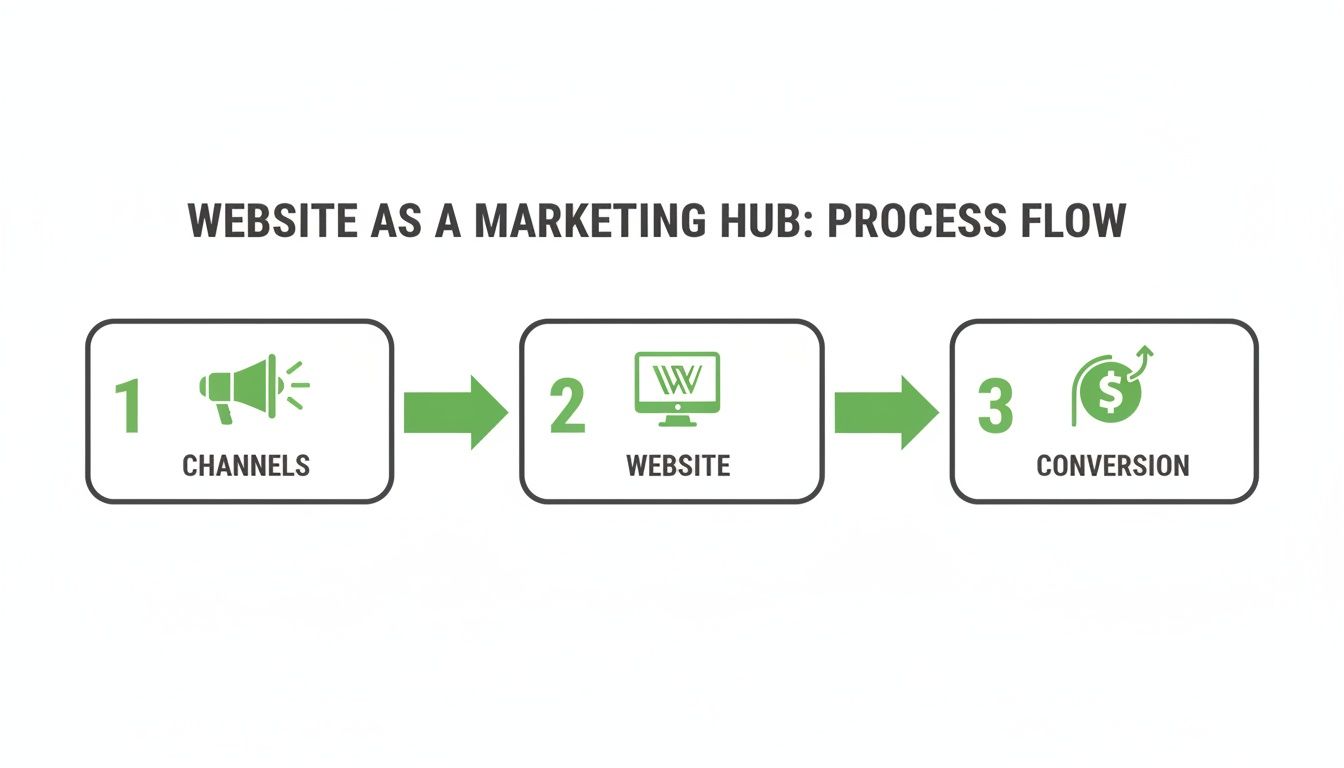
This simple visual reinforces the core concept: your website is the central engine that turns marketing activity into tangible business results.
3. Map Your Sitemap And Content Strategy – Website Design And Digital Marketing
With your goals locked in, you can finally start structuring the site itself. This starts with a sitemap—the architectural blueprint of your website. It outlines all the pages you’ll have and how they connect. A logical sitemap is critical for both users and search engines.
It needs to be intuitive. Making it effortless for visitors to find what they need. For search engines, it provides a clear roadmap for crawlers to understand and index your content effectively.
From there, you build your content strategy. This is where you map specific content ideas to each page of your sitemap.
- Define Your Audience Personas: Who are you talking to? What are their pain points, their questions, their motivations?
- Map Content to the Buyer’s Journey: Create content for every stage—awareness (guides, blog posts), consideration (case studies, comparisons), and decision (service pages, demos).
- Plan Your Core Pages: Nail down the must-haves—Homepage, About Us, Services/Products, and Contact.
- Develop Supporting Content: Plan the blog posts, resource articles, and FAQs that will answer your audience’s questions and target those all-important keywords.
This foundational work—the audit, the goal-setting, the sitemap, the content plan—is the most important part of the entire process. Getting this blueprint right ensures everything else you build is stable, effective, and primed for growth.
Website Design And Digital Marketing – Designing For People And Search Algorithms

Here’s the honest truth. A gorgeous website that nobody can find is just a pretty, expensive secret. On the flip side, a site that ranks on page one but confuses and frustrates every visitor is a conversion killer—a leaky bucket you’re pouring ad spend into.
The real magic in website design and digital marketing happens when you design for both humans and search engines at the same time. They aren’t opposing forces; they’re two sides of the same coin. This is where we get into the practical details of balancing User Experience (UX), Conversion Rate Optimization (CRO), and on-page SEO.
And it’s a big deal. The digital marketing world is growing at a projected 9% CAGR, yet a shocking 70% of small businesses with websites lack a clear call-to-action. A ton of money left on the table. Fixing that one simple issue is often one of the quickest ways to see a lift in performance.
1. Weaving UX And SEO Together – Website Design And Digital Marketing
Think of SEO as the force that brings qualified visitors to your door. And UX is the host that welcomes them inside, makes them feel comfortable, and shows them exactly what they came for. If either one fails, the entire visit is a waste.
Google gets this. Its ranking algorithms increasingly reward sites that deliver a superior user experience, which means many of the changes you make for people will also boost your rankings. A win-win.
- Logical Site Structure: An intuitive navigation menu and a clear page hierarchy help users find what they need without getting lost. This also helps search engine crawlers understand the relationships between your pages, which is crucial for proper indexing.
- Mobile-First Design: Over half of all web traffic now comes from mobile devices, making a flawless mobile experience non-negotiable. Google’s mobile-first indexing means it primarily uses the mobile version of your site for ranking, so responsive design is an absolute must-have.
- Page Speed: Slow-loading pages are a top reason visitors bail. Optimizing images, leveraging browser caching, and using a Content Delivery Network (CDN) are technical tasks that directly impact user satisfaction and Core Web Vitals—a key set of SEO metrics.
The best SEO strategy is one that’s invisible to the user. They don’t see keywords or schema markup; they just experience a fast, helpful, and easy-to-use website that solves their problem. When you achieve that, you’ve won the game.
2. Optimizing For Conversions Every Step Of The Way – Website Design And Digital Marketing
Getting traffic is only half the battle. The next step is guiding that traffic toward a specific action—filling out a form, making a purchase, or downloading a guide. This is the domain of Conversion Rate Optimization (CRO).
A huge part of CRO is crafting compelling Calls-to-Action (CTAs). Your CTAs need to be visually prominent, use action-oriented language, and create a sense of urgency or value. Forget generic buttons like “Submit.” Get descriptive and tell the user exactly what they’ll get.
- Instead of: “Learn More”
- Try: “Get My Free Marketing Audit”
- Instead of: “Buy Now”
- Try: “Add to Cart & Get 10% Off”
This same conversion-focused mindset applies to your landing pages, which are hyper-focused pages designed for a single objective, usually tied to a specific ad campaign. For some great, up-to-date ideas, check out the best landing page designs for conversion.
3. Implementing Critical Technical SEO Elements – Website Design And Digital Marketing
Beyond the user-facing design, several technical elements work behind the scenes to help search engines understand and rank your content. Ignoring these is like building a powerful engine but forgetting to connect it to the wheels.
- Schema Markup (Structured Data): This is code you add to your site to help search engines understand your content more deeply. It can lead to “rich snippets” in search results—like star ratings or product prices—making your listing more attractive and clickable.
- Core Web Vitals: These are specific metrics from Google that measure loading performance, interactivity, and visual stability. A good score here is a clear signal of a healthy user experience.
- Website Accessibility (A11Y): Designing for accessibility means ensuring people with disabilities can use your site. This includes things like adding alt text to images for screen readers and ensuring high color contrast. Not only does this open your site to a wider audience, but it’s also viewed positively by search engines.
Ultimately, integrating these on-page and technical SEO practices isn’t just about appeasing Google. It’s about building a robust, high-performing website that serves every visitor well, turning them into happy customers. To dive deeper into the tactics required to secure top positions, check out our guide on how to rank #1 on Google.
Website Design And Digital Marketing – Choosing The Right Technical Foundation
The tech stack powering your site is every bit as important as how it looks. And honestly, it’s the part people mess up the most. This is the engine under the hood—the technical backbone that makes everything else actually work.
It might not be the sexy part of designing a new website, but getting the tech right from the start saves you from a world of hurt later on. Skip this, and I promise you’ll pay for it in lost revenue, wasted ad spend, and countless headaches.
1. Selecting Your Content Management System
Your first big technical decision is your Content Management System, or CMS. This is the software that lets you create, manage, and update your website’s content without having to become a full-time coder. It’s what gives you the power to add a new blog post or change a product price yourself.
The right CMS puts you in control. A massive number of sites—over 76 million of them—run on a CMS, and for good reason. WordPress is the undisputed king of the hill, holding a huge chunk of the market share that continues to grow. You can dig into more website statistics and market share data on rebootonline.com.
While you’ve got options—from Shopify for e-commerce to completely custom solutions—most businesses end up on WordPress. Here’s why:
- Ultimate Flexibility: It can be molded to do almost anything you can dream up, from a basic service site to a complex membership portal or an online store.
- Massive Community Support: With millions of users, there’s a plugin, a tutorial, or a developer for pretty much any problem you could ever run into.
- SEO-Friendly Foundation: When you set it up correctly, WordPress is an absolute powerhouse for search engine optimization. It gives you all the tools you need to compete for those top rankings.
Picking a CMS is like choosing the foundation for your house. A solid choice like WordPress gives you a stable, expandable base to build on for years. A cheap or obscure one can lead to cracks down the road that are expensive and difficult to fix.
If you’re still weighing your options, our guide to the top website building platforms breaks down the pros and cons in much more detail.
2. Prioritizing Page Speed And Performance
Once you’ve got your CMS picked out, the next technical priority is speed. We live in a world of shrinking attention spans, and a slow website is a conversion killer. If your pages take more than a few seconds to load, a huge chunk of your visitors will hit the back button before they even see what you’re selling.
Google knows this. Which is why page speed is a confirmed ranking factor. A faster site doesn’t just feel better to users; it directly helps your SEO. This isn’t a “nice-to-have”—it’s an absolute must for any serious digital marketing strategy.
Here are the key areas to focus on for a lightning-fast site:
- Quality Web Hosting: Don’t cheap out here. That $5/month shared hosting plan might be tempting, but investing in a reliable managed WordPress host or a Virtual Private Server (VPS) gives you the horsepower needed to handle traffic without slowing down.
- Image Optimization: This is the lowest-hanging fruit. Huge, uncompressed image files are one of the most common culprits for slow sites. Use tools to compress your images before you upload them, and make sure you’re serving them in modern formats like WebP.
- Leverage Caching: Caching is a game-changer. It stores a static, ready-to-go version of your site so the server doesn’t have to rebuild it from scratch for every single visitor. This dramatically cuts down server load and makes everything load faster.
- Use a Content Delivery Network (CDN): A CDN stores copies of your site’s files (like images and code) on servers all over the world. When someone visits your site, the content is delivered from the server closest to their physical location, which significantly slashes load times.
3. Implementing Rock-Solid Security
Finally, your technical foundation has to be secure. A hacked website can destroy your brand’s reputation overnight, get you blacklisted by Google, and leak customer data. Security isn’t an afterthought you tack on at the end; it has to be baked in from day one.
Start with the absolute basics: use strong, unique passwords for all accounts, especially your administrator login. From there, you need a layered security approach. This should include a web application firewall (WAF), regular malware scanning, and—most importantly—keeping your CMS, themes, and plugins updated all the time. This technical due diligence protects your investment and the trust you’ve worked so hard to build with your audience.
Integrating Your Site With Your Marketing Stack
So, the site is built. Now what?
Your website can’t just be a pretty brochure floating in cyberspace. To get real results, you have to plug it into your entire marketing ecosystem. This is where a good-looking website transforms into a powerful marketing engine.
The goal is to create a feedback loop: data from your marketing channels tells you how to improve the website, and data from the website tells you how to sharpen your marketing campaigns. From email platforms to CRMs, this is how you build a unified digital presence that actually drives growth.
1. Setting Up Analytics and Attribution
You can’t improve what you don’t measure. Guesswork has no place in a modern digital strategy, period. Your first move is to install analytics tools—Google Analytics 4 (GA4) is the non-negotiable starting point—to see exactly how people find and interact with your site.
But just tracking visitors isn’t enough. You have to connect those visits to real business outcomes. This is attribution, and it’s how you stop guessing where your best customers come from and start knowing.
Don’t just ask, “How many people visited my website?” Instead, ask, “Which specific ad, social media post, or email blast drove the most sales this month?” That’s the difference between having data and having actionable intelligence.
This means setting up conversion goals in GA4. A “conversion” is any action you deem valuable: a form submission, a phone call click, a product purchase, or a PDF download. Track it.
2. Aligning Landing Pages With Paid Media
With your tracking in place, it’s time to get serious about maximizing your ad spend. Sending paid traffic from Google Ads or a Facebook campaign to your generic homepage is one of the fastest ways to burn through your budget. A jarring experience for the user and an absolute killer for your conversion rates.
Instead, every campaign needs a dedicated landing page.
A great landing page is hyper-focused. It speaks directly to the promise made in your ad and has one, single, clear goal. You won’t find distracting navigation menus or links to other parts of your site—just a compelling headline, persuasive copy, and a call-to-action that’s impossible to miss. This tight alignment between ad and landing page is critical for a high Quality Score in Google Ads, which can directly lower your advertising costs.
3. Connecting Your CRM and Email Platforms
Your website shouldn’t be an island. It needs to talk to the other systems you use to manage customer relationships and communicate with your audience. Integrating your website forms with your Customer Relationship Management (CRM) system is a must.
This connection ensures every new lead is automatically captured, organized, and ready for your sales team to follow up on. No more manually copying and pasting from emails into a spreadsheet.
Similarly, integrating with your email marketing platform (like Mailchimp or Klaviyo) unlocks a ton of potential:
- Build Your Email List: Use pop-ups or embedded forms to capture newsletter subscribers right on your site.
- Segment Your Audience: Tag subscribers based on which pages they visited or what products they viewed, which lets you send highly targeted email campaigns.
- Automate Follow-ups: Trigger automated email sequences when someone downloads a guide or abandons their shopping cart.
These integrations transform your website from a static brochure into an active, intelligent lead-generation and nurturing tool. As you build out this tech stack, you might also explore AI-powered support tools that can further enhance user experience by automating customer interactions right on your site.
For a deeper look at how all these pieces fit together, consider our comprehensive digital marketing audit services to identify gaps and opportunities in your current setup.
Launching, Testing, And Iterating For Growth
And… you’re live. The site is launched, and it looks great. But the job isn’t done—not even close. Honestly, this is where the real work of website design and digital marketing begins.
Your website is not a static brochure you print once and forget about. Think of it as a living, breathing tool that should evolve right alongside your business. This post-launch cycle of testing, learning, and continuous improvement is what separates the good websites from the great ones that deliver consistent, compounding returns.
1. The Pre-Flight Checklist
Before you flip the switch, a final quality check is non-negotiable. A smooth launch sets the tone for everything that follows, so don’t rush this part. It’s like a pilot’s pre-flight inspection for your digital marketing engine.
Run through this quick, practical checklist:
- Final Content Review: Read every page one last time. Hunt for typos, broken links, or any placeholder text you might have missed.
- Cross-Browser Testing: Does the site look and function perfectly on Chrome, Safari, and Firefox? Check it on both desktop and mobile devices. Seriously, check them all.
- Form Functionality: Test every single contact form, newsletter signup, and checkout process. Make sure the information goes where it’s supposed to.
- Analytics Check: Is your Google Analytics tracking code installed and firing correctly? You can’t improve what you don’t measure.
- Submit Your Sitemap: Once the site is live, submit your XML sitemap to Google Search Console. This is how you tell Google your new site is ready to be indexed.
A website launch isn’t the finish line; it’s the starting line for optimization. The data you start collecting on day one is the fuel for every improvement you’ll make in the months and years to come.
2. Embracing Continuous Improvement
With the site live and data flowing in, you can now shift your focus to iterative improvement. Instead of waiting years for a massive, expensive redesign, you make small, data-driven tweaks constantly. This is the heart of agile marketing.
This approach is powerful because it’s based on real user behavior, not just your team’s assumptions. You’re not guessing what will work—you’re letting your audience show you.
3. Your Testing Toolkit
To do this right, you need the right tools to see how people actually use your website. It’s like being able to look over your customer’s shoulder as they browse.
- A/B Testing (Split Testing): This is your secret weapon for conversion optimization. You create two versions of a page—say, one with a green button and one with a red button—and show them to different segments of your audience. The version that gets more clicks wins. You can test headlines, images, calls-to-action, and more to systematically improve performance.
- Heatmaps: Tools like Hotjar or Crazy Egg create visual maps of where users click, move their mouse, and scroll. Heatmaps are brilliant for identifying which parts of your page are getting attention and which are being completely ignored.
- Session Recordings: These are anonymous recordings of real user sessions on your site. Watching these can reveal usability issues or points of friction you would have never found otherwise. Often eye-opening.
- User Feedback: Sometimes, the easiest way to find out what’s wrong is just to ask. Use simple on-site surveys or feedback widgets to collect direct input from your visitors.
By combining these tools, you build a complete picture of your user experience. This lets you move from guessing to knowing, making smart, incremental changes that continuously boost your site’s effectiveness as a marketing tool.
Your Questions, Answered
You’re not the only one with questions. Let’s be honest—some of this can get confusing. Here are a few of the most common things we hear from business owners trying to connect the dots between their website and their marketing strategy.
How Often Should I Redesign My Website?
The old advice was every 2-3 years, but that’s an outdated way to think. A much smarter approach is to let performance, not the calendar, dictate your next move.
If your site isn’t mobile-friendly, has a bounce rate that makes you cringe, fails to generate leads, or just looks ancient next to your competitors, it’s time for a change. And honestly, the best approach is one of continuous improvement—making small, data-driven tweaks instead of a massive, disruptive overhaul every few years.
Can I Just Add SEO After My Website Is Built?
You can, but it’s like trying to add a foundation to a house that’s already built. It’s messy, expensive, and never works as well as doing it right the first time. A bad idea.
Foundational SEO needs to be baked in from day one. It should influence everything from your site structure and navigation to your content strategy and technical performance. Bolting it on later is a painful repair job that costs more and delivers less.
What Matters More: Web Design Or SEO?
That’s a false choice. They are completely codependent, and you can’t have one without the other. This is the central theme of effective website design and digital marketing.
Great SEO gets the right people to your site, but great web design and user experience are what turn that traffic into customers. A site that ranks #1 but is a nightmare to use will ultimately fail. A beautiful site that no one can find will also fail.
A truly effective digital strategy integrates both so they work together, amplifying each other’s strengths to create a powerful engine for growth.
Ready to build a website that not only looks incredible but also drives measurable results? The team at Mr. Green Marketing, LLC specializes in creating conversion-focused websites backed by a data-driven digital marketing strategy. Get your free audit and performance report today.
Leave a Comment
sing in to post your comment or sign-up if you dont have any account.