
Website SEO Audit Services – At its core, a website SEO audit service is a complete health check-up for your site. And it’s a systematic inspection designed to figure out exactly why your website isn’t ranking as high as it should be, revealing the roadblocks that cost you traffic and sales.
What Is A Website SEO Audit Service Anyway?
Let’s cut through the jargon. Think of an SEO audit like a master mechanic popping the hood of your car. Your engine might sound fine to you, but an expert can spot the hidden issues—that worn belt, the low fluid—that are about to cause a major breakdown on the highway.
That’s precisely what a website SEO audit service does. A diagnostic roadmap. It systematically inspects every corner of your online presence. And this isn’t just a quick scan; it’s a full investigation covering everything from the deep technical foundation that only search engines see to the actual content your customers read.
The Problem an Audit Solves
Your website might look fantastic, but what good is a beautiful storefront if it’s on a dead-end street with no signs? Many businesses invest in great design but remain invisible to Google. An audit uncovers the why. It answers critical questions like:
- Why is my competitor outranking me for my most important keywords?
- Is there a technical glitch preventing Google from seeing my best pages?
- Does my content actually connect with what users are searching for?
- Are there toxic backlinks from other sites hurting my online reputation?
Without this deep analysis, your marketing efforts are just guesswork. You could be pouring money into content or ads while a simple technical flaw—something an audit would spot in hours—is holding your entire strategy back.
To truly understand what’s at stake, it helps to know what is SERP tracking and how it reveals your real-time visibility (or lack thereof) on Google.
Why It’s a Must-Have, Not a Nice-to-Have
The impact of a proper audit is undeniable. Industry benchmarks show that regular website SEO audits can deliver staggering results, including up to 61% boosts in organic traffic, 32% higher conversion rates, and 50% reductions in bounce rates for sites audited quarterly versus those that are neglected.
In a world where 94% of webpages get zero traffic from Google, these numbers show why savvy businesses turn to services like Mr. Green Marketing’s free performance reports. It’s about moving from being invisible to being unavoidable.
An SEO audit doesn’t just find problems; it finds opportunities. It transforms your website from a passive digital brochure into an active, lead-generating machine by aligning every technical and creative element with what search engines—and your customers—actually want.
The Five Pillars Of A Powerful SEO Audit
So, what does an auditor really look at when they get under the hood of your website? It’s not about one single thing, and it’s certainly more than a simple automated score. A real audit examines a combination of critical elements that all have to work together—a lot like the pillars holding up a massive building.
If even one of those pillars is weak, the whole structure is at risk. We break this complex process down into five digestible pillars that form the foundation of any high-quality, professional audit.
This diagram shows how the core pieces of an audit fit together, with technical, content, and authority elements all supporting the overall health of the website.
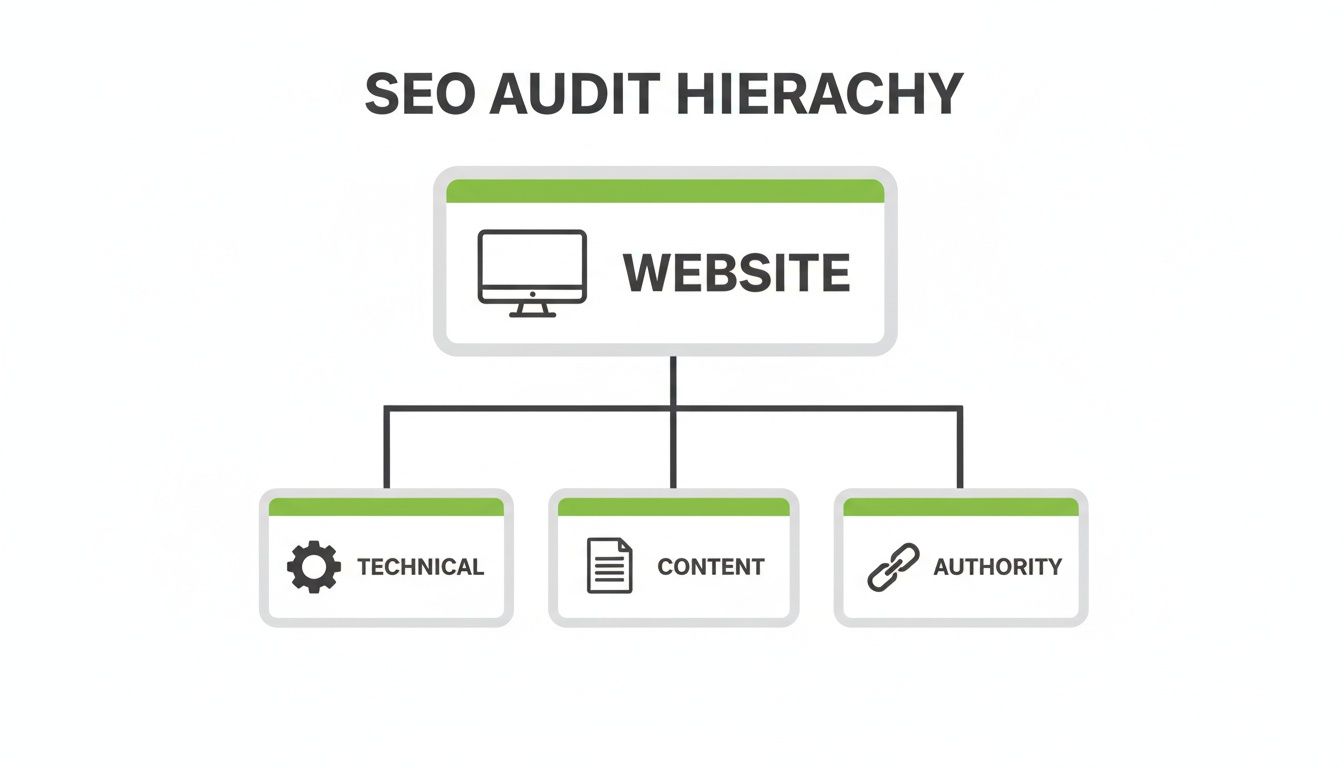
As you can see, a healthy website depends on a solid foundation where the technical side, the content strategy, and off-site authority are all firing on all cylinders.
1. Website SEO Audit Services – Technical SEO: The Bedrock Of Your Website
First up is Technical SEO. Let’s be clear: this is the absolute, non-negotiable foundation. If this part is broken, almost nothing else you do matters. You could have the most beautifully written, persuasive content in the world, but if Google’s crawlers can’t find, access, or make sense of it, you’re invisible.
Think of it like the plumbing and electrical wiring in a house. No one sees it, but if it fails, the house is basically unlivable. A technical SEO audit is all about checking for these critical, behind-the-scenes problems.
An experienced auditor will dig into:
- Crawlability & Indexability: Are parts of your site accidentally blocked from search engines? Can Google actually find and add your most important pages to its database?
- Site Speed: Pages that load at a snail’s pace don’t just frustrate users; they kill rankings. We’ll pinpoint what’s causing the lag, from bloated images to clunky code. A mere 1-second delay in page load can slash conversions by 7%.
- Mobile-Friendliness: With most searches now happening on phones, your site must work flawlessly on a small screen. A massive ranking factor.
- Site Architecture: Is your website laid out in a logical way? A confusing structure makes it hard for both people and search engines to find their way around.
- Schema Markup: This is specialized code that helps search engines understand the context of your content, which can lead to those eye-catching, rich results on the search page.
2. Website SEO Audit Services – On Page SEO: Optimizing What Users See
Next, we have On-Page SEO. This pillar is all about optimizing the individual pages of your website—the content and HTML that users and search engines actually see. The art and science of making it crystal clear what each page is about.
This is where the auditor connects your business goals directly to specific page elements. The analysis goes way beyond just stuffing keywords onto a page; it’s about strategic placement, relevance, and intent.
A great on-page SEO strategy is more than a checklist. It’s about creating a seamless experience where your content perfectly matches a user’s search, signaling to Google that your page is the absolute best answer to their question.
Key elements we review include:
- Title Tags & Meta Descriptions: Are they unique, compelling, and do they accurately describe what’s on the page?
- Header Tags (H1, H2, H3): Is the content broken up logically with headers? This improves readability and shows Google the hierarchy of your topics.
- Keyword Optimization: Are you targeting the right keywords in a way that sounds natural, not robotic?
- Internal Linking: Are you linking between related pages on your site? This helps distribute authority and guides users to more useful information.
3. Website SEO Audit Services – Content Performance & Strategy
The third pillar is Content Performance. This is where so many businesses get stuck. It’s not enough to just have content on your site—it needs to actually perform. This part of the audit moves beyond keywords to ask the tough questions. Is your content truly answering your audience’s questions? Is it driving business goals?
An audit here looks for red flags like:
- Content Gaps: What are your competitors ranking for that you aren’t? Where are the missed opportunities to create content your customers are desperately searching for?
- Thin Content: These are pages with very little valuable information that offer no real benefit to the reader. They’re dead weight.
- Duplicate Content: Having identical or nearly identical content on multiple pages can confuse search engines and water down your ranking potential.
- Engagement Metrics: Are people sticking around to read your content, or are they hitting the back button immediately? A high bounce rate is a huge warning sign to Google.
4. Website SEO Audit Services – Off-Page SEO: Authority & Trust
Fourth on the list is your Off-Page SEO profile. This pillar is all about your website’s reputation and authority across the rest of the internet, and it’s mostly judged by who links to you.
Think of backlinks from other respected websites as votes of confidence. The more high-quality “votes” you have, the more trustworthy your site appears to Google. A website SEO audit service will meticulously analyze your entire backlink profile to see where you stand. As part of any modern content strategy, it’s also becoming critical for businesses to learn how to optimize for AI search.
5. Website SEO Audit Services – User Experience (UX) Signals
Finally, the fifth pillar is User Experience (UX). Google has gotten incredibly good at figuring out if people are having a good or bad time on your site. If your visitors get confused, frustrated, or can’t find what they’re looking for, they’ll leave.
And Google absolutely notices.
This part of the audit analyzes signals that tell us about user satisfaction—things like how long people stay, how many pages they visit, and whether they interact with your content. A poor user experience sends a direct signal to Google that your site isn’t a quality result, which will tank your rankings over time.
A weakness in any one of these five pillars can cause your whole SEO strategy to come crumbling down.
Website SEO Audit Services – What To Expect From The Audit Process
So, you’ve decided an audit is the right move. What actually happens next?
A professional website SEO audit service isn’t some instant, one-click scan that spits out a generic score. It’s a methodical, multi-stage process designed to move from broad questions to a specific, actionable roadmap.
Think of it like hiring a master architect to plan a major renovation. They don’t just show up with a sledgehammer. First, they listen. Then they measure. Then they draw up a detailed blueprint.

A proper audit process is structured and transparent. Every step is designed to ensure the final recommendations are perfectly aligned with your actual business goals.
Website SEO Audit Services – Phase 1: Discovery and Goal Alignment
The first step isn’t about your website at all—it’s about your business. A great audit partner always begins by listening. This kickoff phase is absolutely crucial for setting the stage and making sure everyone is working toward the same finish line.
You should expect questions like:
- Who are your most profitable customers?
- What are your key business objectives for the next year?
- Which competitors are consistently eating your lunch online?
This isn’t just small talk. This is about connecting abstract SEO metrics to real-world outcomes. Without this context, an audit is just a technical exercise; with it, it becomes a business growth strategy.
Website SEO Audit Services – Phase 2: Data Collection
Once your goals are crystal clear, the data gathering begins. This is where we plug in advanced tools to your digital properties to pull all the raw intelligence needed for the analysis. It’s the equivalent of a doctor ordering blood work and X-rays before making a diagnosis.
This usually involves granting secure, read-only access to a few key platforms:
- Google Analytics: To understand user behavior, traffic sources, and conversions.
- Google Search Console: For direct insights from Google on crawl errors, keyword performance, and how it sees your site.
- Specialized Crawling Software: Tools like Screaming Frog or Ahrefs are used to crawl your entire site just like Google does, uncovering technical issues that are otherwise invisible.
This phase can take a little time, especially for larger websites. It’s all about getting a complete, accurate picture of your current performance from every possible angle.
Website SEO Audit Services – Phase 3: Deep-Dive Analysis
Now for the heavy lifting. With all the data collected, the real work of analysis begins. This is where human expertise—something no automated tool can replicate—becomes critical. An experienced auditor sifts through mountains of data, connecting the dots between seemingly unrelated issues to find the root causes of performance problems.
An automated tool can tell you that you have 50 broken links. An expert analyst can tell you that three of those broken links are on your highest-trafficked pages, costing you an estimated $5,000 per month in lost leads. That’s the difference.
We aren’t just checking boxes on a list. We’re identifying patterns, pinpointing opportunities, and prioritizing issues based on their potential impact on your bottom line. This is where insights are born. To see how this fits into a broader strategy, you can explore our overview of digital marketing audit services for the bigger picture.
Website SEO Audit Services – Phase 4: The Report and Action Plan
Finally, you get the results. But a great audit doesn’t end with a confusing, 100-page document filled with technical jargon. The final deliverable should translate complex findings into a clear, prioritized, and easy-to-understand roadmap.
A high-quality audit report will always include:
- An Executive Summary: A simple, concise overview of the key findings and top-level recommendations.
- Prioritized Action Items: Not just a list of what’s wrong, but a plan that separates quick wins (high-impact, low-effort fixes) from longer-term strategic initiatives.
- Clear Next Steps: Specific, actionable guidance on what to do next to implement the recommendations and start seeing results.
The entire process, from kickoff to final report, is designed to give you clarity and confidence. You walk away knowing exactly where you stand, what needs to be fixed, and precisely how to do it.
Website SEO Audit Services – From Audit Findings To Business Growth

This is where the real work begins. An audit report is just a collection of data; its true power comes from turning those findings into fixes that actually grow your business. The problems an audit uncovers aren’t just technical glitches—they’re direct opportunities to make more money.
A seasoned auditor knows how to connect every single recommendation back to a business outcome. We’re not just chasing perfect scores on some tool. No. It’s all about making smart, strategic changes that attract more customers and drive more sales. This is the critical “so what?” behind every finding.
Real-World Examples of Audit Impact
To really grasp the power of a professional website SEO audit service, let’s look at a couple of classic scenarios we see all the time. These aren’t just hypotheticals; they’re the kind of real-world problems that, once fixed, translate directly into profit.
Case Study 1: The E-commerce Site with Sluggish Pages
An online store had gorgeous, high-resolution product photos. The catch? The image files were massive and totally unoptimized, making their product pages load at a snail’s pace—especially on mobile.
- The Audit Finding: Page load speeds were clocking in at over 8 seconds. This led to a sky-high bounce rate because frustrated shoppers were leaving before they even got a chance to see the products.
- The Fix: We put a systematic process in place to compress every image and implement a modern, faster image format.
- The Business Growth: Page load time dropped by a whopping 40%. This one simple fix led to a 12% jump in conversions because shoppers were no longer bailing on the slow-loading pages.
Case Study 2: The Local Contractor Invisible on Maps
A local roofing company had a fantastic reputation, but you couldn’t find them in Google’s local map pack to save your life. They were missing out on a goldmine of high-intent searches like “roofer near me.”
- The Audit Finding: Their business Name, Address, and Phone number (NAP) were a mess—inconsistent across dozens of online directories like Yelp and the Yellow Pages. Google couldn’t figure out which information was correct, so it didn’t trust them enough to feature them in top local results.
- The Fix: A thorough cleanup to standardize all their NAP citations across the web.
- The Business Growth: Within two months, their local map pack visibility doubled, generating a 30% increase in qualified phone calls from new customers right in their service area.
These examples show how a seemingly small technical detail, like an image file size or a phone number listing, can have a direct and measurable impact on your bottom line.
Turning Common Culprits into Opportunities
Most websites are held back by a handful of common issues that a good audit will spot immediately. But a great audit service doesn’t just hand you a list of problems. It reframes them as opportunities. It’s a shift in mindset—from asking “what’s broken?” to “what can we improve to grow?”
Here are a few frequent offenders and the opportunities they really represent:
- Broken Internal Links: These are dead ends for both users and search engine crawlers. The opportunity is to fix them to drastically improve user experience and help Google find and rank your most important pages.
- Duplicate Content: When you have the same content on multiple URLs, you’re confusing search engines and splitting your ranking power. The opportunity is to consolidate these pages, focusing all that SEO authority onto one single, powerful page.
- Thin Backlink Profile: If you don’t have high-quality links pointing to your site from other reputable sources, Google sees you as less trustworthy. The opportunity is to build a strategic link-building campaign that establishes your site as a go-to authority in your industry.
Solving these issues does more than just tidy up your website. It systematically improves how both users and search engines perceive your brand, which directly influences your traffic and sales. If users frequently leave your site right away, you might want to learn more about how to reduce bounce rate on your website.
An audit’s true purpose is to build a bridge between technical SEO issues and tangible business goals. Each identified problem is a signpost pointing toward a specific action you can take to increase visibility, generate more leads, and ultimately, make more money.
This direct line between audit, action, and revenue is why the industry is seeing such a massive expansion. The global SEO software market, which powers these critical audit services, hit USD 74.6 billion in 2024 and is forecasted to more than double to USD 154.6 billion by 2030. This explosive growth is driven by businesses finally realizing that audits are essential for navigating a competitive online world. You can discover more insights about the booming SEO software market and its trends.
Website SEO Audit Services – How To Choose The Right SEO Audit Service
Not all SEO audits are created equal. This is probably the most important thing to remember when you’re looking for help. A cheap, automated report spat out by a free online tool is worlds apart from a comprehensive, expert-led analysis.
Choosing the right partner is critical. The difference between getting a confusing data dump and receiving a clear, strategic roadmap that actually grows your business. You’re not just hiring someone to run a scan; you’re investing in an expert who can translate technical problems into real-world business opportunities.
Beyond The Automated Report
Free online tools are everywhere, and they can be useful for a quick check-up. They’ll happily point out surface-level issues like a missing meta description or a broken link. But that’s where their value ends.
They can’t tell you why something is broken, or more importantly, which fix will actually have the biggest impact on your revenue.
An automated tool tells you what is wrong. A human expert tells you what matters. A great website SEO audit service prioritizes findings based on your specific business goals, ensuring your time and money are spent on fixes that deliver real results.
Relying solely on these tools is like a doctor diagnosing an illness based only on your temperature. It’s one data point, but it completely misses the bigger picture.
Key Questions To Ask Any Potential Provider of Website SEO Audit Services
To separate the true experts from the report-sellers, you need to ask the right questions. Arm yourself with these before you even think about signing a contract. And the quality of their answers will tell you everything you need to know about the service you’ll actually get.
A few critical questions to start with:
- Do you provide a prioritized action plan or just a list of errors? This is huge. You want a partner who can tell you what to fix first, second, and third based on effort versus impact.
- Can you show me a sample audit report? This lets you see exactly what their deliverable looks like. Is it a clear, easy-to-understand document, or a 100-page mess of technical jargon?
- How do you connect your findings to my business goals? The best providers start by understanding what you want to achieve—more leads, higher sales, better brand visibility—and then tailor the entire audit to support those specific objectives.
- What tools do you use for your analysis? While tools aren’t everything, understanding the best tools for SEO analysis they use can give you confidence in their technical capabilities.
Understanding Pricing Models
SEO audit pricing can feel like the Wild West, ranging from a couple of hundred dollars to well over $10,000. That price tag is usually a direct reflection of the depth of the analysis and the expertise of the provider.
- One-Off Projects: This is a flat fee for a single, comprehensive audit. It’s a great option if you need a deep diagnostic to kickstart your SEO efforts. Prices for small business sites often range from $500 to $2,000.
- Part of a Monthly Retainer: Many agencies, including Mr. Green Marketing, include a foundational audit as part of a larger, ongoing SEO partnership. This is ideal because the audit becomes a living document that guides the strategy month after month.
Be very wary of unbelievably cheap offers. A $99 audit is almost certainly just a branded version of an automated report you could have run yourself for free. Remember, you’re paying for expertise and strategic guidance, not just data.
The explosive growth of the SEO software market—projected to hit USD 97.7 billion in 2026—is driven by the immense value that expert-led services provide.
Comparing Audit Providers What To Look For
Use this checklist to evaluate potential SEO audit services and find a partner who delivers real strategic value, not just a generic report.
| Feature | Basic Automated Audit | Expert-Led Strategic Audit |
|---|---|---|
| Analysis | Surface-level scan for common errors | Deep-dive into technical, on-page, and off-page factors |
| Prioritization | A long, unfiltered list of issues | Actionable roadmap prioritized by impact and effort |
| Business Context | Generic findings with no connection to goals | Recommendations tied directly to revenue and growth objectives |
| Competitor Analysis | Little to no competitive insights | In-depth analysis of competitors’ strengths and weaknesses |
| Deliverable | A data-heavy PDF or dashboard | A clear, understandable report with a strategic plan |
| Support | None. You’re on your own to interpret the data. | Direct access to an expert for questions and guidance |
Ultimately, the goal isn’t just to find problems—it’s to find opportunities. A strategic audit provides the roadmap to capitalize on them.
Putting Your SEO Audit Into Action
An audit report is just the beginning. The real value—the part that actually grows your business—comes from what you do with it. Don’t let that detailed analysis become a digital paperweight collecting dust on a hard drive.
The best way to get started is to build immediate momentum. And this is where a professional website SEO audit service truly shines. It doesn’t just hand you a laundry list of problems; it gives you a prioritized action plan.
The goal is to move from diagnosis to cure.
Start With Quick Wins
Your audit will pinpoint a number of high-impact, low-effort tasks we call “quick wins.” Think of them as the low-hanging fruit you can grab right now to see immediate progress.
These aren’t massive, time-consuming projects. They’re smart, targeted fixes that deliver noticeable results in a short amount of time.
- Fixing broken internal links: This is a simple fix that instantly improves user experience and helps search engines map out your site more effectively.
- Optimizing key page titles: A quick tweak to a title tag on a high-value page can boost your click-through rates from search results almost overnight.
- Compressing oversized images: This can give you an immediate lift in page speed, a crucial ranking factor that both Google and your users care about.
Tackling these first creates a powerful snowball effect. You see positive results right away, which builds confidence and fuels the motivation needed for the longer-term strategic work. A few small victories can completely change the trajectory of your marketing efforts.
Integrate Long-Term Recommendations
Once you’ve checked off the quick wins, it’s time to fold the bigger, more strategic recommendations into your ongoing marketing plan. This is how a one-time audit evolves into the foundation for sustainable growth.
These larger initiatives—like creating new content to fill identified gaps or executing a backlink-building campaign—require consistent effort. But they are the fixes that build lasting authority and create a durable competitive advantage. This is what separates market leaders from everyone else.
An audit isn’t the finish line; it’s the starting line. It provides the clear, data-driven roadmap your business needs to stop guessing and start growing with purpose.
Ready to uncover your website’s hidden potential? Request your free audit and performance report from Mr. Green Marketing today and get a clear roadmap for growth.
Still Have Questions?
Of course you do. SEO is a complicated field, and it’s perfectly normal to want a bit more clarity before you dive in. Here are a few of the most common questions we get from business owners just like you.
How Often Should I Get A Website SEO Audit?
For most businesses, a full, deep-dive audit once a year is a solid rule of thumb. It’s the perfect cadence to keep your strategy on track and catch small issues before they snowball into major headaches.
However, if you’re in a cut-throat industry, just launched a brand new website, or are in the middle of a major site overhaul, you’ll want to bump that up to every 6 months. Think of it like a regular check-up with your doctor—preventative care is always smarter and cheaper than emergency surgery.
An SEO audit isn’t a “one and done” task. It’s a recurring health check for your website, ensuring you’re keeping up with Google’s constant algorithm changes and the moves your competitors are making. Neglecting it is like trying to navigate across the country with a map from 2005.
Can I Just Do An SEO Audit Myself?
You can, but it’s a “yes, and no” kind of answer.
You can absolutely use free online tools to run a basic check. This is great for spotting the low-hanging fruit—things like broken links or missing meta descriptions. Honestly, it’s a lot better than doing nothing at all.
But a professional website SEO audit service is on a whole different level. We use sophisticated software, sure, but the real value comes from the human expertise needed to interpret that complex data. An expert connects the dots between dozens of different data points, pinpoints the root cause of a problem (not just the symptom), and builds a prioritized action plan tailored to your business goals. An automated tool just spits out data; an expert gives you a roadmap.
How Much Does A Professional SEO Audit Cost?
There’s no single price tag, as the cost depends entirely on the size and complexity of your website.
- A small local business site with a few dozen pages might fall in the $500 – $2,000 range for a one-time, comprehensive audit.
- A massive e-commerce store with thousands of product pages could easily be $5,000 or more.
A word of caution: be very skeptical of super-cheap offers. These are almost always just rebranded reports from an automated tool, with zero expert analysis or strategic guidance. You’ll get a pile of data, but you’ll be left with no real plan to actually do anything with it.
Ready to stop guessing and start growing with a clear, data-driven plan? The team at Mr. Green Marketing, LLC can build that roadmap for you. Request your free audit and performance report today.
Leave a Comment
sing in to post your comment or sign-up if you dont have any account.