
Social Media Agencies: You’re probably in one of two spots right now. Either you’re posting consistently and wondering why social still feels disconnected from revenue, or you’ve stopped posting consistently because the whole thing became one more job you never meant to take on.
And that’s the problem. Social media doesn’t behave like a side task anymore. It’s a channel mix, a content engine, a paid media environment, a customer service line, and in some cases a reputation risk, all at once. For a busy SMB owner or e-commerce team, that’s a lot.
A good agency can help. A bad one just adds meetings, vague reports, and nicer-looking posts that don’t move the business. The difference comes down to strategy, measurement, and whether the agency understands how your company makes money.
Why Smart Businesses Partner with Social Media Agencies
Most owners don’t hire social media agencies because they love outsourcing. They hire them because social gets messy fast.
A local service business starts with a simple goal. Stay visible, answer questions, maybe run a few promotions. Then the workload expands. Somebody needs to plan content, shoot video, write captions, respond to comments, set up paid campaigns, track leads, review analytics, and explain whether any of it produced profit. E-commerce brands hit the same wall from a different angle. They need creative volume, product hooks, creator partnerships, remarketing, and tighter reporting than a basic social calendar can provide.
That’s why agency help isn’t just about “taking posting off your plate.” It’s about bringing in people who can make channel decisions under pressure.
The scale of the market makes this harder to do casually. In 2025, more than 5.24 billion people worldwide used social media, equal to about 63.9% of the global population, and the average user actively used or visited 6.84 platforms each month, according to ThinkPod Agency’s 2025 social media statistics roundup. That fragmented behavior matters. Your customer isn’t sitting on one app waiting for your next post.
What business owners usually get wrong
A common mistake is treating social like a visibility task instead of a business system.
That shows up in a few ways:
- They hire for output, not outcomes. They ask for “three posts a week” instead of a plan for leads, purchases, retention, or repeat traffic.
- They expect every platform to do the same job. Instagram may support product discovery. LinkedIn may support authority. Meta ads may support retargeting. Those are different roles.
- They judge too early or too vaguely. “Are we getting more engagement?” isn’t the same as “Are qualified buyers reaching the site and converting?”
Social media agencies earn their keep when they reduce decision fatigue and connect activity to a business goal.
Social Media Agencies: What a strong partnership feels like
The right agency usually brings three things your in-house team may not have time to build alone:
- Channel judgment: where to focus, where to stop, and what content deserves paid support.
- Execution capacity: design, copy, video, ad management, moderation, and reporting.
- Accountability: a regular process for reviewing performance and changing direction when something isn’t working.
That last one matters most. If an agency can’t explain why it’s doing what it’s doing, you’re not buying expertise. You’re buying motion.
What Social Media Agencies Actually Do
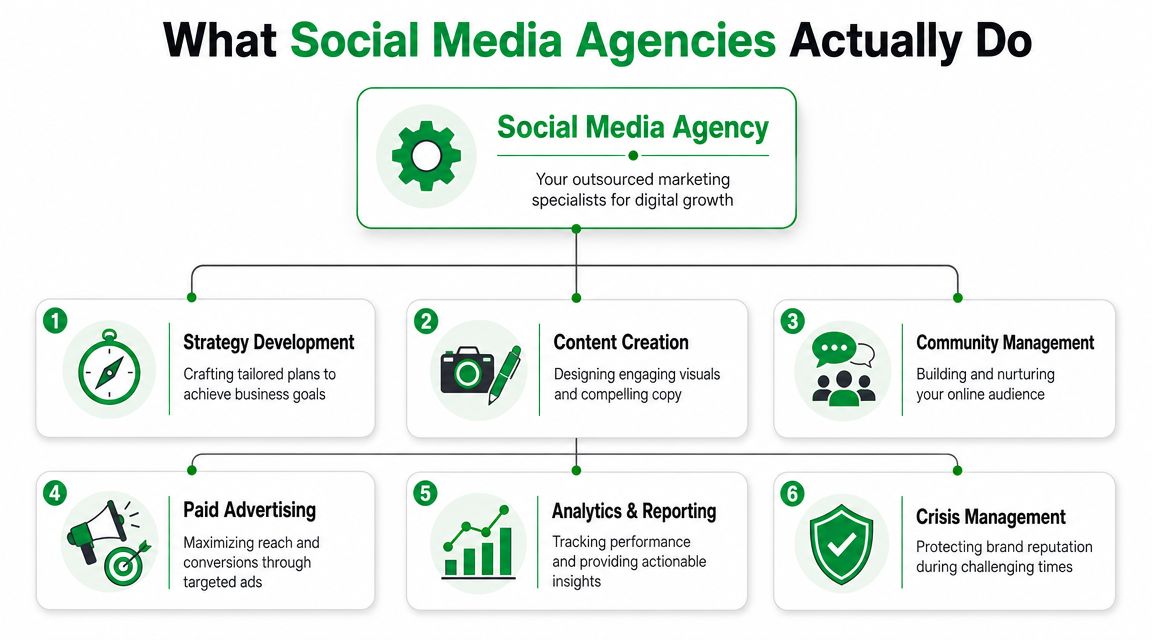
Some owners think social media agencies mainly make graphics and schedule posts. That’s one slice of the work, but it’s nowhere near the full job.
A serious agency acts more like an outsourced specialist team. It connects brand, media, content, customer behavior, and reporting. And because the channel has matured, performance matters more than activity. For example, influencer marketing delivered an average return of about $5.78 for every $1 spent in 2025, as reported in Sprinklr’s social media marketing statistics. That’s why agencies are judged on business impact, not posting volume.
The core service areas that matter
Social Media Agencies: Strategy development
This is the part many clients skip over because it isn’t flashy. It’s also the part that keeps everything else from becoming random.
A real strategy should define audience segments, channel roles, messaging priorities, offer structure, creative themes, and how social supports the sales process. If you run local campaigns, this also includes geography, seasonality, and lead handling. If you sell online, it usually includes product positioning, launch cadence, and retention touchpoints.
Social Media Agencies: Content creation
Yes, this includes design, captions, short-form video, product visuals, and campaign concepts. But strong content creation isn’t just “make it look nice.”
It answers practical questions. What objection are we addressing? What stage of awareness is this for? Should the creative educate, convert, or retarget? Good agencies build content that can do a job, not just fill a calendar.
Social Media Agencies: Community management
On social media, many brands lose trust without realizing it. Replies, DMs, complaints, tags, review responses, and comment threads shape how buyers evaluate your business.
A thoughtful agency sets response rules, escalation paths, and tone guidelines. Fast reaction matters. So does knowing when not to sound scripted.
Social Media Agencies: The performance functions most SMBs actually need
Paid social advertising
Organic content can support trust and discovery, but paid social drives controlled distribution. Agencies handle targeting, budget allocation, creative testing, retargeting, and landing page coordination. That’s where a lot of the commercial value sits.
Analytics and reporting
Weak agencies frequently obscure their true performance. They send screenshots and top-line metrics. Strong agencies build reporting around traffic quality, conversions, and efficiency.
Some agencies also set up automated reporting workflows. The practical pattern is straightforward: scheduled data pulls, historical storage in a database, and white-labeled reporting that makes trend analysis easier across clients and time periods, as described in this guide to social media API workflows for agencies.
Practical rule: If reporting can’t show trend lines, channel differences, and what changed after a campaign decision, it’s not useful enough.
Social Media Agencies: Crisis management
Not every client needs this daily, but every brand needs a plan. A post goes sideways. A customer complaint gains traction. A team member says the wrong thing publicly. Agencies should know how to pause campaigns, align messaging, and protect the brand while facts are still developing.
If your internal team is comparing providers, it helps to review examples of small business social media marketing services so you can see how different firms package strategy, content, ads, and reporting. And if lead generation is part of the mandate, many teams also review top social media prospecting tools to understand how outreach and audience research fit into the wider system.
Social Media Agencies: Understanding Agency Pricing and Contracts
Agency pricing feels confusing because you’re not just paying for hours. You’re paying for judgment, specialization, process, and the ability to move work across multiple functions without hiring a full internal team.
That said, pricing should still be understandable. If a proposal feels intentionally vague, that’s a warning sign.
The most common pricing models
Some businesses need a long-term operating partner. Others need help launching, fixing, or validating something. The contract should match that reality.
| Model | Best For | Pros | Cons |
|---|---|---|---|
| Monthly retainer | Ongoing content, paid social, reporting, and active management | Predictable workflow, consistent strategy, easier planning, stronger continuity | Can feel expensive if scope is unclear or approvals stall |
| Project-based fee | Launches, audits, campaigns, or one-time setup work | Clear deliverables, defined start and finish, easier for testing a relationship | Less flexibility once scope is set, often not ideal for continuous optimization |
| Hourly rate | Advisory work, troubleshooting, training, or overflow help | Useful when needs are irregular, easy to start small | Costs can drift, output may feel fragmented, budgeting is less predictable |
| Performance-based structure | Brands with strong tracking and aligned revenue goals | Incentives can align around outcomes | Hard to define fairly, attribution disputes happen, usually paired with a base fee |
Social Media Agencies: What to look for in the contract
You don’t need a legal deep dive to ask good questions. You do need clarity.
Focus on these points:
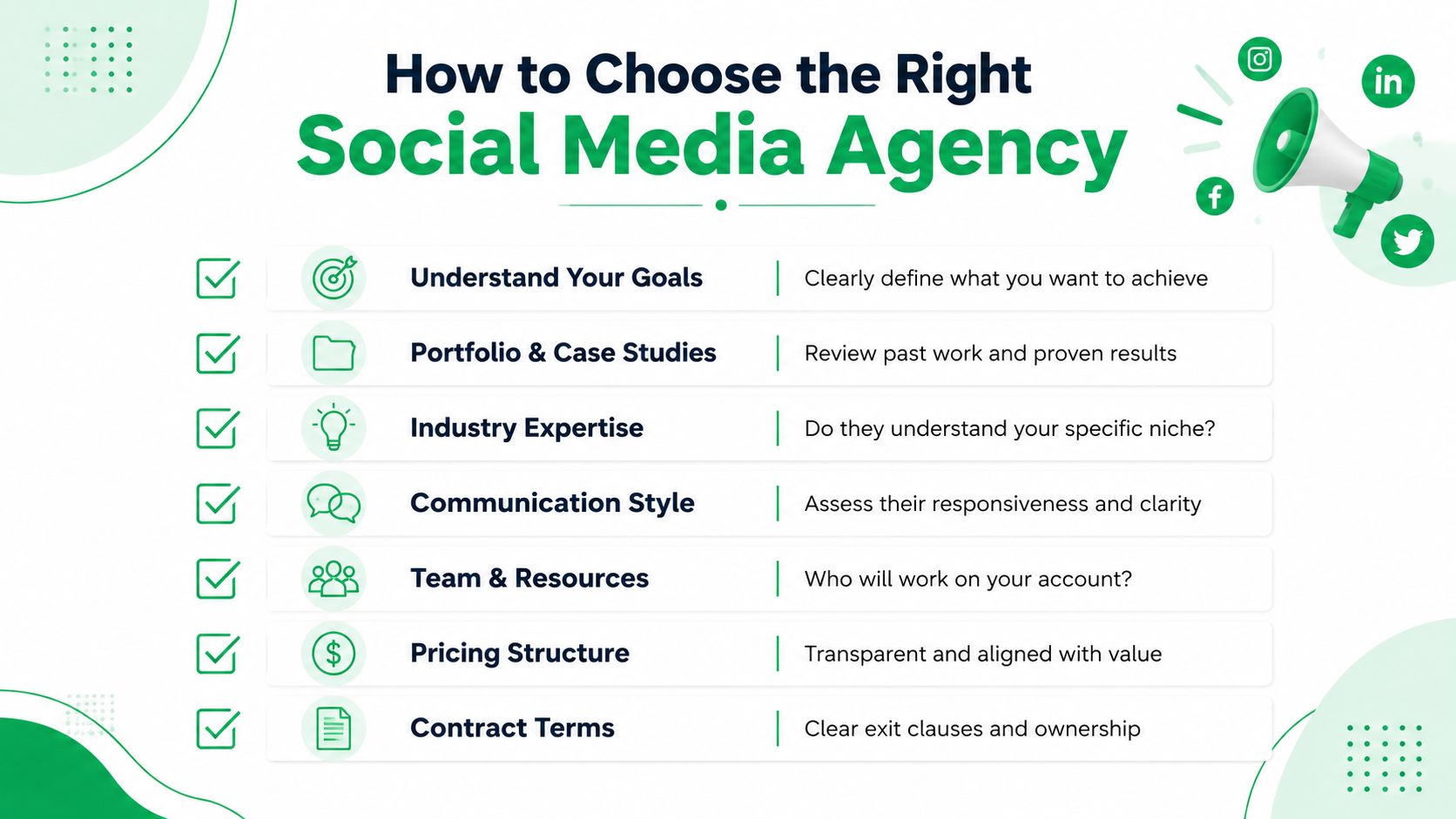
- Scope of work: Exactly what’s included. Content creation, ad management, revisions, reporting, community management, creator outreach, and meetings should all be named.
- Ownership: Ask who owns ad accounts, creative files, audience data, and reporting dashboards.
- Approval timelines: If your team delays approvals, campaigns slow down. Contracts should reflect that operational reality.
- Exit terms: Know how much notice is required and what happens to assets at the end.
- Communication cadence: Weekly check-ins, monthly reviews, and escalation contacts should be explicit.
Social Media Agencies: How to match the model to your business
A retainer makes sense when social is an active growth channel and you need momentum, not sporadic help. A project fee makes more sense when you need a strategy, an audit, or campaign setup before deciding on ongoing support.
If you need daily management, don’t buy a one-time plan and expect it to behave like a retainer.
A lot of owner frustration comes from buying the wrong engagement model. Not because the agency is dishonest, but because the business expected strategic partnership from a tactical package. That mismatch shows up later in meetings, reporting, and disappointment.
Social Media Agencies: How to Choose the Right Social Media Agency
A polished proposal doesn’t tell you much. Plenty of agencies sound sharp on sales calls. The better question is whether they can make sound decisions inside your business model.
That means choosing for fit, not just flair.
Ask questions that expose how they think
Start with the basics, but don’t stop there.
- What does success look like in a business like mine? Listen for answers tied to leads, purchases, conversion paths, repeat customers, or sales cycle realities.
- How do you build strategy before content starts? If they jump straight to post frequency, they may be a production shop more than a strategic partner.
- Who will work on my account? Sales teams often disappear after the contract is signed.
- How do you handle approval delays, changing priorities, or weak creative performance? Good agencies have a process, not just optimism.
A useful comparison point is this guide on how to choose a digital marketing agency, especially if social is only one part of your broader acquisition mix.
Test their answer to the organic reach problem
Weak agencies get exposed fast.
With average Facebook organic reach reported at about 5.2% of a brand’s followers in a 2024 Hootsuite figure cited by Fraser Communications, “we’ll just post more” isn’t a serious growth plan. Organic distribution is constrained. A strong agency should talk about paid amplification, creator collaboration, audience segmentation, retention content, and platform-specific creative systems.
If their answer is mostly consistency, hashtags, and best times to post, keep looking.
The agency’s plan for limited organic reach tells you whether they understand platform economics or just content production.
Here’s a helpful outside perspective if creators are part of your plan. Reviewing frameworks for evaluating influencer partners can sharpen your questions around fit, audience quality, and campaign structure.
Social Media Agencies: Look for cultural competence, not just brand polish
This gets overlooked until a campaign misses the mark.
An agency should be able to explain how it researches audience nuance, validates creative with feedback, and adapts messaging for different communities without tokenism. Inclusive social strategy isn’t a box-checking exercise. It requires research, context, and ongoing feedback loops. If they can’t describe that process, they’re likely relying on assumptions.
A few vetting questions worth asking:
- How do you research audience differences across communities or markets?
- What steps do you take before approving inclusive campaign creative?
- How do you handle accessibility, message testing, and feedback loops?
Video can also help when you’re comparing how agencies present themselves and their process:
The right fit usually feels specific
The best agency for a local service company may not be the best one for an e-commerce brand with heavy creative testing needs. Same channel, different business.
Look for specificity in how they talk. Specific audiences. Specific offers. Specific reporting logic. Specific trade-offs. General answers are easy to sell and hard to operate.
Social Media Agencies: Your First 90 Days with a New Agency
The first three months matter because they set habits. Not just campaigns.
If the relationship starts with confusion, missing assets, delayed approvals, and vague reporting, that usually doesn’t fix itself later. Good onboarding creates speed by forcing clarity early.

Days 1 through 30
The first month is mostly about immersion and setup. The agency should gather access, past performance data, brand assets, product or service details, customer FAQs, offer priorities, and any existing creative. If this step feels too slow, remember that rushed onboarding usually creates weak campaigns later.
Many businesses benefit from starting with a formal social media audit so the agency can identify what’s already working, what’s wasted effort, and where tracking gaps sit.
Days 31 through 60
This is usually where the first real operating rhythm appears. Content starts going live. Paid campaigns begin or get rebuilt. Reporting starts to show early directional signals. Messaging gets refined based on actual audience behavior.
Your role matters here too:
- Give fast feedback: Slow approvals choke momentum.
- Share frontline insight: Sales objections, customer questions, and product issues improve creative.
- Escalate internal blockers: If someone on your team controls access or approvals, fix that quickly.
A healthy agency relationship is collaborative. You don’t need to do the work, but you do need to remove friction.
Days 61 through 90
By this point, the agency should be moving from setup into optimization. You should see clearer hypotheses, stronger creative direction, and more focused reporting. Not perfection. But direction.
This is also the point where good agencies start showing whether they can handle nuance. Culturally competent campaigns require research, not checkbox tactics. Effective teams build inclusive strategies with evidence and community feedback loops, as discussed in this presentation on inclusive marketing. That matters if your audience spans neighborhoods, language preferences, or distinct community contexts.
What shouldn’t happen in the first 90 days? Endless “testing” with no explanation, constant resets, or a team that still doesn’t understand your offer.
Measuring ROI and Spotting Red Flags
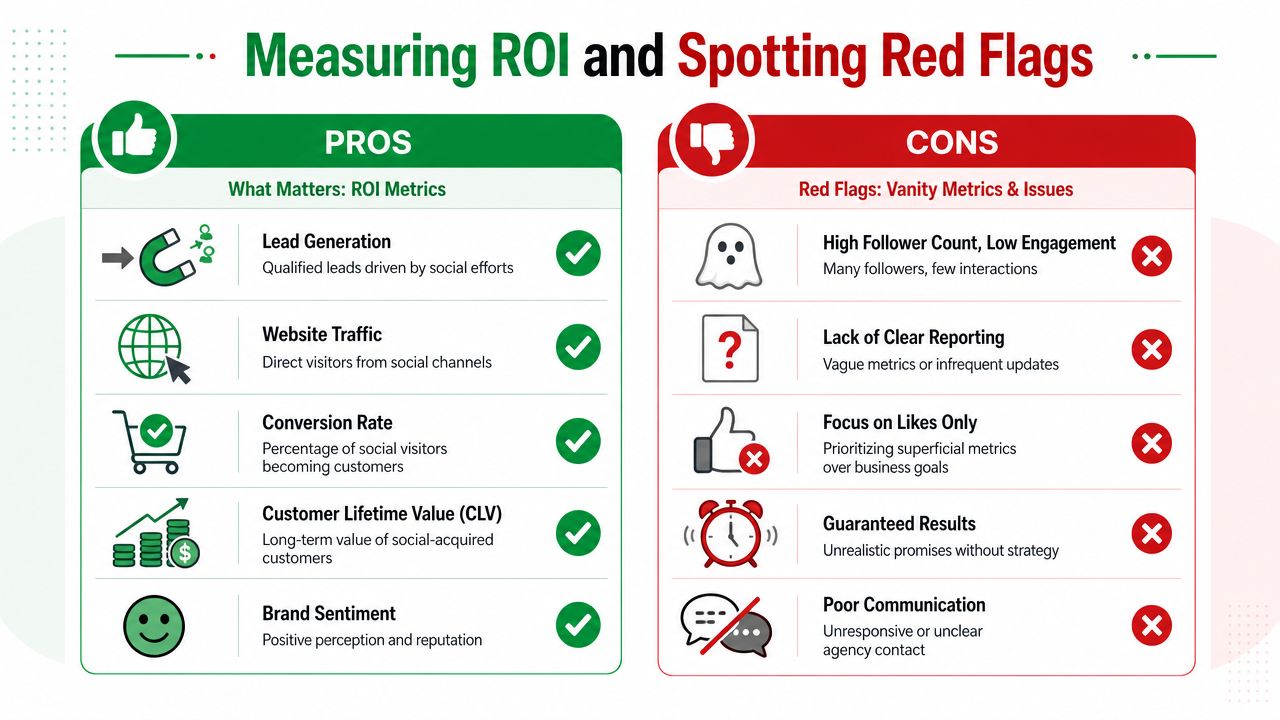
Likes are feedback. Revenue is a business result. Those aren’t the same thing.
A lot of agency reporting leans on the numbers that are easiest to present, not the ones most useful to an owner. You want the metrics that show whether social is helping the business acquire customers efficiently and consistently.
What to measure instead of follower growth
For performance optimization, agencies should prioritize rate-based KPIs such as engagement rate, click-through rate, cost per click, web conversions, and return on ad spend, according to Sprout Social’s guide to social media metrics. Those metrics do a better job of showing media efficiency and business impact than raw counts alone.
That doesn’t mean impressions and reach are useless. It means they’re supporting metrics. They tell you what happened in distribution, not whether the effort produced qualified demand.
Here’s the practical lens:
- Engagement rate: Is the content earning active response relative to exposure?
- CTR: Are people interested enough to leave the platform?
- CPC: How expensive is it to generate that visit?
- Web conversions: Did the traffic do something valuable?
- ROAS: Did the spend generate attributable revenue?
Green flags in an agency relationship
Look for patterns, not one flashy month.
- They explain trade-offs clearly: Why budget moved, why a format was paused, why one audience converted better.
- They connect social to downstream results: Traffic quality, conversion behavior, lead quality, and sales context.
- They revise strategy based on evidence: Not on habit or personal preference.
- They report with context: Performance over time, by channel, by audience, by creative angle.
If you’re trying to improve internal accountability too, this broader framework on how to improve your marketing strategy can help you compare social performance against your wider digital efforts.
Red flags that usually get worse
Some warning signs show up early. Owners often ignore them because they don’t want to restart the search. That’s understandable, but expensive.
Watch for these:
- Reporting that hides business outcomes: Lots of charts, little clarity.
- An obsession with vanity metrics: Follower count as the headline, conversions buried or missing.
- No discussion of attribution limits: Serious agencies know social data has noise and explain it clearly.
- Template strategy: The same cadence, creative style, and recommendations for every client.
- Guaranteed results: Social doesn’t work like a vending machine.
If an agency can’t tell you what’s working, what isn’t, and what they’re changing next, they’re not managing performance. They’re documenting activity.
Frequently Asked Questions About Social Media Agencies
Is hiring an agency better than hiring one in-house marketer
It depends on scope. If you need one person to coordinate content and basic posting, an in-house hire can work. If you need strategy, creative, paid media, reporting, and platform-specific expertise, social media agencies often make more sense because they bring a team with multiple specialties. One person rarely does all of that well for long.
How long does it take to see results
Some signals appear quickly. You may see stronger creative direction, cleaner campaigns, better response handling, and improved reporting in the early months. Financial impact usually takes longer because agencies need time to learn your offer, audience, creative angles, and conversion bottlenecks. The important question isn’t “Did it work instantly?” It’s “Are we learning, improving, and moving toward profitable efficiency?”
Can a very small business still benefit from an agency
Yes, if the scope matches the business. A small company doesn’t always need full-service management. It may need strategy, a setup project, an audit, ad support, or a lighter monthly engagement. The wrong move is buying a large package before the business has the offer clarity, budget discipline, or internal responsiveness to support it.
If you’re weighing whether agency support makes sense for your business, Mr. Green Marketing, LLC offers strategy-led digital services that include social media alongside SEO, PPC, branding, web design, Amazon marketing, and performance reporting. For SMBs that want clearer visibility into what’s working before committing to a larger engagement, the team also provides audit-driven planning to identify gaps, priorities, and practical next steps.
Leave a Comment
sing in to post your comment or sign-up if you dont have any account.