
Social Media Marketing Services: You’re trying to run a business, answer customers, manage staff, keep cash flow steady, and somehow also become your own content strategist, video editor, copywriter, and analyst. That’s usually the moment social media starts feeling less like marketing and more like a second unpaid job.
And posting “when there’s time” rarely works. The page goes quiet, then active, then quiet again. You’re not sure whether Facebook matters more than Instagram, whether short video is worth the effort, or whether any of it is producing calls, leads, or sales.
That confusion is normal. Social isn’t a side task anymore. In a 2024 U.S. survey, 84% of small-to-midsize businesses said they use Facebook to promote products and services, while 67% use Instagram according to Statista’s SMB social media usage data. Your competitors are there because your customers are there.
Social Media Marketing Services: Your All-in-One Guide to Social Media Services
Small business social media marketing services should solve a business problem, not just fill a content calendar. If you hire help and all you get is a few templated graphics and generic captions, you didn’t buy a marketing system. You bought activity.
A real service should help you answer practical questions. Which platforms deserve attention first. What message will resonate with your buyers. What content supports trust. What should be boosted with ad spend. How fast should someone respond to comments and DMs. And most important, how do you know whether the effort is leading to inquiries, booked calls, store visits, or sales.
Most owners don’t need “more posts.” They need structure.
What the right help should do
- Set direction: Define goals, audiences, offers, and the role each platform plays.
- Create consistently: Build content you can publish without scrambling every week.
- Manage engagement: Make sure comments, messages, and brand mentions don’t sit untouched.
- Report clearly: Connect social activity to outcomes you care about.
That’s the difference between random posting and a managed system. If you’re comparing providers, start by looking at whether they offer actual social media management services or just content output.
Social media gets expensive when every post is created in isolation. It gets efficient when content, response workflows, and measurement all support the same goal.
The businesses that get the most from social usually aren’t louder. They’re more organized.
Social Media Marketing Services: What Are Social Media Marketing Services Really
The biggest misconception in this category is simple. People think they’re buying posts.
They’re not. Or at least they shouldn’t be.
Small business social media marketing services are really an operational system. That system covers strategy, content production, publishing, audience interaction, paid promotion, and measurement. If one of those pieces is missing, results usually get messy fast. Content may look polished, but it doesn’t connect to sales. Ads may run, but nobody follows up on comments or messages. Reports may arrive, but they only show likes.
According to a survey summarized by Agility PR, nearly 40% of small businesses had no social media marketing strategy, and almost one-quarter measure success only by likes, shares, and comments rather than business outcomes in this Agility PR summary. That gap is where many services fail. They produce content without building a process.
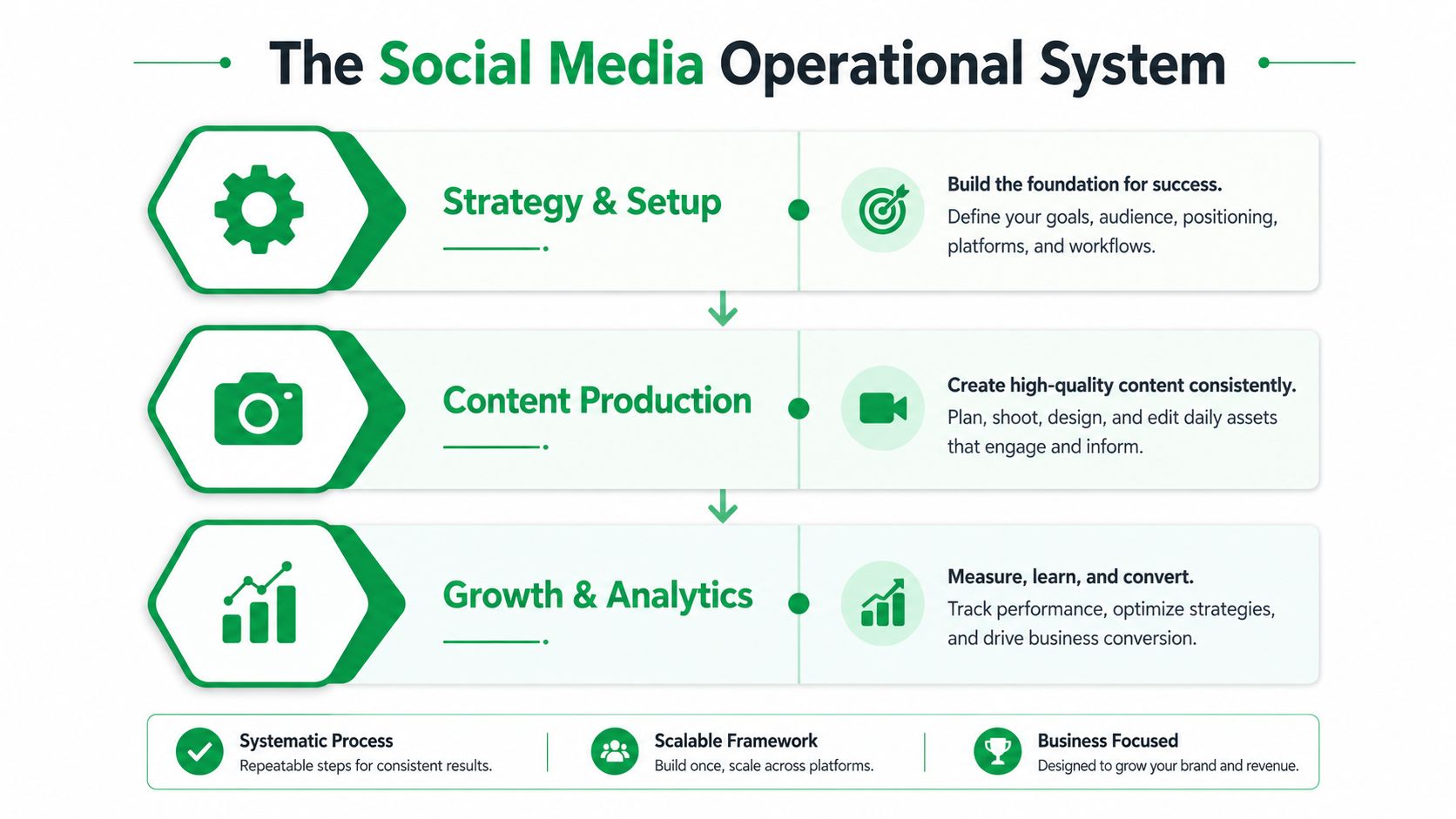
The system behind the posts
A functioning service usually includes three layers:
- Strategy and setup
Audience definition, offer positioning, platform selection, content themes, tracking setup, and response expectations. - Content production and publishing
Copy, graphics, short-form video, approvals, scheduling, and adaptation by platform. - Growth and analytics
Paid social, testing, performance review, and decisions based on business outcomes.
What low-quality service looks like
Low-quality social management tends to have a few obvious traits:
- No diagnosis: They never ask about your sales process, margins, service area, or ideal customer.
- Template overload: The same design style and caption structure gets reused across every client.
- Vanity reporting: Reports focus on impressions or likes without tying activity to leads or inquiries.
- Weak follow-through: Nobody owns replies, DMs, review monitoring, or customer handoff.
Practical rule: If a provider can describe your posting frequency in detail but can’t explain how social supports your pipeline, they’re selling output, not strategy.
That’s the core reframe. You’re not hiring someone to “keep your page active.” You’re hiring a partner to make social channels useful.
The Core Services You Should Expect
When you pay for small business social media marketing services, there are a few essentials that should be on the table. The mix can vary by business type, but the foundation doesn’t change much. If a provider skips these, you’re probably getting a stripped-down version dressed up as full management.

Social Media Marketing Services: Strategy and planning
This is the piece many owners don’t see, which is exactly why weak agencies ignore it. Good strategy work identifies who you’re trying to reach, what message will move them, what offer deserves attention, and which platforms fit the buying context.
Adobe explains that the best platform depends on audience demographics and intent, with Instagram often fitting younger consumers and LinkedIn typically fitting B2B. A good provider chooses channels based on your audience, not internal preference, as noted in Adobe’s guide to small business social media marketing.
That matters more than people think. A local home service company might need Facebook for local trust signals and lead ads. A B2B consultant may need a stronger LinkedIn posting strategy because authority, expertise, and buyer education matter more than broad consumer reach.
Good strategy sounds like this:
- Audience clarity: “We’re targeting homeowners in your service area who are comparing options.”
- Offer clarity: “We’re promoting estimates, consultations, or seasonal packages.”
- Platform logic: “We’re using the channels your buyers already use.”
Bad strategy sounds like this:
- Generic planning: “We post on everything because more exposure is better.”
- No business context: “We’ll keep things engaging.”
- No prioritization: “Let’s try a little of everything.”
Content creation and curation
This is the visible part. Captions, graphics, reels, carousels, stories, photos, edited clips, and sometimes content pulled from customer questions or staff expertise.
But good content creation isn’t about filling space. It’s about matching content format to buying stage. Short video can build awareness. Testimonial graphics can strengthen trust. Offer-based posts can create action. A service that understands that distinction will almost always outperform a service that just posts motivational blurbs and stock photos.
A strong provider also builds around your real business assets. Staff knowledge. Customer FAQs. Before-and-after visuals. Product demos. Process clips. Those usually outperform generic design filler because they feel specific and credible.
Paid social advertising
Organic posting alone usually won’t do everything. Paid social extends reach, promotes offers, retargets visitors, and helps you test what messaging gets action.
This part should include audience setup, creative testing, budget pacing, and conversion-focused thinking. It should not be “boost random posts when they seem to do well.” That’s not a system. That’s improvising.
If you’re comparing support options, some businesses look for a broader social media growth service that combines organic management with campaign support so content and advertising aren’t pulling in different directions.
Community management and engagement
Many packages underdeliver on their promises. They will publish your content, but they will not manage the interactions and engagement that follow.
That’s a problem. Comments, DMs, review mentions, and tagged posts are often where trust gets built. Or lost.
A silent page tells customers you’re absent, even if your posts look polished.
Good community management includes response guidelines, escalation rules, lead handoff, and consistency in tone. If your business gets messages asking for quotes, appointments, pricing, or availability, someone needs to own that workflow. Otherwise social becomes a leaky bucket.
Social Media Marketing Services: Beyond Likes The Real Benefits and ROI
A growing follower count can feel encouraging. It’s just not enough on its own.
The authentic value of small business social media marketing services shows up in three places. Time savings, stronger trust, and better conversion paths. If your service provider can’t connect work to one of those, the program may stay busy without becoming useful.
The operational benefit most owners undervalue
First, you get your time back. Not in some abstract way. In a real way. Fewer last-minute caption scrambles, fewer forgotten replies, fewer evenings trying to design posts in Canva after a full workday.
That reclaimed time matters because owners usually make better decisions when they’re not buried in low-impact marketing tasks. Social support should remove friction, not create another approval bottleneck.
Social as a trust layer
People often see your social profiles before they ever contact you. They scan recent posts, look at comment quality, check whether your brand seems active, and notice how you answer people.
Reputation and social media naturally overlap at this point. For service businesses especially, customer perception forms across platforms, reviews, replies, and website consistency. That’s why practical guidance like the insights from the Review Overhaul team can be useful even outside legal marketing. The core lesson applies broadly. Messaging, responsiveness, and public trust signals work together.
If your website says one thing, your reviews suggest another, and your social feed feels abandoned, prospects notice the mismatch.
What ROI reporting should actually show
According to Hootsuite, consolidating performance data from all channels in one place helps teams identify what works, repeat it, and stop doing what doesn’t, as described in Hootsuite’s small business social media guidance. That’s the center of ROI. Not just collecting metrics, but using them to make better decisions.
A useful report should answer questions like:
- Which content drove action: What attracted clicks, inquiries, or conversations.
- Which platform contributed most: Where attention turned into real business movement.
- What needs adjustment: Creative, targeting, timing, or offer clarity.
- What happens next: The next round of tests based on what the data suggests.
That last point matters. Reporting isn’t a receipt. It’s a decision tool.
Social Media Marketing Services: Understanding Pricing Models and Timelines
Pricing gets confusing because the same label can cover very different levels of work. One “social media package” might include strategy, filming, copywriting, ad management, and reporting. Another might be a handful of scheduled posts with almost no customization.
That’s why the pricing model matters less than the scope and ownership behind it.
Comparing Social Media Service Pricing Models
| Model | Best For | Pros | Cons |
|---|---|---|---|
| Monthly retainer | Businesses that need ongoing management and consistent execution | Predictable scope, recurring support, easier planning, stronger continuity | Can feel expensive if expectations and deliverables aren’t clearly defined |
| Project-based pricing | Businesses launching a campaign, building a strategy, or needing a short-term content push | Clear beginning and end, easier budgeting for one initiative, useful for testing a provider | Momentum can drop after the project ends, less ideal for daily engagement or ongoing optimization |
| Hourly consulting | Businesses with an internal team that needs direction rather than full execution | Flexible, efficient for audits and planning, useful for troubleshooting | Execution still falls on your team, which can create delays or inconsistency |
What to watch for in proposals
Cheap offers usually cut the invisible work. Strategy disappears. Reporting gets thin. Engagement management is excluded. Content becomes generic because there isn’t enough budget to learn your business properly.
A fair proposal should clarify:
- Deliverables: What gets created, published, managed, and reported
- Roles: Who writes, designs, approves, responds, and adjusts campaigns
- Platform scope: Which channels are included and why
- Ad handling: Whether paid media setup and management are part of the package
- Revision process: How feedback is handled without dragging everything out
Timelines are rarely instant
One of the biggest mistakes owners make is expecting a complete turnaround the moment they hire an agency. Good onboarding takes time because the provider has to understand your audience, offers, voice, assets, and internal process.
In practice, the early phase often includes discovery, access setup, content planning, and approval workflows before execution settles into rhythm. If someone promises immediate, fully optimized performance with no diagnostic work, be careful. Fast starts can be good. Rushed starts usually aren’t.
Social Media Marketing Services: How to Evaluate and Choose the Right Agency
Choosing an agency is less about finding the flashiest Instagram feed and more about finding a team that can think clearly about your business. Plenty of agencies can make attractive posts. Fewer can explain how those posts support lead flow, sales conversations, retention, or customer trust.

Ask better questions early
Skip “How many posts do we get?” at the start. That matters, but it’s not the first filter.
Ask questions like these instead:
- How would you decide which platforms matter for my business?
- What would you want to know about my customers before building a plan?
- How do you handle comments, DMs, and lead handoff?
- What does reporting look like, and how do you connect it to business outcomes?
- What happens if a platform is active but not producing useful results?
Those questions force the provider to reveal how they think. If the answers stay vague, that’s useful information.
Social Media Marketing Services: Look for diagnosis, not just deliverables
A thoughtful agency will ask about your margin structure, service area, seasonality, sales process, internal bottlenecks, and capacity. They need that information because social doesn’t operate in a vacuum. If your team can’t answer messages quickly or your landing page is weak, those issues affect results.
That’s also why a broader decision guide like this article on how to choose a digital marketing agency can help. The same evaluation logic applies here. Strategy quality, communication discipline, and reporting clarity matter more than polished sales language.
What to listen for: Good agencies talk about goals, audience behavior, process, and trade-offs. Weak agencies jump straight to content quantity.
A short example helps. If you run a local service company and an agency immediately recommends TikTok without asking who buys from you, how your jobs are scheduled, or whether your team can handle inbound inquiries, they’re guessing.
Here’s a useful benchmark for what smart agency evaluation sounds like in practice:
Red flags that deserve a hard pause
Some warning signs are obvious. Others are subtle.
- Guaranteed results: No honest marketer can promise exact outcomes in advance.
- One-size-fits-all packages: Different businesses need different platform mixes and content priorities.
- No sample reporting: If they won’t show you how they measure success, assume measurement is weak.
- No engagement process: Publishing without response management is incomplete service.
- No questions about your business: If they don’t ask much, they can’t customize much.
And one more. If the sales conversation feels smoother than the strategic conversation, pay attention. Strong agencies may simplify things, but they won’t oversimplify them.
Social Media Marketing Services: What Success Looks Like KPIs and Our Process
Success in social media isn’t a prettier feed. It’s progress you can explain.
That means your KPIs should match your goal. If you need awareness, you monitor visibility and engagement patterns. If you need leads, you focus on traffic quality, inquiry volume, and conversion behavior. If you need better retention or customer trust, response quality and consistency start mattering more.
What a useful KPI view includes
A solid monthly view should show more than raw numbers. It should explain movement.
For example:
- What we published: Which messages, offers, and creative themes went live
- What happened: Which assets earned attention, clicks, replies, or lead activity
- What we learned: What the market responded to and what fell flat
- What changes next: The tests, reallocations, or creative shifts for the next cycle
As ROI measurement becomes standard, with only 1% of businesses saying they can’t measure it, agencies need to provide reporting that links social media activity to tangible outcomes, according to PostcardMania’s small business marketing statistics guide.
How we approach the work
From the agency side, the process should feel structured but not rigid. We start by listening. Business model, audience, offer, sales cycle, internal bottlenecks, existing content, platform history. That context shapes the plan.
Then we build the operating system. Messaging priorities, content cadence, platform focus, approval flow, and reporting expectations. After launch, the work keeps evolving. Social management works best when the team reviews what happened, makes decisions quickly, and adjusts before bad habits harden into routine.
Mr. Green Marketing, LLC offers strategy-led digital marketing support that includes social media among its services, along with broader channel support when a business needs social connected to web, SEO, PPC, or branding efforts. That kind of setup can be useful when isolated posting isn’t the actual problem.
The important part is this. A good partnership gives you clarity. You know what’s being done, why it’s being done, what’s working, and what changes next.
If you want a clearer view of whether your current social presence is helping your business or just keeping you busy, Mr. Green Marketing, LLC can review the gaps, identify practical opportunities, and give you a straightforward starting point for improvement.
Leave a Comment
sing in to post your comment or sign-up if you dont have any account.