
Local SEO averaged about $1,557 per month in a 2024 survey of 439 SEO providers, with agencies near $1,819, freelancers near $1,150, and advisory work at $75–$100 per hour, according to this local SEO cost breakdown. The most common monthly retainer band was $501–$1,000, and one-time projects most often landed at $2,501–$5,000.
And every one of those figures was reported by the people selling the service. That makes the averages a map of asking prices, useful for orientation, silent on what any particular business needs. A plumber with two vans and a leaky website does not appear anywhere in a provider survey.
So a pricing question splits in two. What the market charges has published answers. What your business should spend has only yours: gross profit per job, close rate, lead volume. The break-even test follows from those three numbers. If the leads a retainer generates, valued at your own margins, clear the monthly fee, the quote pays. If they cannot, the benchmark average is trivia.
Table of Contents
- Local SEO Pricing Benchmarks at a Glance
- What a Local SEO Retainer Actually Pays For
- Pricing Models Compared Side by Side
- Factors That Move a Quote Up or Down
- Does AI Discovery Change What You Pay
- Judging Whether a Quote Pays Off
- Cheap Packages and the Pre-Signing Checklist
Local SEO Pricing Benchmarks at a Glance
A 2024 poll of 439 SEO providers summarized in this local SEO cost breakdown found local SEO averaged $1,557 per month, with agencies averaging approximately $1,819 and freelancers about $1,150. That spread alone should stop you from shopping for a single "correct" price.
The engagement type matters as much as the provider type. The most common hourly band in that same market data was $75–$100, which is what you're buying when you pay for an audit, a consultation, or a few hours of implementation rather than a full program.
Local SEO benchmark prices by engagement type
| Engagement | Typical price | Benchmark | What it usually covers |
|---|---|---|---|
| Hourly advisory or audit work | $75–$100 per hour | Most common hourly band | Consultations, audits and limited implementation |
| Freelancer monthly retainer | about $1,150 per month | Average across freelancers | Solo practitioners running a single-location program |
| Agency monthly retainer | about $1,819 per month | Average across agencies | Full-service local programs with technical and content work |
| Most common monthly retainer | $501–$1,000 per month | Used by 20.4% of providers | Foundation or limited-scope programs |
| One-time SEO project | $2,501–$5,000 | Most common project range | Listing cleanup, profile setup and site audits |
| Blended average across providers | about $1,557 per month | Ahrefs 2024 survey of 439 providers | Mixed scope, all provider types |
The $501–$1,000 band isn't a fringe discount tier. In Ahrefs' provider survey, 20.4% of SEO providers charged $501–$1,000 per month, making it the most common monthly retainer range, according to this local SEO pricing analysis.
Why one average hides two markets
A separate 2024 survey of 260 agencies found 64% charged less than $1,000 per month, though the researchers cautioned the sample might not be statistically representative, as noted in this review of local SEO costs. Read that alongside the agency average and you get a market with a large cluster of low-cost foundation providers and a smaller group running full-scale programs.
These are reported provider prices, not a price index. A quote outside a band isn't automatically wrong – it may reflect multi-location optimization, technical remediation, content production, reputation management, or a higher-cost market.
Practical rule: find the row that matches the scope you're actually buying, check which band your quote falls into, and ask for the reason if it sits far outside that band.
Placement first, judgment second. A quote well above the agency average for one location with clean listings deserves hard questions. The same quote for three locations with inconsistent directory data and no service pages may be underpriced.
What a Local SEO Retainer Actually Pays For
A retainer is closer to paying for a storefront's upkeep than to a one-time paint job. The sign fades, the hours change, a competitor opens across the street, and the window display that worked last spring stops pulling people in. Local visibility behaves the same way, which is why local SEO pricing is best modeled as a recurring operations budget rather than a one-time website expense, as this local SEO cost guide argues from a survey of 439 providers that put the average retainer near $1,557 per month.
The technical reason is that the signals you're paying to influence need maintenance. Google evaluates relevance, distance, and prominence, and prominence draws on web references, links, directories, review volume, and review quality. None of those stay fixed while you do nothing.
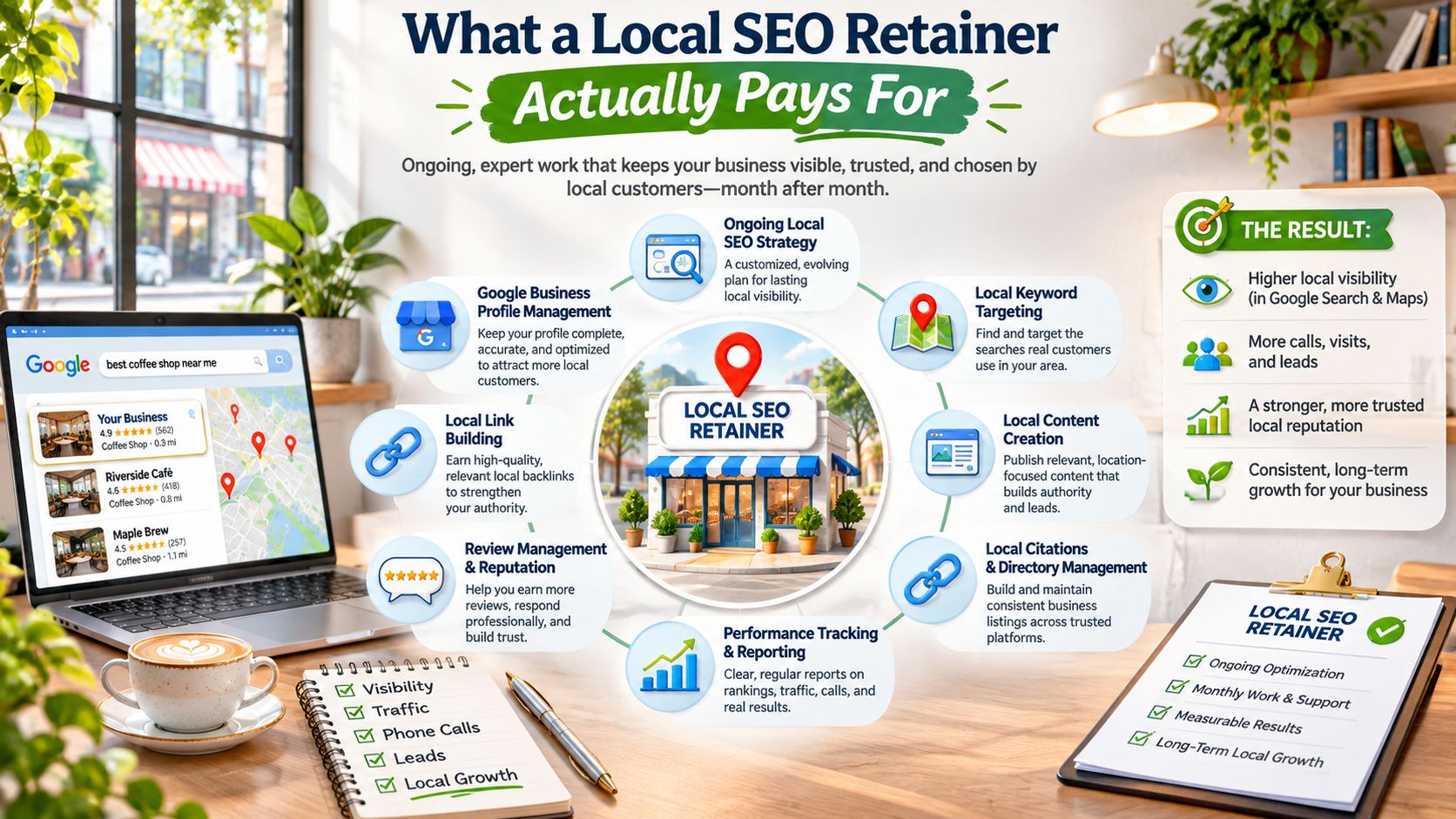
The seven jobs a fair proposal names
Hold any proposal against this list and mark what's included:
- Google Business Profile updates – hours, holiday hours, services, products, photos, posts.
- Citation and NAP monitoring – name, address, phone consistency across the directories that matter, plus suppression of duplicates.
- Review-response workflows – request timing, response templates, escalation for policy problems.
- Service and location page improvements – the pages that have to match what people search for.
- Technical fixes – indexation, internal linking, structured data, page speed issues that block conversions.
- Local content publishing – useful area and service content, not town-name swaps.
- Measurement and reporting – baseline rankings, profile actions, calls, direction requests, form submissions, qualified leads.
A defensible proposal maps price to that production system rather than promising a ranking position. If you want a deeper breakdown of how monthly search work gets scoped and billed, our guide to monthly SEO services walks through the deliverable structure we use.
What each band usually buys
The $501–$1,000 band can represent a limited-scope foundation program: profile upkeep, citation hygiene, a small number of page improvements, basic reporting. Agency-led execution around the $1,800 monthly benchmark is more consistent with ongoing technical, content, reputation, and reporting work running in parallel.
Price should move up when you have multiple locations, inconsistent listings, competitive service keywords, weak review velocity, or a site needing architectural and schema changes. Each location adds entity data, landing pages, tracking, and reputation workload.
So the question to put to any provider is blunt: which of these seven jobs is in my quote, and who does each one every month? We answer that in writing after a consultation, with a customized strategy and proposal that names the recommended services and the approach behind them.
Pricing Models Compared Side by Side
Take one hypothetical business and run it through every model: a two-location dental practice, decent reviews at the older office, almost none at the new one, and a website with a single "Services" page covering everything from cleanings to implants.
Hourly advisory fits the owner who has a marketing-minded office manager and just needs a diagnosis. At $75–$100 per hour, the practice buys a prioritized fix list and coaching, then does the work in-house. Cheap on paper. It fails when nobody internally has time to execute.
A freelancer retainer at roughly $1,150 per month on average suits the older office running as a standalone single-location program. One practitioner, one location, limited scope, direct communication.
An agency retainer near $1,819 per month on average fits the two-location version, where separate location pages, implant and emergency service pages, review generation at the new office, and consolidated reporting all need different specialists. The difference in price usually buys team depth and reporting discipline, not magic.
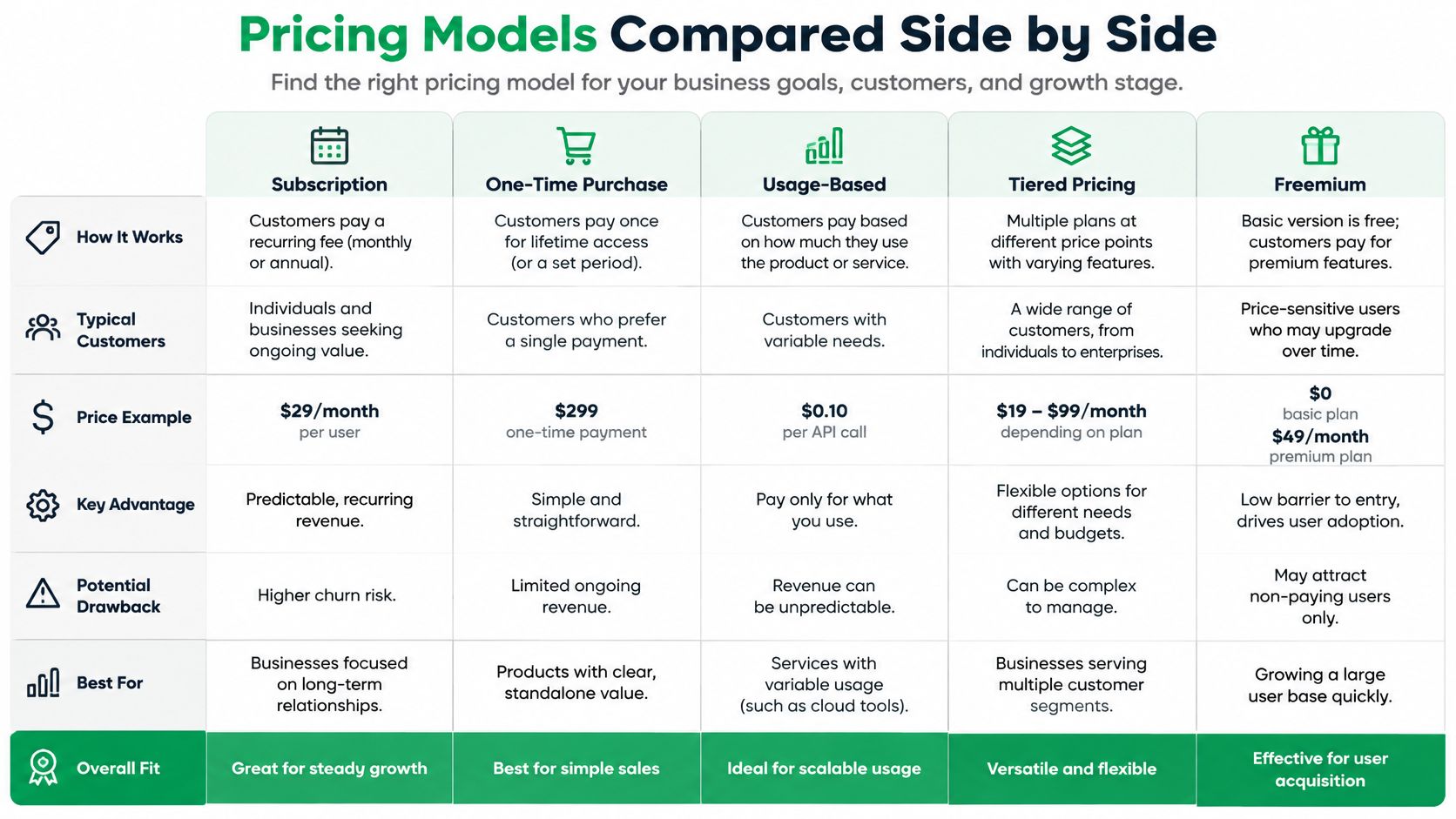
Local SEO pricing models compared
| Model | How it is billed | Typical price | Best fit |
|---|---|---|---|
| Hourly advisory | Billed per hour for audits, consultations or coaching | $75–$100 per hour | Owners who will carry out the fixes themselves |
| Freelancer monthly retainer | Fixed monthly fee | about $1,150 per month on average | Single-location businesses with simple needs |
| Agency monthly retainer | Fixed monthly fee for a team-based program | about $1,819 per month on average | Multi-service or multi-location programs |
| One-time project | Fixed fee for a defined deliverable | $2,501–$5,000 most common | Listing cleanup, profile setup, site audit |
| Performance-linked fee | Base fee plus a bonus tied to qualified leads | No published benchmark, negotiated per contract | Businesses with reliable lead tracking in place |
A one-time project in the $2,501–$5,000 range suits the practice that wants the new office's listings cleaned up, its profile built correctly, and a technical audit delivered – then wants to pause and reassess.
A performance-linked fee only works when both sides agree what counts as a qualified lead. For the dental practice, that means defining whether an implant inquiry from outside the service area counts, who owns the call tracking numbers, and what happens to a lead the front desk never calls back.
Most buyers end up in a hybrid: pay once for the audit and remediation, then run a smaller retainer covering only the items the audit flagged as ongoing.
We build customized strategies for local service businesses aimed at more leads, calls and jobs, and for ecommerce brands aimed at more traffic, conversions and sales – the model follows the goal, not the other way round. And the cheapest model is rarely the cheapest result if it leaves the work undone.
Factors That Move a Quote Up or Down
Price follows work, and work follows inputs. Two businesses in the same industry can receive quotes that differ by a factor of three for entirely defensible reasons.
Location count comes first. Each location adds entity data to maintain, a landing page to write and improve, call tracking to configure, and reviews to generate and respond to. A three-location quote isn't a single-location quote multiplied by three, but it isn't the same quote either.
Listing inconsistency comes second, and it's the most commonly underestimated cost. If your business name, address and phone number differ across directories, someone has to find every variant, claim or edit each listing, and verify the corrections. That's hours of remediation before any growth work starts.
Competitive service keywords raise the content and link workload per ranking gain. Ranking for "emergency plumber" in a dense metro takes more published pages and more acquired authority than ranking for a niche service in a small town. Our comparison of local SEO versus national SEO explains why geographic scope changes the labor curve so sharply.
Website architecture and schema need developer time, not just an SEO's recommendations. Rebuilding a flat site into service and location hierarchies, adding structured data, and fixing internal linking are project-scale tasks that often justify a separate one-time fee.
Weak review velocity adds recurring workflow: request sequences, response management, escalation when something goes wrong.
On the lower side, a single location with clean listings, accurate profile data, and service pages already published needs less monthly production. That business can legitimately buy a foundation program and be well served by it.
Higher-cost markets lift both hourly and retainer quotes because the labor behind them costs more.
Ask one line-item question per factor: how many locations are covered, how many listings need correction, which keywords are in scope, who does the development work, and what review workflow is included.
A quote above the benchmark may reflect multi-location optimization, technical remediation, content production, reputation management, or a higher-cost market. Make the provider name which one applies to you. If they can't, you're paying for a number rather than for work.
Does AI Discovery Change What You Pay
Local discovery no longer runs only through the map pack, and most pricing guides haven't caught up. Early survey and call-tracking reports point the same direction: a growing share of consumers ask AI tools for local-business recommendations, Google keeps testing features that contact businesses directly about availability and pricing, and some agencies report AI-originated call volume climbing fast. Treat that as direction, not forecast. The evidence is early, much of it is seller-reported, and none of it predicts what happens in your specific service area.
It does change what a complete scope looks like, though.
Scope items a fair quote should name
- Accurate hours, prices and service details on the Business Profile and the website, so an AI answer or an automated availability call returns facts you'd stand behind.
- Call tracking that labels AI-originated calls separately, rather than dumping them into a generic "organic" bucket.
- Review and FAQ content written so AI tools can cite it: specific services, specific areas, plain-language answers to the questions buyers ask.
- Reporting that counts those calls next to form fills, so you can see which channel produces jobs.
Each item adds labor. A quote that skips them isn't automatically cheaper, only less complete, and the gap shows up later as an untracked channel you can't evaluate. Our overview of AI search optimization services covers how that work differs from classic map-focused optimization.
The cheapest "citations and Google Business Profile" package was already thin. In an AI-mediated discovery path it's thinner still, because the machine reading your business data has no patience for a wrong service description or an hours field nobody updated.
So ask the question directly: does the retainer include AI visibility monitoring, answer accuracy checks, and call attribution, or is that a separate deliverable with its own price? Undefined "AI optimization" sold as a premium add-on is a scope gap dressed as innovation. And because the published claims come from sellers, verify the channel with your own numbers: ask how AI-originated calls appear in the monthly report, and ask to see a sample report before you sign.
Judging Whether a Quote Pays Off
Here's the weakness in almost every published price range: it's seller-side. A synthesis of local SEO cost evidence notes that no identified survey directly measured what small-business owners pay, while the frequently cited SE Ranking/Duda data surveyed 260 agencies, 94% of which served small or local businesses. In that survey, 22% of U.S. and Canadian agencies charged more than $2,000 per month.
That makes the widely repeated $500–$1,000 range a description of agency pricing bands, not a statement about what buyers spend or what it takes to get results. Useful for placement. Useless for deciding profitability.
A break-even test you can run today
Forget the market for a moment and use your own numbers. Say a home services company is quoted a $1,000 monthly retainer, gets 20 qualified leads a month, closes 25% of them, and earns $400 gross profit per customer.
| Input or result | Example value | Where to get it |
|---|---|---|
| Monthly retainer | $1,000 | The proposal |
| Qualified leads per month | 20 | Call tracking and CRM records |
| Close rate | 25% | Sales records |
| Gross profit per customer | $400 | Accounting records |
| Expected gross profit per lead | $100 | 25% close rate × $400 gross profit |
| Leads needed to cover the fee | 10 per month | $1,000 ÷ $100 |
Five customers at $400 each bring in $2,000, covering the fee twice over. But the number that governs the decision is the last row: at $100 of expected gross profit per lead, the program breaks even at 10 leads a month. Everything above that is contribution. Everything below it is a subsidy.
Those example values are placeholders. Replace every one of them. Our walkthrough on how to calculate marketing ROI shows how to build the same model across channels so local search isn't judged in isolation.
Normalize before you compare
Two quotes aren't comparable until you adjust for location count, competition, service area, lead value, and included labor. A low quote covering one location and profile upkeep can be more expensive per unit of work than a much higher quote covering three locations with content and technical remediation included.
Customer lifetime value moves the answer too. If a customer returns for repeat service, the acceptable cost per acquired customer rises, and a program that looks marginal on first-job profit looks sound over the relationship. Just don't use lifetime value to excuse a program that produces no leads at all.
Pull the real inputs from your CRM, your call tracking, and your accounting records before the first sales call. A provider who won't discuss break-even with your numbers is selling a price, not an outcome.
Cheap Packages and the Pre-Signing Checklist
Say a plumber pays $300 a month for a profile-only package. Meanwhile the business name is spelled one way on Yelp, another on a legacy directory, and the phone number on a third listing is a disconnected line from two years ago. Three months in, the profile looks tidy and the phone hasn't moved.
Nothing mysterious happened. The package edited one input while the actual problem sat elsewhere. Google's guidance on improving local ranking states that local ranking relies primarily on relevance, distance, and prominence, and that review count, review score, links, articles, and directory information contribute to prominence. Entity inconsistency, weak landing-page relevance, missing structured data, and thin local authority all stayed exactly where they were.
Separate the audit from the growth work
A sound proposal prices an initial audit and remediation phase by diagnostic complexity, then a continuing growth retainer. The audit establishes accurate name, address, phone, category, service-area, indexation, and conversion-tracking data. Only then can anyone prioritize pages and locations using baseline rankings, profile actions, calls, direction requests, form submissions, and qualified leads.
Google's local ranking documentation also states there's no way to request or pay for a better local ranking. Any guaranteed map position is therefore a red flag, not a selling point.
Watch equally hard for fabricated locations and keyword-stuffed business names. Google's Business Profile eligibility and representation guidelines require that a business make in-person contact with customers during its stated hours, that the name match how the business is consistently represented offline, that the address or service area be accurate and precise, and that the fewest necessary categories be used – with generally one profile per business, since duplicates create display problems in Search and Maps. A package promising dozens of artificial city profiles isn't aggressive optimization. It's future remediation work you'll pay for twice.
Reviews deserve the same scrutiny. Google's policies apply to reviews, photos, videos, posts and other user-generated content, and content can be limited or suspended when contributions are consistently unhelpful, harmful, off-topic or in violation of policy. Price monitoring, compliant request workflows, response management and escalation. Purchased reviews and review gating aren't deliverables, they're liabilities. For consumer-side context on how reviews influence choice, BrightLocal's 2025 Local Consumer Review Survey used a representative panel of 1,026 U.S. adults.
Five things to check before signing
- A written deliverables matrix – every task, its frequency, and who owns it.
- Monthly hours or production capacity – a number you can hold them to, not "ongoing optimization."
- Excluded costs – paid tools, content, developer time, link acquisition, listed separately.
- Reporting definitions – what "lead," "call," and "visibility" each mean in the report.
- A 90-day review of leading indicators – calls, direction requests, form submissions, qualified inquiries.
Our list of questions to ask an SEO agency expands each of these into the exact wording to use on a call.
Do one thing this week: calculate your break-even lead count, then bring it to the first conversation. We quote after a consultation, so the numbers you bring shape the scope rather than the reverse – and you can start with a free audit by entering your website, email and name in the form on our home page.
Mr. Green Marketing, LLC builds local search programs for service businesses that need more leads, calls and jobs, and for ecommerce brands chasing traffic, conversions and sales, with pricing set after a consultation and a customized proposal that names the recommended services and approach. Bring your break-even numbers and we'll scope the work against them, starting with the free audit and performance report you can request from our home page. Visit Mr. Green Marketing, LLC to request that audit and see where your local visibility is leaking before you commit to a monthly fee.
Leave a Comment
sing in to post your comment or sign-up if you dont have any account.