
U.S. social advertising reached $117.7 billion in 2025, up 32.6% year over year, according to IAB figures reported by Marketing Dive. That single number explains why so many social media quotes now feel mismatched to the work. Social isn't a posting service anymore. It's a paid media channel with organic content attached, and it's priced accordingly.
Which is exactly why the hourly rate confuses people. A quoted social media marketing hourly rate doesn't buy posts, reach, or leads. It buys hours of a person's capacity, and the deliverables you attach to those hours decide what you get. Two quotes at wildly different rates can produce the same invoice total, and the cheaper one can be the more expensive decision.
This guide treats the hourly rate as a labor capacity figure rather than a price. It walks through the benchmarks, what moves them, how to build a quote from scratch, and how to check any number a provider hands you.
Table of Contents
- Social Media Marketing Hourly Rate Benchmarks at a Glance
- What Moves a Social Media Hourly Rate Up or Down
- Choosing Between Hourly, Retainer, Project and Performance Pricing
- How to Build a Quote From Hours and Deliverables
- Pricing Results Without Promising Revenue
- Compare Quotes by Scope, Not Just Rate
Social Media Marketing Hourly Rate Benchmarks at a Glance
Most buyers meet the lowest number first. Freelance social media managers on Upwork quote $14 to $35 an hour, median $20, drawn from historical contracts worldwide. Four times that appears on U.S. agency rate cards in the same month. Both figures are real.
| Provider or level | Hourly rate | Basis |
|---|---|---|
| Freelance social media managers, worldwide (Upwork) | $14–$35, median $20 | Historical freelance contracts |
| Social media managers, all experience levels | $66.96 average | 2024 survey of more than 100 agency and freelance providers |
| Social media managers under 3 years | $46.71–$50.00 | Same 2024 survey |
| Social media managers 4–6 years | $74.86 | Same 2024 survey |
| Social media managers 7+ years | $92.23 | Same 2024 survey |
| Agency social media professionals 7+ years | $85.33 | Same 2024 survey |
| U.S. digital marketing agency listings | $82.66 average, $84.40 median | 2024 analysis of 6,808 listings |
| Agencies, self-reported average | $137.94 | Worldwide self-reported survey; 49.88% of agencies do not bill hourly |
| Consultants, self-reported | $143 | Same worldwide self-reported survey |
Those rows come from Slice Media's benchmark compilation, which pulls marketplace data, agency listings, and self-reported surveys into one place. Read as three separate markets, the numbers stop fighting each other.
A 2024 analysis of 6,808 U.S. digital marketing agency listings found an average listed rate of $82.66 and a median of $84.40. A separate self-reported survey put agency averages at $137.94. Listing pages are marketing, so they quote the number that attracts the client. Self-reported surveys capture what providers wish they charged, or what their best clients pay.
Why a $20 rate and an $84 rate can both be honest
The gap tracks geography, overhead, specialization, seniority, and whether account management, strategy, and reporting are bundled into the hour. A solo operator in a low-cost market with three tools and no office carries almost no overhead per billable hour. A U.S. agency carries rent, insurance, software, sales time, project management, and quality review, and every one of those costs lands in the rate.
The spread also reflects a shift in how digital marketing gets sold. Many providers now use monthly retainers or project pricing rather than treating each deliverable as a standalone hourly task. Nearly half of agencies, 49.88%, say they don't bill hourly at all. If a provider won't quote you an hourly rate, that's not evasion. It's a signal that they price scope, not time.
What the table can't tell you: whether the hour includes strategy, reporting, or just publishing. Ask before you compare two numbers.
Find the row closest to your own situation. A two-platform local business with a part-time need belongs near the bottom of the experience ladder. A multi-location brand with paid social, creator coordination, and monthly reporting sits at the top, whatever the hourly number says.
What Moves a Social Media Hourly Rate Up or Down
Two managers can quote the same three platforms and charge $50 and $95 an hour for identical-looking work. That's rarely greed. It's what each hour contains.
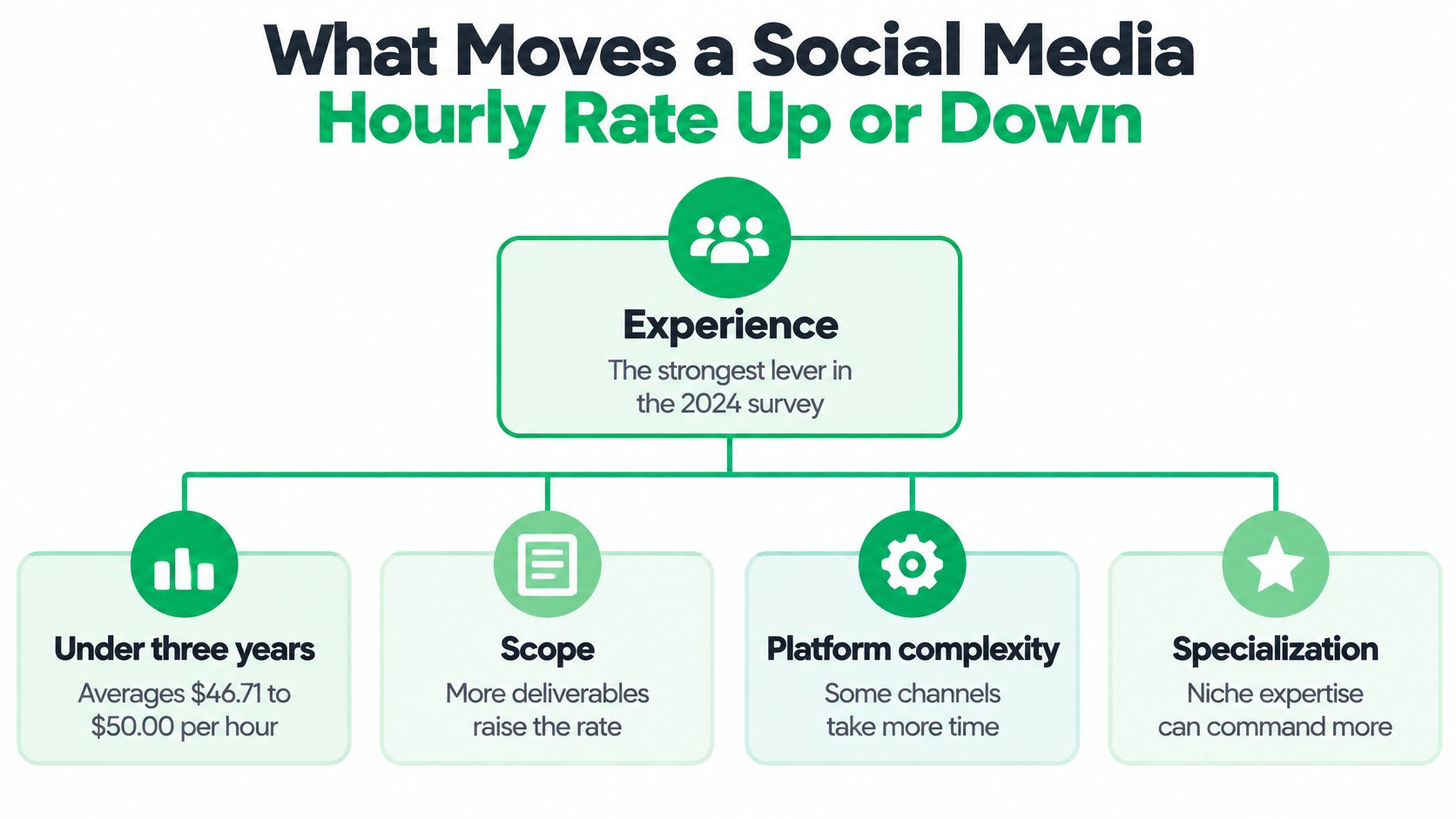
Experience is the strongest lever
A May 2024 survey of more than 100 agency and freelance social media managers reported an average hourly rate of $66.96, and the breakdown by tenure is the most useful part. Professionals with fewer than three years averaged roughly $46.71 to $50.00 per hour. Four to six years averaged $74.86. Seven or more years averaged $92.23, and agency professionals at that level reported about $85.33.
The jump from the first band to the third is close to double, and it doesn't come from typing faster. It comes from strategy, judgment about what not to publish, and the ability to run a complex client program without supervision.
Scope and deliverables set the floor
A rate that covers research, planning, copywriting, publishing, moderation, analytics, and a monthly report is a different product from one that covers publishing alone. Original video, paid-social oversight, influencer coordination, and multi-platform governance each push the effective rate up, because each one adds specialist labor the generalist can't absorb.
Say a bakery gets two quotes for Instagram, Facebook, and a Google Business profile. The first provider schedules twelve posts a month and sends a screenshot report. The second runs the same calendar plus a $1,500 ad budget, tunes audiences weekly, and joins a 45-minute strategy call. Same platforms. Different jobs.
Geography, overhead, and accountability
A provider in a high-cost metro carries rent, insurance, tools, and sales time that a solo freelancer three time zones away doesn't. And a provider willing to be measured on qualified leads, revenue, or assisted conversions is taking on risk that a posting-only provider never accepts. That accountability justifies a premium, as long as the tracking is real.
The honest question isn't "what's your rate?" It's "what's in the hour, and what happens when the hour runs out?"
If you can't answer that from a quote, start with a social media audit of the accounts themselves. The gaps it surfaces usually explain the price difference faster than any conversation about rates.
Choosing Between Hourly, Retainer, Project and Performance Pricing
Decide which model you're buying before you compare a single number. The billing structure determines who carries the risk, and that matters more than the rate attached to it.
| Model | How it bills | Best fit | Main risk |
|---|---|---|---|
| Hourly | Billed per hour worked against a scope | Short audits, one-off launches, undefined work | Unpredictable invoices and scope creep |
| Monthly retainer | Fixed monthly fee for a defined scope | Ongoing posting and community management | Hidden overage if the scope is vague |
| Project | Fixed price for one defined deliverable | Campaign launch, rebrand, content batch | Revision rounds not priced into the quote |
| Performance-linked | Base fee plus bonus tied to leads or sales | Clearly tracked conversions | Attribution disputes over which result counts |
Hourly billing suits short, undefined work: a two-week audit, a launch sprint, a strategy session where nobody knows how many hours the answer needs. It also hands the risk to the buyer, who doesn't see the final invoice until it arrives and has no ceiling to plan against.
A monthly retainer fits ongoing posting and community management because the price stays stable while the scope is defined by platform count, posting frequency, and community-management hours. Project pricing works for one bounded deliverable, such as a campaign launch or a content batch, and it breaks the moment revision rounds weren't counted in the quote. Performance-linked deals only work when tracking is solid on both sides: server-side events, call tracking, and an agreed attribution window. Otherwise you'll spend the last week of every quarter arguing about which number counts.
The hybrid that holds up
For small and midsize businesses, the most defensible structure isn't pure hourly or pure retainer. Credo's analysis of agency pricing surveys makes the case for using an internal hourly rate to forecast and control scope while selling a retainer or fixed project tied to defined outputs and reporting milestones. The provider keeps the math. The client keeps a predictable bill.
A rate card makes that work in practice. Separate lines for strategic consulting, content production, community management, analytics, and paid-social optimization, with senior strategy carrying a premium, let a buyer see exactly where the cost lands. It also stops a client from buying a $2,000 retainer expecting $6,000 of strategic output. For a closer look at how those lines get bundled into sellable tiers, see our guide to digital marketing agency pricing packages.
A simple test: if you can't say what the monthly price buys in deliverables, the model is wrong for you, not the other way around.
How to Build a Quote From Hours and Deliverables
Anyone can run this process, including the buyer checking someone else's math. A Digital Applied pricing guide built on a 2024 survey of more than 100 providers puts the practical benchmark at about $67 per hour for blended agency and freelance social media work. Treat it as a service-line reference, not a universal rate.
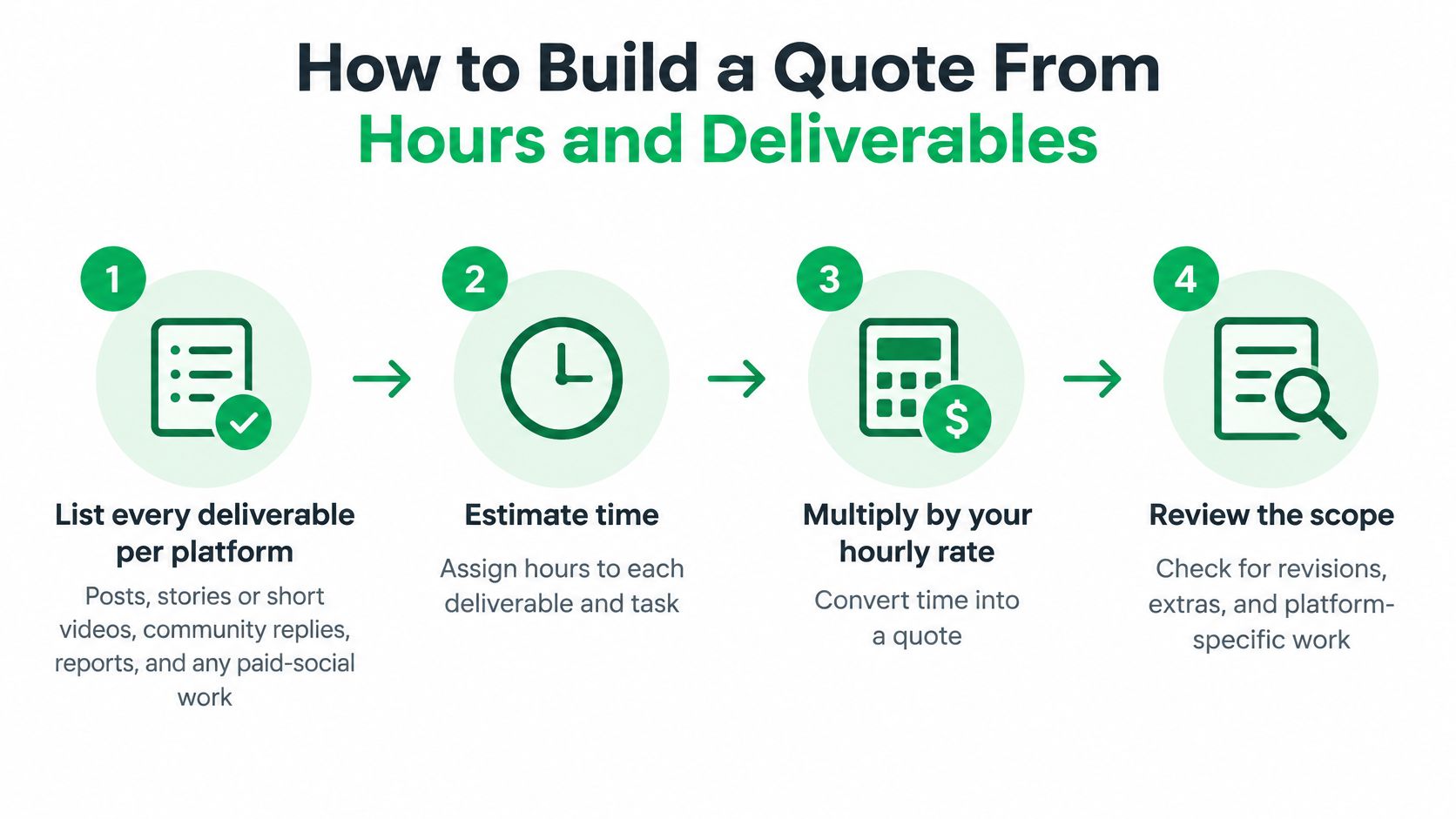
- List every deliverable per platform. Posts, stories or short videos, community replies, reports, and any paid-social work. Vague line items like "social media management" are where quotes go sideways, because six different jobs hide inside that phrase.
- Estimate hours for each task, not each post. Research and planning, content creation, publishing, moderation, reporting, and optimization each carry separate time. Add approvals and revisions now rather than discovering them in month two.
- Total the hours for one month. One number, not a range. A scope that can't be totalled can't be priced or defended.
- Multiply by your target hourly rate. Use $67 as the reference point for blended work and adjust for seniority, video production, or paid-media oversight.
- Add a contingency of 10 to 15 percent. Revisions, asset requests, approval loops, and communication overhead are real labor. Build them in deliberately instead of absorbing them.
- Set the package price and write down its limits. Platform count, posting frequency, response-time window, included reporting, and the number of revision rounds. A limit isn't a threat, it's a boundary that prevents both sides from guessing.
- Review each quarter using hours consumed. Hours burned, revision rounds used, and tracked outcomes tell you whether the price is right. Adjust scope before you adjust the rate.
The worked example
Say a scope estimates 40 hours a month across three platforms: 10 hours of planning and research, 18 of content production, 6 of community management, 4 of reporting, and 2 of optimization. At the $67 benchmark, that's 40 × $67 = $2,680. A 10 percent contingency brings the monthly package to $2,948.
Now flip it. If a provider quotes $1,900 for the same three platforms, run the same math backwards at their rate and see how many hours the price buys. That number tells you more than the rate does. A monthly scope with a content calendar built in advances faster than one where every post is a fresh negotiation.
Pricing Results Without Promising Revenue
Some of what a social media provider does can be priced to the minute. The outcome can't. Creator marketing shows the gap clearly: 73% of marketers planned to increase creator spending, but only 29% expressed confidence in measuring its impact, and engagement aligned with brand impact in only about one-third of creator-content cases, according to Marketing-Interactive's analysis of the measurement gap.

Split any quote into two columns. The first is controllable labor: research, creative development, publishing, moderation, tracking setup, testing, and reporting. That column gets priced by time or scope, and it's the part you can hold a provider to. The second is uncertain results: leads, sales, attributed revenue. Those are performance indicators shaped by budget, offer, landing pages, seasonality, and platform changes, and no hourly rate controls them.
Then there's the cost line most hourly guides skip entirely. Usage rights for content. Paid amplification. Creator fees. Affiliate commissions. Data access. The attribution window itself, which changes what counts as a win.
Practical rule: price the labor you control, share the upside on results you can track, and never promise revenue from likes, views, or shares alone.
Say a provider runs an always-on micro-creator program. Creator fees and usage rights belong in a separate line from the hourly management, because one is a pass-through cost and the other is labor. Mixing them hides both. It also makes the program impossible to cancel cleanly, since nobody can tell which part is which.
A quote that separates controllable labor from uncertain results protects both sides. It keeps you from undercharging for analytics work that takes real hours, and it keeps you from promising revenue off activity metrics. If you're building that reporting layer, start with the KPIs that actually matter on social rather than reach and impressions.
Compare Quotes by Scope, Not Just Rate
Here's the comparison that breaks the hourly illusion. A provider at $50 an hour who needs 60 hours a month bills $3,000. A provider at $80 an hour who needs 35 hours bills $2,800. The higher rate is the cheaper deal, and the lower rate is the one that grows.
Hours don't stay fixed. They climb with every added platform, every increase in posting frequency, every extra revision round, every monitoring window, and every weekly meeting on the calendar. Rarely does a quote show them.
Against that, the 2024 survey of more than 100 agency and freelance social media managers reported an average monthly retainer of $2,107.14 for managing three platforms. That price covered a defined scope, not unlimited work. A quoted hourly rate therefore describes labor capacity, while the actual cost depends on the hours authorized and the deliverables attached to those hours.
The checklist that makes two quotes comparable
Run both quotes through the same seven questions, side by side.
- Platforms counted: three networks or three profiles? The second is much less work, and it's usually priced the same.
- Posts per platform per week: ask for the number, not the promise. "Regular posting" hides a 3x cost difference.
- Community-management hours: a defined weekly window, or "we'll respond to comments"? Only one of those can be staffed.
- Reporting frequency: monthly dashboard, or a written analysis with recommendations? The second is a day of work.
- Strategy sessions: included, and how many? A monthly call is roughly an hour plus preparation.
- Revision rounds: two rounds or unlimited? Unlimited revisions are an unpriced retainer of their own.
- Asset ownership: who owns the video files, graphics, and ad creative when the engagement ends?
A plausibility check on any rate
There's a floor beneath which a quote stops being a bargain. The U.S. Bureau of Labor Statistics reported a mean hourly wage of $49.62 for market research analysts and marketing specialists in the information sector in its May 2023 industry-specific estimates, equivalent to $103,210 a year. That's an employee wage, not a billing rate, and contractor pricing has to cover nonbillable admin, sales, software, insurance, taxes, equipment, and downtime on top.
Still, it's a useful sanity check. A client-facing hourly quote far below what marketing specialists earn as employees usually means research, measurement, or account management has been dropped from the scope. Worth noting that employee wages and client-facing agency rates aren't the same measure, and comparing them directly understates the cost of independent work.
Three steps before you sign
- Name the work you need. Strategy, production, community management, analytics, paid social. Separate them on paper before you ask for a price.
- Choose the billing model that fits. Hourly for a bounded audit or launch, retainer for ongoing management, project for one deliverable, performance-linked only where tracking is airtight.
- Ask for a scoped proposal with hours or deliverables beside the rate. Then check it against the benchmarks in the first table. If the hours are missing, ask why.
When we scope social work at Mr. Green Marketing, LLC, the channel mix follows the client's goals, target audience, budget, and industry rather than a template, and the proposal that follows the initial consultation spells out the recommended services and approach. That's the document worth comparing, not the rate on its own. It's also why choosing a social media agency comes down to whether the scope is written down.
A quoted rate reflects labor capacity. The actual cost depends on the hours you approve, so the key figure to negotiate is the scope.
If you've got a social media quote in hand and can't tell whether the hours are honest, Mr. Green Marketing, LLC will walk the scope with you and show where the price is thin. After an initial consultation, the team develops a customized digital marketing strategy and proposal that outlines its recommended services and approach, so you see the reasoning behind the number before you commit. Visit Mr. Green Marketing, LLC to start that conversation.
Leave a Comment
sing in to post your comment or sign-up if you dont have any account.