
Search engine optimization typically costs $500 to $5,000 per month for small and midsize U.S. businesses, with the most common retainer band at $500 to $2,500. What you should pay depends on the work included and whether the additional customers can cover that investment.
And that's where comparing quotes gets tricky. A low monthly fee might cover advice but leave your team doing the implementation. A larger proposal might include writers, developers and reporting, or charge more for an equally narrow service.
The useful question isn't just how much does search engine optimization cost. It's what will get done, who will do it, and what evidence would justify continuing?
Table of Contents
- What SEO Typically Costs in 2026
- Retainer, Hourly, Project and Performance Models
- Pricing by Provider Type and Business Size
- What Your Monthly Fee Should Cover
- Calculating When SEO Pays Back
- Whether GEO and AI Search Work Is Worth Paying For
- Choosing a Provider and Setting Your Budget
What SEO Typically Costs in 2026
The scope behind a price matters as much as the pricing model. A 2024 survey of SEO providers summarized by Ambeltek reported an average monthly retainer of $2,917, while 68.8% charged $2,000 or less. The average is pulled upward by higher-priced engagements, so it may not reflect the quote a smaller business receives.
SEO price ranges by pricing model
| Pricing model | Typical range | Most common band |
|---|---|---|
| Monthly retainer | $500–$5,000 per month for SMBs | $500–$2,500 per month |
| Hourly consulting | $75–$200 per hour | $75–$100 per hour |
| One-time project or audit | Several hundred dollars to $10,000+ | $2,501–$5,000 |
| Enterprise program | Varies by scope and complexity | No separate band established |
| Performance-based fee | A base fee, an outcome-based fee, or both | Negotiated to match agreed outcomes |
The hourly and project figures come from the 439-provider survey summarized by GTM 80/20. It found $75–$100 per hour and $2,501–$5,000 per project were the most common bands. Those figures are useful comparisons, not a guarantee of what a provider will quote.
Why the average can mislead
Compare offers by the work they include. Hourly consulting buys access to expertise, while a project pays for a defined deliverable or outcome. A retainer reserves ongoing execution capacity. Enterprise programs can involve more coordination, governance and technical complexity, so a single price does not describe every engagement.
Measurement should match the scope. For a project, agree on the deliverable and how completion will be assessed. For ongoing work, define the activities and indicators that will show whether the investment is contributing to business goals. Performance-based fees need clear, agreed outcomes and a defined way to calculate the fee.
Find the matching row first, then inspect the scope. A consulting-only quote and an implementation-heavy engagement are not comparable on price alone. Ask what work is included, what evidence will be reported, and how that evidence connects to the result you need.
Retainer, Hourly, Project and Performance Models
The billing model determines how you pay for work, handle changes and measure progress. Match it to the scope and the people who will implement recommendations.

Retainers and hourly consulting
Monthly retainers suit ongoing work, including keyword research, on-page optimization, content creation, link building and reporting. Before agreeing to a recurring fee, ask what capacity it reserves and which deliverables or priorities that capacity covers. A useful scope might include planned content, technical support and a prioritized backlog. The work can change month to month as needs shift.
The trade-off is flexibility versus visibility. A flexible scope lets the team address urgent problems, but vague terms can leave you paying for meetings and loosely defined maintenance. Set priorities and agree on how progress will be reported.
Hourly consulting fits businesses with people available to carry out the recommendations. A consultant can review a migration plan, diagnose a canonical problem or assess an existing strategy without taking over execution.
Set an authorization limit and specify the output, such as an annotated audit or developer-ready tickets. That way, the fee buys an actionable result, not just time spent discussing problems.
Projects and performance fees
A one-time project fits bounded work such as redirect mapping, structured-data implementation, migration support or a Core Web Vitals repair. Define acceptance criteria before work starts. An audit document and a repaired website are different deliverables, so spell out which one the fee covers.
Also specify who deploys changes, who validates them and whether post-launch troubleshooting is included. If the provider's work ends at delivery, your team needs capacity to implement and verify it.
Performance-based pricing links some compensation to rankings, leads or revenue. Attribution can be difficult because branded demand, promotions, sales follow-up and other channels affect the same outcomes. Agree on the baseline, tracking method and qualifying results before signing.
A transparent base fee can cover the provider's labor, with any bonus tied to qualified leads or sales that you can verify in your own systems. Define how spam, duplicate leads and existing customers are handled. Then compare the fee with the value of the measured outcome, rather than rankings alone.
Practical rule: Use a retainer for continuing work, a project for a defined repair, and hourly consulting for advice. Performance incentives need clear measurement terms before the contract is signed.
Pricing by Provider Type and Business Size
Provider type offers a rough price reference, but scope determines what the fee buys. The 439-provider survey cited earlier reports different averages by provider type: consultants averaged $3,250 monthly, while providers serving local businesses averaged $1,557.08.
Average monthly SEO spend by provider type
| Provider type | Average monthly fee | What moves the number |
|---|---|---|
| Providers serving local businesses | $1,557.08 | Single geography, fewer pages, narrower keyword set |
| Freelancers | $1,349 | Solo capacity and limited scope |
| Agencies | $3,209 | Team size, multi-channel work, reporting depth |
| Consultants | $3,250 | Senior time and strategy-heavy engagements |
| All providers (average) | $2,917 | Mixed scope; most providers charged $2,000 or less |
These are survey averages, not recommended budgets or guaranteed quotes. The agency and freelancer figures come from the provider-type breakdown cited earlier. Use the rows to compare the kinds of work a provider may be pricing, then check the proposed deliverables and how results will be measured. Google's developer guidance offers a starting point for understanding the technical side of building for search.
A local service site versus an online store
A plumber with 15 service pages in one city has a narrower SEO scope: improve service pages, strengthen local visibility, provide useful customer information and track calls. The work can focus on a compact set of commercial opportunities, with leads and calls as relevant measures.
An online store with 4,000 products shipping nationally has a different workload. The team may need to review category architecture, product variants, duplicate URLs, faceted navigation and reporting across templates. A template change can affect many product pages, so implementation and validation take careful planning. A technical SEO agency engagement should account for that work, rather than price the job by keyword count alone.
Several practical factors shape the quote:
- Pages and products: More inventory means more decisions about templates, indexing and priorities.
- Markets and languages: Each market adds localization, competitive analysis and approvals.
- Content and authority work: Expert input, original assets and relevant outreach take production time.
- Reporting depth: Connecting transactions and qualified leads requires more than exporting a ranking chart.
Mr. Green Marketing, LLC tailors strategies for local service businesses around leads, calls and jobs, and for ecommerce brands around traffic, conversions and sales. That distinction should shape the scope and its measurement before it shapes the fee. A local business may not need an enterprise workflow; a complex store still needs enough time and expertise to handle its catalog. To judge whether either quote can pay back, connect its work to outcomes the business can track, rather than treating the provider average as a spending target.
What Your Monthly Fee Should Cover
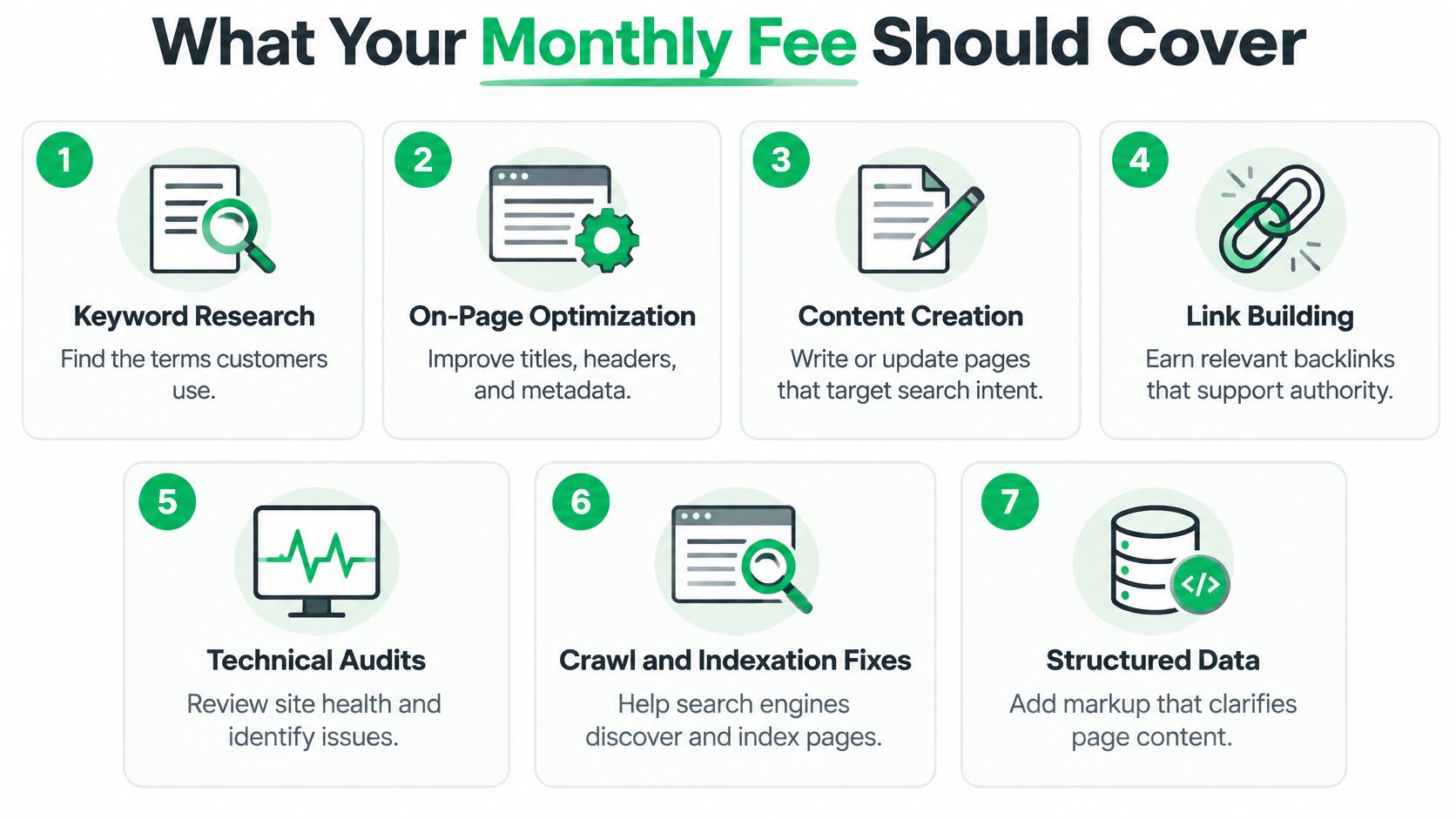
A useful monthly scope identifies outputs, ownership and implementation. Search engine optimization includes keyword research, on-page optimization, content creation, link building and more, but a service list alone isn't enough to evaluate a proposal.
Google's guidance on hiring an SEO states that appearing in organic search results costs nothing. You're paying for labor, tools and implementation, not a placement fee paid to Google.
Check the actual deliverables
Not every engagement needs every service every month. It does need a clear explanation of what's included and what's excluded.
- Keyword research: Map customer searches to suitable pages, separating informational questions from buying intent.
- On-page optimization: Improve titles, headings, copy and internal links on named pages.
- Content creation: Write or substantially update pages, with responsibility for expert review and publication.
- Link building: Develop relevant outreach or digital PR assets, rather than promise an unexplained volume of backlinks.
- Technical audits: Produce prioritized findings with examples, impact and implementation instructions.
- Crawl and indexation fixes: Investigate blocked pages, duplicate URLs, canonicals and discovery problems.
- Structured data: Implement appropriate markup and validate it against visible page content.
- Performance work: Diagnose Core Web Vitals issues and clarify whether developer implementation is included.
- Analytics and reporting: Track qualified traffic, leads, conversion rate and revenue where measurement permits.
Separate the foundation from recurring work
The technical baseline covers crawlability, redirects, canonicals, templates and measurement. It should leave your team with functioning improvements, not just an impressive issue count. A task isn't complete merely because somebody added it to a spreadsheet.
Recurring work covers publishing, internal-link development, authority building and testing. The priorities should change as the team resolves problems and discovers better opportunities.
Google's Search documentation explains that technical compliance doesn't guarantee crawling, indexing or serving a page; sitemaps help discovery but don't buy rankings. Judge the provider on competent work and transparent measurement, not a promised position.
We provide regular analytics and reporting aligned with client goals. A useful monthly SEO reporting format connects completed work with business indicators and the next decisions.
Can each line item name the output it produces?
Calculating When SEO Pays Back
Monthly SEO fee ÷ gross profit per additional customer = additional sales needed to cover the fee. Round up any partial sale.
For a hypothetical business paying $1,500 monthly and earning $300 gross profit per sale, SEO would need to contribute five additional sales per month to cover the retainer. This is a break-even example, not a forecast or an industry margin benchmark.
Break-even sales needed for common retainers
| Monthly retainer | Gross profit per sale | Extra sales needed per month |
|---|---|---|
| $500 | $300 | 2 |
| $1,500 | $300 | 5 |
| $2,500 | $300 | 9 |
| $5,000 | $1,000 | 5 |
These hypothetical examples round up to whole sales and cover the retainer alone, not other acquisition expenses.
Turn the sales target into a measurement plan
Use gross profit rather than revenue. Add costs outside the retainer, such as extra development, photography or internal production time. For a stricter profitability test, calculate contribution after other variable acquisition costs.
For lead-generation businesses, work backward from customers to qualified leads using your actual close rate, then from leads to relevant organic visits. If the traffic required exceeds plausible demand, a polished proposal cannot make the budget viable.
Use this marketing ROI calculation framework to keep the investment, attribution assumptions and profit calculation consistent.
Separate early progress from financial results:
- Leading indicators: Relevant pages indexed, target-query visibility and qualified organic visits.
- Conversion evidence: Valid calls, inquiries, assisted conversions and booked appointments.
- Business outcomes: New customers, gross profit and cumulative acquisition cost.
Measure organic contribution carefully. A purchase may follow several interactions, with search contributing even when it was not the final interaction.
Account for the ramp
The monthly break-even target describes a steady operating position. It does not account for costs incurred while pages are improved, discovered and evaluated.
Set a test window and compare cumulative costs with current monthly performance. A deadline is a planning point, not a guarantee of customer growth.
A low fee can still be costly if the work cannot be tied to qualified demand. SEO may also be a poor fit when margins are thin, conversions cannot be measured or the offer is not competitive. Fix those constraints before increasing the retainer.
Whether GEO and AI Search Work Is Worth Paying For
AI discovery is growing, but growth alone does not justify a higher fee. TechCrunch's reporting on Similarweb counted 1.13 billion AI-platform referrals to the world's top 1,000 websites in June 2025, up 357% year over year, compared with about 191 billion Google Search referrals that month.
Those totals cover a specific group of websites, not the opportunity available to your business. AI referrals may still bring little qualified traffic to an individual company. Judge the potential against your own audience, offer and margins.

Pay for distinct work, not a new label
Generative engine optimization, or GEO, overlaps with sound SEO foundations. Crawlable pages, clearly structured information, accurate business details and trustworthy first-party expertise can support both traditional search and AI citations.
Review proposed AI search optimization services against the work already in your SEO scope. If the deliverables overlap, a new label alone does not justify another fee. Ask what will be done, which pages or content it covers, and how the work will be assessed.
Some early analyses suggest visitors arriving from AI platforms can convert differently from search visitors. Small samples are directional, not a forecast for another business. A higher conversion rate in one analysis would not establish the likely return for your site.
Design a bounded test
Set a defined objective and track AI-oriented work separately:
- Cited mentions: Record which relevant answers mention the business and which pages they cite.
- Qualified referrals: Review landing pages and meaningful engagement, not just sessions.
- Assisted conversions: Check whether those visitors later inquire or purchase.
- Brand-query changes: Monitor branded demand without assuming GEO caused every change.
Budget guardrail: Pay for a bounded experiment alongside working SEO, not a premium promise of inclusion.
A useful test can still produce evidence when referral volume stays small. Mentions alone do not establish a return; connect them to qualified visitors and commercial relevance before expanding the budget.
Choosing a Provider and Setting Your Budget
Start with a written proposal that names target pages, markets, execution capacity, reporting metrics and the expected evaluation horizon. The monthly number should follow those decisions, not replace them.
A proposal can describe hours, deliverable capacity, or a prioritized production plan. What matters is whether you can understand what the team will complete and which dependencies could delay it.
Compare equivalent scopes
Before choosing a provider, put the proposals beside each other and normalize the work:
- Execution ownership: Identify who writes, edits, uploads, develops and approves.
- Target scope: Name the commercial pages, products, locations and audiences included.
- Capacity: Establish what the team can reasonably complete and how priorities change.
- Dependencies: Record access requirements, internal reviews and developer availability.
- Measurement: Define valid leads, conversion events and the business result being pursued.
- Commercial terms: Review exclusions, extra charges, account ownership and termination provisions.
Cheap offers fail when the scope excludes the work needed to make progress. Expensive offers fail when senior people sell the engagement but nobody owns implementation. Neither problem is solved by a polished presentation.
Our approach begins with a consultation, followed by a customized digital marketing strategy and proposal outlining recommended services and the approach. Pricing follows that consultation rather than an assumption that every website needs the same package.
Pause when the proposal cannot answer basic questions
Treat these as reasons to stop and clarify, not minor paperwork issues:
- An unexplained price: There's a fee but no named production or responsibility.
- Guaranteed placement: The sales pitch substitutes certainty for a credible plan.
- No reporting design: Nobody has defined what constitutes a qualified inquiry or sale.
- Opaque labor: The provider can't explain which specialists will perform the work.
- No commercial target: The contract has no agreed method for judging whether the investment is becoming viable.
A practical guide to choosing a marketing agency should help you evaluate those operational details, not just credentials and chemistry.
Commit to an evidence-based test
Set the budget using your own margin, conversion path and capacity to serve additional customers. If sales follow-up is inconsistent, repair it before funding a larger traffic program. If development is the bottleneck, fund implementation rather than more audits.
I would begin with a three-to-six-month test, written metrics and scheduled decision points before accepting a longer commitment. That's a contract-design recommendation, not a promise of profitability within that period.
Record the baseline, planned work, commercial target and conditions for increasing, maintaining or stopping spend. Allow for implementation and search-response time, but don't confuse patience with accepting inactivity.
The right budget is the amount you can sustain while a capable team produces verifiable work and gathers enough evidence to make the next decision. Not the lowest quote. Not the largest package you can afford.
Mr. Green Marketing, LLC offers a free audit to help identify visibility gaps and prioritize SEO work before you commit to a budget. Visit Mr. Green Marketing, LLC and enter your website, email and name in the home-page form to request yours. After an initial consultation, we develop a customized strategy and proposal outlining the recommended services and approach.
Leave a Comment
sing in to post your comment or sign-up if you dont have any account.