
And yes, backlinks can build authority, but only when they're relevant, independently earned, and placed on pages people read. Raw link count doesn't build authority on its own.
That challenges the most popular link-building advice: keep adding links and rankings will follow. It's an attractive promise because counting backlinks is easy. Judging whether another publisher has given readers a useful, independent reference takes more work.
The distinction matters when you're paying for SEO. A report can show a growing backlink profile while your important pages attract no better prospects, and questionable placements can introduce risks that the report never mentions.
Table of Contents
- The Short Answer on Backlinks and Authority
- Which Backlinks Build Authority and Which Do Not
- What Google Says About Links and Ranking
- How Authority Gets Measured and Why Link Counts Mislead
- Where Links Cross Into Spam
- How to Earn Links That Build Real Authority
- Audit Your Links and Choose Your First Project
The Short Answer on Backlinks and Authority
As a volume-based claim, backlinks build authority is mostly false. As a claim about relevant editorial endorsements contributing to a page's search reputation, it's partly true.
The familiar question, true or false backlinks build authority, leaves out the conditions that determine the answer. A backlink isn't a deposit into a universal authority account. It's evidence that search systems may evaluate alongside other evidence about a page.
Reputation isn't a running total
Google's PageRank patent describes a network-based model in which a page's importance reflects the importance of pages linking to it, not merely the existence of incoming links. That supports a weighted interpretation of backlinks rather than a simple counting exercise.
Think of professional references. A recommendation from a respected colleague who understands your work means more than signatures from strangers who've never examined it. The analogy isn't a formula for ranking, but it explains why interchangeable backlink packages are a poor way to evaluate reputation.
Authority is best treated as a page-level, probabilistic effect, not a fixed domain number. A useful reference may strengthen the evidence around a particular resource without making every product or service page on the website more competitive.
Practical rule: Judge a link by the reason it exists, not by the fact that a tool can count it.
Ask better buying questions
Before approving a link-building campaign, establish:
- Which links deserve attention: Identify publishers whose readers could use your expertise.
- What progress means: Connect the linked page to visibility, qualified visits, and business outcomes.
- Why the reference should last: Choose assets worth maintaining, rather than placements purchased to fill a quota.
Paid, swapped, or automated links require particular scrutiny. The immediate filter is simple: Would this link exist if nobody was paid and nobody asked for it? A no doesn't automatically establish wrongdoing, but it tells you to examine the relationship before assigning SEO value.
Which Backlinks Build Authority and Which Do Not
Use this comparison to assess the reason behind a placement, not to predict a guaranteed ranking improvement.
Link types and whether they build authority
| Link type | Builds authority? | Why | Risk level |
|---|---|---|---|
| Editorial mention in a news article | Yes, strongly | Independent endorsement from a relevant audience | Low |
| Trade association or university resource page | Yes | Credible, topically related source | Low |
| Supplier or manufacturer listing | Usually | Real business relationship and relevant context | Low when the page is relevant |
| Local chamber of commerce or community site | Often, locally | Genuine geographic relevance | Low |
| Original research that others cite | Yes | Earned because it solves a documented need | Low |
| Guest post on an unrelated site | Rarely | Weak topical fit | Medium |
| Reciprocal link exchange at scale | No | Manipulative pattern, no real endorsement | High |
| Paid followed link | No, and risky | Violates Google's spam policies | High |
| Mass directory or automated link | No | Low context and low value | High |
The positive assessments describe credible opportunities, not promises. A university domain doesn't make every page valuable, and a news publication's reputation doesn't turn a purchased placement into an independent endorsement.
Google's guidance on unnatural links distinguishes genuine references from arrangements intended to manipulate rankings. For commercial relationships, the circumstances of the placement matter as much as the publisher's name.
Read the page, not just the domain
Look for topical relevance, editorial choice, and a real audience. These checks help distinguish a useful reference from a page built mainly to accommodate outbound links.
Say a regional home-improvement publication links to a local HVAC company's troubleshooting guide. Readers dealing with heating problems have a clear reason to follow that reference. An unrelated international directory listing the same guide offers much less context.
The destination matters too. Sending those readers to an informative diagnostic guide makes sense; sending them to a generic homepage that doesn't answer their question weakens the usefulness of the placement.
Apply a reader-first filter
Before pursuing a prospective backlink, ask:
- Reader expectation: Would someone reading this page reasonably expect to see your website referenced?
- Independent choice: Did an editor choose the reference without receiving payment for the link?
- Destination usefulness: Does the linked page give that reader something specific and worthwhile?
Use the answers to prioritize outreach. A relevant supplier page may be worth pursuing even if its third-party score looks modest. Conversely, an impressive domain metric shouldn't excuse unrelated content or an obvious placement marketplace.
There's also a distinction between marketing value and ranking value. A disclosed advertisement can introduce customers to your business without functioning as an editorial endorsement. Evaluate that opportunity as advertising, with an audience and conversion objective, rather than disguising it as authority building.
What Google Says About Links and Ranking
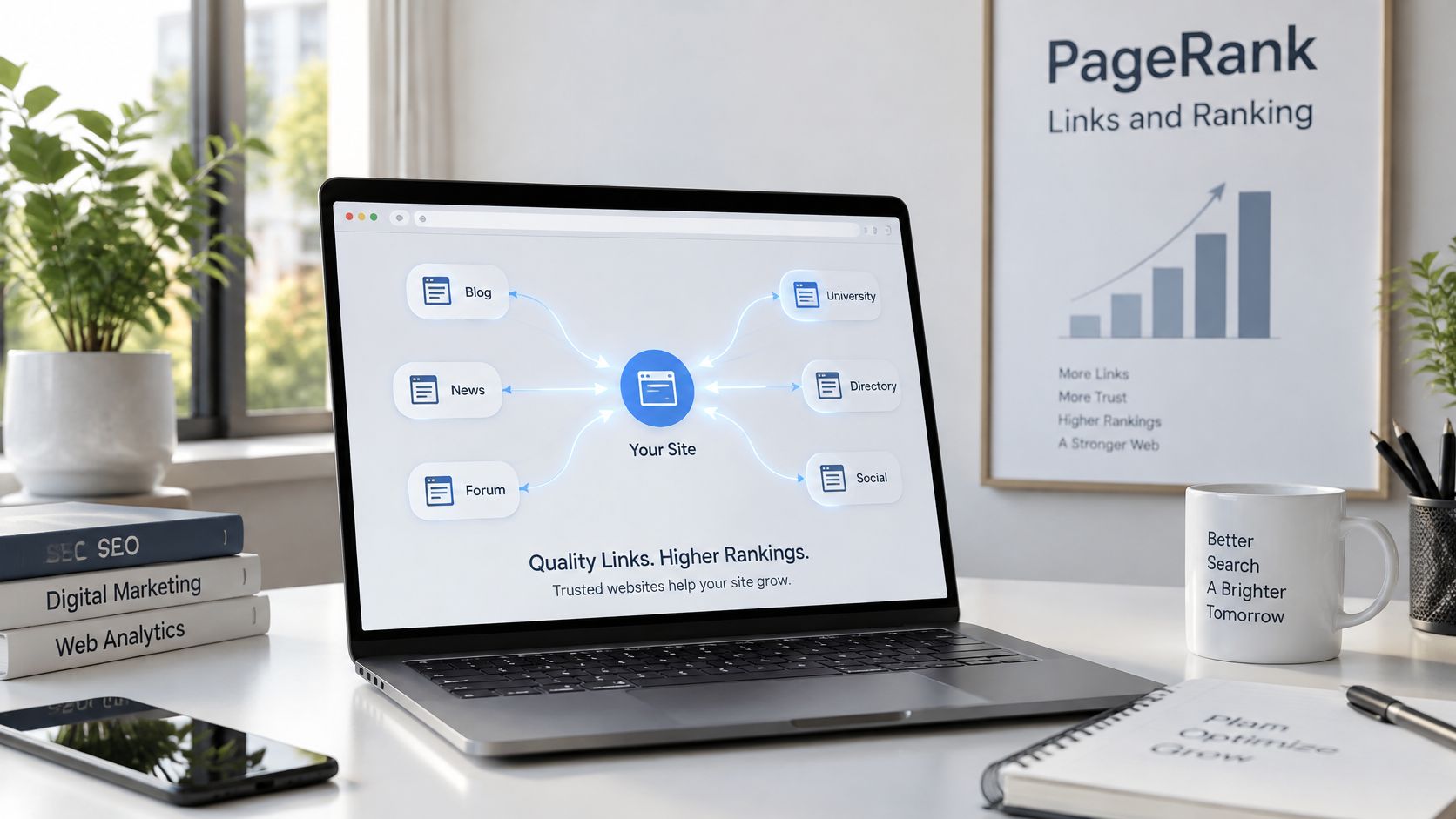
Google's ranking systems guide states that PageRank was a core ranking system when Google launched and remains part of its core ranking systems, although it has evolved substantially.
That history explains why links still deserve attention. It doesn't justify treating modern search as an unchanged contest for the largest backlink profile.
Follow the endorsement through a real scenario
Say a regional publication publishes a guide to preparing homes for severe weather. Its editor references a contractor's detailed explanation of roof drainage, complete with clear diagrams and maintenance instructions.
That link gives the contractor more than another entry in a backlink export. It places the resource inside a relevant discussion, gives readers a reason to visit, and creates a connection between related pages.
A well-connected regional publication can provide a more meaningful reference than a collection of weak, unrelated pages. There's no defensible universal exchange rate, though. You can't convert a newspaper mention into a guaranteed equivalent number of directory links.
Links also provide paths through which search systems can discover pages and understand relationships among resources. A useful page that nobody references or connects to is harder to discover than one integrated into a relevant information network.
A backlink is evidence that a page deserves attention. It isn't proof that the page deserves the top position.
Recognize what a link can't repair
Google describes multiple systems that assess relevance, quality, and helpfulness. A strong reference doesn't excuse a page that fails to answer the searcher's question, and it can't substitute for technical accessibility.
For a small business, that means reviewing the destination before starting outreach. Check whether the page explains the service or topic clearly, works on mobile, and gives visitors an appropriate next step.
A practical plan to improve Google search ranking should connect those improvements with link acquisition rather than treat them as competing priorities. Earn attention for a page that already deserves it.
The accurate conclusion is narrower than the sales pitch: high-quality links can contribute to page-level authority, but no individual backlink is a ranking shortcut.
How Authority Gets Measured and Why Link Counts Mislead
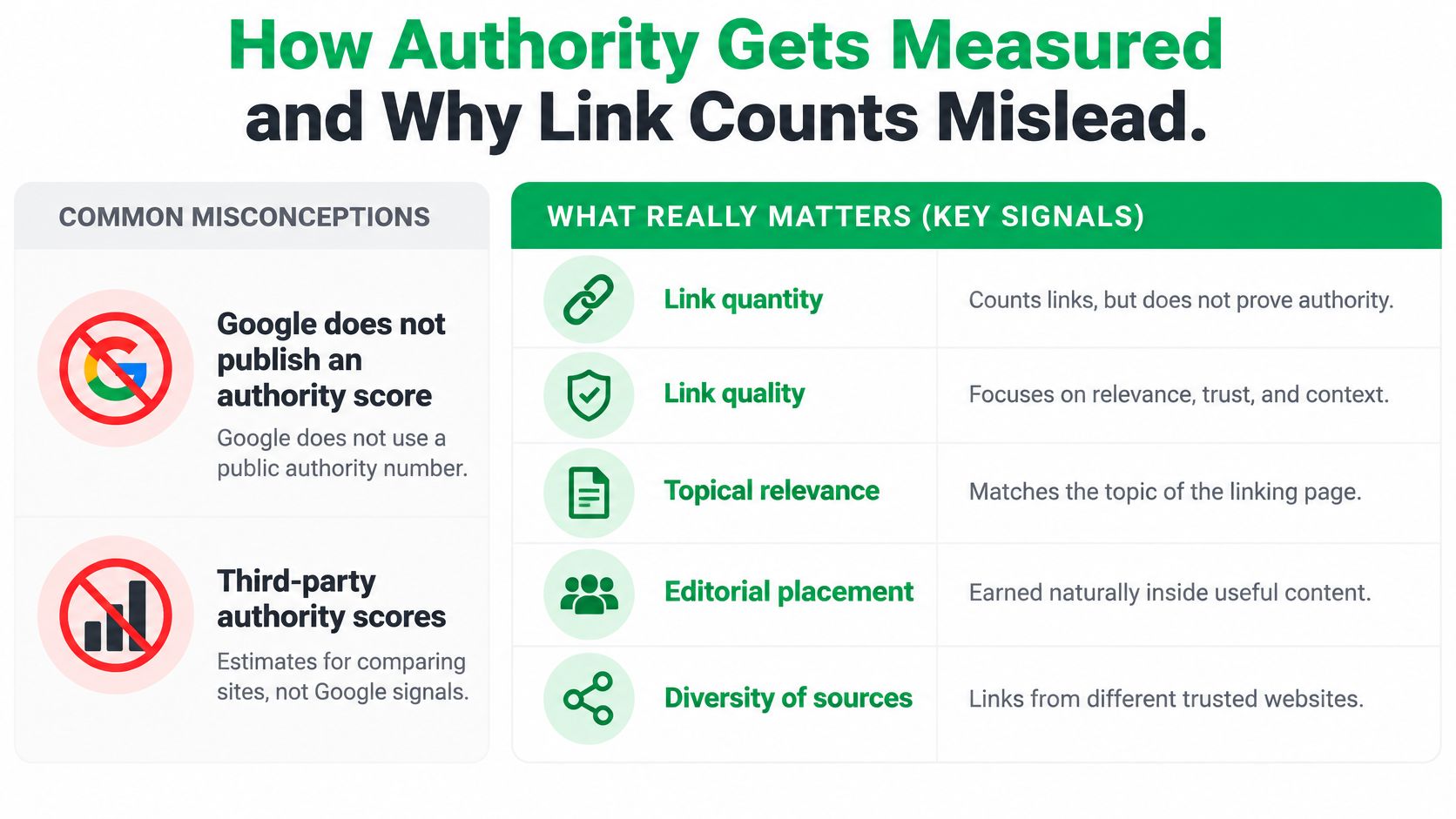
Google doesn't publish a public authority score. Third-party authority numbers are estimates for comparing websites, not public measurements of the score Google assigns your business.
Start with the linked page and the business objective. A domain-wide number can be a supporting benchmark, but it shouldn't decide whether a campaign succeeded.
Signals that show authority is growing
| Signal | What it tells you | Limitation |
|---|---|---|
| Topically relevant referring domains | Breadth of credible endorsement | Raw count hides quality |
| Rankings for the linked topic | Whether the page is competing better | Content and technical changes also move rankings |
| Organic impressions on the linked page | Visibility change after a link lands | Needs a baseline taken before the link |
| Qualified referral traffic | Visitors who came from the link and acted | Small volumes for niche sites |
| Branded search volume | Growing awareness and reputation | Hard to attribute to a single link |
| Assisted conversions | Business value from linked visitors | Requires working conversion tracking |
| Third-party authority score | Rough comparison between sites | Not a Google metric |
AI search makes clicks an incomplete measure
Pew Research Center's analysis of nearly 69,000 Google searches by 900 U.S. adults in March 2025, described by The Decoder, found that 8% of searches with an AI Overview produced a click on a standard result, compared with 15% without an overview.
That finding concerns observed search behavior, not the effectiveness of a particular backlink campaign. It shows why improved visibility and increased website visits shouldn't be treated as interchangeable outcomes.
A business may gain exposure without receiving an immediate visit. Still, visibility without clicks isn't automatically valuable. Don't assume an external mention caused AI inclusion or brand growth because those events happened together.
Track cited-source appearances, branded searches, direct visits, and qualified referrals. Where attribution is incomplete, label the result as directional rather than proven.
Build a comparison you can defend
Before outreach, save the target page's Search Console impressions and query performance. In Google Analytics, confirm that referral traffic and important actions, such as inquiry submissions or purchases, are recorded correctly.
Then:
- Record placement details: Save the referring URL, destination, publication date, and context.
- Compare like with like: Review the same page and query group across comparable periods.
- Annotate other changes: Note content rewrites, technical fixes, promotions, and seasonal demand.
Change only a single major variable at a time where practical. You won't create a laboratory experiment, but you'll avoid crediting a link for improvements that followed a complete website rebuild.
For anyone trying to improve domain authority, the better target is stronger evidence around commercially relevant pages. Treat the score as a reference point, not the objective.
Where Links Cross Into Spam
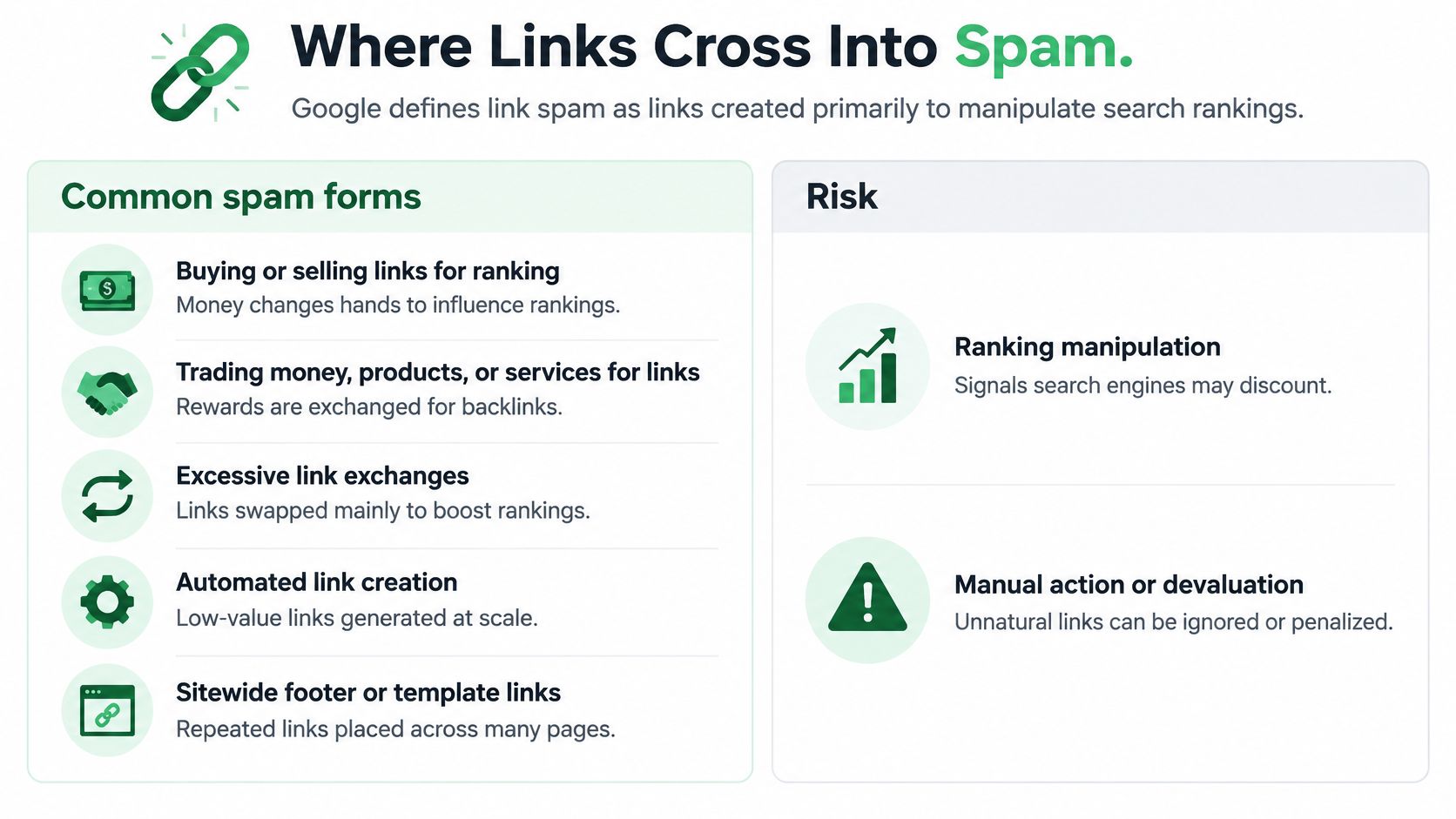
Google's spam policies define link spam as creating links to or from a website primarily to manipulate search rankings. The critical issue is purpose and arrangement, not whether somebody describes the service as outreach.
Common forms include:
- Paid ranking placements: Buying or selling links to influence search results.
- Compensated exchanges: Trading money, products, or services for links intended to pass ranking credit.
- Contractual requirements: Requiring links without allowing the publisher to qualify them.
- Manufactured volume: Automated link creation and excessive reciprocal exchanges.
Separate a genuine relationship from a ranking purchase
A manufacturer listing your company as an authorized supplier helps customers find a relevant seller. A paid listing on an unrelated link farm serves a different purpose, even if both appear in a report as referring domains.
Likewise, a sponsored article can be legitimate advertising when the relationship is disclosed and the link uses an appropriate rel="sponsored" attribute. Buying the same placement with an unqualified followed link for rankings crosses the policy boundary.
A chamber membership page can document a real local relationship. A package of mass directory placements offers no comparable assurance because the seller calls it local SEO.
Don't confuse qualification with disclosure. Readers need to understand the commercial relationship, while the link's attributes communicate its nature to search systems. A visible sponsorship label alone doesn't replace appropriate link qualification.
Understand the asymmetric downside
Google may neutralize artificial link benefits, and manipulative arrangements can lead to manual action. Cleanup isn't a promise that previous visibility will return.
Risk test: Don't ask only what a placement might add. Ask what your business would lose if the ranking benefit disappeared and cleanup became necessary.
This doesn't mean a stray bad backlink automatically cancels legitimate endorsements. The larger concern is a deliberate acquisition pattern that exposes important pages, or the broader site, to enforcement and wasted investment.
For local sponsorships, product seeding, and marketplace relationships, keep the commercial activity separate from demands for ranking credit. Use sponsored or nofollow where appropriate.
Apply the same caution when syndicating content for SEO. Distribution should serve an identifiable audience, not become an excuse to manufacture repeated links with optimized anchor text.
For links already acquired, investigate the arrangement before choosing removal or qualification. Suspicion alone isn't a cleanup strategy.
How to Earn Links That Build Real Authority
Begin with something another publisher can use, not a spreadsheet of websites willing to accept placements. Google's link-spam guidance explains why manufactured links are a poor substitute for independent editorial references and why eliminated artificial benefits may not return after cleanup.
Build usefulness into the outreach process
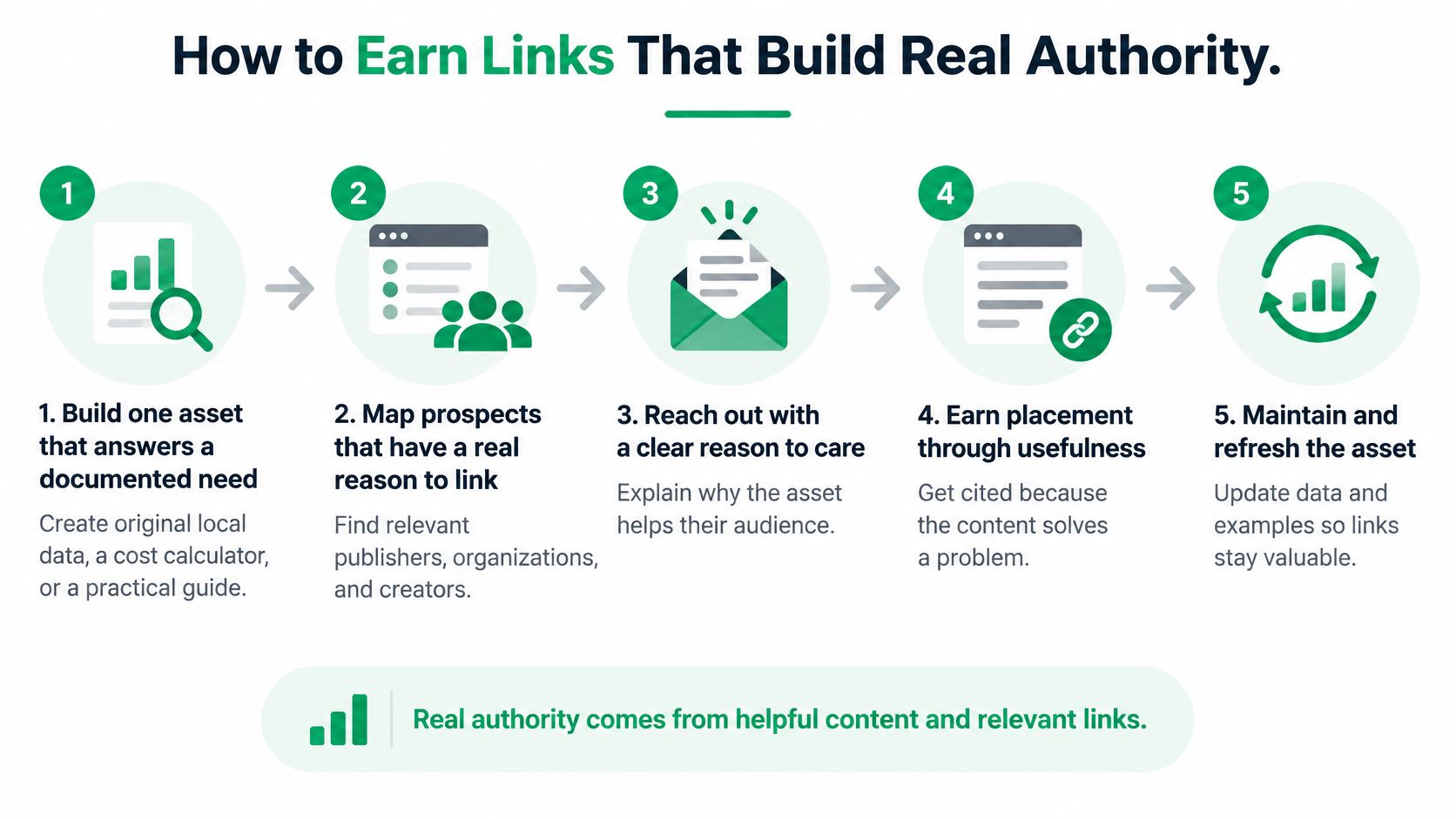
Create an asset that answers a documented need. Use customer questions, support requests, and gaps in existing resources to choose original local data, a cost calculator, or a practical guide. Publish the methodology and limitations where relevant, so an editor can assess whether the material deserves a reference.
Map publishers with a reason to cite it. Consider trade associations, universities, local news outlets, suppliers, and community organizations whose audiences face the problem your asset solves. Relevance gives the publisher a defensible editorial reason to include your work.
Audit each prospect before contacting them. Review topical fit, signs of genuine organic visibility, indexation, editorial ownership, and outbound-link patterns. Traffic estimates are imperfect, so inspect the actual content and reject offers built around selling followed links among unrelated sponsored articles.
Pitch a specific contribution. Point to a missing explanation, a useful data finding, or an outdated resource your material can improve. A focused pitch – not a demand for a backlink – lets the editor judge the benefit to readers.
Make the asset free to reference. Explain how publishers may use the material and provide clear attribution details, without requiring a followed backlink in exchange. Independent choice protects the distinction between an earned citation and a contractual placement.
Request genuine partner listings and disclose sponsorships. Ask suppliers to correct missing dealer information or associations to update an accurate member profile. Keep paid relationships appropriately qualified so a legitimate business connection doesn't become a ranking-credit arrangement.
Track outcomes and maintain the resource. Record referring-page quality and assisted conversions, then refresh outdated examples, methodology, and guidance. Maintenance gives publishers a reason to retain the reference instead of sending readers to obsolete information.
Choose a project with a clear audience
Say a local contractor publishes regional repair-cost information drawn from its own records, explains what the figures include, and states their limitations. A regional news editor might cite the resource when covering household maintenance, while a trade association might add it to a relevant resource page.
That's a hypothetical pathway, not an outcome promise. The contractor earns consideration by making information useful and inspectable, not by demanding coverage.
Good content marketing practices make the asset easier to evaluate: clear authorship, accessible explanations, organized supporting material, and an obvious update process. The objective is a resource someone can confidently recommend.
Search engine optimization includes keyword research, on-page optimization, content creation, link building, and more. Keep outreach inside that wider plan. A compelling resource should connect naturally to relevant service or product information, so visitors can move from learning to taking an appropriate next step.
Audit Your Links and Choose Your First Project
Before new outreach, examine the profile you already have. Google's manual-actions documentation recommends prioritizing sites linking most often and links created recently when investigating unnatural links, and discourages blindly disavowing every backlink.
Use this checklist:
- Export and organize: Download linking-site data from Search Console or a link tool, then group referring domains by topical relevance.
- Flag patterns: Investigate sudden acquisition spikes, apparent paid placements, and repeated exact-match anchors across unrelated websites. These are review signals, not automatic proof of spam.
- Choose an action: Keep legitimate references, ask publishers to qualify compensated relationships with
nofolloworsponsored, or request removal of manipulative placements. - Escalate selectively: For a documented unnatural-link problem, consider disavowal only for problematic links you couldn't remove. You generally can't edit attributes on somebody else's website.
- Save the baseline: Record page visibility, qualified referrals, and the conversion actions tied to your objective.
Make the next decision concrete
Include the review in your broader SEO audit, rather than buying more placements by default. We measure campaign success against goal-specific indicators, which may include website traffic, leads generated, conversion rates, and revenue generated.
This week, decide whether your acquisition practices strengthen credibility or create avoidable risk. Then choose a focused project: fix a problematic arrangement, improve a resource, or approach a relevant publisher.
Mr. Green Marketing, LLC offers strategy-led SEO, content marketing, and website services that connect search visibility with measurable business goals. Visit Mr. Green Marketing, LLC to request a free audit and performance report, identify visibility gaps, and prioritize a credible link-building project instead of another backlink quota.
Leave a Comment
sing in to post your comment or sign-up if you dont have any account.