
And the calls are still quiet.
A business can rank on page one, attract impressions, and leave its owner wondering why the phone isn't producing better work. The problem is often not a lack of visibility. It's a mismatch between what people search, where they are, what they need right now, and which page or profile element receives that intent.
Local SEO keyword research solves that mismatch. Done properly, it isn't a spreadsheet exercise built around search volume. It's a system for finding service, location, urgency, and trust signals, then assigning them to the pages and Google Business Profile elements most likely to produce calls, visits, and qualified enquiries.
Table of Contents
- Why Your Site Ranks but the Phone Is Not Ringing
- The Six-Step Local Keyword Research Workflow
- What Google's Local Algorithm Actually Rewards
- Picking the Right Keywords From a Messy List
- Mapping Keywords to Pages and Your Google Business Profile
- The Volume Trap and the Rise of AI Local Results
- Your First 30 Days of Local Keyword Wins
Why Your Site Ranks but the Phone Is Not Ringing
Consider Maria, who runs a three-bay auto repair business outside Tampa. Her website ranks on page one for broad terms such as “auto repair” and “mechanic,” so the ranking report looks healthy. Yet many of the calls she receives come from customers 40 miles away, while the two shops across the street appear in the Map Pack for searches such as “brake repair near me” and “mechanic in [local area].”
Maria doesn't have a traffic problem. She has a local intent problem.
Broad terms can attract researchers, job seekers, parts shoppers, people comparing services across a large region, and customers who will never drive to the business. A page-one position doesn't tell you whether the searcher is close enough to visit, ready to book, looking for the exact service, or even in the company's service area.
That distinction matters because local search often leads directly to offline action. Industry summaries cited by local keyword research statistics report that about 46% of Google searches have local intent, and one frequently cited benchmark says 76% of people who search for something nearby on a smartphone visit a related business within 24 hours. The exact opportunity depends on the business, service, location, and competition, but the commercial implication is clear. Local searches are often closer to a phone call or visit than generic informational searches.
Traffic metrics can hide the commercial gap
Maria's “auto repair” ranking may look more impressive than a lower-volume term such as “same-day brake repair near [neighborhood].” The second query is more specific, but it tells her far more about the searcher's location and urgency.
Her reporting needs to separate:
- Geographic fit: Is the searcher within a realistic driving distance?
- Service fit: Does the query describe a service the shop truly performs?
- Action intent: Is the person looking to call, visit, schedule, or just learn?
- Local visibility: Does Google show a Map Pack, local finder result, or nearby businesses?
- Page fit: Does the business have a relevant destination for the query?
Google says local results are mainly influenced by relevance, distance, and prominence. A business can have strong organic content and still lose local visibility when its profile, location signals, or authority don't match the query. A focused local SEO audit checklist helps expose that disconnect before another generic service page gets published.
Practical observation: A ranking is useful only when it represents a customer the business can serve, for a service it wants to sell, in a location it can realistically reach.
The solution isn't to abandon broad terms. It's to place them in the right role, then build a fuller keyword set around city, neighborhood, postal code, service detail, urgency, and proximity. Local SEO keyword research should tell you not only what people type, but also which searches deserve a profile optimization, a service page, a neighborhood page, or no page at all.
The Six-Step Local Keyword Research Workflow
A useful workflow starts with customer language and ends with page decisions. Keyword tools help, but they shouldn't be the only source of ideas. The six-step local keyword research process is strongest when every candidate is checked against actual search results and a real business destination.
1. Start with customer language
Pull seed terms from the Google Business Profile queries available to you, call recordings, booking forms, sales notes, chat transcripts, and front-desk questions. A receptionist may hear “my water heater is leaking tonight,” while a keyword tool returns “water heater repair.” Both matter, but they represent different urgency and page requirements.
Build the initial list around real services, problems, products, and customer descriptions. Include the words employees use internally and the less polished phrases customers use aloud.
2. Expand with local and service modifiers
Add modifiers such as “near me,” “same day,” “emergency,” “open now,” and neighborhood names. Use Google Autocomplete, related searches, People Also Ask, and the language in competitor title tags and H1 headings.
Don't force every modifier into a page. Use it to reveal intent. “Emergency locksmith near me” suggests immediate action, while “how to prevent a lockout” may belong in supporting content.
3. Build a service-by-location matrix
Layer geographic terms onto actual services. A simple matrix might include:
- Services: brake repair, tire replacement, oil change, transmission service
- Locations: city, neighborhood, postal code, district, nearby landmark
- Attributes: same day, mobile, affordable, commercial, 24-hour
- Actions: call, book, schedule, quote, directions
This structure prevents a common mistake, creating dozens of pages that repeat the same city phrase while ignoring the service distinctions that customers care about.
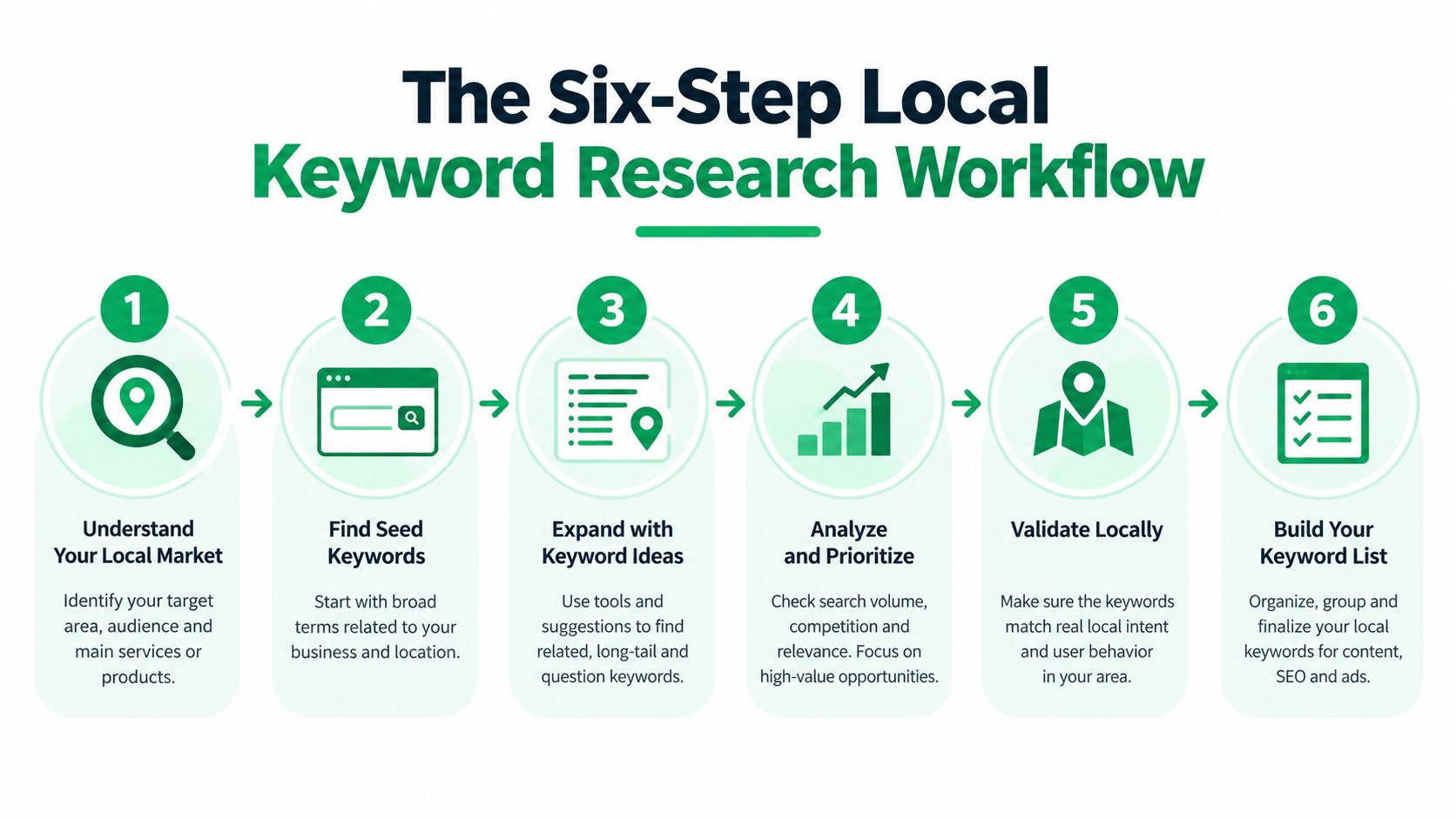
4. Validate the actual SERP
Search each important candidate from the target market, using location controls where possible. Check whether Google shows a Map Pack, local services, directories, review sites, comparison pages, or mostly informational results.
Note which businesses appear, what categories their profiles use, how closely their addresses match the search area, and whether their landing pages answer the query. A keyword tool can estimate demand, but only the SERP shows the type of result Google believes satisfies the search.
5. Tag intent before assigning a page
Use practical intent labels:
- Transactional: The searcher wants to hire, buy, book, call, or request a quote.
- Directional: The searcher wants a nearby location, opening information, directions, or immediate availability.
- Research: The searcher is comparing options, diagnosing a problem, or learning what service they need.
These categories can overlap. “Best dentist near me” may be research-oriented but still commercially valuable. The label helps determine the content depth and conversion path.
6. Prune for business fit
Remove terms that attract people outside the service area, visitors looking for a service you don't offer, or researchers with no realistic path to conversion. A large list isn't a strategy.
The process then cycles back through query data, call recordings, rankings, and changes in the SERP. New customer language creates new candidates, and underperforming pages reveal where the original mapping was too broad or too optimistic.
What Google's Local Algorithm Actually Rewards
Google's local system isn't a pure keyword contest. Google describes local ranking through relevance, distance, and prominence, and each factor changes how you should evaluate a keyword.
Relevance asks whether the business profile and website match the query. A plumbing company may be relevant for “water heater repair,” but less relevant for “commercial boiler installation” if that service isn't clearly represented in its categories, services, content, and supporting information. Keyword research therefore has to identify the exact services the business wants Google to associate with the location.
Distance considers the searcher's location and the location implied by the query. “Near me,” neighborhood, postal-code, and district searches can produce different results from a broad city query. A business can't rewrite its address to win every area, so geographic targeting should reflect realistic coverage instead of creating landing pages for places the company doesn't serve.
Prominence reflects how established and well-known a business appears. Links, reviews, citations, brand mentions, and broader authority can affect which businesses compete successfully for difficult terms. Keywords help communicate relevance, but they don't erase a competitor's stronger local reputation.
| Factor | What It Measures | Keyword Research Implication |
|---|---|---|
| Relevance | How closely the profile and website match the query | Prioritize genuine services, accurate categories, and language that describes the offer |
| Distance | The relationship between searcher, location term, and business address | Test neighborhood, district, and postal-code terms against realistic service coverage |
| Prominence | How established and trusted the business appears | Set difficulty expectations based on competitors, reviews, links, and local authority |
| Search demand | How often a term appears in available data | Use volume as a supporting filter, not as the primary decision |
A local SEO strategy should align keyword research with the three local search optimization factors, but it shouldn't promise that adding a phrase will overcome distance or weak prominence. Search volume is useful at the margin. It can't tell you whether the searcher is close, qualified, or likely to call.
Picking the Right Keywords From a Messy List
A messy keyword list usually contains a few commercial opportunities buried under broad city terms, duplicate variations, irrelevant services, and queries that look impressive but attract the wrong audience. The fastest way to clean it is to judge every candidate by the quality of the search result and the business opportunity, not by the largest number in a keyword tool.
| Criterion | Priority Signal, target first | Vanity Metric, deprioritize |
|---|---|---|
| Intent | A clear service, booking, call, visit, or urgent need | A broad topic with no obvious next action |
| Geography | Neighborhood, district, postal code, or realistic service area | A city term that covers an impractical radius |
| SERP | A Map Pack and local businesses that resemble the target company | National directories or generic informational results |
| Competition | Competitors with weak page quality, incomplete profiles, or limited local relevance | Strong brands dominating every result type |
| Business fit | A service the company actively delivers and wants to sell | A related service that creates unqualified enquiries |
| Search data | Reasonable demand paired with manageable difficulty | High volume without local or commercial relevance |
Read the SERP like a buyer
Search the keyword and inspect the first screen before deciding what it means. If the Map Pack contains nearby specialists, the query likely has local intent. If large directories dominate the organic results but local businesses occupy the Map Pack, the opportunity may belong in the profile and a focused service page rather than a long generic article.
Look at review strength and review velocity as competitive context, not as a reason to manufacture reviews. Check whether competitors use dedicated pages for the service, whether those pages mention the target area naturally, and whether their titles and headings answer the query directly.
Neighborhood modifiers often reveal more useful opportunities than a city name alone. A “roof repair in [neighborhood]” query, a postal-code search, or a service near a recognizable local landmark can better match a company's actual delivery area. The local keyword research benchmark also describes a commonly used prioritization rule, terms below 50% difficulty can be attractive when they align with business and location intent. Treat that as a screening benchmark, not a guarantee.
A keyword fails the triage test when it lacks clear local intent, points to the wrong service, or produces a SERP the business cannot realistically compete in. Cut it, even if the volume looks attractive.
The same discipline improves SEO content strategy. A smaller set of well-matched terms gives writers clearer briefs, gives designers clearer conversion paths, and gives owners a better explanation for why a page exists.
Mapping Keywords to Pages and Your Google Business Profile
Keyword research becomes useful only after each term has a destination. Without page mapping, teams publish several pages around the same city and service, place every phrase on the homepage, or create neighborhood pages with almost identical copy. Those shortcuts blur relevance and make performance difficult to interpret.
Give each destination a defined job
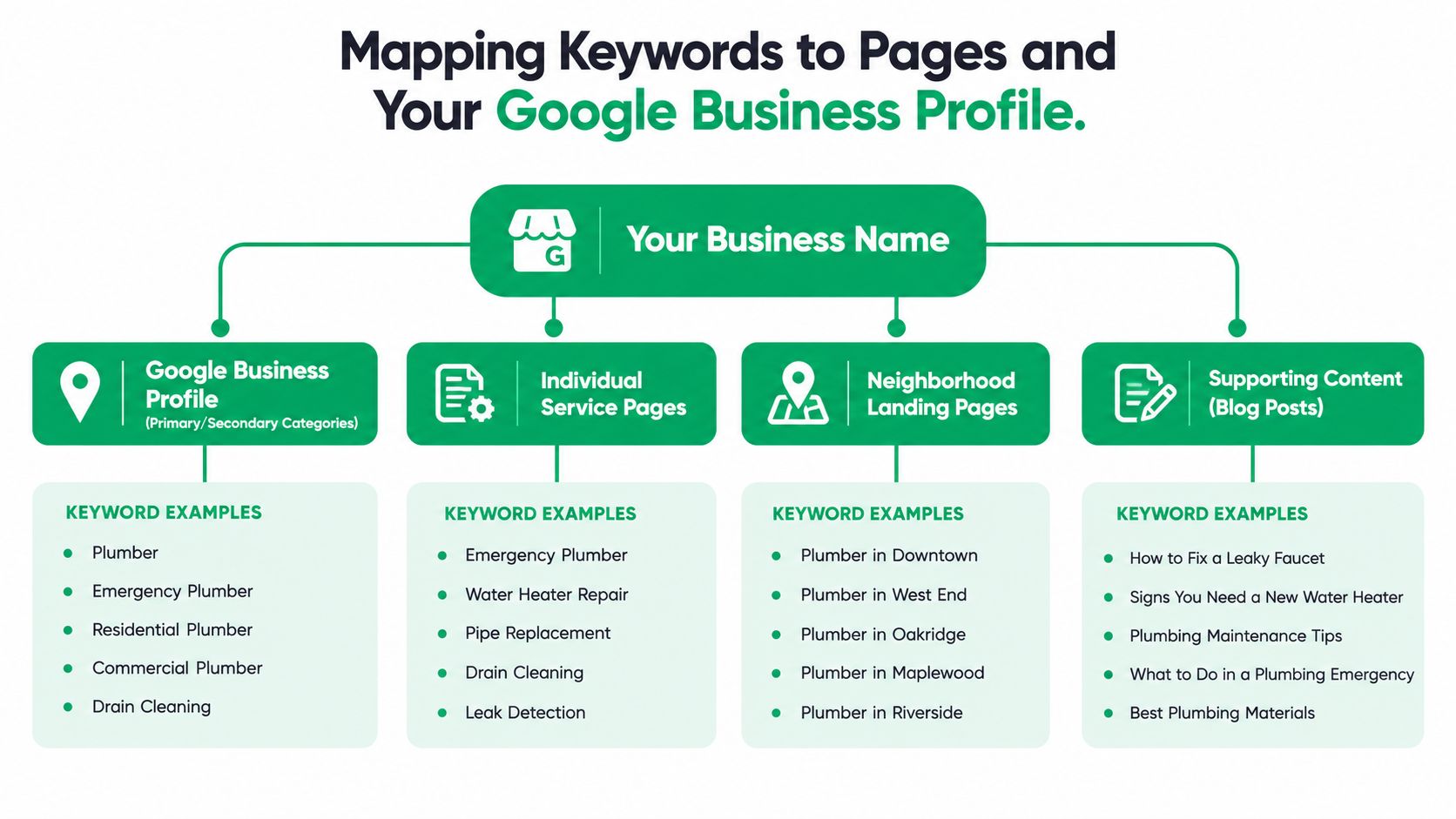
Use the Google Business Profile for the business's core identity, categories, services, attributes, photos, updates, and customer actions. The primary category should describe the central business, while secondary categories and service entries should support genuine offerings. Don't select a category because it contains a desirable keyword if it misrepresents the business.
For website destinations, use a practical map:
- Service pages: Assign one primary service intent to each page, such as emergency plumbing, brake repair, or family dentistry. Add close variants naturally, but keep the page's main promise clear.
- Neighborhood pages: Use these for real service areas with distinct local relevance. Include useful location details, service availability, directions, and proof of local experience.
- Supporting content: Use guides, FAQs, and comparison articles for research queries that help customers understand a problem before choosing a service.
- Homepage: Reserve it for broad brand and primary-market relevance. It shouldn't compete with every service and location page at once.
Prevent cannibalization
The one-keyword-per-page rule is a useful starting point for service pages. It doesn't mean each page can contain only one phrase. It means each page should own one primary intent, with related terms supporting the same customer need.
City and postal-code variations require judgment. If the service, availability, proof, directions, and customer context are genuinely different, separate pages may be justified. If only the location phrase changes, combine the content into a stronger location page instead of producing thin duplicates.
Reinforce the map through title tags, H1 headings, descriptive copy, internal links, and appropriate local business or service schema. The profile and website should describe the same business, services, and locations, but they shouldn't repeat identical wording everywhere.
Handle multi-location businesses differently
Each franchise or multi-location branch needs its own geographic cluster, profile, address, hours, services, and landing page. A location page can target its neighborhood, city, and nearby postal areas, while the homepage anchors broader brand terms.
A regional landing page may help organize locations, but it shouldn't replace individual location pages for branches with distinct customers and service areas. The mapping sheet should show which location owns each term, which profile supports it, and where calls or direction requests should be measured.
The Volume Trap and the Rise of AI Local Results
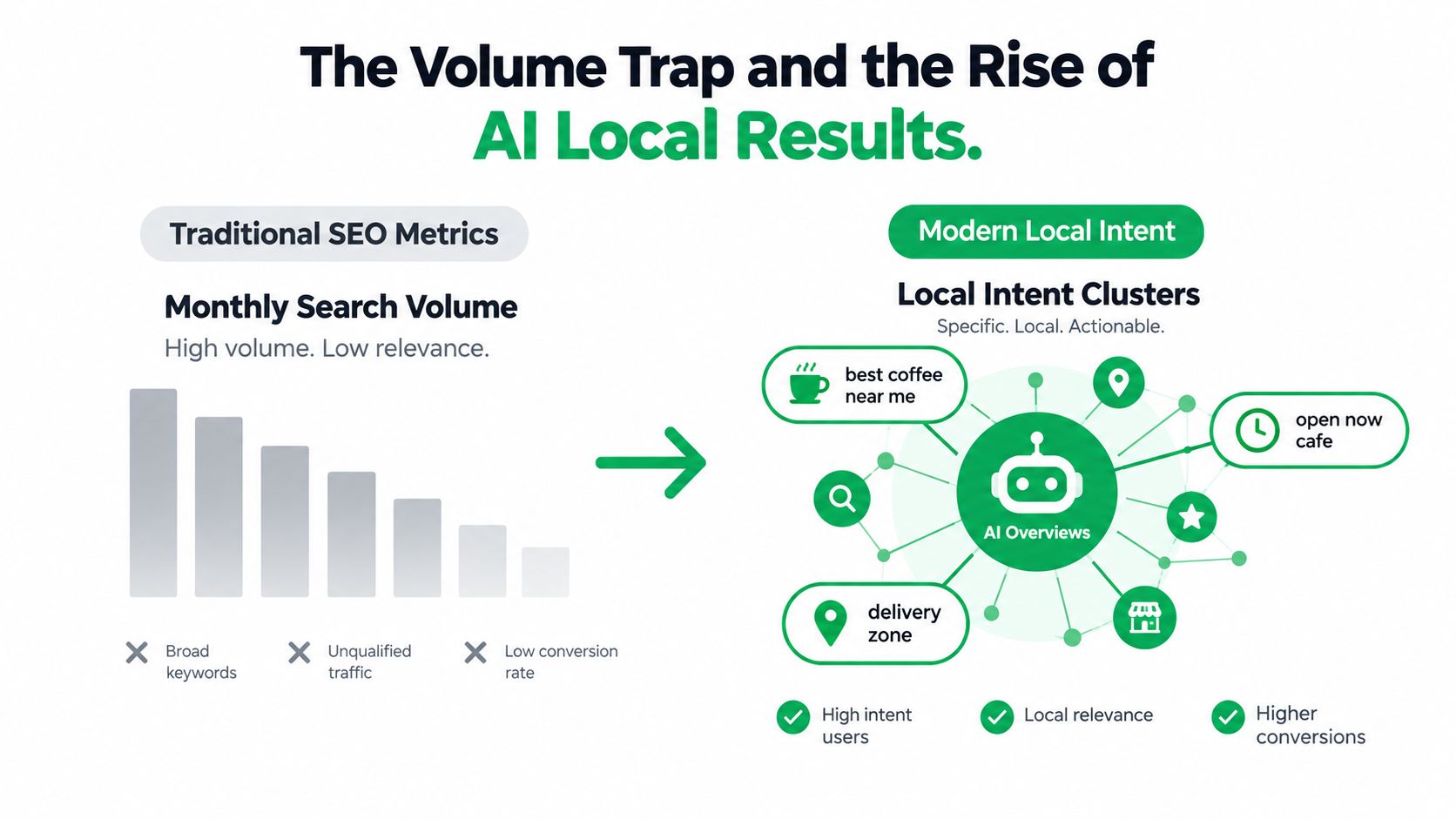
Monthly search volume is useful, but it can become a distraction when it hides the reason someone searched. A term such as “plumber Chicago” may appear more attractive than “emergency water heater repair near West Loop,” yet the second query communicates service, urgency, and a tighter geographic need.
Local demand also lives in conversational variations that keyword databases may undercount. People ask whether a business is open now, whether it serves a particular neighborhood, whether it can arrive today, or whether it handles a specific problem. Those questions may appear in People Also Ask, Reddit discussions, Google Business Profile Q&A, customer calls, and voice searches rather than as neat, high-volume entries.
AI changes the target
AI Overviews are another reason to think in clusters rather than isolated phrases. Recent 2026 industry reporting places AI Overviews on roughly 15.69% to 25.8% of tracked keywords, and one cited study found them on more than half of long-tail queries, as reported in local SEO statistics covering AI search. These figures vary by dataset and query set, so they shouldn't be treated as a universal rate. They do show why conversational local questions deserve attention.
An AI result may summarize businesses, services, locations, and suitability before a searcher clicks a traditional blue link. That makes clear service descriptions, consistent business information, useful location pages, reviews, and answer-focused content important parts of local visibility. It also makes a low-volume query valuable when it represents a phone call that a broad term rarely produces.
Mine questions from customer conversations, profile Q&A, sales objections, and support tickets. Group them by intent, then make sure the answer lives on the correct service or location page rather than creating a separate article for every minor variation.
Research the call, not the click. A keyword is valuable when it connects a real need with a service, location, and action your business can handle.
For teams building that layer deliberately, optimizing for AI search should complement local SEO rather than replace the fundamentals. An AI citation is not a substitute for accurate profiles, relevant pages, and a clear path to contact the business.
Your First 30 Days of Local Keyword Wins
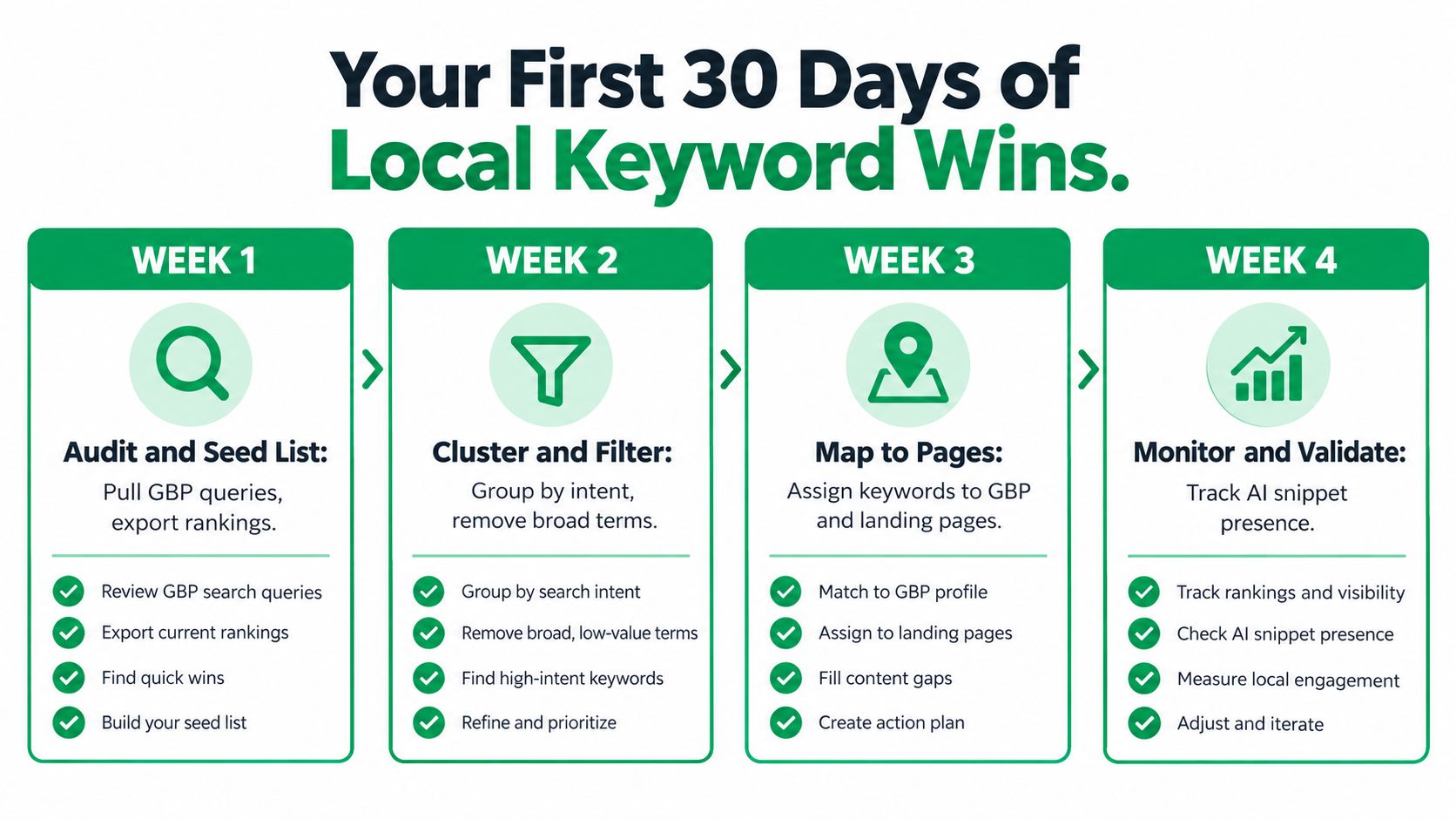
A 30-day kickoff should produce decisions, not just a larger spreadsheet. Keep the work small enough to complete and specific enough to measure.
Week one, audit and collect
Pull current Google Business Profile queries, existing ranking data, call notes, and direction-request information. Export the pages already receiving impressions, then compare them with the top three local competitors for each priority service.
Create a seed list that includes services, neighborhoods, postal codes, urgency modifiers, and customer wording. Mark every term as a possible transaction, direction, or research query.
Week two, cluster and filter
Group close variants around one customer need. Remove broad terms that attract out-of-area users, duplicate city and postal-code phrases, and services the business doesn't provide.
Check each priority term in Google Search, inspect the Map Pack, and record the businesses and page types that appear. The result should be a short, defensible list, not an enormous collection of theoretical opportunities.
Week three, publish and align
Launch or improve one priority service page and one useful neighborhood page. Update the Google Business Profile categories, services, descriptions, and posts so they accurately support the selected services.
Use internal links to connect supporting content with service pages. Add conversion elements such as click-to-call, booking options, service-area details, hours, and directions where appropriate. Mr. Green Marketing, LLC offers local SEO audits, SEO execution, website work, PPC, and GEO optimization for businesses that need help connecting this research to implementation.
Week four, measure real response
Review profile calls and direction requests, local-pack visibility, page engagement, form activity, and the language appearing in new enquiries. Re-score the keyword list against what customers mention.
Solo owners should usually begin with three to seven tightly matched terms, while multi-location teams may need to manage dozens of city and service combinations across separate branches. The correct scope depends on capacity and location complexity, not on a desire to publish everywhere at once.
Use local SEO lead generation guidance to keep the measurement tied to enquiries rather than rankings alone. Review the keyword and call data monthly, add a new service line when the business can fulfill it and customers ask for it, and retire terms that consistently attract the wrong audience. A clean map is more valuable than a crowded one.
Mr. Green Marketing, LLC can audit your local keywords, Google Business Profile, location pages, and conversion paths to identify gaps that cost you calls. Visit Mr. Green Marketing, LLC to request a free audit and performance report, then turn your highest-intent local searches into a practical growth plan.
Leave a Comment
sing in to post your comment or sign-up if you dont have any account.