
Local SEO for Contractors: A crew is ready to work, the voicemail is full, and yet the phone stays quiet. Then a homeowner mentions that three other contractors appeared above you on Google Maps, even though your team has served the area for years. The problem often isn’t workmanship. It’s that the search result has become the first job interview, and your competitors are getting seen before anyone reaches your website.
Local search is now a primary discovery channel for contractors. 46% of all Google searches have local intent, 80% of U.S. consumers search for a local business online at least once a week, and 98% search online for local businesses before contacting them, according to local SEO statistics for contractors. This guide turns that behavior into an operating system built around Google Business Profile proximity, review depth, service relevance, citations, proof-based pages, links, and visibility in AI-generated results.
Local SEO for Contractors: Table of Contents
- Why Contractors Are Losing Jobs to Search and What This Guide Covers
- How Google Ranks Contractors Locally in 2026
- Audit and Optimize Your Google Business Profile First
- NAP, Citations, and Choosing Single vs. Multi-Location Profiles
- Build a Review System That Actually Compounds
- Service Pages, Location Pages, and Schema That Earn Visibility
- Links, Citations, and Digital PR That Move the Needle
Local SEO for Contractors: Why Contractors Are Losing Jobs to Search and What This Guide Covers
A homeowner with a failing water heater usually starts with a nearby service search, not your company history. They scan the map results, compare review quality, and call the contractor that appears credible and available. For most homeowners, the decision is made during that initial search-results scan, before they click through to a website.
That behavior makes the Google local pack a major source of booked work. 42% of local searches result in clicks on Map Pack listings, while 72% of Google Business Profile visits are discovery searches rather than direct brand searches, according to contractor local search data. Homeowners search for “roof repair,” “HVAC contractor,” or “electrician near me,” then decide which unfamiliar business deserves the call.
The practical problem: Your offline reputation can be strong, but Google can only evaluate signals it can verify online.
This guide connects Google’s three local ranking factors, relevance, distance, and prominence, to contractor workflows. It covers service and category alignment, location signals, NAP accuracy, review requests, useful city pages, schema, and links that support local visibility and organic authority. The goal is not a profile edit followed by passive waiting. It is a repeatable operating system.
Two inputs deserve priority in 2026: GBP proximity and review depth. A large review count cannot consistently overcome a meaningful distance disadvantage, while a nearby contractor with shallow or outdated reviews may lose trust at the decision point. Review depth means more than a total score. It includes steady recent reviews that mention real services and service areas.
AI Overviews and other zero-click results add another constraint. Google may summarize a contractor’s services, locations, or reputation without sending the searcher to the website, so clear proof must exist across the profile and site. The benefits of local SEO extend beyond map visibility when that information is consistent.
Use a 90-day cadence: fix foundation problems in the first 30 days, add service and location proof from days 31 through 60, then strengthen prominence with links and digital PR from days 61 through 90. Results require sustained execution.
How Google Ranks Contractors Locally in 2026
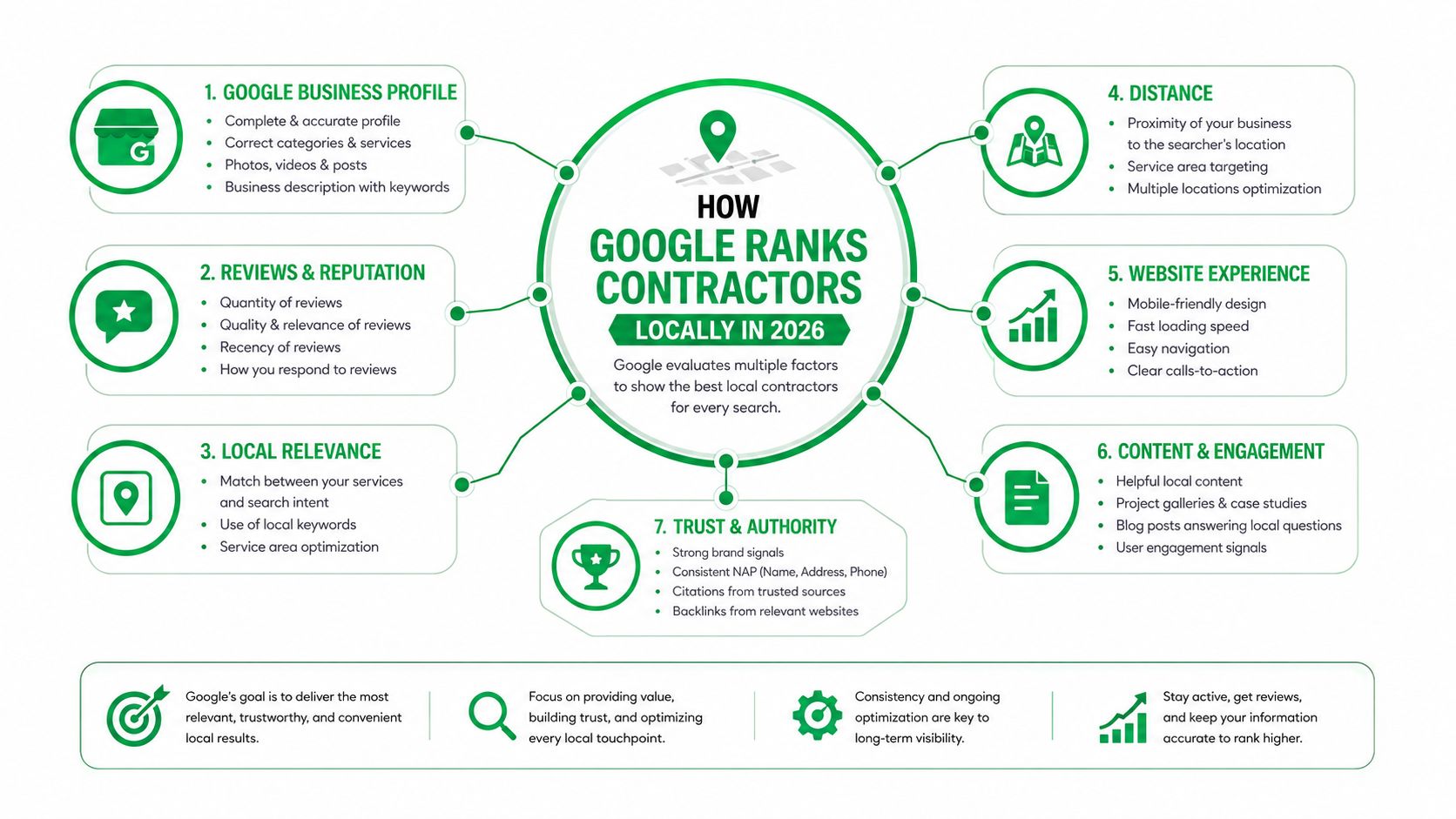
Google describes local rankings through relevance, distance, and prominence. Its official explanation of local ranking defines relevance as how well a profile matches the search, distance as proximity to the searcher or search area, and prominence as how well-known the business is. Reviews and links can influence prominence.
Relevance starts with service clarity
Google needs to understand exactly what you do. Your primary GBP category should match the service that drives the business, while secondary categories should describe legitimate additional services. Website service pages, profile services, headings, internal links, and structured data should reinforce the same entity without keyword stuffing.
A roofer shouldn’t rely on a generic “contractor” label if “Roofing Contractor” accurately describes the business. A plumbing company offering drain cleaning, water heater work, and emergency repairs should make those services easy to identify across the profile and site.
Local SEO for Contractors: Distance creates a hard competitive boundary
Your verified business location remains a major local signal. A service-area business can define the communities it serves, but adding cities to a profile doesn’t create an office there. Contractors should expand service coverage deliberately through real jobs, project evidence, useful location pages, and accurate service-area settings.
One 2025 model of 3,269 profiles found that proximity explained 55% of visibility across positions 1 through 21. In the top 10, proximity explained 36%, while review count contributed 26% and review-keyword relevance reached 22%, according to research on proximity and reviews. That supports a two-track plan: protect geographic alignment, then build review depth.
Prominence reflects reputation and recognition
Reviews, citations, links, brand mentions, and consistent business details help Google assess prominence. The local pack remains valuable because independent industry reporting says it ranks first in 93% of local searches, while 44% of local searchers click Local 3-pack results, compared with 29% for organic results and 19% for paid results in the cited historical data from local SEO for contractors.
For a quick self-assessment, ask:
- Relevance: Could a stranger identify your core services from the GBP and website without guessing?
- Distance: Does your verified location realistically support the cities you’re targeting?
- Prominence: Are reviews, links, citations, and local mentions growing through a repeatable process?
- AI visibility: Can search systems extract clear answers, services, credentials, and review context from your site and profile?
Prioritize proximity alignment first, review depth second, and supporting relevance and prominence assets around those two inputs.
Local SEO for Contractors: Audit and Optimize Your Google Business Profile First
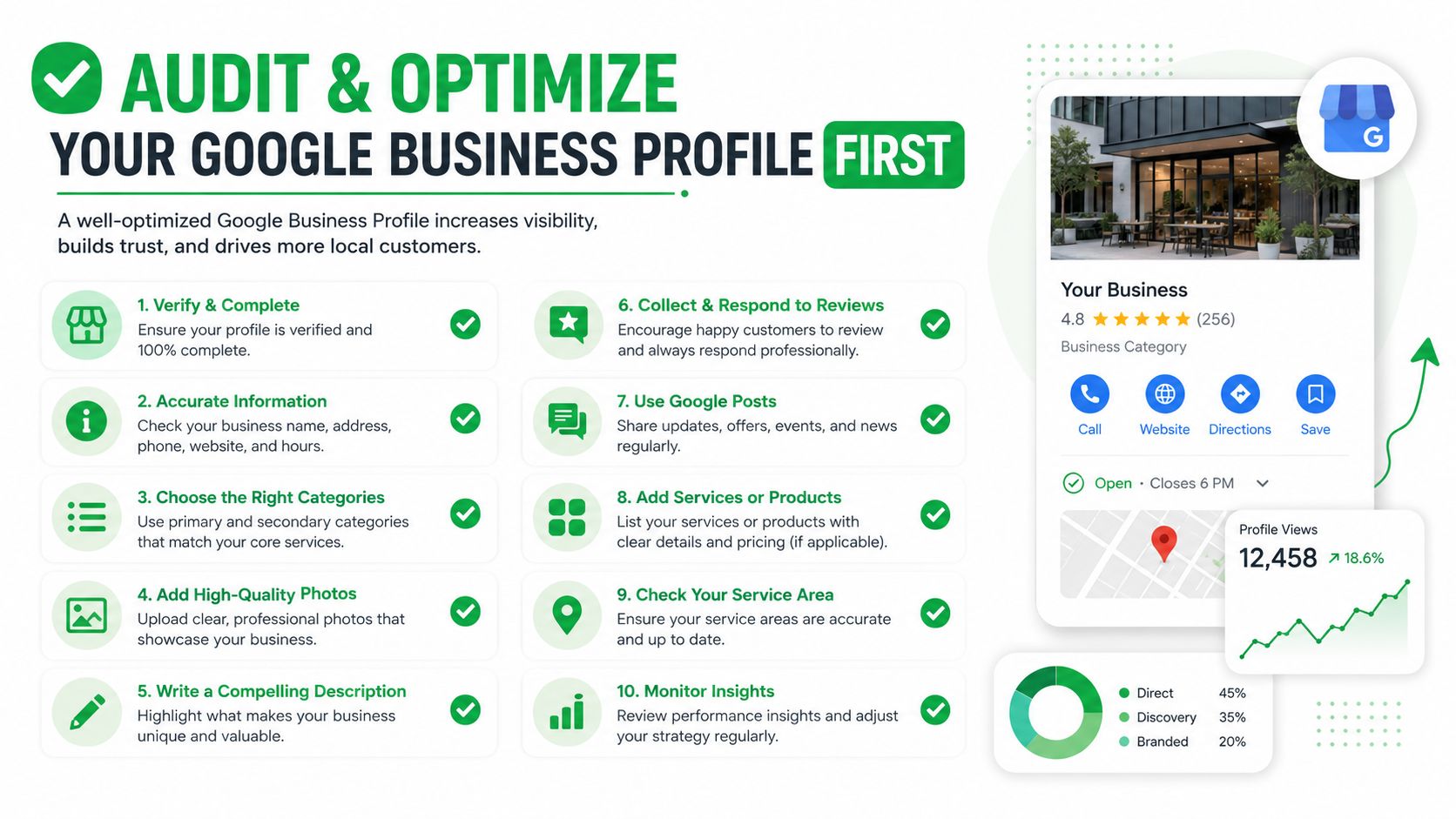
Treat your Google Business Profile as an operating asset, not a form you completed years ago. Start by verifying ownership and recording the current profile state. Save the profile URL, business name, category, address visibility, phone number, service area, hours, services, photo count, unanswered questions, and recent post activity.
Follow the audit in this order
- Confirm ownership and access. Remove former employees or agencies who no longer need control.
- Protect the business name. Don’t add cities, services, or sales language unless they are part of the actual name.
- Choose the primary category precisely. Match the category to the main revenue-producing service.
- Add legitimate secondary categories. Use only categories supported by the services you provide.
- Write 8 to 12 service descriptions. Use homeowner language, explain the problem solved, and state the service area naturally.
- Configure the service area correctly. A service-area business shouldn’t display a residential address, while a staffed storefront should provide accurate location information.
- Build a complete photo inventory. Upload exteriors, active work, finished projects, team members, vehicles, equipment, and jobsite details.
- Seed useful Q&A. Answer questions about estimates, emergency availability, warranties, financing, permits, and preparation.
- Publish weekly Google Posts. Rotate completed projects, seasonal maintenance, FAQs, hiring updates, and service reminders.
- Complete overlooked attributes. Add licensing information where available, payment types, warranties, accessibility details, and booking or messaging options that the business supports.
The local SEO audit checklist can help turn this review into a documented process rather than a memory exercise.
Use a pre and post audit sheet
Create columns for Current state, Target state, Owner, Due date, and Evidence. Record the original category, service list, photos, review count, unanswered questions, and profile completeness before making changes. Afterward, note what changed and capture screenshots or URLs.
Your punch list should separate must-fix items from optimization wins. Must-fix items include ownership problems, wrong names, incorrect hours, duplicate profiles, bad phone numbers, and a misleading address. Optimization wins include a richer photo library, better service descriptions, seeded Q&A, weekly Posts, and complete attributes.
A complete profile won’t override weak geographic relevance, but an incomplete one makes it harder for Google and homeowners to understand the business. Fix the basics first, then maintain the profile every week.
Local SEO for Contractors: NAP, Citations, and Choosing Single vs. Multi-Location Profiles
The single-versus-multi-location decision should reflect the operating structure, not a desire to appear in more cities. A solo contractor serving a tight radius usually benefits from one strong service-area profile. Separate profiles make sense when each branch has a legitimate staffed location, distinct contact details, and a genuine local presence.
| Criterion | Single GBP (SAB) | Multi GBP (Per Location) |
|---|---|---|
| Business structure | One operating business | Distinct branches or offices |
| Address | Hidden eligible service-area address | Public, staffed physical address |
| Phone | Shared main number | Distinct branch phone lines |
| Best fit | Tight trade area and centralized operations | Separate teams serving different regions |
| Main risk | Overextending service-area targeting | Creating thin or ineligible duplicate profiles |
A single profile is generally the cleaner choice for a solo contractor, a centralized team, or a business completing fewer than 10 jobs per month per city, where separate city profiles may lack enough independent activity. Multi-profile structures are more defensible for brick-and-mortar offices or branded trucks stationed across regions, provided each location meets Google’s eligibility requirements.
Run a structured NAP audit
Build a spreadsheet with the official business name, address format, phone number, website, profile URL, and correction status. Check Apple Maps, Yelp, BBB, Houzz, Angi, Nextdoor, and major data aggregators such as Data Axle, Localeze, and Foursquare.
Correct the primary records first. Then claim or update industry directories, chamber listings, city business directories, and trade association pages. For duplicates, document the listing, claim it when possible, correct the authoritative record, and request suppression or removal rather than creating another competing entry.
Service-area businesses can verify through Google’s available methods, which may include postcard or video verification, and can claim a profile without displaying the street address. Don’t use a virtual office or a rented mailbox as a substitute for an eligible business location.
Use multi-location SEO strategy when a growing contractor needs a governance model for branch pages, profiles, and shared brand assets.
Local SEO for Contractors: Build a Review System That Actually Compounds
Reviews are the prominence signal contractors can influence most consistently, provided the process follows the completed-job workflow. A 2026 dataset covering 16,098 Google Business Profiles reported that profiles with 1 to 5 reviews reached a top-three rate of 39.3%, while profiles with 201 to 500 reviews reached 73.0%, as reported in Google local search review data.
The lesson isn’t to chase a vanity total. It’s to replace occasional requests with a predictable closeout system.
Trigger the request while the experience is fresh
Send the first text or email within 2 hours of job wrap. Put a QR code on the final invoice, give technicians a tablet for the handoff when appropriate, and follow a 14-day cadence with one polite follow-up.
SMS template
Hi [Name], thanks for choosing [Company] for your [service] in [City]. If the work met your expectations, would you share an honest Google review? [Review link]
Email template
Subject: How did we do on your [service] project?
Hi [Name], we appreciate the opportunity to complete your [service] in [City]. Your honest feedback helps local homeowners choose a contractor. You can leave a Google review here: [Review link]
Handwritten card
Thank you for trusting us with your [service] project in [City]. If you have a moment, an honest Google review would mean a lot to our team. [Short review URL]
The service and city references should describe the actual job, not force awkward keywords into the request. Never offer incentives, ask only satisfied customers, or filter unhappy customers away from the review platform.
Local SEO for Contractors: Respond quickly and specifically
Respond to every review within 24 hours. A positive response can mention the completed service and city naturally: “Thank you for trusting us with your roof repair in [City], [Name].” A negative response should acknowledge the concern, avoid private customer details, invite offline resolution, and remain calm.
If a review violates Google’s policies, document the issue and use Google’s reporting process. Don’t threaten the reviewer or attempt to bury criticism with manufactured reviews.
Aim for a steady 1 to 2 reviews per month for each service and city combination. That cadence builds topical coverage in the profile while keeping the process manageable for a small team.
Local SEO for Contractors: Service Pages, Location Pages, and Schema That Earn Visibility
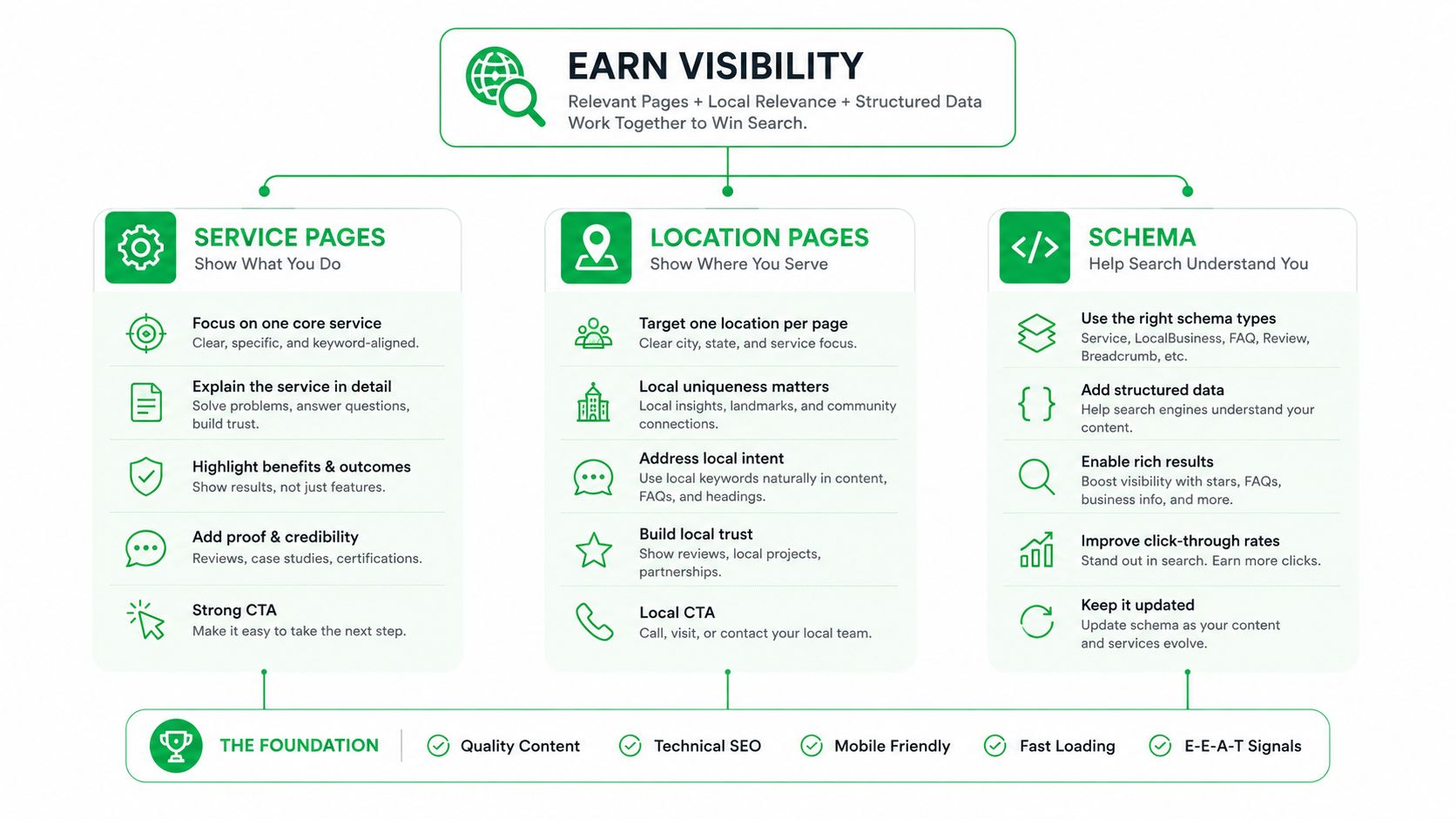
A contractor site needs more than a generic “Services” page. Build one useful page for each core service, such as roof repair, water heater replacement, or deck construction. Each page should answer the homeowner’s practical questions and show proof that the team performs the work.
Include project photos, scope and material details, before-and-after images, permits pulled when relevant, neighborhoods served, warranty information, preparation guidance, and a clear contact path. A page about water heater replacement should explain the types of systems handled, warning signs, what the visit involves, and how the homeowner requests an estimate.
Make location pages prove local relevance
A city page shouldn’t be a copied template with a new place name. Add completed project examples, neighborhood references, local permitting context, service limitations, actual photos, and a specific call to action. An embedded map can support usability, but it isn’t proof by itself.
For every target city, ask whether you have enough real evidence to create a useful page. If you don’t, improve the existing service-area page rather than publishing dozens of thin doorway pages. Scaling across 20 or more cities requires editorial control, unique project evidence, and a reason for each page to exist.
Local SEO for Contractors: Use a hub-and-spoke internal linking model
Service pages should link to relevant city pages, and city pages should link back to the services offered there. A “Roof Repair” hub might link to “Roof Repair in Pensacola” and “Roof Repair in Mobile,” while each city page links to emergency roofing, inspections, and replacement pages where appropriate.
Use JSON-LD structured data for LocalBusiness, Service, FAQPage, Review or AggregateRating when eligible, and BreadcrumbList. Keep the markup consistent with visible page content. Schema doesn’t create a license to claim services, ratings, or locations that the business can’t substantiate.
For AI Overview visibility, format important answers in concise 40 to 60 word blocks, followed by supporting detail, examples, and qualifications. This structure helps machines extract an answer while giving homeowners the context needed to contact you. The schema markup guide for SEO provides additional implementation context.
Local SEO for Contractors: Links, Citations, and Digital PR That Move the Needle
Contractor link building works best when it reflects how the business operates in the community. A manufacturer page can reinforce trade relevance. A chamber listing can reinforce local presence. A project story in a local publication can support both recognition and referral traffic.
The key filter is simple:
If a link wouldn’t drive a qualified homeowner visit when featured on that site’s homepage, skip it.
Rank opportunities by practical value
| Source Type | Effort | Time to Land | Ranking Impact |
|---|---|---|---|
| Manufacturer or supplier partner | Low to medium | Short to moderate | Trade relevance and prominence |
| Trade association | Low to medium | Short to moderate | Industry trust and authority |
| Local sponsorship | Medium | Moderate | Local prominence and referral exposure |
| Completed-job PR | High | Moderate to long | Local recognition and authority |
| Chamber or city directory | Low | Short | Local citation support |
| Angi, Houzz, BBB, and similar directories | Low to medium | Short | Niche relevance and citation support |
| Complementary business partnership | Medium | Moderate | Referral value and contextual relevance |
Manufacturer and supplier links deserve early attention because the outreach angle is straightforward. Send a short note explaining the products used, the service region, and the project page that documents the installation. Ask whether the supplier maintains an authorized installer, contractor network, or project showcase.
Trade associations work similarly. Join only organizations relevant to the trade, complete the member profile, and request inclusion in any contractor directory. These links may support domain authority and industry context, but they won’t replace proximity or a healthy review profile.
Local sponsorships can strengthen community association when the organization publishes a real sponsor page. Ask for accurate business details, a descriptive link to the most relevant service page, and permission to use event or project photos. Don’t buy a link from a site that exists only to sell links.
Use a 90-day rollout
Week one: Correct GBP ownership, name, category, hours, services, address visibility, and service area. Create a baseline for impressions, calls, direction requests, website clicks, branded searches, and a local ranking grid across the main service keywords.
Weeks two through four: Audit NAP listings, remove duplicates, correct major directories, and launch the review request workflow. Track completed jobs, requests sent, reviews received, response time, and review themes.
Days 31 through 60: Publish core service pages, then add location pages only where the business has proof and meaningful coverage. Add relevant schema, improve internal links, and monitor which queries trigger profile impressions or website visits.
Days 61 through 90: Begin supplier, manufacturer, association, sponsorship, and digital PR outreach. Track live links, referral visits, brand mentions, new reviews, and movement in the local grid.
AI Overviews make profile completeness, reviews, photos, Q&A, and clear entity information more important even when a searcher doesn’t click through. Coverage of AI Overviews and zero-click local search reports AI Overviews appearing on around 1 in 6 searches and taking 15.69% of Google queries, up from 6.49% in January 2025. The same source notes that more than 65% of Google searches end without a click, so visibility should be measured beyond organic sessions.
Report weekly, judge the program quarterly
Use a short weekly dashboard:
- GBP visibility: Impressions by discovery query and branded query.
- Actions: Calls, website clicks, and direction requests.
- Reputation: New reviews, response time, service and city mentions.
- Local coverage: Ranking-grid movement by service and search location.
- Authority: New citations, live links, referral visits, and brand mentions.
- Business outcome: Qualified calls, estimates, booked jobs, and missed-call follow-up.
In the first 30 days, leading indicators include corrected listings, profile completeness, photo activity, review requests, and unanswered questions resolved. At 90 days, lagging indicators include stronger local coverage, more qualified calls, direction requests, branded search activity, and booked work.
Don’t pivot a budget because one keyword moves slowly. Pivot when a tactic produces no credible leading indicator after its planned cycle, or when the leads it generates aren’t qualified. A directory that sends no homeowner traffic may still provide basic citation value, but it shouldn’t receive the same investment as a supplier relationship or local story that earns both visibility and referrals.
For the execution details behind this approach, review these link-building strategies for SEO. A contractor can also maintain a reusable monthly template with columns for metric, current period, previous period, change, source, owner, and next action. That format keeps reporting tied to decisions instead of turning it into a collection of screenshots.
Mr. Green Marketing, LLC helps contractors improve local visibility through SEO, conversion-focused web design, GBP strategy, review workflows, structured content, and GEO optimization for AI-driven search. Visit Mr. Green Marketing, LLC to request a free audit and performance report, then prioritize the local search gaps most likely to affect qualified calls.
Leave a Comment
sing in to post your comment or sign-up if you dont have any account.