
Local Lead Generation Services: A slow Tuesday can make a service-area business owner question everything. The phone barely rings, the quote requests disappear, and a quiet Wednesday starts to look expensive. Then one referral surge arrives, the calendar overloads, response times slip, and the business discovers that demand was never the actual problem. The problem was having no reliable way to create, qualify, and measure demand.
Local lead generation services are designed to replace that word-of-mouth roulette with a repeatable intake system. They connect local visibility, trust signals, advertising, landing pages, calls, forms, and follow-up so a business can see not only how many leads arrived, but whether those leads became appointments and revenue.
The right buying decision isn’t just “SEO or ads?” You need to decide which channels deserve investment, how the provider should be paid, how lead quality will be measured, and how the first 90 days will be managed. This guide walks through those decisions in plain language, including the trade-offs that matter to small businesses and multi-location operators.
Local Lead Generation Services: Table of Contents
- The Moment a Local Business Realizes It Needs Steady Leads
- What Local Lead Generation Actually Means
- The Core Channels and How They Capture Local Intent
- How Local Lead Generation Services Are Priced
- KPIs and Attribution That Tell You What Is Working
- A Realistic 30 60 90 Day Onboarding Timeline
- The Pre-Engagement Audit Checklist
- Choosing a Provider and What Realistic Success Looks Like
Local Lead Generation Services: The Moment a Local Business Realizes It Needs Steady Leads
The owner of a plumbing company opens the scheduling system on a Tuesday morning and sees empty spaces. By Wednesday afternoon, the silence feels like a crisis. A referral partner sends several urgent jobs later that week, but the team isn’t ready for the sudden volume, so calls go unanswered and estimates get delayed.
That pattern is common in local businesses that rely on referrals, repeat customers, or occasional promotions. Those sources can be valuable, but they rarely create a dependable flow on their own. The business reacts to demand instead of building an acquisition engine that produces opportunities across ordinary weeks, not just busy periods.
Local search gives that engine a practical starting point. A person searching for a nearby electrician, dentist, cleaner, or repair company usually has a specific problem and a limited service area. The opportunity is immediate, but the business still needs to appear, look credible, make contact easy, and respond quickly.
Practical rule: A lead-generation system isn’t working just because it produces contacts. It needs to produce contacts your team can serve and close.
The useful way to evaluate local lead generation services is as an operating system rather than a marketing checklist. Google Business Profile, local SEO, Local Services Ads, paid search, directories, reviews, call tracking, forms, and CRM stages all influence different parts of the same journey.
By the end of the buying process, you should be able to answer four questions:
- Channel investment: Which sources reach customers with useful intent?
- Pricing: Does the payment model reward qualified opportunities or raw volume?
- Measurement: Can you connect a search, call, or form to a booked job?
- Onboarding: Does the provider have a credible plan for the first 90 days?
What Local Lead Generation Actually Means
A local lead is a person in your defined service area who has expressed purchase intent for a nearby solution. That might be a call, quote request, appointment booking, chat, or message from someone looking for the service you provide in the location you serve.
Raw website traffic doesn’t meet that definition. Someone reading a general article from outside your territory may increase traffic without creating a sales opportunity. A local lead is closer to a customer who walks into your shop already looking for a particular product. Website traffic is everyone passing the window.
The distinction matters because lead generation and demand generation serve different purposes. Demand generation builds awareness and interest over time. Lead generation captures a person who is ready, or close to ready, to take a commercial action. Local businesses often need both, but they shouldn’t judge them by the same standard.
Three signals help separate a useful lead from noise:
- Geo-relevance: The person lives, works, or operates within the area you serve. A location page that attracts inquiries from a city outside your coverage may look successful in analytics while creating no revenue.
- Commercial intent: The contact is asking about a service, price, availability, appointment, estimate, or next step. An informational visit can be valuable, but it isn’t equivalent to a request for work.
- Trustworthy information: Your name, address or service area, phone number, hours, services, reviews, and business details agree across the places customers may encounter you.
Google Business Profile is central because its Insights dashboard can show calls, direction requests, website clicks, and messages, according to this overview of Google Business Profile lead tracking. Those actions are closer to commercial behavior than pageview totals.
A useful local SEO lead generation framework should therefore connect visibility with conversion. Every channel in the next section needs to support at least one of the three signals, and the strongest systems support all three.
Local Lead Generation Services: The Core Channels and How They Capture Local Intent
The six core channels don’t capture the same customer or operate on the same timetable. Google Business Profile reaches people in discovery mode on Maps and local results. Organic local SEO answers service and problem searches. Local Services Ads capture high-intent demand near the point of contact, while paid search gives you control over competitive queries and geographic targeting.
Directories can introduce a business through category-specific discovery, though their value depends on accuracy and audience quality. Reviews act differently from the other channels. They don’t merely create another listing. They influence whether a person trusts the business enough to call, submit a form, or book.
Local search demand is commercially concentrated. A widely cited roundup reports that 46% of Google searches have local intent, and that 76% of mobile local-search users visit a physical business within 24 hours. The same reporting says the Local 3-Pack appears in the top position for 93% of local-intent queries, while an average small-business Google Business Profile reportedly receives 1,009 searches per month. These figures are summarized in local search statistics for 2026.
| Channel | Typical Cost per Lead | Time to Results | Lead Quality | Best For |
|---|---|---|---|---|
| Google Business Profile and local SEO | $0-$40 | 6-12 weeks to first lead | Strong when profile and service match are clear | Sustainable discovery and map actions |
| Local Services Ads | $35-$120 | 3-7 days to first lead | High intent, quality depends on screening | Fast demand capture for eligible services |
| Paid search | Varies by auction and strategy | Fast after launch | Strong for targeted commercial terms | Branded and competitive searches |
| Directories and citations | Varies by provider and placement | Usually gradual | Mixed, depending on directory relevance | Category discovery and consistency |
| Reviews | No universal CPL | Builds over time | Improves trust across channels | Reducing hesitation and supporting conversion |
The cost and timing benchmarks for Google Business Profile, local SEO, and LSAs come from this local lead generation benchmark. Organic visibility can compound, but it may face search-volume limits and ranking plateaus in dense markets. Paid placements can produce contacts sooner and scale with budget, but they need disciplined targeting and qualification.
Reviews aren’t a separate decoration layer. They influence the conversion rate of traffic that other channels already paid for or earned.
Consumer skepticism makes review quality especially important. 94% of consumers trust local reviews to some degree, 55% trust reviews more than a business’s own claims, and 39% don’t trust AI-generated local recommendations unless they can read individual reviews, according to GatherUp’s local trust research. That means review volume, recency, response behavior, and detailed customer experiences belong in the channel plan.
For buyers comparing implementation options, local business lead generation services should be judged as a connected system. Accurate profile data can strengthen paid landing experiences, paid search can reveal valuable query language, and reviews can improve the performance of both.
How Local Lead Generation Services Are Priced
Pricing determines who carries the risk, but it doesn’t determine whether the leads are good. Before signing, ask what the provider counts as a lead, whether ad spend is separate, which tools are included, and how the team handles duplicates, spam, wrong numbers, out-of-area inquiries, and contacts seeking services you don’t offer.
| Model | Typical Price Range | Risk Allocation | Best For |
|---|---|---|---|
| Flat monthly retainer | Varies by scope | More risk sits with the business | Ongoing strategy, SEO, content, and campaign management |
| Per-lead fee | Varies by qualification and market | Shared risk, with quality definitions critical | Businesses with clear service boundaries and intake capacity |
| Performance-based | Varies by contract and closed-sale definition | More risk sits with the provider | Proven offers with reliable sales tracking |
| Hybrid | Base fee plus agreed performance component | Shared according to the base and bonus structure | Scaling operators with usable CRM data |
A flat retainer can include profile management, local SEO, landing pages, paid campaign work, reporting, and conversion improvements. It gives the provider room to work on foundations that don’t produce an immediate contact, but it may involve a longer commitment before you can judge the full return.
Per-lead pricing sounds safer because you pay for activity rather than time. The weakness is incentive design. If the provider earns money for every form fill, the system may favor quantity over service area, urgency, or fit. A good agreement defines a qualified lead and gives you a process for rejecting invalid contacts.
Performance-based arrangements can align incentives with closed revenue, but they require clean CRM stages and agreement on what counts as a sale. “Closed deal” can become difficult to verify when a customer returns later, buys another service, or contacts the business offline.
Setup fees, ad-spend markups, content production, landing-page work, call-tracking licenses, CRM connections, and cancellation terms often sit outside the headline price. Review the scope line by line, using this guide to digital marketing agency pricing packages as a comparison point.
For an SMB still stabilizing its offer, a transparent retainer or hybrid model usually makes evaluation easier than an unlimited per-lead commitment. A multi-location operator with proven conversion data may justify performance incentives, provided each location has its own source and revenue records.
Local Lead Generation Services: KPIs and Attribution That Tell You What Is Working
A report full of impressions, clicks, and total leads can still leave you unable to answer the only question that matters: which source produces profitable customers?
Start with the funnel. Track qualified lead volume, cost per qualified lead, lead-to-appointment rate, appointment-to-close rate, and customer acquisition cost by location or service line. These metrics reveal where the system is leaking. A campaign can produce cheap leads and still fail if staff can’t reach them, appointments don’t happen, or salespeople close poorly.
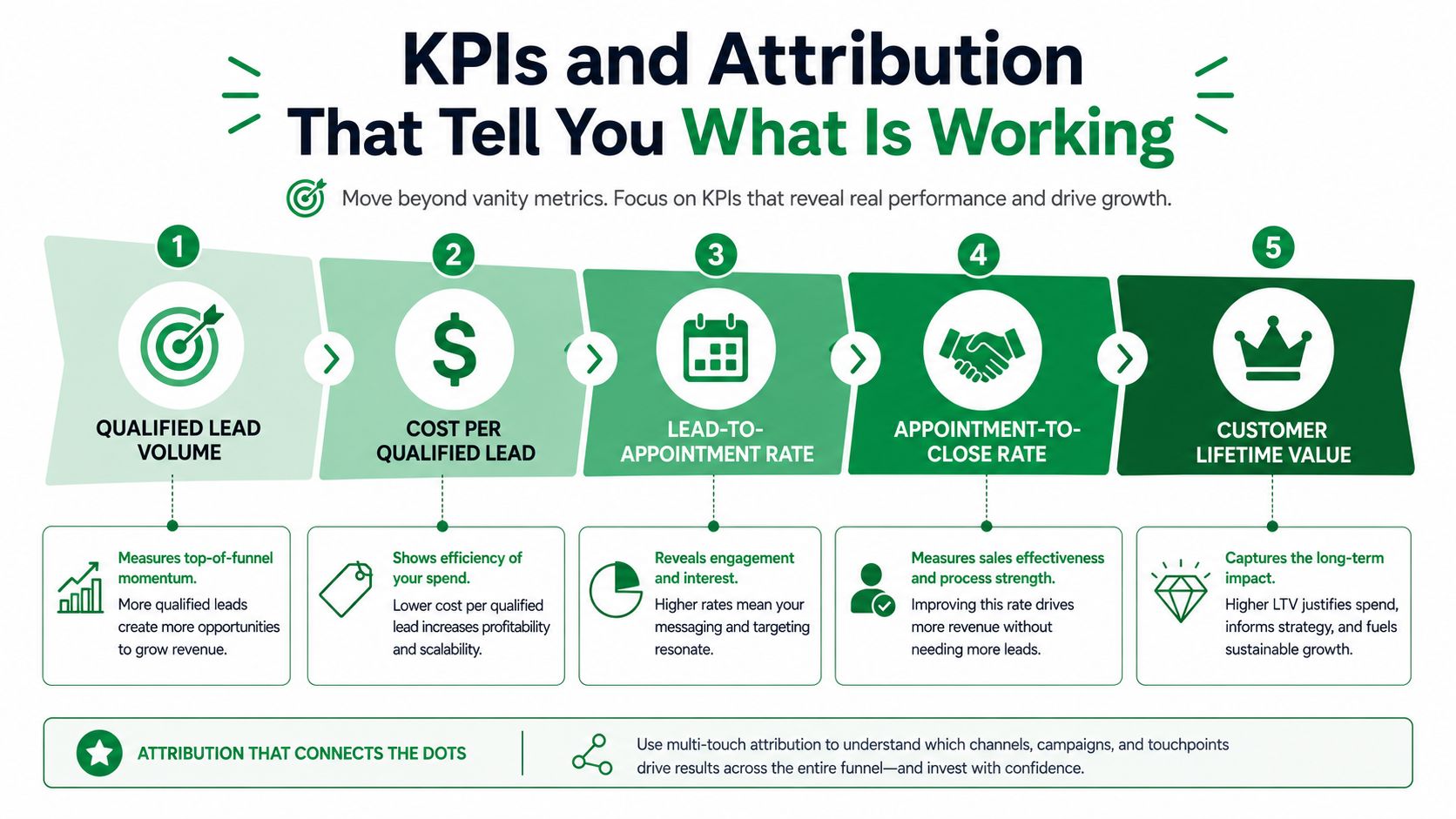
Suppose 100 leads produce 20 appointments and 6 closed deals. Those figures are a funnel illustration, not an industry benchmark. The meaningful cost metric is the cost per closed deal, because six customers create the economic result, not the original 100 contacts.
Build attribution into the intake path
Use a unique tracking number for each major channel when calls matter. Dynamic number insertion can show a source-specific number to website visitors, while source fields on forms can preserve campaign and landing-page information. Connect those records to CRM stages such as new lead, qualified, appointment, proposal, won, and lost.
Google Business Profile Insights deserves attention because it records calls, direction requests, website clicks, and messages. Combine those actions with actual call outcomes rather than treating every interaction as equivalent.
Call handling also changes downstream performance. A 2026 benchmark reports an average 31% booking rate on answered calls, with top performers above 40%, as detailed in this call-tracking platform comparison. The practical lesson is simple: improving qualification and response can increase booked work without changing the cost per lead.
Measurement warning: Never let several locations disappear into one corporate average. A strong branch can hide a weak one, and a high-volume market can distort the apparent cost of every other market.
Use the marketing campaign effectiveness measurement guide to structure reporting around outcomes. Every monthly review should show source, location, service, lead status, appointment status, and revenue where available.
Local Lead Generation Services: A Realistic 30 60 90 Day Onboarding Timeline
A provider should be able to explain what happens before asking you to judge results. The first month usually belongs to discovery and infrastructure, not dramatic scaling.
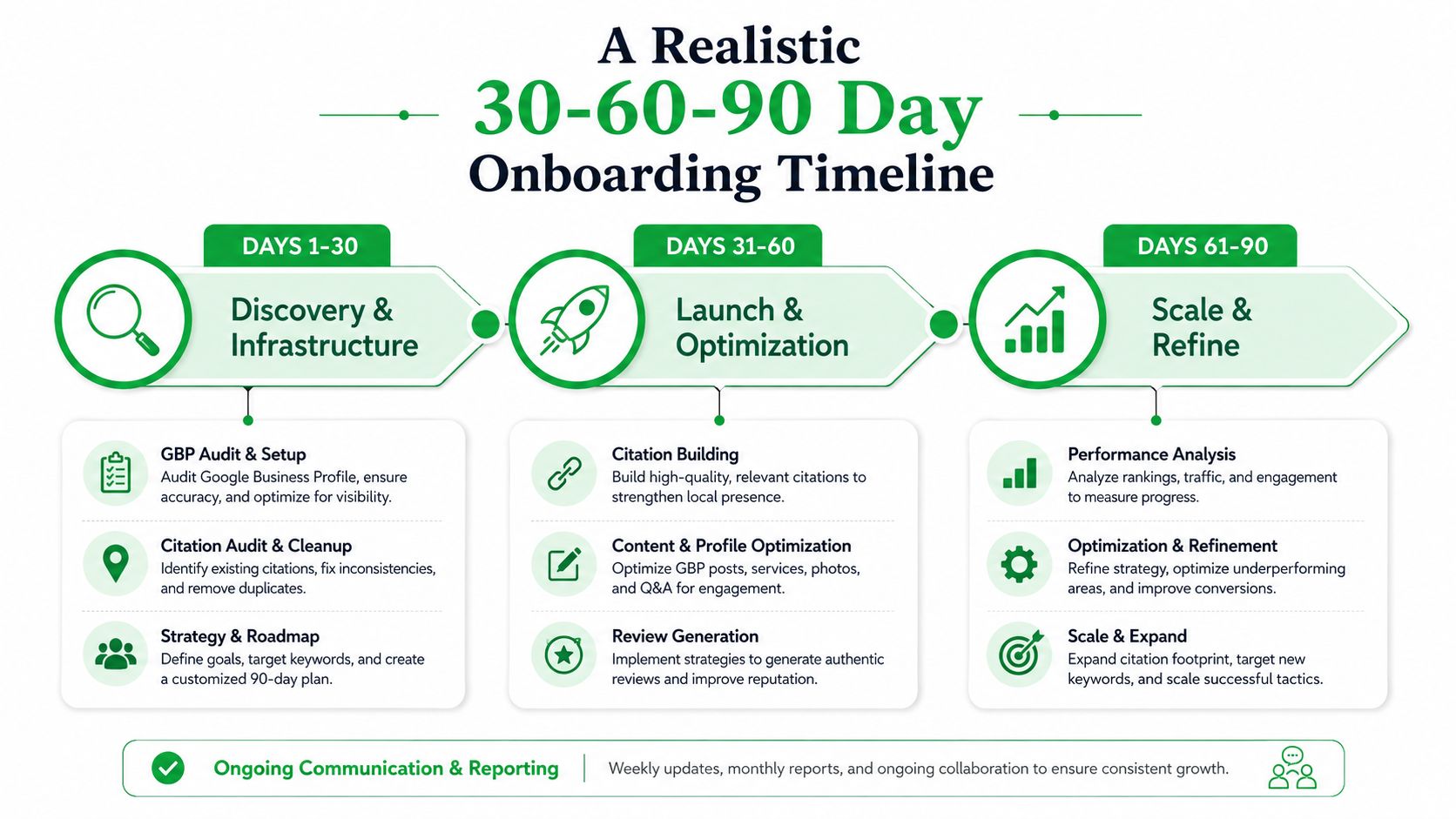
Days 1 to 30 cover discovery and infrastructure
The team should audit your Google Business Profile, website, citations, service areas, reviews, forms, phone setup, and existing campaigns. Install call tracking, preserve source information in forms, connect CRM stages, and document the starting lead volume by source.
This phase should also clarify the commercial basics. Which services have capacity? Which locations are profitable? Which jobs should campaigns exclude? A provider who skips these questions may generate activity that your team can’t fulfill.
Days 31 to 60 cover launch and early optimization
Publish the highest-priority local SEO fixes, activate Local Services Ads or paid search where appropriate, improve landing-page paths, and establish a review-generation cadence that follows real customer interactions. Begin testing meaningful variations, such as a shorter quote form versus a fuller qualification form.
Lead quality may dip before it improves. Early campaigns often reveal poor search terms, weak geographic boundaries, or unclear service definitions. That isn’t automatically failure, but the provider should show what was learned and what changed.
Days 61 to 90 cover scale and refinement
By this stage, the team should identify which sources produce qualified calls, appointments, and closed work. Increase attention on those sources, prune underperformers, and document a repeatable operating procedure for additional locations.
Promises of instant, guaranteed results deserve caution. Local SEO requires time to establish visibility, while paid campaigns can launch quickly but still need conversion and quality feedback. A credible partner sets milestones, reports exceptions, and adjusts the plan instead of hiding behind a fixed deliverables list.
Local Lead Generation Services: The Pre-Engagement Audit Checklist
Run this audit before the first serious provider conversation. It turns “we need more leads” into a set of observable problems.
Score the foundations
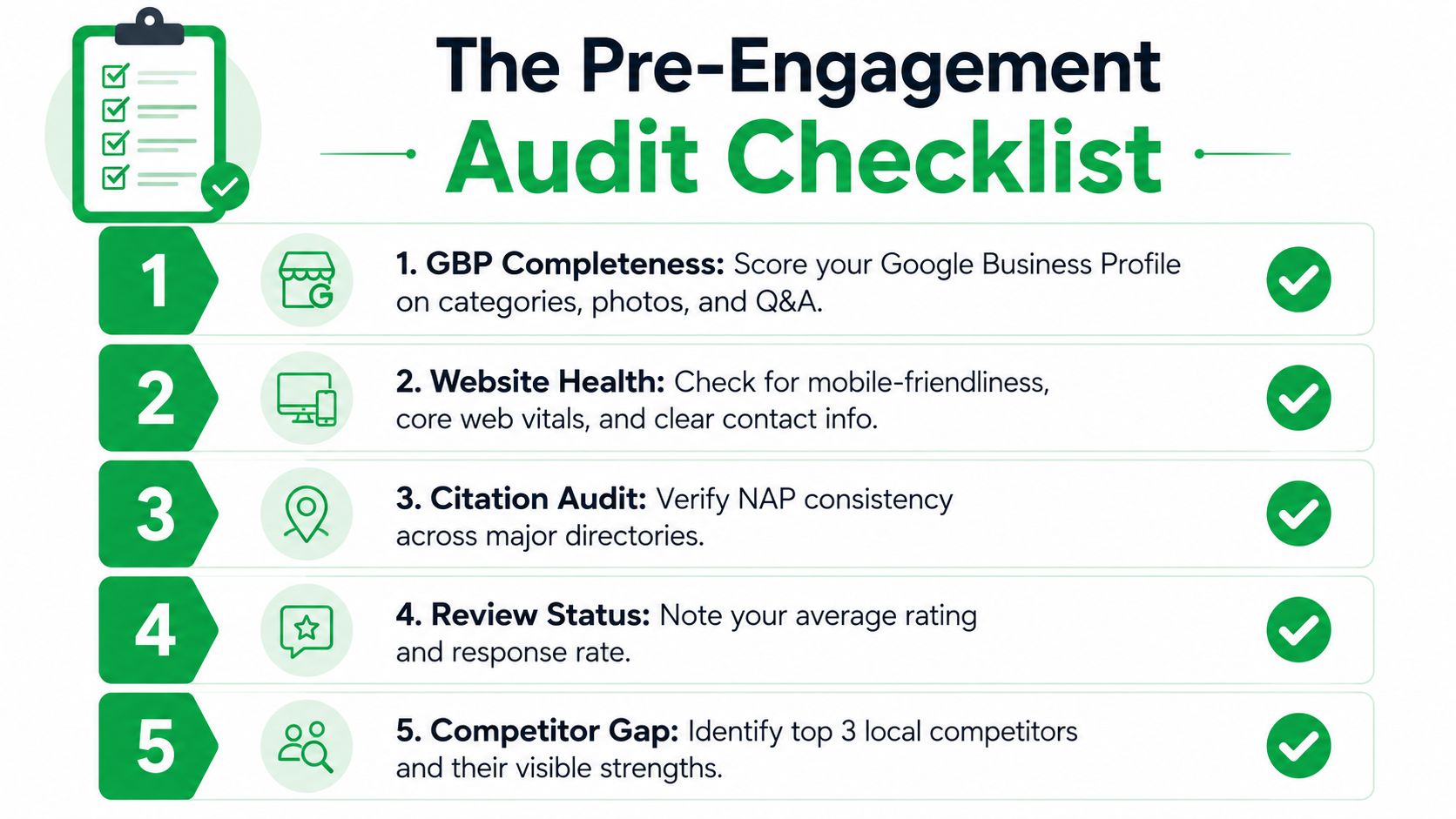
Give each area a simple score of 0, 1, or 2. Use zero when the asset is missing, one when it exists but needs work, and two when it is complete, accurate, and actively managed.
- Google Business Profile: Check primary and secondary categories, services, photos, business description, hours, service areas, Q&A, and conversion actions. Missing categories or outdated hours signal that discovery may be incomplete.
- Website health: Confirm mobile usability, clear contact details, service-area relevance, fast paths to calls or forms, and dedicated pages for important services and locations.
- Citation consistency: Compare your business name, address, phone number, website, and service details across major directories. Mismatches create uncertainty for customers and complicate cleanup.
- Review status: Record your average rating, review recency, response rate, and whether reviews describe specific services. A high score with stale or generic feedback may not provide enough decision support.
- Competitor gap: Identify your top three visible competitors and note what customers can see immediately, including categories, photos, reviews, service explanations, offers, and contact options.
A low score means foundational cleanup should come before aggressive scaling. A middle score suggests the business may benefit from a coordinated channel plan. A high score doesn’t guarantee performance, but it gives a provider better infrastructure for testing and attribution.
Gather administrator logins, historical campaign reports, call records, CRM exports, location lists, service menus, capacity limits, and competitor examples. The local SEO audit checklist can help organize that material before kickoff.
Local Lead Generation Services: Choosing a Provider and What Realistic Success Looks Like
The right provider depends on the operating problem, not the agency’s preferred service.
A solo local SEO specialist may fit one location with a narrow service area and a patient growth horizon. A full-service agency may make more sense when the business needs website work, paid campaigns, tracking, creative, and CRM coordination. A pay-per-lead vendor can suit a business with clear qualification rules and enough capacity to handle incoming opportunities. An in-house marketer supported by tools may work for an operator that already has strong execution and needs additional expertise.
Ask these questions on the first call:
- Ownership: Who owns the Google Business Profile, website, ad accounts, landing pages, tracking numbers, and creative assets?
- Reporting: How often will the provider report, and will reports separate qualified leads, appointments, closed work, and location?
- Attribution: Can each call, form, chat, and message be tied to a channel and campaign?
- Exclusivity: Are leads shared with other businesses, and what geographic or service restrictions apply?
- Rollouts: How will the team adapt campaigns, pages, budgets, and reporting for multiple locations?
- Quality control: What happens when a lead is outside the service area, duplicated, spam, or looking for an unavailable service?
A realistic first quarter emphasizes baseline lift in profile actions and qualified calls within 60 days, not overnight page-one rankings. Google reports that 60% of consumers click AI-generated overviews in Google Search, according to the 2025 local search consumer behavior study. Providers should therefore discuss AI-mediated discovery, review-backed visibility, and how they will preserve attribution when users receive answers before visiting a traditional result.
At 30 days, expect clean data and documented fixes. At 60 days, expect launched channels and early quality signals. At 90 days, expect budget decisions based on qualified outcomes. Vague deliverables, lead-volume guarantees without quality filters, opaque pricing, and inaccessible accounts are red flags.
Mr. Green Marketing, LLC helps businesses connect local SEO, conversion-focused landing pages, PPC, review visibility, and attribution into a measurable lead-generation plan. Visit Mr. Green Marketing, LLC to request a free audit and performance report, then use the findings to prioritize visibility gaps and practical next steps.
Leave a Comment
sing in to post your comment or sign-up if you dont have any account.