
What Is Conversion Rate Optimization: You’re spending money on ads, posting on social media, and watching traffic climb, but the phone still isn’t ringing like it should. That’s the point where a lot of small business owners start asking for more leads, when the problem is usually already on the page. The visitors are there. The site just isn’t doing enough with them.
That gap is where conversion rate optimization, or CRO, comes in. It’s the discipline of turning more of the traffic you already have into buyers, booked calls, form fills, or whatever action matters to your business. And that’s the whole point.
What Is Conversion Rate Optimization: Table of Contents
- Why Your Traffic Isn’t Converting (And What To Do About It)
- What Is Conversion Rate Optimization
- Why CRO Matters for SMBs and E-commerce Businesses
- How the CRO Process Works
- Key CRO Metrics and the Tools That Track Them
- Real CRO Examples and Quick Wins You Can Use Today
- Common CRO Mistakes That Are Costing You Conversions
- How Mr. Green Marketing Can Help You Optimize and Grow
Why Your Traffic Isn’t Converting (And What To Do About It)
You know the feeling. The ads are live, the blog posts are getting clicks, your social content is being seen, and the dashboard says traffic is up. Then you check sales, quote requests, or demo bookings, and nothing meaningful has changed. It’s frustrating because the marketing seems active, but the business result isn’t moving.
A common reaction is to buy more traffic. That can work later, but only if the site is ready to turn attention into action first. If you want a better starting point, a useful companion read is this guide on how to reduce bounce rate on your website, because the same friction that pushes people away often keeps them from converting.
The real problem is usually friction
Traffic doesn’t convert when the next step feels unclear, risky, slow, or annoying. Maybe the headline doesn’t say what you sell. Maybe the form asks for too much. Maybe the page takes too long to load on a phone. Maybe the trust signals are buried below the fold.
That’s why CRO matters. It shifts the question from “How do I get more visitors?” to “Why aren’t the visitors I already paid for taking the next step?” If you only chase traffic, you can end up paying to repeat the same leak over and over.
Practical rule: if your traffic is steady but revenue is flat, the page is telling you something. Listen to the page before you scale the spend.
The business owner who understands this stops treating marketing as a volume game and starts treating it like a measurement problem. That mindset change is the first real CRO win.
What Is Conversion Rate Optimization
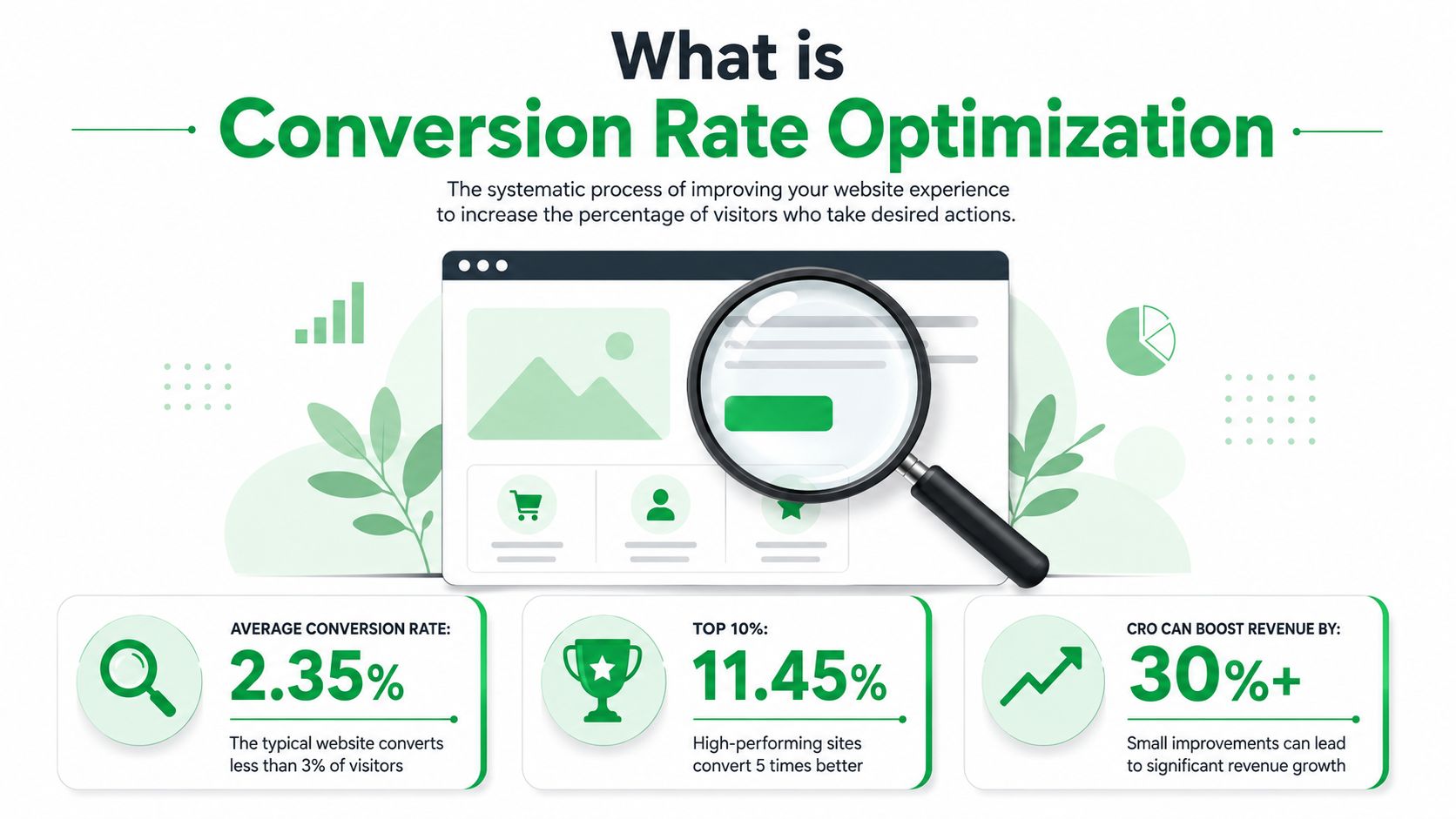
Conversion rate optimization is the systematic practice of testing and refining a website or app so a higher share of visitors completes a chosen action. Fullstory defines it that way and gives the standard formula, (number of conversions / total number of visitors) x 100 = conversion rate (Fullstory). That formula matters because it turns a vague marketing idea into something you can measure, compare, and improve.
What CRO means in practice
A conversion can be a purchase, signup, demo request, quote submission, or contact form. CRO is not a redesign project with a softer name. It is a process of testing specific changes and comparing the results against a baseline, so you can see whether the change improves business outcomes or just looks nicer.
The benchmark gap is the reason this field exists. Across industries, the average website conversion rate is 2.35%, while the top 25% of websites convert at 5.31% or higher and the top 10% reach 11.45% or above (Matomo). The same source says average landing page conversion is 2.35%, while highly optimized landing pages can reach 11.45% (Matomo). That spread is the whole argument for CRO.
Bottom line: CRO is about measurable experiments, not cosmetic tweaks.
A button color change might matter. So might a headline rewrite. But the test only counts if it improves the conversion rate in a way you can track. A page can lift conversions and still miss the larger goal if those conversions do not improve lead quality, sales, or profit. That is why serious CRO starts with a number, a hypothesis, and a result, not with taste.
Conversion rate optimization also reaches beyond one page. A visitor may click an ad, read a landing page, leave, return through email, and convert later after retargeting. That full path matters, which is why a system-level view often works better than treating each page as a separate problem. For a practical next step, see this guide to retargeting advertising, since returning visitors usually need a different message than first-time visitors.
What Is Conversion Rate Optimization and Why CRO Matters for SMBs and E-commerce Businesses
Small and medium-sized businesses do not have much room for waste. Every click that reaches a page but never becomes a lead or sale makes acquisition feel more expensive, because the traffic cost stays the same while the return shrinks. CRO helps you get more value from the visitors you already paid for, which is why it matters so much when budgets are tight.
A useful benchmark shows why. In some analyses, organic search traffic converts at 16%, while paid leads convert at around 2.35% and email can reach 19.3% (VWO). The channel changes the odds, but the lesson stays the same. If you understand how people move through the journey, you waste less money trying to force growth from the wrong place. And that is the whole point.
Mobile makes the case even harder to ignore
A cited Statista benchmark in the available research puts average conversion at 4.14% on desktop versus 1.53% on mobile (Sixth City Marketing). That gap is a blunt reminder that mobile UX, page speed, and form friction are not side issues. They are conversion issues.
The speed problem is even more direct. Research summarized in recent CRO benchmark reports says slow pages can cause a 7% decrease in conversions, and mobile studies show every 1-second delay in mobile load time can reduce conversions by up to 20% (VWO). If your ad click lands on a sluggish page, you are paying for the friction.
For e-commerce, that friction usually shows up in product pages, cart flow, and checkout. For service businesses, it shows up in contact forms, quote requests, and trust signals. A useful next read is how to increase e-commerce sales, because CRO and sales growth are connected at the point where someone decides to act.
What Is Conversion Rate Optimization: How the CRO Process Works
A store owner staring at a drop in sales often wants one quick fix. CRO rarely works that way. The better starting point is evidence. A senior team reviews analytics, heatmaps, session recordings, and survey feedback, then uses those signals to decide what to change. That separates guessing from optimization, and that is the whole point.
The five phases of CRO
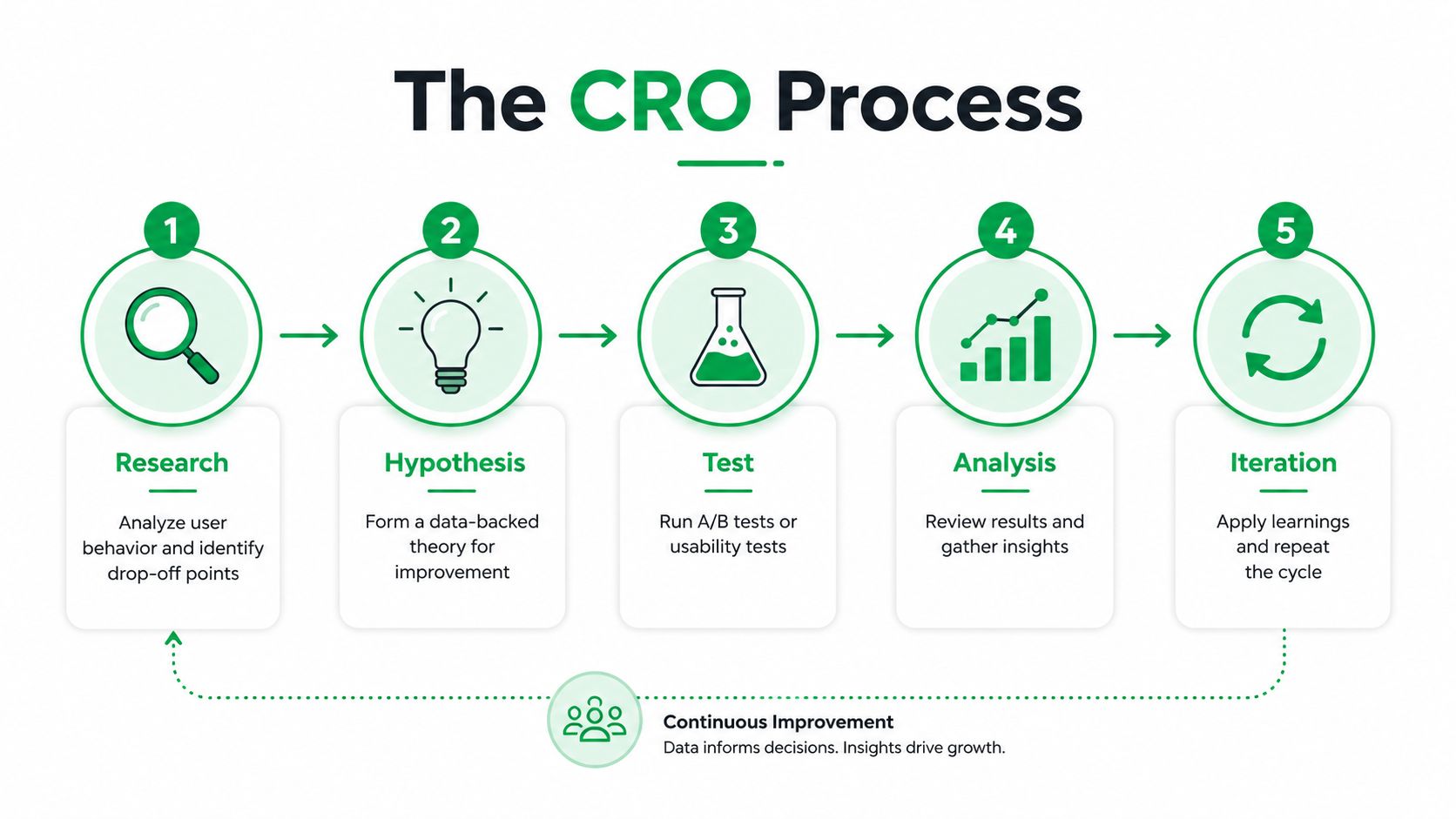
- Research. Find where people drop off, what they click, and what they ignore. Session recordings and heatmaps matter here because they show behavior, not assumptions. If you need a stronger read on user friction, a focused UX testing services review can show where confusion starts.
- Hypothesis. Turn the pattern into a testable idea. If the checkout form is too long, then reducing the fields should increase completion.
- Test. Run an A/B test or, where appropriate, a usability test. The goal is to isolate the change so you can tell what moved the result. A good test is like isolating one ingredient in a recipe, if you change three things at once, you never know which one changed the taste.
- Analysis. Review the outcome, compare it with the baseline, and look for meaning instead of noise. If the lift is real, the result informs the next decision. If it is not, the result still teaches you something useful.
- Iteration. Apply the win, then keep going. CRO is a loop, not a one-off project, because the next improvement usually depends on what the last test exposed.
A lot of business owners want the answer before the work. That is usually why they keep testing random headlines and button colors without seeing meaningful improvement. Behavior should lead the decision. If the problem is trust, a button color will not fix it. If the problem is friction, a new headline will not fix it either.
Simple truth: if you do not know why people hesitate, you are just decorating the problem.
A practical CRO program keeps the loop moving. You observe, predict, test, learn, and repeat. The site starts improving with purpose instead of luck, and the focus shifts from page-by-page guessing to system-level journey improvement.
What Is Conversion Rate Optimization: Key CRO Metrics and the Tools That Track Them
A conversion rate by itself doesn’t tell the whole story. A site can convert more people and still make less money if the wrong visitors are coming in, discounts are too deep, or lead quality falls. That’s why CRO has to connect to business outcomes, not just form fills or purchases.
The metrics that actually deserve attention
| Metric | Why it matters | Tools that help track it |
|---|---|---|
| Conversion rate | Shows how many visitors complete the goal | Google Analytics, VWO, Optimizely |
| Bounce rate | Flags pages that fail to keep attention | Google Analytics, Hotjar |
| Exit rate | Helps identify where people leave most often | Google Analytics, Fullstory |
| Average session duration | Gives a rough signal of engagement | Google Analytics, Fullstory |
| Click-through rate on key elements | Shows whether people notice and act | Hotjar, Fullstory, Optimizely |
| Revenue per visitor | Connects optimization to profit, not just volume | Google Analytics, reporting dashboards |
How to read the numbers without fooling yourself
Google Analytics is useful for the broad picture. Hotjar helps you see patterns through heatmaps and recordings. Fullstory adds behavior detail. VWO and Optimizely are common for experimentation. A solid analytics stack doesn’t just tell you what happened, it helps you decide what to test next.
The mistake many make is chasing the easiest number to move. A higher conversion rate looks good on a report, but if the leads are poor or the margin drops, the business may be worse off. That’s why the conversion rate needs to sit alongside revenue and lead quality.
If you want a structured way to review those numbers, a practical starting point is analytics and reporting. Regular reporting keeps CRO from becoming a pile of disconnected tests.
What Is Conversion Rate Optimization: Real CRO Examples and Quick Wins You Can Use Today
A lot of people think CRO is abstract until they see a simple change work in the world. A retailer trims a crowded product page and makes the main call to action easier to find. A service business shortens a contact form and puts the most important trust cue closer to the button. In both cases, the fix wasn’t flashy. It removed friction.
Quick wins that don’t require a rebuild
- Add social proof near the action. Testimonials, reviews, or client logos work best when they sit close to the button people are about to click.
- Remove unnecessary form fields. Every extra field is another chance for someone to quit.
- Clarify the value proposition above the fold. Visitors should know what you do and why it matters before they scroll.
- Speed up slow pages. Especially on mobile, sluggish load times can kill momentum.
- Match the page to the offer. If the ad promised one thing and the landing page talks about something else, people leave.
Those are not fancy moves. They’re the basics, and the basics often outperform the clever stuff because they address real hesitation.
A boutique agency like Mr. Green Marketing, LLC can also support this work through conversion-focused website design, A/B testing, pay-per-click optimization, and GEO, which is SEO for AI systems. That matters when you need the page, the traffic, and the reporting to work together instead of operating in separate silos.
The fastest CRO wins usually come from removing confusion. Not from piling on more copy, more graphics, or more buzzwords.
Common CRO Mistakes That Are Costing You Conversions
The biggest misconception is that CRO means testing button colors and headlines until something moves. That approach can help in small doses, but it misses the bigger shift happening in the field. Recent practice is moving toward system-level optimization across the full journey, including owned touchpoints, mobile performance, and AI-assisted personalization, not just one page at a time (PMC).
Where businesses go wrong
Most page-centric strategies treat the landing page like the only place that matters. It isn’t. People compare your site to your emails, your ad copy, your checkout flow, your support response, and whatever they see after they leave your site. When those touchpoints feel disconnected, the conversion rate suffers.
Another mistake is assuming more traffic will fix a broken journey. It won’t. More traffic can magnify the problem, because now more people see the same confusion, the same slow load, and the same weak offer.
A better CRO framework starts with business KPIs, customer-touchpoint research, and sales-influencing touchpoints, not just on-site metrics.
The smarter view is broader and more practical. Optimize the whole path, not just the page. That means looking at mobile performance, external perception, and the quality of the experience before and after the click. And once you see CRO that way, isolated tests stop feeling like the whole strategy.
How Mr. Green Marketing Can Help You Optimize and Grow
Mr. Green Marketing, LLC starts with a free audit and performance report, then uses that to identify visibility gaps and prioritize quick wins. That’s useful for SMBs, e-commerce sellers, and growing companies that need clear next steps instead of broad advice. The work can include conversion-focused website design, pay-per-click campaign optimization, GEO for AI search environments, and ongoing reporting that keeps conversion rates visible as a KPI.
The agency’s value is in how the pieces fit together. Creative storytelling helps the offer feel clear and credible. Data-driven testing keeps the team honest about what improves performance. For many businesses, that combination is what turns CRO from a theory into a repeatable process.
If your site is getting traffic but the leads or sales aren’t keeping pace, the next move is simple. Get a clear read on what’s blocking conversion, fix the bottlenecks, and measure the lift instead of guessing at it.
Mr. Green Marketing, LLC helps businesses improve conversion rates through audit-driven strategy, website optimization, PPC, SEO, and ongoing reporting. If you’re ready to stop guessing and start improving the way your site turns traffic into leads and sales, visit Mr. Green Marketing, LLC and request a free audit.
Leave a Comment
sing in to post your comment or sign-up if you dont have any account.