
AI Search Optimization Services: Most advice on AI visibility starts in the wrong place. It tells you to publish more AI-written content, add a few schema tags, and wait for ChatGPT or Google to notice you.
That’s incomplete. Sometimes flat-out wrong.
AI search optimization services aren’t about teaching a robot to like your keywords. They’re about making your business easy for AI systems to understand, trust, and cite when a buyer asks for an answer. That’s a different job than classic SEO. And for a lot of companies, it means changing the goal from getting a click to getting selected.
That shift matters because AI search doesn’t behave like a list of links. A buyer asks a full question. The model pulls from what it can validate. Then it presents a compact answer that often narrows the field before the user ever visits a website. If your brand isn’t in that answer, your ranking report can look fine while your actual visibility slips.
AI Search Optimization Services: So You Think AI Can Handle Your SEO
The popular shortcut sounds like this: use AI tools to write content, automate optimization, and let the machine handle the machine. Clean theory. Weak strategy.
Data from 50+ AI visibility audits found that standard SEO practices, even when executed by AI, fail to generate consistent AI search visibility without a dedicated AEO methodology built to engineer brand authority for AI selection, according to the audit findings reported by AI Search Engineers. That lines up with what agencies are seeing in live campaigns. Content can be technically “optimized” and still never appear in AI answers.
Here’s the mistake. Business owners assume AI search is just SEO with new software. It isn’t. Traditional SEO asks, “How do I rank this page?” AI search asks, “Why should the model trust this brand enough to use it in the answer?”
Practical rule: AI can accelerate research, drafting, tagging, and content cleanup. It cannot decide your authority position in the market on its own.
That’s why generic content often underperforms. So does content that says the same thing as everyone else with cleaner wording. AI systems don’t need another recycled explainer. They need a source they can confidently interpret as credible, specific, and worth citing.
A lot of teams also miss the business consequence. When AI becomes the front door, the winner isn’t just the site with more pages. It’s the company most likely to be named as the trusted answer. Small distinction on paper. Big difference in pipeline quality.
What AI Search Optimization Services Really Are
AI search optimization services are the operational layer that helps your business become understandable and selectable in generative search. You’ll also hear the terms AISO, GEO, and AEO. The labels vary. The core idea doesn’t.
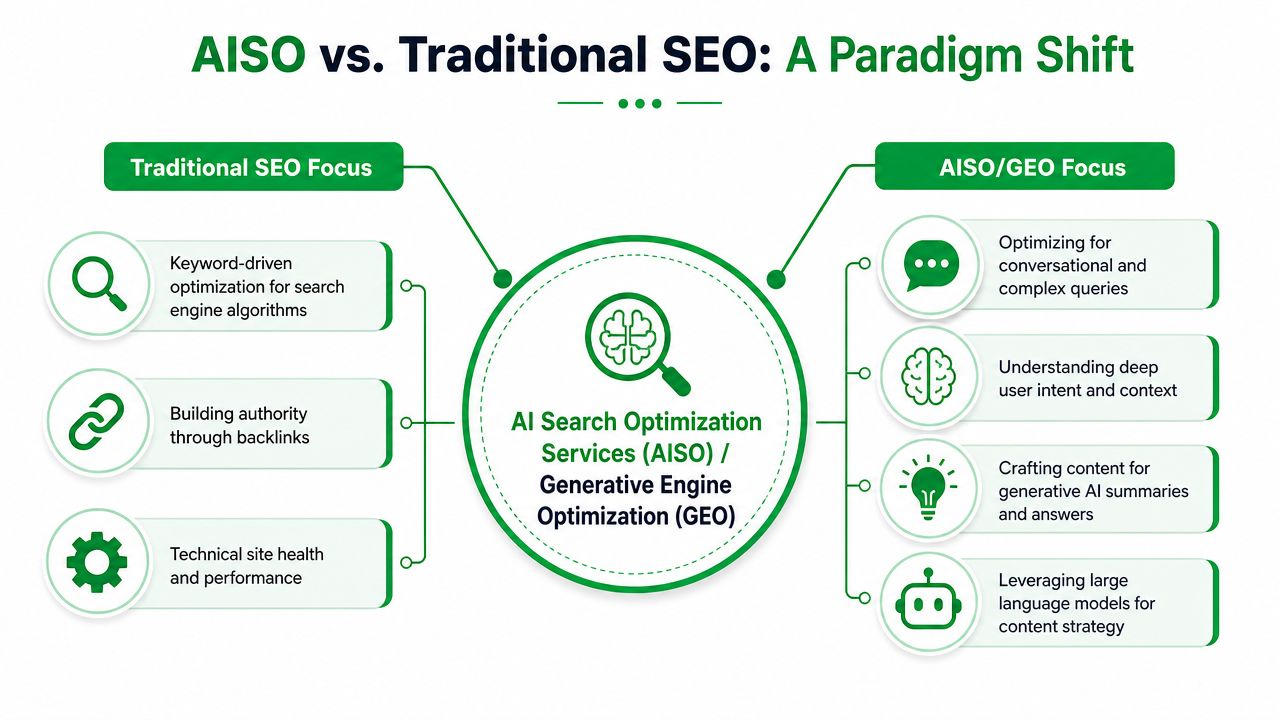
Traditional SEO often centers on pages, keywords, backlinks, and rankings. AISO shifts toward semantic entity validation, structured data, and topic architecture. According to OuterBox’s explanation of AI SEO, AISO services move from keyword ranking to semantic entity validation by using advanced Schema.org markup and content clusters to establish brand recognition in LLM knowledge bases. The core metric becomes brutally simple: your brand either appears in the answer or it doesn’t.
AI Search Optimization Services: What semantic entity validation means in plain English
Think of your business like a legal identity file. AI systems need to know who you are, what you do, what category you belong to, where you operate, which problems you solve, and which claims about you remain consistent across the web.
If your site says one thing, your profiles say another, and third-party mentions are vague, the model has weak confidence. If your service pages, organization markup, author signals, category language, and corroborating citations all align, confidence rises. Not magic. Just cleaner evidence.
A practical starting point is building a repeatable content and optimization process instead of treating AI visibility like a collection of hacks. This practical AI SEO framework from Surnex is useful because it keeps the focus on workflow and decision-making rather than novelty tactics.
What a real service actually does
A credible AISO engagement usually includes:
- Entity definition: Clarifying your brand, offerings, differentiators, geography, and expertise in language AI systems can parse.
- Structured implementation: Applying the right schema types and cleaning up page structure so important information isn’t buried.
- Content clustering: Connecting pillar pages and supporting pages so the relationship between topics is obvious.
- Answer readiness: Rewriting sections so they answer buyer questions directly, with context and specificity.
- Cross-platform testing: Checking how systems like ChatGPT, Perplexity, Gemini, and Bing Copilot describe or omit your business.
- Gap correction: Finding where competitors get named instead of you, or where AI descriptions drift away from your actual offer.
For a deeper look at the service model itself, this overview of Answer Engine Optimization services is a useful companion.
A short walkthrough helps make the distinction concrete:
AI search rewards businesses that are easy to classify, easy to verify, and hard to confuse with a generic alternative.
AI Search Optimization Services: Why Your Business Cannot Ignore This Shift
The market signal is already loud. The global AI Search Optimization Software market is valued at USD 1.23 billion in 2026 and is projected to reach USD 3.32 billion by 2031, growing at a 21.97% CAGR, while traditional SEO services are growing at 6.07% according to Mordor Intelligence’s market report. That gap tells you where companies are reallocating attention.
But software market growth alone isn’t the reason to care. The more important business signal is user behavior and traffic value. Semrush reports that AI search traffic currently accounts for about 0.15% of global internet traffic, has grown sevenfold since 2024, and the average AI search visitor is 4.4 times more valuable than a traditional organic visitor based on conversion rates in its AI search traffic study. Small share, high intent. That combination gets serious fast.
Why an AI visitor can be worth more
A traditional searcher often clicks to compare options, skim, and leave. An AI-assisted searcher usually arrives later in the decision process. The answer has already framed the category, filtered weak options, and summarized key differences. By the time they visit, they’re often checking fit, pricing, proof, or availability.
That changes lead quality.
It also changes how visibility loss happens. You may still collect traffic from old SEO wins while subtly losing influence in buying conversations that now start inside an AI interface.
AI Search Optimization Services: The window to adapt is open, not permanent
About 50% of Google searches already include AI summaries, and that figure is projected to exceed 75% by 2028, according to McKinsey’s analysis of AI search. If your category gets summarized before a click, then the sites most likely to shape those summaries have the advantage.
And there’s another wrinkle. Pages with original data or proprietary research receive 30 to 40 percent higher visibility in AI search results according to the Digital Marketing Institute’s AI search guidance. Generic “ultimate guides” don’t disappear, but they lose some edge when AI systems look for non-commodity inputs.
The practical takeaway is simple. If your business depends on inbound discovery, this isn’t something to leave on the innovation list for later.
AI Search Optimization Services: The Core Components of an AISO Engagement
AISO is not a plugin install or a prompt library. It is an operating process for making your business easier for AI systems to identify, trust, and cite.
That requires technical cleanup, editorial discipline, and evidence. If one of those pieces is weak, you can still publish a lot and get ignored in the answers that shape buying decisions.
The working parts
A strong engagement usually includes six workstreams:
- AI visibility audit
The agency reviews how your brand appears across major AI search experiences, which topics trigger mentions, how accurate those mentions are, and where competitors are getting picked instead. The point is to find the gap between what your business offers and what AI systems currently believe. - Entity and source cleanup
Many companies send mixed signals. Service names vary across pages. Founder or author bios are thin. Case studies lack specifics. Third-party profiles conflict with the website. AISO fixes those inconsistencies so your company reads like one clear entity, not a loose collection of claims. - Schema and page structure
Schema will not make a weak page win, but it does help machines interpret meaning, relationships, and page purpose. A practical guide to schema markup for SEO can help teams choose the right implementation without turning the site into markup clutter. - Content architecture
AI systems do not evaluate pages in isolation. They infer expertise from how service pages, industry pages, comparisons, FAQs, and proof content support each other. Good architecture reduces ambiguity and makes it easier for a model to connect your brand to a topic with confidence. - Answer-focused rewriting
With answer-focused rewriting, many engagements either produce results or drift into busywork. Strong rewrites put the direct answer near the top, tighten headings, define terms clearly, add real examples, and replace vague marketing language with supportable statements. The goal is not to sound more robotic. The goal is to become easier to quote correctly. - External seeding and corroboration
Your website is only one input. AI systems also look at third-party references, citations, listings, interviews, reviews, and industry mentions. If your site says one thing and the rest of the web says little, your authority is weak.
AI Search Optimization Services: Traditional SEO vs. AI Search Optimization
| Aspect | Traditional SEO | AI Search Optimization (AISO) |
|---|---|---|
| Primary goal | Rank pages for queries | Be selected in AI-generated answers |
| Core unit of success | Position and clicks | Inclusion, citation, and answer presence |
| Main optimization target | Keywords and pages | Entities, claims, context, and answer-readiness |
| Content style | Broad coverage often aimed at rankings | Clear, structured, specific content built for retrieval and synthesis |
| Technical focus | Crawlability, speed, indexing, metadata | Those same basics plus structured meaning and machine-readable context |
| Competitive threat | A higher-ranking page | A competitor becoming the named answer |
| Reporting emphasis | Traffic, rankings, CTR | Inclusion rates, citation quality, platform-by-platform visibility |
The practical shift is simple. Traditional SEO asks, “Can we rank?” AISO asks, “Will the model choose us as the answer source?”
That changes the work.
What tends to work is plain and disciplined. Clear category language. Specific claims backed by proof. Distinct service pages. Original points of view. Pages that answer a buyer’s question without filler or hedging.
What usually fails is just as predictable. Publishing thin AI-written articles at scale. Adding FAQ blocks to every page because a template said so. Pasting in random schema types. Chasing keyword variations while leaving the business description vague.
Field note: If an agency spends more time talking about prompts than about entity clarity, corroboration, and reporting, they are probably selling activity instead of a system.
Clean measurement matters too, because weak tracking makes AISO look harder to judge than it already is. For teams that need cleaner event tracking and reporting inputs, Trackingplan’s Martech data quality debugger is a practical tool to evaluate.
One provider in this space is Mr. Green Marketing, LLC, which offers GEO work focused on analyzing how brands appear on AI search platforms and updating website content to improve AI-driven lead quality.
AI Search Optimization Services: Measuring Success Beyond Traffic and Rankings
Many AI search conversations encounter a point of uncertainty. Business owners ask a fair question: if clicks decline, how do I know this is working?
The honest answer is that the industry still lacks a clean universal reporting model. A major gap today is the absence of a standardized protocol that correlates AI citations with revenue, which makes it hard for SMBs to justify investment without lead evidence, as noted by Olive & Company’s analysis of AI search optimization.
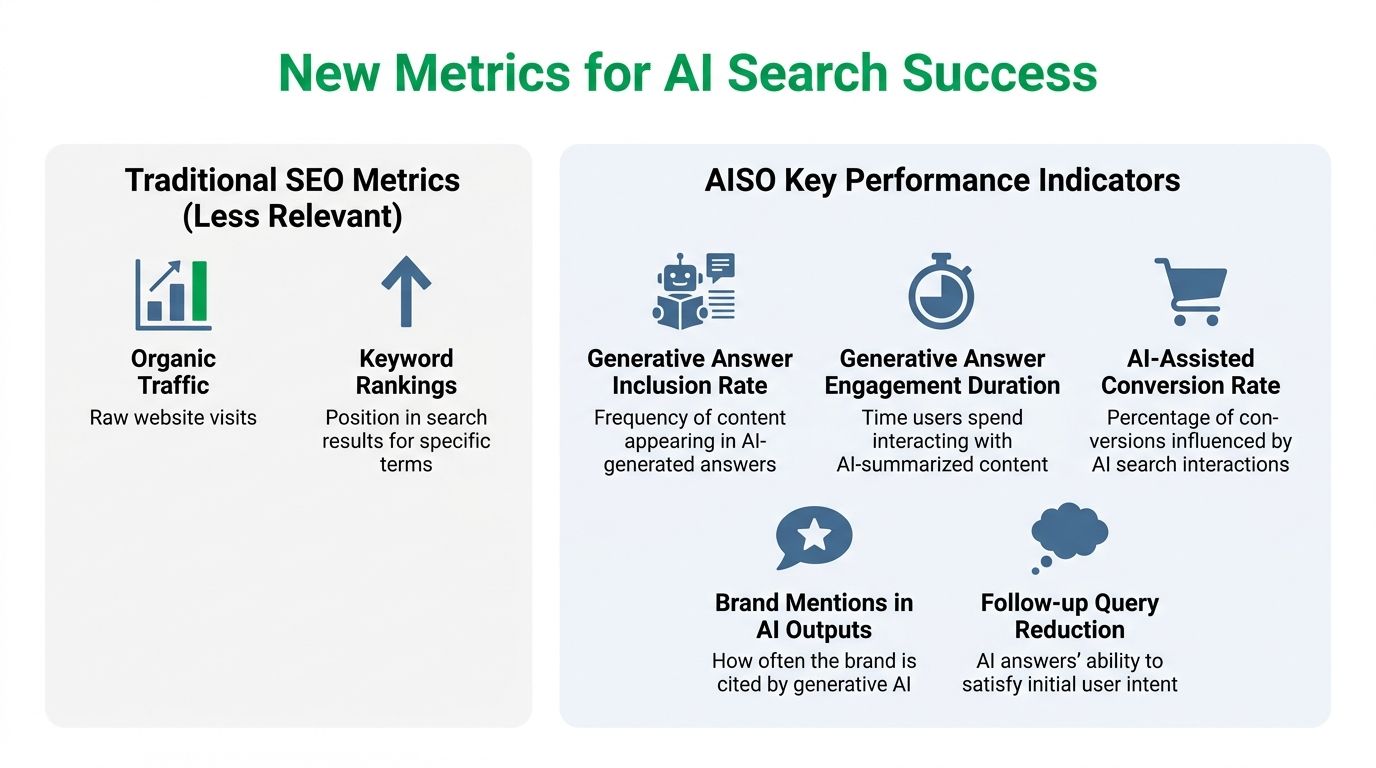
What to track instead
You need a blended scorecard. Not one vanity chart.
Start with these measures:
- AI answer inclusion rate
How often your brand, page, or product appears in relevant AI-generated answers by query category. - Citation quality
Are you cited directly, paraphrased accurately, or omitted while weaker sources shape the answer? - Entity accuracy
Does the model describe your services, market, locations, and differentiators correctly? - Share of answer presence
Across your key topics, how often does your brand appear versus direct competitors? - Assisted lead signals
Sales calls, forms, and chats often reveal AI influence even when analytics don’t. Ask prospects how they found you. You’ll hear patterns before dashboards catch up.
AI Search Optimization Services: A practical reporting model
I prefer three reporting layers.
First, visibility reporting. Which prompts matter, which platforms are tested, and where your business appears or disappears.
Second, quality reporting. Whether the answer is accurate, favorable, and aligned with your actual offer.
Third, commercial reporting. Whether branded search quality improves, lead conversations get more informed, or sales teams hear more “I already saw you recommended” language.
That matters because zero-click isn’t automatically zero value. If the AI answer frames your business as a credible shortlist option, it can reduce friction before the visit.
Brands should stop asking only, “How many clicks did this page get?” and start asking, “Did this content help the AI choose us?”
One more important nuance. A Reddit discussion often cited by practitioners pointed out that over 40 percent of citations in AI Overviews come from sites beyond the first two pages of traditional Google results, in this conversation about AI search optimization. That isn’t a formal benchmark for every niche, but it reinforces the practical reality: rankings alone don’t explain AI visibility.
AI Search Optimization Services: How to Choose the Right AISO Partner
The market is filling with agencies that added “GEO” to a services page last week. Some know what they’re doing. Some are just rebranding content production.
The fastest way to tell the difference is to ask process questions, not branding questions.
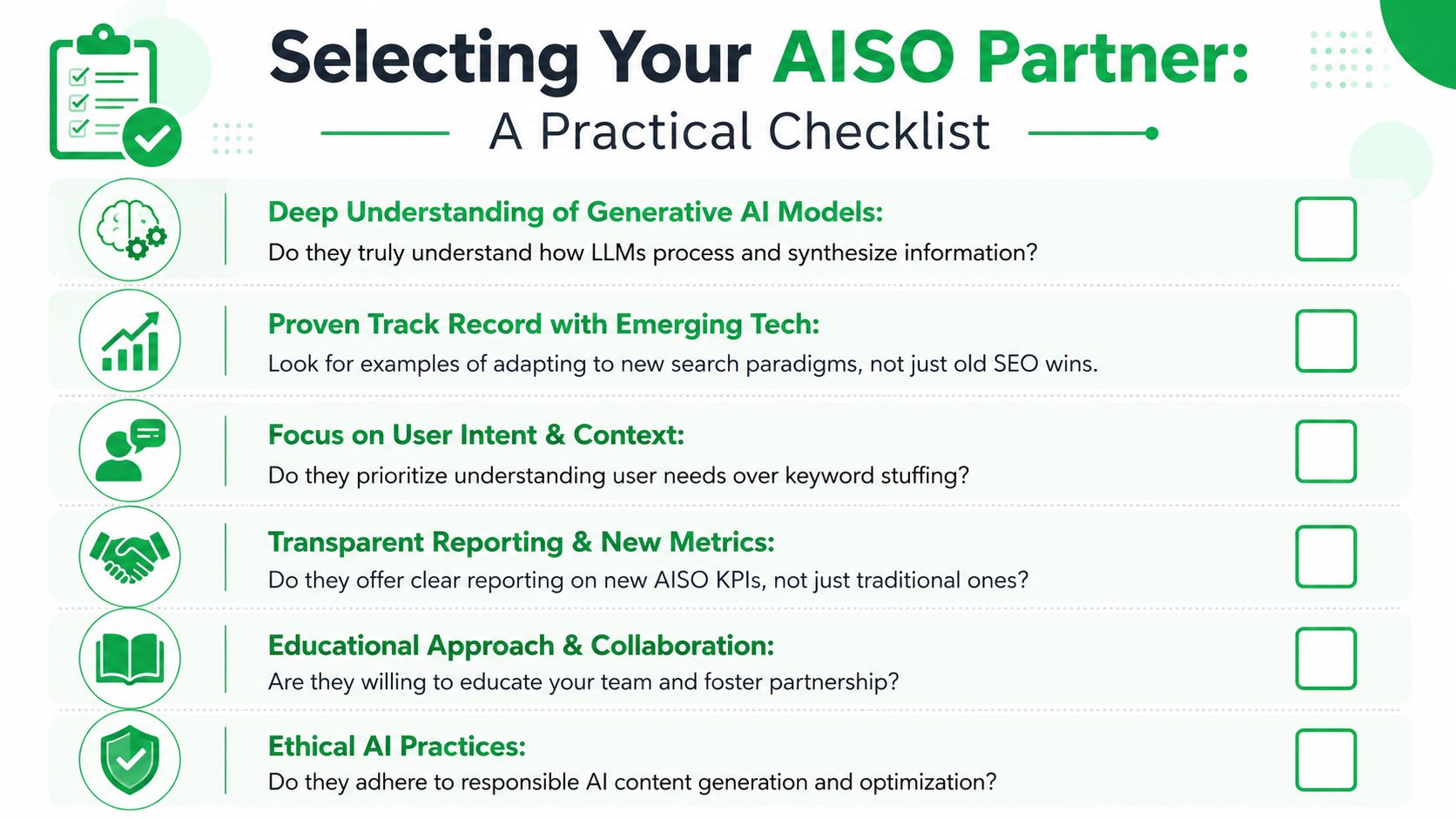
Questions worth asking in the first call
- How do you test AI visibility across platforms
They should name the platforms they monitor and explain how they compare outputs, not just mention Google. - How do you define the business entity
A real partner will talk about services, products, locations, category language, proof, and consistency. If they jump straight to blog volume, keep digging. - What does reporting look like
Ask to see a sample. You want inclusion tracking, citation review, and accuracy analysis. Not just impressions and rankings with new labels attached. - How do you handle content strategy
The right answer includes architecture, answer-readiness, and original expertise. The wrong answer is “we’ll generate more posts with AI.” - What do you avoid doing
Good practitioners usually have a list. They’ll mention weak shortcuts, unnecessary hacks, and low-value automation.
AI Search Optimization Services: Signals that should make you cautious
Some warning signs show up quickly:
| Green flag | Red flag |
|---|---|
| Talks about entity clarity and corroboration | Talks only about prompts and tools |
| Can explain why pages are or aren’t cited | Promises guaranteed placement in AI answers |
| Distinguishes SEO, GEO, and AEO roles | Says “it’s all the same thing” |
| Reports on accuracy, inclusion, and business fit | Reports only on traffic changes |
| Treats foundational SEO as necessary | Claims AI search replaces technical SEO |
Ask a simple question: “How do you know when the model understands my business correctly?” If they can’t answer clearly, they can’t manage the work clearly either.
There’s also a philosophy issue. The right partner should educate your team, not hide behind black-box language. This field changes fast. If the agency can’t explain its method in plain English, you’ll struggle to evaluate results when conditions shift.
Your Implementation Timeline and Quick Wins
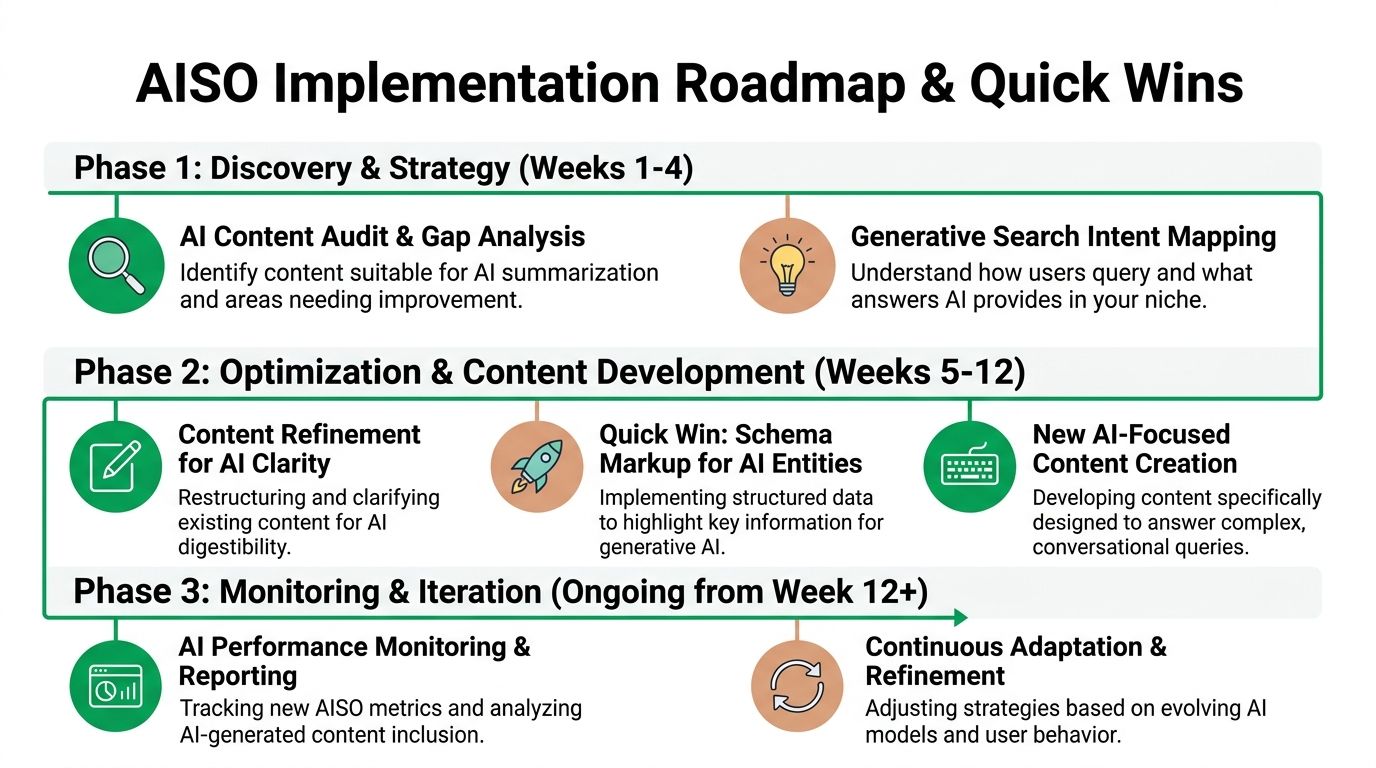
AISO is not a switch you flip. It is an operating cycle. Some brands start seeing early movement in AI visibility within weeks, but true value comes after a few rounds of testing, cleanup, and reinforcement. The pattern is familiar from SEO, yet the target has changed. The goal is no longer just earning a click. It is increasing the odds that an AI system selects your brand as the answer it trusts enough to summarize or cite.
What the first cycle usually looks like
The first cycle usually starts with an audit of how your business is being interpreted across AI-generated answers, search features, and supporting sources. Then come structural fixes, content revisions, and entity clarification. After that, teams monitor where the brand is cited, where it is misrepresented, and which pages are strong enough to be pulled into answers. Then they iterate.
It is less flashy than people expect. That is usually a good sign.
Foundational SEO still carries the load. If the site is hard to crawl, vague about services, or thin on proof, AI-specific work will not rescue it. Strong AISO builds on a clean technical base, clear positioning, and content that answers real buying questions better than generic copy.
AI Search Optimization Services: Quick wins by business type
A local service business can often improve quickly by tightening service definitions, location signals, business details, and specialty qualifiers. A plumber benefits when the site clearly separates emergency repair from standard service, defines the actual service area, and gives AI systems enough context to summarize capabilities accurately.
An e-commerce brand has a different path. Product pages usually need cleaner attributes, stronger comparisons, better structured data, and clearer explanations of what makes each product distinct. Manufacturer copy tends to blur those differences, which makes it harder for AI systems to choose your product as the best-fit recommendation.
As noted earlier, the fastest gains usually come from clarity. Brands that win in AI search are easier to verify, easier to summarize, and easier to trust.
If you want a practical assessment of where your brand stands in AI-generated search results, Mr. Green Marketing, LLC can review how your business appears across emerging AI platforms, identify visibility gaps, and map out the next fixes in plain English.
Leave a Comment
sing in to post your comment or sign-up if you dont have any account.