
SEO Content Strategy: You’re probably in one of two places right now.
You’ve been publishing blog posts for months and almost nothing happens. Or you have years of content on the site, but rankings are uneven, leads are weak, and nobody on the team can say which pages pull their weight.
That’s where most businesses get stuck. They don’t have a content problem. They have a strategy problem. And in an AI-shaped search environment, that gap gets exposed fast. Generic posts blend together. Consensus takes get summarized away. The pages that still earn attention usually bring original perspective, strong structure, and a clear reason to exist.
A real SEO content strategy isn’t about pumping out more articles. It’s about building authority in places you can defend, then using the content you already own to create momentum instead of starting from zero every quarter.
What an SEO Content Strategy Actually Is
A new client comes in with 150 blog posts, a few service pages, and a calendar full of ideas. Traffic is flat. Sales asks for bottom-funnel content. The content team wants to chase higher-volume terms. Leadership wants faster results from search. Without a strategy, every new page becomes another isolated request.
An SEO content strategy is the plan that decides where you can win, what content deserves investment, how pages support each other, and how that work turns into pipeline, not just pageviews. It connects business goals, search intent, site structure, and editorial decisions so content builds momentum instead of piling up.
That distinction matters more now because AI-driven search compresses generic advice fast. If your site is publishing the same definitions, listicles, and recycled tips as everyone else, you are competing on formatting. The better path is to build topical authority in areas your team can defend with experience, proof, and a point of view, then use that authority across the content you already have.
Random publishing versus a real plan
A real plan starts with choices.
Which topics tie closely to revenue. Which terms bring the wrong audience even if they have volume. Which pages should introduce the category, which ones should compare options, and which ones should help a buyer say yes. Those are strategy decisions, not writing decisions.
Here are the questions worth answering before you add another article to the queue:
- Business fit: Which topics connect directly to your services, products, or sales conversations?
- Search intent: Is the visitor trying to learn, evaluate options, or make a decision?
- Authority potential: Can your team produce something more useful or more credible than what already ranks?
- Content role: Should this page attract new visitors, support conversion, or strengthen a larger topic area?
- Maintenance cost: Can you keep this topic current, or will it decay the moment it goes live?
Look, here’s how it really is. Plenty of pages never had a ranking problem. They had a job-definition problem. A page trying to rank for a broad query, educate a beginner, and convert a high-intent buyer usually underperforms on all three.
SEO Content Strategy: What strategy looks like in practice
The strongest SEO content strategies are built from business outcomes backward. They map search demand to a set of ownable themes, assign each page a clear role, and make internal linking intentional so authority flows across the site. That is how content starts compounding.
On-page work still carries a lot of the load. Titles, headers, page structure, internal links, metadata, and intent alignment shape whether a page earns visibility and whether that visibility turns into action. This aligns with reality. Sites that publish often but ignore structure rarely build durable performance.
If you are planning for search beyond blue links, this guide on improving AI visibility is useful because it frames content around discoverability in AI surfaces as well as traditional search. For the operating model behind that work, these content marketing best practices for execution and governance connect strategy to the day-to-day decisions that keep quality high.
The shift that matters now
Broad keyword targeting used to carry weak strategy for longer than it should have. That window is closing.
The better approach is narrower and stronger. Pick a few topic areas you can own. Build supporting content around them. Improve the pages you already have before adding more. Bring in first-hand examples, real customer questions, original framing, and proof that your team knows the subject beyond a summary of what is already ranking.
That is what makes an SEO content strategy valuable. It is not a content calendar with search terms attached. It is a system for building defensible authority, getting more from existing assets, and creating content that still has a reason to rank when AI can summarize the generic version in two seconds.
SEO Content Strategy: Start by Auditing Your Existing Content Goldmine
Before creating anything new, look at what’s already on your site.
Most companies are sitting on pages that are close to working. Old guides with decent impressions. Service pages that answer the wrong intent. Two blog posts competing with each other. A useful article from last year that now looks dated because the examples, screenshots, or sources feel stale.

What to look for first
Start in Google Search Console and Google Analytics 4. You’re not trying to create a giant spreadsheet on day one. You’re trying to spot opportunities.
Focus on these page types:
- Almost-ranking pages: URLs getting impressions and some clicks, but not enough visibility to matter yet
- Decayed assets: Posts that used to perform better and now look neglected
- Overlap pages: Multiple URLs covering the same query or close variants
- Unexpected winners: Pages attracting the wrong audience, or ranking for terms you didn’t plan around
This matters more than is often realized. Data from 2025 indicates that 60% of traffic now comes from refreshing and consolidating old content rather than publishing new pages, with search engines favoring updated statistics, newer sources, and enriched media.
That should change how you allocate effort. Not every quarter needs a big publishing push. Sometimes the fastest gain comes from pruning, merging, and tightening what’s already indexed.
SEO Content Strategy: A practical audit workflow
Use a simple triage model. Every page gets one label.
| Page status | What it usually means | Action |
|---|---|---|
| Keep | The page is aligned and still useful | Improve internal links, sharpen on-page elements |
| Refresh | The topic is good but the page is stale | Update examples, rewrite weak sections, improve media |
| Merge | Two or more pages compete for the same intent | Consolidate into one stronger URL |
| Remove | The page adds little value and has no clear role | Redirect or deindex based on context |
If you want a deeper process, this guide on how to boost SEO with content auditing is a solid companion because it turns the audit from a vague exercise into a page-by-page review.
For a more technical checkpoint, this walkthrough on how to do an SEO audit helps tie content findings to crawl, indexation, and site health issues.
SEO Content Strategy: Audit for intent, not just rankings
Teams often miss easy wins.
A page can rank and still fail because it solves the wrong problem. A service page might pull informational traffic from early-stage searches while doing nothing for conversions. A blog post might rank for commercial queries but avoid the comparisons users want.
If a page earns clicks but visitors don’t move forward, the issue usually isn’t traffic. It’s intent mismatch.
Look at the query set behind each URL. Ask what the searcher is trying to do. Learn? Compare? Evaluate providers? Solve a technical issue? Then reshape the page around that need.
And yes, this often means rewriting more than the intro. Sometimes the page format itself is wrong.
Plan Authority with Topic Clusters Not Just Keywords
Keyword lists are useful. Keyword-led strategy on its own is not enough.
Search engines don’t just evaluate one page in isolation. They look at how consistently your site covers a subject, how pages relate, whether internal links reinforce that relationship, and whether the overall structure suggests real expertise. That’s why topic clusters outperform random article production over time.

SEO Content Strategy: The cluster model that actually works
The simplest useful version is a pillar and cluster structure.
That sounds abstract until you map it.
Say you sell running shoes online. The weak approach is publishing disconnected posts like “best marathon shoes,” “running shoe materials,” and “how to choose footwear” with no hierarchy. The stronger approach looks like this:
- Pillar page: Running shoes
- Cluster page: Best running shoes for marathon training
- Cluster page: How to choose running shoes for different foot types
- Cluster page: Running shoe cushioning explained
- Cluster page: Trail versus road running shoes
- Cluster page: Common mistakes when buying running shoes online
Each page has its own intent. Each supports the broader topic. Each links logically to the others.
Internal links are part of the strategy, not cleanup work
One of the biggest mistakes in a modern SEO content strategy is treating internal linking as a final pass. It isn’t. It’s a planning decision.
If a site has strong topic coverage but weak internal pathways, search engines and users both get a fragmented experience. The better model is to decide in advance:
- Which page acts as the hub
- Which pages support that hub
- Which cluster pages should reference each other
- Which anchor text reflects the actual topic relationship
This is also where AI search optimization overlaps with traditional SEO. A tightly connected topic network gives your site a clearer footprint. This article on how to optimize for AI search is useful if you’re thinking beyond standard rankings and into entity depth, topical completeness, and answer visibility.
SEO Content Strategy: Don’t build clusters around vanity terms
Here’s how this goes wrong. A team picks a giant head term because it has broad appeal, then builds supporting pages around it even though the site has no unique angle, no proof, and no realistic path to authority.
That usually produces a beautiful content map and weak outcomes.
Build clusters around subjects you can win. The best lanes tend to have three things:
- Commercial relevance: The topic connects to revenue, not just traffic
- Expertise depth: Your team knows something worth publishing repeatedly
- Differentiation: You can add first-hand examples, stronger frameworks, or better explanations than what already ranks
A quick note on proof and originality. A LinkedIn analysis reported that first-party data drives 83% more traffic value and generates 34% more backlinks across content types, and it also noted that Google displays images 24.4% of the time in search results, making original visuals strategically useful in content planning, especially inside structured topic systems like hub-and-spoke models (LinkedIn analysis).
Here’s a good explainer if you want to see the concept in action:
The practical takeaway is simple. Own fewer topics. Cover them more thoroughly. Connect them intentionally.
SEO Content Strategy: Create High-Performance Content with a Brief
Weak content usually starts before writing starts.
Not because the writer is bad. Because the assignment is vague. “Write a blog post on SEO content strategy” is not a brief. It’s a shrug. The writer fills the gaps with assumptions, the editor fixes what they can, and the final piece sounds like everybody else’s.

What a usable content brief includes
A strong brief removes ambiguity without strangling the writing.
At minimum, include:
- Primary topic and target query: What the page needs to be about in plain language
- Search intent: Informational, commercial, or transactional
- Audience context: Who this is for, what they already know, what they need next
- Primary angle: The perspective that makes this piece worth reading
- Required sections: Core questions, objections, comparisons, or examples the page must include
- Internal links to include: Relevant supporting or conversion pages
- Conversion goal: Newsletter signup, contact form, demo request, product page click, or another next step
And yes, I’d include SERP notes too. What formats are ranking? Are the top pages listicles, guides, templates, landing pages, or comparison posts? If the search results are telling you users want a practical checklist, don’t hand them a thought-leadership essay.
SEO Content Strategy: Optimize while writing, not after
This point matters more now because generic content gets exposed quickly.
That means the writer should handle structure, depth, and search fit as the draft is built. Not toss a finished piece to an SEO manager for metadata and keyword insertions later.
Writing rule: If a section feels thin during drafting, it probably is. Don’t mark it for later and move on. Fix it while the logic of the piece is still fresh.
A simple brief template
Use something like this:
| Brief element | What to write |
|---|---|
| Page goal | What business outcome this page supports |
| Reader intent | What the visitor wants solved |
| Primary topic | Main search theme |
| Supporting topics | Related subtopics or questions |
| SERP pattern | What top-ranking pages include |
| Differentiator | Original insight, expert input, proprietary examples |
| Outline | H2s and H3s with notes on what each section must do |
| Conversion path | The most logical next action for the reader |
This is also where tools can help if used properly. Google Docs works well for collaborative briefs. Notion is useful for editorial planning. Ahrefs and Google Search Console help validate opportunities and supporting terms. If you need outside strategy support, Mr. Green Marketing, LLC offers SEO strategy services that align website copy and content with the language customers use, which can be useful when the issue is less about writing capacity and more about planning discipline.
What high-performance content does differently
The finished page should do more than “cover the topic.”
It should answer the obvious question quickly, then go deeper where competitors stay generic. It should use headers that make scanning easy. It should include examples that sound lived-in, not assembled from ten other blog posts. And it should move the reader somewhere useful.
Fragments matter here. So does restraint.
If your draft reads smoothly but says nothing new, it’s still weak. If it says something useful but hides it inside a bloated structure, it’s also weak. Good briefs prevent both problems.
SEO Content Strategy: Amplify Your Reach with Distribution and Technical SEO
A page goes live. The draft is strong, the topic is right, and the team expects traffic to follow. Three months later, nothing meaningful has happened. Usually the problem is not the idea. The problem is that nobody gave the page a real launch path, and the site made it harder for search engines and users to trust what was published.
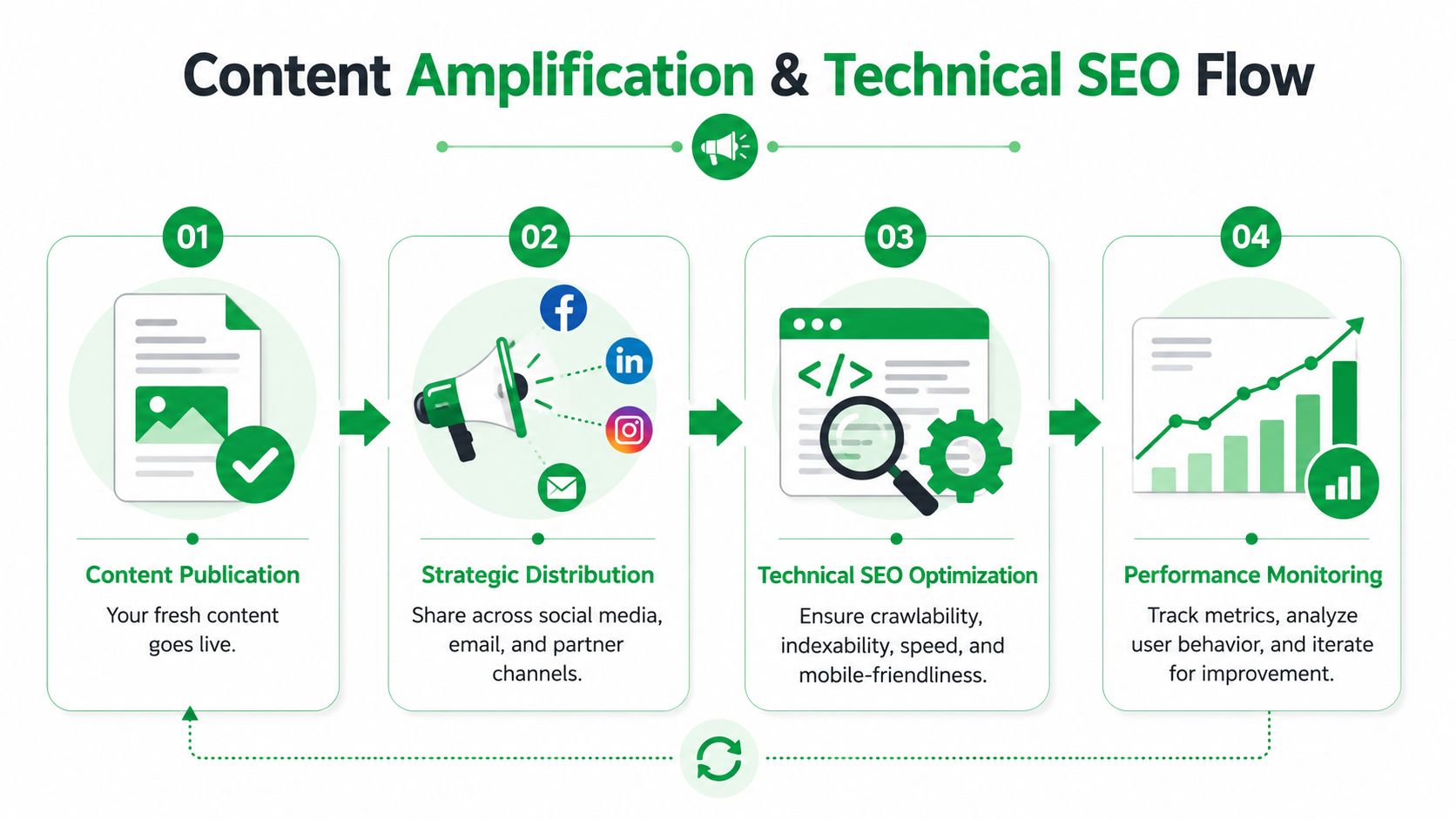
That gap matters even more now. In an AI-shaped search environment, generic posts do not get much room for error. If you want existing content to keep earning visibility, every important page needs support from distribution, internal links, technical hygiene, and clear signals about why your brand knows this topic better than the next publisher.
On-page and technical basics are required
Plenty of content programs fail on basic execution. Pages load slowly on mobile. Metadata stays vague. Important articles sit three clicks deep with no internal links from stronger URLs. Images add weight but no context. Then leadership concludes that SEO content is unreliable.
Look, here is how it really is. Strong content strategy breaks when weak site mechanics keep good pages from being discovered, understood, or used.
Focus on the basics that directly affect performance:
- Titles and meta descriptions: Specific copy that matches search intent and earns the click
- Header structure: H2s and H3s that show a logical hierarchy and make scanning easier
- Image optimization: Descriptive alt text, compressed files, and visuals that clarify the point
- Internal linking: Direct paths from older authority pages to newer cluster pages and conversion pages
- Mobile usability: Fast, readable pages with clean spacing, tappable elements, and no layout issues
- Indexation health: Pages that can be crawled, indexed, and separated from thin or duplicate content
None of that is flashy. It is still where a lot of results are won.
SEO Content Strategy: Distribution gives new content a fighting chance
Search compounds over time. Distribution creates early momentum, helps the right people see the piece, and often earns the first engagement signals that tell you whether the angle is working.
A practical rhythm usually looks like this:
- Email send: Put the piece in front of the segment most likely to care or convert
- Social adaptation: Rewrite the core point for LinkedIn, short-form posts, or industry communities
- Internal promotion: Add links from relevant legacy pages that already have traffic and authority
- Sales enablement: Give account executives or customer success teams content they can send to prospects
- Repurposing: Turn the article into a short video, FAQ, webinar prompt, or founder post
If you want a useful model for building that system, SleekPost’s distribution strategy treats promotion like an operating process instead of a last-minute task.
That matters because topical authority is not built by publishing alone. It is built by repeatedly putting your best insights in front of the right audience, then connecting those assets across the site so they reinforce each other.
What tends to work
Consistency beats intensity here.
The teams that get returns usually run the same launch checklist every time. They update older posts to support new ones. They watch crawlability, page speed, and internal links on revenue-driving URLs first. They also promote existing content with proven traction instead of acting like every win must come from a brand-new article.
What usually fails is the opposite approach. Publish once. Share once. Ignore the technical cleanup. Leave old high-potential pages untouched. That is how businesses end up sitting on a content library that should be producing authority, links, and pipeline but instead does very little.
Technical SEO should serve content priorities. If your team spends the quarter arguing about minor site tweaks while your best pages are thin, outdated, or disconnected from the rest of the topic cluster, the plan is off track.
Measure What Matters and Optimize for Growth
If your reporting starts and ends with keyword rankings, you’re missing the actual business picture.
Rankings matter. But they are one signal, not the scoreboard. A page can move up and still fail to generate leads. Another page can sit outside the top positions and still produce qualified traffic because it attracts the right audience with the right intent.
The metrics worth watching
The useful set is usually smaller than people think.
Track:
- Organic traffic quality: Which pages attract relevant visits, not just volume
- Conversions and assisted conversions: Contact forms, demos, purchases, or other meaningful actions
- Engagement signals: Time on page, page depth, and whether visitors continue into the site
- SERP feature visibility: Featured snippets, AI overviews, image visibility, and other search surfaces
- Content decay and recovery: Which URLs slip, which rebound after updates
That timeframe matters because it prevents bad decisions. Teams publish in January, panic in February, and rewrite the entire strategy by March. Too early. Often much too early.
A practical review cadence
Use a rolling review cycle instead of one annual postmortem.
| Review window | What to check | Typical action |
|---|---|---|
| Weekly | Indexation issues, traffic anomalies, broken links | Fix urgent blockers |
| Monthly | Query trends, internal link gaps, engagement shifts | Improve pages showing potential |
| Quarterly | Conversion contribution, cluster performance, stale content | Refresh, consolidate, or expand |
| Bi-annual | Full content inventory and topic map | Reprioritize based on business goals |
This keeps strategy grounded in evidence. It also stops the common drift where the content calendar gets filled by whoever shouts the loudest.
Build a feedback loop, not a reporting deck
The strongest SEO content strategy is iterative.
A page wins. You study why. Was it the intent match, stronger structure, better media, narrower angle, or tighter internal linking? A page stalls. You diagnose whether the issue is competition, cannibalization, weak conversion design, or lack of topical support. Then you feed those lessons back into the next brief.
That’s the whole game. Measure, adjust, redeploy.
And here’s how it really is. Growth usually comes from a few categories of action, not endless novelty:
- Refresh winners before they fade
- Consolidate overlap before pages compete
- Expand clusters that show authority potential
- Stop publishing pages with no strategic role
Don’t ask, “What should we publish next?” first. Ask, “What is the highest-leverage move in the content library we already own?”
That question saves time, budget, and a lot of mediocre output.
If your business needs a clearer SEO content strategy, Mr. Green Marketing, LLC helps companies turn scattered content into a structured growth plan through strategy-led SEO, website optimization, and performance reporting. A practical starting point is a free audit and performance report to identify visibility gaps, quick wins, and the pages most worth fixing first.
Leave a Comment
sing in to post your comment or sign-up if you dont have any account.