
Answer Engine Optimization Services: AI summaries now appear on approximately 18% of all searches, and when they do, click-through rate drops from 15% to 8% according to OWDT’s overview of answer engine optimization. That one shift changes the job of search marketing. The old target was a visit. The new target is visibility inside the answer itself.
That’s why answer engine optimization services matter. Not because AEO is a shiny new label, but because buyers are increasingly getting what they need before they ever reach your website. If your brand isn’t one of the sources an AI system selects, summarizes, or cites, you’re still technically online. You’re just absent from the moment that matters.
A lot of businesses hear “AEO” and assume it means better formatting, a bit of schema, and some FAQ pages. Sometimes that’s part of it. But real answer engine optimization services go further. They shape how AI systems recognize your authority, how your content gets extracted, and how your internal expertise becomes citable.
And that’s the gap. Some providers are building answer visibility. Others are repackaging standard SEO with fresher vocabulary.
Answer Engine Optimization Services: The End of Clicks and the Rise of Answers
Search used to reward the page that won the click. Answer engines reward the page that can be lifted, summarized, and trusted.
That sounds subtle. It isn’t.
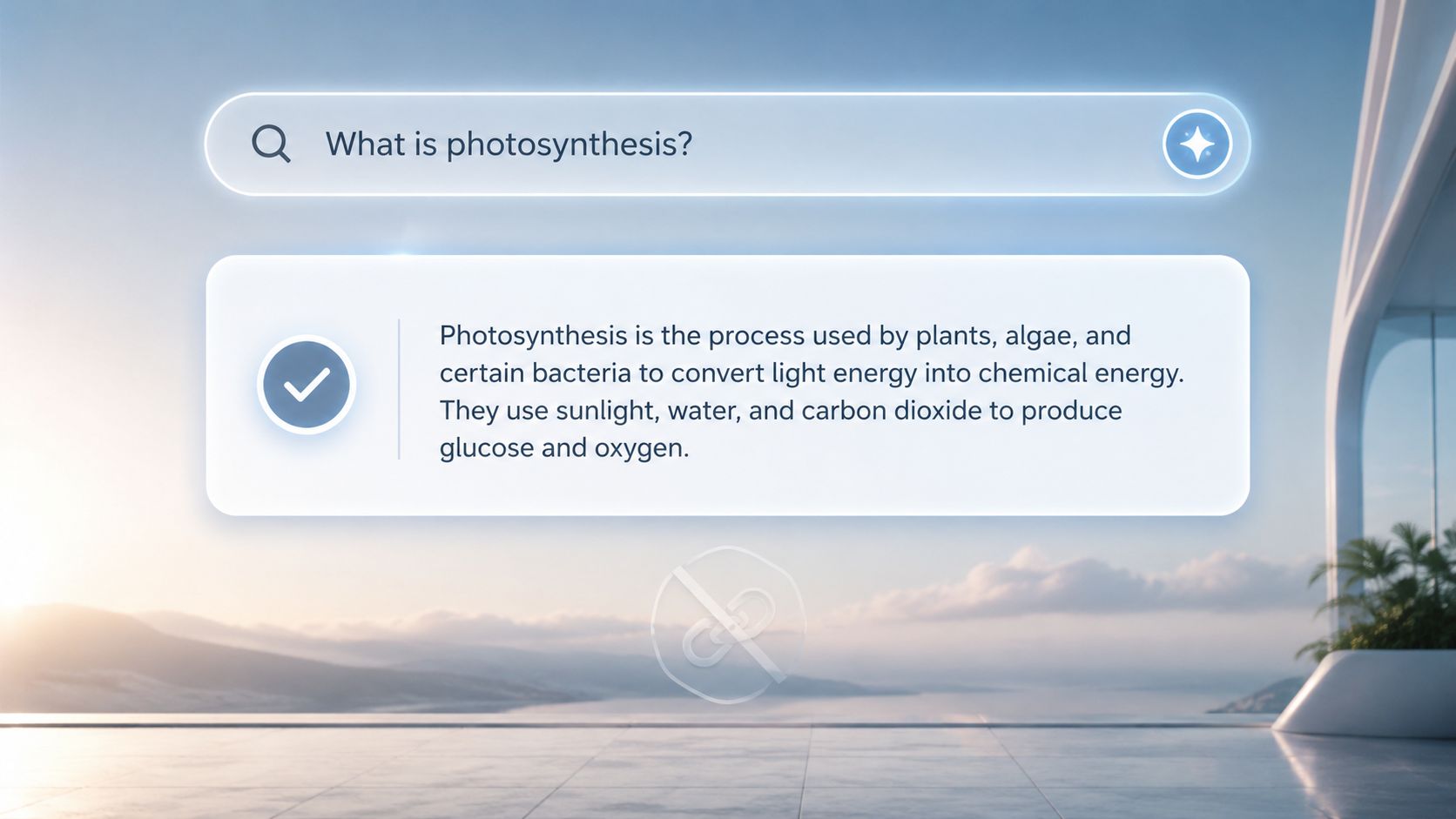
When an AI overview or conversational engine answers the question directly, the user may never need to browse ten links, compare snippets, and decide where to click. The evaluation happens upstream. Your content either helps power the answer, or it sits outside the conversation.
What changed in practical terms
Traditional SEO still matters. Strong pages, clear architecture, and technical hygiene still give you a base to work from. But answer engines don’t behave like old search result pages. They extract passages. They compress ideas. They privilege content that can be interpreted quickly and reused safely.
That’s why “share of answer” has become the strategic objective. You’re not only competing for rank. You’re competing for citation, inclusion, and representation.
A useful way to think about it is this:
- SEO asked whether your page could earn a visit.
- AEO asks whether your page can supply the answer.
- Modern search asks both, but the second question increasingly decides the first.
If you want a technical example of how companies are improving retrieval quality inside AI systems, Powering precise AI search with Cohere is worth reading. It shows why precision, ranking, and passage relevance matter so much once AI becomes the interface.
A page can rank and still lose the answer.
Answer Engine Optimization Services: Why old reporting misses the shift
Many business owners still review organic traffic, keyword rankings, and conversions as if those metrics tell the full story. They don’t anymore. A user can see your brand in an AI-generated answer, get confidence from that mention, and convert later through another channel. Your analytics may show weak direct traffic while your authority is working behind the scenes.
That’s one reason teams are rethinking content strategy for AI search. If you want a broader primer on that transition, this guide on how to optimize for AI search gives useful context.
The urgency isn’t hype. It’s behavioral. Buyers are getting comfortable with synthesized answers, follow-up questions, and AI-assisted research. And once that habit sets in, brands that only optimize for blue-link traffic start losing ground in places they aren’t measuring.
Answer Engine Optimization Services: The Core Components of Real AEO
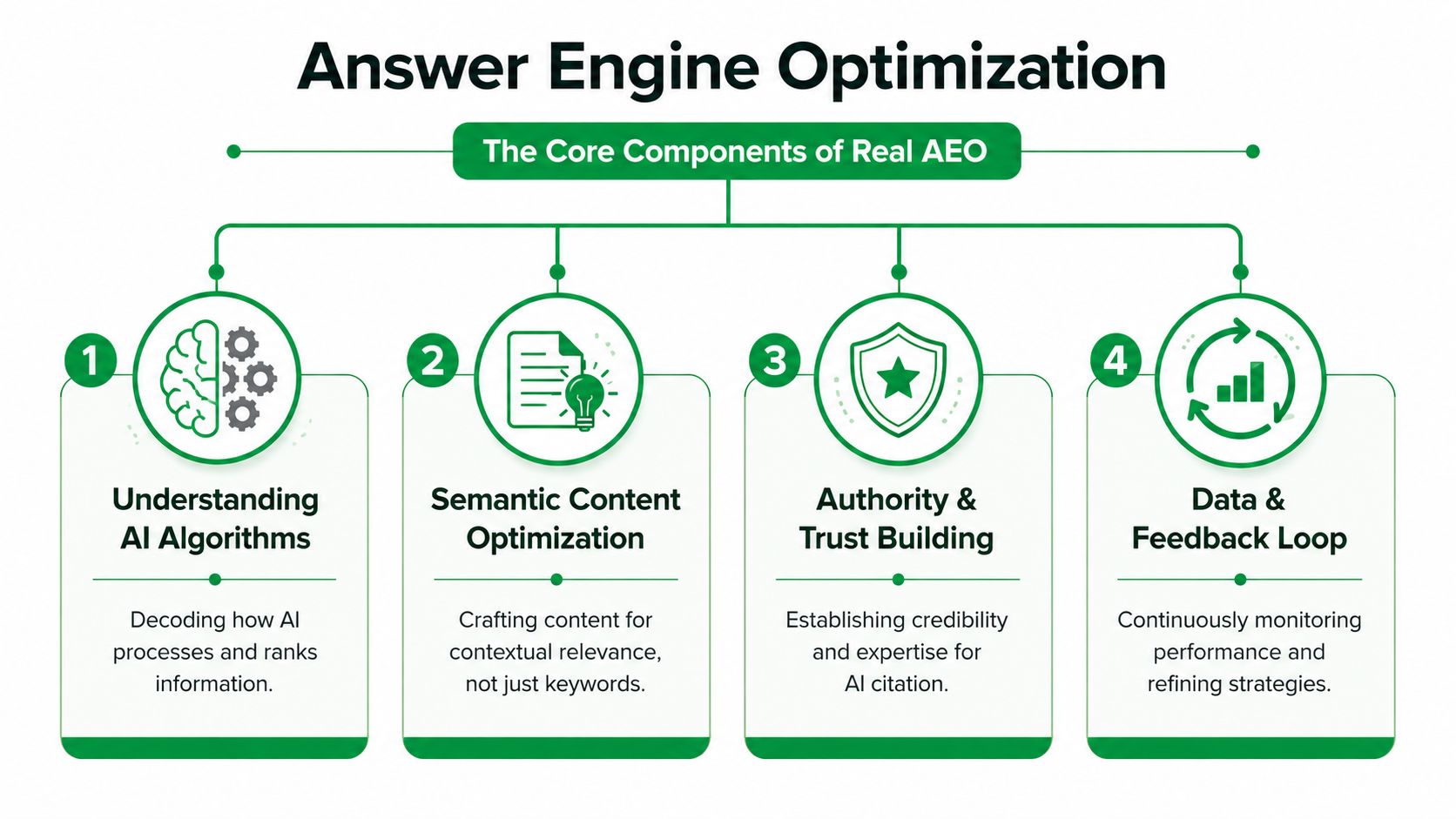
Real answer engine optimization services are built on a few connected disciplines. Not one trick. Not one plugin. And definitely not “we added FAQ schema, you’re done.”
At the center is a simple technical reality from CXL’s guide to answer engine optimization: the primary specification is structuring content to deliver a direct, 40 to 60 word answer at the very beginning of a section, followed by 2 to 3 atomic paragraphs of 1 to 3 sentences each so large language models can extract passages cleanly. That’s not a writing style preference. It’s an extraction format.
Content engineering comes first
Most weak AEO work starts with existing pages and lightly reformats them. Better headings. Shorter intros. Maybe a FAQ block at the bottom.
That helps, but only to a point.
Real content engineering starts by identifying the exact question a buyer asks, then answering it immediately in a self-contained passage. After that, the page expands the answer in short, logically separated blocks. This makes the passage usable for AI Overviews, chat interfaces, and voice responses.
Practical rule: If a sentence only makes sense when read with the whole page, it’s harder for an answer engine to reuse.
This is also why conversational phrasing matters. Natural language queries aren’t an edge case anymore. They’re the interface.
For a useful outside take on how AI-focused search content is evolving, Nuwtonic has a good overview of the shift from keyword-first writing to semantic, answer-driven structure.
Answer Engine Optimization Services: Structured data is not optional
Schema isn’t magic, but it does act like a translator. It helps search systems and AI-related crawlers understand what a page contains, who published it, and where question-answer relationships exist.
The basics usually include FAQPage and Speakable where appropriate, along with consistent entity information across the site. What matters is not adding every schema type available. What matters is deploying the right structured data on the right pages, with clean implementation and alignment to the visible content.
That work often overlaps with content distribution decisions too. If you republish, excerpt, or adapt answers across multiple properties, your process needs to preserve source clarity. This article on syndicating content for SEO is useful because the same discipline applies when you want machine-readable authority without muddying authorship.
A video can help make the distinction clearer:
The overlooked asset is internal language
Advanced AEO separates itself.
Many service descriptions focus on visible website content only. Stronger programs also mine the language your business already owns:
- Customer service logs that reveal the exact questions people ask
- Sales call notes and scripts that show objections and comparison language
- On-site search data that exposes intent in raw form
- Support emails and chat transcripts that contain natural phrasing
- Internal expert explanations that product pages usually flatten
Those assets often contain the most citable material because they sound like real conversation, not catalog copy. Short answers built from those sources tend to be sharper, more specific, and more useful than generic marketing text.
Fragments matter here. So does tone. The best AEO content often feels less polished than a brand brochure and more grounded than a landing page.
Answer Engine Optimization Services: An AEO Agency Workflow in Action
A proper AEO engagement usually feels less like a campaign launch and more like a disciplined editorial and technical rebuild.
It starts with diagnosis.
An agency reviews what AI systems are likely to understand about the brand today. Not what the brand thinks it has published, but what machines can parse. That means checking entity consistency, structured data, crawlable content, page architecture, and whether the company has clear topic ownership anywhere on the site.
The first pass is usually humbling
A typical business has useful material scattered across service pages, blog posts, support docs, PDFs, and sales collateral. The problem isn’t lack of knowledge. It’s fragmentation.
One service page may state what the company does. Another may imply who it serves. A third may include an FAQ written in marketing language that no customer would ever use. AI systems don’t resolve those contradictions kindly. They pick from what they can understand.
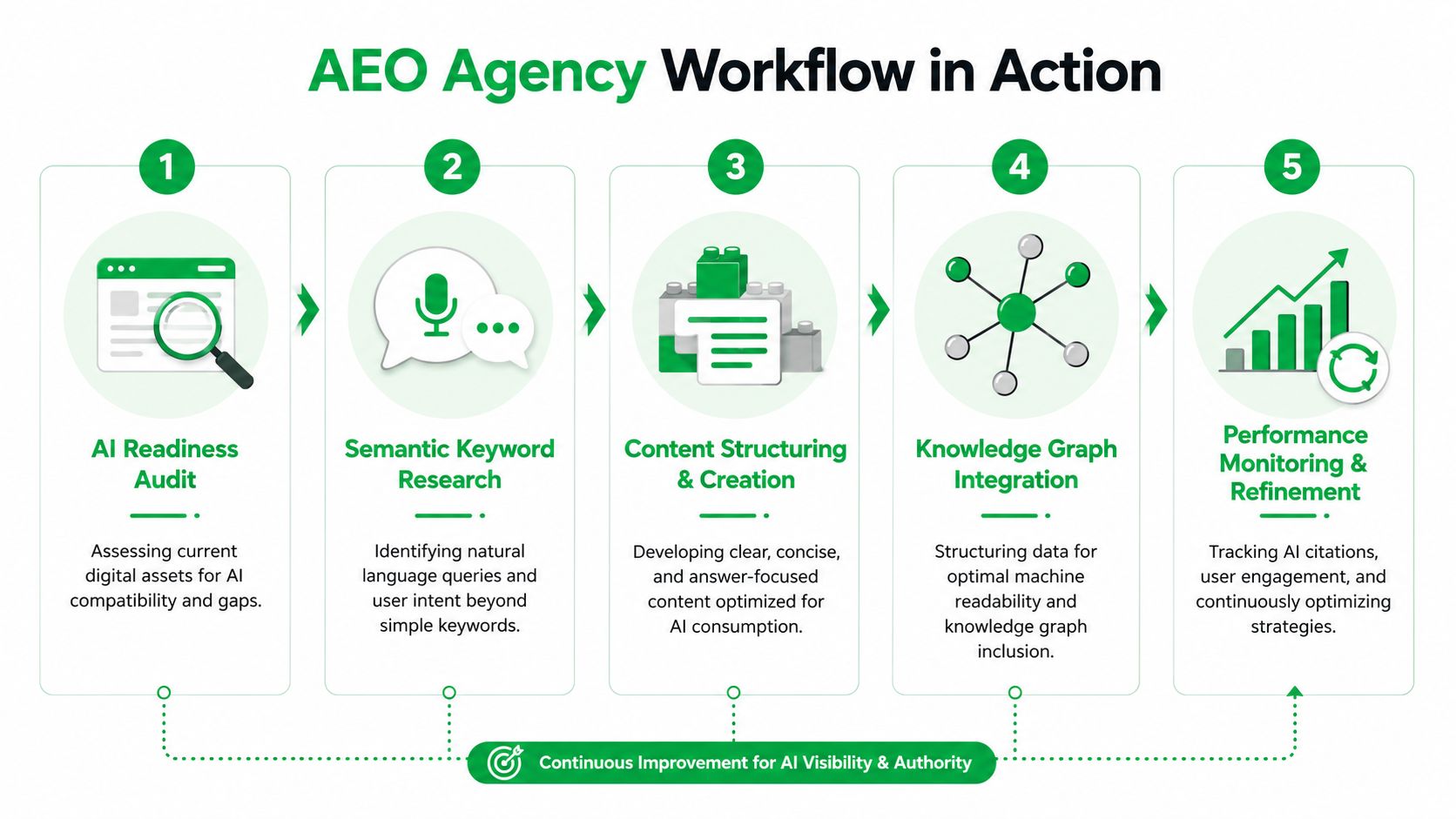
So the workflow often looks like this:
- Audit the existing footprint
The agency maps current pages, entities, schema, authorship signals, and technical barriers to extraction. - Match questions to existing authority
Instead of chasing every prompt in the market, the team starts with topics the site already performs well on in traditional search. That’s where citation probability is usually highest. - Rebuild priority pages
Core pages are restructured with direct answers, compact supporting paragraphs, clearer headings, and stronger source signals. - Publish net-new answer assets
Internal business language proves useful. Teams turn support, sales, and operational knowledge into answer-ready content. - Run prompt testing and refine
The work doesn’t stop at publishing. The team checks whether prompts produce the desired mention, citation, or representation across answer environments.
Answer Engine Optimization Services: What early wins actually look like
According to Marketing Illumination’s AEO best practices, a practical goal is earning 1 to 2 direct mentions for related questions within a three-month window, especially on topics where you already rank well in traditional search. That’s a useful benchmark because it forces realism. You’re not trying to dominate the entire category overnight.
Start with adjacent wins. The fastest path to AI citations usually runs through topics where your site already has credibility.
This is also where agency discipline matters. Controlled prompt testing sounds simple, but it isn’t. Query phrasing changes outcomes. So do location terms, platform differences, and the way AI systems interpret ambiguous categories.
And there’s a technical wrinkle many teams miss. AI-related crawlers, data access, and content retrieval don’t always behave neatly. If you’re curious about the infrastructure challenges behind modern web extraction, Scrapfly’s anti-bot insights are useful reading because they show how access friction affects what systems can retrieve from the web.
Good AEO work is iterative. You test, tighten, and publish again. Then again.
Measuring Success in a Post-Click World
If you judge answer engine optimization services with old SEO reporting alone, you’ll underestimate the impact and sometimes kill the program too early.
The cleanest shift is this one: Directive Consulting’s framework for generative engine optimization metrics argues that success is measured through AI Answer Mention Rate, meaning the percentage of tracked prompts where your brand appears in the AI-generated response, whether or not the user clicks.
That metric sounds unfamiliar at first. It shouldn’t. It directly reflects the new battleground.
What changes in reporting
Traditional SEO reports are built around sessions and ranking positions. AEO reports need to capture influence before the visit and sometimes without the visit.
Here’s the comparison that matters most:
| Metric Focus | Traditional SEO KPI | Modern AEO KPI |
|---|---|---|
| Visibility | Keyword rankings | AI Answer Mention Rate |
| Traffic outcome | Organic sessions | Brand presence inside AI-generated responses |
| User action | Click-through rate | Assisted conversions from AI-influenced sessions |
| Query performance | Position by keyword | Coverage across tracked prompts and follow-up questions |
| Brand authority | Backlink growth and page rank strength | Share of answer and consistency of citation |
Answer Engine Optimization Services: What to ask for in a real report
A credible AEO reporting cadence usually includes a mix of quantitative tracking and qualitative review. Not vanity screenshots. Actual monitoring.
Look for reporting that answers questions like these:
- Prompt coverage
Which tracked questions currently include the brand in the answer? - Mention quality
Is the brand mentioned by name, or is it cited as a source with accurate context? - Representation accuracy
When the brand appears, does the AI describe products, services, and expertise correctly? - Conversion influence
Do AI-touched journeys show up later through direct, branded, or assisted paths?
AEO reporting also requires patience. Mention patterns can shift before traffic patterns do. That’s normal. In a post-click environment, influence often surfaces before attribution catches up.
What not to obsess over
Don’t expect every useful outcome to show up as a last-click organic conversion. That model is too narrow now.
And don’t let a temporary drop in question-query clicks automatically signal failure. If the user got the answer, remembered your brand, and returned later through another path, the content still did its job.
The reporting model has to match buyer behavior. Otherwise, you end up measuring the disappearance of clicks instead of the growth of authority.
Answer Engine Optimization Services: How to Choose the Right AEO Partner
The market is crowded now. Some agencies understand answer engine optimization services at a systems level. Others are selling a renamed SEO package with a few AI buzzwords layered on top.
The difference matters because the deliverables look similar on the surface. Almost every provider will mention schema, FAQs, and content structure. Far fewer can explain how they engineer authority signals across the full ecosystem.
According to this analysis on the AEO agency gap, buyers need to verify whether an agency builds the five authority signals required for LLMs: entity cleanup, structured data deployment, trusted source citation building, answer-focused content engineering, and ongoing validation via controlled prompt testing. That’s the line between real AEO work and page reformatting.
Questions that expose the difference
Ask direct questions. If the agency gets vague, that’s your answer.
- How do you handle entity cleanup
Can they explain how they align brand names, service definitions, author profiles, business details, and topical expertise across the site? - What structured data do you deploy, and where
A real partner should talk about page-level implementation, validation, and alignment with visible content. Not just “we add schema.” - How do you build trusted citation signals
This isn’t about random link building. It’s about strengthening the sources, references, and corroborating signals that support citation trust. - What does answer-focused content engineering look like
Ask how they structure passages, select target questions, and rewrite existing content for extractability. - How do you validate outcomes
If there’s no prompt testing process, there’s no serious AEO program.
If the deliverable sounds like “better SEO formatting,” keep digging.
Red flags that show up early
Some warning signs appear before the proposal even lands.
| Signal | What it usually means |
|---|---|
| They only talk about keywords and rankings | They haven’t updated the measurement model |
| They promise fast domination across all AI platforms | They’re selling certainty they can’t control |
| They treat schema as the whole solution | They’re overvaluing markup and undervaluing authority |
| They ignore internal business knowledge | They’ll likely produce generic, low-citation content |
| They don’t mention validation or prompt testing | They aren’t measuring what answer engines actually return |
A good selection process still applies the basics. Clear scope, clear reporting, and honest trade-offs. If you want a broader framework for evaluating service providers, this guide on how to choose a digital marketing agency is a useful companion.
What strong partners usually say
The best agencies don’t sell AEO as a hack. They talk about engineering clarity, authority, and machine-readable trust over time.
They’ll also tell you what AEO can’t do. It can’t force a platform to cite you. It can’t replace weak expertise. And it can’t compensate for thin source material if your site says the same thing as every competitor.
That honesty is a good sign. So is curiosity about your internal knowledge base. The right partner usually wants access to customer questions, sales language, support patterns, and expert interviews. Because that’s where differentiated answers come from.
Frequently Asked Questions About AEO Services
Is AEO the same thing as voice search optimization
Not exactly.
Voice search optimization is one application area. AEO is broader. It covers how your content gets selected for AI overviews, conversational assistants, synthesized responses, and spoken answers. Voice interfaces benefit from the same direct-answer structure, but answer engine optimization services also deal with citation readiness, entity signals, and prompt validation across text-based AI environments.
Can a business do AEO in-house
Sometimes, yes.
If your team already has strong SEO, technical publishing support, subject matter experts, and someone who can run structured testing, you can handle parts of it internally. Smaller teams usually struggle with consistency. They can write a few answer blocks, but they don’t maintain the full loop of schema deployment, entity alignment, content engineering, and validation.
A hybrid model often works well. Internal experts provide the raw knowledge. Specialists turn it into structured, citable assets.
How long does it take to see results
It depends on your starting point, your current authority, and whether you begin with pages that already perform well in search. Some brands see mentions emerge first on narrow, adjacent queries. Others need a longer cleanup phase before answer visibility improves.
The important thing is to set expectations around progression, not instant transformation. Early signals may show up as cleaner citations, better representation, or isolated mentions before broader visibility follows.
Why aren’t product catalogs enough
Because catalogs usually describe inventory, not understanding.
Forbes highlighted a more advanced issue in its discussion of AEO: uploading product catalogs is ineffective for LLMs, and many service descriptions still fail to answer the question of how to extract and publish internal, non-public conversational data that can influence LLM training in a way that becomes useful for discovery and citation. That’s where internal business language becomes valuable.
What internal data is actually useful
Usually the materials your team already has but hasn’t treated as publishable knowledge:
- Support conversations that reveal plain-language problems
- Sales scripts that surface objections and comparisons
- Site search queries that show intent without marketing polish
- Expert explanations from product, service, or operations teams
That material often produces stronger answer content than a polished brochure page because it sounds grounded. Useful. Human.
If you want clarity on where your brand stands in AI-driven search, Mr. Green Marketing, LLC offers a free audit and performance report that can uncover visibility gaps, identify quick wins, and show whether your current SEO setup is ready for answer engines.
Leave a Comment
sing in to post your comment or sign-up if you dont have any account.