
Video Marketing Services: You’re probably in one of two spots right now.
Either you know you need video and haven’t started because it feels expensive, slow, and weirdly vague. Or you’ve already made a few videos, posted them to Instagram, Amazon, YouTube, or your site, and the results were all over the place. Some views. A few likes. Not much clarity.
That’s normal.
For small businesses and Amazon sellers, video marketing services often get presented like a luxury add-on. In practice, they’re closer to an operating system. The right videos help a local service business turn traffic into calls. They help an ecommerce brand answer objections before a shopper bounces. They help an Amazon listing do the job that static images can’t quite finish.
And that’s the difference that matters. Not “brand awareness” in the abstract. Actual movement. More qualified leads. Better product understanding. Fewer drop-offs. More confidence before the click.
Video Marketing Services: Why Everyone Is Talking About Video Marketing
If your competitors seem louder than they were a year ago, you’re not imagining it. Video is taking more space in search, social feeds, product discovery, and ad inventory. Buyers see it everywhere because platforms keep prioritizing it, and businesses keep funding it.
The adoption curve is basically over. Video content is projected to account for approximately 82% of all internet traffic by 2025, while 91% of businesses globally now use video as a marketing tool according to Insivia’s compiled video marketing statistics. That isn’t hype. It’s a practical description of how people consume information online now.
Why that matters for SMBs
A big brand can survive some wasted motion. Most SMBs can’t.
If you run a home service company, a clinic, a law office, a local franchise, or a niche ecommerce brand, your marketing has to do real work. Your website has to explain fast. Your ads have to earn attention fast. Your product pages have to reduce uncertainty fast. Video is strong at all three because it compresses context.
A thirty-second clip can show what a paragraph struggles to explain. A product demo can answer the question a shopper didn’t know how to phrase. A founder video can make a small company feel credible in a crowded market. Small things. But they stack up.
Practical rule: If a buyer needs to understand, trust, or compare before taking action, video usually shortens that path.
Video Marketing Services: Why it matters even more for Amazon sellers
Amazon is its own ecosystem. Shoppers move quickly, compare constantly, and rarely give you the benefit of the doubt. They don’t want clever. They want clarity.
That makes video useful in a very specific way:
- Show the product in use: Buyers can see scale, texture, movement, and setup.
- Answer objections early: Good product video handles confusion before it becomes a lost sale.
- Support ad creative: The same core footage can often be repurposed for marketplace ads and off-Amazon traffic campaigns.
And yes, there’s pressure in that. But there’s also opportunity. If your category is crowded, strong video doesn’t just make you look polished. It makes you easier to buy from.
What Video Marketing Services Actually Include
A lot of businesses hear “video marketing services” and think it means a crew shows up with cameras, captures some footage, and hands over a file. That’s production. It’s only one part.
A complete engagement usually works more like building a house. You need the plan, the prep, the construction, and the final finish. Skip one, and the whole thing gets weaker.
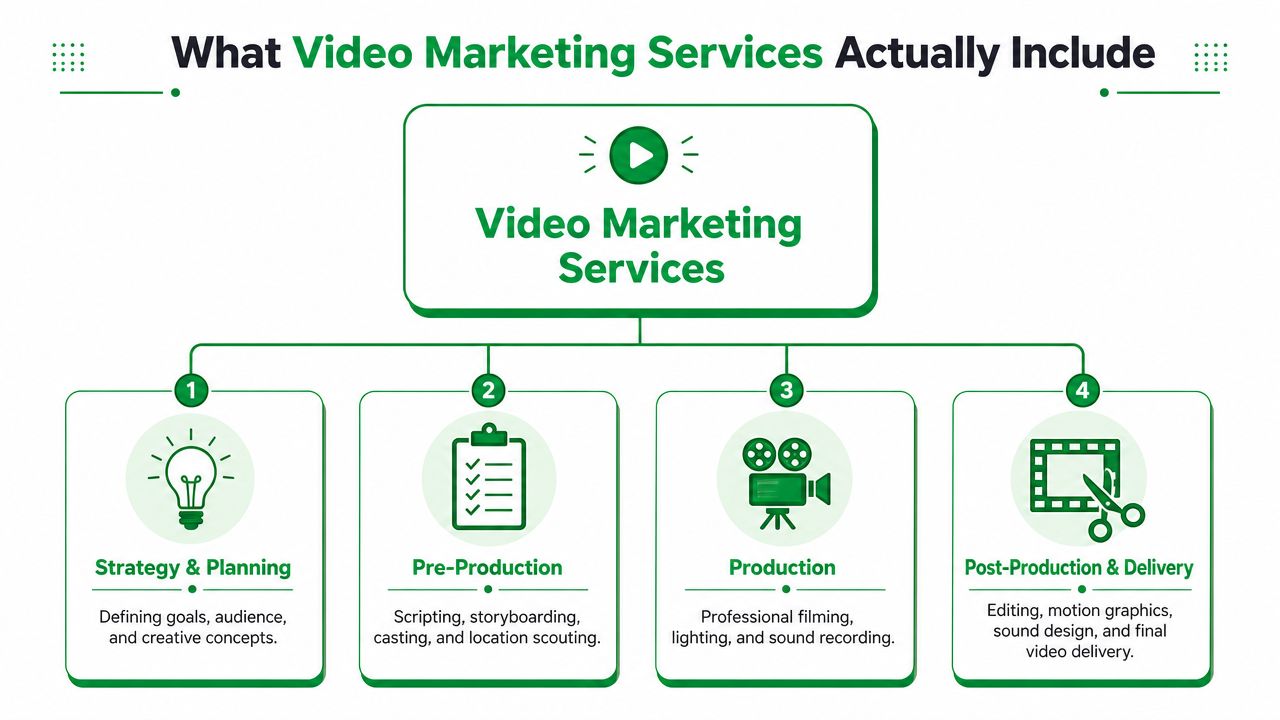
Video Marketing Services: Strategy and planning
This forms the backbone of good projects.
Before anyone writes a script, you need answers to a few blunt questions. Who is this video for? What action should it drive? Where will it live? What objection is it supposed to remove? A homepage explainer, an Amazon product video, and a retargeting ad shouldn’t sound the same because they’re doing different jobs.
For SMBs, this is the phase that protects budget. It keeps you from making one polished video that says everything and achieves nothing.
Video Marketing Services: Pre-production
This is the unglamorous part people underestimate. Scripts, storyboards, shot lists, location planning, casting, product prep, wardrobe choices, and approvals all sit here.
When this step is rushed, production days get expensive fast. Time gets lost. Messaging wanders. Editors have to “find the story” in weak footage. That’s a bad trade.
If you want a grounded overview of technical setup and workflow discipline, these best practices for filmmakers are useful because they connect production quality to planning, not just gear.
Video Marketing Services: Production and post-production
Production is the visible part. Cameras, lighting, audio, direction, B-roll, interviews, product shots, screen captures. Post-production is where the footage becomes a marketing asset instead of raw material. Editing, motion graphics, captions, pacing, sound design, versioning.
A strong team will also think beyond the master edit. They’ll cut variants for paid social, vertical placements, Amazon-compatible formats, web embeds, and remarketing use.
Here’s the simplest way to approach it:
| Phase | What happens | What clients should expect |
|---|---|---|
| Strategy | Goal setting and creative direction | Clear audience, offer, CTA, and distribution plan |
| Pre-production | Scripting and logistics | Approval checkpoints before filming |
| Production | Capture the footage | Efficient shoot day and organized asset gathering |
| Post-production | Edit and deliver | Final versions tailored to channels |
One provider that offers this type of work as part of a broader digital stack is video production through Mr. Green Marketing. The useful question isn’t whether a team can shoot. It’s whether they can connect the final asset to a business objective.
Video Marketing Services: The Menu of Common Marketing Videos
Most businesses don’t need more videos. They need the right kinds.
The easiest way to choose is to start with the problem. If traffic is decent but visitors don’t understand what you do, that points to one type of asset. If your Amazon listing gets views but weak conversion, that points to another. Different jobs, different video formats.
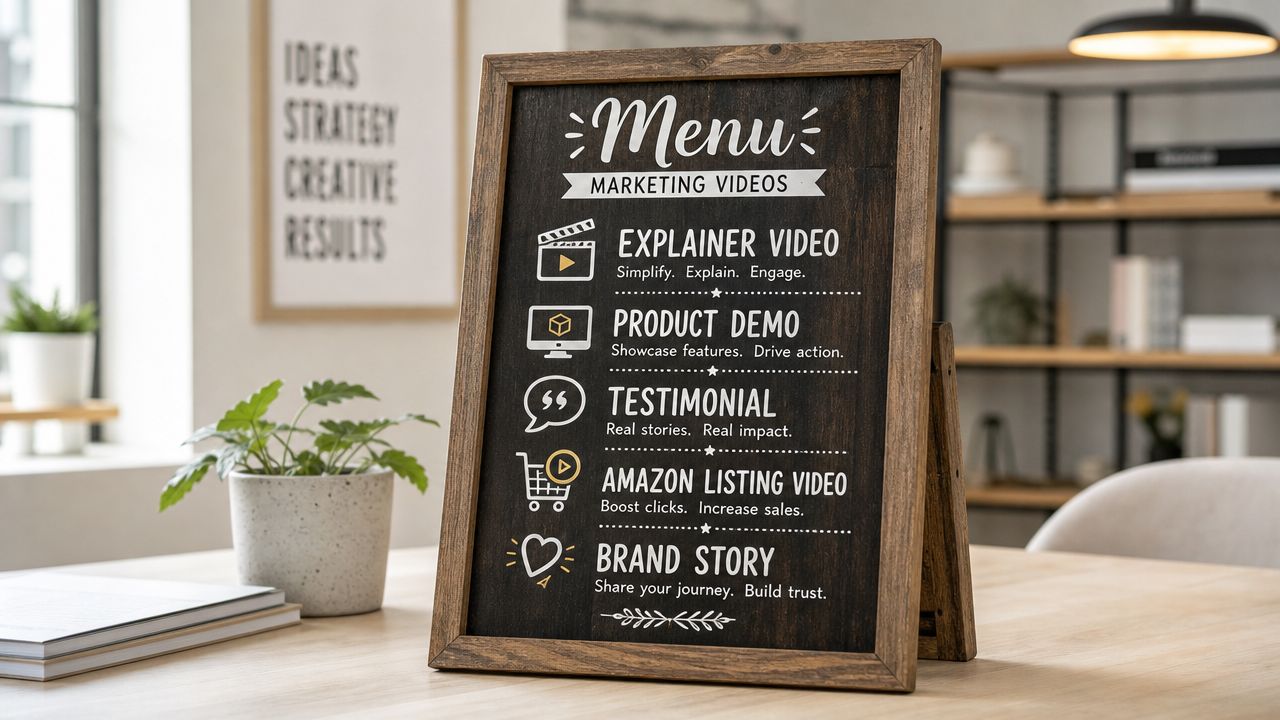
Explainer videos for confused visitors
Your website may be getting traffic from SEO, paid search, referrals, or Amazon brand traffic, but if people land and don’t quickly understand the offer, bounce rates stay stubborn.
That’s where explainer videos earn their keep. They simplify. They show the problem, the solution, and the next step without forcing a visitor to decode your business from scattered copy blocks.
These work especially well for:
- Service businesses: Plumbing, legal, medical, home services, consulting
- Complex offers: Software, specialty products, custom processes
- Sales-assisted businesses: Teams that need prospects to arrive warmer
Video Marketing Services: Product demos for ecommerce and Amazon
If you sell physical products, product video is often the shortest route to buyer confidence.
A good demo doesn’t just show the item spinning on a white background. It shows use, setup, fit, scale, and outcome. For Amazon sellers, this can reduce uncertainty in a way images alone often can’t. For DTC brands, it can improve product page clarity and support paid social creative at the same time.
Buyers don’t need more adjectives. They need to see what happens when the product is in someone’s hands.
Testimonial and proof videos
These are for trust gaps.
When prospects hesitate because your service feels risky, a customer story can do more than a branded pitch. The strongest testimonial videos aren’t overproduced speeches. They’re specific. What problem did the customer have? Why did they choose you? What changed after they did?
For local businesses, these often work well on landing pages and retargeting campaigns. For B2B, they can support sales sequences. For Amazon-adjacent brands selling through their own site too, they help validate quality and experience.
Short-form vertical videos for attention
This is the format many businesses try first, often with mixed results. The format itself isn’t the issue. The lack of strategy usually is.
Short-form vertical video under 60 seconds generates 2.5× more engagement per impression than longer-form or horizontal formats, according to Digital Applied’s 2026 video benchmark summary. That makes it powerful for awareness, especially on TikTok, Reels, and Shorts.
But attention isn’t the same as intent.
Use short-form for hooks, product angles, founder presence, FAQs, before-and-after visuals, and quick demonstrations. Don’t expect it to replace your whole funnel. It’s the front door, not the entire house.
If your team needs creative prompts that feel native to the platform, this roundup of Reels ideas for organic growth is a practical place to start. And if you’re scripting paid or organic creative, reviewing an ad script example helps tighten the opening lines that matter most.
Video Marketing Services: Building Your Video Strategy and Measuring Success
A random collection of nice-looking videos is expensive clutter.
The businesses that get real traction from video usually do one thing differently. They assign each asset a job in the funnel. Not vaguely. Specifically. One video earns attention. Another explains. Another removes doubt. Another pushes the decision over the line.
Match the format to the funnel
A simple funnel is enough.
Top of funnel content gets attention. This includes short-form vertical clips, social teasers, broad awareness ads, and simple founder-led videos. The job here is to stop the scroll and make the audience care for a few seconds longer.
Middle of funnel content builds understanding. Think explainers, comparison videos, educational walkthroughs, and FAQ videos. Local service businesses can answer “how it works” questions, and Amazon sellers can drive off-platform traffic into better-informed product research through this content.
Bottom of funnel content reduces risk. Testimonials, detailed demos, offer videos, onboarding previews, and sales follow-up videos all fit here. These help people act once they’re already interested.
| Funnel stage | Best-fit video types | Better success signal |
|---|---|---|
| Top | Short-form social, hooks, teasers | Click-through quality and engaged visits |
| Middle | Explainers, FAQs, comparisons | Time on page, lead form starts, deeper product views |
| Bottom | Testimonials, demos, offer videos | Qualified leads, purchases, sales conversations |
What to measure instead of vanity metrics
Views aren’t useless. They’re just incomplete.
A video with a modest view count can still drive strong business results if the right people watch it and take action. On the other hand, a flashy clip can rack up engagement and produce very little revenue.
That’s why serious teams ask harder questions. Which landing page converted after a video view? Did demo requests improve? Did Amazon shoppers spend longer with the listing and move toward purchase? Did lead quality improve after sales started using a video in follow-up?
For a clean framework, this guide on how to improve marketing performance is helpful because it forces the conversation back to ROI logic instead of surface metrics. And if your reporting is loose today, a practical place to tighten it is this article on measuring marketing campaign effectiveness.
What usually works: Track video against the next business action, not the video event itself.
Video Marketing Services: Silent-first design matters more than most teams think
A lot of social video gets watched with little or no sound. That changes how the asset has to be built.
Accessible video is also a performance lever: videos designed for sound-off viewing with clear on-screen text and captions can materially improve retention and completion rates in mobile social feeds where attention is scarce, as explained in Atlassian’s piece on small business video marketing.
That means captions aren’t just a compliance detail. They’re a conversion detail.
A few practical habits help:
- Open visually: The first frames should communicate even with muted audio.
- Use on-screen text carefully: Short, clear, high-contrast phrases beat dense captions everywhere.
- Design for mobile: Vertical or mobile-aware framing matters because that’s how people watch.
- Front-load the point: Don’t save the value until the end.
How Video Marketing Services Are Priced
This is the part most agencies make harder than it needs to be.
There usually isn’t one universal rate card because the work can range from a single interview edit to an ongoing content engine. Still, the pricing models themselves are predictable. Once you understand the structure, it gets much easier to judge fit.
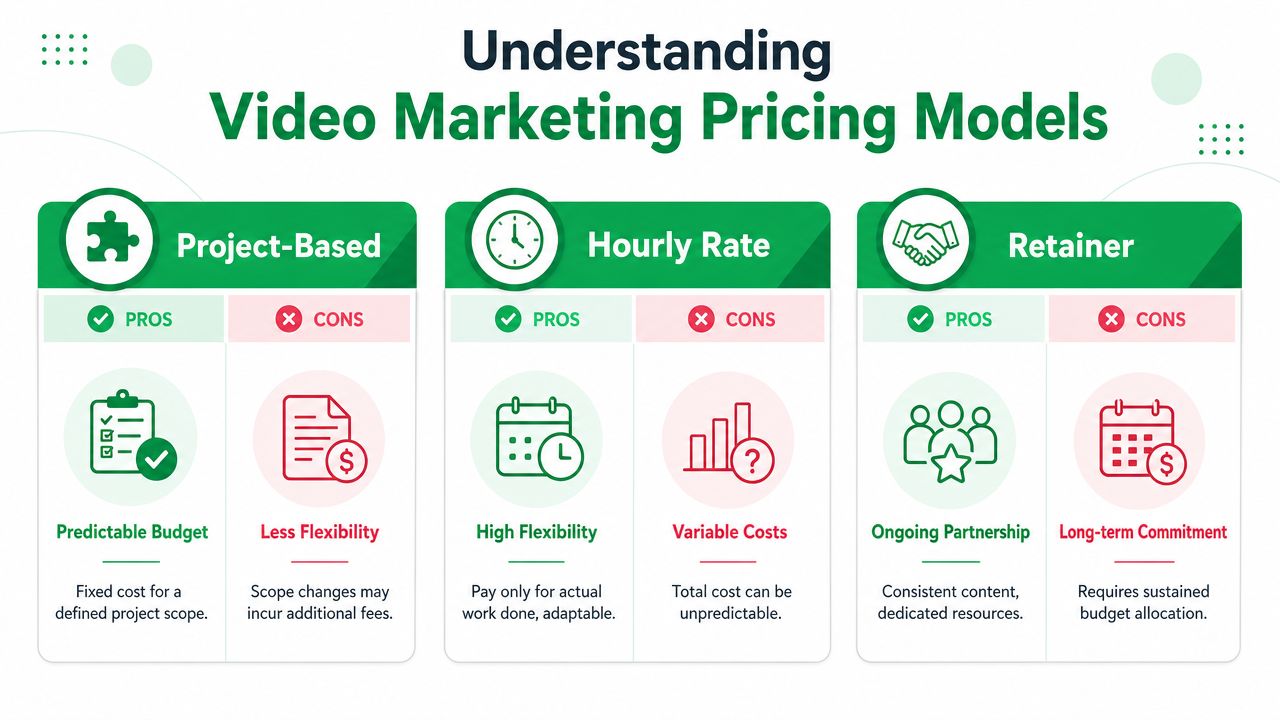
Project-based work
This is the cleanest model for one-time needs. A launch video. A homepage explainer. A product demo set. A testimonial shoot. Scope gets defined, deliverables get listed, and the project has a start and end.
This model works well when the business need is narrow and timing is fixed. It’s less ideal when you know you’ll need multiple rounds of creative testing or ongoing short-form content because every new request can turn into a new estimate.
Hourly work
Some shops and freelancers bill this way, especially for editing, revisions, consulting, or platform-specific production support.
Hourly pricing gives flexibility. It can be useful when the brief is still evolving or when you need tactical support rather than full campaign ownership. The downside is obvious. Budget certainty gets weaker if the scope isn’t tightly managed.
A few businesses like hourly because it feels simple. It is simple. Right up until feedback cycles expand.
Retainers and subscriptions
This model fits businesses that need consistent output. Monthly creative for paid social. Product video refreshes. Ongoing Amazon ad creative. Recurring website and email video assets. Reels, Shorts, and ad variants cut from core footage.
Retainers tend to work best when you already know video will be part of your rhythm, not a one-off experiment. They usually support better planning because the team can batch strategy, production, editing, and iteration instead of rebuilding from zero every month.
Don’t buy a retainer because it sounds sophisticated. Buy it when you need a repeatable content system.
A simple comparison helps:
| Model | Best for | Main trade-off |
|---|---|---|
| Project-based | One clear deliverable | Limited flexibility after scope is set |
| Hourly | Variable or undefined support | Cost can drift |
| Retainer | Ongoing campaigns and testing | Requires sustained commitment |
The pricing question isn’t “What does video cost?” It’s “What are we asking this video program to do?” A local roofer needing one credibility video has a different fit than an Amazon brand testing multiple creatives across listings, ads, and social channels.
Video Marketing Services: How to Choose the Right Video Partner
A polished reel can hide a weak process. That’s why choosing a provider takes more than liking their visuals.
You want a team that can think strategically, handle production cleanly, and connect the work to outcomes you care about. That last part gets skipped a lot.
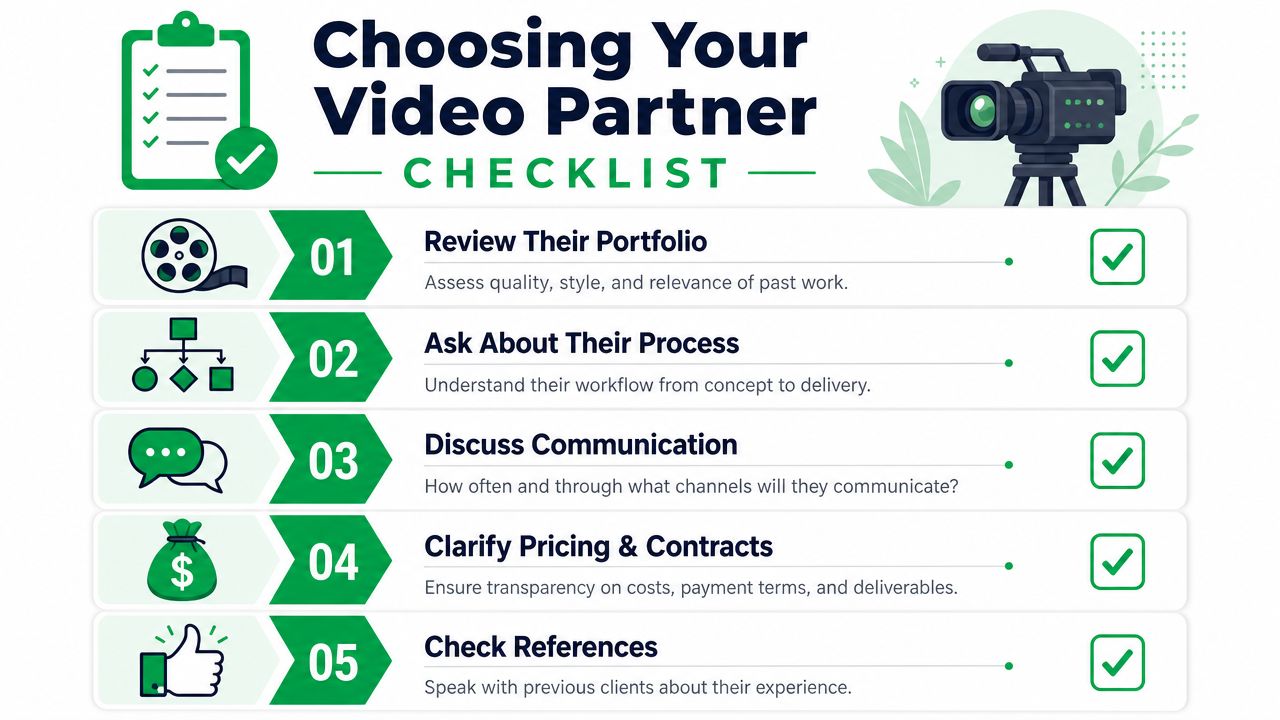
Questions worth asking on the first call
Start with their thinking, not their camera package.
- Ask how they define success: If they jump straight to views, press further.
- Ask how they adapt for platforms: A homepage video and a Reel shouldn’t be clones.
- Ask what happens before filming: Strategy, scripting, and approvals tell you a lot about how organized they are.
- Ask how revisions work: This reveals whether their process is collaborative or chaotic.
- Ask what they need from your team: Good partners know where client delays usually happen.
A short portfolio review still matters. But relevance matters more than flash. If you’re an Amazon seller, look for product clarity and conversion thinking. If you’re a local service business, look for trust-building and lead-gen logic.
Later in the process, this can help frame your evaluation:
The question most clients don’t ask enough about Video Marketing Services
Here’s the one that separates vendors from partners: how do they prove impact beyond engagement?
That question matters because marketers are under pressure to connect video to business outcomes using lift studies and conversion metrics, moving beyond vanity metrics alone, as noted in Blue Door Consulting’s analysis of video measurement and incrementality.
If the answer is vague, that’s a warning sign.
A strong team should be able to discuss tracked landing pages, lead-quality reporting, conversion actions, test structures, or at least the practical limits of attribution by channel. They don’t need to promise perfect measurement. Nobody can. But they should have a plan that goes beyond “we’ll watch the views.”
Red flags that show up early
Some are subtle. Some aren’t.
- Everything sounds the same: If every client gets the same format, the strategy is probably thin.
- No distribution conversation: Good video can still fail if no one discusses where it will be seen.
- Too much focus on gear: Equipment matters. Messaging and use case matter more.
- Reporting stays surface-level: If all the updates are likes, reach, and impressions, you may be paying for motion instead of progress.
Your First Step Toward Video Driven Growth
Most businesses don’t need a cinematic masterpiece. They need a video system that helps people move from interest to action.
That’s the core trade-off to keep in mind. High production quality helps, but only after the strategy is right. A clear, useful video placed in the right part of the funnel will beat a beautiful, unfocused one almost every time. For SMBs and Amazon sellers, that’s good news because it means you don’t have to start with the biggest production. You have to start with the clearest business problem.
Maybe that’s weak conversion on a product page. Maybe it’s low trust on a service landing page. Maybe your sales team keeps answering the same questions by hand. Maybe your Amazon listing needs better demonstration content and your social ads need stronger hooks. Those are all solvable.
And that’s where a boutique, strategy-led approach tends to work well. Smaller teams usually need sharper prioritization, tighter creative decisions, and reporting that ties back to leads or sales. Not fluff. Not a content treadmill for its own sake.
If you’re sorting through what to create first, the smartest move is usually an audit. Review the funnel, identify where buyers are getting stuck, and decide which video assets can remove friction fastest. That gives you a blueprint before you commit to production days, edits, and media spend.
If you want a practical next step, Mr. Green Marketing, LLC offers a free audit and performance report that reviews your current digital presence, highlights visibility gaps, and surfaces quick wins for video, lead generation, and marketplace growth.
Leave a Comment
sing in to post your comment or sign-up if you dont have any account.