
Brand Strategy for Startups: You’re probably building the plane while flying it. Product bugs in one tab, cash flow in another, and a homepage draft that still says “lorem ipsum” in the footer because nobody had time to fix it.
That’s normal. It’s also exactly why brand strategy for startups matters earlier than most founders want to admit.
Early-stage teams often treat branding like a luxury project for later, after revenue, after funding, after the “real work” is done. That’s backwards. Your brand shows up before your roadmap does. Buyers see your landing page, your onboarding email, your founder’s LinkedIn posts, your support replies, your pitch deck. They decide whether you look credible long before they understand every feature.
And if you’re bootstrapped, the stakes are even higher. You don’t have infinite runway to outspend sloppy positioning. You need a brand that earns trust fast, stays consistent, and gives your small team something solid to execute against.
Brand Strategy for Startups: Your Brand Starts Now Whether You Like It or Not
A startup doesn’t get to choose whether it has a brand. It only gets to choose whether that brand is intentional.
Right now, people are already forming an opinion. They’re reading your site copy. They’re noticing whether your product screenshots match your sales deck. They’re deciding whether your email signature looks thrown together. Small things, yes. But early trust is built from small things.

Bootstrapped founders especially need to hear this. According to research on underserved markets and startup positioning, bootstrapped startups have a 2.5x higher 5-year survival rate than VC-funded peers, and a minimum viable brand can be built for under $5,000 and has been shown to triple conversions. That matters because survival usually comes from focus, not polish for its own sake.
Brand Strategy for Startups: Audit the brand you already have
Don’t start with a mood board. Start with an honest audit.
Open every customer-facing asset and review it as if you were seeing your company for the first time:
- Homepage clarity. Can a stranger tell what you do, who it’s for, and why it matters in a few seconds?
- Logo and visual consistency. Are the same logo, colors, and fonts showing up everywhere, or does each asset look like it came from a different company?
- Voice and tone. Does your copy sound confident and specific, or vague and interchangeable?
- Proof. Do you show product images, testimonials, client logos, founder credibility, or any signal that this business is real?
- Responsiveness. If someone messages you, how quickly and how clearly do they hear back?
- Channel discipline. Are you showing up consistently in even one place, or posting randomly across five?
Most founders find the same problem. Their product may be sharp, but the brand signals are fragmented. Sales says one thing. The site says another. Social says almost nothing.
Practical rule: If a prospect removes your logo from your homepage and could mistake it for a competitor, your positioning is still too generic.
Brand Strategy for Startups: Build a minimum viable brand
A Minimum Viable Brand, or MVB, is the smallest brand system that makes you look credible and recognizable. Not complete. Credible.
For a bootstrapped startup, that usually means four essential elements:
- A usable logo
Not perfect. Just clean, readable, and appropriate across web, social, and sales materials. - One clear audience focus
You are not serving “everyone who needs efficiency.” You’re serving a specific buyer with a specific problem. - One channel-specific voice
Pick the place where your first buyers pay attention and develop a voice that fits that environment. - A simple ruleset
Basic usage standards for colors, fonts, headline style, and messaging themes.
That’s enough to stop the chaos.
A lot of founders overbuild here. They spend weeks debating brand archetypes while their contact form still breaks on mobile. Others underbuild and call it scrappy. Neither works. You need just enough system to create consistency under pressure.
Brand Strategy for Startups: What to fix first
Founders always ask what deserves attention now versus later. Use this order.
| Priority | Fix first | Why it matters |
|---|---|---|
| High | Homepage message | If people don’t understand you, nothing else rescues conversion |
| High | Logo and basic visual consistency | People judge legitimacy fast |
| High | Sales deck and email templates | These close deals before your full site often does |
| Medium | Social profile cleanup | Buyers check it, even if they don’t engage there |
| Medium | Founder narrative | Useful once the core offer is clear |
| Later | Full rebrand system | Worth doing after you’ve validated what resonates |
If you want a useful outside perspective on what modern buyers expect from positioning, messaging, and brand systems, Fame’s guide to modern B2B branding is worth reading. It’s especially useful for founders trying to move from “we have visuals” to “we have a coherent market identity.”
And if your issue is more practical than strategic, this walkthrough on how to build a brand online is a good gut check for the digital pieces that usually drift first.
Brand Strategy for Startups: Define Your Audience and Unfair Advantage
A bootstrapped startup usually burns money in one predictable way. The team tries to sound credible to everyone, builds a broad homepage, runs a few scattered campaigns, and then wonders why no one converts. The problem is usually not awareness first. It is relevance.
Your brand gets sharper the moment you choose who it is for.
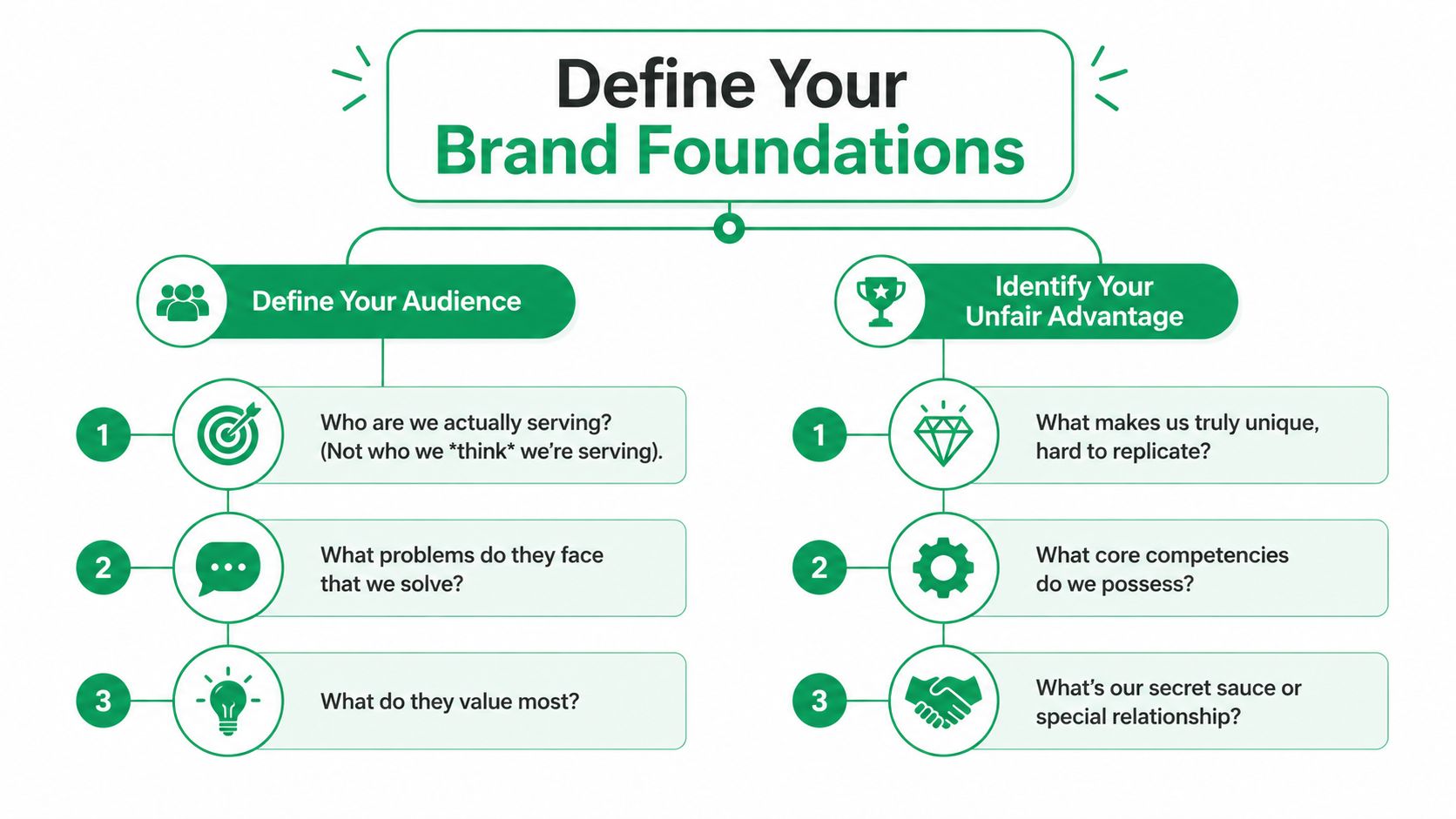
A Minimum Viable Brand starts with a tight audience definition, not a giant persona exercise. Early-stage teams do not need six buyer types, a polished segmentation model, and a workshop deck nobody will reopen. They need a clear read on the first buyers who already feel the pain, already want a fix, and can say yes without needing the whole market to validate the category first.
I call these people your first true fans. They are usually more forgiving of rough edges because the problem is expensive enough that progress matters more than polish.
Find the first buyers with real urgency
Start with the people who have pain now, not the people who might care later.
Good early buyers usually share a few traits:
- They deal with the problem frequently, not once a quarter.
- They can explain the pain fast, in plain language.
- They already built a workaround, even if it is ugly.
- They can name the cost of the problem, whether that cost is lost revenue, wasted time, missed follow-up, or team frustration.
- They spend time in places you can reach, such as niche communities, industry groups, or specific corners of LinkedIn.
That last point matters more than founders think. If you cannot find your audience without paid spray-and-pray tactics, your first go-to-market motion gets expensive fast.
A narrow audience feels risky. In practice, it lowers waste. It gives you better interviews, clearer copy, tighter sales calls, and a shorter path to repeatable demand.
Brand Strategy for Startups: Use interviews to get language you can actually use
Founders are usually too close to the product to hear the market clearly. They know what they built. Buyers care about what changed, what it replaced, and what headache went away.
That is why customer interviews matter, even for a lean team with no research budget.
Ten strong conversations beat a month of internal guessing. Twenty is better if you can get them. The goal is not statistical perfection. The goal is pattern recognition. You are listening for repeated pain, buying triggers, objections, and the exact words people use when they describe the problem to a peer.
Ask questions that pull out behavior, not opinions:
- What were you doing before you looked for a solution?
- What made that approach stop working?
- What did you try first?
- What almost convinced you to choose another option?
- What would make this feel too complicated or not worth switching to?
- If this disappeared tomorrow, what would break first?
The phrasing in those answers is brand material. Homepage copy, sales deck language, onboarding promises, ad hooks. All of it gets better when it sounds like the buyer instead of the founder.
If you need a useful design companion while you are shaping positioning and basic identity, this piece on unlocking a good logo for your brand is a practical reference. A logo will not fix weak positioning, but it does help when the positioning is already clear.
Define the advantage that actually matters
Once the audience is clear, the next job is to answer a harder question. Why should this specific buyer choose you instead of sticking with their current workaround, buying from a known competitor, or delaying the decision?
That answer is your unfair advantage.
For startups, a lot of positioning often falters. Founders write things like “better service,” “innovation,” or “cutting-edge technology.” Buyers have seen that language a thousand times. It gives them nothing to hold onto.
A real advantage is specific, provable, and tied to the buyer’s situation.
Here are the common places it comes from:
| Source of advantage | What it looks like |
|---|---|
| Founder proximity | You have lived the workflow and understand the ugly details incumbents ignore |
| Speed to value | Buyers get a useful result quickly, with less setup and less hand-holding |
| Workflow fit | The product matches how a niche segment already operates |
| Credibility | You bring relationships, expertise, or domain trust that lowers buying risk |
| Distribution edge | You can reach the audience through communities or channels competitors overlook |
For a bootstrapped company, the best unfair advantage is often operational, not flashy. You answer faster. You implement faster. You fit a niche process better. You solve one painful use case cleanly while larger competitors try to serve everyone.
That is enough.
Brand Strategy for Startups: Write a positioning statement your team can use
Keep the first draft plain.
For [specific audience], who need [urgent problem solved], our startup provides [category or solution] that delivers [primary outcome]. Unlike [main alternative], we [specific differentiator that matters].
A weak version sounds broad and forgettable:
“For growing businesses, we provide a powerful platform that streamlines operations.”
A stronger version gives the market something concrete:
For multi-location service businesses that cannot see which locations turn marketing spend into booked jobs, we provide a reporting platform built for location-level attribution. Unlike generic analytics tools, we match reporting to franchise-style workflows and local decision-making.
That kind of statement does more than clean up messaging. It helps a small team decide what to build, what to cut, and which leads to ignore.
Brand Strategy for Startups: Pressure-test it before you publish it
Run your position through three checks:
- Would the right buyer recognize themselves quickly?
- Would a credible competitor struggle to make the same claim authentically?
- Would your team make different decisions because this position is true?
The third question is the one founders skip.
If your positioning does not rule anything out, it is still too soft. A Minimum Viable Brand is supposed to create focus under constraint. That means saying no to some audiences, some channels, and some message angles, even when money is tight. That discipline is usually what gives early-stage brands their first real traction.
Brand Strategy for Startups: Crafting Your Core Message and Visual Foundation
A startup can survive with a simple brand system. It cannot survive long with a chaotic one.
Founders often drift into one of two mistakes. Either they over-design and delay launch, or they rush assets into the world with no rules at all. The better choice is usually good enough and consistent.

That’s not just aesthetic advice. According to Refokus on startup brand strategy, consistent branding across platforms can increase revenue by up to 33%. The same source notes that 75% of consumers recognize a brand by its logo, and that brand memory often requires 5 to 7 exposures. If each exposure feels disconnected, you’re forcing buyers to re-learn who you are every time.
Brand Strategy for Startups: Build three messaging pillars
Your startup does not need dozens of message variants on day one. It needs three stable ideas that show up everywhere.
A useful structure looks like this:
Problem pillar
State the pain clearly. Many startups get abstract at this stage.
Bad version: “Operations are more complex than ever.”
Better version: “Your team is wasting time stitching together lead data from multiple systems, and nobody trusts the reporting.”
The problem pillar should sound like a buyer’s lived experience, not a category headline.
Outcome pillar
Name the result buyers care about after the problem is solved.
Founders often talk about features when they should talk about relief, speed, clarity, confidence, or control. Keep it close to the buyer’s decision criteria.
Proof pillar
Give people a reason to believe you.
Proof can come from founder expertise, customer feedback, implementation simplicity, product screenshots, clear process, partnerships, or public examples of your work. Early-stage companies may not have a long client roster, but they can still communicate proof through clarity and specificity.
Use this test: if your homepage headline, pitch deck opening, and LinkedIn bio don’t reinforce the same three ideas, your message isn’t stable yet.
Brand Strategy for Startups: Create a one-page visual foundation
This doesn’t need a branding agency deck with fifty slides. One page is enough if it’s usable.
Include:
- Primary logo with spacing rules and background examples
- Secondary mark for social profiles or favicon use
- Core color palette with one primary, one secondary, one neutral set
- Two fonts only, one for headings and one for body text
- Image style guidance such as product-first, candid team photos, simple illustrations, or clean diagrams
- Do and don’t examples so contractors and teammates stop improvising
A lot of startup visual inconsistency comes from too much freedom. Give people fewer choices.
If you’re refining a mark and need a grounded primer on what makes a logo usable in real-world settings, unlocking a good logo for your brand gives a practical checklist that’s more helpful than trend-chasing galleries.
What good enough actually looks like
Good enough means your brand can be repeated accurately by people who didn’t invent it.
That includes your co-founder, your freelance designer, your paid media contractor, your sales rep, and the person posting on social at 10:30 p.m. because launch is tomorrow. If they all make slightly different choices, your brand starts fragmenting immediately.
A simple internal guide should answer questions like:
| Asset | Rule |
|---|---|
| Homepage hero | Use the primary promise and one supporting proof point |
| Social graphics | Use only approved colors and the secondary font never for body copy |
| Sales deck | Open with the same positioning statement used on-site |
| Product screenshots | Show real workflows, not generic UI crops |
| Founder posts | Stay aligned with the three messaging pillars |
For teams that need a visual explanation of how these pieces fit together, this short video is useful:
A polished brand doesn’t rescue weak positioning. But a clear, repeatable visual and verbal system makes your positioning easier to trust. That’s the job.
Brand Strategy for Startups: Planning Your Go-To-Market and Growth Channels
A startup doesn’t need more channels. It needs better bets.
Founders burn a lot of time trying to maintain a presence everywhere at once. LinkedIn, Instagram, YouTube, podcasts, SEO, paid search, newsletters, webinars. The result is usually mediocre execution across the board and a team that feels busy but can’t point to traction.

Brand Strategy for Startups: Choose one primary channel and one support channel
The right early setup is usually simple:
- Primary channel where your first true fans already spend attention
- Support channel that reinforces credibility or captures demand created elsewhere
A few examples:
| Startup type | Primary channel | Support channel |
|---|---|---|
| B2B founder-led SaaS | Email capture from the website | |
| Consumer niche product | Short-form social with UGC | Retargeting or email |
| Local service startup | Local search and reviews | Social proof on Meta |
| Technical tool | Reddit, niche communities, founder demos | Search-driven landing pages |
And yes, some channels look less glamorous than others. That doesn’t matter. A quiet niche where buyers talk is more valuable than a broad channel where nobody cares.
If your team needs a practical refresher on creating social consistency without drowning in content demands, the DailyShorts blog on social media presence is a useful tactical read.
Why micro-influencers outperform for startups
Big influencers often look attractive because they simplify the fantasy. One post, lots of reach, done. But startup growth usually comes from relevance and trust, not borrowed scale.
According to branding statistics on influencer and UGC performance, micro-influencers see engagement rates of 5 to 7% compared with 1 to 2% for larger influencers, and UGC influences 79% of purchases. For startups, that makes smaller creators and real customer content far more useful than a vanity partnership with broad but shallow reach.
That changes how you should evaluate partnerships.
Look for creators who have:
- Audience fit. Their followers match your actual buyer, not your ego.
- Comment quality. People ask real questions and trust their opinion.
- Content style that can carry proof. Demos, walkthroughs, before-and-after context, honest reactions.
- Willingness to co-create. Good startup partnerships often involve testing angles, not buying one polished mention.
A creator with the right small audience is often more valuable than a famous one with the wrong large audience.
Brand Strategy for Startups: Start laying the groundwork for GEO
This part is newer, and a lot of founders are still ignoring it.
Buyers increasingly discover brands through AI-assisted search experiences, not just classic search results. That means your brand needs content that is easy for AI systems to interpret and surface. Clear service pages, direct answers to buyer questions, category-specific terminology, useful comparisons, structured FAQs, and consistent naming all help.
The practical move is not to build an “AI content strategy” full of fluff. It’s to publish material that answers real questions cleanly and authoritatively.
That means:
- Create pages around actual buyer questions
- Use plain language before clever language
- Show who the offer is for and who it isn’t
- Keep naming consistent across site, social, and directories
- Publish proof-bearing content, not just opinion pieces
For teams that want a broader framework for picking channels, balancing paid and organic, and building a startup-ready plan, this guide on digital marketing strategy for startups is a practical complement to brand work.
There are also cases where outside execution support makes sense. One option is Mr. Green Marketing, LLC, which works across branding, web design, SEO, PPC, social, Amazon marketing, and GEO-oriented optimization. For startups with a validated offer but a scattered go-to-market setup, that kind of integrated support can be useful because channel execution tends to break when positioning and site experience aren’t aligned.
Brand Strategy for Startups: Measuring What Matters with 30-60-90 Day Sprints
A founder spends six weeks rewriting the homepage, posting on LinkedIn, testing paid ads, and asking friends for feedback. At the end, traffic is up a little, sign-ups are flat, and nobody can say which change helped or hurt. That is what happens when brand work has no operating rhythm.
For a bootstrapped startup, the answer is not a bigger launch. It is a tighter system. A Minimum Viable Brand needs short cycles, clear bets, and hard decisions tied to limited time and budget.
Treat brand strategy as a series of tests across 90 days. You are checking whether your message attracts the right people, whether your pages turn interest into action, and whether your chosen channels bring in prospects worth talking to. If one part breaks, fix that part first.
The sprint mindset
Use five parts for every sprint:
- Hypothesis. What specific change do you expect, and why?
- Audience. Which segment are you testing with?
- Asset. What are you changing: headline, offer framing, landing page, outbound script, or ad creative?
- Metric. Which signal will show improvement?
- Decision rule. What will you do if the result is strong, weak, or mixed?
That last point saves money.
Teams often run “tests” with no agreed threshold for success. Then every result gets debated after the fact, usually by the loudest person in the room. Set the rule before launch. If the new page lifts qualified demo requests by a meaningful margin, keep it. If it gets more clicks but worse lead quality, cut it.
If success is undefined before launch, you are not testing. You are guessing with extra steps.
Brand Strategy for Startups: Sample 90-Day Brand Sprint Plan
| Phase (Days) | Focus | Key Activity | Success Metric |
|---|---|---|---|
| 1 to 30 | Message resonance | Test one homepage headline and one outbound or paid message for a single audience segment | Better click-through rate, lower bounce, stronger response quality |
| 31 to 60 | Conversion path | Launch a revised landing page with clearer proof, objections handled, and a sharper CTA | More demo requests, trial starts, or qualified leads |
| 61 to 90 | Channel efficiency | Compare one primary acquisition channel against one support channel using the same core message | Lower customer acquisition cost and better lead quality |
This works because it keeps the variables under control. Early-stage teams do not have the margin for six experiments at once.
What to track instead of vanity metrics
Follower count looks nice in a board update. It rarely helps a startup make a better decision in month two.
Track signals that tell you whether the brand is getting clearer and the go-to-market motion is getting stronger:
- Click-through rate on message tests
- Landing page conversion rate
- Demo bookings or trial starts
- Lead quality by channel
- Reply rates on outbound messaging
- Sales call feedback on clarity and differentiation
- Retention or activation signals after first use
Branded search, direct traffic, and sentiment can matter later. In the first 90 days, clarity, conversion, and sales feedback usually give you a cleaner read.
If your team needs a practical reporting framework, this guide on how to measure marketing campaign effectiveness lays out a useful structure.
Common failures inside the first 90 days
The first mistake is changing too much at once. New pricing, new copy, new audience, new design, new CTA. When results come in, nobody knows what caused them.
The second is blaming the channel before fixing the message. A weak result on email, LinkedIn, or paid search often starts with poor positioning, vague proof, or an offer that asks for too much too early.
The third is founder attachment. I have seen teams keep an underperforming message alive for two extra months because it sounded smart internally. Buyers did not care. The market is the judge.
A 30-60-90 model keeps brand work grounded. Small bets. Fast feedback. Clear decisions. For cash-strapped startups, that discipline matters more than polish.
Your Next Steps After the First 90 Days
After the first sprint, your brand should feel less accidental. Your team knows who it’s speaking to, what it’s trying to say, and where that message gets tested in the market.
That doesn’t mean the work is finished. It means you now have a system.
Keep the basics tight. Update your one-page brand guide as language sharpens. Review customer interviews regularly. Retire messages that don’t land. Strengthen the channels that bring qualified demand. If your audience shifts, adjust the position before the visuals.
And if you need to pivot, don’t assume that means a full rebrand. Many startups can shift their offer framing, proof, channel mix, and site narrative without blowing up everything they already built. Small corrections usually beat dramatic resets.
Brand strategy for startups works when it stays close to reality. Buyers change. Markets move. Founders learn. Your brand has to keep up without losing coherence.
If your startup has the product but not the brand system to support growth, Mr. Green Marketing, LLC can help turn scattered messaging, inconsistent visuals, and underperforming channels into a clearer digital growth plan. That can include brand development, logo creation, website design, SEO, PPC, GEO, social execution, and a practical audit to identify the next moves that matter.
Leave a Comment
sing in to post your comment or sign-up if you dont have any account.