
Case Study Marketing: You know the feeling. A prospect asks, “Can you show me results like this for a business like mine?” and suddenly your confident pitch turns into a scramble through old emails, screenshots, and half-remembered wins.
You did the work. The client got the outcome. But the proof lives in fragments.
That gap costs deals.
Case study marketing fixes it. Not by producing a stiff PDF nobody reads, but by turning customer outcomes into stories that buyers can recognize themselves in. A strong case study says, “Here was the problem, here’s why it mattered, here’s what we changed, and here’s what happened.” It gives your sales process something solid to stand on.
And for smaller businesses, this matters even more. A key gap in marketing content is that 75% of marketing case studies focus on big brands, while 68% of SMBs report underserved digital visibility according to this analysis of marketing case study gaps. So a local service company, a niche ecommerce seller, or a growing agency often looks around and finds examples that feel impressive but useless.
That’s the opening.
If you can tell a believable story about a customer who looks like your next customer, your marketing gets sharper fast. Trust goes up. Sales conversations get easier. Objections get handled earlier. And your best client work stops disappearing into the void.
Case Study Marketing: Introduction The Unsung Hero of Your Marketing Toolkit
A lot of businesses are sitting on great case study material without realizing it.
They have the raw ingredients. A client came in frustrated. The project had constraints. Somebody made smart decisions. Results followed. Then everyone moved on to the next campaign, next launch, next quarter. No one stopped to package the win in a way a future buyer could understand.
That’s why case study marketing is so underused. Not because it’s weak. Because it takes a little discipline to capture the story while it’s still fresh.

Why most “proof” falls flat
A testimonial says someone liked working with you. Helpful, sure.
But buyers need more than that. They want context. They want to know whether your team solved a problem that feels close to theirs. They want to understand what changed after the work started.
A few bullet points in a proposal won’t do that. Neither will a vague sentence like “we helped improve visibility.”
Buyers don’t just want praise. They want evidence they can map to their own risk.
That’s the core job of case study marketing. It translates delivery into credibility.
Case Study Marketing: The story matters as much as the metric
Plenty of businesses make the same mistake. They collect a few numbers, slap them on a page, and call it a case study. That’s not enough.
Numbers without narrative feel cold. Narrative without proof feels soft.
The best case studies combine both. They show the human problem behind the KPI. They explain why the challenge mattered. They make the reader think, “That sounds like us.”
And when you do that well, one client win becomes more than a portfolio piece. It becomes a sales tool, a trust asset, and a reusable content engine.
Why SMBs have an edge here
Big brands dominate generic marketing examples. Fine. Let them.
Smaller companies can win by being more specific. A case study about a regional ecommerce brand dealing with rising acquisition costs or a multi-location service business trying to clean up messy local search visibility is often more persuasive to an SMB buyer than another polished enterprise success story.
That specificity is what makes case study marketing effective in practice. Not broad applause. Relevance.
Case Study Marketing: What Exactly Is Case Study Marketing Anyway
Case study marketing is the practice of turning customer outcomes into structured stories that help future buyers trust your process and imagine similar results for themselves.
Think of it less as a report and more as a compact documentary. The customer is the central character. They had a problem that was affecting the business. Your company stepped in with a strategy, not magic, and helped create a measurable change. That full arc is what makes the content persuasive.
It’s not the same as a testimonial
A testimonial is a quote. Good social proof, but limited.
A case study is a sequence. It explains:
- Who the customer was: Enough detail to make them recognizable to your target buyer
- What was going wrong: The friction, bottleneck, missed opportunity, or business risk
- What you did: The strategic choices, not just a list of services
- What changed: Results, observations, and business impact
- Why it matters now: The long-term value or next phase
That sequence is what moves a prospect from “interesting” to “I can see this working for us.”
Case Study Marketing: It’s also not a white paper
White papers explain ideas, trends, systems, or frameworks. They educate.
Case studies prove execution. They answer a very different buyer question: “Can these people solve a problem like mine?”
That distinction matters. A lot.
If your blog teaches well but your site doesn’t prove outcomes, prospects may respect you and still choose somebody else. Case study marketing closes this gap by adding evidence to expertise.
The best frame is storytelling with receipts
That’s the cleanest way to think about it.
You’re not writing fiction. You’re not exaggerating. You’re not stuffing in jargon to sound advanced. You’re building a narrative with documentation behind it.
A practical resource on how to write a case study can help if you need a starting framework, especially for structuring the customer challenge, the solution, and the results in a way that reads naturally.
A case study should feel like a guided walkthrough of a solved problem, not a brag sheet.
Case Study Marketing: What good case study marketing does in practice
When it’s done right, it gives your business several assets at once:
- A trust asset for your website: Prospects can evaluate your thinking before they contact you
- A sales tool for conversations: Reps can send the right story to the right lead at the right moment
- A positioning tool: You can show what kinds of problems you solve best
- A filtering mechanism: Buyers who want your process tend to lean in. Buyers looking for random cheap execution often drift away
And that’s good. Not every lead should move forward.
Case study marketing works best when it’s honest, specific, and built around a reader who wants proof, not hype.
Why Case Studies Are Your Secret Sales Weapon
The fastest way to weaken your own marketing is to make claims you can’t support.
That’s why case studies matter so much. They replace broad promises with grounded proof. And in crowded markets, proof tends to beat polish.

Case Study Marketing: They work because buyers are trying to reduce risk
Most prospects aren’t asking one question. They’re asking several at once.
Can you understand our business?
Have you solved this kind of problem before?
Will your team be strategic or just busy?
If we pay more, will the outcome justify it?
A strong case study answers all of that without sounding defensive. It shows your work. It gives the buyer a path to trust you before the call even starts.
The sales impact is not theoretical
In SaaS, case studies have been ranked as the #1 most effective tactic for driving sales, and in 2024 49% of SaaS marketers rated them “very effective,” up from 39% the previous year, while the average company produced 14 new case studies annually, according to Uplift Content’s SaaS case study marketing report.
That tracks with what happens in buying cycles. When buyers can see a believable before-and-after story tied to a business problem they understand, the conversation gets easier.
Not shorter every time. But easier.
Case Study Marketing: What case studies do better than most content
Blog posts can attract traffic. Service pages can explain offers. Ads can generate attention.
Case studies do a different job. They convert uncertainty into confidence.
Here’s where they tend to pull their weight:
- They handle objections early: A buyer wondering whether you understand their industry can answer that by reading the right story
- They support pricing conversations: Results-based narratives make fees easier to justify than feature lists ever will
- They sharpen positioning: If you keep publishing stories in a specific niche, the market starts to associate you with that category
- They help sales teams stay concrete: Instead of abstract promises, reps can point to specific client situations and outcomes
Why proof beats claims in a skeptical market
Buyers have seen enough inflated marketing language to last a lifetime.
“Results-driven.”
“Original.”
“Full-service.”
“Growth-focused.”
None of those phrases mean much on their own. They become meaningful only when attached to a real customer story with a credible arc.
That’s also why weak case studies fail. If the piece reads like self-congratulation, readers tune out. If it reads like a useful breakdown of a business challenge and what changed, they keep going.
A short explainer on the topic can help if you want to see how other marketers frame this asset in practice.
Case Study Marketing: They become reusable sales infrastructure
This is the part many teams miss.
A case study isn’t just a blog post or a PDF. It becomes part of the operating system for growth.
Sales can use it in outreach. Account managers can use it for upsell conversations. Paid media teams can pull proof points from it. Web teams can feature it on service pages. Founders can use it in investor or partner conversations.
Practical rule: If your team has to repeatedly “explain what good work looks like,” you need more case studies.
Case study marketing earns its value because one documented win can support many parts of the business at once.
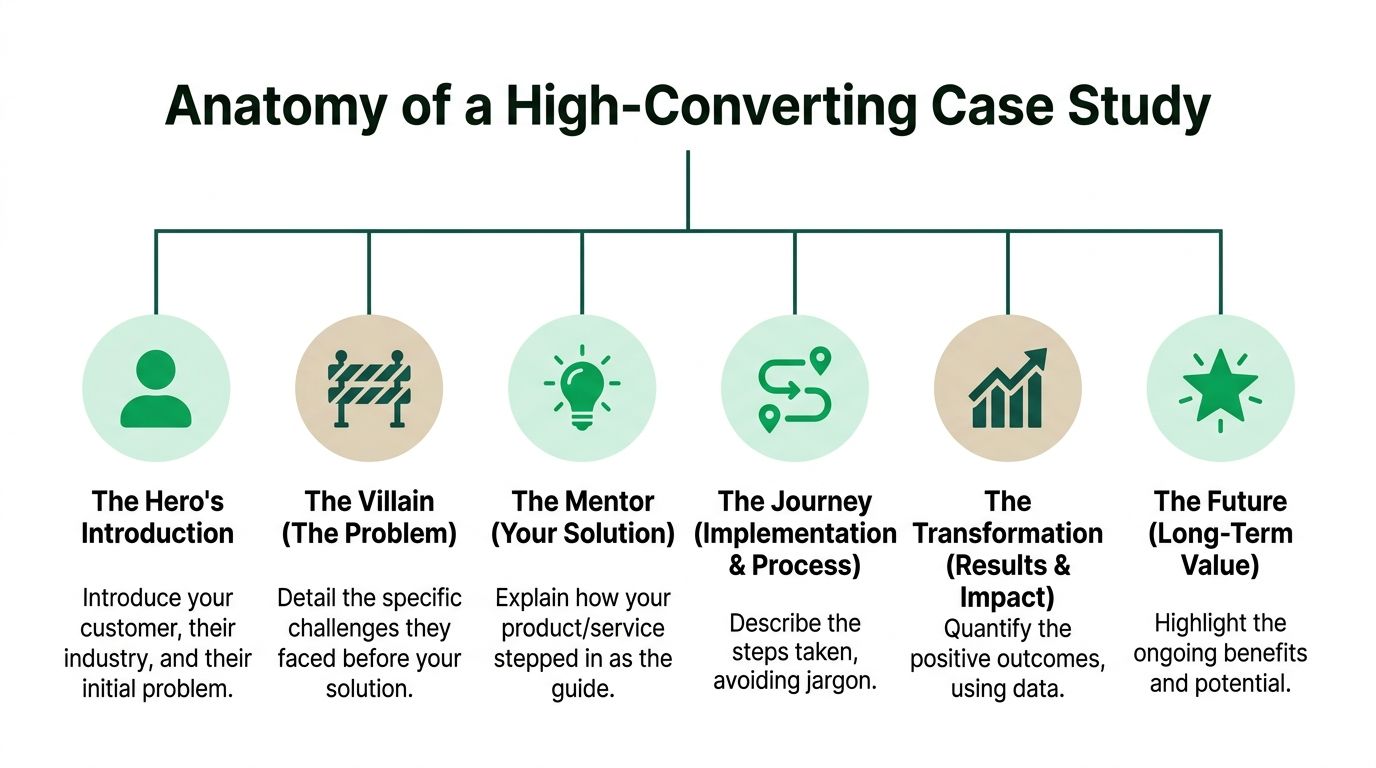
Case Study Marketing: Anatomy of a High-Converting Case Study
A prospect lands on your case study because they are close to a decision. They are not looking for a victory lap. They are looking for evidence that you understand a problem like theirs, made smart choices under real-world constraints, and produced an outcome that mattered.
That changes how the piece should be built.
Most case studies underperform because they read like a project summary. A high-converting one reads like a business story. It gives the reader enough context to see themselves in the situation, enough detail to trust the process, and enough proof to believe the result was repeatable.
Start with the customer, not your company
Open on the buyer’s world.
Name the type of business. Clarify the growth stage or operating context. Show the pressure they were under. A reader should know within a few lines whether the story feels familiar.
Good opening context often includes:
- Who the customer is: industry, size, model, or market
- What was happening: stalled growth, weak lead quality, low retention, messy attribution
- Why it mattered: missed revenue, wasted spend, slower sales, internal friction
A stronger setup sounds like this:
- Relevant context: “A multi-location home service company was getting traffic but not enough qualified calls.”
- Clear tension: “The pages ranking well were attracting broad searches, not local buyers ready to book.”
- Business stakes: “That mismatch was hurting lead volume in the markets that drove the most revenue.”
Now the reader has a reason to keep going.
Make the problem concrete
Vague challenges kill momentum.
“We needed better marketing” tells the reader nothing. “Paid search was driving form fills, but sales rejected half the leads because service-area targeting was off” gives them something real to evaluate.
Specificity does not mean stuffing the section with technical detail. It means defining the constraint. Was the problem lead quality, conversion rate, long sales cycles, weak positioning, poor onboarding, or broken reporting? State it plainly.
The best challenge sections do one more thing. They make the cost of inaction obvious.
Show the diagnosis before the solution
This is the section that separates a persuasive case study from a polished testimonial.
Prospects do not just want to know what you did. They want to know how you thought. What signals did you notice first? What assumptions turned out to be wrong? Which options did you reject, and why?
That strategic reasoning is where trust gets built. It proves the outcome came from judgment, not luck.
For example, instead of saying, “we launched new landing pages and updated campaigns,” explain the diagnosis behind that choice. Organic traffic might have looked healthy, but intent analysis showed visitors were landing on informational pages with poor conversion paths. Paid campaigns might have been generating leads, but CRM review showed the highest-spend ad groups produced the weakest close rates. Those details turn a dry report into a story about cause and effect.
If you want your broader content to carry the same level of clarity and usefulness, these content marketing best practices help tighten the structure across case studies, blogs, and sales pages.
Explain the implementation in plain English
Execution matters, but readability matters too.
A buyer should be able to follow what changed without needing your internal terminology. Break the work into a clear sequence. Keep the language simple. Mention tools only when they help the reader understand the work or the constraint.
A useful implementation section usually covers four points:
- The first move: What changed first, and why that step came before everything else
- The adjustment period: What the team learned once the plan met real conditions
- The operational constraints: Approvals, dev bottlenecks, messy data, bandwidth limits, legal review
- The turning point: When the change started producing visible movement
That middle section matters more than many teams think. Buyers know projects rarely run in a straight line. Showing the adjustments makes the story more credible, not less.
Treat results as proof, not decoration
Numbers alone are not enough. They need context.
A jump in traffic means very little if the traffic did not convert. More leads can still be a weak outcome if lead quality dropped. The job of the results section is to connect the metric to the business result.
Use evidence that reflects commercial impact whenever possible. Revenue contribution, qualified pipeline, close rate, retention, and cost efficiency usually carry more weight than raw impressions or clicks. If you cannot share exact numbers, describe directional change with enough specificity to stay credible.
Use a mix of proof types:
- Hard metrics: Revenue, conversion rate, qualified leads, retention, cost per acquisition
- Operational proof: Faster reporting, better routing, shorter launch cycles, cleaner attribution
- Customer language: A short approved quote that explains what changed on the ground
- Before-and-after framing: The old condition versus the new one
Here’s a simple planning table for the results block.
| Metric Category | Example KPIs | Why It Matters |
|---|---|---|
| Traffic quality | Organic sessions, branded search interest, landing page engagement | Shows whether attention is turning into relevant attention |
| Lead generation | Form submissions, qualified calls, demo requests | Connects visibility to pipeline creation |
| Sales impact | Conversion rate, close rate, revenue contribution | Ties marketing work to business outcomes |
| Customer behavior | Repeat purchase, retention, email engagement | Useful when the project affects lifecycle marketing |
| Efficiency | Cost per lead, time to launch, reporting clarity | Shows operational value alongside growth |
Close with what happened next
Do not end the story the second the main metric appears.
The strongest case studies show the aftereffects. Did the client expand the scope? Did the process get rolled out to other regions, service lines, or channels? Did the first win reveal a more valuable opportunity the company could pursue next?
That final layer changes the tone of the piece. Instead of sounding like a one-off success, it shows a system that can keep producing results. For SMBs especially, that matters. Buyers are not just hiring for a campaign. They are buying confidence that the work can hold up after the first burst of activity.
Case Study Marketing in the Wild Real Examples
A prospect is on your site, comparing you with three other options. Everyone claims strong results. The business that wins is usually the one that can show a believable story. Clear problem, smart decision, measurable outcome, and proof that the result came from a repeatable process.
That is why real examples matter. They show how strong case study marketing turns raw performance data into a sales argument buyers can trust.
Zapier and the power of matching intent at scale
Zapier is a useful example because the company built pages around very specific integration searches instead of publishing broad, catch-all content. According to ActiveCampaign’s marketing case study examples, that approach led to over 25,000 unique landing pages and a 10x traffic increase over 18 months.
The lesson is not “publish more pages.” The lesson is to publish the right story for the right moment.
Someone searching for a connection between two tools already has a job to do. Zapier met that person with a page that reflected the exact workflow in front of them. That is strong case study thinking in practice. It starts with context, not volume.
Case Study Marketing: A Danish supermarket group and the case for sharper customer stories
Another example comes from a Danish supermarket group featured by Apsis in its data-driven marketing case examples. After combining demographic and behavioral data into a single customer view, the team improved campaign targeting, tripled email conversion rates, generated a €170,000 revenue uplift from a homepage personalization element, and saw a 324% conversion rate increase on that front-page change.
What makes that example persuasive is the decision-making behind it.
The team identified meaningful differences in customer behavior and built offers around those patterns. That creates a better case study than vague language about personalization. Buyers trust stories that show judgment. They want to see why a team made a specific call, what evidence supported it, and how that choice produced the result.
That is the storytelling edge many SMBs miss. They collect numbers, then skip the plot.
AppSumo and why outcome framing closes more deals
A strong case study does not stop at traffic charts. It connects marketing work to business value buyers care about.
As noted earlier, Omniscient Digital’s campaign for AppSumo is a good example. The story stands out because it ties content performance to revenue growth, not just audience growth. That changes how the result feels. Traffic sounds interesting. Revenue sounds useful.
For smaller companies, this trade-off matters. A vanity metric can make a founder feel good for a week. A case study that shows better lead quality, faster sales cycles, or stronger customer value helps a prospect justify a purchase.
What smaller businesses should copy from these examples
SMBs do not need enterprise budgets to use the same mechanics.
A local service company can show how revised service-page messaging reduced bad-fit inquiries and improved close rates. An ecommerce brand can document how tighter ad-to-page alignment increased conversion quality and repeat purchases. A niche agency can show how industry-specific positioning changed the kind of leads coming in.
In each case, the win gets stronger when the facts are shaped into a story with tension and payoff.
Written case studies also do more work when you adapt them into other formats. A short client interview, a narrated slide deck, or a simple before-and-after video can help buyers grasp the story faster. For teams building that mix, this guide to video marketing for small business fits naturally beside case studies. It helps turn one customer win into proof your sales team can use. The same story can also feed broader content repurposing, which is how one good case study keeps generating returns long after it is published.
The standard is simple. A prospect should be able to read the story and say, “You understood the problem, made smart choices, and got a result that maps to our situation.” That is what turns a case study from a nice piece of content into a reliable lead-generation asset.
Case Study Marketing: Maximize Your ROI Distribute and Repurpose Like a Pro
Publishing a case study and leaving it buried in a resources tab is wasteful.
A good case study takes effort. Client coordination, approvals, screenshots, metrics, editing. If you’re going to do that work, squeeze the value out of it.

Case Study Marketing: Treat the original as the master asset
Your main case study page should be the source document. Keep it clear, searchable, and easy to skim. Add strong headings, a short summary near the top, and a visible next step.
Then build everything else from that. For this, a disciplined approach to content repurposing helps. The goal isn’t to repeat the same material everywhere. It’s to adapt the same proof for different contexts and buyer attention spans.
Case Study Marketing: What to create from one strong case study
One customer story can become a whole set of sales and marketing assets if you break it apart properly.
- A one-page sales PDF: Useful for outreach, follow-ups, and proposal support
- A short LinkedIn post series: Pull out the challenge, the strategy, and the result as separate posts
- An email nurture segment: Send the most relevant story based on service interest or industry
- A homepage proof block: Feature a compact summary with a link to the full story
- A short video recap: Founder-led or client-led, depending on what’s realistic
- Paid ad proof lines: Use the clearest result statement where compliance and accuracy allow
That’s how case study marketing becomes a powerful asset instead of a one-time publishing exercise.
Case Study Marketing: Match the version to the moment
Different buyers need different formats.
A busy owner may want a fast skim. A marketing manager comparing vendors may want process detail. A sales lead in the middle of procurement may need a clean PDF they can circulate internally.
So build for that reality.
A useful internal discipline is to track how each version performs inside your wider reporting framework. If you’re already reviewing pipeline and campaign performance, fold case study assets into the same process. This guide on how to measure marketing campaign effectiveness is a practical companion because it helps teams judge what content influences action.
If a case study never gets used by sales, featured on core pages, or adapted into smaller assets, you didn’t finish the job.
Keep the story alive
The best case studies aren’t static.
Update them when the engagement evolves. Add a new quote. Refresh the screenshots. Expand the “what happened next” section when the client moves into a new phase.
That’s especially useful for long-term retainers, SEO work, lifecycle marketing, Amazon management, or paid media programs where the story deepens over time. A living case study keeps getting more persuasive because it reflects continuity, not a lucky moment.
Common Questions About Case Study Marketing
How do you get customers to agree to one
Make it easy.
Write the draft yourself. Keep the interview short. Give them approval control over quotes, branding, and sensitive details. If needed, anonymize parts of the story while keeping the lesson intact.
What if the results aren’t huge
That’s fine.
A relatable outcome sells better than a flashy one. If your reader has the same problem, a realistic win feels believable and useful. Case study marketing works on relevance first.
How long should a case study be
Long enough to be credible, short enough to scan.
A full web version works best when it has a clear summary, a readable story arc, and a concise results section. Then create shorter versions for email, sales follow-up, and social use.
What if you can’t share exact numbers
Use qualitative outcomes and process insight.
You can still show the challenge, the strategic decisions, the implementation path, and the business effect in plain language. Just don’t pad the story with hype. Readers can tell.
If your business has good client outcomes but weak proof, Mr. Green Marketing, LLC can help turn those wins into usable sales assets through strategy, content development, and distribution planning. That can include identifying the right customer stories, shaping the narrative, and integrating case studies into SEO, PPC, video, and broader lead-generation campaigns.
Leave a Comment
sing in to post your comment or sign-up if you dont have any account.