
Social Media Marketing for Startups: You’ve launched your startup. The excitement is real, but the marketing budget? Tight. And this is where smart social media marketing for startups becomes your secret weapon—not just for making noise, but for building a real, sustainable business from day one.
1. Social Media Marketing for Startups: Building Your Foundation For Social Media Success

It’s easy to feel like you need to be everywhere at once, posting 24/7 and praying for a viral hit. Classic startup mistake. And it’s a fast track to burnout with zero to show for it.
Instead, let’s cut the noise. This foundational stage is all about building a smart, strategic presence that actually moves the needle. We’re not boiling the ocean here; we’re focusing on what truly matters.
First, Define Your Ideal Customer—Not Just Demographics
Before you write a single post, you have to know exactly who you’re talking to. And I mean really know them. “Millennials who like tech” is a surefire way to get nowhere. We need to build a detailed persona that feels like a real person.
This goes way deeper than basic demographics. You need to understand their world.
- Pain Points: What keeps them up at night? For a fintech startup, the customer’s problem isn’t just “being bad with money.” No. The real pain is the gut-wrenching anxiety of not knowing if they can make rent next month. That’s what you connect with.
- Motivations & Goals: What are they trying to achieve? Someone using a productivity app isn’t just buying software; they’re buying back time—time to spend with their kids or finally work on that side project.
- Online Hangouts: Where do they actually live online? Scrolling LinkedIn for career insights? Laughing at TikToks late at night? Or diving deep into niche subreddits? Research shows about 90% of startups fail, and a massive reason is failing to connect with the right audience in the right place.
Expert Takeaway: Your customer persona is a living document, not a one-and-done task. Revisit it before every campaign. Before every post. Constantly ask yourself: “Would [Persona Name] actually stop scrolling for this?”
Second, Set Crystal-Clear Business Goals
With your audience defined, what does success actually look like? “More followers” is a vanity metric; for a startup, every single action has to tie back to a real business outcome. We need SMART goals (Specific, Measurable, Achievable, Relevant, Time-bound). Simple.
Your goals will dictate your entire social media strategy.
- Goal 1: Brand Awareness. The main objective is just getting on your audience’s radar. Your key performance indicators (KPIs) here are things like reach, impressions, and video views.
- Goal 2: Lead Generation. You need to fill the sales funnel. Here, you’ll track metrics that matter, like link clicks to your website, email sign-ups, or demo requests.
- Goal 3: Community Building. Your focus is creating a loyal tribe. Success is measured by your engagement rate—meaningful comments, shares, saves—and the quality of conversations you’re starting.
This is your strategic bedrock. Nailing down your audience and goals ensures you’re not just shouting into the void. It’s the foundation that makes every other step in this playbook work. And as you lay the groundwork, using a structured social media content strategy template provides a clear framework to plan engaging posts that drive real growth.
Before moving forward, you may want to get a complete inventory of where you stand today. Check out our guide on Social Media Audit to get a full picture of your current digital footprint.
2. Social Media Marketing for Startups: Choosing Your Platforms And Crafting Content Pillars
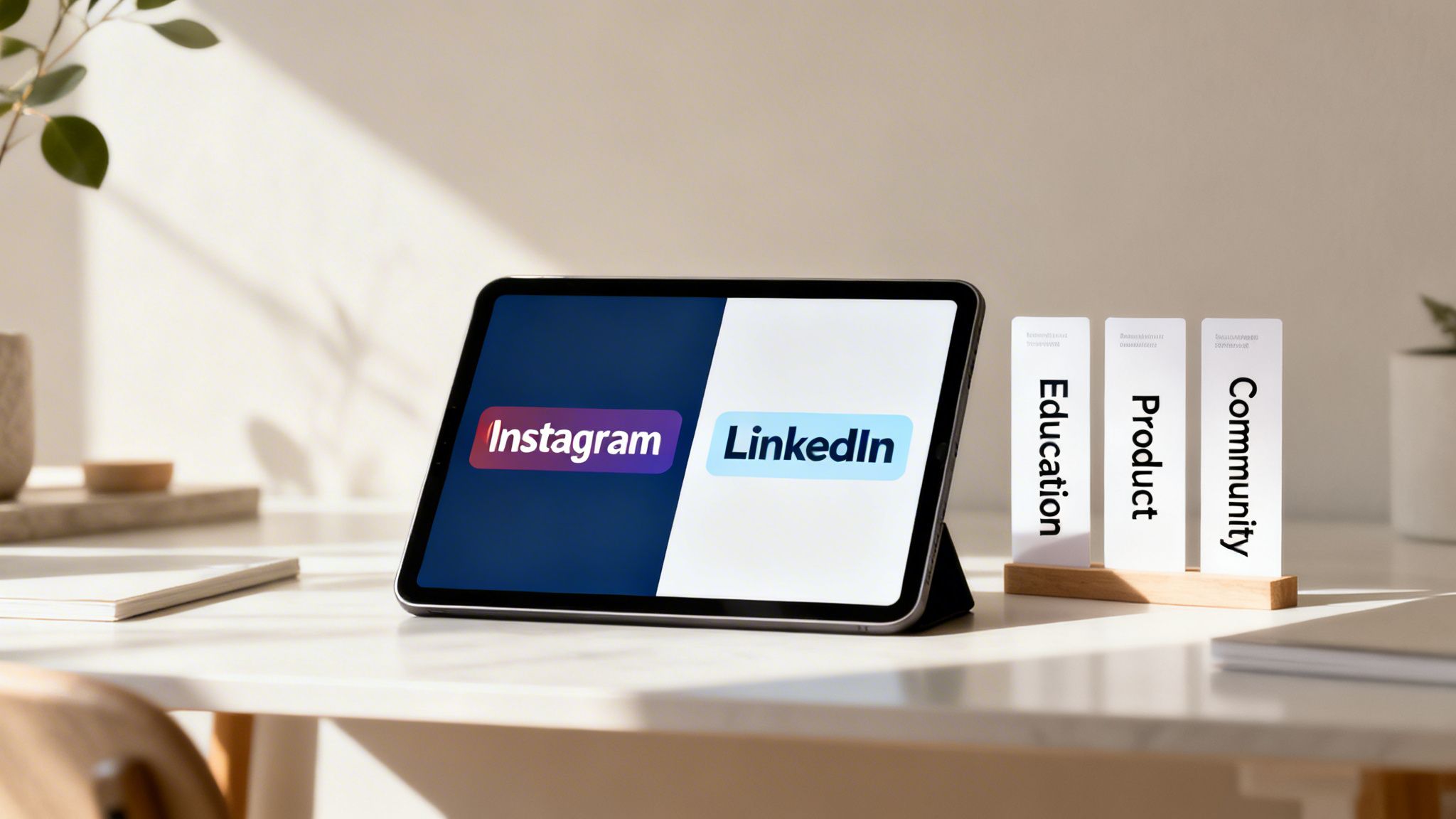
You’ve defined your audience and set your goals. Now for the moment of truth: where will you actually post? This is where many startups stumble—they try to be everywhere at once, stretching their small teams impossibly thin. A classic resource-draining mistake.
The goal isn’t to plant your flag on every social media network. The real goal is to show up where your ideal customers already are and dominate that space. We’re talking quality over quantity, every single time. Let’s focus on nailing one or two platforms first.
Social Media Marketing for Startups: How To Pick Your Startup’s Social Media Platforms
Think of each social platform as a different type of party. LinkedIn is a professional networking conference, Instagram is a sleek art gallery, and TikTok is a high-energy street festival. You wouldn’t wear the same outfit to all three. Your content shouldn’t be the same, either.
To narrow it down, ask yourself a few pointed questions:
- Where does my customer persona actually hang out online? If you’re chasing C-suite execs, LinkedIn is non-negotiable. Selling a trendy DTC product to Gen Z? You’ll find them scrolling on TikTok and Instagram.
- What kind of story does my product tell? Visual products—think fashion, food, or design software—were made for platforms like Instagram and Pinterest. Complex B2B services, on the other hand, shine on LinkedIn, where you can share in-depth posts and case studies.
- What are my real-world resource limits? Be brutally honest. If you’re a one-person marketing team with no video gear, launching on TikTok is a recipe for burnout. It’s far smarter to master text-and-image posts on LinkedIn or Facebook first.
Choosing the right platform is about aligning your startup’s strengths with the platform’s native culture. It’s that simple. This table breaks down the strategic value of each major player to help you decide.
Platform Selection Matrix for Startups
| Platform | Primary Audience | Best For… | Key Content Format |
|---|---|---|---|
| B2B Professionals, C-Suite, Job Seekers | B2B Lead Gen, Thought Leadership, Employer Branding | Text Posts, Articles, Carousels, Professional Video | |
| Millennials, Gen Z | B2C, E-commerce, Visual Brands, Influencer Marketing | Reels, Stories, High-Quality Photos, Carousels | |
| TikTok | Gen Z, Young Millennials | B2C, Trend-Based Marketing, Community Building | Short-Form Vertical Video, Live Streams, User-Generated Content |
| Gen X, Millennials, Broad Demographics | Local Businesses, Community Groups, Diverse Ad Targeting | Video, Images, Text Updates, Live Streams, Events | |
| X (Twitter) | Tech, Media, Politics, B2B Professionals | Real-Time News, Customer Service, Networking | Short Text Updates, Threads, Memes, Quick Videos |
| Millennial Women, DIYers, Planners | E-commerce, Visual Discovery, Driving Web Traffic | Idea Pins, Static Image Pins, Video Pins |
Ultimately, your platform choice dictates your content strategy. A B2B SaaS company will find more traction with insightful LinkedIn articles; a DTC fashion brand should go all-in on Instagram Reels. Start small, win there, then expand.
Crafting Your Core Content Pillars
Once you’ve chosen your digital home, you need a plan for what to talk about. Random posting leads to a messy brand and a confused audience. This is where content pillars save the day.
Content pillars are the 3-5 core themes your brand will own. Think of them as the foundational columns holding up your whole content strategy, ensuring everything you post is on-brand and valuable.
A content pillar isn’t just a topic; it’s a value-driven conversation starter. It’s where what your audience cares about intersects with where your brand has authority to speak.
For a SaaS startup with a project management tool, the pillars might look like this:
- Productivity Hacks: Actionable tips for getting more done.
- Team Collaboration: Stories and strategies for better teamwork.
- Behind the Scenes: Humanizing the brand by showing the people building it.
- Product in Action: Creative use cases and customer success stories.
Suddenly, staring at a blank calendar isn’t so intimidating. You just ask, “What can we share today under the ‘Team Collaboration’ pillar?” And the ideas start flowing.
This framework also helps you maintain a healthy content mix. A solid guideline is the 80/20 rule: 80% of your content should educate, entertain, or inspire, while only 20% is directly promotional. Your pillars force you to think beyond just “buy our stuff.”
With your pillars in place, you can start building a schedule. To dive deeper into structuring your posting frequency and topics, check out our guide on how to create a content calendar that keeps you consistent and sane.
3. Social Media Marketing for Startups: Bootstrapped Growth Tactics That Actually Work

You don’t need a massive budget to generate real momentum. For a startup, every dollar counts, which makes scrappy, low-cost growth tactics your secret weapon in social media marketing for startups.
These aren’t abstract theories. These are three proven strategies you can use right now to build relationships, generate buzz, and drive growth—without breaking the bank.
Social Media Marketing for Startups – Tactic 1: Become an Active Community Member
The single biggest mistake I see startups make is treating social media like a megaphone. Blasting promotional posts into the void and wondering why no one’s engaging. Wrong approach. Real growth happens when you treat social media like a conversation.
This means more than just replying to comments on your own profile. It’s about proactive engagement where your customers already are.
- Find Your Digital Hubs: Pinpoint the subreddits, Facebook Groups, and LinkedIn communities where your ideal customers hang out. Join them.
- Listen Before You Speak: Spend time understanding the culture. What are their biggest pain points? What questions come up over and over?
- Add Value, Don’t Pitch: Your goal is to become a recognized, helpful voice. Answer questions. Share expertise freely. When you consistently show up to help, your product will come up organically. Trust me.
This builds trust and authority you simply can’t buy.
Social Media Marketing for Startups – Tactic 2: Turn Your Customers Into Your Marketing Team with UGC
For any bootstrapped startup, user-generated content (UGC) is a game-changer. UGC is any content—photos, videos, reviews—created by your customers, not your brand. It’s authentic social proof. And best of all? It’s free.
Think about it: a polished ad from a brand is expected. A rave review from a real person who spent their own money? Marketing gold. People trust people far more than they trust brands.
So, how do you get it? You ask.
- Run a Branded Hashtag Campaign: Create a unique hashtag and encourage customers to share how they use your product. Feature the best posts on your profile (with credit!).
- Launch a Contest or Giveaway: Offer a prize for the best photo or video submission. This gamifies the process and quickly builds a library of authentic content.
- Just Reach Out: See someone post about your brand? Send them a quick message, thank them, and ask for permission to repost. Most customers are thrilled to be featured.
UGC provides a steady stream of real-world content and makes customers feel like part of the brand. To get the most out of this, it’s worth learning How to Make UGC That Actually Converts.
Social Media Marketing for Startups – Tactic 3: Master Micro-Influencer Marketing on a Budget
When you hear “influencer marketing,” you probably picture celebrities with seven-figure price tags. Forget that. The real opportunity for startups is with micro-influencers—creators with smaller, but intensely loyal and engaged, niche audiences.
The data is clear: influencer marketing has overtaken traditional digital ads in spend for 2026, and it’s because authenticity sells. Micro-influencers (10K-100K followers) are driving 60% higher conversion rates compared to macro-influencers. Perfect for startups.
Finding and working with them is about genuine partnership, not transactions.
- Find the Right Partners: Look for creators whose audience perfectly matches your ideal customer. Check their engagement rate—it’s far more important than follower count.
- Make a Personal Connection: Don’t send a generic, copy-pasted outreach email. Follow them. Engage with their content. Show you actually appreciate their work before you ever ask for anything.
- Propose a Value Exchange: Many micro-influencers are happy to collaborate in exchange for free products, especially if it’s something they genuinely love. A classic bootstrapped tactic that just works.
This approach creates authentic advocacy that feels like a recommendation from a friend, not a paid ad. As you build these campaigns, consider how different content formats can amplify your reach. To learn more, check out our guide on video marketing for small business.
4. Social Media Marketing for Startups: Knowing When To Spend Your First Marketing Dollars
You’ve been grinding it out with organic social media, and it’s working. You’re building a community, seeing real engagement, maybe even getting a few sales. But at some point, you’ll hit a wall. Organic reach is fantastic for a foundation, but paid social is the fuel you pour on the fire to truly scale.
This is where most startups get nervous. Spending money on ads can feel like gambling—especially when every dollar counts. But a smart, targeted paid strategy isn’t about throwing money at the wall. It’s about making calculated investments to amplify what’s already working. It’s about making your first $100 in ad spend work like $1,000.
The Signals It’s Time To Start Spending
So, when do you pull the trigger? Not a gut feeling. A decision driven by data. There are a few key signals that tell you the time is right to dip your toes into paid social.
Look for these green lights:
- You’ve Hit an Organic Plateau: Your follower count has slowed to a crawl and your post reach has flatlined, even with consistent effort. This is a natural ceiling that paid promotion is designed to break.
- You Have a Proven Winner: You’ve identified a post, video, or piece of content that dramatically outperforms everything else. If a post is already getting tons of organic shares and comments, paying to get it in front of more people is one of the safest bets you can make.
- You Have a High-Converting Offer: You have a landing page, lead magnet, or product that already turns visitors into leads or customers. The offer is proven; now it’s time to drive more targeted traffic straight to it.
If any of these sound familiar, you’re ready. Don’t think of it as spending money. Think of it as buying data and fast-tracking growth.
Your First Tiny-Budget Ad Campaign
Starting with paid ads doesn’t mean you need a four-figure budget. In fact, you should start small—think $50 to $100 for your very first test. The goal here isn’t to get a flood of sales overnight. The goal is to learn.
The purpose of your first ad campaign is to validate your assumptions. You’re paying for data that will inform your entire future paid strategy. Is your audience targeting correct? Does your creative resonate? That’s what you’re here to find out.
This investment is exploding for a reason. By 2026, global social media ad spend is projected to hit a staggering $219 billion, making up nearly one-third of all digital advertising budgets. Platforms like Facebook have 3.1 billion monthly active users, giving startups direct access to massive audiences. The data is clear: social media marketing can deliver an average ROI of $5.20 for every $1 spent, offering quick wins in competitive markets. If you want to see the full picture, discover more powerful social media marketing statistics.
Laser-Focusing Your Audience
The real magic of social ads isn’t just boosting a post—it’s the incredibly detailed targeting. You can make sure your precious ad dollars are only spent on people highly likely to care about what you’re selling.
For your first campaign, focus on two audience types to minimize risk:
- Custom Audiences: This is your warmest group. You can upload a list of your existing email subscribers or create an audience of people who have recently engaged with your Instagram or Facebook page. These people already know you, making them far more likely to convert.
- Lookalike Audiences: This is where things get really powerful. Once you have a Custom Audience, you can ask the ad platform to build a “lookalike” audience—a much larger group of new people who share similar demographics, interests, and behaviors with your best customers. It’s the fastest way to find new, high-potential customers at scale.
Starting with these two audience types means you aren’t just guessing who to target. You’re using real data from your best-performing organic segments to guide your ad spend. This is the core of effective social media marketing for startups—using data, not just dollars, to drive real results.
5. Social Media Marketing for Startups: Your 30-60-90 Day Startup Launch Plan
All the strategy in the world is useless without execution. This is where the rubber meets the road. A solid plan turns your goals into consistent, daily actions that build the kind of momentum startups thrive on.
What follows isn’t just another to-do list. It’s a structured, battle-tested framework for your first three months of social media marketing for startups. Your roadmap for going from launch to legitimate growth.
The First 30 Days: Foundation and Consistency
Your first month is all about getting your house in order and establishing a rhythm. Forget going viral. The only goal here is consistency. You’re building the engine and proving it can run.
- Week 1: Finalize and Fortify. Go through your chosen one or two social media profiles and complete every single field. That means a professional bio, a clear link in bio, and high-quality profile and banner images. Your profiles are your digital storefronts—make sure they look open for business.
- Weeks 2-4: Establish Your Content Cadence. Start posting 3-5 times per week. Don’t get hung up on perfection. Just focus on hitting your content pillars and giving your audience value. This is how you start to find your brand’s voice.
- Daily Engagement Routine. Block out 15-30 minutes every single day for proactive engagement. Non-negotiable. Respond to every comment, find relevant conversations in your niche, and leave thoughtful comments on other people’s posts.
The goal of Month 1 is to prove to the algorithm—and your audience—that you’re here to stay. Consistency builds trust and lays the groundwork for everything that comes next.
The Next 30 Days: Optimization and Outreach
You survived the first month. Now you have data. And Month 2 is all about using that data to make smarter decisions, double down on what’s working, and expand your reach.
First things first: dive into your analytics from the last 30 days. Ignore vanity metrics like follower count. Look for posts that drove the highest engagement rate—specifically comments, shares, and saves. These are the topics and formats that genuinely connect with your audience.
Once you know what works, it’s time to optimize.
- Refine Your Content Pillars: Did one of your pillars completely flop? It’s okay. Swap it out for a new theme based on the topics your audience actually cared about.
- Start Micro-Influencer Outreach: Identify 10-15 micro-influencers in your niche. Don’t just follow them—genuinely engage with their content. Start building a relationship now. The pitch comes later.
This is the point where your social media marketing for startups goes from just posting to strategic execution. You’re letting real data guide your content and building relationships that will amplify your message.
The Final 30 Days: Scale and Amplify
With two months of consistency under your belt, it’s time to scale. You’ve found your best-performing content and started warming up key players in your niche. Now, you can pour a little fuel on the fire.
This is when you should introduce a small, controlled budget for paid ads. But you’re not guessing. You’re simply amplifying what has already proven to work organically.
This timeline shows how to think about your ad spend, moving from an organic plateau into smart testing and scaling.
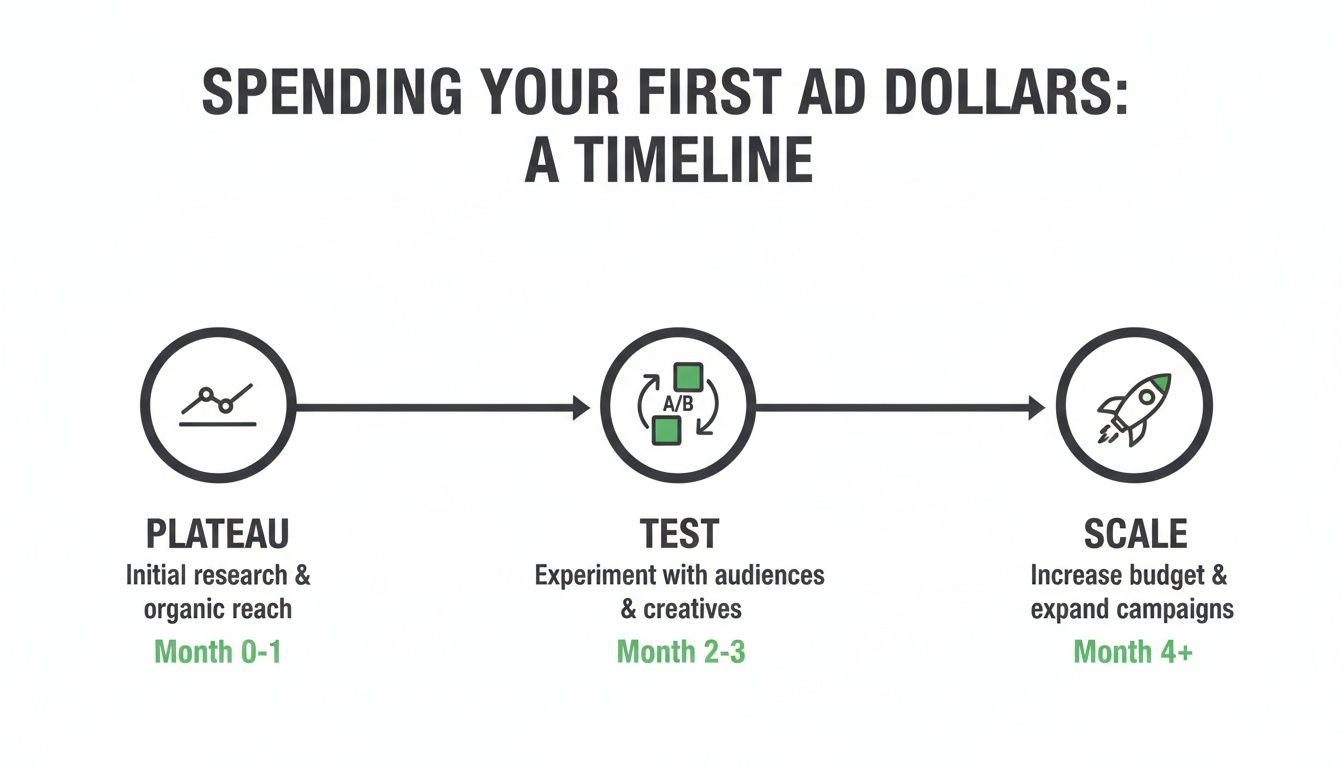
This simple roadmap is key: you only start spending money once you know what resonates organically. This lets you test effectively before you scale up your investment.
Your action items for this month are crystal clear:
- Launch Your First Test Ad. Find your single best-performing organic post from the last 60 days. Put a small budget—even just $50 or $100—behind it. Target a lookalike audience based on your most engaged followers.
- Double Down on Winners. Identify the strategy driving the most results, whether it’s a specific content format or your community engagement. Allocate more time and resources there.
- Activate Influencer Collaborations. Now you can send your first product-for-post pitches to the micro-influencers you’ve been engaging with. Thanks to your earlier work, this is a much warmer (and more effective) ask.
By the end of these 90 days, you won’t just “have” social media. You’ll have a repeatable, data-driven marketing engine that you can keep refining as your startup grows.
Here is a summary of the plan you can use as a checklist for your first three months.
30-60-90 Day Action Plan
| Timeframe | Key Focus | Action Items | Success Metric |
|---|---|---|---|
| Days 1-30 | Foundation & Consistency |
|
Consistent posting and engagement |
| Days 31-60 | Optimization & Outreach |
|
Improved engagement rate |
| Days 61-90 | Scale & Amplify |
|
Positive ROAS on test ad |
This plan provides the structure you need to build a strong foundation and transition into a scalable, long-term growth strategy. Stick to it, and you’ll build a social media presence that delivers real business results.
6. Common Startup Social Media Questions (The Quick & Dirty FAQ)
Even the best plan runs into real-world questions. I get these from founders all the time, so let’s tackle the most common ones head-on with some straight answers.
These are the roadblocks that trip up most startups. Here’s how to get past them.
How Much Should A Startup Spend On Social Media Marketing?
At the very beginning? Next to nothing. Seriously. Your most valuable resource isn’t your budget; it’s your time and energy.
Focus every bit of that energy on the organic tactics we’ve covered—joining communities, publishing valuable content, making real connections.
Once you have a post that’s a clear winner—getting solid engagement or driving clicks with zero ad spend—that’s your signal. Now you can put a little money behind it. But start small. Test with a tiny budget, maybe just $50-$100, to see if you can amplify what’s already resonating. Don’t spend a cent until you have organic proof of what works.
What Is The Most Important Metric To Track?
Forget follower count—it’s a vanity metric. Early on, the only number that really matters is your engagement rate. A high engagement rate is the clearest sign that your content is hitting home with your target audience.
Likes are easy and passive. Comments, shares, and saves? Active. They show someone stopped scrolling, thought about your content, and either joined the conversation or passed it on. That’s how you build a real community, and community drives sales.
A thousand followers who just scroll by are worthless. One hundred die-hard fans who comment and share are everything.
How Do I Create Content If I’m Not A Designer?
Don’t let a lack of design skills stop you. Some of the highest-performing content from startups is raw, authentic, and far from perfect. Your smartphone is all you really need.
A few tips to get you moving:
- Use simple tools: Canva is your best friend. It has thousands of templates you can quickly customize for clean, simple graphics without any design experience.
- Prioritize value over polish: A grainy video that teaches a valuable skill will always beat a beautiful graphic that says nothing. Your message is 10x more important than production quality, especially when you’re just starting.
- Show the real story: People connect with people. Post behind-the-scenes content—a quick tour of your workspace, a clip from a team meeting, or an unboxing of your first prototype. Authenticity sells.
Which Social Media Platform Is Best For B2B Startups?
The obvious answer is LinkedIn, and you definitely need a presence there. But stopping at LinkedIn is a mistake. Real social media marketing for startups means meeting your audience wherever they are.
Remember, B2B buyers are people. They don’t just exist in a corporate bubble on LinkedIn.
They scroll X (formerly Twitter) for industry news and unfiltered opinions. They’re on Instagram, where you can humanize your brand with quick, authentic Stories. The “best” platform is simply where your ideal customer spends their free time. Go back to your audience research and meet them there.
Ready to stop guessing and start growing your startup with a data-driven strategy? The team at Mr. Green Marketing, LLC specializes in crafting custom marketing plans that deliver measurable results. Request your free audit today and let’s build your success story together.
Leave a Comment
sing in to post your comment or sign-up if you dont have any account.