
Brand Awareness Strategy: A brand awareness strategy is a deliberate, long-term plan to make your brand recognizable and memorable to your ideal customers. It’s the difference between being a random search result and becoming the first name people think of in your category. A solid strategy ensures every marketing action builds toward a singular goal: becoming unforgettable.
Brand Awareness Strategy: What Is a Brand Awareness Strategy Anyway?
Alright, let’s cut through the marketing jargon. Before we dive into the tactics, what are we really talking about here? A brand awareness strategy isn’t just about shouting your name from the rooftops or racking up a bunch of likes. It’s a calculated plan. A blueprint.
Think of it as the difference between being another face in a crowded room and being the person everyone instinctively turns to. It’s the “why” that has to come before you can figure out the “how.” Without it, you’re just making noise.

And this isn’t some high-level theory reserved for mega-corporations with nine-figure budgets. It’s a non-negotiable for everyone, from a local service business to a global e-commerce brand. A documented strategy provides clarity and focus, turning random acts of marketing into a cohesive effort that actually builds lasting value.
To see the real-world impact, just look at the difference between a planned approach and winging it.
| Metric | With a Brand Awareness Strategy | Without a Strategy (Random Acts) |
|---|---|---|
| Audience | Connects with the right people | Reaches a random, untargeted audience |
| Message | Consistent, memorable, and clear | Confusing, disjointed, or forgettable |
| ROI | Measurable impact on long-term growth | Impossible to track true return on effort |
| Recognition | Becomes the go-to name in the niche | Remains a commodity or “one of the options” |
| Customer Trust | Builds familiarity and credibility | Fails to establish a meaningful connection |
The bottom line? One path builds an asset, while the other just burns cash.
Brand Awareness Strategy: The Core of Your Strategy
At its heart, a brand awareness strategy defines how you’ll introduce and reinforce your brand’s purpose to the world. It’s about building a memory structure in your audience’s mind, so when they have a problem you solve, your name is the first one that pops into their head.
This boils down to a few critical components:
- Consistency: Your message, tone, and visuals must be the same everywhere—from your website to your social media to your packaging. This is what builds recognition. In fact, consistent brand presentation has been shown to increase revenue by up to 33%.
- Differentiation: You have to clearly and quickly communicate what makes you different—and better—than the competition. Why should they choose you?
- Familiarity: It’s about creating multiple touchpoints so your audience sees you in various contexts. This repeated, helpful exposure is what builds trust over time.
To really get it, it helps to understand the difference between a brand strategy and a content strategy. One defines your brand’s core identity, while the other outlines the specific content you’ll create to express it. If you want to see how the pros do it, it’s worth exploring some powerful examples of brand strategy in action.
Ultimately, a brand awareness strategy isn’t just a marketing function; it’s a business asset. It transforms your company name from a simple label into a symbol of trust, quality, and connection.
Alright, let’s get down to business. You can’t just throw marketing dollars at the wall and hope for brand awareness. A winning strategy starts with a solid foundation—the kind that supports everything else you build. Without it, you’re just guessing.
This is where we define what success looks like and who you’re actually trying to reach.
Brand Awareness Strategy: Set Goals That Actually Mean Something
Vague goals like “get more followers” are useless. Real brand awareness goals are specific, measurable, and tied directly to business growth. You’re building a presence in your audience’s mind, so your targets should reflect that.
Good goals sound like this:
- Increase unaided brand recall by 20% in our target demographic within six months.
- Grow branded search volume (people searching your brand name) by 30% quarter-over-quarter.
- Boost your “share of voice” on key platforms from 5% to 15% within a year.
- Increase direct website traffic by 40%, proving more people are seeking you out.
These aren’t vanity metrics. They’re leading indicators of brand health. A jump in direct traffic is a powerful signal that your brand is becoming top-of-mind. It means customers are intentionally looking for you, not just stumbling across an ad. That’s the gold standard.
Dig Deep Into Your Audience
You can’t build awareness if you don’t know who you’re building it for. And I mean really know them. This isn’t about surface-level demographics; it’s about understanding what makes your ideal customer tick.
Become an expert on their world. Where do they hang out online? Is it scrolling through TikTok, listening to niche podcasts, or debating in Reddit threads? This is how you’ll eventually choose the right channels to reach them.
Start asking the right questions:
- What problems do they have that your brand solves?
- What content do they actually consume and share? Is it funny memes or in-depth case studies?
- Who influences their decisions—industry experts, micro-influencers, or peers?
- What values matter to them? Sustainability? Convenience? Cutting-edge design?
Answering these questions gives you the intel to craft messaging that connects. It helps you talk with your audience, not just at them.
Remember, you’re not just selling a product. You’re inviting people to connect with a brand that shares their values and solves their problems.
Audit Your Current Brand Presence
Before you move forward, you need a clear picture of where you stand right now. A quick brand audit is an essential reality check.
Analyze Your Digital Footprint
- Google your brand name. What shows up on page one? Is it your website and positive press, or something totally irrelevant? This is your brand’s first impression.
- Review social media mentions. Use a monitoring tool or just the platform’s search bar. Are people talking about you? Is the sentiment positive, negative, or neutral?
- Check your website analytics. Look at direct and referral traffic. Low direct traffic is a clear sign your brand awareness needs work.
Evaluate Your Positioning and Messaging
- Is your value proposition crystal clear on your homepage? Can a visitor understand what you do in under five seconds?
- Is your brand voice consistent across all channels? Or does it sound like it was written by three different people?
- Does your visual identity—logo, colors, fonts—feel cohesive? Inconsistency erodes trust and makes your brand forgettable.
This audit reveals the gaps between where you are and where your goals say you need to be. Now you have a baseline, and you can start building a strategy that closes that gap and makes your brand stick.
Brand Awareness Strategy: Choosing Your Channels in the Modern Marketing Mix
So, you’ve defined your goals and you know exactly who you’re talking to. Now for the big question: where do you actually find them?
This is the point where a lot of strategies fall apart. The sheer number of options—SEO, social media, PPC, content, podcasts, Amazon—is overwhelming. It’s easy to get paralyzed by choice or, even worse, try to do a little bit of everything.
Let me be clear: you don’t have to be everywhere. In fact, you shouldn’t be. A winning brand awareness strategy is about picking the right battlegrounds where your audience already spends their time and mastering those channels. Surgical precision. Not a scattergun approach.
SEO: The Long Game for Lasting Authority
Search Engine Optimization is the foundation for sustainable, long-term brand awareness. This isn’t about quick hits or overnight success; it’s about building a digital asset that drives traffic and builds authority for years to come.
When someone searches for a solution you provide, SEO is what makes you the answer they find.
- Pros: SEO builds incredible long-term value. A single high-ranking article can generate qualified traffic for years. It also pulls in an audience with high intent—they are actively looking for you (or a solution like yours).
- Cons: It’s a marathon, not a sprint. You might not see significant results for 6-12 months. It demands a consistent investment in high-quality content and technical maintenance.
Think of SEO as building equity in your brand. Every piece of optimized content is another brick in your foundation, making your brand more valuable and harder for competitors to displace.
Social Media: Building Communities, Not Just Follower Counts
Social media is much more than a place to post your latest promotions. It’s where you give your brand a human voice, engage in real-time conversations, and build a genuine community. A well-executed social plan is a cornerstone of brand awareness, creating the advocate networks that fuel real growth.
The numbers don’t lie. A strong, consistent brand identity across social platforms can increase recognition by a massive 39.7%, and brands with high awareness often see 60% higher repurchase rates. With digital ads projected to take 68.7% of a $1.14 trillion global ad spend, a smart social presence is non-negotiable.
Social media is your brand’s digital living room. It’s where you host conversations, listen to your audience, and build the genuine relationships that create brand loyalists.
The key is to choose your platforms wisely. Don’t waste resources creating a profile on every new app. Go where your customers are. Are they B2B professionals on LinkedIn? Creatives scrolling through Instagram? Or part of active community groups on Facebook?
For most businesses, a focused approach is far more effective. You can dive deeper into this with our complete guide on creating a social media marketing strategy for small business.
This all starts with a solid brand foundation, which should be in place long before you select your channels.
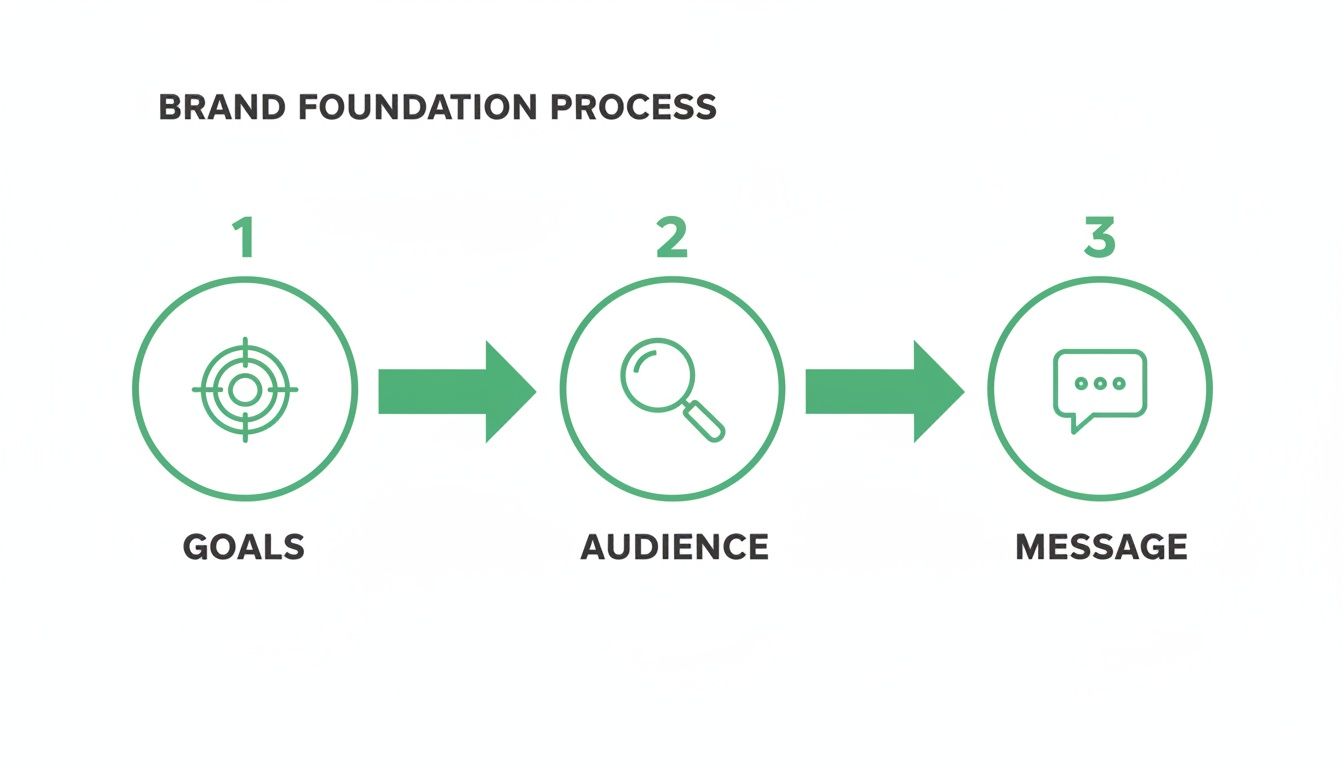
Your goals, audience, and message are the inputs that directly inform which channels will actually work.
PPC and Paid Ads: The Fast-Track to Visibility
If SEO is your marathon, Pay-Per-Click (PPC) ads on platforms like Google or social media are your sprint. PPC is your accelerator—it’s how you get your brand in front of a hyper-targeted audience immediately.
This channel is a powerful tool for three key things:
- Testing Messaging: Quickly validate which headlines, offers, and value props resonate before you commit them to your website or organic content.
- Targeting Competitors: Strategically place your brand in front of people actively searching for your direct competitors.
- Driving Launch Traffic: When you have a new product or a time-sensitive offer, you can’t afford to wait months for SEO to kick in. PPC delivers traffic now.
The trade-off is simple: the traffic stops the second you stop paying. It’s rented land, not an owned asset like your website’s SEO. But for surgical campaigns, rapid feedback, and immediate visibility, its value is unmatched.
Other Channels to Consider
The “big three” are just the beginning. The modern marketing mix offers plenty of other powerful avenues for building awareness.
- Content Marketing: This is the fuel for both your SEO and social media strategies. High-value blog posts, in-depth guides, videos, and case studies establish you as an expert and give people a reason to talk about and trust your brand.
- Podcast Advertising & Appearances: Podcasts offer an incredibly intimate connection. Getting your brand mentioned—or better yet, appearing as a guest expert—puts your voice directly in the ears of a highly engaged and niche audience.
- Amazon Marketing: For any e-commerce brand, Amazon is not just a marketplace; it’s one of the world’s largest search engines. Optimizing your product listings and running ads on the platform is critical for getting seen at the moment of purchase.
Ultimately, choosing your channels boils down to a simple formula: Goals + Audience = Channel Strategy. Don’t chase trends. Follow your customer.
Brand Awareness Strategy: Executing with Impact: From Creative Ideas to Consistent Action
Ideas are cheap. Execution is everything. This is where the real work begins—the ‘doing’ phase of your brand awareness strategy. You’ve set your goals, defined your audience, and picked your channels. And now, it’s time to bring it all to life with creative that captures attention and a consistent presence that makes you unforgettable.
This isn’t just about making things look good; it’s about making a genuine impact. You need a plan for every creative asset, whether it’s a compelling video, a scroll-stopping social graphic, or even a new logo that finally tells your story. This is the tangible, visible part of your brand.

Planning Your Creative Assets
Your creative is the vehicle for your message. Without strong creative, even the best-laid plans will fall flat. Think of it as the difference between whispering in a crowded room and speaking clearly into a microphone. This isn’t about having a Hollywood budget; it’s about being intentional.
So, where do you start?
- Conduct a Creative Audit: Lay out everything you’re currently using. Your website images, social media templates, ad banners, email headers. Does it all look and feel like it came from the same brand? Be brutally honest.
- Define Your Core Visuals: Based on your brand positioning, what’s your visual theme? Is it bold and modern? Warm and rustic? This core identity should inform your color palette, fonts, and photography style.
- Map Assets to Channels: The creative for a TikTok video is worlds apart from a LinkedIn carousel. List your chosen channels and brainstorm the specific asset types you’ll need for each. For instance, Instagram might require high-quality photos and Reels, while your blog needs data-rich charts and infographics.
Don’t forget that brand experiences go beyond the screen. Physical items can create a lasting, tangible impression. If you’re looking for smart ways to integrate these, it’s worth exploring a guide to promotional products that actually work.
The Undeniable Power of Consistency
Here’s the secret sauce—the part so many businesses get wrong. Consistency. It’s the single most important factor in building brand recognition. When your visual identity, tone of voice, and messaging are unified across every single touchpoint, you create a seamless experience that builds trust and familiarity.
Inconsistent branding is like having a conversation with someone who changes their personality every five minutes. Jarring. Confusing. And it makes it impossible to build a real relationship.
Imagine rolling out a fresh, unified brand identity across your website, social media, PPC ads, and Amazon listings. What happens? Companies that commit to this see their brand recognition soar by an average of 39.7%. Even better, high-awareness brands enjoy 60% higher repurchase rates because customers know, like, and trust them enough to come back again and again.
A consistent brand feels reliable. It shows you have your act together. Every time a customer interacts with your brand and has the same positive experience, you’re not just making a sale—you’re building a memory.
Creating Your Content Calendar and Budget
Great ideas and a strong vision need a practical plan to become reality. This is where your content calendar and budget come in. They are the tools that turn your strategy document into a daily operation.
Your Content Calendar
This is your master plan for what you’ll post, where you’ll post it, and when.
- Themes and Pillars: Don’t just plan day by day. Organize your calendar around monthly or quarterly themes that align with your business goals and marketing campaigns.
- Asset Allocation: For each post, note which creative asset is needed (e.g., “New Product Demo Video,” “Customer Testimonial Graphic”). This keeps your creative team ahead of schedule.
- Smart Repurposing: Plan how one big piece of content, like a webinar, can be sliced and diced into smaller assets—blog posts, social clips, quote graphics, and email snippets. This makes your efforts go so much further.
Setting a Realistic Budget
Your budget isn’t just for ad spend. It needs to cover the entire execution process.
- Creation Costs: This includes software subscriptions (like Canva or Adobe), fees for freelance designers or videographers, and stock photo licenses.
- Distribution Costs: This is your ad spend for PPC, social media boosts, and any influencer collaborations you have planned.
- Tooling: Don’t forget to account for scheduling tools, analytics platforms, or project management software that helps your team stay organized and efficient.
This isn’t about having a massive fortune; it’s about investing smartly. Start with what you can afford, measure what works, and double down on the creative and channels that deliver the biggest impact for your brand.
Measuring What Matters with KPIs and Optimization

If you don’t measure your brand awareness strategy, you’re just guessing. I get it—tracking something as vague as “awareness” can feel like trying to nail jello to a wall. But it’s not impossible. This is where we stop throwing money at campaigns and hoping for the best.
The secret is to ignore the vanity metrics. A million impressions or a spike in likes means nothing if the audience is wrong or they forget you a second later. We need to zero in on the Key Performance Indicators (KPIs) that prove people are actually remembering and seeking out your brand.
Identifying Your Core Awareness KPIs
Let’s get real about what matters. True awareness KPIs don’t just count eyeballs; they measure memory and intent. They show your brand is sticking.
These are the metrics I obsess over when building a brand:
- Direct Website Traffic: This is the gold standard. When someone types your URL directly into their browser, it’s proof your brand is top-of-mind. They didn’t stumble upon you; they came looking for you.
- Branded Search Volume: This is a simple count of how many people are Googling your company or product name. If this number is climbing, your name recognition is growing. It’s a direct pulse on your brand’s visibility.
- Social Media Engagement Rate: Forget follower counts. Engagement rate—the percentage of your audience that comments, shares, and saves—shows you’re building a real community, not just an audience.
- Share of Voice (SOV): This metric stacks your brand mentions up against your competitors. Are you becoming a bigger part of the conversation in your industry? SOV gives you the answer.
Don’t drown in data. Pick three to five core KPIs that actually align with your goals and track them obsessively. Simplicity keeps you focused on what really moves the needle for your brand awareness strategy.
Building Your Simple Reporting Dashboard
You don’t need a data science degree or a six-figure software suite to track these KPIs. In fact, you can build a powerful, at-a-glance dashboard using tools you already have.
Start with a simple Google Sheet or a Looker Studio report. All you have to do is pull in the data from your main sources:
- Google Analytics for Direct Traffic and Branded Search Volume.
- Native social media analytics for your engagement rates.
- A social listening tool for Share of Voice.
Update it weekly or bi-weekly. The point isn’t to create a monster report nobody reads. It’s to build a simple visual that tells you in five minutes whether your strategy is working. If you want to go deeper, check out our full guide on how to measure marketing campaign effectiveness.
Testing and Optimization: The Key to Compounding Results
Data is useless without action. The final, and most critical, step is using what you learn to get better. This is all about testing and optimization. It’s how you turn small wins into major, long-term growth.
This doesn’t have to be a huge, intimidating project. Start with small, smart experiments. A/B test two different ad headlines. Try a new tone of voice in your next email. Test one thing at a time, see what the data says, and learn from it.
Personalization is your superpower here. By 2026, hyper-personalization is no longer a buzzword; it’s a proven engine for growth, driving 10-15% higher returns for brands that get it right. With 92% of marketers increasing their brand awareness budgets, using data to create more relevant, personal experiences is how you cut through the noise.
Did your test work? Check your KPIs. If it did, double down and make it a permanent part of your playbook. If it bombed, that’s great—you just learned what not to do. Kill the idea and test something new. This loop of measuring, testing, and refining is what separates the brands that fade away from the ones that become unforgettable.
Your Brand Awareness Questions Answered
Even with a solid plan for setting goals, choosing channels, and measuring results, it’s normal to have questions. After all, a strategy on paper is one thing—putting it into action is another.
We get asked about the nitty-gritty details all the time. Here are straight-to-the-point answers to the most common questions we hear from business owners who are ready to build a memorable brand.
How Long Does It Take to See Results
Let’s be honest: it depends. A brand awareness strategy is a long-term investment, not an overnight win. You’re building a valuable asset, and that simply takes time.
Some tactics – like a hyper-targeted ad campaign – can generate buzz within a few weeks. But true, unprompted brand recall—where customers think of you first—is built over months of consistent effort. You’re creating a memory in your audience’s mind, and that doesn’t happen with a single impression.
- For foundational work like SEO: Expect to see meaningful traffic improvements in 3-6 months. From there, those results compound. A single great article can deliver value for years to come.
- For social media communities: You can spot engagement growth within a single quarter, but building a loyal community that sustains itself often takes closer to a year.
- For overall brand lift: You need to think in quarters, not days. Look for steady, upward trends in your KPIs over a 6-12 month period.
One study showed that consistent branding across all platforms can increase recognition by nearly 40%. The real key isn’t speed—it’s consistency.
What Is the Biggest Mistake Businesses Make
The single biggest and most costly mistake is inconsistency. We call it “random acts of marketing.” A few social media posts this week, a blog post next month, and a panicked Google Ad campaign when sales dip.
This approach is a massive waste of time and money. Nothing connects, so nothing builds on itself. You’re pouring effort into a bucket with a hole in it, and the level never rises.
A winning brand awareness strategy is a system. It locks in your message, visuals, and brand voice across every single touchpoint—your website, ads, packaging, emails, everything.
That consistency is how you build a memory structure for your audience. It’s how you shift from being just another name to a brand they recognize and trust on sight. Without it, you’re just adding to the noise.
How Much Should I Budget for Brand Awareness
This is the big question. The good news is, it doesn’t have to be a million dollars. While there’s no magic number, there are smart ways to determine your budget.
A solid starting point is to dedicate a percentage of your total marketing budget to these top-of-funnel activities. A new startup, for example, might need to invest heavily—say, 50% or more of its marketing spend—just to get its name on the map.
An established brand with existing recognition might allocate a smaller slice, maybe 20-30%, to maintain its position while focusing the rest on conversion-driven campaigns.
The most important part is having a dedicated budget. Your investment will typically be split across a few key areas:
- Content Creation: Writing blog posts, shooting videos, designing graphics, and producing podcasts.
- Ad Spend: The budget for your PPC campaigns, social media ads, and boosted content.
- Tools & Tech: Software for social media scheduling, analytics, SEO, or design.
Start with a clear goal and work backward. Ask yourself what it will realistically take to hit that target, and that’s your starting budget.
Can I Actually Measure the ROI of Brand Awareness
Yes, you absolutely can—but you have to measure it differently than a direct sales campaign. You can’t always draw a straight line from one blog post to a specific sale, and that’s okay. The ROI of brand awareness is tracked by monitoring a basket of metrics over time.
Instead of looking for a simple “this campaign made $500” answer, you track leading indicators that prove your brand is growing stronger.
- Direct Traffic: Did it climb by 30% this quarter? That’s ROI.
- Branded Search Volume: Are 50% more people Googling your brand name compared to last year? That’s ROI.
- Social Media Share of Voice: Did your brand capture 10% more of the industry conversation? That’s ROI.
Over time, these top-of-funnel gains directly impact your bottom line. Increased direct traffic and branded searches lead to more qualified leads, shorter sales cycles, and higher customer lifetime value. Your report might read, “Our brand awareness strategy drove a 40% increase in direct traffic and a 25% lift in inbound leads this quarter.” That’s a measurable return on your investment.
Ready to stop guessing and start building a brand that gets noticed? The team at Mr. Green Marketing, LLC specializes in creating data-driven brand awareness strategies that deliver real, measurable results. Request your free audit and performance report today to see where you stand and uncover your biggest opportunities for growth.
Leave a Comment
sing in to post your comment or sign-up if you dont have any account.