
An RFP for website design is the document you send out to find a web design agency. And it’s supposed to outline everything you need for your project, acting as the first handshake in finding the right partner to build or overhaul a critical business asset.
Why Most Website Design RFPs Fail to Attract Top Talent
Let’s be honest, just starting an RFP feels like a huge project before the real project even begins. You know you need a new website, but translating that need into a document that attracts the right partners—not just a flood of cut-and-paste proposals—is the real challenge. A common frustration.
The hard truth? Many RFPs get completely ignored by top-tier agencies. Why? Because they often read like rigid feature checklists instead of compelling invitations to solve a real business problem. A document that just lists “responsive design” and “contact form” signals you’re shopping for a commodity, not a strategic partner.

Shifting from a Shopping List to a Strategic Brief
A great RFP for a new website doesn’t just list what you want; it explains why you want it. And this single shift in perspective can completely change the quality of the proposals you get back.
Consider the difference:
- Vague Request: “We need an e-commerce website with a blog.”
- Strategic Goal: “We need to increase online sales by 40% and use a blog to drive organic traffic for our key product categories, ultimately reducing our reliance on paid ads.”
The second statement invites an agency to think critically about your business. It opens the door for them to suggest innovative solutions you might not have even considered. It shows you value their expertise beyond just coding and graphic design.
The goal is to move your mindset from ‘buying a website’ to ‘investing in a core business asset.’ A well-crafted RFP is the foundation of that investment, ensuring the final product actively contributes to your growth.
The Real Cost of a Poorly Written RFP
When an RFP is unclear or way too prescriptive, it creates a ripple effect of problems. Agencies that do respond are forced to make assumptions, leading to proposals with wildly different scopes and price tags. This makes it nearly impossible to compare them apples-to-apples.
You end up wasting hours in clarification calls and endless email chains—time that could have been saved with a better document from the start. Even worse, you might pick a partner who is a poor fit, leading to project delays, budget overruns, and a final website that misses the mark entirely.
Ultimately, a strong RFP isn’t just about administrative box-checking. It’s a strategic tool that:
- Filters out unqualified vendors who aren’t equipped to meet your goals.
- Attracts creative, problem-solving agencies who are genuinely excited to collaborate.
- Sets clear expectations from day one, minimizing confusion and scope creep later on.
- Saves you significant time and money throughout the entire selection and development process.
This guide will walk you through creating an RFP that accomplishes all of this, making sure you find a partner who will build a website that delivers real, measurable results.
Defining Your Project Goals and Company Story

This is where you give agencies a real reason to get excited about your project. Seriously. Don’t just drop in a generic mission statement you pulled from an old brochure. A great partner needs to understand who you are, what you do, and most importantly, who you’re trying to reach.
Before you can ask for a website, you have to tell your story. Why does your company exist? What problem do you solve better than anyone else? This context is the soul of your website design RFP.
Crafting a Compelling Company Introduction
Think of this section as your elevator pitch. It needs to be brief, impactful, and crystal clear. Never assume agencies will go digging through your current site to figure you out—lay it all out for them right here.
Your intro should quickly cover:
- Who you are: A snapshot of your history and what your company does.
- What you sell: Your core products, services, or main offerings.
- Who you serve: A clear description of your target audience or ideal customer profile.
- Your unique value: What makes you different? Why do customers choose you over the competition?
This isn’t about writing a novel. It’s about providing the essential context an agency needs to get a feel for your brand’s voice and vision. They can’t build a website that reflects your personality if they don’t know what it is.
From Vague Wishes to Concrete Business Goals
Now for the most important part—your project goals. And this is where so many RFPs fall flat.
“We need a modern-looking website” isn’t a goal; it’s a wish. It gives an agency nothing to measure success against.
Instead, you need to frame your objectives in terms of tangible business outcomes. What do you need this new website to actually do for your company? Tie every single request back to a business metric.
The difference is stark: one approach gets you a pretty online brochure, while the other gets you a high-performance growth engine. Your goals define which one you’ll receive.
Start by looking at the problems with your current website. Are you losing sales? Is your bounce rate through the roof? Are you invisible on search engines? These pain points are the starting line for defining powerful, measurable goals.
Setting SMART Goals for Your Website Project
The best way to articulate your needs is by using the SMART framework—Specific, Measurable, Achievable, Relevant, and Time-bound. It forces you to be clear and gives agencies a concrete target to aim for.
Let’s translate some common vague requests into powerful SMART goals:
- Instead of: “We want more leads.”
- Try: “Increase qualified B2B leads from our organic blog content by 30% within the first 12 months post-launch.”
- Instead of: “Our e-commerce store needs to be better.”
- Try: “Decrease the checkout abandonment rate from 45% to below 25% by implementing a streamlined, one-page checkout process within Q3.”
- Instead of: “We need better SEO.”
- Try: “Achieve first-page Google rankings for our top 5 commercial keywords and increase organic search traffic by 50% within 8 months of the new site going live.”
This level of detail is a game-changer. It shows agencies you’re a serious, data-driven client and allows them to propose specific strategies—like UX improvements for the checkout flow or a content marketing plan for SEO—that directly address your objectives.
Recent guides show that including clear goals in a comprehensive RFP can reduce scope creep by over 50%. An RFP that ties design to performance will always get better engagement, and agencies love proposing collaborative processes rooted in these clear targets. For more insights on this, you can check out documents like this responsive RFP from the City of Solvang.
By clearly defining your story and goals, you’re not just writing an RFP for a website; you’re creating a strategic brief that attracts partners ready to deliver real, measurable value.
Outlining Your Scope And Technical Requirements

Alright, let’s get into the details. This is the part of your RFP where the dreaded “scope creep” is either born or decisively put down before it can cause any trouble. Your goal here is to create a project scope that’s detailed enough to get accurate pricing but flexible enough to let agencies propose creative, expert-driven solutions.
It’s a balancing act. Be too rigid, and you might shut down a brilliant idea you hadn’t even considered. But if you’re too vague – you’re practically inviting ambiguity and those awkward “oh, that wasn’t included” conversations that always end with a bigger invoice.
A successful RFP for website design really comes down to a solid understanding of how to define project scope. Think of it as painting a clear picture of the destination without dictating every single turn on the map.
Identifying Must-Have Pages And Core Functionality
Start with the absolute basics. Make a list of the key pages that are non-negotiable for your website to function. This doesn’t have to be the final, polished sitemap, but it gives agencies a clear baseline for the project’s size and complexity.
Your list of essential pages will likely include:
- Homepage: Your digital front door.
- About Us: Your company’s story, team, and mission.
- Services/Products Pages: Individual, detailed pages for each of your core offerings.
- Blog/Resources: The command center for your content marketing.
- Contact Page: A clear and simple way for people to get in touch, complete with a form, map, and contact details.
Once you have the pages down, think about what you need users to do on your site. This is where you connect your business goals to specific features and functionalities.
Examples of core functionality include things like:
- E-commerce Capabilities: A full shopping cart, secure checkout process, and a system for you to manage products.
- Lead Capture Forms: For everything from newsletter sign-ups and demo requests to quote inquiries.
- Appointment Scheduling System: Letting users book time directly on the site.
- Search Functionality: A robust internal search engine to help people find what they’re looking for quickly.
Defining Critical Technical Specifications
This is the section a lot of people tend to skim over, but it’s absolutely vital. Don’t worry, you don’t need to be a developer—you just need to clearly state your expectations for the site’s technical foundation. Skipping this is like building a house without mentioning what the foundation should be made of.
Content Management System (CMS)
Specify that you need a user-friendly CMS. The last thing you want is to be held hostage by your web agency every time you need to make a simple text edit or publish a blog post. Mentioning platforms like WordPress or Webflow shows you’ve done your homework and have a preference for an easy-to-manage backend.
Search Engine Optimization (SEO)
SEO isn’t something you tack on after launch; it needs to be baked into the website from day one. Your RFP should mandate that the site be built from the ground up with SEO best practices in mind.
Key takeaway—your RFP should explicitly state that the new website must be technically sound for SEO. This includes clean URL structures, proper use of heading tags, fast page load speeds, and compliance with mobile-first indexing.
Accessibility Standards
Inclusivity isn’t just good ethics; it’s good business. Your website should be usable by everyone, including people with disabilities. Specify that the site must comply with Web Content Accessibility Guidelines (WCAG) 2.1 AA standards. This not only protects you legally but also ensures a better experience for all of your users.
Detailing Key Project Deliverables
Finally, be explicit about what you expect to receive at each stage of the project. This prevents misunderstandings and makes it much easier to track progress. You aren’t just buying a finished website; you’re buying a structured process. For a deeper look into what that entails, you can learn more about the different stages of a professional design process.
Your list of required deliverables should include:
- Project Plan & Timeline: A detailed schedule with all key milestones clearly laid out.
- Sitemap & Wireframes: The blueprint of the site’s structure and the layout for key pages.
- High-Fidelity Mockups: Full-color designs that show the final look and feel of the site.
- Fully Developed Website: A staging link where you can review and test everything before it goes live.
- Training & Documentation: Clear instructions on how to use your new CMS and manage the site.
- Post-Launch Support: A defined period of support for bug fixes after the site is live.
To help you cover all your bases, here’s a quick checklist to make sure you’ve included the essential scope and requirements in your RFP.
Essential RFP Scope And Requirements Checklist
| Requirement Category | Key Items to Include | Example Specification |
|---|---|---|
| Functional Requirements | List core user actions (e.g., e-commerce, forms, search, scheduling) and third-party integrations (e.g., CRM, email marketing). | “The website must include an e-commerce platform with secure checkout and integration with our Stripe payment gateway.” |
| Technical Requirements | Specify desired CMS (e.g., WordPress, Webflow), hosting preferences, and performance expectations (e.g., page load speed). | “The site must be built on WordPress and achieve a Google PageSpeed Insights score of 90+ on both mobile and desktop.” |
| SEO Requirements | Mandate SEO-friendly URL structures, mobile-first design, proper schema markup, and on-page optimization features. | “All pages must follow SEO best practices, including customizable meta titles/descriptions and proper H1-H6 heading structures.” |
| Accessibility Requirements | State the required compliance level, such as WCAG 2.1 AA, to ensure the site is usable for people with disabilities. | “The final website must be fully compliant with WCAG 2.1 Level AA standards, including keyboard navigation and screen reader compatibility.” |
By thoroughly outlining the scope, technical needs, and deliverables, you give agencies the clarity they need to submit a thoughtful and accurate proposal. This detailed groundwork is the single best thing you can do to avoid expensive surprises down the road.
Setting a Realistic Budget and Clear Timelines
Let’s talk about the two elephants in every project room: money and time. It’s a common impulse for companies to get cagey about their budget in an RFP, thinking it’ll give them the upper hand in negotiations. But from my experience, being vague is the fastest way to get proposals that are either wildly overpriced or suspiciously cheap.
This secrecy forces agencies to guess. And when they guess, they often aim high to cover unknown risks or lowball just to get a foot in the door, only to hit you with a barrage of change orders down the line. Honesty is your best tool here. Being upfront helps you get accurate, creative, and comparable proposals right from the start.
Why You Should Always Include a Budget Range
Including a budget range in your RFP for website design doesn’t mean an agency will automatically charge you the top end. What it does do is set realistic boundaries. A top-tier agency simply won’t waste their time (or yours) responding to a $5,000 RFP if their minimum project is $50,000.
Think of it like buying a car. You wouldn’t walk into a dealership and say, “Show me your best car,” without giving the salesperson some idea of what you’re willing to spend. You’d end up looking at a basic sedan and a luxury sports car, neither of which might be what you actually need.
A budget range helps agencies tailor their proposals to what’s actually possible. To get a handle on what’s realistic, check out a realistic website budgeting guide that breaks down the different costs involved. This context is invaluable.
What Different Budget Levels Can Realistically Achieve
So, what should you expect to pay? Website project budgets can swing dramatically based on complexity, custom features, and the agency’s depth of experience. In early 2026, we saw a surge in website redesign RFPs from public and nonprofit sectors with budgets spanning from $30,000 to $750,000. The Dakota County CDA, for example, put out a request for a full redesign with complex features like 24/7 support and deep data analytics, showing just how specific needs drive up the cost.
Here’s a general breakdown of what your money can get you:
- Under $15,000: This typically gets you a template-based design on a platform like WordPress or Shopify. It’s a solid choice for simple brochure sites or basic e-commerce stores with limited customization.
- $15,000 – $40,000: In this range, you can expect a semi-custom design, more robust functionality (like API integrations), and a dedicated project manager. You’re paying for a more unique look and a more strategic approach to UX.
- $40,000+: Now you’re in fully custom territory. This budget supports deep discovery phases, user research, custom animations, complex integrations, and a truly bespoke digital experience built from the ground up.
Mapping a Sensible Project Timeline
A realistic timeline is just as critical as the budget. Rushing a project is a surefire way to cut corners, miss details, and end up with a subpar website. Any agency promising a fully custom site in two weeks should be a major red flag.
A good timeline allows for proper discovery, creativity, and thorough testing. The best approach is to state your ideal launch date and ask agencies to propose a timeline to get there. To map out what that might look like, our website redesign checklist is a great resource for making sure you don’t miss any critical steps.
Your timeline should be a roadmap, not a race. Building in buffer time for feedback, revisions, and unexpected hurdles is a sign of a well-planned project, not a slow one.
A standard project is usually broken into a few key phases. Here’s what that typically looks like:
- Discovery and Strategy (2-4 weeks): This is all about planning—stakeholder interviews, goal setting, competitor analysis, and technical groundwork.
- UX/UI Design (3-6 weeks): This is where the vision comes to life, covering the sitemap, wireframes, and high-fidelity visual mockups.
- Development and Content Integration (4-8 weeks): The coding phase. This is where designers bring the designs to life and your content is loaded into the CMS.
- Testing and QA (1-2 weeks): Time to find and squash bugs. The site is rigorously tested across different browsers, devices, and user scenarios.
- Launch and Post-Launch Support (1 week + ongoing): The site goes live, followed by a period of close monitoring and support to handle any immediate issues.
By setting a clear budget and a realistic timeline in your RFP, you’re creating a foundation of trust and clarity. You aren’t just buying a service; you’re starting a partnership on the right foot.
How to Choose the Right Agency Partner
The proposals are in. Now what?
It’s tempting to just pick the cheapest option or the one with the flashiest mockups. But you can’t just go with your gut—that’s a recipe for disaster down the road. This is the moment to build a bulletproof, objective evaluation process.
The goal here is to move past the sales pitch and find a true partner who genuinely understands your business. A simple scoring system is one of the best ways to objectively compare agencies based on what actually matters.
This flowchart shows a common fork in the road for many businesses at this stage.
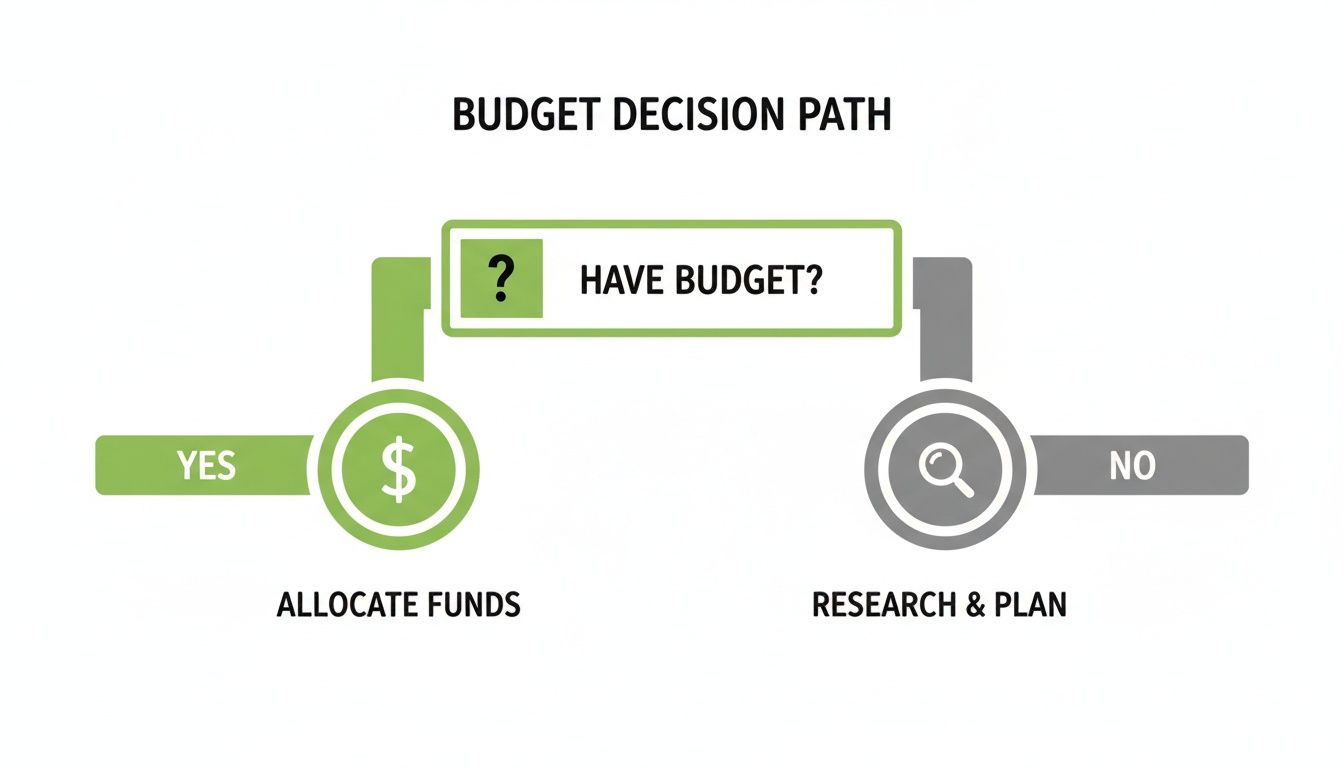
If your budget is locked in, you’re ready to move forward. If not, it’s a sign you need to pause for more internal research and planning before you can properly evaluate the proposals in front of you.
Building a Simple Scoring System
To avoid getting swayed by a slick presentation, create a scorecard. This forces you and your team to evaluate every proposal against the same consistent standards. It’s hands-down the most effective way to compare vendors apples-to-apples.
Assign a weight to each category based on what’s most important for this specific project. For example, if the technical approach is more critical than their design portfolio, give it a higher weight.
Here are the key criteria to score:
- Understanding of Your Goals (30%): Did they just parrot your RFP back to you, or did they demonstrate a real understanding of your business objectives? The best proposals connect their solutions directly to your stated goals.
- Portfolio and Case Studies (25%): Look for relevant experience. Have they worked with companies in your industry or solved similar business challenges before?
- Proposed Technical Approach (20%): Does their plan for the CMS, hosting, and SEO make sense for your needs? They should be able to clearly explain why they chose a specific technology stack over others.
- Team Experience (15%): Find out who will actually be working on your project. Look at the real-world experience of the project manager, designers, and developers assigned to you.
- Overall Professionalism and Clarity (10%): Was the proposal well-written, clear, and free of glaring errors? This small detail speaks volumes about their attention to detail.
Digging Deeper Than Just the Portfolio
A pretty portfolio is just table stakes. You have to look past the beautiful designs and focus on the results they generated. When you’re reviewing case studies, ask yourself: what was the real business impact?
A great case study doesn’t just show you before-and-after screenshots. It tells a story backed by proof.
The true measure of a case study is the data. Look for quantifiable results: a 35% increase in conversions, a 50% reduction in bounce rate, or a doubling of organic traffic. These are the metrics that prove an agency delivers tangible value, not just pretty visuals.
If their case studies are all sizzle and no steak—lacking any real performance data—that’s a major red flag. It could mean they don’t track the business impact of their work, or worse, the results weren’t worth sharing.
Critical Questions to Ask Your Finalists
Once you’ve scored the proposals and narrowed your list down to two or three finalists, it’s interview time. This is your chance to probe deeper into their process, communication style, and how they handle the inevitable bumps in the road. For more guidance, you might find our article on how to choose a digital marketing agency helpful.
Don’t let them just run through their sales deck again. Come prepared with specific, pointed questions:
- What does your project management and communication process look like? Find out how often you’ll meet, who your main point of contact will be, and what tools they use to keep things on track (like Asana, Slack, or Basecamp).
- How do you handle scope creep or unexpected project changes? Their answer will reveal how flexible and transparent they are. A good partner will have a clear, fair process for managing change requests.
- Can you walk me through a project that didn’t go as planned? What happened, and what did you learn from it? This question is a great test of their honesty and problem-solving skills. Every agency has projects with hiccups; it’s how they respond that matters.
- Who from your team will be working on our project, and can we meet them? You need to ensure the A-team that pitched you is the same team that will actually be doing the work.
This structured evaluation framework helps you cut through the noise. It empowers you to confidently choose a partner based on solid evidence and genuine fit, ensuring your RFP for website design leads to a successful and lasting partnership.
Common Questions About Website RFPs
We’ve covered a ton of ground, but there are always a few lingering questions that pop up right when you think you have everything locked down. That’s totally normal—writing a website design RFP isn’t something most people do every day.
So, let’s tackle the most common questions I hear. Think of this as your final sanity check before you hit send.
How Long Should My RFP Document Be?
Honestly, there’s no magic number. I’ve seen fantastic RFPs that were five pages and others that pushed twenty. The real goal isn’t to hit a specific page count; it’s to achieve absolute clarity.
A short, focused RFP that nails your goals, scope, and budget is infinitely better than a 50-page monster filled with corporate jargon. Agencies are busy people. A concise document that respects their time will always get a better, more thoughtful response.
Focus on being thorough, not verbose. If a section doesn’t help an agency understand your needs or submit a better proposal, cut it. Clarity always wins.
Should I Just Use a Generic RFP Template?
Templates can be a great starting point. They give you a solid structure and make sure you don’t forget critical sections like your project background or technical requirements. But—and this is a big but—relying on one without heavy customization is a huge mistake.
Sending out a generic, copy-pasted RFP signals to top-tier agencies that you haven’t put much thought into your own project. And what do you get back? An equally generic, copy-pasted proposal.
- Use a template for structure: Let it be your guide for the document’s flow.
- Write the content yourself: Every section should be filled with details unique to your business, your goals, and your audience.
- Customize the language: Make sure it sounds like it came from your company and reflects your brand’s voice.
Your RFP is the very first impression an agency has of you. Make it count by showing you’ve done your homework.
What Are the Biggest Red Flags to Look for in a Proposal?
Once proposals start hitting your inbox, it’s easy to get overwhelmed. But there are a few tell-tale signs that a vendor might not be the right partner for you. Spotting these red flags early will save you a world of headaches down the road.
Here’s what to keep an eye on:
- It’s All About Them: The proposal goes on and on about their awards, their history, and their amazing team but barely mentions your business or your specific goals. This is a dead giveaway they didn’t really read your RFP and just sent a boilerplate sales pitch.
- A Lack of Questions: A great partner will have questions. If their proposal doesn’t ask for clarification or suggest areas for discussion, they probably aren’t thinking critically about your project’s unique challenges.
- Vague Timelines and Deliverables: If they can’t provide a clear, phased timeline or a specific list of what you’ll get for your money, that’s a massive warning sign. It often points to a disorganized process or inexperience.
- A Suspiciously Low Price: It’s tempting, I get it. But a price that seems too good to be true almost always is. It usually means they’ve misunderstood the scope, are planning to cut corners, or will hit you with surprise fees later. A professional website is an investment.
Crafting a great RFP for website design sets the stage for a successful project. If you need a partner who can help you translate your business goals into a powerful digital experience, Mr. Green Marketing, LLC is ready to help. We build conversion-focused websites backed by data-driven strategy. Get a free audit and see how we can help you stand out.
Learn more at https://mrgreenmarketing.com.
Leave a Comment
sing in to post your comment or sign-up if you dont have any account.